Soviet-Era Illustrations of J. R. R. Tolkien’s The Hobbit (1976)
Until I read J. R. R. Tolkien’s The Lord of the Rings, my favorite book growing up was, by far, The Hobbit. Growing up in Russia, however, meant that instead of Tolkien’s English version, my parents read me a Russian translation. To me, the translation easily matched the pace and wonder of Tolkien’s original. Looking back, The Hobbit probably made such an indelible impression on me because Tolkien’s tale was altogether different than the Russian fairy tales and children’s stories that I had previously been exposed to. There were no childish hijinks, no young protagonists, no parents to rescue you when you got into trouble. I considered it an epic in the truest literary sense.
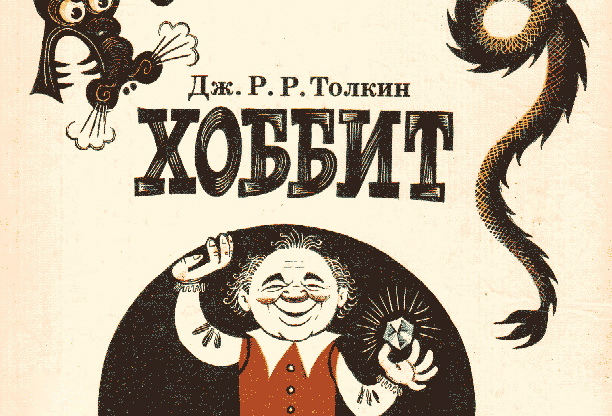
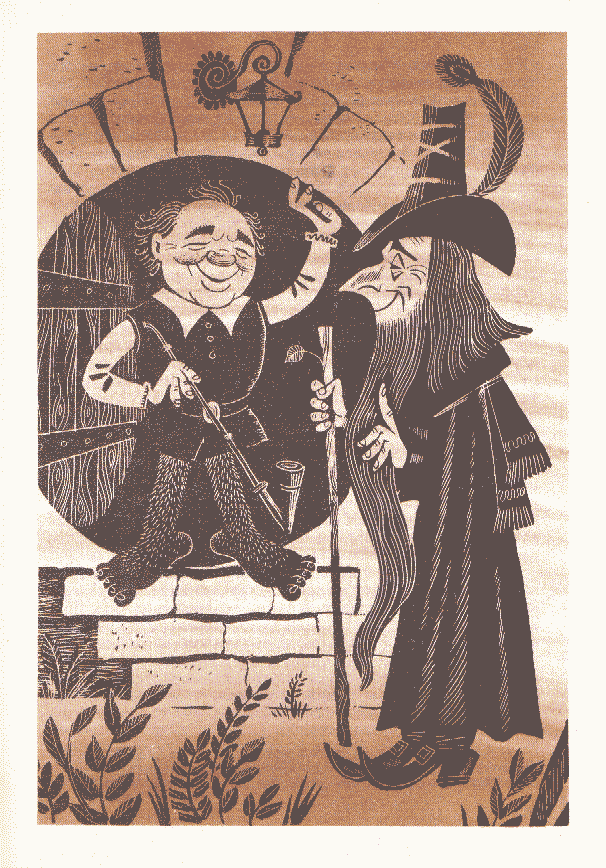
As with many Russian translations during the Cold War, the book came with a completely different set of illustrations. Mine, I remember regretting slightly, lacked pictures altogether. A friend’s edition, however, was illustrated in the typical Russian style: much more traditionally stylized than Tolkien’s own drawings, they were more angular, friendlier, almost cartoonish. In this post, we include a number of these images from the 1976 printing. The cover, above, depicts a grinning Bilbo Baggins holding a gem. Below, Gandalf, an ostensibly harmless soul, pays Bilbo a visit.
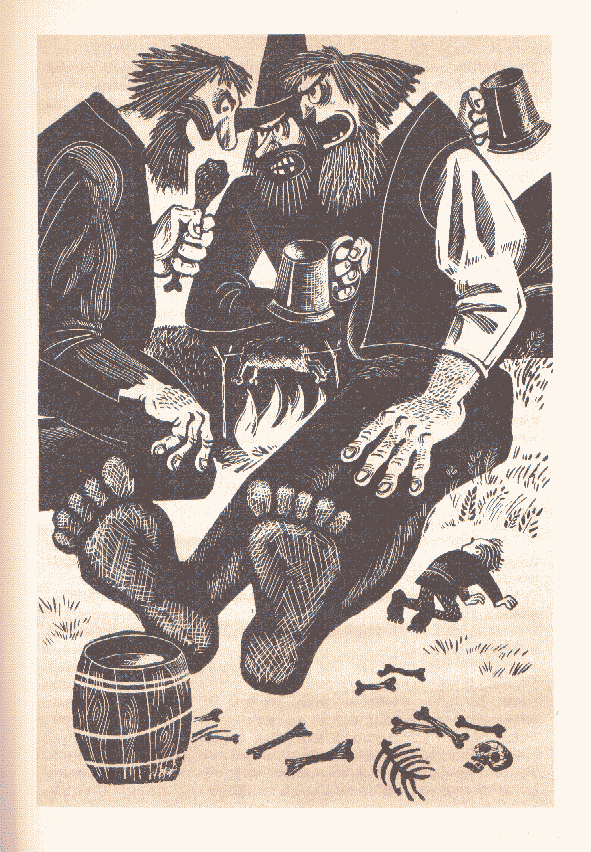
Next, we have the three trolls, arguing about their various eating arrangements, with Bilbo hiding to the side.
Here, Gollum, né Sméagol, paddles his raft in the depths of the mountains.

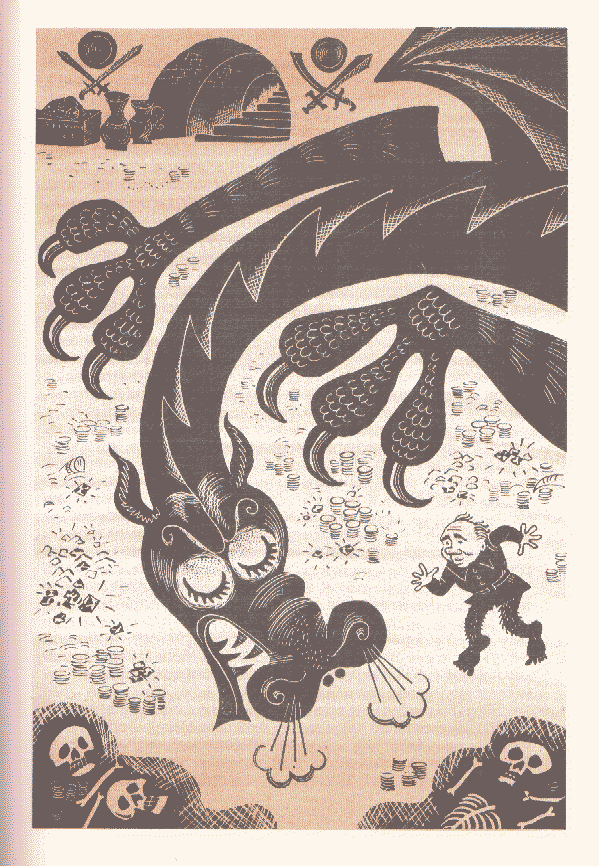
Finally, here’s Bilbo, fulfilling his role as a burglar in Smaug’s lair.
Note: An earlier version of this post appeared on our site in 2014.
Ilia Blinderman is a Montreal-based culture and science writer.
Related Content:
110 Drawings and Paintings by J.R.R. Tolkien: Of Middle-Earth and Beyond
The Only Drawing from Maurice Sendak’s Short-Lived Attempt to Illustrate The Hobbit
Discover J.R.R. Tolkien’s Personal Book Cover Designs for The Lord of the Rings Trilogy
Read More...The Bialetti Moka Express: The History of Italy’s Iconic Coffee Maker, and How to Use It the Right Way
I am sure that many an Open Culture reader has a Bialetti Moka Express in their kitchen. I know I do, but I must add that I knew little about its history and apparently even less about how to properly use one. Coffee expert and author of The World Atlas of Coffee James Hoffmann introduces us to the appliance we think we know in the above video.
Alfonso Bialetti didn’t originally get into the coffee business. In 1919, the Bialetti company was an aluminum manufacturer, with the Moka Express invented somewhere around 1933 by Luigi de Ponti, who worked for the company. According to Deconstructing Product Design by William Lidwell and Gerry Manacsa, the inspiration came from Bialetti’s wife’s old-fashioned washing machine: “a fire, a bucket, and a lid with a tube coming out of it. The bucket was filled with soapy water, sealed with the lid, and then brought to a boil over the fire, at which point the vaporized soapy water was pushed up through the tube and expelled on to the laundry.”
As Hoffmann shows, earlier coffee-makers did use steam and a drip technique, but the Moka Express was the first all-in-one maker that could sit on the stove top and do the work. All the user had to listen for was the tell-tale gurgle when it finished brewing.
In 1945, Alfonso’s son Renato returned from a prisoner-of-war camp and took over the family business. He was instrumental in focusing on the Moka Express and turning it into an international coffee brand. He hired cartoonist Paul Campani to design l’omino coi baffi, “the mustachioed little man” whose image is on the side of every Moka Express, and who, during the 1950s, was in a series of humorous animated commercials. Bialetti was the pride of Italy, and for Italian immigrants living abroad, it was a treasured object in the kitchen.
Such was the identification of Renato Bialetti with the Moka Express that when he died in 2016, his ashes were interred in a giant replica pot. Hoffmann details the fate of the company afterwards, how it has fared against competitors in Italy and outside. Will it still be around in decades? Who knows. But it does make a great cup of coffee.
And he shows the correct way to brew a cup with the Moka Express in this other video. Here are a few things I was doing wrong: not using hot water in the bottom to start; trying to pack in the ground coffee like I was making an espresso; using too fine a grind; and not cooling the bottom as soon as it’s done working its magic. (Note: a Moka Express coffee is somewhere between an espresso and a pour-over.) All these tips I’m going to try tomorrow morning. Maybe you have been making your Bialetti cup the right way all along. Let me know in the comments. I’ll read them over a freshly brewed cup.
Note: An earlier version of this post appeared on our site in 2022.
Related Content:
Life and Death of an Espresso Shot in Super Slow Motion
How to Make the World’s Smallest Cup of Coffee, from Just One Coffee Bean
The Birth of Espresso: How the Coffee Shots The Fuel Our Modern Life Were Invented
Philosophers Drinking Coffee: The Excessive Habits of Kant, Voltaire & Kierkegaard
Ted Mills is a freelance writer on the arts.
Read More...The Biggest Ship in History Was Built in China 600 Years Ago—Or Was It?
In 2002, the retired British submarine lieutenant-commander turned amateur historian Gavin Menzies created a stir with a book about Chinese seafaring in the fifteenth century. 1421: The Year China Discovered the World (tellingly titled 1421: The Year China Discovered America in the United States) began as a global history of that year, only coming to focus on the claim of the title through the interventions of publishing-industry professionals. They no doubt sensed a lucrative controversy in the offing, and events proved them right. Not only did the book turn bestseller, it also managed the rare feat of drawing, among other responses, a two-hour PBS documentary dedicated to debunking it. Today, 1421 is most charitably remembered as a work of historical fiction written around the idea that, even if China didn’t actually discover the world, wouldn’t it be neat if it had?
That question is hardly as frivolous as it may sound. Much of Menzies’ book has to do with the exploits of Zheng He, a Ming-dynasty admiral and diplomat whose fleet really did make voyages to much of the world, or at least the parts surrounding the Indian Ocean. Even if the claim that he beat Christopher Columbus to the Americas can’t be supported, he really did get around, and in seriously impressive ships at that. In the Hoog video above, you can see Zheng He’s story told with retro 3D video-game graphics suitable to convey the kind of adventure his life became. Yet it could hardly have begun more humbly: born into a Muslim family in the southern, Mongol-controlled Yunnan province, he was captured by the Ming military and castrated in adolescence. Harsh though that sounds, it made him able to accrue a kind of power that could never have been his otherwise.
“The Ming empire was built on eunuchs,” says the video’s narrator. “Unlike other imperial Chinese dynasties, the Ming elevated castrated men beyond what any had known.” Their inability to reproduce and serve their own bloodline inspired the trust of the rulers: “What they lost in mutilation, they gained in access to power.” Under Zhu Di, known as the Yongle Emperor, Zheng He became “the most powerful eunuch in the Ming Dynasty.” In order to project his power overseas, the emperor decided to construct “the greatest fleet the world has ever seen,” consisting of 300 transport ships, 180 warships, 240 supply ships, 700 horse ships, and 36 massive “treasure ships” that might have been the largest wooden vessels ever to set sail. To lead this “moving empire” with its staff of 27,000 — many of them eunuchs — he knew no one more reliable than his old friend Zheng He.
This fleet’s expeditions maintained sufficient hegemony to ensure a period of regional stability some call the Pax Ming. At the same time, the civil service grew ever more resentful of the privileged eunuch class, and a lightning strike on the Forbidden City in 1421 was taken as a sign that the time had come to criticize their leadership. It would seem that Zhu Gaochi, the Yongle Emperor’s son, took this criticism to heart. When he took power as the Hongxi Emperor after his father died while Zheng He was at sea, he put an end to the costly naval expeditions that could, in theory, one day have reached the New World. Questions about why China’s age of maritime exploration had to end have more recently been joined by others about whether such a vast fleet really could have sailed, and for that matter, whether the enormous treasure ships could even have been built in the first place. China may have done away with the eunuch system more than a century ago, but there’s no doubt that its current leadership recognizes the importance of sea power — or that it has its eyes on the heavens.
Related content:
How Ancient Greek Warships Worked: The Engineering of the Trireme Explained in 3D Animation
The 500-Year-Old Chinese “Bagel” That Helped Win a War
Based in Seoul, Colin Marshall writes and broadcasts on cities, language, and culture. He’s the author of the newsletter Books on Cities as well as the books 한국 요약 금지 (No Summarizing Korea) and Korean Newtro. Follow him on the social network formerly known as Twitter at @colinmarshall.
Read More...A 900-Page Pre-Pantone Guide to Color from 1692: A Complete High-Resolution Digital Scan
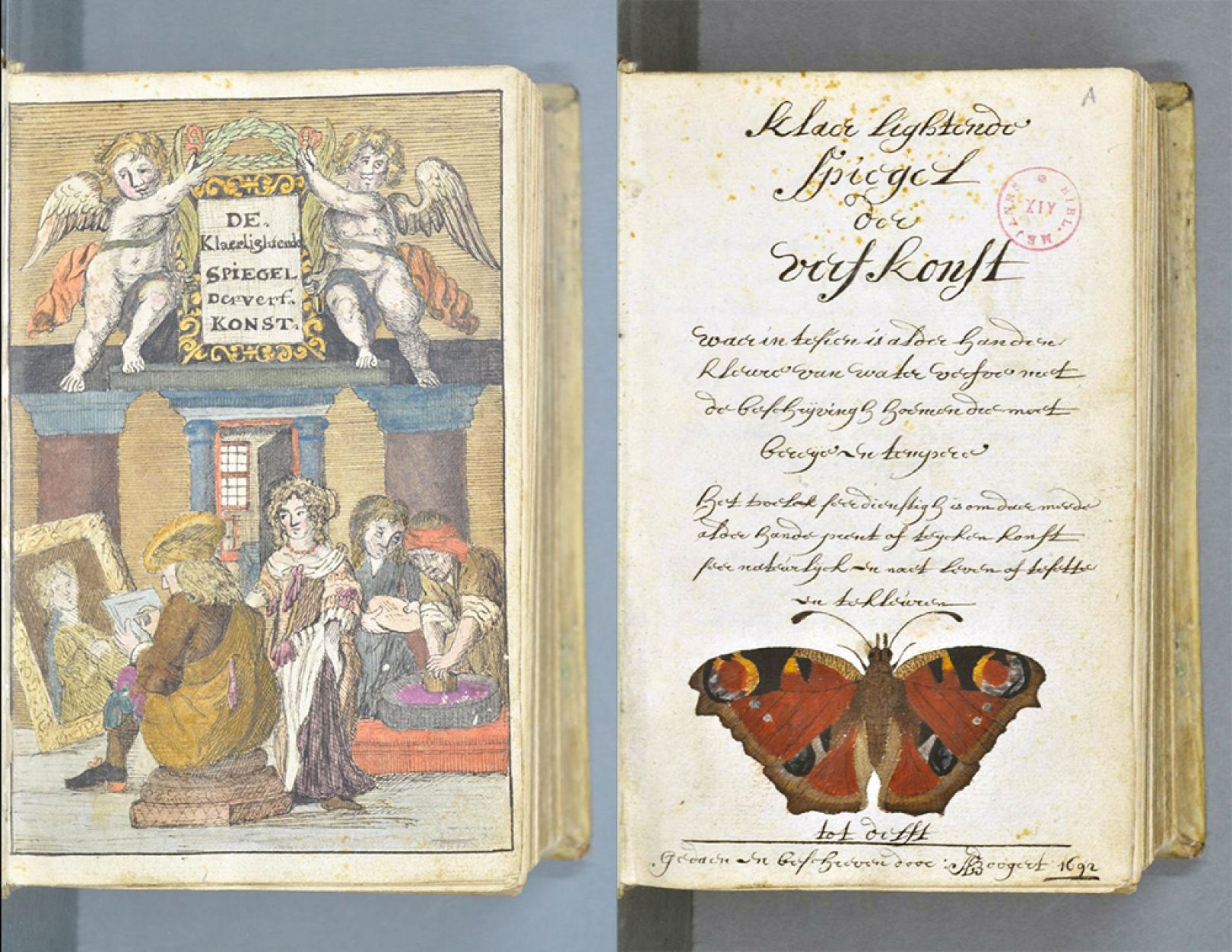
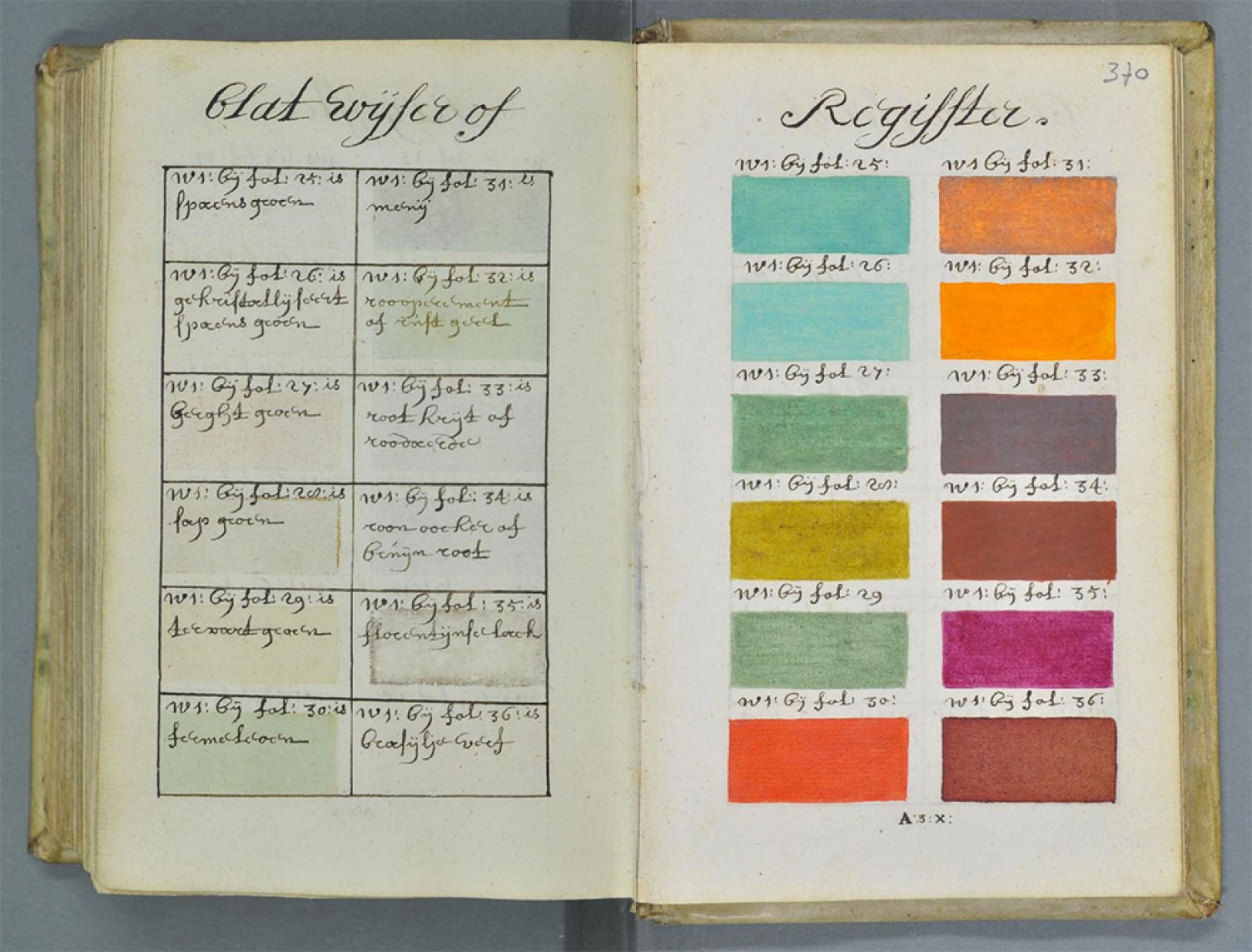
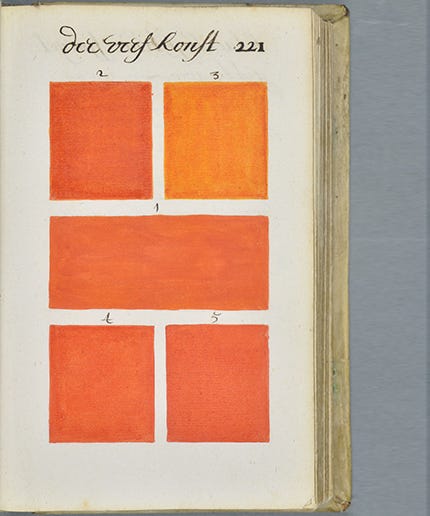
There’s ahead of its time, then there’s Traité des couleurs servant à la peinture à l’eau — or, in its original Dutch title, Klaer Lightende Spiegel der Verfkonst, a 900-page book of paint colors made before any such things were common tools of the artist’s, scientist’s, and industrial designer’s trade. Author and artist A. Boogert created one, and only one, copy of his extraordinary manual on color mixing in 1692. Appearing on the threshold of modern color theory, and featuring over 700 pages of color swatches, the book draws on Aristotle’s system of color rather than the new understanding of the color spectrum, fully elaborated by Newton in his Opticks over a decade later.
It would be another hundred years before a flood tide of color books began to make the theory more practical: from Goethe’s 1810 Theory of Colors and Werner’s 1814 Nomenclature of Colour to the dream of color standardization realized: the Pantone company, launched in 1963.
But if A. Boogert had much influence on the theory or practical application of color in his day, there doesn’t seem to be much evidence for it. Of course most of the Dutch masters had died when the book was completed, and it seems unlikely that those still working in 1692 would have been familiar with its single copy.
Instead, the book was meant to educate watercolorists, hence its French title, which refers to “water-based paint.” (A literal translation of the Dutch runs something like “clearly lighting mirror of the painting art.”) Medieval historian Erik Kwakkel found the book in a French database, “and it turns out to be quite special,” he writes, “because it provides an unusual peek into the workshop of 17th-century painters and illustrators.
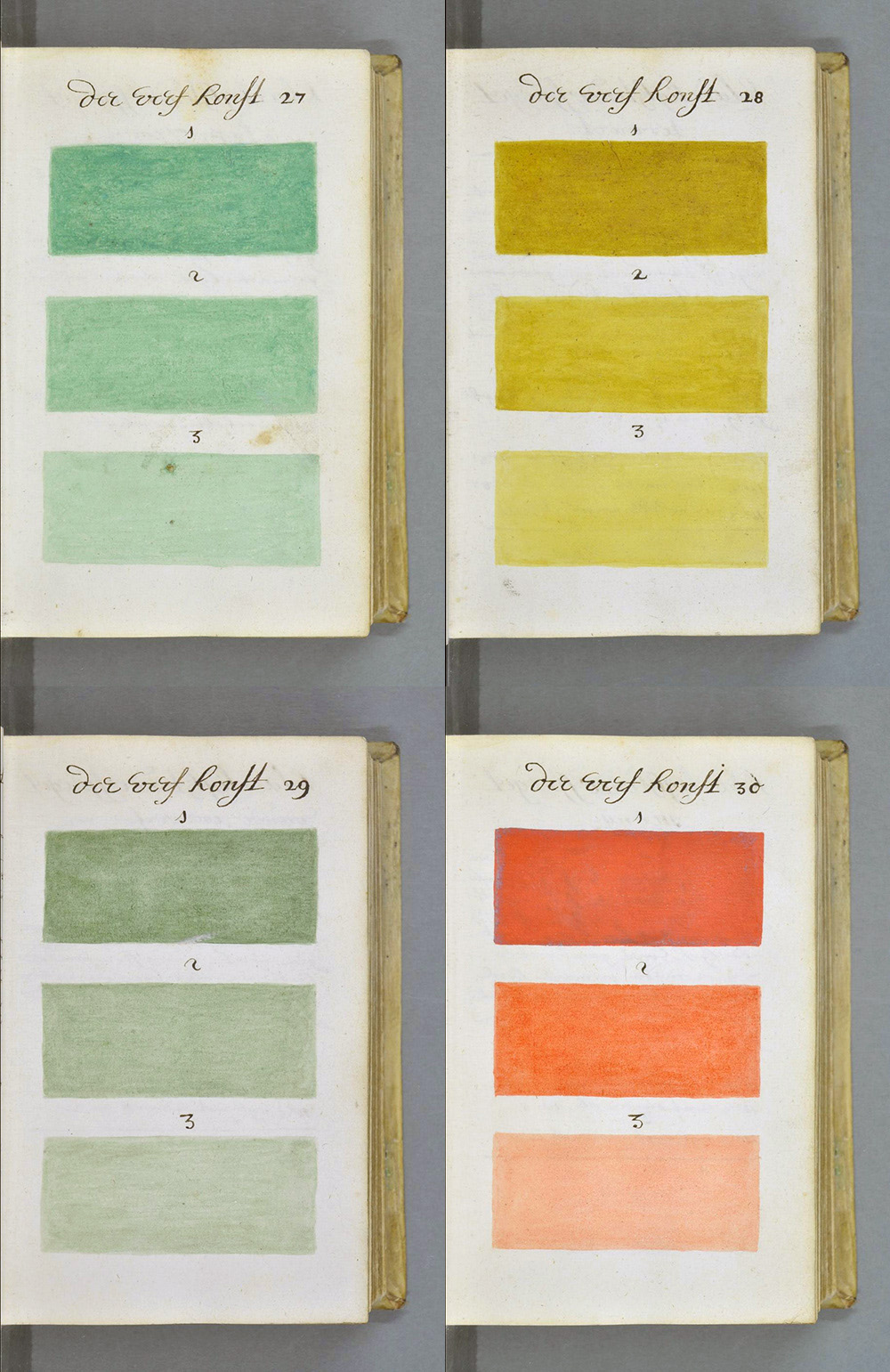
In over 700 pages of handwritten Dutch, the author, who identifies himself as A. Boogert, describes how to make watercolour paints. He explains how to mix the colours and how to change their tone by adding ‘one, two or three portions of water.’… In the 17th Century, an age known as the Golden Age of Dutch Painting, this manual would have hit the right spot.”
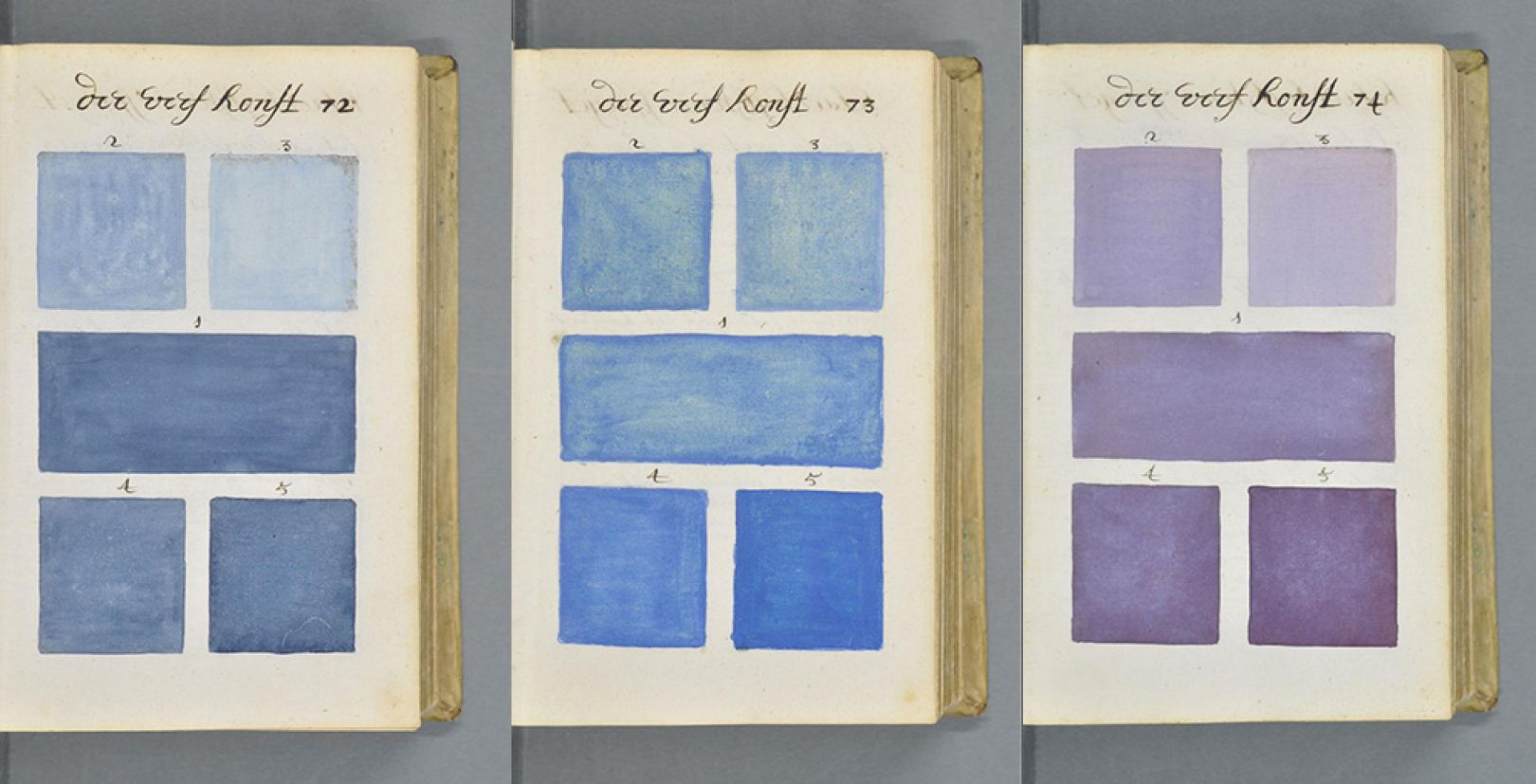
The book is currently housed at Bibliothèque Méjanes in Aix-en-Provence, where you’ll find full-page, zoomable, hi-resolution scans. “Beyond being informational, the images from the book are stunning and addictive flip through,” notes Refinery29. “They resemble page after page of Pantone color chips, except without the household name.” One wonders if “A. Boogert” would have become a household name had his book been printed and distributed. But his color system was already passing away in the Newtonian age of color spectrums and wheels, until paint chips finally came back in style. Visit the color manual online here.
Note: An earlier version of this post appeared on our site in 2019.
Related Content:
The Vibrant Color Wheels Designed by Goethe, Newton & Other Theorists of Color (1665–1810)
Josh Jones is a writer and musician based in Durham, NC.
Read More...It’s the End of the World as We Know It: The Apocalypse Gets Visualized in an Inventive Map from 1486
When will the world end?
We can find serious scientific answers to this question, depending on what we mean by “world” and “end.” If we mean the end of civilization as we currently know it, climate scientists’ worst-case scenario points toward somewhere around 2100 as the beginning of the end. (New York magazine points out that it “probably won’t kill all of us”). It’s possible, but not inevitable.
If we mean the end of all life on earth, the forecast looks quite a bit rosier: we’ve probably got about a billion years, writes astrophysicist Jillian Scudder, before the sun becomes “hot enough to boil our oceans.” Still not a cheerful thought, but perhaps many more creatures will take after the tardigrade by then. That’s not even to mention nuclear war or the epidemics, zombie and otherwise, that could take us out.
But of course, for a not inconsiderable number of people, the question of the world’s end has nothing to do with science at all but with eschatology, that branch of theological thought concerned with the Apocalypse.
Theological thinkers have written about the Apocalypse for hundreds of years, and the world’s end was frequently perceived as just around the corner for many of the same reasons modern secular people feel apocalyptic dread: disease, natural disasters, wars, rumors of wars, imperial power struggles, uncomfortably shifting demographics….
Take 15th-century Europe, when “the Apocalypse weighed heavily on the minds of the people,” as Betsy Mason and Greg Miller write at the National Geographic blog All Over the Map: “Plagues were rampant. The once-great capital of the Roman empire, Constantinople, had fallen to the Turks. Surely, the end was nigh.”
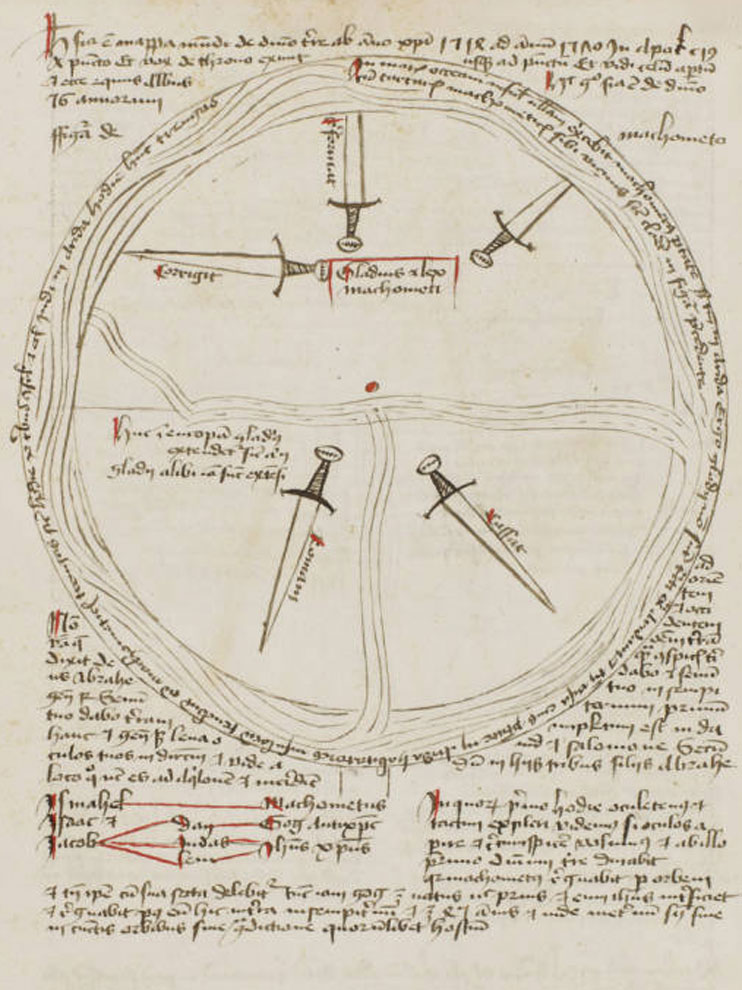
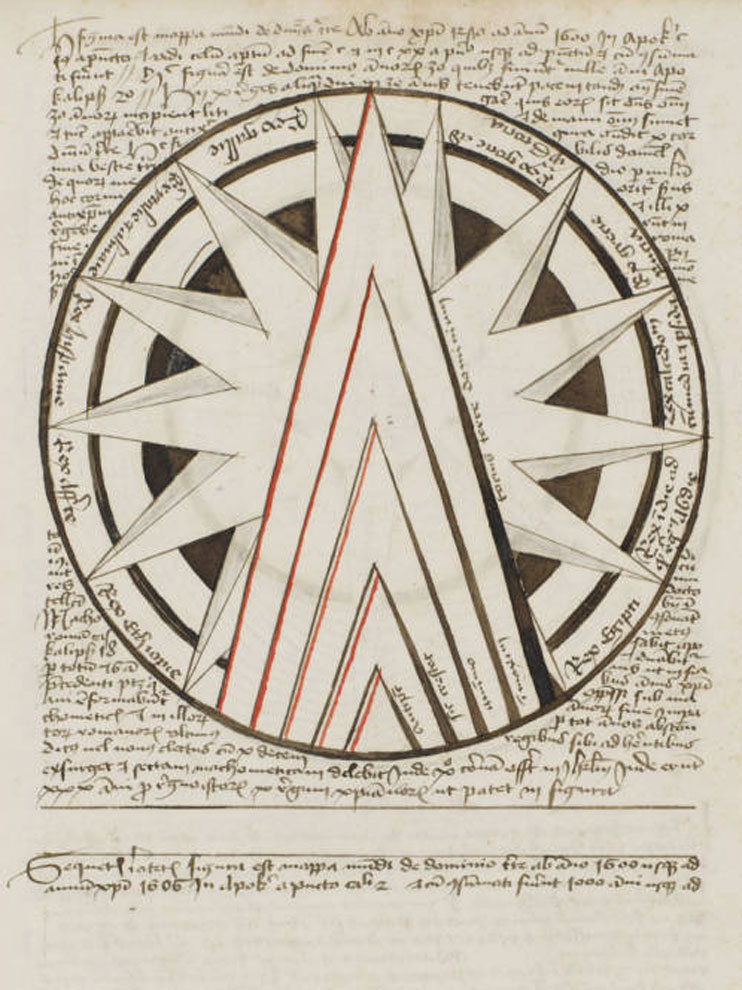
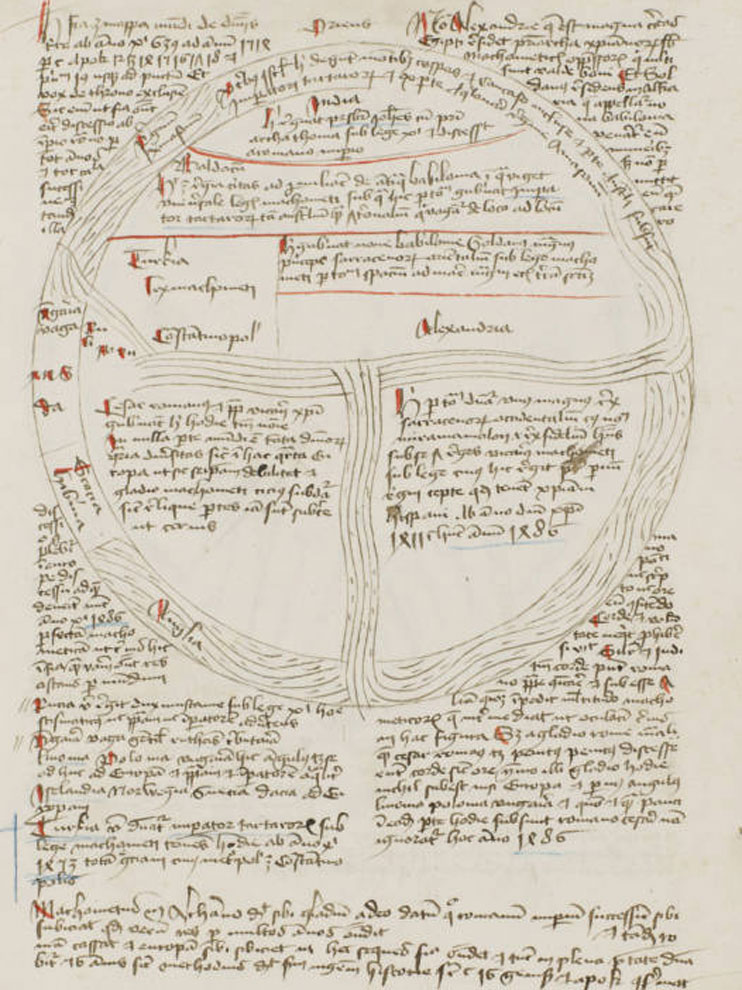
While a niche publishing market in the nascent print era produced “dozens of printed works” describing the “coming reckoning in gory detail… one long-forgotten manuscript depicts the Apocalypse in a very different way—through maps.” As you can see here, these maps convey the unfolding of worse-to-worser scenarios in a number of visual registers: temporal, symbolic, geographic, thematic, etc.
At the top, the nested triangles depict the rise of the Antichrist between the years 1570 and 1600. The central concern for this author was the supposed global threat of Islam. Thus, the next map, its “T” shape a common Medieval world map device, shows the world before the Apocalypse, the text around it explaining that “Islam is on the rise from 639 to 1514.”
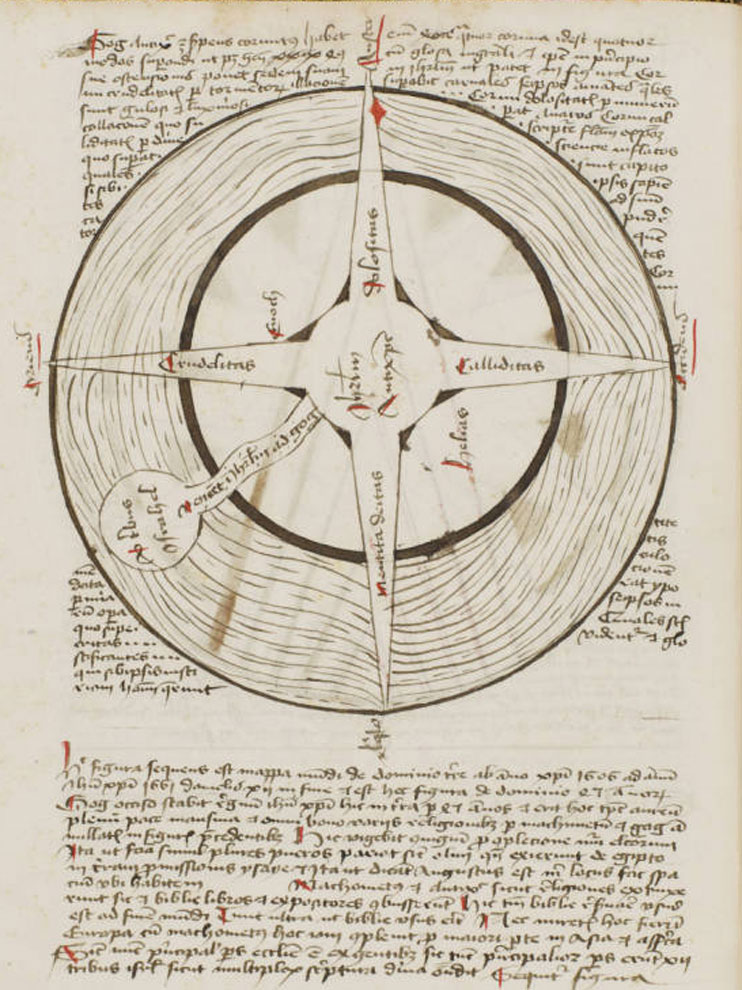
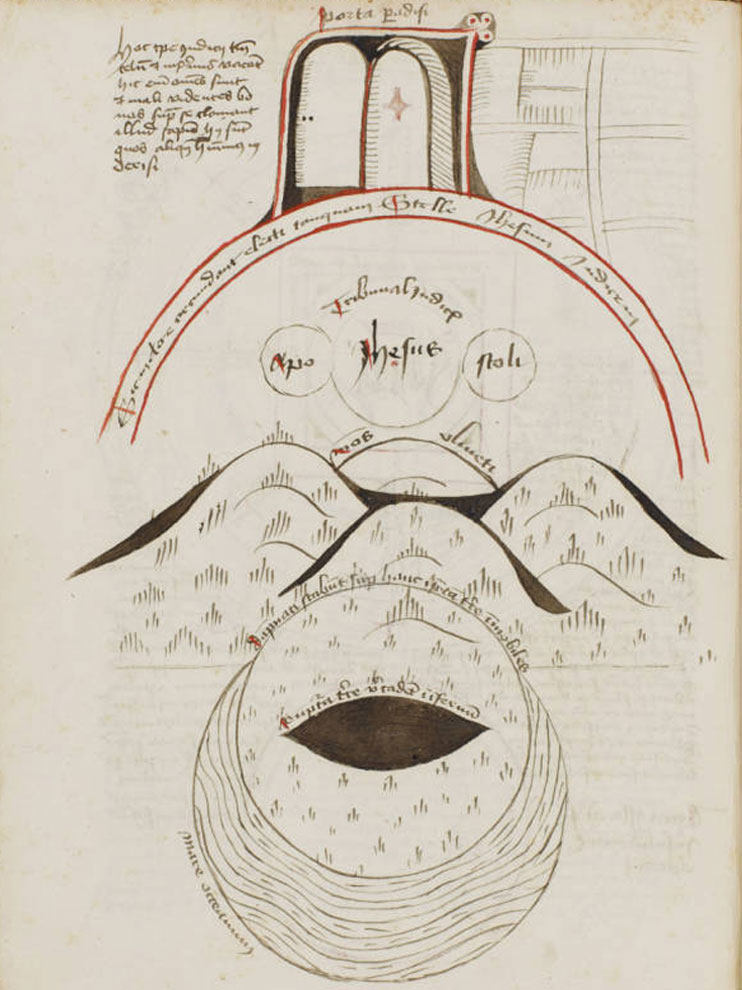
Then, we have a circular map with five swords pointing at the edges of the known world, illustrating the author’s contention that Islamic armies would reach the edges of the earth. The other maps depict the “four horns of the Antichrist,” above, Judgement Day, below, (the black eye at the bottom is the “black abyss that leads to hell”), and, further down, a diagram describing “the relative diameters of Earth and Hell.”
Made in Lübeck, Germany sometime between 1486 and 1488, the manuscript is written in Latin, “but it’s not as scholarly as other contemporary manuscripts,” write Mason and Miller, “and the penmanship is fairly poor.” Historian of cartography Chet Van Duzer explains that “it’s aimed at the cultural elite, but not the pinnacle of the cultural elite.”
Pointing out the obvious, Van Duzer says, “there’s no way to escape it, this work is very anti-Islamic,” a widespread sentiment in medieval Europe, when the “clash of civilizations” narrative spread its roots deep in certain strains of Western thinking. This particular text also “includes a section on astrological medicine and a treatise on geography that’s remarkably ahead of its time.”
Van Duzer and Ilya Dines have studied the rare manuscript for its insightful passages on geography and cartography and published their research in a book titled Apocalyptic Cartography. For all its theological alarmism, the manuscript is surprisingly thoughtful when it comes to analyzing its own formal properties and perspectives.
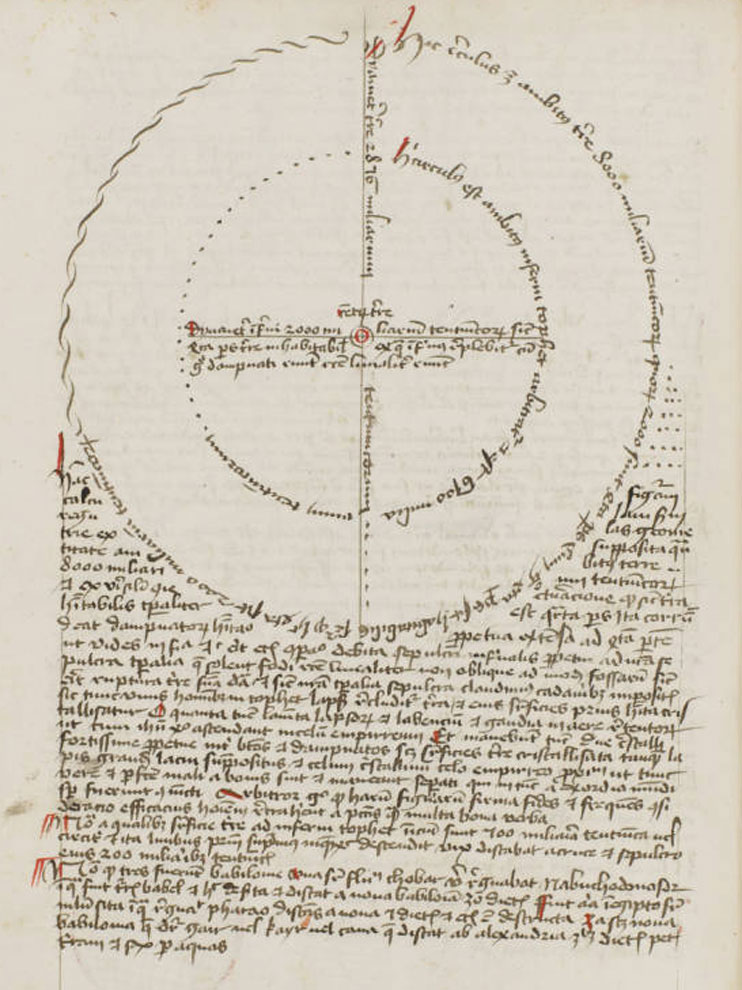
Mason and Miller note that “the author outlines an essentially modern understanding of thematic maps as a means to illustrate characteristics of the people or political organization of different regions.” As Van Duzer puts it, “this is one of the most amazing passages, to have someone from the 15th century telling you their ideas about what maps can do.” This marks the work, he claims in the introduction to Apocalyptic Cartography, as that “of one of the most original cartographers of the period.”
The Apocalypse Map now resides at the Huntington Library in Los Angeles.
Note: An earlier version of this post appeared on our site in 2018.
Related Content:
M.I.T. Computer Program Predicts in 1973 That Civilization Will End by 2040
A Survival Guide to the Biblical Apocalypse
In 1704, Isaac Newton Predicted That the World Will End in 2060
Josh Jones is a writer and musician based in Durham, NC.
Read More...
300 Years Before ChatGPT, Jonathan Swift’s Gulliver’s Travels Imagined Machines Writing Books and Producing Knowledge (1726)
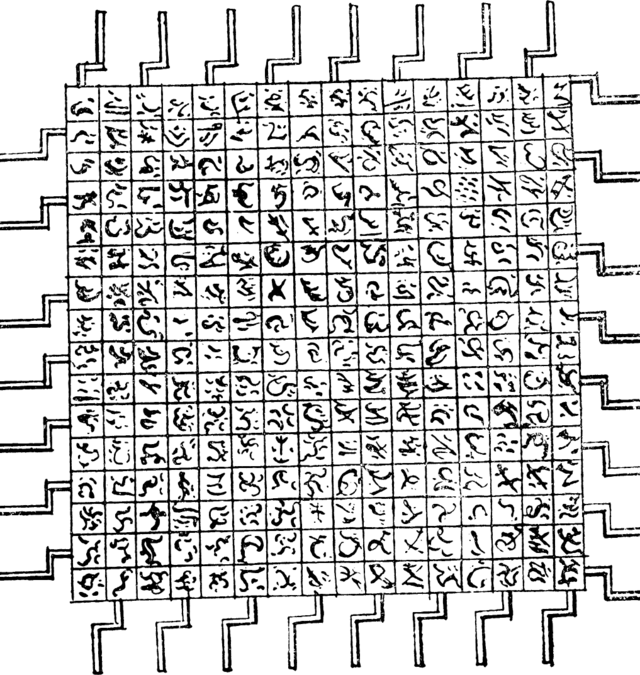
The printing press was invented in the middle of the fifteenth century, and it’s been downhill for the written word ever since. Even before then, arguments that the volume of writing being done far outstripped the value of that writing surely weren’t unheard of. Whatever the era, the most incisive remarks on the apparent victory of verbal quantity over verbal quality tend to have come from writers themselves. No less a satirist than Jonathan Swift made it one of his many targets in Gulliver’s Travels (1726), imagining an elaborate machine of wood and wire called “the Engine” (see illustration above) that automatically generates text, though few remember it — or rather, few remembered it until the rise of large language models in the real world.
Gulliver encounters that technological marvel, the Engine, at an institution called the Academy of Projectors in the city of Lagado. Swift’s protagonist records its creator’s explanation as follows: “Every one knew how laborious the usual method is of attaining to arts and sciences; whereas, by his contrivance, the most ignorant person, at a reasonable charge, and with a little bodily labor, might write books in philosophy, poetry, politics, laws, mathematics, and theology, without the least assistance from genius or study.” The Engine’s operation, with its unwieldy, clacking components and a scrambling staff of young crankers, readers, and scribes, may strike us as bizarre, just as it did audiences in the eighteenth century. But in our time, when students can write their papers literally without giving it a thought (to say nothing of what their professors may be getting up to), its concept now sounds all too plausible.
“This is one of the earliest known mentions of a machine that could be considered as a computer in literature, more than a hundred years prior to the first calculating engine designs by Charles Babbage,” writes Chris Garcia at the web site of the Computer History Museum. “The Engine might be seen as a computer, but perhaps it’s better thought of as a sort of random-number generator,” spouting out whichever words of the local language that correspond with the digits. That post dates from ten years, nearly to the day, before the launch of ChatGPT, which changed the general public’s ideas about what computers can and can’t do. We may disagree about whether a machine can truly generate “a complete body of all arts and sciences,” as the Engine’s inventor intends, but it no longer sounds like sheerest fantasy.
Swift had in mind not engineers of artificial intelligence but the Royal Society, whose enthusiasm for scientific knowledge and experimentation he saw as insufficiently tethered to reality, or at least practicality. In addition to the Engine, writes literature professor Robin Bates, “Swift imagines scientists attempting to extract sunbeams from cucumbers, soften marble into pillows and pincushions, replace silkworms with spiders (and having them eat brightly colored flies so the threads will be pre-dyed), mix paint by smell, reassemble original food stuffs from excrement, and build houses from the top down (in imitation of the bee and the spider).” His satire holds up today thanks to his understanding that, “for all the promises of the Enlightenment, the Age of Reason, and the Scientific and Technological Revolutions,” our attempts to change the world “founder the moment we start ignoring human nature.” But who needs human nature, the Projectors of today might argue, when you’ve got enough compute?
Related content:
How George Orwell Predicted the Rise of “AI Slop” in Nineteen Eighty-Four (1949)
Why AI Companies Are Buying — And Then Destroying — Old Books
George Orwell Got a B- at Harvard, When Michael Crichton Submitted an Orwell Essay as His Own
A Busy Person’s Introduction to Large Language Models (LLMs)
Based in Seoul, Colin Marshall writes and broadcasts on cities, language, and culture. He’s the author of the newsletter Books on Cities as well as the books 한국 요약 금지 (No Summarizing Korea) and Korean Newtro. Follow him on the social network formerly known as Twitter at @colinmarshall.
Read More...When Buckminster Fuller Proposed Putting a Dome Over Manhattan (1960)
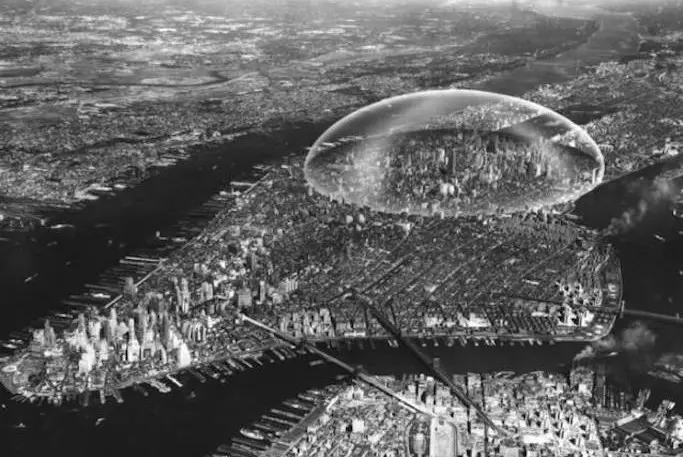
Image via Buckminster Fuller Estate
The novels of John Brunner have become a niche taste, even within his genre of science fiction. A more sociologically minded version of Philip K. Dick at his best, he could write with what now looks like a simultaneous prescience about the civilization to come and an apocalyptically anxious concern with the issues of his day. His undisputed masterpiece Stand on Zanzibar came out in 1968, the same year as the late Paul R. Ehrlich’s The Population Bomb. Both books deal with the dire consequences of what, at the time, looked like the runaway multiplication of humanity, though elements of the dystopian sci-fi writer’s vision now look rather more credible than the predictions of the Stanford biologist — apart from the giant geodesic dome covering Manhattan, anyway.
In a sense, Brunner was actually behind the times, since Buckminster Fuller himself had suggested doming Manhattan nearly a decade earlier. In their ambitious proposal for a “two-mile-wide Dome Over Manhattan” from the turn of the nineteen-sixties, Fuller and longtime collaborator Shoji Sadao “imagined a massive architectural surface that would regulate the city’s ecosystems,” write Next City’s Janette Kim and Erik Carver. “They delivered this design along with a series of surprising calculations: the Dome would reduce heat loss by scaling the city to one eighty-fifth of its surface area; the elimination of snowplowing alone would pay for heat; buildings inside the Dome could be built lighter and cheaper without need for weatherproofing; and interior air could be heated by remote plants.”
Fuller and Sadao did bring some numbers to back up their claims, but even more importantly, they made assurances that the dome’s glass would be one-way, a defense against prying non-Manhattanite eyes, and would keep residents’ cars and lawns in prime condition. However outlandishly forward-thinking Fuller could be, he never forgot that he needed to appeal to the worries and aspirations of mid-century America. As a personality, he also fit in well with the era’s enthusiasm for sweeping infrastructural fixes. “It was a time when people really believed in the power of technology,” says Never Built New York co-author Sam Lubell. “We’re building spaceships that go to the moon. Why can’t we build a dome over Manhattan to get rid of all this pollution, get rid of all the problems of weather?”
Still, as eccentric as he was, Fuller wasn’t delusional. “It’d be very worthwhile to have cities under geodesic domes, but New York City, if you think about all the different owners of different lands, the controversy about ‘this is my air rights, I don’t want a thing over my thing here,’ I just don’t think it’s going to happen,” he admitted. But “it can happen where you start out in places where energy is a really fantastic problem.” At the time, the ever-increasing demand for resources of all kinds by a rapidly growing population appeared to be not just a but the fantastic problem. Today, once-unforeseeable developments like rising energy efficiency and an apparently inexorable decline in global birthrates have directed our nervous gazes elsewhere. Yet dated visions of technological utopia and dystopia still strike us as oddly familiar — and indeed, as strangely similar to one another.
Related content:
The Life & Times of Buckminster Fuller’s Geodesic Dome: A Documentary
A Brief Introduction to Buckminster Fuller and His Techno-Optimistic Ideas
Based in Seoul, Colin Marshall writes and broadcasts on cities, language, and culture. He’s the author of the newsletter Books on Cities as well as the books 한국 요약 금지 (No Summarizing Korea) and Korean Newtro. Follow him on the social network formerly known as Twitter at @colinmarshall.
Read More...LEGO Lets You Build Gaudí’s Sagrada Família in Its Largest Set Ever
When work on the Sagrada Família first began in 1882, the original architect could hardly have imagined that, 144 years later, the ambitious undertaking would still be underway. Yet here we are. Famously, the Catalan architect Antoni Gaudí (1852–1926) spent the last four decades of his life designing and building the Gothic-inspired basilica in Barcelona. Then came the Spanish Civil War (1936–1939), which destroyed many of his architectural plans, leaving successive generations of architects to piece together Gaudí’s vision and move the project forward. At long last, earlier this year, builders completed the central Tower of Jesus Christ, which stands 566 feet high, making the Sagrada Família the tallest church in the world.
Although work on the Glory façade still remains, the basilica has reached a near-complete state—complete enough for Lego to roll out the official Sagrada Família Lego set. At 12,060 pieces, it’s the largest Lego set ever made, and it lets you build the Sagrada Família section by section, following the same order as the original architects. “Your building journey begins with the Apse with Crypt, the Nativity façade and the Passion façade. It then moves on to the naves and the Western Sacristy. Complete the 6 towers and finish the basilica with the Eastern Sacristy and the Glory façade.” With the video above, you can watch the building of the Lego basilica, compressing hours of work into 10 minutes. The Lego set will be available on November 1, 2026.
Related Content
Download Instructions for More Than 6,800 LEGO Kits at the Internet Archive
With 9,036 Pieces, the Roman Colosseum Is the Largest Lego Set Ever
Read More...The Cable that Changed the World: How Instant Global Communication Began in 1858
The word wireless is going the way of computerized and portable, and for much the same reasons. We no longer regard wireless devices that require no physical connections to anything else as marvels, but as something close to necessities. But our age, with its increasingly common assumptions that information just travels through the air, owes its existence to wires — and, in a historical sense, to one set of wires in particular, whose story is told in the Primal Space video above. Woven into a mighty 2,000-mile-long cable, it was laid across the Atlantic Ocean 168 years ago, enabling the first direct communication link between North America and Europe. Not that intercontinental video sharing was just around the corner.
No, the height of communication technology at the time was the telegraph: the Victorian Internet, if you like, to borrow the title of the book by Economist editor Tom Standage that inspired the video. As a technology, telegraphy itself is quite a bit older than the aforementioned transatlantic cable. One possible starting point is 1746, when scientist Jean-Antoine Nollet managed to send a jolt of static electricity all the way down a line of 200 monks.
Another is 1792, when inventor Claude Chappe’s system of semaphoric towers was first implemented. Though described as a telegraph, it used no electricity: if a human operator up in one of the towers spotted a change in the signal of the previous one, he’d rearrange his own semaphores to match it, and so on down the line. In 1800, Alessandro Volta’s chemical battery helped make the electric telegraph viable, but nobody was sure how best to transmit intelligible messages in the form of electrical pulses.
Nobody was sure, that is, until the eighteen-thirties, when a painter named Samuel Morse came up with the dot-and-dash code that now bears his name, as well as the devices used to encode and decode communications made with it. At the same time, English inventors William Cooke and Charles Wheatstone had come up with their own telegraph system that didn’t require a codebook, though its five wires made it more expensive and technologically complex. Within a few years, the U.S. and the U.K. had independently built thousands of miles of telegraph lines, making the next step of linking them together obvious, if easier said than done. Though the cable laid in 1858 failed within months, its basic concept has proven unusually robust. Without the roughly 600 undersea cables through which global internet traffic now flows, after all, you wouldn’t be reading this post — to say nothing of watching the video.
Related Content:
What the Entire Internet Looked Like in 1973: An Old Map Gets Found in a Pile of Research Papers
A Fascinating 3D Animation Shows the Depths of the Ocean
Based in Seoul, Colin Marshall writes and broadcasts on cities, language, and culture. He’s the author of the newsletter Books on Cities as well as the books 한국 요약 금지 (No Summarizing Korea) and Korean Newtro. Follow him on the social network formerly known as Twitter at @colinmarshall.
Read More...The Oldest Book Printed with Movable Type is Not The Gutenberg Bible: Jikji, a Collection of Korean Buddhist Teachings, Predated It By 78 Years and It’s Now Digitized Online
The history of the printed word is full of bibliographic twists and turns, major historical moments, and the significant printing of books now so obscure no one has read them since their publication. Most of us have only the sketchiest notion of how mass-produced printed books came into being—a few scattered dates and names. But every schoolchild can tell you the first book ever printed, and everyone knows the first words of that book: “In the beginning….”
The first Gutenberg Bible, printed in 1454 by Johannes Gutenberg, introduced the world to movable type, history tells us. It is “universally acknowledged as the most important of all printed books,” writes Margaret Leslie Davis, author of the 2019 book, The Lost Gutenberg: The Astounding Story of One Book’s Five-Hundred-Year Odyssey. In 1900, Mark Twain expressed the sentiment in a letter “commenting on the opening of the Gutenberg Museum,” writes M. Sophia Newman at Lithub. “What the world is to-day,” he declared, “good and bad, it owes to Gutenberg. Everything can be traced to this source.”
There is kind of an oversimplified truth in the statement. The printed word (and the printed Bible, at that) did, in large part, determine the course of European history, which, through empire, determined the course of global events after the “Gutenberg revolution.” But there is another story of print entirely independent of book history in Europe, one that also determined world history with the preservation of Buddhist, Chinese dynastic, and Islamic texts. And one that begins “before Johannes Gutenberg was even born,” Newman points out.
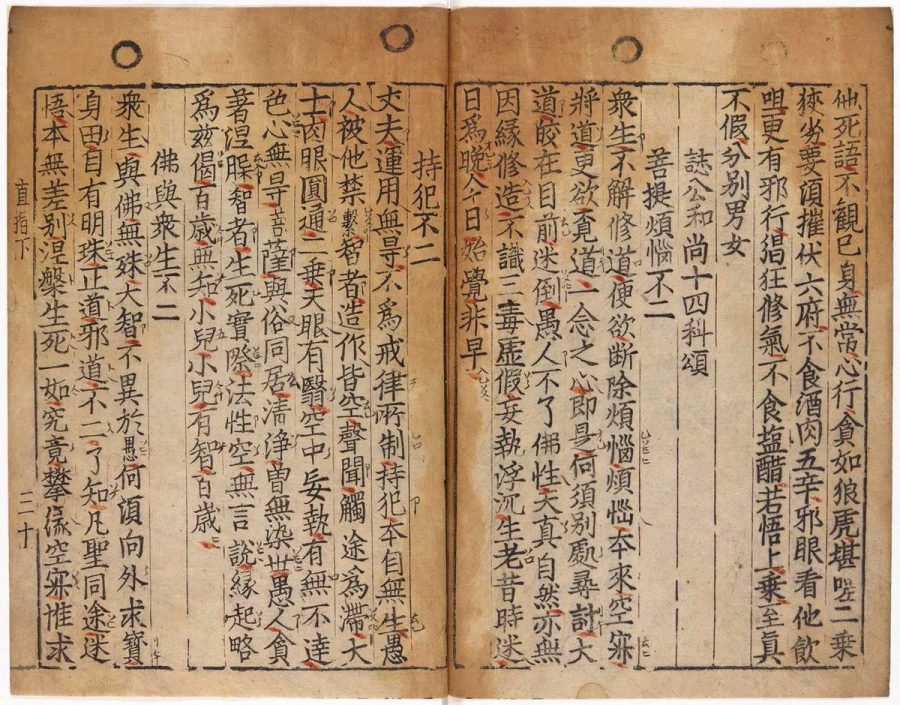
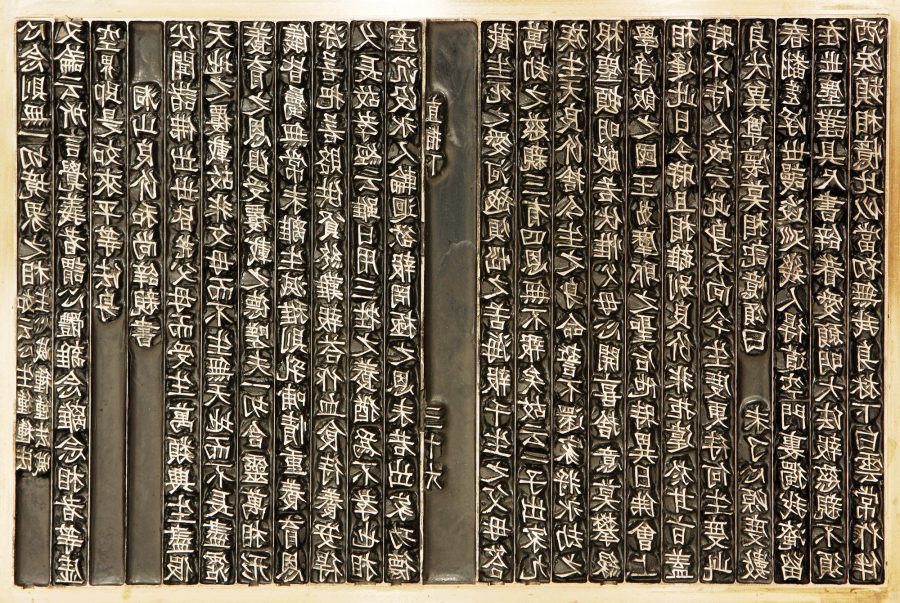
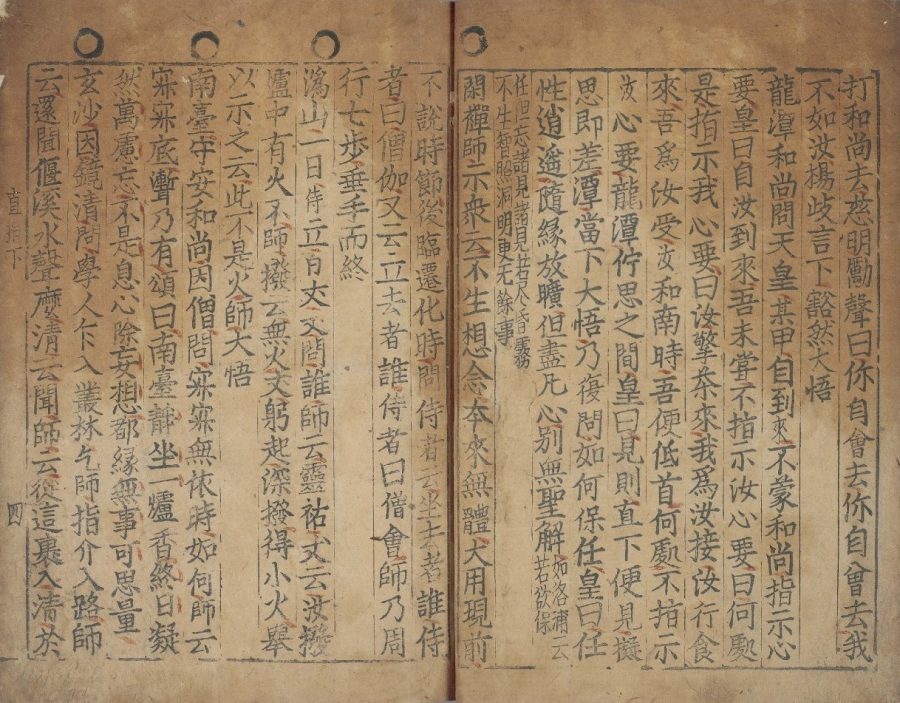
The oldest extant text ever printed with movable type predates Gutenberg himself (born in 1400) by 23 years, and predates the printing of his Bible by 77 years. It is the Jikji, printed in Korea, a collection of Buddhist teachings by Seon master Baegun and printed in movable type by his students Seok-chan and Daijam in 1377. (Seon is a Korean form of Chan or Zen Buddhism.) Only the second volume of the printing has survived, and you can see several images from it here.
Impressive as this may be, the Jikji does not have the honor of being the first book printed with movable type, only the oldest surviving example. The technology could go back two centuries earlier. Margaret Davis nods to this history, Newman concedes, writing that “movable type was an 11th century Chinese invention, refined in Korea in 1230, before meeting conditions in Europe that would allow it to flourish.” This is more than most popular accounts of the printed word say on the matter, but it’s still an inaccurate and highly cursory summary of the evidence.
Newman herself says quite a lot more. In essays at Lithub and Tricycle, she describes how printing techniques developed in Asia and were taken up in Korea in the 1200s by the Goryeo dynasty, who commissioned a printer named Choe Yun-ui to reconstruct a woodblock print of the massive collection of ancient Buddhist texts called the Tipitaka after the Mongols burned the only Korean copy. By casting “individual characters in metal” and arranging them in a frame—the same process Gutenberg used—he was able to complete the project by 1250, 200 years before Gutenberg’s press.
This text, however, did not survive, nor did the countless number of others printed when the technology spread across the Mongol empire on the Silk Road and took root with the Muslim Uyghurs. It is possible, though “no clear historical evidence” yet supports the contention, that movable type spread to Europe from Asia along trade routes. “If there was any connection,” wrote Joseph Needham in Science and Civilization in China, “in the spread of printing between Asia and the West, the Uyghurs, who used both block printing and movable type, had good opportunities to play an important role in this introduction.”
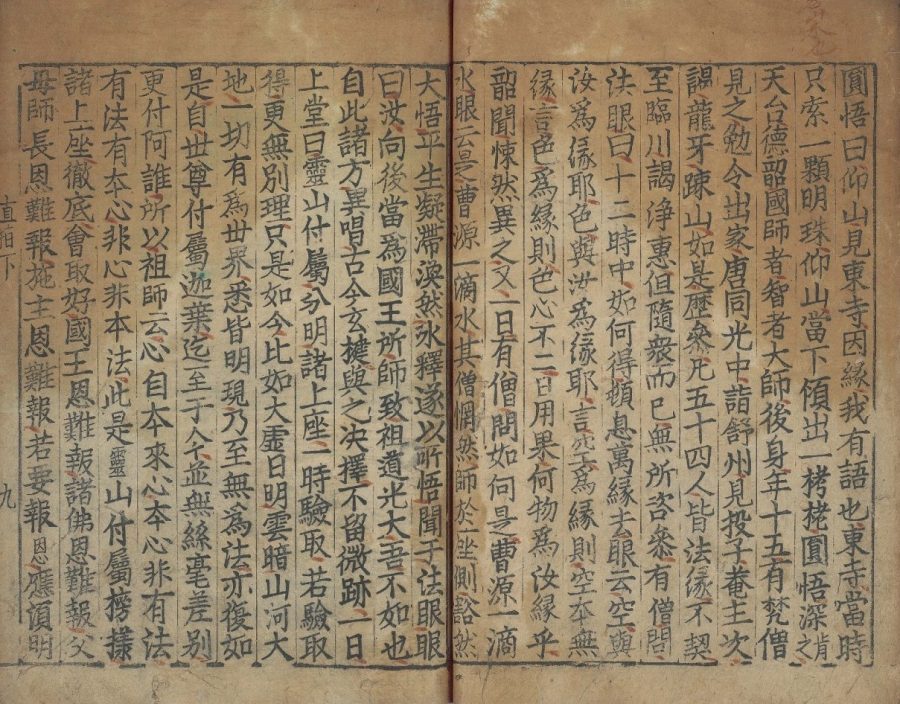
Without surviving documentation, this early history of printing in Asia relies on secondary sources. But “the entire history of the printing press” in Europe” is likewise “riddled with gaps,” Newman writes. What we do know is that Jikji, a collection of Korean Zen Buddhist teachings, is the world’s oldest extant book printed with movable type. The myth of Johannes Gutenberg as “a lone genius who transformed human culture,” as Davis writes, “endures because the sweep of what followed is so vast that it feels almost mythic and needs an origin story to match.” But this is one inventive individual in the history of printing, not the original, godlike source of movable type.
Gutenberg makes sense as a convenient starting point for the growth and worldwide spread of capitalism and European Christianity. His innovation worked much faster than earlier systems, and others that developed around the same time, in which frames were pressed by hand against the paper. Flows of new capital enabled the rapid spread of his machine across Europe. The achievement of the Gutenberg Bible is not diminished by a fuller history. But “what gets left out” of the usual story, as Newman tells us in great detail, “is startlingly rich.”
“Only very recently” has the long history of printing in Asia been “acknowledged at all” in popular culture, though scholars in both the East and West have long known it. Korea has regarded Jikji “and other ancient volumes as national points of pride that rank among the most important of books.” Yet UNESCO only certified Jikji as the “oldest movable metal type printing evidence” in 2001. The recognition may be late in coming, but it matters a great deal, nonetheless. Learn much more about the history, content, and provenance of Jikji at this site created by “cyber diplomats” in Korea after UNESCO bestowed World Heritage status on the book. And see a fully digitized copy of the book here.
Note: An earlier version of this post appeared on our site in 2019.
via Lithub
Related Content:
Oxford University Presents the 550-Year-Old Gutenberg Bible in Spectacular, High-Res Detail
Josh Jones is a writer and musician based in Durham, NC. F
Read More...Support Us
We're hoping to rely on loyal readers, rather than erratic ads. Please click the Donate button and support Open Culture. You can use Paypal, Venmo, Patreon, even Crypto! We thank you!

About Us

Open Culture scours the web for the best educational media. We find the free courses and audio books you need, the language lessons & educational videos you want, and plenty of enlightenment in between.
Advertise With Us

FREE UPDATES!
GET OUR DAILY EMAIL
Get the best cultural and educational resources on the web curated for you in a daily email. We never spam. Unsubscribe at any time.
FOLLOW ON SOCIAL MEDIA

Open Culture editor Dan Colman scours the web for the best educational media. He finds the free courses and audio books you need, the language lessons & movies you want, and plenty of enlightenment in between.
Advertise With Us

