Mick Jagger Tells the Story Behind ‘Gimme Shelter’ and Merry Clayton’s Haunting Background Vocals
In the fall of 1969 the Rolling Stones were in a Los Angeles recording studio, putting the final touches on their album Let It Bleed. It was a tumultuous time for the Stones. They had been struggling with the album for the better part of a year as they dealt with the personal disintegration of their founder and multi-instrumentalist Brian Jones, whose drug addiction and personality problems had reached a critical stage. Jones was fired from the band in June of that year. He died less than a month later. And although the Stones couldn’t have known it at the time, the year would end on another catastrophic note, as violence broke out at the notorious Altamont Free Concert just a day after Let It Bleed was released.
It was also a grim time around the world. The assassinations of Martin Luther King and Robert F. Kennedy, the Tet Offensive, the brutal suppression of the Prague Spring—all of these were recent memories. Not surprisingly, Let It Bleed was not the most cheerful of albums. As Stephen Davis writes in his book Old Gods Almost Dead: The 40-Year Odyssey of the Rolling Stones, “No rock record, before or since, has ever so completely captured the sense of palpable dread that hung over its era.”
And no song on Let It Bleed articulates this dread with greater force than the apocalyptic “Gimme Shelter,” in which Mick Jagger sings of a fire “sweepin’ our very street today,” like a “Mad bull lost his way.”
Rape, murder!
It’s just a shot away
It’s just a shot away
In an interview with Melissa Block for the NPR program All Things Considered, Jagger talked about those lyrics, and the making of the song:
One of the most striking moments in the interview is when Jagger describes the circumstances surrounding soul singer Merry Clayton’s powerful background vocals. “When we got to Los Angeles and we were mixing it, we thought, ‘Well, it’d be great to have a woman come and do the rape/murder verse,’ or chorus or whatever you want to call it,” said Jagger. “We randomly phoned up this poor lady in the middle of the night, and she arrived in her curlers and proceeded to do that in one or two takes, which is pretty amazing. She came in and knocked off this rather odd lyric. It’s not the sort of lyric you give anyone–‘Rape, murder/It’s just a shot away’–but she really got into it, as you can hear on the record.”
The daughter of a Baptist minister, Merry Clayton grew up singing in her father’s church in New Orleans. She made her professional debut at age 14, recording a duet with Bobby Darin. She went on to work with The Supremes, Elvis Presley and many others, and was a member of Ray Charles’s group of backing singers, The Raelettes. She is one of the singers featured in the documentary film, 20 Feet From Stardom. In an interview with Terry Gross on NPR’s Fresh Air, Clayton talked about the night she was asked to sing on “Gimme Shelter”:
Well, I’m at home at about 12–I’d say about 11:30, almost 12 o’clock at night. And I’m hunkered down in my bed with my husband, very pregnant, and we got a call from a dear friend of mine and producer named Jack Nitzsche. Jack Nitzsche called and said you know, Merry, are you busy? I said No, I’m in bed. he says, well, you know, There are some guys in town from England. And they need someone to come and sing a duet with them, but I can’t get anybody to do it. Could you come? He said I really think this would be something good for you.
At that point, Clayton recalled, her husband took the phone out of her hand and said, “Man, what is going on? This time of night you’re calling Merry to do a session? You know she’s pregnant.” Nitzsche explained the situation, and just as Clayton was drifting back to sleep her husband nudged her and said, “Honey, you know, you really should go and do this date.” Clayton had no idea who the Rolling Stones were. When she arrived at the studio, Keith Richards was there and explained what he wanted her to do.
I said, Well, play the track. It’s late. I’d love to get back home. So they play the track and tell me that I’m going to sing–this is what you’re going to sing: Oh, children, it’s just a shot away. It had the lyrics for me. I said, Well, that’s cool. So I did the first part, and we got down to the rape, murder part. And I said, Why am I singing rape, murder? …So they told me the gist of what the lyrics were, and I said Oh, okay, that’s cool. So then I had to sit on a stool because I was a little heavy in my belly. I mean, it was a sight to behold. And we got through it. And then we went in the booth to listen, and I saw them hooting and hollering while I was singing, but I didn’t know what they were hooting and hollering about. And when I got back in the booth and listened, I said, Ooh, that’s really nice. They said, well, You want to do another? I said, well, I’ll do one more, I said and then I’m going to have to say thank you and good night. I did one more, and then I did one more. So it was three times I did it, and then I was gone. The next thing I know, that’s history.
Clayton sang with such emotional force that her voice cracked. (“I was just grateful that the crack was in tune,” she told Gross.) In the isolated vocal track above, you can hear the others in the studio shouting in amazement. Despite giving what would become the most famous performance of her career, it turned out to be a tragic night for Clayton. Shortly after leaving the studio, she lost her baby in a miscarriage. It has generally been assumed that the stress from the emotional intensity of her performance and the lateness of the hour caused the miscarriage. For many years Clayton found the song too painful to hear, let alone sing. “That was a dark, dark period for me,” she told the Los Angeles Times in 1986, “but God gave me the strength to overcome it. I turned it around. I took it as life, love and energy and directed it in another direction, so it doesn’t really bother me to sing ‘Gimme Shelter’ now. Life is short as it is and I can’t live on yesterday.”
Note: An earlier version of this post appeared on our site in 2013.
Related Content:
Chuck Berry Takes Keith Richards to School, Shows Him How to Rock (1987)
Read More...Read the CIA’s Manual of Trickery and Deception, Written by a Professional Stage Magician

The idea of a youngster vacillating between whether to become a magician or join the Central Intelligence Agency may sound implausible, but those two working environments have deeper commonalities than it would seem. So, in any case, believes John McLaughlin, whose more than 30 years at the CIA included periods as its deputy director and acting director. He also describes himself as a lifelong amateur magician, an avocation that owes much to his boyhood discovery of Quicker Than the Eye, a magic manual from 1932 by one John Mulholland. Around the same time the young McLaughlin came across that book in the library, Mulholland was writing the more specialized guidebooks Some Operational Applications of the Art of Deception and Recognition Signals — though nobody without a serious security clearance would have known it.
In 1953, Mulholland left his position as editor of the magicians’ trade magazine The Sphinx, ostensibly for health reasons, but actually to go to work for the CIA. Formed just six years before, the organization was still determining what its mission of preventing surprise foreign attacks against the U.S. and countering the global advance of communism would entail on the ground. To anyone who’s made enough of a habit of novels and films dealing with Cold War espionage, it may come as no surprise that the arts of disguise, misdirection, and sleight of hand practiced by master magicians would look useful indeed to the CIA. “Just as a magician’s methods must elude detection in front of a closely attentive audience,” writes McLaughlin, “so an intelligence officer doing espionage work must elude close surveillance and pass messages and materiel without detection.”
Additionally, “analysts must be as familiar as magicians with methods of deception, because analysts are almost always working with incomplete information and in circumstances where an adversary is seeking to mislead them — or in the magician’s term, misdirect them.” The Company’s specialists in counterintelligence described their subfield as a “wilderness of mirrors,” an expression professional illusionists must find especially evocative. Commissioned in the time of the CIA’s human-experimentation program MKULTRA, previously featured here on Open Culture, Mulholland’s manuals were long assumed officially destroyed along with many other of its documents in 1973. After they unexpectedly resurfaced during declassification in the two-thousands, they were published in The Official CIA Manual of Trickery and Deception by Agency historians H. Keith Melton and Robert Wallace. You can find a copy over at the Internet Archive.
At that time, the Boston Globe published illustrated explanations of some of Mulholland’s techniques, such as transporting spies using a mechanism similar to the one that conceals an apparently sawed-in-half stagehand, or surreptitiously dropping into a drink a pill affixed to the back of a book of matches. Amid “the superpower struggle for power and influence around the world,” writes Tom Scocca, “both the ideas and techniques of secret war pervaded the culture — the corrosive belief in hidden conspiracy and the nifty thrill of spycraft itself, the codes and disguises and miniature cameras.” Today, “Mulholland’s account of real-world stagecraft amounts to an etiquette manual for a lost moment of history. The matchbook trick depends on people smoking and drinking. There is a survey of the many pockets found in every man’s suit, and which ones are most natural for casually slipping objects into.” However much of the romance has drained out of espionage — as it has from so much else since the mid-twentieth century — the best magicians know that old tricks can always be re-enchanted for a new world. You can read The Official CIA Manual of Trickery and Deception here.
Related content:
The CIA’s Former Chief of Disguise Show How Spies Use Costumes in Undercover Operations
Inside MKUltra, the CIA’s Secret Program That Used LSD to Achieve Mind Control (1953–1973)
Based in Seoul, Colin Marshall writes and broadcasts on cities, language, and culture. He’s the author of the newsletter Books on Cities as well as the books 한국 요약 금지 (No Summarizing Korea) and Korean Newtro. Follow him on the social network formerly known as Twitter at @colinmarshall.
Read More...The Little Albert Experiment: The Perverse 1920 Study That Made a Baby Afraid of Santa Claus & Bunnies
The field of psychology is very different than it used to be. Nowadays, the American Psychological Association has a code of conduct for experiments that ensures a subject’s confidentiality, consent,and general mental well-being. In the old days, it wasn’t the case.
Back then, you could, for instance, con subjects into thinking that they were electrocuting a man to death, as they did in the infamous 1961 Milgram experiment, which left people traumatized and humbled in the knowledge that deep down they are little more than weak-willed puppets in the face of authority. You could also try to turn a group of unsuspecting orphans into stutterers by methodically undermining their self-esteem as the folks who ran the aptly named Monster Study of 1939 tried to do. But, if you really want to get into the swamp of moral dubiousness, look no further than the Little Albert experiments, which traumatized a baby into hating dogs, Santa Claus, and all things fuzzy.
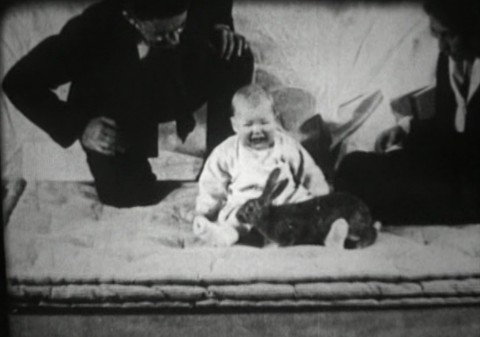
In 1920, Johns Hopkins professor John B. Watson was fascinated with Ivan Pavlov’s research on conditioned stimulus. Pavlov famously rang a bell every time he fed his dogs. At first the food caused the dogs to salivate, but after a spell of pairing the bell with dinner, the dogs would eventually salivate at just the sound of the bell. That’s called a conditioned response. Watson wanted to see if he could create a conditioned response in a baby.
Enter 9‑month-old Albert B., AKA Little Albert. At the beginning of the experiment, Albert was presented with a white rat, a dog, a white rabbit, and a mask of Santa Claus among other things. The lad was unafraid of everything and was, in fact, really taken with the rat. Then every time the baby touched the animals, scientists struck a metal bar behind him, creating a startlingly loud bang. The sound freaked out the child and soon, like Pavlov’s dogs, Little Albert grew terrified of the rat and the mask of Santa and even a fur coat. The particularly messed up thing about the experiment was that Watson didn’t even bother to reverse the psychological trauma he inflicted.

What happened to poor baby Albert is hard to say, in part because no one is really sure of the child’s true identity. He might have been Douglas Merritte, as psychologists Hall P. Beck and Sharman Levinson argued in 2009. If that’s the case, then the child died at the age of 6 in 1925 of hydrocephalus. Or he might have been William Albert Barger, as Russ Powell and Nancy Digdon argued in 2012. He passed away in 2007 at the age of 87. He reportedly had a lifelong aversion to dogs, though it cannot be determined if it was a lasting effect of the experiment.
Later in life, Watson left academicia for advertising. You can watch a video of the experiment above.
Note: An earlier version of this post appeared on our site in 2015.
Related Content:
Hermann Rorschach’s Original Rorschach Test: What Do You See? (1921)
Free Online Courses Psychology
Jonathan Crow is a writer and filmmaker whose work has appeared in Yahoo!, The Hollywood Reporter, and other publications.
Read More...The Long, Strange History of Tarot Cards: From the 14th Century to Modern Times
We have any number of reasons for difficulty getting to sleep, not least worries about the future. This is hardly a recent phenomenon, and indeed practices meant to clarify the nature of events to come may be older than civilization itself. In fact, many of us moderns trust the old ways of fortune-telling more than the new. Take the cards of the Tarot, often featured here on Open Culture, whose recognizable European form dates back to at least the fourteenth century. But as explained in the new video above from YouTube channel Bedtime & Historian, their pre-history begins longer ago and farther away, with the invention of the playing card itself in Tang-Dynasty China. For Tarot decks weren’t originally a means of glimpsing the future, but of passing time in the present.
In the 400 years or so between the civilizational journey playing cards made along the Silk Road and their first employment as a divination tool by French occultists, many a game of Tarot — or tarocchi, Tarock, and so on — took place in Europe. Monetary stakes, and sometimes considerable ones, were not unknown, which drew the ire of both state and Church authorities.
Yet not only did the cards survive these attempts at repression, they evolved along numerous long and winding cultural paths, taking artistically elaborate and evocative forms that still capture the imagination today. At the same time, the structure of the Tarot deck used by esotericists has remained remarkably stable, with its 78 cards consisting of 22 Major Arcana and 56 Minor Arcana, the latter divided into four suits (like the standard deck used for poker or blackjack).
If you aren’t sure what some of those terms mean, know that all is clarified over the course of the video’s nearly three-hour runtime, the final third of which is dedicated to explaining the identities, characteristics, and meanings of the cards themselves. It’s worth a listen as a kind of advance preparation if you’ve considered going in to get a Tarot reading done by one of the professionals who still ply their trade all around the world. (In Korea, where I live, they even work out of booths set up on the sidewalk, a true convenience for commuters in need of spiritual guidance on the way home.) True to Bedtime & Historian’s concept, the narrator speaks as slowly and calmly as possible, with a fire crackling in the background. You’ll learn a lot about Tarot, certainly, but you may also find that your sleep troubles have been solved before you’ve drawn your first card.
Related content:
Behold the Sola-Busca Tarot Deck, the Earliest Complete Set of Tarot Cards (1490)
Alejandro Jodorowsky Explains How Tarot Cards Can Give You Creative Inspiration
Based in Seoul, Colin Marshall writes and broadcasts on cities, language, and culture. He’s the author of the newsletter Books on Cities as well as the books 한국 요약 금지 (No Summarizing Korea) and Korean Newtro. Follow him on the social network formerly known as Twitter at @colinmarshall.
Read More...When Salvador Dalí Gave a Surrealist Lecture in a Diving Suit … and Almost Suffocated (1936)

Image by Library of Congress/Carl Van Vechten, via Wikimedia Commons
Many a foreigner has visited England and found it an unexpectedly surreal place. Some of that effect has to do with encountering familiar icons — Big Ben, double-decker Routemaster buses, Marmite — in cold, damp reality. More of it may be induced by the country’s simultaneously thoroughgoing cultures of normality and eccentricity, an endless source of inspiration for Monty Python’s Flying Circus and much other British comedy since. Yet England came relatively late to Surrealism, or rather, Surrealism came late to England. When the International Surrealist Exhibition opened at the New Burlington Galleries behind London’s Royal Academy in the summer of 1936, the Manchester Evening News decried it as “a travesty of everything that’s decent.” Naturally, the show was a smash hit.
On display was work by artists including Pablo Picasso, René Magritte, Max Ernst, Alexander Calder, Giorgio de Chirico, Marcel Duchamp, Alberto Giacometti, Paul Klee, Man Ray, and Salvador Dalí, who turned up in person to deliver a lecture on “Authentic Paranoiac Phantoms.” In order to “descend to the subconscious” with a properly Surrealist literalism, he rented a diving suit and helmet from a local outfitter for his appearance. (You can see an actual image from 1936 here.) “The diving suit had extremely heavy lead shoes which I could barely lift,” he writes in his autobiography, as translated by Haakon Chevalier. “I therefore had to walk very slowly, leaning on friends who helped to move me, as though I were completely paralyzed, and thus I appeared before the audience holding two luxurious white Russian wolfhounds on a leash.”
Only after he’d been talking for a few minutes did Dalí realize that “it would be impossible for me to deliver my speech through the glass window of my helmet. Moreover, I had been shut up in this thing for ten minutes and became heated from the exertions I had made in walking across the stage to reach my chair, so that I was dripping with perspiration, and felt faint and on the point of suffocating.” With the technician who’d screwed the helmet on in the first place nowhere to be found, his wife Gala and friend Edward James worked desperately to free him, eventually taking a hammer to the bolts. “At each blow I thought I would faint.” When Dalí finally emerged, the audience, having assumed it had all been an act, “was impressed by my really deathly pallor, which constituted the accurate gauge of that Dalinian dramatic element which never fails to attend my most trivial acts and undertakings.”
As uncompromisingly as they made their declarations to change the world through sheer force of nonsense, the Surrealists also understood that the show must go on. Dalí moved on to the visual portion of his lecture, presenting slides out of order and, for the most part, upside down. This was just one of the attractions with which the International Surrealist Exhibition drew 30,000 visitors during its three-week run, and “had it not been for the gathering storm clouds of war in Europe,” writes the Guardian’s Joanna Moorhead, “it might have gone on to achieve far more.” The old English intolerance for Gallic self-seriousness would also have made things difficult for Surrealism as the likes of Dalí, Duchamp, and André Breton conceived it. Or perhaps the domestic variety was simply enough: as critic and poet Herbert Read puts it in the exhibition’s catalog, a nation that has produced both William Blake and Lewis Carroll is to the manner born.
Related Content:
When Salvador Dali Met Sigmund Freud, and Changed Freud’s Mind About Surrealism (1938)
When Salvador Dalí Created a Surrealist Funhouse at New York World’s Fair (1939)
Salvador Dali Gets Surreal with Mike Wallace (1958)
Based in Seoul, Colin Marshall writes and broadcasts on cities, language, and culture. He’s the author of the newsletter Books on Cities as well as the books 한국 요약 금지 (No Summarizing Korea) and Korean Newtro. Follow him on the social network formerly known as Twitter at @colinmarshall.
Read More...Watch Interplanetary Revolution (1924): The Most Bizarre Soviet Animated Propaganda Film You’ll Ever See
In 1924, Zenon Komissarenko, Youry Merkulov and Nikolai Khodataev produced Interplanetary Revolution, which might just be one of the strangest Soviet propaganda films ever produced.
First, the film is animated using not only traditional cel animation but also collage and stop motion, giving the work a queasy, disorienting feel. A bit like looking at a painting by Henry Darger.
Then there is the film’s story. As an intertitle proclaims, this is “a tale about Comrade Coninternov, the Red Army Warrior who flew to Mars, and vanquished all the capitalists on the planet!!” This already sounds better than John Carter.
The movie, however, is rather hard to follow without either the appropriate amount of revolutionary fervor or, perhaps, hallucinogens. Interplanetary Revolution opens with a wild-eyed, ax-wielding bulldog with a top hat – a capitalist, obviously. Other capitalists, with swastikas on their foreheads, suck the blood from a hapless member of the proletariat. (By the early 1920s, Germany’s nationalist right had adopted the swastika, and Soviet propagandists quickly used it to brand capitalists as fascists.) Then the revolution comes and a pantless capitalist demon loses his mind after devouring a copy of Pravda. Next, the capitalists board a giant flying shoe and fly off into space. From there, the film gets kind of weird.
You can watch the whole thing above. It’s also added to our list of Free Animated Films, a subset of our collection, 4,000+ Free Movies Online: Great Classics, Indies, Noir, Westerns, Documentaries & More.
Note: An earlier version of this post appeared on our site in 2015.
Related Content:
Watch Dziga Vertov’s Soviet Toys: The First Soviet Animated Movie Ever (1924)
Watch Dziga Vertov’s A Man with a Movie Camera, Named the 8th Best Film Ever Made
Jonathan Crow is a writer and filmmaker whose work has appeared in Yahoo!, The Hollywood Reporter, and other publications.
Read More...How Alan Turing and His Fellow Codebreakers Broke the Nazis’ “Unbreakable” Enigma Code
There was a time when you could just go out and buy an Enigma machine. In the early nineteen-twenties, any organization with a need to keep its communications secret could order a few of those brand-new devices from Germany and rest assured that any messages encoded using them would be safe from prying eyes. It didn’t take long for the military to catch on to the Enigma’s usefulness. Just a few years after the machine came on the market, it had been adopted by the German Navy, Army, and Air Force, and made possible the rapid, secret coordination central to the technique we now call blitzkrieg. When World War II began, Axis forces were confident, as anyone in possession of an unbreakable code might well be.
As history played out, of course, that code turned out to be breakable. That this came as a surprise to the Nazis makes sense if you watch the new video above from Veritasium, which opens up an actual Enigma machine and explains its inner workings. Each letter typed into its keyboard passes through a series of interchangeable rotors wired together, then comes back through in the opposite direction, resulting in a particular substitute letter.
Each character entered advances at least one of the rotors, each of which turns at a different speed, meaning that the already complex substitution cipher constantly changes. To make it even trickier, the Nazis made modifications to their Enigma machines, including a telephone-operator-style plugboard that expanded the possible encryption keys to 7 x 10¹⁸: an infinite-seeming number that fairly cried out for the mathematical services of Alan Turing.
Already famous for having come up with the “Turing machine,” which could theoretically manipulate strings of symbols in what we’d now call an algorithmic fashion, he was recruited by Britain’s wartime codebreaking headquarters at Bletchley Park, where experts were already hard at work reverse-engineering the Enigma machine. There he considered flaws in the design of the device, such as its inability to encrypt any given letter as itself, and the ways in which its human operators used it, such as making predictable weather reports. Exploiting these weaknesses required building a non-theoretical computation engine, the Bombe, to grind through all possibilities at what would then have seemed an unfathomable speed. The intelligence the Bombe produced contributed to the success of the surprise D‑Day invasion and may have taken years off the potential ravages of World War II. It wouldn’t have happened without Turing’s formidable intelligence — or his understanding that you need a machine to outsmart a machine.
Related Content:
The Enigma Machine: How Alan Turing Helped Break the Unbreakable Nazi Code
How British Codebreakers Built the First Electronic Computer
The LEGO Turing Machine Gives a Quick Primer on How Your Computer Works
A Turing Machine Handmade Out of Wood
Can You Crack the Uncrackable Code in Kryptos, the CIA’s Work of Public Art?
Based in Seoul, Colin Marshall writes and broadcasts on cities, language, and culture. He’s the author of the newsletter Books on Cities as well as the books 한국 요약 금지 (No Summarizing Korea) and Korean Newtro. Follow him on the social network formerly known as Twitter at @colinmarshall.
Read More...The Digital Dada Library: Discover the Archive That Preserves the Original Publications of the Experimental Anti-Art Movement Online
Critical theorists like Theodor Adorno may have overreached in claiming that all mass culture is mediocre, mechanized propaganda made to justify the status quo. But that doesn’t mean they were entirely wrong. Over and over we see even the most subversive art, literature, film, and music has a way of being tamed and Bowdlerized. Global mega-corporate industries don’t need to censor what they don’t like; they only need to buy it, rebrand it, or price it out of reach.
So what? Why do we need challenging, independent art when we have endless entertainment? Is the concept a nostalgic, elitist, Eurocentric idea? Artists have justified the need for art since antiquity, with poetic and logical arguments of every kind. But Dada artists of the early 20th century broke ranks, building their movement on the insight that no defense could possibly mean anything when it came to art’s purpose, especially in the face of the technocratic slaughter of World War I.
When the hyperrationalism of modernity led to mass death and destruction, the only humane response was to declare war on rationalization—to “destroy the hoaxes of reason,” as French artist Jean Arp put it. “For the disillusioned artists of the Dada movement,” the Museum of Modern Art explains, “the war merely confirmed the degradation of social structures that led to such violence: corrupt and nationalist politics, repressive social values, and unquestioning conformity of culture and thought.”
Dada took a combative stance against, for one thing, the insistence that art justify its existence to win establishment approval. “All activity is vain,” declared poet Tristan Tzara in his 1918 “Dada Manifesto,” including the “monetary system, pharmaceutical product, or a bare leg advertising the ardent sterile spring…. The beginnings of Dada were not the beginnings of art, but of disgust” with the ossified culture of the “nice, nice bourgeois,” who would preserve at any cost “the possibility of wallowing in cushions and good things to eat.”
“And so Dada,” wrote Tzara, “was born of a need for independence, of a distrust toward unity.” Such declarations aside, the movement was decidedly unified in its aims. “For us, art is not an end in itself,” poet Hugo Ball wrote. “It is an opportunity for the true perception and criticism of the times we live in.” This critique required new experimental techniques that deformed and repurposed the technologies of mass culture.
The undertaking would not have been possible without a Dada publishing wing that turned out scores of journals, magazines, books, leaflets, essays, manifestos, etc., written, designed, edited, illustrated, photographed, and controlled by the artists themselves. They might find no small amount of irony in the fact that their productions have received the ultimate institutional sanction: housed in “nice, nice bourgeois” museums, libraries, and universities around the world.

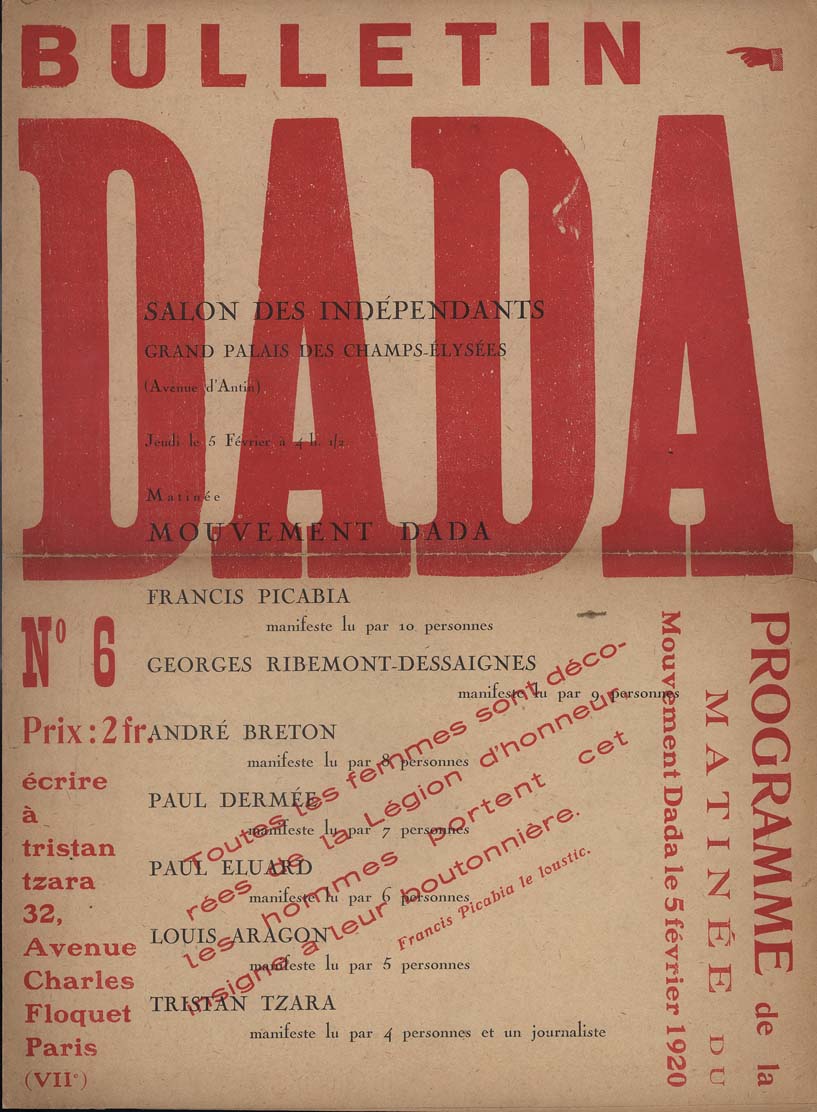
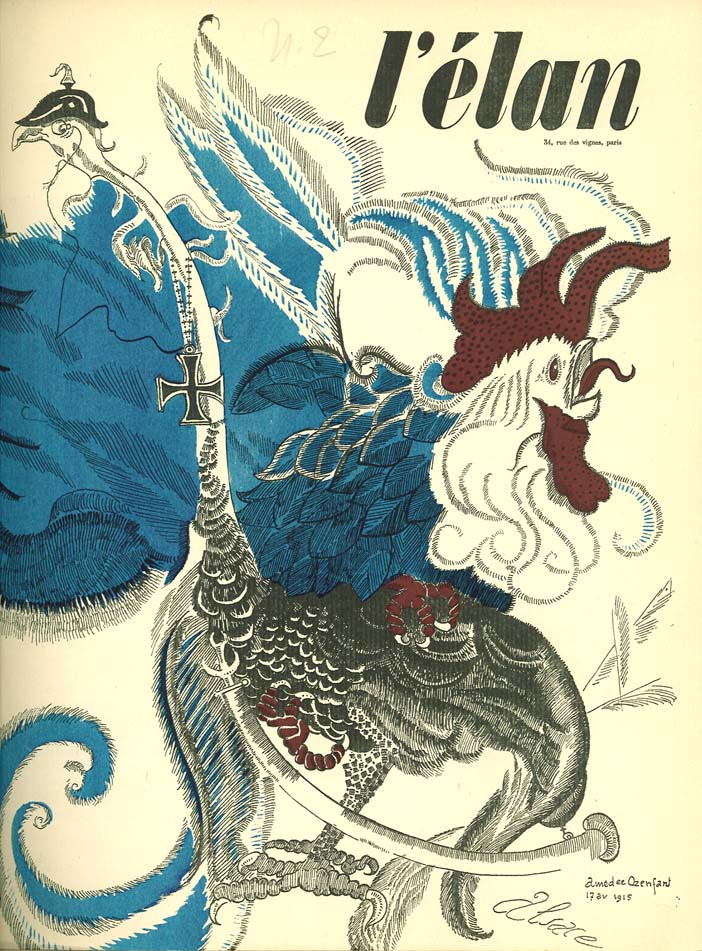
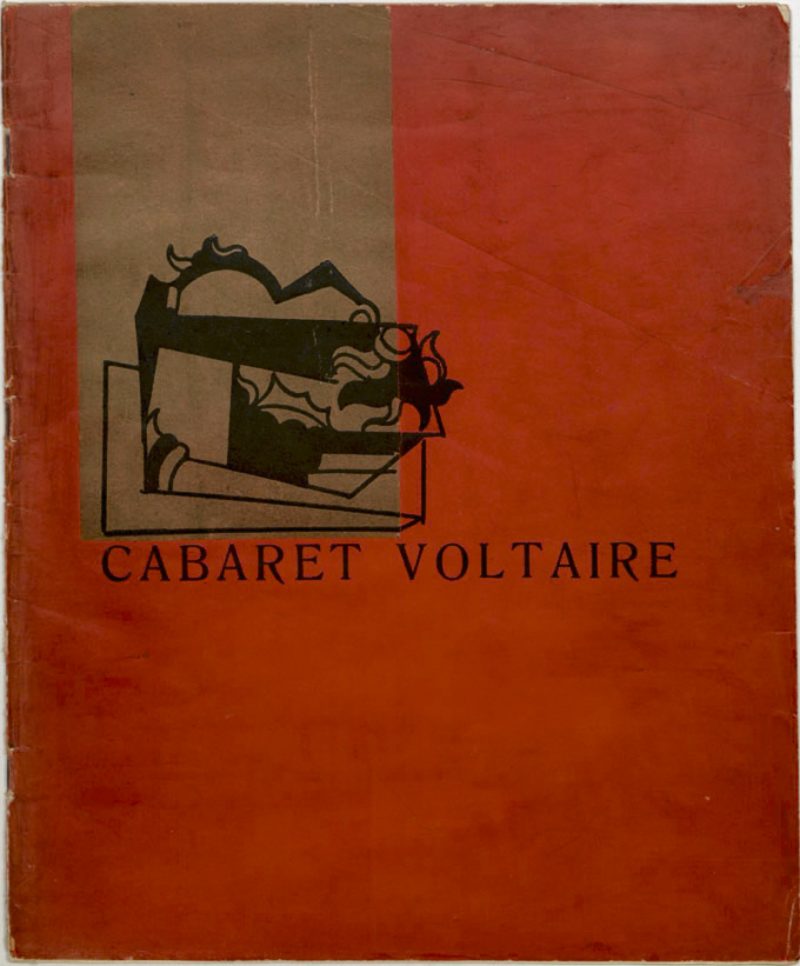
The University of Iowa’s International Dada Archive has amassed a considerable number of Dada publications and offers a wealth of high-quality scanned images of the originals on their site. “The first section” of their Digital Library “includes some of the major periodicals of the Dada movement from Zurich, Berlin, Paris, and elsewhere.”
The second section of the site “includes books by some of the participants in the Dada movement, as well as some of the more ephemeral Dada-era publications, such as exhibition catalogs and broadsides.” You’ll find writings by all of the artists mentioned above, as well as other well-known names like Max Ernst, Paul Eluard, George Grosz, Man Ray, Francis Picabia, and more.
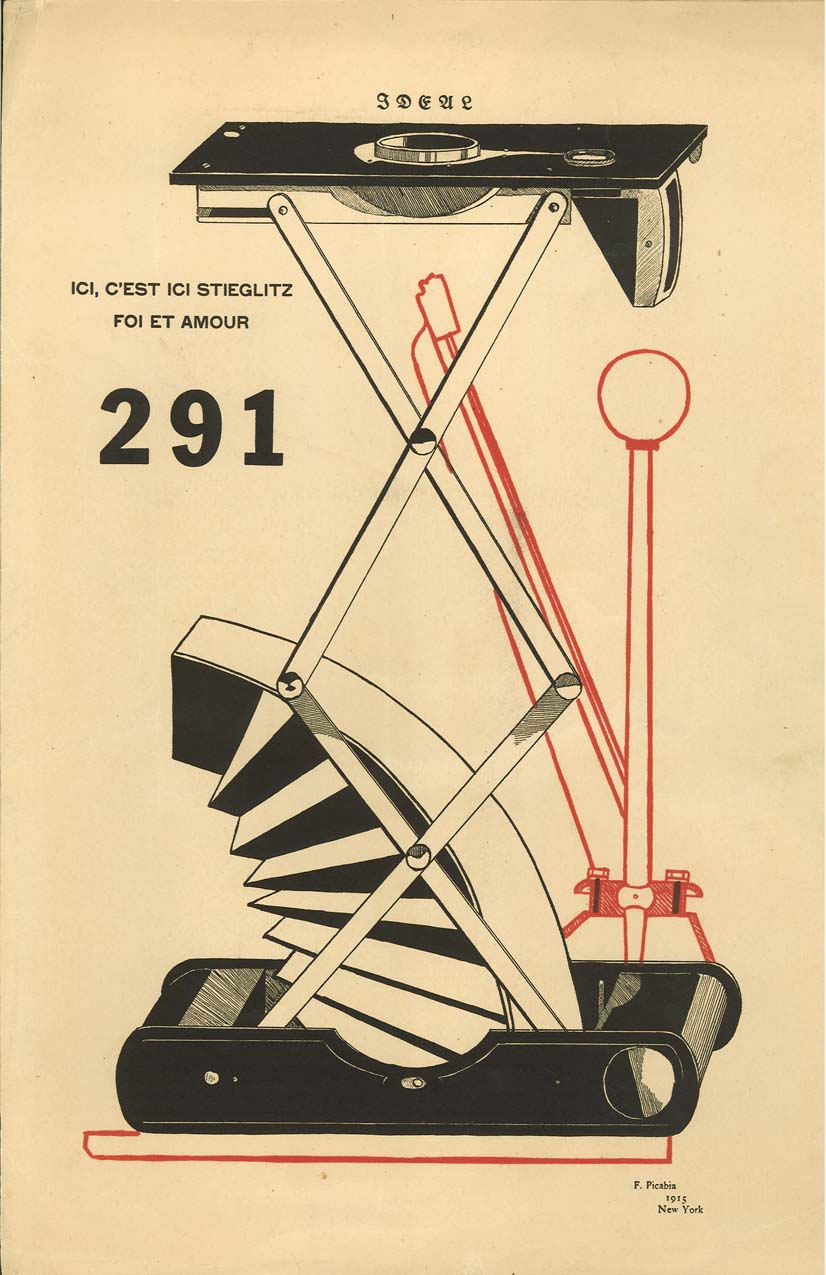
All of these publications are, of course, in their original European languages, though you can find translations of many documents online. The most influential Dada magazine in English, Alfred Stieglitz’s 291, will give monolingual readers a flavor of the larger scene. Published in New York between 1915 and 1916, the short-lived journal included many of the major European names. Its first issue covered experiments like “simultanism,” “sincerism,” and “idiotism,” and introduced visual poetry to American readers. Issue 5–6 featured on its cover one of the weird, nonsensical machines of Francis Picabia.
Dada splintered into other movements before its artists were forced out of Europe or hounded into obscurity by the Nazis. Their unified attempt to fragment and disrupt the dominance of mass culture was itself fragmented and disrupted by a horrific new war machine. But while their ideas may have been co-opted, their spirit may yet live on. Inspired by their work, perhaps a new generation will take up the Sisyphean task of making radical, critical, experimental art to subvert the homogenizing juggernaut of the culture industry.
Enter the University of Iowa’s Digital Dada Library here.
Note: An earlier version of this post appeared on our site in 2019.
Related Content:
The ABCs of Dada Explains the Anarchic, Irrational “Anti-Art” Movement of Dadaism
Hear the Experimental Music of the Dada Movement: Avant-Garde Sounds from a Century Ago
Josh Jones is a writer and musician based in Durham, NC.
Read More...When Galileo Calculated the Precise Dimensions of Hell in Dante’s Inferno
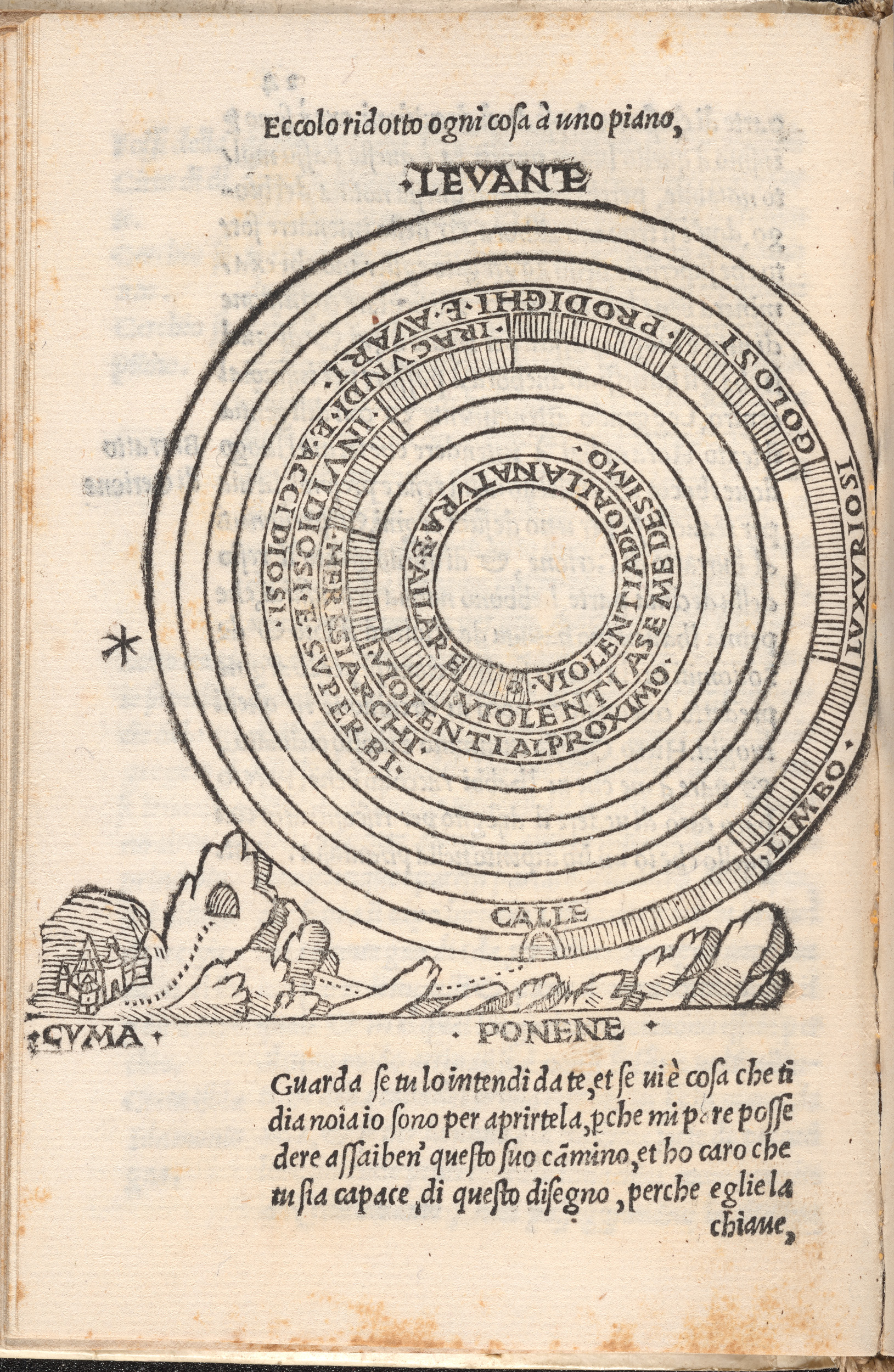
We venerate Galileo Galilei for daring to speak the scientific truth in the face of severe institutional opposition. He publicly acknowledged that the Earth revolves around the Sun in a time when the Church would rather he didn’t, displaying a bloody-mindedness that he seems to have acquired with age. Decades earlier, in the first stage of his career, he found himself (circa 1588) tasked by the Florentine Academy with calculating the precise dimensions of hell as described in Dante’s Divine Comedy. Dutifully applying himself to this now-absurd-sounding work, he determined that the underworld’s roof had to be centered in Jerusalem, as wide as the radius of the entire Earth, and no less than 600 kilometers thick.
Not that any of this was based on frivolous reasoning. As a model for the dimensions of hell’s roof, for instance, Galileo looked over to Filippo Brunelleschi’s dome, which had topped the Florence Cathedral for a century and a half at that point. Galileo’s calculations of hell’s dimensions contradicted an earlier model proposed by the scholar Alessandro Vellutello. Instead, they supported a model developed by architect Antonio Manetti, whose drawings appear here.
That Manetti was a fellow Florentine, and Vellutello was from Florence’s longtime rival Lucca could well have counted among the motivating factors. But we must bear in mind that, in the sixteenth century, people really did want to get these facts straight — if “facts” be the proper term.
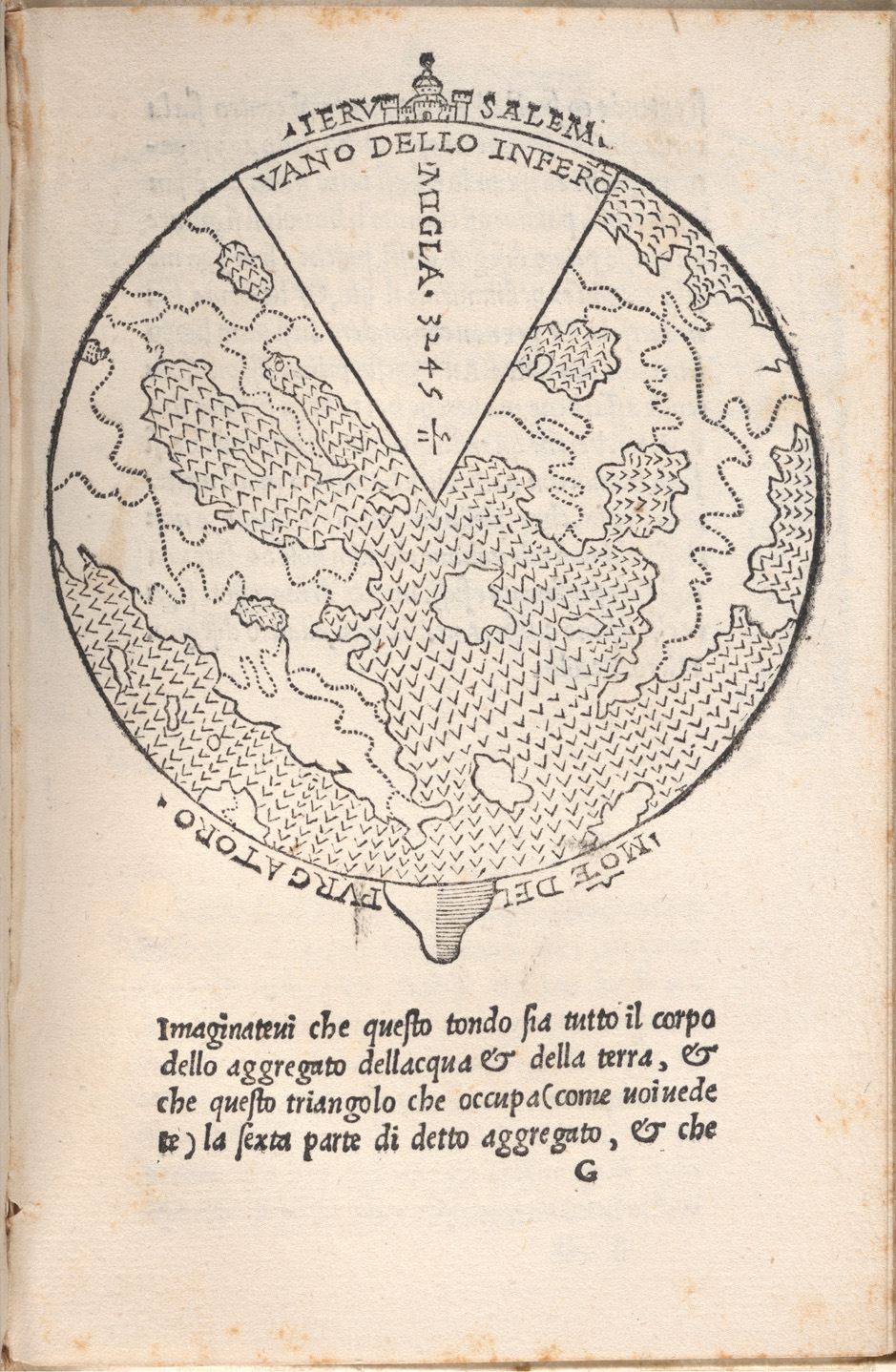
The attempt to reconcile scripture with objectivity absorbed the lives of many highly intelligent people throughout the Middle Ages and the Renaissance. However hopeless that goal could be, the thought Galileo devoted to the problem may have resulted in a genuine breakthrough. Mathematician and science historian Mark Peterson, previously featured here on Open Culture, has argued that his calculations of Dante’s non-Euclidean, topology-curved universe — as we might plausibly describe it today — laid out the basis for what would become mathematical physics. In any case, the young Galileo’s lectures at the Florentine Academy landed him a job as a mathematics lecturer at the University of Pisa, as good a reason as any for him to keep his private doubts to himself. When it comes to science and religion, as he must have known, you’ve got to pick your battles.
Related content:
Dante’s Divine Comedy: A Visitor’s Guide to Hell, Purgatory & Paradise
Physics from Hell: How Dante’s Inferno Inspired Galileo’s Physics
Beautiful 19th Century Maps of Dante’s Divine Comedy: Inferno, Purgatory, Paradise & More
A Digital Archive of the Earliest Illustrated Editions of Dante’s Divine Comedy (1487–1568)
Based in Seoul, Colin Marshall writes and broadcasts on cities, language, and culture. He’s the author of the newsletter Books on Cities as well as the books 한국 요약 금지 (No Summarizing Korea) and Korean Newtro. Follow him on the social network formerly known as Twitter at @colinmarshall.
Read More...Listen to 4+ Hours of Jazz & Classical Music from Haruki Murakami’s Novels
Before he became a novelist, Haruki Murakami ran a jazz bar in Tokyo, and music has filled his novels ever since. For your listening pleasure, NTS Radio has created two playlists of the jazz and classical music referenced in his fiction. Together, they run nearly five hours and feature everyone from John Coltrane, Bill Evans, and Thelonious Monk to Schubert, Liszt, and Mozart. Our suggestion: Pick up a Murakami novel, press play, and let the music become the soundtrack to your reading. Enjoy!
Related Content
Haruki Murakami’s Daily Routine: Up at 4:00 a.m., 5–6 Hours of Writing, Then a 10K Run
Haruki Murakami Translates The Great Gatsby, the Novel That Influenced Him Most
Read 12 Stories By Haruki Murakami Free Online
Read More...
Support Us
We're hoping to rely on loyal readers, rather than erratic ads. Please click the Donate button and support Open Culture. You can use Paypal, Venmo, Patreon, even Crypto! We thank you!

About Us

Open Culture scours the web for the best educational media. We find the free courses and audio books you need, the language lessons & educational videos you want, and plenty of enlightenment in between.
Advertise With Us

FREE UPDATES!
GET OUR DAILY EMAIL
Get the best cultural and educational resources on the web curated for you in a daily email. We never spam. Unsubscribe at any time.
FOLLOW ON SOCIAL MEDIA

Open Culture editor Dan Colman scours the web for the best educational media. He finds the free courses and audio books you need, the language lessons & movies you want, and plenty of enlightenment in between.
Advertise With Us


