Noam Chomsky Spells Out the Purpose of Education
E + ducere: “To lead or draw out.” The etymological Latin roots of “education.” According to a former Jesuit professor of mine, the fundamental sense of the word is to draw others out of “darkness,” into a “more magnanimous view” (he’d say, his arms spread wide). As inspirational as this speech was to a seminar group of budding higher educators, it failed to specify the means by which this might be done, or the reason. Lacking a Jesuit sense of mission, I had to figure out for myself what the “darkness” was, what to lead people towards, and why. It turned out to be simpler than I thought, in some respects, since I concluded that it wasn’t my job to decide these things, but rather to present points of view, a collection of methods—an intellectual toolkit, so to speak—and an enthusiastic model. Then get out of the way. That’s all an educator can, and should do, in my humble opinion. Anything more is not education, it’s indoctrination. Seemed simple enough to me at first. If only it were so. Few things, in fact, are more contentious (Google the term “assault on education,” for example).
What is the difference between education and indoctrination? This debate rages back hundreds, thousands, of years, and will rage thousands more into the future. Every major philosopher has had one answer or another, from Plato to Locke, Hegel and Rousseau to Dewey. Continuing in that venerable tradition, linguist, political activist, and academic generalist extraordinaire Noam Chomsky, one of our most consistently compelling public intellectuals, has a lot to say in the video above and elsewhere about education.
First, Chomsky defines his view of education in an Enlightenment sense, in which the “highest goal in life is to inquire and create. The purpose of education from that point of view is just to help people to learn on their own. It’s you the learner who is going to achieve in the course of education and it’s really up to you to determine how you’re going to master and use it.” An essential part of this kind of education is fostering the impulse to challenge authority, think critically, and create alternatives to well-worn models. This is the pedagogy I ended up adopting, and as a college instructor in the humanities, it’s one I rarely have to justify.
Chomsky defines the opposing concept of education as indoctrination, under which he subsumes vocational training, perhaps the most benign form. Under this model, “People have the idea that, from childhood, young people have to be placed into a framework where they’re going to follow orders. This is often quite explicit.” (One of the entries in the Oxford English Dictionary defines education as “the training of an animal,” a sense perhaps not too distinct from what Chomsky means). For Chomsky, this model of education imposes “a debt which traps students, young people, into a life of conformity. That’s the exact opposite of what traditionally comes out of the Enlightenment.” In the contest between these two definitions—Athens vs. Sparta, one might say—is the question that plagues educational reformers at the primary and secondary levels: “Do you train for passing tests or do you train for creative inquiry?”
Chomsky goes on to discuss the technological changes in education occurring now, the focus of innumerable discussions and debates about not only the purpose of education, but also the proper methods (a subject this site is deeply invested in), including the current unease over the shift to online over traditional classroom ed or the value of a traditional degree versus a certificate. Chomsky’s view is that technology is “basically neutral,” like a hammer that can build a house or “crush someone’s skull.” The difference is the frame of reference under which one uses the tool. Again, massively contentious subject, and too much to cover here, but I’ll let Chomsky explain. Whatever you think of his politics, his erudition and experience as a researcher and educator make his views on the subject well worth considering.
Josh Jones is a doctoral candidate in English at Fordham University and a co-founder and former managing editor of Guernica / A Magazine of Arts and Politics.
Read More...Marilyn Monroe Reads Joyce’s Ulysses at the Playground (1955)
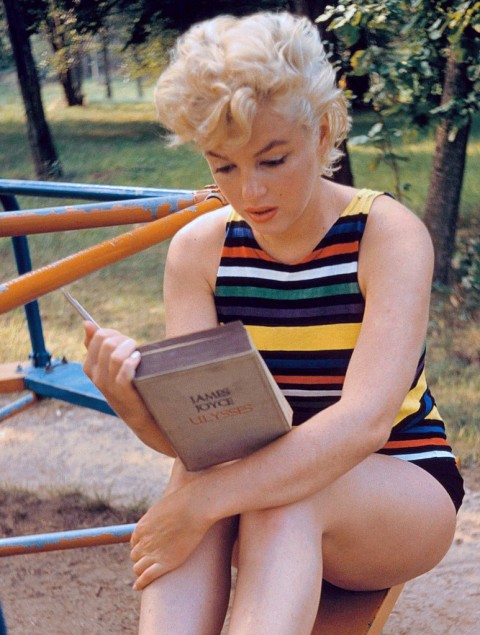 During the 1950s, the pioneering photojournalist Eve Arnold took a series of portraits of Marilyn Monroe. The now iconic photos generally present Monroe as a larger-than-life celebrity and sex symbol. Except for one. In 1955, Arnold photographed Monroe reading a worn copy of James Joyce’s modernist classic, Ulysses. It’s still debated whether this was simply an attempt to recast her image (she often played the “dumb blonde” character in her ’50s films), or whether she actually had a pensive side. (Her personal library, catalogued at the time of her death, suggests the latter.) But, either way, Arnold explained years later how this memorable photo came about:
We worked on a beach on Long Island. She was visiting Norman Rosten the poet.… I asked her what she was reading when I went to pick her up (I was trying to get an idea of how she spent her time). She said she kept Ulysses in her car and had been reading it for a long time. She said she loved the sound of it and would read it aloud to herself to try to make sense of it — but she found it hard going. She couldn’t read it consecutively. When we stopped at a local playground to photograph she got out the book and started to read while I loaded the film. So, of course, I photographed her. It was always a collaborative effort of photographer and subject where she was concerned — but almost more her input.
You can find more images of Marilyn reading Joyce over at The Retronaut. Of course, you can download your own copy of Ulysses from our Free Ebooks collection. But we’d recommend spending time with this finely-read audio version, which otherwise appears in our list of Free Audio Books.
Related Content:
The 430 Books in Marilyn Monroe’s Library: How Many Have You Read?
Stephen Fry Explains His Love for James Joyce’s Ulysses
Henri Matisse Illustrates 1935 Edition of James Joyce’s Ulysses
Read More...Jean Cocteau’s Avante-Garde Film From 1930, The Blood of a Poet
In a 1946 essay Jean Cocteau cautions against making a quick interpretation of his first film, The Blood of a Poet, with a quote from Montaigne:
Most of Aesop’s fables have many different levels and meanings. There are those who make myths of them by choosing some feature that fits in well with the fable. But for most of the fables this is only the first and most superficial aspect. There are others that are more vital, more essential and profound, that they have not been able to reach.
Cocteau conceived The Blood of a Poet (Le Sang d’un Poète) in late 1929, soon after the publication of his novel Les Enfants Terribles. He had just kicked his opium habit and was entering one of the most prolific periods of his career. The film is often called a surrealist work, but Cocteau rejected the association, saying that he had set out “to avoid the deliberate manifestations of the unconscious in favor of a kind of half-sleep through which I wandered as though in a labyrinth.” He goes on:
The Blood of a Poet draws nothing from either dreams or symbols. As far as the former are concerned, it initiates their mechanism, and by letting the mind relax, as in sleep, it lets memories entwine, move and express themselves freely. As for the latter, it rejects them, and substitutes acts, or allegories of these acts, that the spectator can make symbols of if he wishes.
Many of its first spectators saw anti-Christian symbolism in the film. Although production ended in September of 1930, Cocteau was not able to get his film shown publicly until January of 1932. The Blood of a Poet features the only film appearance by Lee Miller, a noted photographer and model of Man Ray. (She plays a statue.) The film is now considered a classic of experimental cinema and is the first in what came to be known as Cocteau’s “Orphic Trilogy,” which includes Orphée (1950) and Testament of Orpheus (1959). The Blood of a Poet will be added to our collection, 4,000+ Free Movies Online: Great Classics, Indies, Noir, Westerns, Documentaries & More.
Related content:
Man Ray and the Cinéma Pur: Four Surrealist Films From the 1920s
Anémic Cinéma: Marcel Duchamp’s Whirling Avant-Garde Film (1926)
Read More...The History of Western Architecture: A Free Online Course Moving from Ancient Greece to Rococo

Image by Arild Vågen, via Wikimedia Commons
If you have plans to visit the Old World any time soon, you should spend a few good minutes — make that hours — with The History of Architecture, a free course that recently debuted on YouTube. Taught by Jacqueline Gargus at Ohio State, the course features 39 video lectures that collectively offer a classic survey of Western architecture. We begin in Ancient Egypt, Greece and Rome, laying the conceptual foundations for what’s to come. Then we dive headlong into Islamic, Byzantine and Medieval architecture, before spending a good deal of time with Renaissance, Baroque, and Rococo styles. Of course, we encounter many great landmarks along the way: the pyramids of Egypt, the temples of Ancient Greece, the Hagia Sophia in Constantinople, Chartres in France, Brunelleschi’s Duomo of Florence, and the list goes on. The course appears on YouTube. Find the lectures below.
The History of Architecture has been added to our collection, 1,700 Free Online Courses from Top Universities. And if/when Prof. Gargus posts a sequel that gets us into modern times, we’ll be sure to let you know.
If you would like to support the mission of Open Culture, consider making a donation to our site. It’s hard to rely 100% on ads, and your contributions will help us continue providing the best free cultural and educational materials to learners everywhere. You can contribute through PayPal, Patreon, and Venmo (@openculture). Thanks!
Related Content:
Roman Architecture: A Free Online Course from Yale
Take an Online Course on Design & Architecture with Frank Gehry
Read More...Carnegie Mellon Takes Online Courses to Another Level with Its Open Learning Initiative
Open online courses—massive or otherwise—are revolutionizing higher education by making learning more and more accessible.
Carnegie Mellon University has taken online courses to another level, offering virtual classroom environments based on deep research into how adults learn.
The courses are free. Carnegie Mellon’s Open Learning Initiative currently offers 15 courses through a platform that provides targeted progress feedback to students.
The program doesn’t offer course credit or certificates but the courses are sophisticated. CMU spent anywhere from $500,000 to $1 million for each course to write the software, which includes a course builder program for instructors and a system of feedback loops that send student learning data to the instructor, the student and the course design team.
More than 10,000 students enrolled in OLI courses last year. So far CMU promotes OLI courses as supplementary to traditional classroom instruction. But the courses are certainly rich enough to be enjoyed by anyone. They’re mostly in the sciences but include a few language and social science classes too.
The list of currently-available courses appears below. We also have them listed in our complete list of Massive Open Online Courses from Great Universities (many of which happen to offer certificates too):
- American English Speech
- Anatomy and Physiology
- Argument Diagramming
- Biochemistry
- Elementary French 1
- Elementary French 2
- Engineering Statics
- Introduction to Biology
- Introduction to Chemistry
- Introduction to Psychology
- Logic and Proofs
- Media Programming
- Modern Biology
- Probability and Statistics
- Statistical Reasoning
Kate Rix writes about digital media and education. Read more of her work on thenifty.blogspot.com and .
Read More...The Drinking Party, 1965 Film Adapts Plato’s Symposium to Modern Times
The word “symposium” tends to conjure images of a formal, academic gathering, which it most often is these days. It’s kind of a stuffy word, but it shouldn’t be. In Plato’s day, it was simply a drinking party, the kind you might have with a group of brainy acquaintances when the last course is cleared, there’s no shortage of wine, and no one has to work the next day. (This being ancient Greece, these were all-male affairs). Plutarch defined a symposium as “a passing of time over wine, which, guided by gracious behavior, ends in friendship.” Plato’s Symposium, the best-known of his dialogues, is much more in the latter vein—a celebration among accomplished friends to mark the triumph of the poet Agathon’s first tragedy. The dialogue contains seven speeches on love, including of course, one from Plato’s primary mouthpiece Socrates. But the main draw is comic playwright Aristophanes; no undergraduate who takes a philosophy course forgets his romantic origin myth, in which love actually is a yearning for one’s missing other half.
When writer and director Jonathan Miller decided to adapt Plato’s classic text into a film in 1965, he evidently decided to combine both the modern, academic definition of “symposium” and its classical precedent. His film is called The Drinking Party, and involves its share of that in moderation (as in the original), but it also transposes Plato’s casual gathering to a group of students in formal attire dining on a neo-Classical terrace with an Oxford don, their classics master. Each character adopts the role of one of Plato’s Symposium speakers. A few things to note here: the excerpt above is of relatively high quality, but the complete film itself (below) did not fare nearly as well: transferred from a well-worn 16mm print from a university archive, the film is muddy, scratched and quite dim. This is too bad. Miller’s film, which was shown to college philosophy students in the 60s and 70s, sunk into cultural oblivion for a couple decades, and copies of it are very rare. Nonetheless, this is well worth watching, particularly for students of philosophy. The Drinking Party was produced as part of a mid-60s arts documentary series called “Sunday Night,” which ran from 1965–1968.
Related Content:
Find The Symposium and other great works in our collection of 375 Free eBooks.
Josh Jones is a doctoral candidate in English at Fordham University and a co-founder and former managing editor of Guernica / A Magazine of Arts and Politics.
Read More...Nicolas Cage, Paul Newman & Dennis Hopper Bring Their American Style to Japanese Commercials
Westerners who grew interested in Japan during the past 30 years will remember one point of early contact with the culture: Japanese commercials. Television advertisements from the Land of the Rising Sun have long offered the rest of the world a source of uncomprehending astonishment and mystified laughter. What a weird place Japan is, many must think to themselves as they gaze upon spots involving dancing dogs and salty snacks or brush fire and high blood-pressure tea. But as foreign observers tend to discover — and as I have had reconfirmed while visiting the country for the past week — Japan may have many qualities, but pure weirdness isn’t among them. Artifacts that strike the rest of us as weird emerge according to logic, albeit a logic of their own. This goes double for the most prized Japanese commercials of the bunch: those starring American celebrities.
Here on Open Culture, we’ve featured Woody Allen for Seibu and James Brown for Nissin. Please enjoy, at the very top of this post, the eccentric Nicolas Cage playing his American-ness to the very hilt. When pachinko machine manufacturer Sankyo recruited Cage, they went all-out, getting him square-dancing in the middle of a lonely southwestern highway with a pack of metal ball-headed aliens. Right above, we have Paul Newman flashing a smile and pointing his finger not once, but two times, in a 1980 commercial for Maxwell House. And speaking of eccentricity, below you’ll find perhaps the most oblique example of the American actor-starring Japanese commercial I’ve ever come across: Dennis Hopper for Tsumura. Sofia Coppola satirized all of this, of course, in Lost in Translation, but the exchange of Japanese corporate money for a dose of devil-may-care American panache could hardly make better business sense.
Related content:
Jean-Luc Godard’s After-Shave Commercial for Schick
Ingmar Bergman’s Soap Commercials Wash Away the Existential Despair
Fellini’s Fantastic TV Commercials
Wes Anderson’s New Commercials Sell the Hyundai Azera
Colin Marshall hosts and produces Notebook on Cities and Culture. Follow him on Twitter at @colinmarshall.
Read More...Classic Charles Mingus Performance on Belgian Television, 1964
In early 1964 Charles Mingus put together one of the great combos in jazz history. The sextet was composed of Mingus on bass, Dannie Richmond on drums, Jaki Byard on piano, Johnny Coles on trumpet, Clifford Jordan on tenor saxophone and the extraordinary multi-instrumentalist Eric Dolphy on alto saxophone, flute and bass clarinet. Mingus called his experimental group The Jazz Workshop.
In April of that year Mingus and his band embarked on a three-week tour of Europe, much of which is recorded on film and audiotape. The tour is remembered as one of the high-water marks in Mingus’s career. As Rob Bowman writes in the liner notes to the Jazz Icons DVD Charles Mingus Live in ’64:
The tour effectively introduced two new compositions, “Meditations On Integration” and “So Long Eric”, while the band walked a fine line between Mingus’s usual amalgam of bop, swing and New Orleans jazz and the free-jazz leanings of the cataclysmic Dolphy. The result, of course, was something that could only be called Mingus Music–a galvanizing, high-energy sonic stew that, while the product of the kinetic interplay of six musicians, could only have been conjured up with Mingus as the master of ceremonies.
The performance above is from Charles Mingus Live in ’64. It was recorded by Belgian television on Sunday, April 19, 1964 at the Palais des Congrés in Liège, Belgium. The band had unexpectedly been reduced to a quintet two nights earlier, when Coles collapsed onstage in Paris and was rushed to the hospital with what was later diagnosed as an ulcer. In the Belgian TV broadcast, pianist Byard makes up for the missing trumpet parts as the band plays three Mingus compositions:
- So Long Eric
- Peggy’s Blue Skylight
- Meditations on Integration
“So Long Eric” was named in honor of Dolphy, who had announced before the band left America that he would remain in Europe when the tour was over. Sadly, Dolphy fell into a diabetic coma in Germany and died just two months after finishing the tour. Mingus would later call the song “Praying With Eric.”
Related content:
Charles Mingus and His Eviction From His New York City Loft, Captured in Moving 1968 Film
How to Potty Train Your Cat: A Handy Manual by Charles Mingus
Read More...Nirvana’s Home Videos: Watch Nirvana Rehearse in Krist Novoselic’s Mother’s House (1988)
When Nirvana hit it big I was in high school, a punk-rock purist with little time for their MTV revisionism or the fact that they inspired teen rebellion from people who’d never heard “Teenage Kicks.” But even though I was trapped in a late-70s time warp, I found myself at home alone when no one else was listening slipping in a tape (that’s right, cassette) of Nevermind and nodding my head. Cause, I had to admit, they were pretty damn good. When I got my hands on their debut, Bleach, I dug it even more, especially “About a Girl.” It’s still the tune that comes to mind unbidden when I drift back to memories of the band. And despite the cultish hype surrounding Kurt Cobain’s sad end and his bandmate Dave Grohl’s rise to pop stardom, I appreciate them for what they once were—a really excellent garage band—talented, unpretentious, melodic, devoid of flash and ego and able to deliver the rock in one of the most impressive of configurations: the power trio.
Few places are Nirvana’s garage chops more in evidence than in home video of their early days, shot in grimy practice rooms, stages, and the streets of Seattle. In the video above from 1988 (recorded at Krist Novoselic’s mother’s house, Aberdeen 1988), the band bangs out a version of “About a Girl” with muted ferocity. Strobe lights strobe, some dudes lounge around the doorway, and Cobain shouts the lyrics with his face pressed to the wall. It’s a perfect little document of the band, looking more or less like they always did, but without lighting banks, TV cameras, and screaming fans distracting from their lo-fi fuzz-rock appeal; all that machinery that seemed so ridiculous surrounding these guys. But we know that story.
The setlist of songs performed appears below:
0.07 Love Buzz
2:21 Scoff
3:18 About A Girl
6:17 Big Long Now
10:38 Immigrant Song
13:17 Spank Thru
16:19 Hairspray Queen
20:07 School
22:58 Mr. Moustache
Josh Jones is a doctoral candidate in English at Fordham University and a co-founder and former managing editor of Guernica / A Magazine of Arts and Politics.
Read More...Take First-Class Philosophy Courses Anywhere with Free Oxford Podcasts
Image by llee wu, via Flickr Commons
When someone develops an interest in philosophy, good luck trying to keep them away from it. They’ll find the stuff anywhere. These days, the internet makes possible such wide and instantaneous dissemination of philosophical materials that you literally can find it anywhere. (Take for example our list of 140 Free Philosophy Courses from Great Universities.) With developments in internet media, even the biggest institutional players in philosophy have joined in. The appearance of conveniently podcast lecture courses from the University of Oxford must count as an on-the-go philosophy fan’s dream realized. Writing this very post while traveling through western Japan, I plan to soundtrack my journey with the John Locke Lectures, which rank “among the world’s most distinguished lecture series in philosophy.” (Then again, I do have a strong sense of incongruity.) The archive includes David Cooper’s “Ancient Greek Philosophies as a Way of Life,” David Chalmers’ “Constructing the World,” and Thomas Scanlon’s “Being Realistic About Reasons.”
But maybe you’d prefer to start from the beginning. Oxford offers philosophy podcasts on all levels, allowing you to gain a footing on the subject and climb upward. First listen to Marianne Talbot’s “Philosophy for Beginners,” which “will test you on some famous thought experiments and introduce you to some central philosophical issues and to the thoughts of some key philosophers.” Then try the same lecturer’s “Critical Reasoning for Beginners,” followed by Peter Millican’s “General Philosophy,” an eight-week course geared toward first-year philosophy students. At that point, you’re not far from the likes of “Nietzsche on Mind and Nature,” “Kant’s Critique of Pure Reason,” and “Aesthetics and the Philosophy of Art,” all of which you can absorb through headphones no matter where you’re going or what you’re doing. Whether or not you consider philosophy to be the most interesting branch of culture, it’s certainly the most open.
All courses mentioned above appear in our collection of 1100 Free Courses Online.
Related content:
The Partially Examined Life: A Philosophy Podcast
The History of Philosophy Without Any Gaps – Peter Adamson’s Podcast Still Going Strong
Philosophy Bites: Podcasting Ideas From Plato to Singularity Since 2007
140 Free Philosophy Courses
Colin Marshall hosts and produces Notebook on Cities and Culture. Follow him on Twitter at @colinmarshall.
Read More...Support Us
We're hoping to rely on loyal readers, rather than erratic ads. Please click the Donate button and support Open Culture. You can use Paypal, Venmo, Patreon, even Crypto! We thank you!

About Us

Open Culture scours the web for the best educational media. We find the free courses and audio books you need, the language lessons & educational videos you want, and plenty of enlightenment in between.
Advertise With Us

FREE UPDATES!
GET OUR DAILY EMAIL
Get the best cultural and educational resources on the web curated for you in a daily email. We never spam. Unsubscribe at any time.
FOLLOW ON SOCIAL MEDIA

Open Culture editor Dan Colman scours the web for the best educational media. He finds the free courses and audio books you need, the language lessons & movies you want, and plenty of enlightenment in between.
Advertise With Us


