53 Years of Nuclear Testing in 14 Minutes: A Time Lapse Film by Japanese Artist Isao Hashimoto
It’s strange what can make an impact. Sometimes a message needs to be loud and over-the-top to come across, like punk rock or the films of Oliver Stone. In other cases, cool and quiet works much better.
Take the new time lapse map created by Japanese artist Isao Hashimoto. It is beautiful in a simple way and eerie as it documents the 2,053 nuclear explosions that took place between 1945 and 1998.
It looks like a war room map of the world, black landmasses surrounded by deep blue ocean. It starts out slow, in July of 1945, with a blue blip and an explosion sound in the American southwest—the Manhattan Project’s “Trinity” test near Los Alamos. Just one month later come the explosions at Hiroshima and Nagasaki.
From there the months click by—condensed down to seconds—on a digital clock. Each nation that has exploded a nuclear bomb gets a blip and a flashing dot when they detonate a weapon, with a running tally kept on the screen.
Eeriest of all is that each nation gets its own electronic sound pitch: low tones for the United States, higher for the Soviet Union—beeping to the metronome of the months ticking by.
What starts out slow picks up by 1960 or so, when all the cold neutral beeps and flashes become overwhelming.
If you’re like me, you had no idea just how many detonations the United States is responsible for (1,032—more than the rest of the countries put together). The sequence ends with the Pakistani nuclear tests of May 1998.
Hashimoto worked for many years as a foreign exchange dealer but is now an art curator. He says the piece expresses “the fear and folly of nuclear weapons.”
Kate Rix is an Oakland-based freelance writer. See more of her work at .
If you would like to support the mission of Open Culture, consider making a donation to our site. It’s hard to rely 100% on ads, and your contributions will help us continue providing the best free cultural and educational materials to learners everywhere. You can contribute through PayPal, Patreon, and Venmo (@openculture). Thanks!
Related Content:
63 Haunting Videos of U.S. Nuclear Tests Now Declassified and Put Online
Haunting Unedited Footage of the Bombing of Nagasaki (1945)
How a Clean, Tidy Home Can Help You Survive the Atomic Bomb: A Cold War Film from 1954
Read More...Heat Mapping the Rise of Bruce Springsteen: How the Boss Went Viral in a Pre-Internet Era
A friend of mine and former musical collaborator was married this past weekend in Asbury Park, New Jersey, where Springsteen got his start with his first album in 1973. This was deliberate—she’s a die-hard Jersey girl and the biggest Springsteen fan I’ve ever met. But while Springsteen is firmly rooted in his working-class New Jersey, he is also a poet of Americana writ large (Nebraska is my favorite record), and his songs are as much celebrations of his home state as they are eulogies of it, or rousing calls to hit the road and leave the Jerz behind. All that’s to say, Springsteen is something of a rock-and-roll geographer, so he’s the perfect subject for the Mapbrief project above which charts his career from folk troubadour to arena-rock hitmaker and back again–from 1973 to the present–by showing the impact of each album’s tour on a map of the U.S. Here are some things to keep in mind as you watch the visualization above:
- each red dot is a performance (data courtesy of the Killing Floor database).
- the intensity or “heat” generated is a function of the location of a show, the size of the venue, and inversely correlated with the overall population within 40km of the concert location. So for instance, a single arena show in New York City will generate less heat than a single arena show in Omaha, NE.
- there is a tapering effect applied so returning to a particular area within a few months will reflect a cumulative heat effect (**Click here for interactive map version).
Using the geographer’s methodology of reading expansion diffusion and hierarchical diffusion, creator Brian Timony draws some interesting conclusions about the nature of “going viral” in a pre-internet age, and about the continuing importance of place, despite its ostensible erasure by the Internet. Timony writes, “the Jersey Shore provided a unique, accessible symbolic resonance to audiences that resonates as a Place. (In stark contrast to the way a million bands from Brooklyn today fail to convince the rest of us of the intrinsic awesomeness of…Brooklyn.)”
It’s worth nothing that almost none of those “Brooklyn” bands actually come from Brooklyn and can claim it in the way Springsteen claims the Jersey Shore. That kind of anchor has always seemed to give him license to explore musical forms and metaphors from the South and Midwest in authentic and personal ways. A counterexample, of course, is Bob Dylan, who seems to come from nowhere at all, but the wandering mystic minstrel also figures into Timony’s scheme. He concludes by noting that the ability of Springsteen, Dylan, and Leonard Cohen to still command the stage and defy the cult of youth in pop culture exemplifies “the wise-man/shaman/entertainer who is best equipped to channel both what the audience wants to hear and what it needs to hear.” Not a strictly “geographical” point, but it’s a hard one to argue with all the same.
via Metafilter
Josh Jones is a doctoral candidate in English at Fordham University and a co-founder and former managing editor of Guernica / A Magazine of Arts and Politics.
Related Content:
Bruce Springsteen Singin’ in the Rain in Italy, and How He Creates Powerful Imaginary Worlds
Bruce Springsteen’s Personal Journey Through Rock ‘n’ Roll (Slightly NSFW But Simply Great)
Read More...The Making of Drugstore Cowboy, Gus Van Sant’s First Major Film (1989)
Portland, 1988. Filmmaker Gus Van Sant shoots Drugstore Cowboy, the project that will bring he and his collaborators a formidable burst of mainstream attention. Starring Matt Dillon, Kelly Lynch, and Heather Graham, the film follows a roving quartet of drug addicts — and, consequently, drug thieves, especially from the businesses of the title — who wash up in Portland’s then-gritty Pearl District. A death among their own spooks the leader of the pack into trying to clean up, and an encounter with a sepulchral junkie priest does its part to convince him further. Or maybe we should call him a Junkie priest, portrayed as he is by a controversial cameo from writer William S. Burroughs. “I’m going back to the old days,” Burroughs says of his role early in the above documentary on the making of Drugstore Cowboy. “The old days when they used to give people morphine in jail. The old days before the methadone programs.”
This footage captures Van Sant on the point of transition between obscurity and fame. His previous work — semi-autobiographical shorts on Super 8 film, the unreleased fallen-actress story Alice in Hollywood, and the retroactively acclaimed grim snapshot of grim psychosexual strife Mala Noche — demonstrated that he could make universally affecting movies about kids on the skids and their potential redemption. But thrown into this $2.5 million production, he found himself in another realm entirely: a full professional cast, a full professional crew, and a photography department that could take up to twenty minutes (he says, with exasperation) to light. “I’m caught in the middle of this traveling circus,” he reflects, wearily. “This is exactly the kind of thing I didn’t want to happen: I didn’t want people hanging around, joking, drinking coffee,” he says, coffee in hand. But from this combination of collective laxness and directorial anxiety arose one of the most critically acclaimed American films of 1989. Van Sant describes it as an “anti-drug” film, but Burroughs suggests a broader message: “Say no to drug hysteria. Or any other kind of hysteria, for that matter.”
Related content:
Gus Van Sant Adapts William S. Burroughs: An Early 16mm Short
William S. Burroughs’ “The Thanksgiving Prayer,” Shot by Gus Van Sant
Colin Marshall hosts and produces Notebook on Cities and Culture. Follow him on Twitter at @colinmarshall.
Read More...Yeah, Baby! Deep Purple Gets Shagadelic on Playboy After Dark
This is so bad it’s good. Or maybe, as the character played by Thora Birch deadpans in a memorable scene in Terry Zwigoff’s film Ghost World, “This is so bad it’s gone past good and back to bad again.”
In any case once it gets going you may find it hard to resist watching this clip from the September 23, 1968 episode of Hugh Hefner’s syndicated TV program Playboy After Dark. It looks like it came straight out of an Austin Powers movie. The show was choreographed to represent the hippest, grooviest cocktail party ever.
The musical guests that night were the British rock group Deep Purple, who had formed only nine months earlier and were still in their original lineup, which featured Rod Evans on vocals and Nick Simper on bass (both of whom left the band less than a year later) along with Jon Lord on organ, Richie Blackmore on guitar and Ian Paice on drums.
Looking debonair in his black tie and jacket, Hefner fakes interest in a brief guitar lesson from Blackmore before chatting awkwardly with Lord (who died last month) and asking the group to play their first hit, “Hush” (written and originally recorded by Joe South, who also died recently), which had just made it to the top five in the American pop charts around the time of the broadcast. Says Hef: “I think it would really groove the kids if you’d do that.”
Read More...With Or Without U: Promoting a Scrabble Book to the Tune of U2
David Bukszpan’s new book for Scrabble aficionados is out — Is That a Word? From AA to ZZZ, the Weird and Wonderful Language of SCRABBLE®. And, when it comes to promoting the book, Bukszpan and his publishers aren’t cutting corners. In the book trailer above, we find the author channeling the young Bono — the Bono who came into stardom in 1987’s widely-played video for “With or With Out You” (below). Watching the two clips together, you’ll see that the aesthetic remains entirely the same. But the “You” in “With or Without You” takes on a new meaning. H/T GalleyCat
William S. Burroughs Shows You How to Make “Shotgun Art”
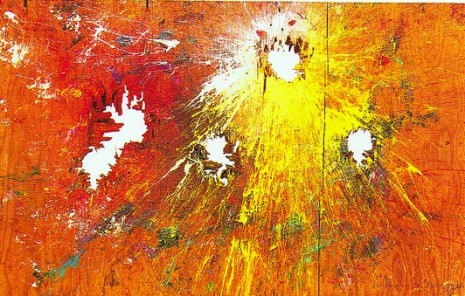
It’s no secret that William S. Burroughs liked guns. He’s shot both Shakespeare and himself in effigy, and in a bizarre and tragic accident, he shot and killed his wife. In addition to shooting at people, he also shot at spray paint cans to create abstract paintings, known as “shotgun art.” His paintings have appeared in galleries and one of them, once owned by Timothy Leary, was auctioned off a few years ago on Ebay. In the film above (date unknown), watch Burroughs in action with a rifle. He described the process in an interview with Gregory Ego:
There is no exact process. If you want to do shotgun art, you take a piece of plywood, put a can of spray paint in front of it, and shoot it with a shotgun or high powered rifle. The paint’s under high pressure so it explodes! Throws the can 300 feet. The paint sprays in exploding color across your surface. You can have as many colors as you want. Turn it around, do it sideways, and have one color coming in from this side and this side. Of course, they hit. Mix in all kinds of unpredictable patterns. This is related to Pollack’s drip canvases, although this is a rather more basically random process, there’s no possibility of predicting what patterns you’re going to get.
This is, admittedly, a very lo-fi film. It appears to have been shot on super‑8, and about two thirds of the way through, the camera flips upside down, then seems to have been tossed into a car. The sound goes out, and the last minute captures a cloud-strewn Kansans sky speeding by in silence. It’s a strange and captivating piece of found art that, like Burroughs’ work, contains casual violence, odd perspectives, herky-jerky editing, sudden confusion and upheaval, and rare moments of beauty.
Related Content:
When William S. Burroughs Appeared on Saturday Night Live: His First TV Appearance (1981)
William S. Burroughs Teaches a Free Course on Creative Reading and Writing (1979)
Josh Jones is a doctoral candidate in English at Fordham University and a co-founder and former managing editor of Guernica / A Magazine of Arts and Politics.
Read More...Pi in the Sky: The World’s Largest Ephemeral Art Installation over Beautiful San Francisco
 Yesterday, on my way to lunch, I looked up and saw it — the world’s largest ephemeral art installation called “Pi in the Sky.” The installation featured planes flying through the San Francisco Bay Area skies, using dot matrix printer technology to write out the first 1,000 digits of the number Pi. Presented as part of the 2012 ZERO1 Biennial, a festival celebrating art and technology in Silicon Valley, the Pi project was the brainchild of ISHKY, an eclectic collaboration of artists, programmers and scientists looking to explore “the boundaries of scale, public space, impermanence, and the relationship between Earth and the physical universe.” You can learn more about the initiative by watching a video (below) from ISHKY’s Kickstarter campaign:
And here you can watch the art installation in realtime, as we saw it yesterday:
via Gizmodo
Read More...Gertrude Stein Recites ‘If I Told Him: A Completed Portrait of Picasso’
Although her own works are seldom read, Gertrude Stein cast an imposing shadow over the evolution of 20th century literature. Like other high modernists, she broke from tradition to experiment with new forms, but whereas her rival James Joyce’s writing became more dense and complex over time, Stein’s became abstract and simple. Like Paul Cézanne and other modern painters, Stein sought to transcend representation and reveal an underlying structure in the perceptual world. Her nonlinear prose and poetry are like paintings, frozen in what she called a “continuous present.” As Jonathan Levin writes in the Barnes & Noble Classics edition of Stein’s Three Lives:
Stein clearly takes pleasure in words, almost in a way that a seven-year-old might, endlessly repeating a word, and variously inflecting it, to the point that it is effectively emptied of all meaning. Relying mostly on simple, often monosyllabic words, Stein wields language much as the modern painters she admired and collected were wielding paint, suggesting form through a radically simplified use of line and color.…By combining and repeating such simple words and phrases, Stein helped reinvent the English language for the twentieth century. Much as Paul Cézanne, Henri Matisse, and Pablo Picasso helped people understand how the eye constructs its field of vision, so Stein helped readers understand how words construct a field of meaning.
But most readers find Stein tedious and unintelligible. As Edmund Wilson writes in Axel’s Castle: A Study in the imaginative Literature of 1870–1930, “Most of us balk at her soporific rigmaroles, her echolaliac incantations, her half-witted-sounding catalogues of numbers; most of us read her less and less. Yet, remembering especially her early work, we are still always aware of her presence in the background of contemporary literature.”
Among the writers who knew Stein and were influenced by her was Ernest Hemingway. Echoes of Stein’s rhythms and repetitions can be sensed in some of Hemingway’s prose. In his postumously published memoir, A Moveable Feast, Hemingway offers his own frank assessment of Stein and the nature of her influence:
She had such a personality that when she wished to win anyone over to her side she would not be resisted, and critics who met her and saw her pictures took on trust writing of hers that they could not understand because of their enthusiasm for her as a person, and because of their confidence in her judgement. She had also discovered many truths about rhythms and the uses of words in repetition that were valid and valuable and she talked well about them.
For a sense of Stein’s experimental style you can listen above as she recites “If I Told Him: A Completed Portrait of Picasso,” a poem Stein wrote in the summer of 1923 while visiting her friend Pablo Picasso on the French Riviera. (To read along as you listen, click here to open the text in a new window.) The recording was made in New York during the winter of 1934–35, when Stein was promoting her popular but less experimental book The Autobiography of Alice B. Toklas. Encountering Stein today, we can still feel the same annoyed bewilderment that her first readers felt. “Perhaps,” writes Levin, “this is because language, unlike paint, does not simply become ‘beautiful’ once a style is widely accepted. In any event, we might consider ourselves fortunate to be able still to feel what is shocking and irritating in modern writing. It reminds us that we are in the presence of something that still feels genuinely new and different.”
To hear more of Stein reciting, and to hear a rare recorded interview of her from 1934, visit the archive at PennSound. And to read several of Stein’s works, please visit our collection of 375 Free eBooks.
Read More...Revisit the Radio Sessions and Record Collection of Groundbreaking BBC DJ John Peel
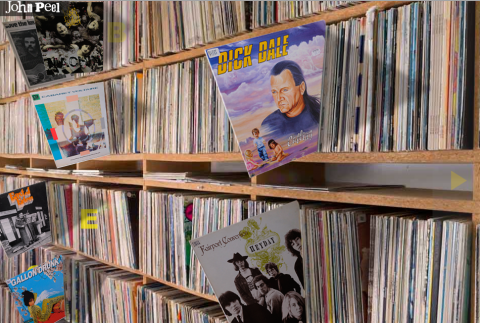
Will any radio DJ ever draw more respect than John Peel has? It seems unlikely, especially since so many fascinating artifacts of his life and career have become available on the internet since his death in 2004. You can now explore, thanks to the John Peel Archive, Peel’s digitized office, a repository of videos, sound recordings, photos and broadcasts. But for its obvious pièce de résistance, look no further than Peel’s record collection, made virtual for your browsing enjoyment. There you’ll find streamable albums, pop-cultural artifacts, and testimony from many a famous musician about the vital importance of John Peel to their careers. Those too young or too non-English to have tuned in to BBC Radio 1 during Peel’s heyday may not realize that this is no ordinary record collection. This is a treasure trove of 25,000 LPs and 40,000 singles assembled by a man who brought to the rock-enthusiast public the likes of Billy Bragg, Orchestral Manoeuvres in the Dark, The Fall, Pavement Buzzcocks, Elvis Costello, David Bowie… the list goes on.
Peel showcased such artists on his famous Peel Sessions, which would bring these performers into the BBC’s studios to lay down four or five songs. Quickly mixed and readied for broadcast, these songs would retain a rougher, looser, often more improvisational feel than the records that made these players famous. Tapes of a band’s Peel Session thus immediately became a hotly traded commodity among that band’s fans. Today, Peel’s own fans have helpfully uploaded a selection of his broadcasts, official Peel Sessions and otherwise, to the audio-sharing site Soundcloud. Perhaps you’d like to hear a snapshot of Peel’s view or the rock world on Christmas Eve 1979. Or how about October 13, 2004? Maybe April 4, 1988? Then, when you’re ready — and if you use Spotify — make a return to the John Peel Archive and pull up his Sessions with a favorite band, be it The Cure, Smashing Pumpkins, PJ Harvey, Cinerama, or whomever. You’ll hear why, 45 years on from his broadcasting debut and eight from his passing, John Peel remains the locus classicus of knowledgeable, discerning rock-radio cool.
Colin Marshall hosts and produces Notebook on Cities and Culture. Follow him on Twitter at @colinmarshall.
Read More...Jean-Paul Sartre’s No Exit: A BBC Adaptation Starring Harold Pinter (1964)
Each time I see a reference to Jean-Paul Sartre’s play No Exit (Huis Clos), I think of the nightclub scene in Bret Easton Ellis’s American Psycho, which is fitting since that novel is, in a sense, about a group of people who hate each other. No Exit conjures Sartre’s famous phrase “Hell is other people,” but in the play, hell is, more accurately, oneself—or the inability to leave oneself, to “take a little break,” by sleeping, turning off the lights, or even blinking. Hell, in Sartre’s play, means being endlessly confronted with the sordid trivialities of one’s self through the eyes of other people. Trapped in a room with them, to be exact, forever. It’s a chilling concept.
In this BBC adaptation of Sartre’s play, called In Camera, certain details have changed. Instead of the “Second Empire furniture” from Sartre’s descriptions of the hellish room, we have a brightly-lit modernist gallery space. The bronze objet d’art in Sartre’s play has been replaced by massive abstract painting and sculpture, a commentary, perhaps, on the way the bourgeois space of art galleries imposes artificial decorum on everyone inside. It’s as incongruous with the situation as the haughty drawing room of the original. Aside from the mise en scene, In Camera is largely faithful to the dialogue and characterization of Sartre’s play. Featuring absurdist playwright Harold Pinter as the insufferable writer and journalist Garcin, Jane Arden as Inez, Katherine Woodville as Estelle, and Jonathan Hansen as the valet, In Camera was part of the BBC series “The Wednesday Play,” which ran from 1964 to 1970 and presented original work and the occasional adaptation. Only the second episode in the series, In Camera ran on November 4th, 1964 and was adapted and directed from Sartre’s original by Philip Saville.
via Biblioklept
Related Content:
Jean-Paul Sartre Breaks Down the Bad Faith of Intellectuals
Sartre, Heidegger, Nietzsche: Three Philosophers in Three Hours
Walter Kaufmann’s Lectures on Nietzsche, Kierkegaard and Sartre (1960)
Josh Jones is a doctoral candidate in English at Fordham University and a co-founder and former managing editor of Guernica / A Magazine of Arts and Politics.
Read More...Support Us
We're hoping to rely on loyal readers, rather than erratic ads. Please click the Donate button and support Open Culture. You can use Paypal, Venmo, Patreon, even Crypto! We thank you!

About Us

Open Culture scours the web for the best educational media. We find the free courses and audio books you need, the language lessons & educational videos you want, and plenty of enlightenment in between.
Advertise With Us

FREE UPDATES!
GET OUR DAILY EMAIL
Get the best cultural and educational resources on the web curated for you in a daily email. We never spam. Unsubscribe at any time.
FOLLOW ON SOCIAL MEDIA

Open Culture editor Dan Colman scours the web for the best educational media. He finds the free courses and audio books you need, the language lessons & movies you want, and plenty of enlightenment in between.
Advertise With Us

