Watch Student Science Experiments Conducted on the International Space Station at 10:30 AM EDT
When YouTube Space Lab launched a competition calling for experiments to be conducted aboard the International Space Station, thousands of high school students around the world responded. The two winning experiments will be performed live Thursday at 7:30am PDT / 9:30am CDT / 10:30am EDT / 3:30pm BST / 4:30pm CEST. Back on Earth, we can watch astronaut Sunita Williams live in the microgravity capsule as she puts the experiments to the test.
Students submitted short videos explaining the scientific experiments they hoped to see tested aboard the space station. One of the winning proposals, from Amr Mohamed of Egypt, asks whether zebra spiders, which jump on their prey, will be able to catch their food in their usual way in microgravity. The other experiment, from Dorothy Chen and Sara Ma of Michigan, asks whether the growth of bacteria delivered into space will slow down when certain compounds are added.
YouTube viewers helped choose the winners from a pool of six semi-finalists. Then materials needed to conduct the two winning experiments were packed into a rocket and sent up to the space station, 250 miles above the Earth.
Watch live as Williams observes bacteria and hungry zebra spiders in microgravity. Will the spiders figure out a new way to hunt?
Kate Rix is a freelance writer in Oakland. See more of her work at .
Read More...Charade, the Best Hitchcock Film Hitchcock Never Made. Stars Cary Grant & Audrey Hepburn
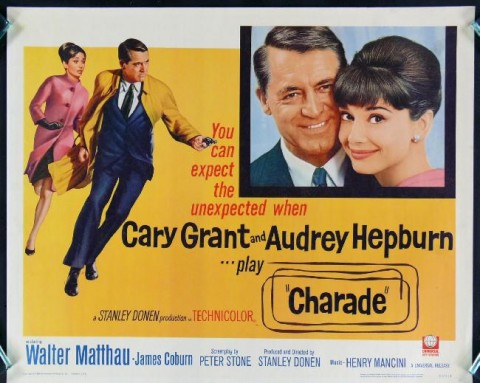
The best Hitchcock film Hitchcock never made. That’s how certain enthusiasts of American film think of Charade, Stanley Donen’s 1963 lightly comedic mystery thriller filled with international intrigue. Its cast list draws deeply from the era’s formidable well of cinematic icons: Cary Grant, Audrey Hepburn, Walter Matthau, James Coburn, and George Kennedy. Its action takes place in no less a screen-illuminating world city than Paris. The Criterion Collection has seen fit to give it a scholarly, respectable DVD and Blu-Ray release. It comes scored by Henry Mancini. It has inspired four remakes, including one in Bengali and one in Hindi. It director also made On the Town, Singin’ in the Rain, Funny Face, and Bedazzled. “A terrifically entertaining comedy-thriller,” critic Dave Kehr calls it, “perfectly crafted” and “a marvelous use of Paris.” All these qualities and more strongly recommend the picture, at least to my mind, and if you’d like to see it for yourself, you have only to pull it up on Archive.org.
Wait — really? A film of such seemingly high profile, made only 49 years ago? You don’t exactly come across the likes of Charade in the public domain every day. But I have an explanation, and it will surely delight those film fans who make sport of pointing out the incompetence of major studios. It seems that pre-1978 United States copyright law absolutely required you to include some sort of mark on your work indicating your intent to claim copyright at all — ©, for instance — and in Charade’s case, Universal Pictures seemed to have just sort of forgotten about it. The film thus went public domain as soon as it came out. Criterion’s provides a superior transfer and a wealth of cinephilic accoutrements besides, but if you want to dip into the picture right now, simply click play. An unknowable but capable Cary Grant and a Givenchy-clad Audrey Hepburn pursued through the early sixties’ City of Light for gold stolen in wartime — who, especially those on an office lunch break, could resist?
You can, of course, find Charade listed in our collection, 4,000+ Free Movies Online: Great Classics, Indies, Noir, Westerns, Documentaries & More.
Related Content:
Detour: The Cheap, Rushed Piece of 1940s Film Noir Nobody Ever Forgets
Female Noir Director Ida Lupino’s The Hitch-Hiker, Free Online
Colin Marshall hosts and produces Notebook on Cities and Culture. Follow him on Twitter at @colinmarshall.
Read More...Google Releases “Course Builder,” an Open Source Platform for Building Your Own Big Online Courses
Earlier this year, we saw Udacity and Coursera take flight, two online ventures dedicated to offering Massive Open Online Courses (MOOCs) and democratizing education. Caught off-guard, traditional universities have scrambled to get a foothold in this brave new world of e‑learning, and 16 universities have already signed agreements to offer their own MOOCs through Coursera. We welcome that trend. But, if you talk with profs at these universities, they often ask these questions: Why are we paying good money to develop courses that will build Coursera’s business (which is for-profit and VC-backed)? Or why are we creating courses for a platform that we don’t control or have a stake in? They ask these questions when they’re not otherwise asking “what will happen to our jobs and beloved universities in 20 years?”
For schools asking those questions, Google might have an answer. According to an announcement yesterday, Google is releasing the code base for Course Builder, a new open source platform that will give individual educators and universities the ability to create MOOCs of their own. As Peter Norvig, Google’s Director of Research, explains above, the company gave the platform a test drive this summer when it offered Power Searching with Google, a course attended by 155,000 registered students. Now you can try it out too and bring MOOCs in-house, under your own control. You can find documentation to get started here. But, as Norvig warns, you’ll need some tech skills in your toolkit to make initial headway. In the future, you can almost guarantee that the software will become user-friendly for everyone straight out of the box.
Already schools like Stanford, Indiana University, and UC San Diego are giving Course Builder a look. Keep an eye on it.
Update: Stanford reports today that it is trying out its own open source platform. It’s called Class2Go. Learn more about it here.
Related Content:
500 Free Online Courses from Great Universities
Free Online Certificate Courses from Great Universities: A Complete List
Read More...Fear of a Female Planet: Kim Gordon (Sonic Youth) on Why Russia and the US Need a Pussy Riot
Courageous feminist punk band Pussy Riot has received more public exposure than they ever could have hoped for since three members were arrested after a February 21st performance at Moscow’s Christ the Savior Cathedral and charged with “hooliganism.” The band formed last September in direct response to Vladimir Putin’s decision to seek the presidency again in March 2012, and they have demonstrated against his rule ever since, staging confrontational, but non-violent, protest performances in Red Square and other Russian landmarks. They draw much of their energy and inspiration from working-class British Oi! bands of the 80s, the American feminist punk of the 90s Riot Grrrl movement, and from the stalwart Sonic Youth, whose three decade run has put singer/bassist Kim Gordon in the spotlight as a musician, artist, and icon.
In the video interview above from Exploded View, Gordon offers her take on Pussy Riot’s significance and their relevance to the political struggles of women in the U.S.. Gordon reads Pussy Riot as “dissident art… targeted as a weapon” against a system, and its authoritarian leader, that has widely suppressed dissent. Like the notorious online collective Anonymous and their endlessly proliferating Guy Fawkes masks, Pussy Riot eschews the trappings of individual fame, wearing balaclavas to obscure their identities. As they state in a Vice Magazine interview before the arrests, “new members can join the bunch and it does not really matter who takes part in the next act—there can be three of us or eight, like in our last gig on the Red Square, or even 15. Pussy Riot is a pulsating and growing body.” The band keeps its focus on the body, as a growing collective or as a symbol of resistance to patriarchal control. One member explains the band’s name in the Vice interview:
A female sex organ, which is supposed to be receiving and shapeless, suddenly starts a radical rebellion against the cultural order, which tries to constantly define it and show its appropriate place. Sexists have certain ideas about how a woman should behave, and Putin, by the way, also has a couple thoughts on how Russians should live. Fighting against all that—that’s Pussy Riot.
The choice of name—which has forced dozens of newscasters to say the word “pussy” with a straight face—is, in all seriousness, a pointed reference to what Gordon calls a “fear of women,” which may explain what nearly everyone who has an opinion on the case characterizes as an extremely disproportionate sentence for the three convicted members. As Gordon says above, “Clearly Putin is afraid.” Relating the events in Russia to the backlash against women’s legislative gains in this country, Gordon says, “what’s going on in Washington is really indicative of that [fear],” and she wonders “why there aren’t more men who aren’t concerned about it or bringing it up. It’s beyond a women’s issue.” Nevertheless, she strongly implies that the U.S. is ripe for a “pussy riot”—a new punk-rock women’s movement—since “women make natural anarchists and revolutionaries because they’ve always been second-class citizens and had to claw their way up.”
Pussy Riot has cited Sonic Youth’s “Kool Thing” (above) as an influence, a taunting feminist retort to male come-ons that asks its target “are you gonna liberate us girls / From male white corporate oppression?” The unstated answer is, no, he isn’t. As Gordon implies above, and as Pussy Riot explain in an interview with The Guardian below, the only response to so-called “wars on women” everywhere may be a “feminist whip”:
Josh Jones is a doctoral candidate in English at Fordham University and a co-founder and former managing editor of Guernica / A Magazine of Arts and Politics.
Read More...
Michio Kaku Schools a Moon Landing-Conspiracy Believer on His Science Fantastic Podcast
For every major world event, there’s a conspiracy theory to go along with it. Skeptics, kooks and cranks didn’t wait for the dust to settle before they started speculating on the real dark forces behind the 9/11 attacks. And the same happened decades earlier when Neil Armstrong took his first steps on the moon. No sooner had Armstrong said “That’s one small step for man, one giant leap for mankind” than conspiracy theorists started claiming that the moon landing was really an elaborate production staged by Stanley Kubrick and other Hollywood filmmakers. That strange line of thinking was explored in William Karel’s 2002 mockumentary, Dark Side of the Moon. But despite the derision, the moon conspiracies go on today. Take this exchange for example. It comes from a May 2011 episode of the Science Fantastic podcast hosted by well-known physicist Michio Kaku. Amusingly, the clip walks you through the main claims of the moon landing conspiracy theory and the reasonable rejoinders to them.
If you would like to support the mission of Open Culture, consider making a donation to our site. It’s hard to rely 100% on ads, and your contributions will help us continue providing the best free cultural and educational materials to learners everywhere. You can contribute through PayPal, Patreon, and Venmo (@openculture). Thanks!
Related Content:
Michio Kaku Explains the Physics Behind Absolutely Everything
Michio Kaku: We’re Born Scientists But Switch to Investment Banking
What Is Déjà Vu? Michio Kaku Wonders If It’s Triggered by Parallel Universes
Read More...
The Comic Biography of Underground Publisher & Political Writer, John Wilcock
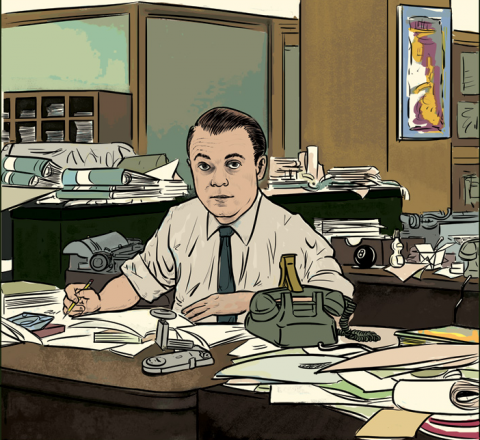
He describes himself as a “peripatetic patriarch of the free press,” and so he may be. John Wilcock, a British ex-pat who helped found the Village Voice in 1955 went to work as the New York Times’ travel editor. His Europe on $5 a Day was seminal in the travel guidebook publishing world. His subsequent Mexico on $5 a Day was a trailblazer.
Wilcock, who lives in California and publishes the online Ojai Orange, was the ultimate gadfly. His 1971 Autobiography and Sex Life of Andy Warhol included interviews with Nico, Lou Reed and other associates of the enigmatic artist. Wilcock was also a founding editor, with Warhol, of Interview Magazine in 1969. He accompanied Warhol out the night that the Velvet Underground played its first gig and wrote liner notes for Nico.
Published online in graphic novel form, John Wilcock: The New York Years chronicles this period in Wilcock’s life with an extensive interview and sumptuous cartoon illustrations by artists Ethan Persoff and Scott Marshall. Chapters one and two are deliciously fun reading, as Wilcock recounts his arrival in New York City from England and his early interviews with Leonard Bernstein, Rock Hudson and Milton Berle and launching the Village Voice.
It’s an impressive site that captures the Bohemian circles Wilcock moved in. Persoff and Marshall have just released chapter three, which includes Wilcock’s time editing Norman Mailer and his interviews with actor Jean Shepherd and Marilyn Monroe. Stay tuned for more. Chapter three brings us up to 1957 so there should be plenty more to share.
Kate Rix is freelance writer. Find more of her work at
Read More...O. Henry on the Secrets of Writing Short Stories: Rare Audio Recording
Today is the 150th anniversary of the birth of the short story writer O. Henry. He was born William Sydney Porter in Greensboro North Carolina on September 11, 1862, and his life was not easy. He chose the pen name “O. Henry” while he was in the penitentiary.
Trained as a pharmacist, Porter came down with tuberculosis in his early twenties and moved to the drier climate of Texas, where he worked as a ranch hand, a draftsman for the Texas Land Office, and a clerk at the First National Bank of Austin before striking out on his own as a writer and launching a humor magazine called The Rolling Stone. When the magazine folded the following year, Porter took a job as a reporter, columnist and cartoonist at the Houston Post. Meanwhile, though, Federal investigators were looking into shortages in Porter’s accounts from his days at the bank in Austin, and in February of 1896, when he was 33 years old and had a wife and a young daughter to support, Porter was arrested and charged with embezzlement.
While being brought to Austin for trial, Porter managed to elude his captors and hop a train to New Orleans, where he arranged passage on a freighter bound for Honduras. Despite the appearance of guilt Porter would always maintain his innocence, saying that his flight from justice was brought on by panic. He compared himself to the protagonist of one of Joseph Conrad’s classic novels, a sailor who abandoned a fully loaded passenger ship that he thought was sinking. “I am like Lord Jim,” he said, “because we both made one fateful mistake at the supreme crisis of our lives, a mistake from which we could not recover.”
When Porter got to Central America he began making plans for his family to join him there, but soon learned that his wife was dying of tuberculosis. He returned to Texas and was with his wife when she died. A few months later he was sentenced to five years in a federal penitentiary in Ohio. While behind bars, Porter began writing short stories in earnest. To disguise his identity he used a series of pen names, eventually settling on “O. Henry.”
Porter was released from prison in 1901, two years early for good behavior. He moved to New York to write stories under his new name for magazines. From there he skyrocketed to success. Between 1904 and his death in 1910, he published some 300 stories and ten books. “O. Henry worked at whirlwind speed,” writes Victoria Blake in the Barnes & Noble Classics edition of Selected Stories of O. Henry, “producing more over a shorter period than any other writer of his time and cultivating a literary demand unmatched by anyone, anywhere in the history of American letters.”
Some of the very same elements that made O. Henry’s stories so popular in his lifetime–the sentimentality, the “twist” endings–have caused them to age poorly since his death. A few of his stories, like “The Gift of the Magi,” are still widely read, but his reputation has been surpassed by more modern writers like Ernest Hemingway, James Joyce and Sherwood Anderson. A little of his former prestige is revived every year with the awarding of the O. Henry Prize for the best short fiction.
For his 150th birthday we bring you what is said to be a rare recording of O. Henry’s voice. Although the date and authenticity are an open question, the recording was apparently made on an Edison cylinder sometime between 1905 and the writer’s death in 1910. It was included in the vinyl record The Golden Age of Opera: Great Personalities, 1888–1940. Here is a transcript:
This is William Sydney Porter speaking, better known to you, no doubt, as O. Henry. I’m going to let you in on a few of my secrets in writing a short story. The most important thing, at least in my humble opinion, is to use characters you’ve crossed in your lifetime. Truth is indeed stranger than fiction. All of my stories are actual experiences that I have come across during my travels. My characters are facsimilies of actual people I’ve known. Most authors spend hours, I’m told even days, laboring over outlines of stories that they have in their minds. But not I. In my way of thinking that’s a waste of good time. I just sit down and let my pencil do the rest. Many people ask me how I manage to get that final little twist in my stories. I always tell them that the unusual is the ordinary rather than the unexpected. And if you people listening to me now start thinking about your own lives, I’m sure you’ll discover just as many odd experiences as I’ve had. I hope this little talk will be heard long after I’m gone. I want you all to continue reading my stories then too. Goodbye, folks.
Related content:
John Steinbeck’s Six Tips for the Aspiring Writer
James Joyce Reads ‘Anna Livia Plurabelle’ from Finnegans Wake
Rare 1959 Audio: Flannery O’Connor Reads ‘A Good Man is Hard to Find’
Read More...Kids Record Audio Tours of NY’s Museum of Modern Art (with Some Silly Results)
In an early, abortive flirtation with art school, I learned the technique of sauntering around a gallery, looking alternately bored and engrossed in whatever happened to be on the walls, the floor, the ceiling, never committing to any emotion, especially one that might betray my absolute befuddlement with a good bit of modern art. I’m happy to look back on that younger self and call him a pretentious dilettante, and happier now that I’m old enough not to care if someone knows that I’m confused, irritated, or genuinely bored with some experimental piece that defies my limited aesthetic categories. One of the things I anticipate most as the father to an already wry and curious one-year-old is hearing her unschooled reactions to some artwork I once fetishized but never really “got,” since there can often be no better means of deflating the pompous auras surrounding high culture than letting kids have an irreverent, uncensored go at it.
Perhaps this is why Audio Tour Hack decided to harness the unvarnished truths contained in “darndest things” with their unauthorized gallery tour entitled MOMA Unadulterated (short preview above). The “hack,” a clever update on often staid and monotone gallery audio tours, features “experts” from kindergarten to fifth grade passing judgment on the work of modern art stars like Andy Warhol, Cy Twombly, and Roy Lichtenstein. Unadulterated by faux sophistication and onerous over-educated referentiality? Yes. A tad bid too cutesy? Perhaps. But even so, still a fun idea, with lots of silliness (and if it gets kids interested in art, all the better). At times, the kid critics even drop a bit of adult knowingness into their “anyone could have done this” assessment of, say, Jackson Pollack (whom one kid accuses of “just wanting a lot of money”). MOMA Unadulterated refers to a permanent exhibit and installation of painting and sculpture on the New York Museum of Modern Art’s fourth floor. The tour takes in thirty pieces of art, each accompanied by audio commentary from the kid critics. Visit the Audio Tour Hack website to listen to the commentary online and see some delightful pictures of the “unadulterated” commentators.
Correction 9/18/12: An earlier version of this post stated that MOMA Unadulterated was created by the Museum of Modern Art. It was not, nor is Audio Tour Hack affiliated with MoMA in any way. You can find links to MoMA’s own audio tours (including tours for kids) here.
via Kottke
Related Content:
MoMA Puts Pollock, Rothko & de Kooning on Your iPad
Free: The Guggenheim Puts 65 Modern Art Books Online
Google “Art Project” Brings Great Paintings & Museums to You
Jackson Pollock: Lights, Camera, Paint! (1951)
Josh Jones is a doctoral candidate in English at Fordham University and a co-founder and former managing editor of Guernica / A Magazine of Arts and Politics.
Read More...The Early Days of Animation Preserved in UCLA’s Video Archive
Animation has come so far, exploring such ever-expanding frontiers of elaborateness, realism, and stylization, that truly understanding the medium might require a return to its early years. Luckily, the UCLA Film and Television Archive has made available a selection of preserved shorts from the silent era, free to watch online. You’ll find the earliest of these, The Enchanted Drawing from 1900, embedded above. But I recommend watching not this YouTube version but the one on the Film and Television archive’s site. There you can select one of four soundtracks — piano accompaniment, a full score, the preservationist’s commentary, or, of course, silence — and read notes from preservationist Jere Guldin and historian Jerry Beck. The Enchanted Drawing, Beck writes, “is considered one of the forerunners of animated films to come. It’s more appropriately a “trick film,” employing stop-action techniques pioneered by Georges Melies to make a sketched face, cigars, a bottle of wine, and a hat appear as real objects after being drawn.”
Just below, you can watch the YouTube version of 1928’s The Wandering Toy, the most recent film now viewable in this archive of preserved animation. But again, if you watch it on UCLA’s site, you can enjoy their range of audio options and program notes. “A sizeable amount of the silent features and short subjects still in existence do not survive on theatrical 35mm film gauge but in the smaller 16mm amateur and home-movie format,” writes Guldin, shedding light on the archive’s raison d’être, noting that this particular short “was preserved from what is thought to be the only 16mm print in existence.”
The Wandering Toy, as Beck describes it, “combines paper cut-out animation mixed with live travelogue footage of Sweden, Bavaria, Morocco, Holland, Mexico, India, and Japan. [ … ] The results are an attractive and unique combination of travelogue and cartoon, certainly quite different from the usual animated fare at the time” — and, I might add, a world apart from, though a clear antecedent of, the high-tech, high-budget, spectacle-oriented animation we see in theaters today.
Related Content:
The Best Animated Films of All Time, According to Terry Gilliam
Gertie the Dinosaur: The Mother of all Cartoon Characters
Lots of Free Animated Films in our collection of 500 Free Movies Online
Colin Marshall hosts and produces Notebook on Cities and Culture. Follow him on Twitter at @colinmarshall.
Read More...Leonard Cohen’s 1983 Musical for Canadian Television: I Am a Hotel
One of the more curious pieces in Leonard Cohen’s illustrious catalogue is his romantic half-hour musical, I Am a Hotel, made for Canadian television in 1983. The film is essentially a long-form music video. It was inspired by his song “The Guests,” which begins:
One by one, the guests arrive
The guests are coming through
The open-hearted many
The broken-hearted few
The film tells the story, through music and dance, of the romantic yearnings of the hotel’s staff and guests, with Cohen appearing throughout the film as the detached but sympathetic storyteller. “It’s light entertainment,” Cohen told the Toledo Blade in 1985. “It uses songs from my first record up through recent songs.” Those songs are:
- “The Guests” from the 1979 album Recent Songs.
- “Memories” from the 1977 album Death of a Ladies’ Man.
- “The Gypsy’s Wife” from Recent Songs.
- “Chelsea Hotel #2” from the 1974 album New Skin for the Old Ceremony.
- “Suzanne” from his 1967 debut album Songs of Leonard Cohen.
I Am a Hotel was filmed at the King Edward Hotel in Toronto over a six-day period in April of 1983. It was directed by Allan F. Nicholls and written by Cohen and Mark Shekter. The cast included ice skating champion Toller Cranston as “The Manager,” dancer and choreographer Anne Ditchburn as “The Gypsy Wife,” and Celia Franca, founder of the National Ballet of Canada, as “The Diva.” The film was first broadcast in Canada on May 7, 1984, and although it went on to win a Golden Rose at the Montreux International Television Festival, it has rarely been shown since. The version above is from Dutch television.
Related content:
Leonard Cohen Reads “The Future”
The 2005 Documentary, Leonard Cohen: I’m Your Man
The 1965 Documentary, Ladies and Gentlemen…Mr. Leonard Cohen
Read More...Support Us
We're hoping to rely on loyal readers, rather than erratic ads. Please click the Donate button and support Open Culture. You can use Paypal, Venmo, Patreon, even Crypto! We thank you!

About Us

Open Culture scours the web for the best educational media. We find the free courses and audio books you need, the language lessons & educational videos you want, and plenty of enlightenment in between.
Advertise With Us

FREE UPDATES!
GET OUR DAILY EMAIL
Get the best cultural and educational resources on the web curated for you in a daily email. We never spam. Unsubscribe at any time.
FOLLOW ON SOCIAL MEDIA

Open Culture editor Dan Colman scours the web for the best educational media. He finds the free courses and audio books you need, the language lessons & movies you want, and plenty of enlightenment in between.
Advertise With Us

