A Big List of 375 Free eBooks for Your iPad, Kindle, Nook and Other Devices
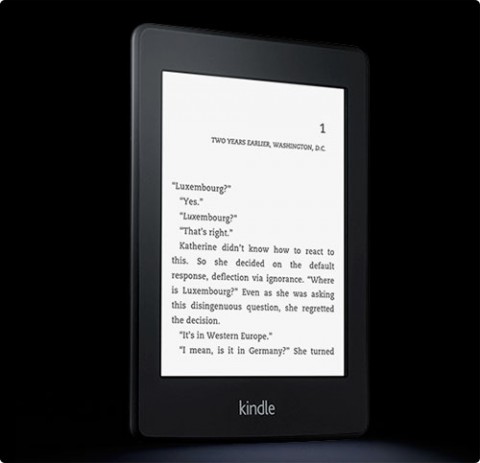 Last week, Amazon announced that it would start shipping a promising, new ebook reader in early October — the Kindle Paperwhite. The Paperwhite looks much like the old school, e‑ink Kindle that you know and maybe love. But this new model has a touchscreen and better contrasting fonts. Plus … drum roll … it sports a built-in light that evenly illuminates the screen, as you can see here. If Amazon can deliver on these promises, the new Kindle should be a pretty excellent deal, especially seeing that the cheapest model is priced at $119.
If you’re ready to splurge for an ebook reader, then we’re ready to do our part — to hook you up with Free eBooks. If you visit our collection, 600 Free eBooks for iPad, Kindle & Other Devices, you’ll find 600 great works. The list includes many classic masterpieces (Tolstoy’s War & Peace, Jane Austen’s Pride & Prejudice, and Kafka’s The Metamorphosis), but also more modern works by such authors as Isaac Asimov, Philip K. Dick, Kurt Vonnegut, and even Neil Gaiman.
If you’re an iPad/iPhone user, the download process is super easy. Just click the “iPad/iPhone” links and you’re good to go. Kindle and Nook users will generally want to click the “Kindle + Other Formats links” to download ebook files, but we’d suggest watching these instructional videos (Kindle — Nook) beforehand to take full advantage of the collection. And, if downloading files seems like a burden, fear not. We often give you the ability to simply read texts online. Find our full collection here: 600 Free eBooks for iPad, Kindle & Other Devices
PS When you return, you can always find this collection along the top navigation bar — where it says eBooks.
Related Content:
500 Free Online Courses from Top Universities
150 Free Textbooks: A Meta Collection
450 Free Audio Books: Download Great Books for Free
500 Free Movies Online: Great Classics, Indies, Noir, Westerns, etc.
Learn 40 Languages for Free: Spanish, English, Chinese & More
Read More...
Signature Shots from the Films of Stanley Kubrick: One-Point Perspective
Stanley Kubrick’s filmography, a towering, multifaceted edifice of sheer craft, offers many patterns for attentive fans to spot. Some occur within a film of his, others between them; some he and his collaborators deliberately included, while others simply emerged. The short video embedded above spots a pattern in Kubrick’s technique itself. Those unschooled in photography or other types of image composition may feel what the video means to shows them without being able to put it into words. All these shots — from films as varied as 2001, Paths of Glory, Barry Lyndon, and A Clockwork Orange — use what’s called “one-point perspective,” which you get when “the painting plate (also known as the picture plane) is parallel to two axes of a rectilinear (or Cartesian) scene – a scene which is composed entirely of linear elements that intersect only at right angles.” Got that? In other words, all the visual lines in these shots appear to converge on a single point, usually dead ahead.
Like many of Kubrick’s signature choices — see also the Kubrick zoom — using one-point perspective has its controversies. One commenter calls the video “best argument against those who tell me that you should not make symmetric shots.” Another calls it “a prime example of how off-putting symmetry can be in motion picture photography,” since “you feel like there’s something wrong in every one of these shots,” that “you can’t put your finger on it, but you know things aren’t quite right.” (Given the free-floating but thorough dread in pictures like The Shining, 2001, and A Clockwork Orange, might the shots be perfectly suited to their projects?) Still another invokes a Kubrick dictum that, whether or not it explains anything about his one-point perspectives, seems necessary in any discussion of his methods: take the first idea you thought of, then do the exact opposite.
The Vimeo account of the video’s creator, a certain kogonada, also features compilations of the technical patterns found in Quentin Tarantino, Darren Aronofsky, and Wes Anderson.
Related Content:
The Making of Stanley Kubrick’s A Clockwork Orange
James Cameron Revisits the Making of Kubrick’s 2001: A Space Odyssey
Colin Marshall hosts and produces Notebook on Cities and Culture. Follow him on Twitter at @colinmarshall.
Read More...The Story of Ziggy Stardust: How David Bowie Created the Character that Made Him Famous
In 1973, legendary director D.A. Pennebaker decided to film the London leg of David Bowie’s tour of Britain in support of Aladdin Sane. Little did Pennebaker know that Bowie, in his most famous incarnation as Ziggy Stardust, would announce his retirement after the final encore. What Bowie retired, of course, was the Ziggy persona—fans of that incarnation are indebted to Pennebaker for catching the final act in his film Ziggy Stardust and the Spiders from Mars.
Pulling footage from Pennebaker’s concert film, and a great deal of rare footage, and narrated by Jarvis Cocker, the BBC documentary David Bowie: The Story of Ziggy Stardust (above) does what Pennebaker’s film refused to; it tells a story, in typical TV documentary fashion, of the rise of Ziggy. And it’s not a story that many fans know. The first part of the film addresses Cocker’s question: “What made this mysterious extra-terrestrial one of the most influential cultural icons of the 20th century?” It turns out, quite a lot went into the making of Bowie’s 1973 breakthrough as Ziggy Stardust. In fact, says Cocker, “at that time,” when Bowie emerged as this seemingly fully-formed character, “we didn’t realize that he’d been trying to be successful for 10 years.”
Bowie had fronted a number of derivative R&B groups in the early sixties under his given name Davy (or Davie) Jones. Since his name invited confusion with the then-famous Monkee, he changed it in 1967 and released his first single as David Bowie, a creepy novelty record called The Laughing Gnome, which was included on his first self-titled album. The album, “a strange mix of musical and pop,” was inspired by light comic entertainer Anthony Newley–whose “surreal comedy paved the way for Monty Python”–and it was a failure. But, Cocker informs us, Bowie was learning from his mistakes: “Newley’s quirky versatility would inform the theatrical DNA of Ziggy Stardust.” Bowie was casting around, trying to find a persona to suit the latent talent it seemed only he believed in. His longtime drummer Woody Woodmansey says above, “he was going through a trial and error period, and there was a lot of error.”
One breakthrough came when he met dancer Lindsay Kemp, who taught him mime and with whom Bowie toured in a theater production and had an affair. During these years of seeming failure, Bowie learned all of the skills that he would use to construct Ziggy: dance, mime, stage and television acting, and sexual expression. As Kemp tells it, “he had an enormous sexual appetite”—a central part of Ziggy, and Bowie’s, pull. Another breakthrough came with 1970’s “Space Oddity, which hit #5 on the UK charts. But the album of the same name did not fare well. Filled with meandering psych-folk ballads more Donovan than Queen Bitch, Space Oddity disappointed. Bowie had not yet found his voice, nor his muse, and he would not until he met his first wife Angie, who “made him brave” and helped him put together his first glam-rock project The Hype, with guitarist Mick Ronson. The hype went nowhere, but Ronson and Bowie collaborated on his next album, The Man Who Sold the World.
Finally, says Bowie, after those years of near-obscurity, “somebody did come along and grab me by the empty wallet and said, I’m Tony Defries and I’m going to make you a star.” Defries introduced him to Andy Warhol’s New York scene and he became something of a scenester himself, but he was still too shy to fully inhabit Ziggy Stardust, so he used a surrogate—a fashion designer named Freddie Burretti. Burretti was to serve as the face, while Bowie wrote and sang the songs. He called the project “Arnold Corns.” Bowie produced the Arnold Corns record with many of the songs that would eventually make it to the Ziggy Stardust album—including “Moonage Daydream”—but they were rudimentary and flat and the project was a failure, though the idea lived on while Bowie wrote and recorded Hunky Dory with Ronson, Woody Woodmansey, and Trevor Bolder, the lineup of Ziggy’s future Spiders From Mars. Just two weeks after the 1972 wrap of Hunky Dory, the sessions for Ziggy Stardust and the Spiders from Mars began.
Though Bowie seemed to come out of nowhere in the early 70s as an androgynous young harbinger of rock and roll to come, those ten years he spent working to find the perfect formula for fame had made him reflective. A 2002 New York Times reviewer of Pennebaker’s film writes that in 1973, Bowie’s, “lyrics often find Mr. Bowie wrestling with the threats of time and aging, as if he were already, at age 26, staring decrepitude in the face. Mr. Bowie is now 55 and, superficially at least, seems none the worse for wear.”
Josh Jones is a doctoral candidate in English at Fordham University and a co-founder and former managing editor of Guernica / A Magazine of Arts and Politics.
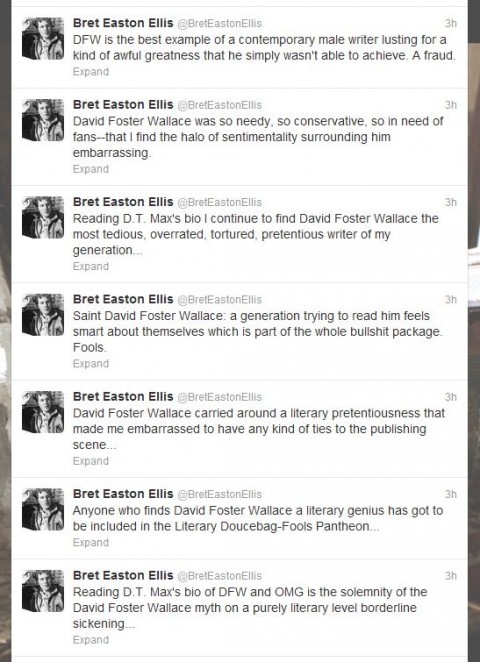
Read More...The Chutzpah of Bret Easton Ellis: Calls David Foster Wallace “The Most Tedious, Overrated, Tortured, Pretentious Writer of My Generation”
We have been in Beverly Hills shopping most of the late morning and early afternoon. My mother and my two sisters and me. My mother has spent most of this time probably at Neiman-Marcus, and my sisters have gone to Jerry Magnin and have used our father’s charge account to buy him and me something and then to MGA and Camp Beverly Hills and Privilege to buy themselves something. I sit at the bar at La Scala Boutique for most of this time, bored out of my mind, smoking, drinking red wine. Finally, my mother drives up in her Mercedes and parks her car in front of La Scala and waits for me.
–Bret Easton Ellis, Less Than Zero
Tedious? Check. Overrated? Check. Pretentious? Check.
Well, no one will say that Bret Easton Ellis isn’t an authority in this area.
via Biblioklept
Read More...60-Second Adventures in Economics: An Animated Intro to The Invisible Hand and Other Economic Ideas
The Invisible Hand:
Back in 2011 The Open University released an engaging series of animated intellectual puzzles called 60-Second Adventures in Thought, narrated by the British comedian and writer David Mitchell. The series offered a witty and fast-paced trip through some of the most famous paradoxes and thought experiments in the history of ideas. This week the same team is back with six new adventures, this time focused on economics. As the introduction on the OU channel at YouTube says:
Ever shaken an invisible hand? Been flattened by a falling market? Or wondered what took the bend out of Phillips’ curve? David Mitchell helps reveal some of the great dilemmas faced by governments trying to run an economy–whether to save or spend, control inflation, regulate trade, fix exchange rates, or just leave everyone to get on with it and not intervene. You’ll learn why Adam Smith put such a high price on free markets, how Keynes found a bold new way to reduce unemployment, and what economists went on to discover about the impact of policy on people’s and businesses’ behavior–which may not always be entirely rational.
60-Second Adventures in Economics is a fast and fun way to acquaint yourself with a few of the fundamental ideas in economics. All six episodes are here, beginning with “The Invisible Hand,” above, and continuing below.
The Paradox of Thrift:
The Phillips Curve:
The Principle of Comparative Advantage:
The Impossible Trinity:
Rational Choice Theory:
Jimi Hendrix Wreaks Havoc on the Lulu Show, Gets Banned From the BBC (1969)
Can you imagine Jimi Hendrix singing a duet with Lulu? Well, neither could Hendrix. So when the iconoclastic guitar player showed up with his band at the BBC studios in London on January 4, 1969 to appear on Happening for Lulu, he was horrified to learn that the show’s producer wanted him to sing with the winsome star of To Sir, With Love. The plan called for The Jimi Hendrix Experience to open their set with “Voodoo Child (Slight Return)” and then play their early hit “Hey Joe,” with Lulu joining Hendrix onstage at the end to sing the final bars with him before segueing into her regular show-closing number. “We cringed,” writes bassist Noel Redding in his memoir, Are You Experienced? The Inside Story of The Jimi Hendrix Experience.
Redding describes the scene that he, Hendrix, and drummer Mitch Mitchell walked into that day as being “so straight it was only natural that we would try to combat that atmosphere by having a smoke in our dressing room.” He continues:
In our haste, the lump of hash got away and slipped down the sink drainpipe. Panic! We just couldn’t do this show straight–Lulu didn’t approve of smoking! She was then married to Maurice Gibb of the Bee Gees, whom I’d visited and shared a smoke with. I could always tell Lulu was due home when Maurice started throwing open all the windows. Anyway, I found a maintenance man and begged tools from him with the story of a lost ring. He was too helpful, offering to dismantle the drain for us. It took ages to dissuade him, but we succeeded in our task and had a great smoke.
When it was time for The Jimi Hendrix Experience to go on camera, they were feeling fairly loose. They tore through “Voodoo Child” and then the program cut to Lulu, who was squeezed awkwardly into a chair next to an audience member in the front row. “That was really hot,” she said. “Yeah. Well ladies and gentlemen, in case you didn’t know, Jimi and the boys won in a big American magazine called Billboard the group of the year.” As Lulu spoke a loud shriek of feedback threw her off balance. Was it an accident? Hendrix, of course, was a pioneer in the intentional use of feedback. A bit flustered, she continued: “And they’re gonna sing for you now the song that absolutely made them in this country, and I’d love to hear them sing it: ‘Hey Joe.’ ”
The band launched into the song, but midway through–before Lulu had a chance to join them onstage–Hendrix signaled to the others to quit playing. “We’d like to stop playing this rubbish,” he said, “and dedicate a song to the Cream, regardless of what kind of group they may be in. We dedicate this to Eric Clapton, Ginger Baker and Jack Bruce.” With that the band veered off into an instrumental version of “Sunshine of Your Love” by the recently disbanded Cream. Noel Redding continues the story:
This was fun for us, but producer Stanley Dorfman didn’t take it at all well as the minutes ticked by on his live show. Short of running onto the set to stop us or pulling the plug, there was nothing he could do. We played past the point where Lulu might have joined us, played through the time for talking at the end, played through Stanley tearing his hair, pointing to his watch and silently screaming at us. We played out the show. Afterwards, Dorfman refused to speak to us but the result is one of the most widely used bits of film we ever did. Certainly, it’s the most relaxed.
The stunt reportedly got Hendrix banned from the BBC–but it made rock and roll history. Years later, Elvis Costello paid homage to Hendrix’s antics when he performed on Saturday Night Live. You can watch The Stunt That Got Elvis Costello Banned From SNL here.
Related content:
‘Electric Church’: The Jimi Hendrix Experience Live in Stockholm, 1969
Read More...Mitch Hedberg Remembered by Modern Comedian, a New Documentary Web Series
If ever there was a golden era to enjoy comedy, it’s now, a moment when comedians and those who love their work have heartily exploited nearly every form of media newly generated by the internet. At times I wonder if the medium of podcasting doesn’t owe its very existence to those funny men and women — the earliest high-profile example being Ricky Gervais, collectively with his writing partner Stephen Merchant and oracle/object of ridicule Karl Pilkington — who immediately understood its potential. Some comedians podcast so well that you’d almost believe they had just been waiting for the technology to arrive. Alas, it arrived in the mid-2000s, too late for Mitch Hedberg to make use of it. Though we’ll never know how or if Hedberg, who died in 2005, would have podcast, we can at least still call up his comedic spirit at a moment’s notice through the miracle of internet video.
Though Hedberg has gone, his fans’ interest in his unconventional persona, sensibility, and delivery haven’t. A new documentary web series called Modern Comedian has even put out a whole episode dedicated to him, based upon an interview with his widow Lynn Shawcroft. She describes Hedberg as “a huge proponent of daydreaming,” which seems only to begin to describe his way of life and work. If you missed out on Hedberg during his life, don’t miss out on him during this wave of posthumous popularity. Just above, you’ll find embedded a five-minute stand-up set that should give you a glimpse of the distinctive angles from which Hedberg viewed existence. And the next time a whole bunch of internet comedy enthusiasts insist that you simply must check out a strange young rising talent, certainly don’t make the same mistake I did eight years ago and tell yourself you can always catch him later.
Related Content:
“Learn English With Ricky Gervais,” A New Podcast Debuts (NSFW)
Colin Marshall hosts and produces Notebook on Cities and Culture. Follow him on Twitter at @colinmarshall.
Read More...Demystifying the Higgs Boson with Leonard Susskind, the Father of String Theory
In early July, researchers working at CERN in Europe announced they had found it — the Higgs Boson. Finally, we had proof of a theory first formulated in 1964. It was a big day. Physicists everywhere rejoiced. The media did too. But the media coverage didn’t help the public understand the discovery very well. Leonard Susskind, a prominent theoretical physicist at Stanford, realized that. So, days later, he gave a free public lecture where he explained how the Higgs mechanism works and what it actually means to “give mass to particles.” And it all involved taking his audience through some basic quantum mechanics and explaining the concept of fields, plus using a handy-dandy sombrero for a prop. You can watch the full presentation above.
When not teaching undergrads and grad students, Susskind teaches in Stanford’s Continuing Studies program where he introduces lifelong learners to the heady world of physics. Most notably, Susskind has offered a six-quarter sequence of courses called “Modern Physics: The Theoretical Minimum.” It’s aimed at a general audience of lifelong learners (like you), and it provides students with a baseline knowledge for thinking intelligently about modern physics. Happily, the complete lecture series is available online. You can find the video lectures right below, or find more introductory courses in the Physics section of our big collection of Free Online Courses.
Modern Physics: The Theoretical Minimum
- Modern Theoretical Physics: Classic Mechanics (Video) – iTunes –YouTube
- Modern Theoretical Physics: Quantum Mechanics (Video) –iTunes – YouTube
- Modern Theoretical Physics: Special Relativity (Video) – iTunes –YouTube
- Modern Theoretical Physics: Einstein (Video) – iTunes –YouTube
- Modern Theoretical Physics: Cosmology (Video) - iTunes –YouTube
- Modern Theoretical Physics: Statistical Mechanics (Video) –iTunes – YouTube
Charles Bukowski Tells the Story of His Worst Hangover Ever
Charles Bukowski, “Hank” to his friends, was once called the “best poet in America” by kindred spirit Jean Genet. He was a writer who told the truth, when he wasn’t lying, and who could tell a great story, whether sober or drunk. Bukowski once told Sean Penn in a 1987 Interview magazine piece: “Alcohol is probably one of the greatest things to arrive upon the earth — alongside of me. Yes…these are two of the greatest arrivals upon the surface of the earth. So…we get along.” This statement encapsulates the qualities Bukowski is best known for—lifelong heavy drinking and bravado. They tend to go hand in hand, especially in novelists of his generation. But what made him a poet was another quality the booze helped him cope with, his tendency to be “a shy, withdrawn person,” an almost tender person, and humane in his own low-rent way. In the video above, he tells the story of his worst hangover ever. I’ll let him tell it. There’s no way a paraphrase could come close to Bukowski’s own voice.
Related Content:
Charles Bukowski: Depression and Three Days in Bed Can Restore Your Creative Juices (NSFW)
The Last Faxed Poem of Charles Bukowski
Charles Bukowski Reads His Poem “The Secret of My Endurance”
Josh Jones is a doctoral candidate in English at Fordham University and a co-founder and former managing editor of Guernica / A Magazine of Arts and Politics.
Read More...Listen to the New David Byrne/St. Vincent Album, Love This Giant. Free for a Limited Time
Over twenty years after the Talking Heads, the band’s former frontman David Byrne seems more creative than ever. Even aside from his numerous solo albums, he’s lately written books on cycling and the nature of music, advocated for cycling itself, and crafted an intricate disco opera with Fatboy Slim about Imelda Marcos, former first lady of the Philippines. (Less recently, but still a personal favorite of mine, was his “I ♥ PowerPoint” tour.) Now we have Love This Giant, a new musical collaboration between Byrne and singer-songwriter Annie Clark, better known as St. Vincent. Having originally joined forces on a benefit for the AIDS and homelessness charity Housing Works, the two decided to go ahead and create an entire album together, engaging a brass band and crafting a dozen songs well up to Byrne’s eclectic, cerebral, and surprisingly funky standard (even if those three descriptors, though appropriate, have become clichés regarding any music in the sphere of the Talking Heads).
At the top of this post, you’ll find embedded the video for “Who,” one of the tracks which features the vocals of both Byrne and Clark but on which Byrne takes the lead. Just above, you’ll find “Weekend in the Dust,” with Clark at the top of the mix. But why settle for YouTube videos when, at least for a little while, you can stream the entire album at NPR.org?
For a recording artist of long standing, Byrne has displayed an unusually clear head about the changes underway in the commerce of music: “The ‘industry’ had a nice 50-year ride,” he once blogged, “but it’s time to move on.” With that in mind, he and Clark will launch a 24-date tour later this month which promises many things, including but not limted to “complex choreography.” Still, no matter the state of sales and distribution, it always comes back to how strongly the music compels. “A lot of people, hearing a description of this project, assumed that it might be an artsy indulgence,” Byrne writes on Love This Giant’s site. “But somehow it didn’t turn out that way. It’s a pop record—well, in my book anyway.”
Related content:
How David Byrne and Brian Eno Make Music Together: A Short Documentary
David Byrne: From Talking Heads Frontman to Leading Urban Cyclist
David Byrne: How Architecture Helped Music Evolve
Colin Marshall hosts and produces Notebook on Cities and Culture. Follow him on Twitter at @colinmarshall.
Read More...Support Us
We're hoping to rely on loyal readers, rather than erratic ads. Please click the Donate button and support Open Culture. You can use Paypal, Venmo, Patreon, even Crypto! We thank you!

About Us

Open Culture scours the web for the best educational media. We find the free courses and audio books you need, the language lessons & educational videos you want, and plenty of enlightenment in between.
Advertise With Us

FREE UPDATES!
GET OUR DAILY EMAIL
Get the best cultural and educational resources on the web curated for you in a daily email. We never spam. Unsubscribe at any time.
FOLLOW ON SOCIAL MEDIA

Open Culture editor Dan Colman scours the web for the best educational media. He finds the free courses and audio books you need, the language lessons & movies you want, and plenty of enlightenment in between.
Advertise With Us

