Ayn Rand’s Philosophy and Her Resurgence in 2012: A Quick Primer by Stanford Historian Jennifer Burns
| The Colbert Report | Mon — Thurs 11:30pm / 10:30c | |||
| Jennifer Burns | ||||
|
||||
In 2009, Stanford historian Jennifer Burns published Goddess of the Market: Ayn Rand and the American Right, which traced Rand’s intellectual development and her relationship to the conservative and libertarian movements. It was somewhat fortunate timing. Indeed, from the first day President Obama took office, the defenders of pre-2008 capitalism began buying Rand’s well-known book, Atlas Shrugged, by the dozens. Now, with Paul Ryan, a card-carrying Randian, getting the VP nod from the Grand Old Party, Burns and her book are getting another moment back in the spotlight. They’re helping answer some very basic questions people might have: How do you pronounce her first name? What is her philosophy of objectivism all about? Why does the right adore someone who mercilessly mocked their core religious beliefs? And, what would Rand have thought about a political figure like Paul Ryan? Would the love have been reciprocated?
They’re all good questions — ones that Burns recently addressed on The Colbert Report (above), in the Op-Ed pages of The New York Times, and now in the latest edition of Stanford Magazine. We’ve extracted a few of the key Q & A’s:
First things first, I always stumble on her name. What is the correct pronunciation of Ayn?
Here’s a good trick to remember it. In keeping with her philosophy of selfishness, “Ayn” rhymes with the word “mine.”
So what does Rand’s philosophy of objectivism boil down to?
Here is how Rand summed it up in ten words or less: “metaphysics: objective reality; epistemology: reason; ethics: self-interest; politics: capitalism.”
If I was going to break that down a little bit, metaphysics is objective reality, which means we can only rely on our mind and on reason. It’s our only guide to thought and action. Epistemology, reason. The only way we can know anything is through the reasoning mind. Ethics, self-interest. Rand claimed that selfishness was a virtue. It was virtuous to pursue your own interests and defend your own interests. And politics is capitalism because laissez-faire capitalism for her was the only system that allowed the individual to realize his or her full potential and to keep the fruits of his or her labor and not be obligated to others or punished for success.
Was she concerned about the less fortunate?
That was not a big part of her ethics. Her ethics were based on the individual and on the individual’s right to pursue his or her goals. The individual was not obligated to other people. If you chose, because of your own values, to help other people or to engage in charity, that was fine, but that did not make you a moral person. What made you a moral person is relying on yourself, pursuing your own interests, and not being a burden on others.
Some of the characters she depicts the most negatively in her novels are people like social workers. She thought social workers were [about] the most evil people possible because they made their lives on the misery of others. Morality and ethics, for her, had nothing to do with helping other people.
Why has Ryan started to measure his support for her?
She is very hard for politicians to embrace because not only is she not religious, she’s antireligious. The fact that Ryan gave Atlas Shrugged as a Christmas gift [to staffers] is a tremendous irony because Rand was a fire-breathing atheist. She did not believe in God. She called religion a psychological disorder. She truly believed you needed to use reason and logic and no faith whatsoever.
So as Ryan’s star began to rise, he quickly began to back away from her for that very reason. And he made this sort of clumsy substitution of St. Thomas Aquinas as his major inspiration rather than Ayn Rand, although he’s on the record in multiple places very recently talking about Rand and not talking about Aquinas.
You can read the full interview here.
Related Content:
Ayn Rand Instructs Johnny Carson on the Virtue of Selfishness, 1967
Read More...Le Ballet Mécanique: The Historic Dadaist Film by Fernand Legér (1924)
Film is by nature a collaborative medium, and certainly one of the strangest and most interesting cinematic collaborations of all time has to be the 1924 avant-garde film Ballet Mécanique, which brought together the modernist luminaries Fernand Léger, Ezra Pound, Man Ray and George Antheil.
The glue that actually held the whole project together was an unknown young American filmmaker named Dudley Murphy, who was living in Paris and saw Man Ray’s experimental film Le Retour à la Raison when it came out in 1923. Murphy was so impressed that he sought Man Ray out and suggested they work together on a project. Murphy was a technically skilled and well-equipped cinematographer with several films under his belt, so the offer intrigued Man Ray. He said he would do it as long as Murphy agreed to work by the Dadaist principle of spontaneous, irrational experimentation. Murphy agreed, and the two men began filming scenes together
Murphy also sought help from the poet Ezra Pound. As Susan B. Delson documents in her book, Dudley Murphy, Hollywood Wild Card, Pound wrote a letter to his father in 1923, saying, “Dudley Murphy, whom I met in Venice in 1908, he being then eleven, turned up a few days ago. His dad is a painter, he is trying to make cinema into art.” Pound was famously generous when it came to helping other artists, and he agreed to help Murphy and Man Ray. “I knew him as a kindhearted man, always ready to help others,” Man Ray later said of Pound, yet “dominatingly arrogant where literature was concerned.”
The extent of Pound’s direct involvement in the making of Ballet Mécanique is an open question, but it’s generally believed that he exerted some aesthetic influence, particularly in the prismatic multiple image shots that call to mind some of the earlier experiments of Vorticism, a movement Pound was closely connected with. “The vortex,” Pound once wrote, “is the point of maximum energy. It represents, in mechanics, the greatest efficiency. We use the words ‘greatest efficiency’ in the precise sense–as they would be used in a text book of Mechanics.” The title of the film was actually taken from a 1917 piece by Man Ray’s friend, the Dadaist painter Francis Picabia.
In the fall of 1923 Murphy began editing the scenes he had shot with Man Ray, but by then they were running out of money. Pound suggested that his friend the cubist painter Fernand Léger might agree to see the project through to completion. Man Ray knew of Léger’s domineering personality and wanted no part of it. He left the project and asked Murphy (with whom he was still on friendly terms) to make sure his name was left out of the credits. Pound also arranged for the wealthy American writer and art patron Natalie Barney to commission a musical score to accompany the film. Pound chose a young American composer he had met earlier in the year named George Antheil, who lived above Sylvia Beach’s Shakespeare and Company bookstore.
Antheil accepted the commission but went his own way, showing no interest in even seeing the film while he was working on the music. “From the outset,” writes Delson in her biography of Murphy, “the film and the score led remarkably separate lives. In his letters to Pound during this period, Antheil made little or no mention of the film.” Not surprisingly, the film and music did not match. The music was twice as long as the completed film. In fact the film would eventually be released without the music, and the two have only rarely been exhibited together.
Although Antheil eventually composed several variations of his score, the version he finished in 1924 calls for a bizarre group of mechanistic or industrial-sounding instruments, including 16 player pianos, seven electric bells, three airplane propellers of varying sizes, and a siren. In his manifesto “My Ballet Mécanique: What it Means,” Antheil describes his accomplishment in words that are perhaps more bizarre than the airplane propellers and siren:
My Ballet Mécanique is a new FOURTH DIMENSION of music. My Ballet Mécanique is the first piece of music that has been composed OUT OF and FOR machines, ON EARTH. My Ballet Mécanique is the first piece of music that has found the best forms and materials lying inert in a medium that AS A MEDIUM is mathematically certain of becoming the greatest moving factor of the music of future generations.
Mathematically certain or not, Antheil’s score did go on to exert considerable influence. “The textures and effects in this work are,” according to musician and scholar Mark Fenderson, “direct predecessors to those used in the music of John Cage, Terry Riley, Philip Glass and John Adams.” Although the music for Ballet Mécanique would always remain Antheil’s most famous accomplishment, the film itself was something of a footnote to Fernand Léger’s career.
The film begins and ends with Léger’s playful image of a cubist Charlie Chaplin, along with shots of Murphy’s wife Katherine relaxing in a bucolic setting. In between it moves frantically from image to image, with industrial engines, mannequin parts, kitchenware, clock pendulums and shapes of pure abstraction appearing and reappearing with machine-like regularity. In one sequence a washerwoman climbs a steep stairway only to keep reappearing again, like Sisyphus, at the bottom.
The close-ups of a woman’s eyes and lips are of Man Ray’s lover and model, Kiki of Montparnasse. In the original version of the film, Murphy had reportedly included some erotic nude images of Man Ray and Kiki embracing, but Léger had them edited out. As a matter of fact, when the film was released the autocratic Léger arranged to have Murphy edited out of the credits, despite the fact that Murphy was the one who basically made the film–much of it before Léger was even involved. All surviving versions of the film, including the one above, say simply “un film de Fernand Léger.”
The story behind the making of Ballet Mécanique reveals a great deal about the personalities involved: about Pound’s generosity, Léger’s ruthlessness, Man Ray’s wariness, Murphy’s naiveté, Antheil’s egomania. The film itself, according to the Circulating Film Library Catalogue at the Museum of Modern Art, “remains one of the most influential experimental works in the history of cinema.”
Le Ballet Mécanique has been added to our meta collection of 500 Free Movies Online. You can find it in the section that includes Silent films.
Related content:
Anémic Cinéma: Marcel Duchamp’s Whirling Avante-Garde Film
Man Ray and the Cinéma Pur: Four Surrealist Films from the 1920s
Read More...
The Business Card of William Carlos Williams: Doctor by Day, Poet by Night
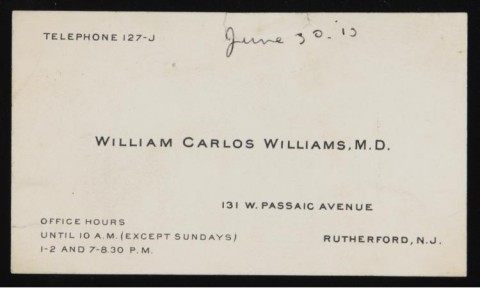
There you have it: the business card of William Carlos Williams. Yes, that William Carlos Williams. Imagist poet, novelist, playwright, essayist, critic, writer of short stories — and New Jersey pediatrician. Would any of us, upon reading his written work, have advised him not to quit his day job? And yet quit it he did not, practicing medicine by day and writing in the evenings. Given that his office hours evidently ran to 8:30 p.m., he must have spent some seriously late nights at his desk. But because Williams burnt the candle at both ends, we may today enjoy poems like The Red Wheelbarrow, This is Just to Say, and the vastly longer Paterson, an adaptation into verse of the city of Paterson, New Jersey. Such poems show that the concrete and the everyday — just the things you’d expect a small-town family doctor to deal with — never escaped Williams’ attention. Critics tend to cite one phrase from Paterson that sums up this sensibility: “No ideas but in things.”
In the clip just above, you can hear Allen Ginsberg, a friend of Williams but a decidedly more bohemian sort, read from Williams’ Spring and All. It certainly seems possible that the poet’s maintenance of a day job and all its trappings of the non-poetic life not only failed to hamper but actually fueled his writing. Wallace Stevens, another poet who famously held a seemingly mundane parallel career, said as much about his own traditional employment. He credited the daily walk to his lawyer’s job at the American Bonding Company, and later the Hartford Accident and Indemnity Company, with providing the mental space that made what we think of as his lasting work possible. This work led to a Pulitzer Prize in 1955. An offer of a place on Harvard’s faculty followed, but he turned it down. Sometimes we simply hit upon a lifestyle that lets us express what we need to express. Did Stevens’ lifestyle work for him? Have a listen to him reading Final Soliloquy of the Interior Paramour. Perhaps the results speak for themselves:
A special thanks goes to Steve Silberman (aka @stevesilberman) for sending Williams’ business card our way.
Related content:
William Carlos Williams Reads His Poetry (1954)
101 Early Wallace Stevens Poems on Free Audio
Harold Bloom Recites ‘Tea at the Palaz of Hoon’ by Wallace Stevens
Colin Marshall hosts and produces Notebook on Cities and Culture. Follow him on Twitter at @colinmarshall.
Read More...Vintage Film: Watch Henri Matisse Sketch and Make His Famous Cut-Outs (1946)
In April of 1946, a camera crew recorded the scene as the great French artist Henri Matisse sat down at his easel to make a charcoal sketch of his grandson, Gerard, at his his home and studio in Nice. The brief clip above is from a 26-minute film by François Campaux which was commissioned by the French Department of Cultural Relations. Alas, we’ve been unable to find the entire film online, but you can watch a 15-minute German version on YouTube, or you can visit a Web page at the Art Institute of Chicago for a group of higher quality silent excerpts from the film, accompanied by explanatory captions. In the clip above, we hear Matisse speaking in French. Here is a translation:
Me, I believe that painting and drawing are the same thing. Drawing is a painting done in a simpler way [or with “limited/reduced resources”]. On a white surface, a sheet of paper, with a plume [or “pen”] and some ink, one creates a certain contrast with volumes; one can change the quality of the paper given supple surfaces, light [or clear] surfaces, hard surfaces without always adding shadow or light. For me, drawing is a painting with limited means/resources.
For another glimpse of Matisse at work, look below for a rare color clip (from an unknown source) of the artist at work creating one of his distinctive paper cut-outs.
Related content:
Astonishing Film of Arthritic Impressionist Painter Pierre August Renoir
Rare Film: Claude Monet at Work in His Famous Garden at Giverny, 1915
Wassily Kandinsky Caught in the Act of Creation, 1926
Read More...The Evolution of F. Scott Fitzgerald’s Signature: From 5 Years Old to 21
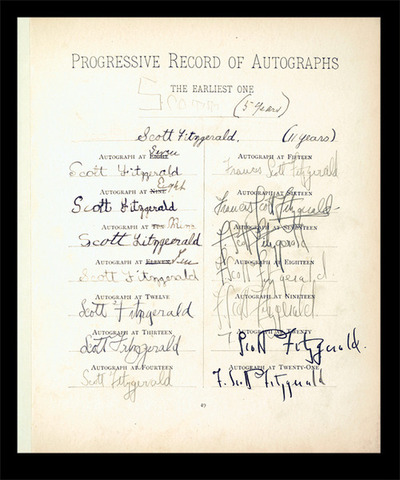
Take, for example, the evolution of Fitzgerald’s signature (above). From the labored scrawls of a five year-old, to the practiced script of an eleven-year-old schoolboy, to the experimental teenaged poses, we see the lettering get looser, more stylized, then tighten up again as it assumes its own mature identity in the confidently elegant near-calligraphy of the 21-year-old Fitzgerald–an evolution that traces the writer’s creative growth from uncertain but passionate youth to disciplined artist. Alright, maybe that’s all nonsense. I’m no expert. The practice of handwriting analysis, or graphology, is generally a forensic tool used to identify the marks of criminal suspects and detect forgeries, not a mindreading technique, although it does get used that way. One site, for example, provides an analysis of one of Fitzgerald’s 1924 letters to Carl Van Vechten. From the minute characteristics of the Gatsby novelist’s script, the analyst divines that he is “creative,” “artistic,” and appreciates the finer things in life. Color me a little skeptical.
But maybe there is something to my theory of Fitzgerald’s growing maturity and self-conscious certainty as evidenced by his signatures. He published This Side of Paradise to great acclaim three years after the final signature above. In the prior signatures, we see him struggling for control as he wrote and revised an earlier unpublished novel called The Romantic Egotist, which Fitzgerald himself told editor Perkins was “a tedious, disconnected casserole.” The outsized, extravagant lettering of the artist in his late teens is nothing if not “romantic.” But Fitzgerald achieved just enough control in his short life to write a veritable treasure chest of stories (many brilliant and some just plain silly) and a handful of novels, including, of course, the one for which he’s best known. Most of the rest of the time, as most everyone knows, he was kind of a mess.
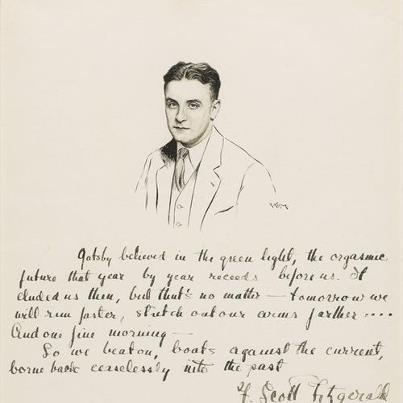
Try a little amateur handwriting analysis of your own on the last sentence of The Great Gatsby, written in Fitzgerald’s own hand below a portrait of the writer by artist Robert Kastor.
via I always wanted to be a Tenenbaum
Josh Jones is a doctoral candidate in English at Fordham University and a co-founder and former managing editor of Guernica / A Magazine of Arts and Politics.
Read More...Stephen Greenblatt’s Pulitzer Prize Winner, The Swerve, Available as AudioBook on iTunes for $5.95
 In the preface of The Swerve: How the World Became Modern, Stephen Greenblatt recalls the day he encountered a translation of Lucretius’ 2000 year old poem, On the Nature of Things. He was a grad student back at Yale, living on modest means, when he ambled into a bookstore and found a copy marked down to ten cents. He picked it up, not having much to lose and not knowing what he’d find. Soon enough he was reading one of the most scandalous and groundbreaking texts from antiquity, a book that eventually traveled a long and winding road and changed our entire modern world. That story Greenblatt tells in The Swerve.
The ten cents Greenblatt spent in the 1960s may be roughly equivalent to the deal you can get today. Right now, The Swerve, the winner of the 2012 Pulitzer Prize for general nonfiction, can be downloaded as an audio book for $5.95 via iTunes. Yes, we know, $5.95 is not free, and iTunes is not open, but it’s certainly a deal worth mentioning nonetheless.
But if you’re really hankering for something free, then don’t miss our meta lists of Free Audio Books and Free eBooks, which include a copy of Lucretius’ famous work. Or definitely check out Audible.com’s Free Trial offer, which lets you download pretty much any audio book you want (classic or modern) for free. Get details here.
Read More...Ray Bradbury: “The Things That You Love Should Be Things That You Do.” “Books Teach Us That”
“I suppose you’re wondering why I’ve called you all here,” says Ray Bradbury above, in a lengthy interview with the The Big Read project sponsored by the National Endowment for the Arts. Breaking the ice with this stock phrase, Bradbury–author of Fahrenheit 451, The Illustrated Man, The Martian Chronicles, and several dozen more fantasy and sci-fi novels and short story collections (and some truly chilling horror)–begins to talk about… Love. Specifically a love of books. “Love,” he says, “is at the center of your life. The things that you do should be things that you love, and the things that you love, should be things that you do.” That’s what books teach us, he says, and it becomes his mantra.
Bradbury, who passed away in June, was certainly an early inspiration for me, and several million other bookish kids whose warmest memories involve discovering some strange, life-altering book on the shelf of a library. As he recounts his childhood experiences with books, he’s such an enthusiastic booster for public libraries that you may find yourself writing a check to your local branch in the first ten minutes of his talk. And it’s easy to see why his most famous novel sprang from what must have been a very pressing fear of the loss of books. Bradbury was largely self-taught. Unable to afford college, he pursued his fierce ambition to become a writer immediately out of high school and published his first short story, “Hollerbochen’s Dilemma,” at the age of nineteen. As he says above, he became a writer because, “I discovered that I was alive.” But I’m not doing it justice. You have to watch him tell it to really feel the thrill of this epiphany.
The Big Read’s mission is to create a “Nation of Readers,” and to do so, it posts free audio guides for classics such as Bradbury’s Fahrenheit 451, Hemingway’s A Farewell to Arms, and Fitzgerald’s The Great Gatsby. They also feature video interviews with other authors, like Amy Tan, Ernest J. Gaines, and Tobias Wolff. Each of the interviews is fantastic, and the readers’ guides are superb as well. Bradbury’s, for example, narrated by poet and author Dana Gioia, also features sci-fi giants Orson Scott Card and Ursula K. Le Guin, as well as several other writers who were inspired by his work.
Related Content:
Ray Bradbury Gives 12 Pieces of Writing Advice to Young Authors (2001)
Ray Bradbury: Literature is the Safety Valve of Civilization
Josh Jones is a doctoral candidate in English at Fordham University and a co-founder and former managing editor of Guernica / A Magazine of Arts and Politics.
Read More...Face to Face with Bertrand Russell: ‘Love is Wise, Hatred is Foolish’
In April of 1959 the British philosopher and mathematician Bertrand Russell sat down with John Freeman of the BBC program Face to Face for a brief but wide-ranging and candid interview. Russell reminisced about his early attraction to mathematics. “I got the sort of satisfaction that Plato says you can get out of mathematics,” he said. “It was an eternal world. It was a timeless world. It was a world where there was a possibility of a certain kind of perfection.”
Russell, of course, distinguished himself in that rarified world as one of the founders of analytic philosophy and a co-author of Principia Mathematica, a landmark work that sought to derive all of mathematics from a set of logical axioms. Although the Principia fell short of its goal, it made an enormous mark on the course of 20th century thought. When World War I came along, though, Russell felt it was time to come down from the ivory tower of abstract thinking. “This world is too bad,” Russell told Freeman. “We must notice it.”
The half-hour conversation, shown above in its entirety, is of a quality rarely seen on television today. The interviewer Freeman was at that time a former Member of Parliament and a future Ambassador to the United States. Russell talks with him about his childhood, his views on religion, his political and social activism, even his amusing conviction that smoking extended his life. But perhaps the most famous moment comes at the end, when Freeman asks the old philosopher what message he would offer to people living a thousand years hence. In answering the question, Russell balances the two great spheres that occupied his life:
I should like to say two things, one intellectual and one moral:
The intellectual thing I should want to say to them is this: When you are studying any matter or considering any philosophy, ask yourself only what are the facts and what is the truth that the facts bear out. Never let yourself be diverted either by what you wish to believe or by what you think would have beneficent social effects if it were believed, but look only and solely at what are the facts. That is the intellectual thing that I should wish to say.
The moral thing I should wish to say to them is very simple. I should say: Love is wise, hatred is foolish. In this world, which is getting more and more closely interconnected, we have to learn to tolerate each other. We have to learn to put up with the fact that some people say things that we don’t like. We can only live together in that way, and if we are to live together and not die together we must learn a kind of charity and a kind of tolerance which is absolutely vital to the continuation of human life on this planet.
Related content:
Bertrand Russell on the Existence of God and the Afterlife
Three Passions of Bertrand Russell (and a Collection of Free Texts)
Face to Face with Carl Jung: ‘Man Cannot Stand a Meaningless Life’
Read More...Truman Capote (In Cold Blood) Talks Death Penalty with William F. Buckley (1968)
“Truman Capote didn’t study to become expert in capital crime and its punishment,” says William F. Buckley on the Firing Line broadcast of September 3, 1968, “but his five and one half year engagement of the slaughter of the Clutter family, which went into the writing of In Cold Blood, left him with highly settled impressions in the matter.” You can hear Buckley elicit and Capote concisely lay out the position to which these impressions brought him in the clip above. Though remembered for his own conservative views, Buckley seemed ever eager to invite onto his show, frequently and without hesitation, public figures who strongly disagreed with him. This sense of controversy generated a stream of classically compelling televisual moments over Firing Line’s 33-year run, but for my money, all the direct conflicts have less to offer than the times a guest — or even the host — broke from standard ideological positions, as Capote does here.
Buckley opens by asking whether “systematic execution of killers over the preceding generation might have stayed the hand of the murderers of the Cutter family.” Capote replies that “capital punishment — which I’m opposed to, but for quite different reasons than are usually advanced — would in itself be a singularly effective deterrent, if it were, in fact, systematically applied. But because public sentiment is very much opposed to it and the courts have allowed this endless policy of appeal — to such a degree that a person can be eleven, twelve, thirteen, fourteen years under a sentence of capital punishment — it becomes, in effect, an extreme, unusual, and cruel punishment. If people really were sentenced to be executed and were within a reasonable period of time, the professional murderer knew the absolute, positive end of their actions would be their own death, I think it would certainly give them second thoughts.” This perhaps lends itself poorly to a sound bite, but Firing Line at its best never dealt in those.
Related content:
William F. Buckley Meets (Possibly Drunk) Jack Kerouac, Tries to Make Sense of Hippies, 1968
James Baldwin Bests William F. Buckley in 1965 Debate at Cambridge University
Allen Ginsberg Reads a Poem He Wrote on LSD to William F. Buckley
Colin Marshall hosts and produces Notebook on Cities and Culture. Follow him on Twitter at @colinmarshall.
Read More...Campbell’s to Sell Special Andy Warhol Soup Cans, and What Makes Those Cans Art Anyway

When Mad Men kicked off its fifth season earlier this year, we encountered Don Draper and Peggy Olson brainstorming an advertising campaign for Heinz baked beans. The goal? To make this staple of the American diet sexier to a younger generation. It’s a perennial problem for many traditional brands, something that real-world companies contend with day in, day out. Take Campbell’s Soup for example. As part of a broader effort to make its products “more ethnic, more hip,” the company founded in 1869 plans to sell 1.2 million cans with artwork inspired by Andy Warhol.
Of course, Warhol is the artist who famously began producing silkscreens of Campbell’s soup cans back in 1962. When Andy first created these iconic pieces of pop art, Campbell’s was none too pleased. In fact, the company considered hitting him with a lawsuit. But, by 1964, they were sending him nice letters and free cases of soup, and they also commissioned him to make a painting for the firm’s retiring chairman. Now 50 years later, they’re hoping that Warhol’s pop art can get their sagging sales going again.
The soup cans will go on sale at Target, starting this Sunday, for 75 cents a pop. In the meantime, we’ll leave you with this — Sal Khan (Khan Academy) and Steven Zucker (Smarthistory) explaining what makes Warhol’s art, art. And, by the way, I spotted Sal at the local grocery store tonight. Should have said hi. It’s a small world.
Support Us
We're hoping to rely on loyal readers, rather than erratic ads. Please click the Donate button and support Open Culture. You can use Paypal, Venmo, Patreon, even Crypto! We thank you!

About Us

Open Culture scours the web for the best educational media. We find the free courses and audio books you need, the language lessons & educational videos you want, and plenty of enlightenment in between.
Advertise With Us

FREE UPDATES!
GET OUR DAILY EMAIL
Get the best cultural and educational resources on the web curated for you in a daily email. We never spam. Unsubscribe at any time.
FOLLOW ON SOCIAL MEDIA

Open Culture editor Dan Colman scours the web for the best educational media. He finds the free courses and audio books you need, the language lessons & movies you want, and plenty of enlightenment in between.
Advertise With Us

