Celebrate Samuel Beckett’s Birthday with Waiting For Godot (the Film) and Harold Pinter’s Memories
Today is the 106th anniversary of the birth of Samuel Beckett, whose pared-down prose and plays are among the greatest achievements of late modernism.
At a young man Beckett moved to Paris, where he befriended another Irish exile, James Joyce. As a writer, Beckett realized early on that he would never match Joyce’s “epic, heroic” achievement. Where Joyce was a synthesizer, Beckett once said, he was an analyzer. “I realized that my own way was impoverishment,” he said, “in lack of knowledge and in taking away, subtracting rather than adding.”
To celebrate Beckett’s birthday we bring you a pair of videos, including an excellent 2001 film version (above) of the most famous of his enigmatic creations, Waiting for Godot. It’s the centerpiece of Beckett on Film, a series of adaptions of all 19 of Beckett’s plays, organized by Michael Colgan, artistic director of the Gate Theatre in Dublin. The film features Barry McGovern as Vladimir, Johnny Murphy as Estragon, Alan Stanford as Pozzo and Stephen Brennan as Lucky. It was directed by Michael Lindsay-Hogg, who describes Waiting for Godot as being “like Mozart–too easy for children, too difficult for adults.” He goes on:
The play is what it is about. Samuel Beckett would have said it’s about two men waiting on the side of the road for someone to turn up. But you can invest in the importance of who is going to turn up. Is it a local farmer? Is it God? Or is it simply someone who doesn’t show up? The important thing is the ambiguity–the fact that it doesn’t really state what it is. That’s why it’s so great for the audience to be part of–they fill in a lot of the blanks. It works in their imaginations.
You can order the 19-film boxed set of Beckett on Film here, and listed to a CBC audio recording of Waiting for Godot here.
Harold Pinter in A Wake for Sam:
In early 1990, less than two months after Beckett’s death on December 22, 1989, the British playwright Harold Pinter paid tribute to his friend and hero as part of a BBC series called A Wake for Sam. Pinter begins by telling the story of the night in 1961 when he first met Beckett, while in Paris for a performance of The Caretaker:
I’d known his work for many years of course but it hadn’t led me to believe that he’d be such a very fast driver. He drove his little Citroen from bar to bar throughout the whole evening, very quickly indeed. We were together for hours, and finally ended up in a place in Les Halles eating onion soup at about four o’clock in the morning and I was by this time overcome–through, I think, alcohol and tobacco and excitement–with indigestion and heartburn, so I lay down on the table. I can still see the place. When I looked up he was gone. As I say, it was about four o’clock in the morning. I had no idea where he’d gone and he remained away and I thought, “Perhaps this has all been a dream.”
The conclusion of Pinter’s story (you’ll have to watch the video) reveals something of Beckett’s character. Pinter then goes on to read an eloquent, oft-quoted passage from a letter he wrote to a friend as a young man, in 1954, assessing Beckett’s power as a writer:
The farther he goes the more good it does me. I don’t want philosophies, tracts, dogmas, creeds, ways out, truths, answers, nothing from the bargain basement. He is the most courageous, remorseless writer going and the more he grinds my nose in the shit the more I am grateful to him. He’s not fucking me about, he’s not leading me up any garden path, he’s not slipping me a wink, he’s not flogging me a remedy or a path or a revelation or a basinful of breadcrumbs, he’s not selling me anything I don’t want to buy–he doesn’t give a bollock whether I buy or not–he hasn’t got his hand over his heart. Well, I’ll buy his goods, hook, line and sinker, because he leaves no stone unturned and no maggot lonely. He brings forth a body of beauty. His work is beautiful.
The 13-minute film concludes with a dramatic reading by Pinter of the final section of Beckett’s experimental novel The Unnamable, which was completed the same year as Waiting for Godot, in 1953. The passage builds in a crescendo of doubt and despair, with a sliver of resolve at the end:
Perhaps it’s done already, perhaps they have said me already, perhaps they have carried me to the threshold of my story, before the door that opens on my story, that would surprise me, if it opens, it will be I, it will be the silence, where I am, I don’t know, I’ll never know, in the silence you don’t know, you must go on, I can’t go on, I’ll go on.
Related Content:
Read More...Alan Watts On Why Our Minds And Technology Can’t Grasp Reality
“The world is a marvelous system of wiggles,” says Alan Watts in a series of lectures I keep on my iPod at all times. He means that the world, as it really exists, does not comprise all the lines, angles, and hard edges that our various systems of words, symbols, and numbers do. Were I to distill a single overarching argument from all I’ve read and heard of the body of work Watts produced on Zen Buddhist thought, I would do so as follows: humanity has made astounding progress by creating and reading “maps” of reality out of language, numbers, and images, but we run an ever more dangerous risk of mistaking these maps for the land. In this 1971 National Educational Television program, A Conversation With Myself, Watts claims that our comparatively simple minds and the simple technologies they’ve produced have proven desperately inadequate to handle reality’s actual complexity. But what to do about it?
Using an aesthetic now rarely seen on television, A Conversation With Myself captures, in only two unbroken shots, an informal “lecture” delivered by Watts straight to the viewer. Speaking first amid the abundant greenery surrounding his Mount Tamalpais cabin and then over a cup of ceremonial Japanese green tea (“good on a cold day”), he explains why he thinks we have thus far failed to comprehend the world and our interference with it. In part, we’ve failed because our “one-track” minds operating in this “multi-track” world insist on calling it interference at all, not realizing that the boundaries between us, one another, our technology, and nature don’t actually exist. They’re only artifacts of the methods we’ve used to look at the world, just like the distortions you get when digitizing a piece of analog sight or sound. Like early digitization systems, the crude tools we’ve been thinking with have, in Watts’ view, forced all of reality’s “wiggles” into unhelpful “lines and rows.” He sums up the problem with a memorable dash of Buddha-by-way-of-Britain wit: “You’re trying to straighten out a wiggly world, and now you’re really in trouble.”
(If you’d like a side of irony, ponder for a moment the implications of absorbing all this not only through human language, but through technology like iPods and Google Video!)
Related Content:
Alan Watts Introduces America to Meditation & Eastern Philosophy (1960)
Colin Marshall hosts and produces Notebook on Cities and Culture. Follow him on Twitter at @colinmarshall.
Read More...Damien Hirst Takes Us Through His New Exhibition at Tate Modern
From April 4 through September 9, the Tate Modern will stage the first serious UK exhibition of major works by Damien Hirst, one of Britain’s most influential, controversial and wealthy artists. Many of his famous sculptures — including, of course, the famous/infamous shark suspended in formaldehyde — will be on display. It’s our job to get you better acquainted with the exhibit. So let’s have Damien Hirst, the artist himself, take you on a tour of the big affair. The program above, Damien Hirst — The First Look, originally aired on Channel 4 in the UK. You can also watch Hirst wander through the exhibition with curator Ann Gallagher right here. Finally, you might want to spend a few minutes with a review by Oliver Wallington, an artist who wonders whether the emperor of art “has no clothes.” Or scan the review at The Guardian, which quietly raises eyebrows of its own.
Read More...Philosophy Bites: Podcasting Ideas From Plato to Singularity Since 2007

I’ve spent four years writing Podthoughts, a podcast review column, for Maximumfun.org. At one podcast a week, this means I’ve listened to and written up well over 200 different podcasts. At this point, each and every one that doesn’t consist of two guys volleying shapeless complaints about their least favorite bands, movies, television shows, and sports teams comes as a drop of water in the desert. Yes, I exaggerate, but the vast creative territory offered by a form of media as fresh and open as podcasting nevertheless remains mostly unexplored. None of the blame, however, falls upon Open University lecturer Nigel Warburton and BBC producer David Edmonds, whose podcast Philosophy Bites (iTunes — Libsyn — Web) pushed the medium forward very early in its lifetime. Alas, my predecessor in Podthinking beat me to reviewing Philosophy Bites, but I later interviewed Edmonds on my own show about what it takes to craft a podcast with so many top philosophers talking about so many philosophical topics in such short spans of time, so we’ll call it even.
The Philosophy Bites canon now forms a wider-ranging, more accessible philosophy curriculum than you’ll find in any university — and notably, in these trying economic times, an infinitely cheaper one. You can pick from a variety of possible points of entry, including clear explanations of well-known concepts like Plato’s Cave and free will; philosophical perspectives on such issues of the day as the singularity and genetic enhancement in sports; discussions of Adam Smith, David Hume, and philosophy’s other luminaries of old; and conversations with modern-day philosophical luminaries like Alain de Botton and A.C. Grayling. When you’d like to move on to longer-form roundtable discussions of famous works of philosophy, start downloading The Partially Examined Life, a podcast I did get the chance to Podthink about. For the earbud-equipped and philosophically inclined, these are fruitful times indeed.
Note: Philosophy Bites recently published a book based on its podcast. And it starts by trying to answer the question. What is Philosophy? BrainPickings has more on their answers.
Related content:
55 Free Philosophy Courses
The History of Philosophy… Without Any Gaps
Colin Marshall hosts and produces Notebook on Cities and Culture. Follow him on Twitter at @colinmarshall.
Read More...Orson Whales!: Welles Meets Led Zeppelin Meets Melville in Mashup Animation
Last week we gave you “ein Stop-Motion” animation of Ernest Hemingway’s little classic, The Old Man and the Sea, set to “Sail” by AWOLNATION. How can we possibly connect the dots and give you another maritime mashup this week? Easy-peasy. Today, we’re serving up Alex Itin’s animation of Orson Welles reading Moby Dick, with images being drawn in the pages of Herman Melville’s classic, and with Led Zep providing the soundtrack and playing their version of “Moby Dick.” Mission accomplished!
Free copies of Moby Dick can be found in our Free Audio Books and Free eBooks collections. And you can watch original footage of the great Orson Welles reading Moby Dick right here.
If you would like to support the mission of Open Culture, consider making a donation to our site. It’s hard to rely 100% on ads, and your contributions will help us continue providing the best free cultural and educational materials to learners everywhere. You can contribute through PayPal, Patreon, and Venmo (@openculture). Thanks!
Read More...Yale Introduces Another Seven Free Online Courses, Bringing Total to 42
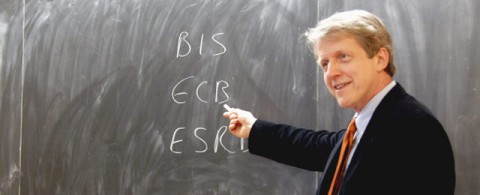
It’s April, which means it’s time for a new batch of Open Courses from Yale University. The latest release adds another six courses to the mix, bringing Yale’s total to 42. We have listed the new additions below, and also added them to our ever-growing list of Free Online Courses. As always, Yale gives you access to their courses in multiple formats. You can generally download their lectures via YouTube, iTunes or Yale’s Open Course web site.
- African American History: From Emancipation to the Present — Web Site — Jonathan Holloway
- Financial Markets 2011 — YouTube — Robert Shiller
- Freshman Organic Chemistry II — YouTube — iTunes — Web Site — J. Michael McBride
- Hemingway, Fitzgerald, Faulkner — YouTube — Wai Chee Dimock
- Philosophy and the Science of Human Nature — YouTube — iTunes Audio — Web Site — Tamar Gendler
- The Atmosphere, the Ocean, and Environmental Change — YouTube — iTunes — Web Site — Ronald B. Smith
- The Early Middle Ages, 284‑1000 — YouTube — iTunes — Web Site — Paul H. Freedman
Note: Earlier this week, my local NPR station featured a big conversation about Disruptive Innovation in Higher Education. Guests included Salman Khan (Khan Academy), Sebastian Thrun (Udacity), Anant Agarwal (MITx) and Ben Nelson (The Minerva Project). You can listen to their wide-ranging conversation here.
Read More...‘The Sound of Miles Davis’: Classic 1959 Performance with John Coltrane
Here’s an amazing time capsule from the golden age of jazz: Miles Davis and his group–including John Coltrane–performing with the Gil Evans Orchestra on the CBS program, The Robert Herridge Theater.
The show was recorded on April 2, 1959 at Studio 61 in New York. It was a bold departure for The Robert Herridge Theater, a program normally devoted to the dramatic story-telling arts. Davis was slated to appear with his full sextet, but alto saxophonist Julian “Cannonball” Adderley had a migraine headache that day, according to the Miles Ahead Web site, so the group was pared down to a quintet, with Davis on trumpet and flugelhorn, Coltrane on tenor and alto saxophone, Wynton Kelly on piano, Paul Chambers on bass and Jimmy Cobb on drums.
The broadcast took place halfway through the recording of Davis’s landmark album, Kind of Blue. The 26-minute show (see above) opens with the classic “So What,” recorded only a month earlier. Davis solos twice on the song to fill in for Adderley. The group is then joined by Gil Evans and his orchestra. Together they play three numbers from Davis’s 1957 album, Miles Ahead. Here’s the set list:
- So What
- The Duke
- Blues for Pablo
- New Rhumba
- So What (reprise)
“There are many ways of telling a story,” says host and producer Robert Herridge. “What you’re listening to now, the music of Miles Davis, is one of those ways.”
Related Content:
Thelonious Monk, Bill Evans and More on the Classic Jazz 625 Show
1959: The Year that Changed Jazz
Classic Jazz Album Covers Animated, or the Re-Birth of Cool
The Universal Mind of Bill Evans: Advice on Learning to Play Jazz & The Creative Process
Read More...My Best Friend’s Birthday, Quentin Tarantino’s 1987 Debut Film
Fewer than 40 minutes survive of My Best Friend’s Birthday, the first film directed by Quentin Tarantino. But its brief screen time runs dense with references to Elvis Presley, the Partridge Family, A Countess from Hong Kong, Rod Stewart, Deputy Dawg, and That Darn Cat. In between the rapid-fire gab sessions, we also witness a slapstick kung-fu battle and even hear a bit of repurposed early-seventies pop music. Though a fire claimed the second half of what was presumably the picture’s only print, the first half, which you can watch free on YouTube, leaves no doubt as to the identity of its auteur. In some sense, it bears an even deeper imprint of Tarantino’s personality than his subsequent films, since he stars in it as well. To behold the early-twentysomething Tarantino portraying the good-hearted and aggressively enthusiastic but jittery and distractible rockabilly DJ Clarence Poole is to behold the Quentin Tarantino public persona in an embryonic form, a distilled form — or both.
The plot of My Best Friend’s Birthday, such as it remains, finds Clarence looking to give a birthday present to his pal Mickey, who’s been freshly, and harshly, re-rejected by an ex-girlfriend. None of Clarence’s ideas — not the cake, not the call girl — work out quite as intended, though now I suppose we’ll never know how wrong things really went, or if they managed to right themselves in the end. Yet the truncated version of the film feels somehow more fascinating — more satisfying, even — than any completion I can imagine. Both the movie’s hopelessly unresolved story and its dreamy visual quality, courtesy of a beaten-up 16-millimeter print transferred onto what looks like a VHS tape, turn it into the most experimental art Tarantino has ever created. It casts adrift even the director’s hardiest fans in a stark southern California reality: long-running arguments about meaningless culture, ceaseless elevation of the disposable, and a vague, looming, but nevertheless constant sense of threat. And amid all this, it can still serve up a line like, “What made you interested in tackling prostitution as a career goal?”
My Best Friend’s Birthday appears in our collection of Free Movies Online.
Related content:
Filmmaking Advice from Quentin Tarantino and Sam Raimi (NSFW)
Quentin Tarantino Gives Sneak Peek of Pulp Fiction to Jon Stewart (1994)
Colin Marshall hosts and produces Notebook on Cities and Culture. Follow him on Twitter at @colinmarshall.
Read More...Henri Matisse Illustrates 1935 Edition of James Joyce’s Ulysses
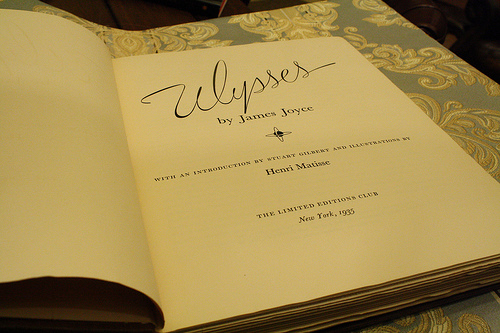
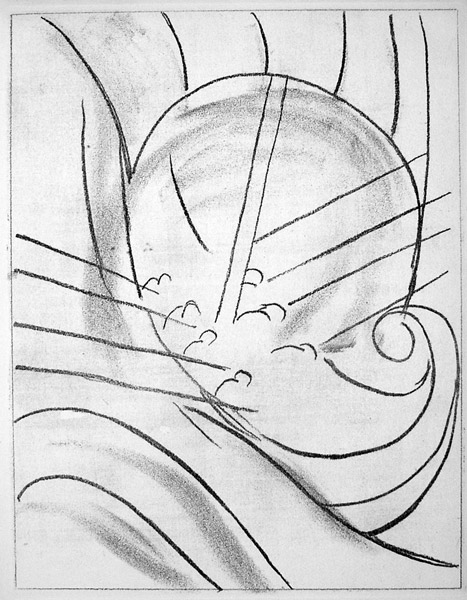
A couple weeks back, we mentioned that you can download a finely-read audio version of James Joyce’s Ulysses for free. What that version doesn’t include — and couldn’t include — are etchings by Henri Matisse. Back in the mid-1930s, George Macey, an American publisher, approached the celebrated painter and asked him how many etchings he could provide for $5,000. Although it’s widely believed that Matisse never read Joyce’s sprawling classic (despite being given a French translation of the text), he did come back with 26 full-page illustrations, all of them based on six themes from Homer’s Odyssey, the epic poem that Ulysses consciously plays upon. In 1935, an illustrated edition of Ulysses was printed. Matisse signed 1500 copies; Joyce only 250. And today a copy signed by both artists will run you a cool $37k. Buy, hey, the shipping is only $6.
Odysseus Blinding Polyphemus

Odysseus and Nausicaa

Odysseus’ Ship
Purdue Sets World Record with Largest Rube Goldberg Machine
Hats off to the Purdue Society of Professional Engineers team. This weekend, the team broke its own world record for the Largest Functional Rube Goldberg Machine. The contraption only took 300 steps to do something quite simple — blow up and pop a balloon. If you’re a fan of Rube Goldberg machines and books, then you won’t want to miss one of my favorites — The Page Turner created by Joseph Herscher, a New Zealand kinetic artist who now resides in Brooklyn. via i09
Follow us on Facebook, Twitter and now Google Plus and share intelligent media with your friends! They’ll thank you for it.
Read More...Support Us
We're hoping to rely on loyal readers, rather than erratic ads. Please click the Donate button and support Open Culture. You can use Paypal, Venmo, Patreon, even Crypto! We thank you!

About Us

Open Culture scours the web for the best educational media. We find the free courses and audio books you need, the language lessons & educational videos you want, and plenty of enlightenment in between.
Advertise With Us

FREE UPDATES!
GET OUR DAILY EMAIL
Get the best cultural and educational resources on the web curated for you in a daily email. We never spam. Unsubscribe at any time.
FOLLOW ON SOCIAL MEDIA

Open Culture editor Dan Colman scours the web for the best educational media. He finds the free courses and audio books you need, the language lessons & movies you want, and plenty of enlightenment in between.
Advertise With Us

