Google “Art Project” Brings Great Paintings & Museums to You
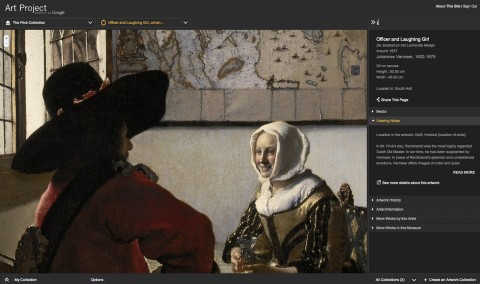
More goodness out of Googleplex. Today, Google is rolling out a new tool called “Art Project,” which gives you access to more than 1,000 works of art appearing in 17 great museums across the world. Using Google’s Street View technology, you can now tour collections at the MoMA and Met in New York City, the Uffizi Gallery in Florence, the Hermitage in St. Petersburg, the Van Gogh Museum and Rijksmuseum in Amsterdam, the National Gallery in London – just to name a few museums now virtually open to you. And you can visit countless paintings, some rendered in super high resolution. (We’re talking 7 billion pixels!) Take for example, Vermeer’s Officer and Laughing Girl (see above) or Van Gogh’s The Bedroom. When you view Van Gogh’s painting, make sure you zoom in and look at the brushwork.
Although you won’t have access to the entirety of every museum (actually the selections are rather limited in many cases), Google’s Art Project does put 385 rooms on display. Not a bad start. You can read more about the new initiative on Google’s blog here. H/T to @eugenphoto
Read More...Jake Shimabukuro Plays “Bohemian Rhapsody” on the Uke
If you’ve never seen Jake Shimabukuro handle the ukulele before, you’re in for a little treat. Known for his complex fingerwork, the ukulele virtuoso now tours with Jimmy Buffet and has recorded with Yo-Yo Ma. Meanwhile his fab recording of “While My Guitar Gently Weeps” has clocked 7,000,000 views on YouTube, all of which sets the stage for this: Shimabukuro bringing his act to the TED 2010 stage. For more ukulele fun, don’t miss The Complete Beatles on Ukulele.
If you would like to support the mission of Open Culture, consider making a donation to our site. It’s hard to rely 100% on ads, and your contributions will help us continue providing the best free cultural and educational materials to learners everywhere. You can contribute through PayPal, Patreon, and Venmo (@openculture). Thanks!
Read More...Al Jazeera’s Live Stream of Egyptian Uprising
A quick fyi: We may be witnessing a watershed moment in the history of Egypt and The Middle East, with police battling massive protests across Cairo and other Egyptian cities. These protests are being covered on the ground by Al Jazeera in English, and you can watch the live stream on the web right here, or download the free Al Jazeera iPhone app and watch the stream on the iPhone.
Note: If you’re looking for some resources that explain what’s happening in Egypt, you might want to visit these resources here and here. Both come at the recommendation of Jad Abumrad, the host of Radio Lab.
Read More...The Photography of The Sartorialist & Musings on the Creative Life
In the latest video appearing in Intel’s Visual Life series, we get a look inside the creative approach of Scott Schuman, the editor of the very popular fashion photography blog The Sartorialist. On the surface, this is all about how an influential fashion photographer goes about his craft. But the message – it’s more about doing and refining your personal approach, than formal schooling – easily extends to most any other artistic endeavor. Along similar lines, if you’re looking for insight into the creative process, you will want to revisit comedian John Cleese talking about The Origins of Creativity itself…
Read More...Don’t You Eva Interrupt Me While I’m Reading a Book!
This is for every reader out there who gets the basic sentiment. A bit of random silliness, courtesy of YouTuber Julian Smith.
via The New Yorker
Read More...MIT’s Vintage 1970 Calculus Courses Now Online … And Still Handy
Long ago, long before MIT hatched plans for its OpenCourseWare initiative and later edX, the university taped a lecture series covering the equivalent of a freshman-level calculus course. Released in 1970, the introductory class taught by Herbert Gross was suited for any student brushing up on his/her calculus, or learning the subject for the first time. MIT has now revived the lecture series, called “Calculus Revisited: Single Variable Calculus,” along with two more advanced courses. Although times have changed, calculus remains the same. And you’ll still find the series to be quite handy.
- Calculus Revisited: Single Variable Calculus (1970) – YouTube — iTunes Video – Web Site
- Calculus Revisited: Multivariable Calculus (1970) – YouTube – iTunes Video – Web
- Calculus Revisited: Complex Variables, Differential Equations, and Linear Algebra (1972) — YouTube — iTunes Video — Web
The courses are also listed in the Math section of our Free Online Course collection (where you’ll find many other calc courses)…
Related Content:
Free: Richard Feynman’s Physics Lectures from Cornell (1964)
Calculus Lifesaver: A Free Online Course from Princeton
MIT Introduces Complete Courses to OpenCourseWare Project
Read More...Watch Alexander Calder Perform His “Circus,” a Toy Theatre Piece Filled With Amazing Kinetic Wire Sculptures
Alexander “Sandy” Calder (1898 – 1976) was one of America’s foremost modern artists, internationally recognized for his invention of the mobile and his large-scale sculptures. At the age of eight, he started working with wire to make kinetic sculpture (one of his first was a small duck that would rock when pushed, done at the age of 11). Although he became an engineer and worked a variety of jobs, he eventually enrolled in The Art Students League of New York. While there, he worked for the National Police Gazette, covering, among other things, the Ringling Brothers and Barnum & Bailey Circuses.
Calder had a lifelong fascination with the circus and, upon moving to Paris in 1926, he created the Cirque Calder, a collection of wire sculptures with complex mechanisms allowing them to move and do various tricks. His first showing of his circus was to family and friends, but his popularity grew and he was soon giving shows lasting two hours in Paris and New York. It was then that his artistic recognition spread, and he enjoyed a prolific career until his death in 1976. The video above comes to us via The Whitney Museum in NYC, which presented an exhibition called “Alexander Calder: The Paris Years, 1926–1933” in 2008-09. And we also recommend watching the 1961 short film, Le Cirque de Calder, where he talks about his toy-like creations.
This is the first of hopefully many guest posts by Adrienne Rumsey.
If you would like to support the mission of Open Culture, consider making a donation to our site. It’s hard to rely 100% on ads, and your contributions will help us continue providing the best free cultural and educational materials to learners everywhere. You can contribute through PayPal, Patreon, and Venmo (@openculture). Thanks!
Read More...Sundance Film Festival 2011 on YouTube’s Screening Room
A quick note for film aficionados: The 2011 edition of the Sundance Film Festival is now underway. And over the next two weeks, The YouTube Screening Room will bring you short films from festivals past and present. Right now, you can watch four new films by up-and-coming directors – 8 Bits, Andy and Zach, The High Level Bridge, and Skateistan: To Live and Skate in Kabul (above). More new films will be added on January 27th and February 3rd. In the meantime, you can catch several other short films that originally played at Sundance, or were made by Sundance Institute alumni.
via Switched.com
Read More...Stop Motion Fun in Venice
Shelley Jones and Marko Anstice “space hop” through Venice with the help of some stop motion photography. It’s a wintery Venice, very different from the city (watch video) millions come to know during the summer months.
Appreciate the tip Ellen. If you have a great piece of intelligent media to share with your fellow readers, please send it our way. They’re always welcome…
Read More...Homer’s Iliad and Odyssey: Free AudioBooks & eBooks
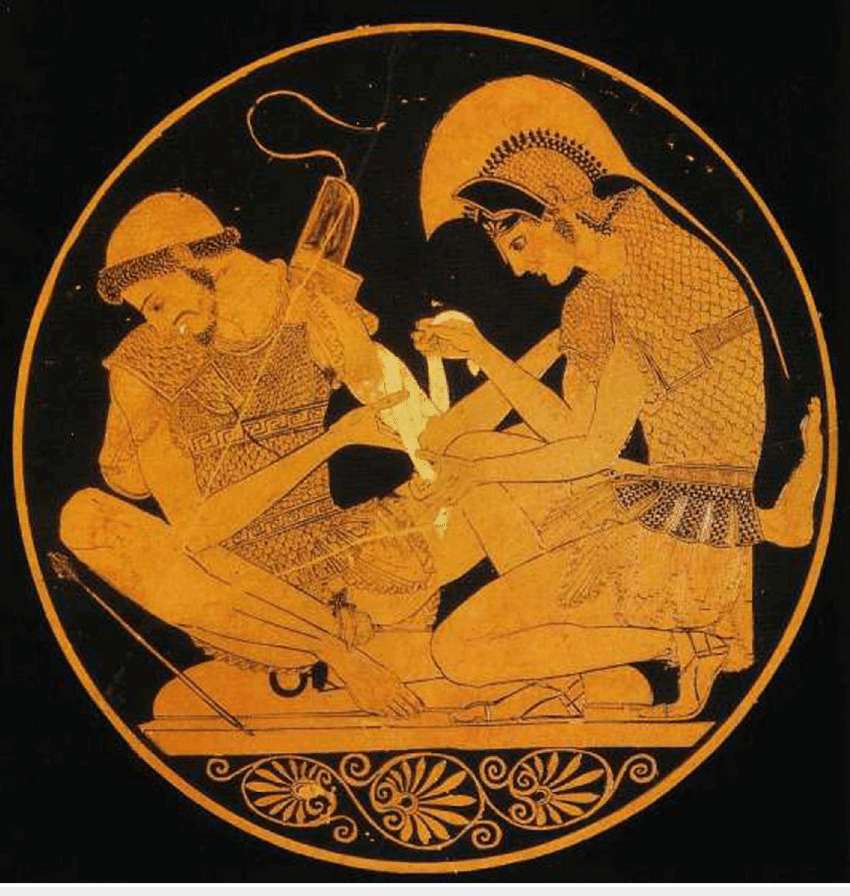
The Iliad and Odyssey — they form the bedrock of western literature and culture. And now, thanks to Ian Johnston of Vancouver Island University, you can find online numerous English translations of Homer’s great epic poems, including some by major literary heavyweights. Johnston’s list features translations of the Iliad by Thomas Hobbes (1675), George Chapman (1614), Alexander Pope (1720), William Cullen Bryant (1870), Samuel Butler (1888), and Richmond Lattimore (1951), along with accompanying versions of the Odyssey. Separately, but certainly worth noting, Librivox offers free audiobook versions of the Iliad and Odyssey, both based on the Butler translation. They’re now added to our list of Free Audio Books, and we have e‑texts within our Free eBooks collection.
Related Content:
Learning Ancient History for Free
Read More...Support Us
We're hoping to rely on loyal readers, rather than erratic ads. Please click the Donate button and support Open Culture. You can use Paypal, Venmo, Patreon, even Crypto! We thank you!

About Us

Open Culture scours the web for the best educational media. We find the free courses and audio books you need, the language lessons & educational videos you want, and plenty of enlightenment in between.
Advertise With Us

FREE UPDATES!
GET OUR DAILY EMAIL
Get the best cultural and educational resources on the web curated for you in a daily email. We never spam. Unsubscribe at any time.
FOLLOW ON SOCIAL MEDIA

Open Culture editor Dan Colman scours the web for the best educational media. He finds the free courses and audio books you need, the language lessons & movies you want, and plenty of enlightenment in between.
Advertise With Us


