29 Free Short Stories from Some of Today’s Most Acclaimed Writers: Margaret Atwood, David Mitchell & More
Let us call your attention to 29 free short stories, written by some of today’s most acclaimed writers. They come courtesy of The New York Times’ Decameron Project. They write:
Inspired by Giovanni Boccaccio’s “The Decameron,” a 14th-century collection of tales told by a group of 10 characters taking shelter in an Italian villa during the Black Plague, this [collection] features stories from Margaret Atwood, David Mitchell, Téa Obreht, Karen Russell, Tommy Orange, Yiyun Li and others. The so-called Decameron Project is the first time in the magazine’s modern history that an entire issue is devoted to new fiction.
You can read the stories online here. And if you prefer audio, hear two stories read aloud by Tommy Orange and Edwidge Danticat here.
If you would like to support the mission of Open Culture, consider making a donation to our site. It’s hard to rely 100% on ads, and your contributions will help us continue providing the best free cultural and educational materials to learners everywhere. You can contribute through PayPal, Patreon, and Venmo (@openculture). Thanks!
Related Content:
1,000 Free Audio Books: Download Great Books for Free
Read 9 Stories By Haruki Murakami Free Online
Read More...
How Cannonball Adderley Shared the Joy of Jazz
Jazz has always had big personalities. In the mid-20th century, an explosion of major players became as well known for their personal quirks as for their revolutionary techniques and compositions. Monk’s endearing oddness, Miles Davis’ brooding bad temper, Charles Mingus’ exuberant shouts and rages, Ornette Coleman’s cryptic philosophizing, Coltrane’s gentle mysticism…. These were not only the jazz world’s greatest players; they were also some of the century’s most interesting people.
The same can be said for Julian Edwin “Cannonball” Adderley, saxophonist and bandleader who was heralded as a new Charlie Parker on arrival in the New York scene from Ft. Lauderdale, Florida, where he had worked as a popular high school band director and local musician before deciding to pursue graduate studies. Music had other plans for him. Instead of going back to school when he arrived in Manhattan in 1955, he fell in with the right crowd and became an instant critical sensation.
Adderley ended up playing onstage and recording with greats like Davis, Coltrane, Art Blakey, Bill Evans, and his brother, Nat Adderley, who joined him to play in his Quintet, completed the Cannonball Adderley Sextet in the sixties with Yusef Lateef, and helped him make some of the best music of his career. Adderley joined Miles Davis’s band when Coltrane left and played on Kind of Blue and Milestones, leaving “a deep impression on Davis and his sextet,” notes one biography.
Unlike some of his famous peers, Adderley had none of the traits of the difficult or enigmatic artiste. Where most jazz musicians remained silent and mysterious onstage, Adderley engaged boisterously with his audience, in monologues one can imagine him shouting gregariously over a band room full of students warming up. With his irrepressible charm, he established an “amusing and educational rapport with his audience, often-times explaining what he and his musicians were about to play” (hear him do so before launching into his popular 1966 soul jazz single “Mercy, Mercy, Mercy,” below.)
Adderley’s personality helped put jazz newcomers at ease, but he didn’t teach from the textbook, experimenting broadly with several genres and incorporating electronic elements and African polyrhythms in the 60s and 70s, when he also became “a jazz spokesman. Whether it was television, residencies at several colleges, or film appearances.” Adderley helped pioneer soul jazz, post-bop, and other experimental subgenres, many of which crossed over into the pop charts. “Two words best encapsulate the music of alto saxophonist Julian “Cannonball” Adderley,” writes Nick Morrison at NPR: “’joy’ and ‘soul.’”
The Polyphonic video at the top focuses on the role of joy in Adderley’s music, making the case that he “exemplifies joy more than anyone else in jazz.” His voracious appetite for life—reflected in his high school nickname “Cannibal,” which morphed into “Cannonball”—propelled him into the “center of the jazz universe.” It also led him to devour influences other jazz musicians avoided. He had no pretensions to jazz as high art, though he was himself a high artist, and he joyfully embraced pop music at a time when it was scorned by the jazz elite.
“Adderley’s great ambition was to share the joy of jazz with the world, and he knew that no matter how technically impressive a piece of music was, people wouldn’t listen to it if it wasn’t fun, so Cannonball made his music fun and accessible.” Records like The Cannonball Adderley Sextet in New York sound like “a party,” writes CJ Hurtt at Vinyl Me, Please: “a party with some far-out nearly free jazz post-bop elements to it” but no shortage of straight-ahead grooves. The album kicks off with Cannonball “telling the audience that they are actually hip and not merely pretending to be.” It’s tongue-in-cheek, of course; Adderley never pretended to be anyone but his own outgoing self. But his unrelenting cheerfulness, even when he played the blues, also made him one of the hippest cats around.
Related Content:
How Jazz Helped Fuel the 1960s Civil Rights Movement
Herbie Hancock’s Joyous Soundtrack for the Original Fat Albert TV Special (1969)
Josh Jones is a writer and musician based in Washington, DC. Follow him at @jdmagness
Read More...Ennio Morricone (RIP) and Sergio Leone Pose Together in Their Primary School Year Book, 1937
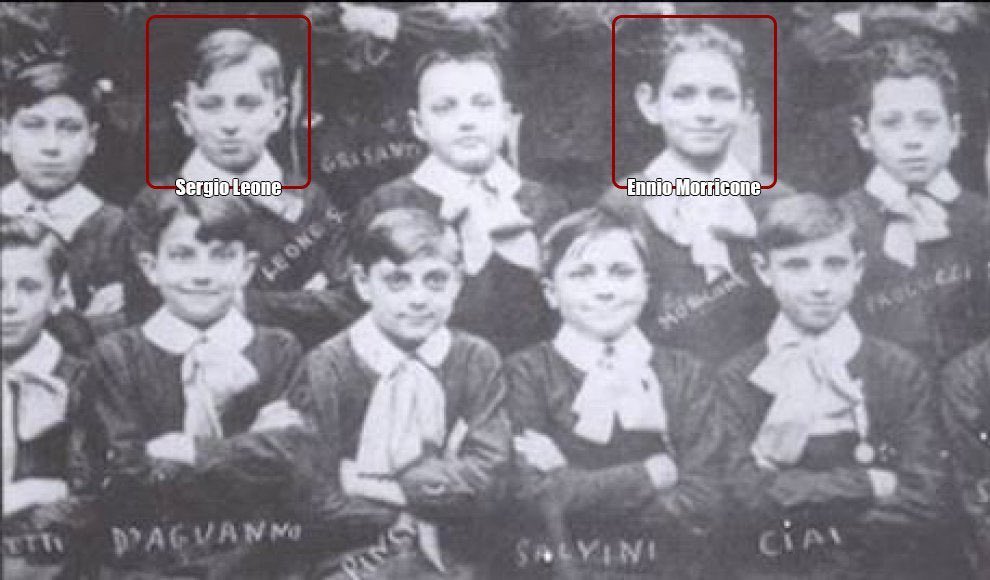
Little did they know where life would take them–and how their futures would be intertwined.
A great find by @ddoniolvalcroze.…
Read More...Did the CIA Write the Scorpions’ “Wind of Change,” One of the Bestselling Songs of All Time?
By the time the Berlin Wall fell in 1989, it seemed the fate of the Soviet Union was all but sealed. It would be two more years before the USSR officially dissolved, and flew the Soviet flag over the Kremlin for the last time, but the age of Cold War belligerence officially ended with the 1980s, so it seemed. Soft power and suasion would finish the job. And what better way to announce this transition than with the soft-rock stylings of a power ballad like the Scorpions’ “Wind of Change”? The sentimental song from German metal and hard rock favorites was suddenly inescapable in 1990, and it was not at all subtle about its message.
The song became a massive hit and remains one of the best-selling singles of all time. It served as “a soundtrack of sorts to a political and cultural revolution,” writes Richard Bienstock at Rolling Stone. Oddly, “especially in light of the Scorpions’ background… ‘Wind of Change’ was about neither the Berlin Wall nor their German homeland.” Instead, the song was ostensibly inspired by a historic two-day festival the band played in Moscow in 1989, a so-called “hard-rock Woodstock” featuring metal royalty like Ozzy Osbourne, Mötley Crüe, Cinderella, and Skid Row alongside hard rock Soviet bands like Gorky Park.
Three months after the concert, the Berlin Wall fell, and Scorpions’ lead singer Klaus Meine wrote the words:
The world is closing in
Did you ever think
That we could be so close, like brothers
The future’s in the air
I can feel it everywhere
Blowing with the wind of change
The iconic whistled intro and lighters-in-the-air video cemented “Wind of Change” as a definitive statement on how the “children of tomorrow” will “share their dreams” in a globalized world. Tantalizingly vague, the lyrics read like Surrealist ad copy, sliding back and forth between doggerel and weird Symbolist incantation:
The wind of change
Blows straight into the face of time
Like a stormwind that will ring the freedom bell
For peace of mind
Let your balalaika sing
What my guitar wants to say
These lines, it may not shock you to learn, may have been written by the CIA. At least, “that’s the mystery driving the new eight-part podcast series Wind of Change,” writes Nicholas Quah at Vulture. (Listen on Apple, Spotify, Google, and on the podcast website.) “Led by New Yorker staff writer Patrick Radden Keefe and produced by Pineapple Street’s Henry Molofsky… the journey takes us to a shape-shifting Wonderland, a world where an American agency like the CIA may very well have participated in the production of pop culture as part of concerted efforts to build sentiment against its enemies abroad. It might even be something that’s happening right now.”
Those who’ve read about how the Agency has influenced everything from Abstract Expressionism, to literary magazines, creative writing, and Hollywood films might not find these allegations particularly surprising, but as with all the best examples of the serial podcast form, it’s the journey, not the destination that makes this story worth pursuing. Keefe approaches the subject with a naiveté that might be deliberate, playing up the idea of mass entertainment as “carefully devised and calibrated messaging.”
The podcast is great fun (“it’s been described as This is Spinal Tap meets All the President’s Men,” writes Deadline); its story, Keefe says in a statement, “stretches across musical genres, and across borders and periods of history.” Do we ever find out for sure whether the agency best known for overthrowing governments it doesn’t like wrote the Scorpions’ 1990 power ballad “Wind of Change”? “Hear the music, and the accents and the voices,” says Keefe, “and judge for yourself who might be lying and who is telling the truth.”
If you ask Klaus Meine, it’s all a fantasy. (But, then, he would say that, wouldn’t he?) “It’s weird,” the Scorpions singer commented after learning about Keefe’s podcast. “In my wildest dreams I can’t think about how that song would connect with the CIA.” The idea, however, would make “a good idea for a movie,” he says, “That would be cool.” A movie, maybe, funded by the CIA.
Related Content:
How the CIA Helped Shape the Creative Writing Scene in America
Josh Jones is a writer and musician based in Durham, NC. Follow him at @jdmagness
Read More...Thomas Jefferson’s Great-Great-Great-Great-Great-Great Grandson Poses for a Presidential Portrait
We hold these truths to be self-evident: that all men are created equal; that they are endowed by their Creator with certain unalienable rights; that among these are life, liberty and the pursuit of happiness… —Thomas Jefferson, 3rd President of the United States of America
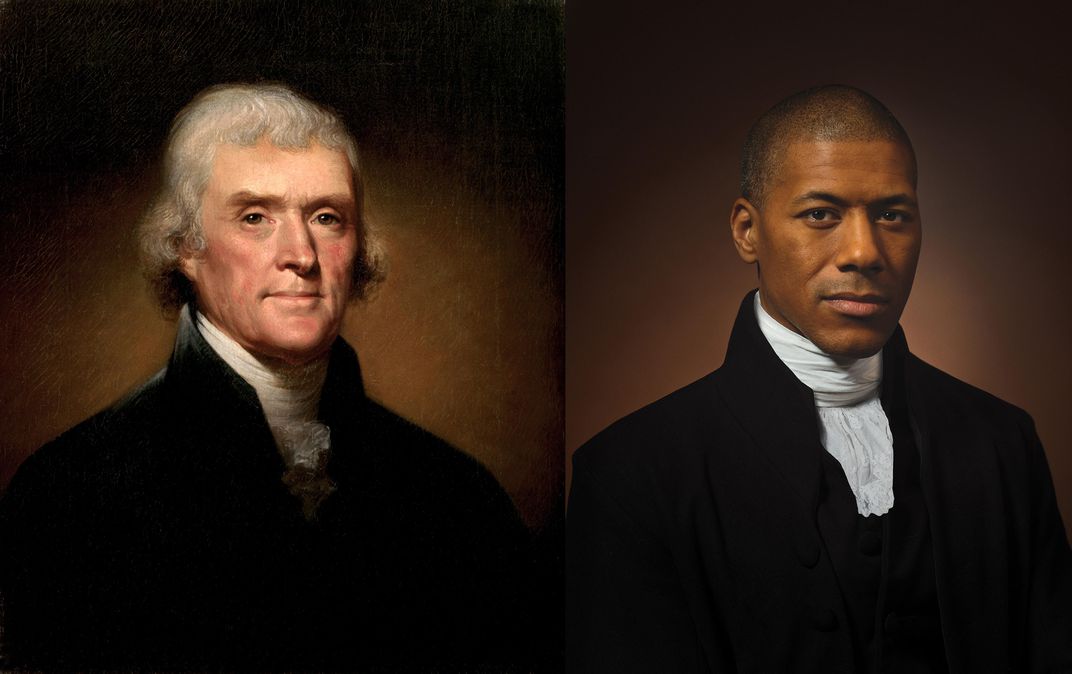
He was a brilliant man who preached equality, but he didn’t practice it. He owned people. And now I’m here because of it. —Shannon LaNier, co-author of Jefferson’s Children: The Story of One American Family
Many of the American participants in photographer Drew Gardner’s ongoing Descendants project agreed to temporarily alter their usual appearance to heighten the historic resemblance to their famous ancestors, adopting Elizabeth Cady Stanton’s lace cap and sausage curls or Frederick Douglass’ swept back mane.
Actor and television presenter Shannon LaNier submitted to an uncomfortable, period-appropriate neckwrap, tugged into place with the help of some discreetly placed paperclips, but skipped the wig that would have brought him into closer visible alignment with an 1800 portrait of his great-great-great-great-great-great-great-grandfather, Thomas Jefferson.
“I didn’t want to become Jefferson,” states LaNier, whose great-great-great-great-great-great-great-grandmother, Sally Hemings, was written out of the narrative for most of our country’s history.
An enslaved half-sister of Jefferson’s late wife, Martha, Hemings was around sixteen when she bore Jefferson’s first child, as per the memoir of her son, Madison, from whom LaNier is also directly descended.
She has been portrayed onscreen by actors Carmen Ejogo and Thandie Newton (and Maya Rudolph in an icky Saturday Night Live skit.)
But there are no photographs or painted portraits of her, nor any surviving letters or diary entries. Just two accounts in which she is described as attractive and light-skinned, and some political cartoons that paint an unflattering picture.
The mystery of her appearance might make for an interesting composite portrait should the Smithsonian, who commissioned Gardner’s series, seek to entice all of LaNier’s female and female-identifying cousins from the Hemings line to pose.
While LaNier was aware of his connection to Jefferson from earliest childhood, his peers scoffed and his mother had to take the matter up with the principal after a teacher told him to sit down and stop lying. As he recalled in an interview:
When they didn’t believe me, it became one of those things you stop sharing because, you know, people would make fun of you and then they’d say, “Yeah, and I’m related to Abraham Lincoln.”
His family pool expanded when Jefferson’s great-great-great-great-grandson, journalist Lucian King Truscott IV—whose fifth great-grandmother was Martha Jefferson—issued an open invitation to Hemings’ descendants to be his guests at a 1999 family reunion at Monticello.
It would be another 20 years before the Thomas Jefferson Foundation and Monticello tour guides stopped framing Hemings’ intimate connection to Jefferson as mere tattle.
Now visitors can find an exhibit dedicated to her life, both online and in the recently reopened house-museum.
Truscott lauded the move in an essay on Salon, published the same week that a yearbook photo of Virginia Governor Ralph Northam in blackface posing next to a figure in KKK robes began to circulate:
Monticello is committing an act of equality by telling the story of slave life there, and by extension, slave life in America. When my cousins in the Hemings family stand up and proudly say, we are descendants of Thomas Jefferson, they are committing an act of equality…. The photograph you see here is a picture of who we are as Americans. One day, a photograph of two cousins, one black and one white, will not be seen as unusual. One day, acts of equality will outweigh acts of racism. Until that day, however, Shannon and I will keep fighting for what’s right. And one day, we will win.
Watch a video of Jefferson descendant Shannon Lanier’s session with photographer Drew Gardner here.
See more photos from Gardner’s Descendents project here.
Read historian Annette Gordon-Reed’s New York Times op-ed on the complicated Hemings-Jefferson connection here.
Related Content:
Ayun Halliday is an author, illustrator, theater maker and Chief Primatologist of the East Village Inky zine. Follow her @AyunHalliday.
Read More...Carl Reiner & Mel Brooks’ Timeless Comedy Sketch: The 2000-Year-Old-Man
I read the obits. If I’m not in it I’ll have breakfast. —Carl Reiner
Up until this week week, it seemed as if Mel Brooks and Carl Reiner could keep their 2000-Year-Old Man routine going forever.
The premise was simple—Reiner as the serious minded announcer, interviewing Brooks as an elder with a Middle European Yiddish accent about some of the historic moments, trends, and celebrities he’d had personal contact with over the years.
The idea originated with Reiner, who, as a young staff writer for Sid Caesar’s Your Show of Shows, thought there was comic gold to be mined from We the People, a weekly news program that dramatized important current events—notably a plumber who claimed to have overheard some toe curling plans while repairing a faucet in Stalin’s bathroom.
Unfortunately, or rather fortunately, no one else in the writers room had caught the show, so he drafted coworker Brooks to play along, interviewing him as if he were the host of We the People, and Brooks were an average Joe who’d been at the Crucifixion:
Mel, aging before our eyes, sighed and allowed a sad “Oooooh, boy” to escape from the depths of his soul…
I pressured the Old Man and asked, “You knew Jesus?”
“Jesus … yes, yes,” he said, straining to remember, “thin lad … wore sandals … always walked around with twelve other guys … yes, yes, they used to come into the store a lot … never bought anything … they came in for water … I gave it to them … nice boys, well-behaved… .”
For a good part of an hour Mel had us all laughing and appreciating his total recall of life in the year 1 A.D. I called upon Mel that morning because I knew that one of the characters in his comedy arsenal would emerge. The one that did was similar to one he did whenever he felt we needed a laugh break. It was a Yiddish pirate captain who had an accent not unlike the 2,000-Year-Old Man.
The durable, always unscripted 2000-Year-Old Man made an instant splash with friends and family, but his accent—which came quite naturally to the Brooklyn-born Brooks—caused the duo to question the wisdom of trotting him out before a wider audience.
In the 20’s and 30’s Yiddish accents had been a comic staple on the radio, and in Broadway, vaudeville, and burlesque houses, but that changed when the Nazis came to power, as Reiner recalled in his 2003 memoir, My Anecdotal Life:
…when Adolf Hitler came along and decreed that all Jews were dirty, vile, dangerous, subhuman animals and must be put to death, Jewish and non-Jewish writers, producers, and performers started to question the Yiddish accent’s acceptability as a tool of comedy. The accent had a self-deprecating and demeaning quality that gave aid and comfort to the Nazis, who were quite capable of demeaning and deprecating Jews without our help. From 1941 on, the Yiddish accent was slowly, and for the most part, voluntarily, phased out of show business.
Eventually, however, the character found his way onto their 1961 LP 2000 Years with Carl Reiner & Mel Brooks.
They buttressed his 12-minute appearance with sketches involving astronauts, teen heartthrob Fabian, and Method actors, hedging their bets lest the accent flop with both reference-challenged WASPs and fellow Jews nervous about reinforcing problematic stereotypes.
One wonders what the 2000-Year-Old Man—who as a caveman had trouble determining “who was a lady”—would have had to say about the movements for Trans Equality, #MeToo, and Black Lives Matter.
A quote on Brooks’ website may provide a hint:
It’s OK not to hurt the feelings of various tribes and groups, however, it’s not good for comedy. Comedy has to walk a thin line, take risks. It’s the lecherous little elf whispering in the king’s ear, telling the truth about human behavior.
Brooks delighted by putting imminently quotable, off-the-cuff punchlines in the mouth of the 2000-Year-Old Man, hooking many young listeners, like veteran comedian and stand up comedy teacher Rick Crom:
The 2000-Year-Old Man was the first comedy album I ever listened to. I was quoting it at 10. I told my Sunday school teacher that before God, people worshipped “a guy…Phil.”
But it was Reiner—who maintained a wish list of questions for the 2000-Year-Old Man and who left us earlier this week at the not-too-shabby age of 98—who steered the act, often by pressing his subject to substantiate his wild claims.
As Anne Libera, Director of Comedy Studies at The Second City and Columbia College Chicago, notes:
Carl Reiner was a master of the underrated art of the setup. Most “straight men” are known for their responses that release the laugh. Carl did that too, but even more brilliantly, he subtly puts all of the pieces into play for Mel Brooks to push off of into the comedy stratosphere. You see it in the Dick Van Dyke Show as well —he knew how to create the exact space for a comic character to do their best work.
Copies of the Complete 2000 Year Old Man can be purchased on Amazon.
Related Content:
Hear 30 of the Greatest Standup Comedy Albums: A Playlist Chosen by Open Culture Readers
Judd Apatow Teaches the Craft of Comedy: A New Online Course from MasterClass
Steve Martin Performs Stand-Up Comedy for Dogs (1973)
Ayun Halliday is an author, illustrator, theater maker and Chief Primatologist of the East Village Inky zine. Here latest project is an animation and a series of free downloadable posters, encouraging citizens to wear masks in public and wear them properly. Follow her @AyunHalliday.
Read More...When Debbie Harry Combined Artistic Forces with H.R. Giger
After four years of phenomenal chart success, the band Blondie went on hiatus in 1981. While Debbie Harry pursued the acting she had started in punk rock filmmaker Amos Poe’s works, she also went the solo album route. On paper, this album, KooKoo, must have looked like a surefire hit: Nile Rogers and Bernard Edwards from the band Chic were brought in to write and produce, hot on the heels of their successful resuscitation of Diana Ross’s career the year before. Harry and boyfriend/band member/guitarist Chris Stein wrote tracks as well, and fully indulged in the Black music genres they had already been toying with on Blondie’s Autoamerican, like “Rapture” and “The Tide Is High.”
But here’s where it gets a bit weird, and everything goes off kilter. The choice for the album art and promotional videos was H.R. Giger, the artist who had rattled moviegoers’ brains the previous year with his designs for Ridley Scott’s Alien.
The couple had met Giger in 1980 at a reception for his paintings at New York’s Hansen Gallery.
“There I was introduced to a very beautiful woman, Debbie Harry, the singer of the group Blondie, and her boyfriend, Chris Stein,” Giger said in an interview. “They were apparently excited about my work and asked me whether I would be prepared to design the cover of the new Debbie Harry album.”
Though he didn’t know the group–Giger preferred to listen to jazz–he agreed to the cover and to the promo videos, even directing when the original director didn’t show.
The album cover is probably better known than the music inside, and no wonder: it features Harry’s face pierced horizontally by four spikes. Her expression is ambiguous, possibly ecstatic. It was in one way a throwback to Giger’s other famous record cover, the one for Emerson, Lake, and Palmer’s Brain Salad Surgery. But the cover also would see its influence in films like Hellraiser, the rise of what was called the “modern primitive” movement, and help cultivate the dark masochistic character Harry would play in David Cronenberg’s Videodrome. It was a feeling that would flourish in the decadent ‘80s.
Harry wrote about this in Heavy Metal magazine, which often featured the artist, saying “Giger’s work has a subconscious effect: it engenders the fear of being turned into metal.”
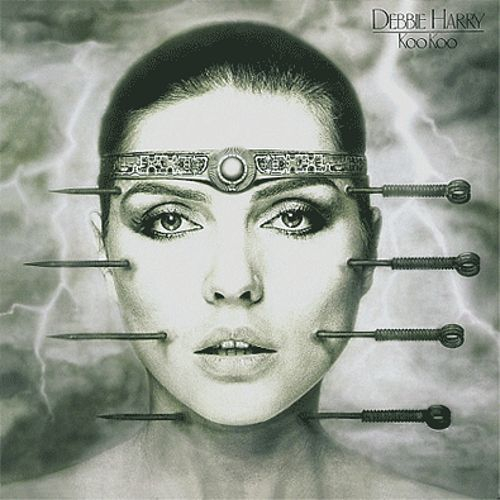
The cover was a taster for more menacing things, however. It’s the videos where Harry goes full Giger. First of all, the blonde hair is gone, replaced by black. And Giger puts Harry in a bodysuit, half flayed-human, half machine. The music videos are simple, performance based, though the sunny, alluring Harry has disappeared and a proto-Goth being has taken her place.
But that leaves us with the music, which one has to admit, is completely unsuited for this design. If Harry had made an album closer to Danielle Dax, for example, then we might have seen one of the oddest mid-career shifts in ‘80s music. Instead the commercial flatlining of the album threw Harry off-track, while Giger went on to be the go-to album artist for metal and punk bands, from the Dead Kennedys to Bloodbath.
Related Content:
How Blondie’s Debbie Harry Learned to Deal With Superficial, Demeaning Interviewers
Ted Mills is a freelance writer on the arts who currently hosts the Notes from the Shed podcast and is the producer of KCRW’s Curious Coast. You can also follow him on Twitter at @tedmills, and/or watch his films here.
Read More...John Prine’s Last Song Was Also His First to Go No. 1: Watch Him Perform “I Remember Everything”
It feels cosmically ironic that Great American Songwriter John Prine died of COVID-19 in early April, just before the U.S. response to the virus was developing into what may well be the Greatest Political Folly most Americans have ever witnessed in their lifetimes. Mass death for profit and power, colossal stupidity and bullying ignorance—these were just the kinds of things that got Prine’s wheels turning. His thoughts became folk poetry with teeth.
Prine’s targets included the conservative demonization of single mothers in “Unwed Fathers,” who “can’t be bothered,” he sang, “They run like water, through a mountain stream.” In 1971, he told belligerent American nationalists “Your Flag Decal Won’t Get You into Heaven Anymore,” in a song he’d actually written in the late 60s, calling out America’s “dirty little war.” He revisited this evergreen anti-war theme in 2005’s “Some Humans Ain’t Human,” a song that angered many fans. While Prine’s explicitly political songs are only a small part of his catalogue, his lyricism always clearly reflected his beliefs.
“Bestowing dignity on the overlooked and marginalized was a common theme throughout Prine’s career,” writes Annie Zaleski in an NPR Music tribute. “He became known for detailed vignettes about ordinary people that illustrated truths about society.” His mastery of this form made him the ultimate songwriter’s songwriter. But while he won two Grammys and several other distinguished awards, “inductions into multiple songwriter halls of fame,” notes Eli Enis at Consequence of Sound, “and gushing praise from peers like Bob Dylan, Bruce Springsteen, and Tom Petty,” Prine never had a No. 1 hit, until now—in a final irony he would have appreciated—with his posthumous release, “I Remember Everything.”
The song came out on June 11 and this week “debuted at the top of the Rock Digital Song Sales chart, making it the highest-charting single of the late legend’s entire career.” It showcases Prine’s ability to make the personal reflect larger social realities he may never have seen coming but somehow tuned into nonetheless. In this case, the subject is a man who knows he’s out of time and wants to savor every memory before he goes. Written with longtime collaborator Pat McLaughlin, the lyrics are gorgeously bittersweet, touching the depths of loss and reckoning with mortality.
Prine’s performance at the top was recorded last year by Grammy-winning producer Dave Cobb. “Given that Prine passed away back in April following a battle with coronavirus, the song’s life-spanning, self-reflective lyrics are achingly prescient,” writes Enis. And it’s “almost too on-the-nose that the track was presented in a home performance context, months before that setup would become normalized for a world in quarantine.” Prine always had an “uncanny ability to address (if not predict) the societal and political zeitgeist,” Zaleski wrote in April. No matter how ugly the zeitgeist was, he never let it dull his wit or cloud his eye for beauty.
I Remember Everything
I’ve been down this road before
I remember every tree
Every single blade of grass
Holds a special place for me
And I remember every town
And every hotel room
And every song I ever sang
On a guitar out of tuneI remember everything
Things I can’t forget
The way you turned and smiled on me
On the night that we first met
And I remember every night
Your ocean eyes of blue
How I miss you in the morning light
Like roses miss the dewI’ve been down this road before
Alone as I can be
Careful not to let my past
Go sneaking up on me
Got no future in my happiness
Though regrets are very few
Sometimes a little tenderness
Was the best that I could doI remember everything
Things I can’t forget
Swimming pools of butterflies
That slipped right through the net
And I remember every night
Your ocean eyes of blue
How I miss you in the morning light
Like roses miss the dewHow I miss you in the morning light
Like roses miss the dew
Related Content:
Bill Murray Explains How He Was Saved by John Prine
Josh Jones is a writer and musician based in Durham, NC. Follow him at @jdmagness
Read More...Rewatch Every Episode of The Sopranos with the Talking Sopranos Podcast, Hosted by Michael Imperioli & Steve Schirripa
The Sopranos premiered on January 10, 1999, and television did not change forever — or rather, not right away. Though its treatment of the life of mid-level New Jersey mob boss Tony Soprano drew large numbers of dedicated viewers right away, few could have imagined during the show’s eight-year run how completely its success would eventually rewrite the rules of dramatic TV. More than twenty years later, nearly all of us place the beginning of our ongoing televisual “golden age” at the broadcast of The Sopranos’ first episode. You can hear that epoch-making 50 minutes discussed in depth on the first episode of the new podcast Talking Sopranos (YouTube — Apple — Spotify), whose hosts Michael Imperioli and Steve Schirripa know the series more intimately than most — not least because they were on it.
Fans know Imperioli and Schirripa as Tony’s protégé Christopher Moltisanti and Tony’s brother-in-law Bobby Baccalieri. On Talking Sopranos they “follow the Sopranos series episode by episode giving fans all the inside info, behind the scenes stories and little-known facts that could only come from someone on the inside,” announces the podcast’s description, which also promises “interviews with additional cast members, producers, writers, production crew and special guests.”
Among these voices there is, of course, one sizable absence: star James Gandolfini, Tony Soprano himself, who died in 2013. But it shows promise that, just fourteen episodes in, the podcast has already brought on Edie Falco, who played Tony’s wife Carmela; Robert Iler, their son A.J. Soprano; Jamie-Lynn Sigler, their daughter Meadow Soprano; and Michael Rispoli, the first season’s short-lived Jackie Aprile Sr.
None of these actors would have made their mark on the show without the work of casting directors Georgianne Walken and Sheila Jaffe, who also make an appearance on the podcast, as does co-executive producer and sometime director Henry Bronchtein. You can download Talking Sopranos on its web site, subscribe to it on Apple Podcasts and elsewhere, or even watch it on Youtube. If you’d like to supplement all this with an even greater wealth of detail, pick up a copy of Matt Zoller Seitz and Alan Sepinwall’s book The Sopranos Sessions, an episode-by-episode analysis featuring interviews with figures including series creator David Chase. Never has there been a better time to do a Sopranos re-watch of your own — and if you never watched it in the first place, well, better a couple of decades late than never.
Related Content:
How David Chase Breathed Life into the The Sopranos
David Chase Reveals the Philosophical Meaning of The Sopranos’ Final Scene
Maurice Sendak Animated; James Gandolfini Reads from Sendak’s Story “In The Night Kitchen”
James Gandolfini Shows Kinder, Softer, Gentler Side on Sesame Street (2002)
Based in Seoul, Colin Marshall writes and broadcasts on cities, language, and culture. His projects include the book The Stateless City: a Walk through 21st-Century Los Angeles and the video series The City in Cinema. Follow him on Twitter at @colinmarshall, on Facebook, or on Instagram.
Read More...Hear Brian Eno’s Rarely-Heard Cover of the Johnny Cash Classic, “Ring of Fire”
“Ring of Fire” has been covered many times and in many ways since Johnny Cash released it in 1963. But for all its recognition as one of his signature songs, Cash’s “Ring of Fire” is itself a cover — or another interpretation, in any case, of a tune originally written by Cash’s wife June Carter and songwriter Merle Kilgore for June’s sister, Anita Carter. Though it made nothing like the mark Cash’s recording did, the original “Ring of Fire” has its appreciators, a group that may well include Brian Eno. Or at least one feels an affinity between Anita Carter’s take on the song and Eno’s own, the latter of which you can listen to above.
Unlikely enough to begin with, in an artistic sense, the recording’s availability on the internet has saved it from near-complete obscurity. “In 1990, Brian Eno and John Cale made a wonderful experimental pop/art rock record called Wrong Way Up, released by Warner Bros. Records,” writes Boing Boing’s David Pescovitz.
“At the time, the label would send out 7” records to alt.rock/college radio stations to promote their new releases. The promo series, called Soil Samples, featured different artists on each side of the record performing songs that weren’t included on their new albums.” Cale’s contribution to the sample was an instrumental called “Shuffle Down to Woodbridge,” and the flip side of this translucent-vinyl rarity featured “Merry Christmas” by the two-man Americana group House of Freaks.
As the legend goes — for every story connected with Johnny Cash becomes a legend — the idea for how to do “Ring of Fire” came to the Man in Black in a dream. The “Mexican horns” that had risen up from his subconscious “sound like they’ve stumbled in from somewhere else on the radio dial and are trying desperately not to fall over Cash’s standard shave-and-a-haircut clomping beat,” writes The Atlantic’s Noah Berlatsky. “Cash, for his part, turns in one of the most awkward vocals of his career.” And yet “all those elements knocking against each other,” he continues “fit the song’s lyrics perfectly.” Eno’s flowing, languid, Mexican-horn-free recording may sound more like the original “Ring of Fire” than any other cover, but it also befits its artist, the man who popularized ambient music. Neither Cash nor Eno sing like men especially subject to “wild desire,” but what song isn’t enriched by a bit of counterpoint?
via Boing Boing
Related Content:
Johnny Cash Sings “Man in Black” for the First Time, 1971
Johnny Cash & Joe Strummer Sing Bob Marley’s “Redemption Song” (2002)
Inside the 1969 Bob Dylan-Johnny Cash Sessions
Based in Seoul, Colin Marshall writes and broadcasts on cities, language, and culture. His projects include the book The Stateless City: a Walk through 21st-Century Los Angeles and the video series The City in Cinema. Follow him on Twitter at @colinmarshall, on Facebook, or on Instagram.
Read More...Support Us
We're hoping to rely on loyal readers, rather than erratic ads. Please click the Donate button and support Open Culture. You can use Paypal, Venmo, Patreon, even Crypto! We thank you!

About Us

Open Culture scours the web for the best educational media. We find the free courses and audio books you need, the language lessons & educational videos you want, and plenty of enlightenment in between.
Advertise With Us

FREE UPDATES!
GET OUR DAILY EMAIL
Get the best cultural and educational resources on the web curated for you in a daily email. We never spam. Unsubscribe at any time.
FOLLOW ON SOCIAL MEDIA

Open Culture editor Dan Colman scours the web for the best educational media. He finds the free courses and audio books you need, the language lessons & movies you want, and plenty of enlightenment in between.
Advertise With Us

