How Scholars Finally Deciphered Linear B, the Oldest Preserved Form of Ancient Greek Writing
In the early 1900s, British archaeologist Sir Arthur Evans unearthed almost 3,000 tablets on the island of Crete, inscribed with a language he had never seen before. The discovery began a decades-long race to read the language of Europe’s oldest civilization. And the final deciphering of the script, which Evans called Linear B, ended up overturning an accepted history of ancient Greek origins as we learn in the TED-Ed video above scripted by classics professor Susan Lupack.
The tablets, found among the ruins of the ancient city of Knossos, belonged to a people who thrived 3,000–4,000 years ago, and whom Evans named the Minoans after the mythical king Minos, keeper of the Minotaur. Evans spent a good part of thirty years trying to decipher Linear B with no success, keeping most of the tablets locked away. He did, however, find two keys that allowed future researchers to translate the ancient language.
One of those scholars, Alice Kober, became interested in the Minoan script while an undergraduate at Hunter College in New York. By the time she earned her doctorate, she had “devoted herself to the decipherment of the phonetic signs,” notes Rutgers University. “To do so, she studied archaeology in New Mexico and at the ASCSA, acquainting herself with the scripts of as many ancient languages and cultures as she could.”
Scholars around the world speculated about Linear B. “Was it the lost language of the Etruscans?” they asked. “Or an early form of Basque?” Kober herself spent two decades trying to decode the script. Like Evans, she died before she could complete her work, but she came closer than anyone had before. Meanwhile, architect Michael Ventris became obsessed with Linear B, even working on it while he served in World War II.
Building on Kober’s methods and new tablets excavated at a Greek site, Pylos, he was able to isolate the names of ancient places. From these geographical references, Ventris “unraveled Linear B, with each word revealing more clearly” that the language it represented was not Minoan, but Greek. It is, in fact, “the oldest preserved form of written Greek that we know of,” the Ancient History Encyclopedia explains, likely “devised in Knosses (Crete), somewhere around 1450 BCE when the Mycenaeans took control of Knosses, and spread from here to Mainland Greece.”
It had previously been assumed that the opposite occurred, that the Minoans had invaded Greece. This was Evans supposition, but Ventris’ discovery showed, “whether by peaceful annexation or armed invasion… the Minoan culture was replaced, both in Crete and in mainland Greece, by the Mycenean culture”—Greeks from the mainland who adopted the Minoan script to write in Greek.
This means that the ancient Minoan language Evans hoped to find still remains a mystery, locked away in the labyrinth of another ancient script, called Linear A. When this primal linguistic ancestor is finally deciphered, it will probably not be through decades of painstaking efforts by dedicated scholars, but through the singular breakthrough of a machine language.
Related Content:
Learn Latin, Old English, Sanskrit, Classical Greek & Other Ancient Languages in 10 Lessons
Josh Jones is a writer and musician based in Durham, NC. Follow him at @jdmagness
Read More...Revisit Scenes of Daily Life in Amsterdam in 1922, with Historic Footage Enhanced by Artificial Intelligence
Welkom in Amsterdam… 1922.
Neural network artist Denis Shiryaev describes himself as “an artistic machine-learning person with a soul.”
For the last six months, he’s been applying himself to re-rendering documentary footage of city life—Belle Epoque Paris, Tokyo at the start of the the Taishō era, and New York City in 1911—the year of the Triangle Shirtwaist Fire.
It’s possible you’ve seen the footage before, but never so alive in feel. Shiryaev’s renderings trick modern eyes with artificial intelligence, boosting the original frames-per-second rate and resolution, stabilizing and adding color—not necessarily historically accurate.
The herky-jerky bustling quality of the black-and-white originals is transformed into something fuller and more fluid, making the human subjects seem… well, more human.
This Trip Through the Streets of Amsterdam is truly a blast from the past… the antithesis of the social distancing we must currently practice.
Merry citizens jostle shoulder to shoulder, unmasked, snacking, dancing, arms slung around each other… unabashedly curious about the hand-cranked camera turned on them as they go about their business.
A group of women visiting outside a shop laugh and scatter—clearly they weren’t expecting to be filmed in their aprons.
Young boys looking to steal the show push their way to the front, cutting capers and throwing mock punches.
Sorry, lads, the award for Most Memorable Performance by a Juvenile goes to the small fellow at the 4:10 mark. He’s not hamming it up at all, merely taking a quick puff of his cigarette while running alongside a crowd of men on bikes, determined to keep pace with the camera person.
Numerous YouTube viewers have observed with some wonder that all the people who appear, with the distant exception of a baby or two at the end, would be in the grave by now.
They do seem so alive.
Modern eyes should also take note of the absences: no cars, no plastic, no cell phones…
And, of course, everyone is white. The Netherlands’ population would not diversify racially for another couple of decades, beginning with immigrants from Indonesia after WWII and Surinam in the 50s.
With regard to that, please be forewarned that not all of the YouTube comments have to do with cheeky little boys and babies who would be pushing 100…
The footage is taken from the archival collection of the EYE filmmuseum in Amsterdam, with ambient sound by Guy Jones.
See more of Denis Shiryaev’s upscaled vintage footage in the links below.
Related Content:
Watch Vintage Footage of Tokyo, Circa 1910, Get Brought to Life with Artificial Intelligence
Ayun Halliday is an author, illustrator, theater maker and Chief Primatologist of the East Village Inky zine. Follow her @AyunHalliday.
Read More...Watch Metropolis’ Cinematically Innovative Dance Scene, Restored as Fritz Lang Intended It to Be Seen (1927)
When it came out in 1927, Fritz Lang’s Metropolis showed audiences the kind of wholly invented reality, hitherto beyond imagination, that could be realized in motion pictures. Its vision of a society bisected into colossal skyscrapers and underground warrens, an industrial Art Deco dystopia, continues to influence filmmakers today. This despite — or perhaps because of — the simple story it tells, in which Freder, the scion of the city of Metropolis, rebels against his father after following Maria, a good-hearted maiden from the underclass, into the infernal lower depths.
In the role of Maria was a then-unknown 18-year-old actress named Brigitte Helm. “For all the steam and special effects,” writes Robert McG. Thomas Jr. in Helm’s New York Times obituary, “for many who have seen the movie in its various incarnations, including a tinted version and one accompanied by music, the most compelling lingering image is neither the towers above nor the hellish factories below. It is the startling transformation of Ms. Helm from an idealistic young woman into a barely clad creature performing a lascivious dance in a brothel.”
Halfway through the film, Maria gets kidnapped by the villainous inventor Rotwang and cloned as a robot. It is this robot, not the real Maria, who takes the stage in the scene in question, practically nude by the standards of silent-era cinema. Lang used the sequence to push not just the bounds of propriety, but the aesthetic capabilities of his art form: viewers would never have seen anything like the frame-filling field of eyeballs into which the slavering crowd of tuxedoed men dissolve. Here we have a medium demonstrating decisively and powerfully what sets it apart from all others, in just one of the scenes restored only recently to its original form.
When Thomas alluded to the many extant cuts of Metropolis in his 1996 obituary for Helm, the now-definitive version of the picture that made her a star still lay in the future. 2010’s The Complete Metropolis includes material rediscovered just two years before, on a 16-millimeter reduction negative stored at Buenos Aires’ Museo del Cine and long forgotten thereafter. Now, just as Lang intended us to, we can behold his cinematic vision of rulers employing the highest technology to keep even the elite mesmerized by titillating spectacles — a fantastical scenario that has nothing at all to do, of course, with the future as it actually turned out.
Related Content:
Metropolis: Watch a Restored Version of Fritz Lang’s Masterpiece (1927)
Read the Original 32-Page Program for Fritz Lang’s Metropolis (1927)
Fritz Lang Invents the Video Phone in Metropolis (1927)
H.G. Wells Pans Fritz Lang’s Metropolis in a 1927 Movie Review: It’s “the Silliest Film”
10 Great German Expressionist Films: From Nosferatu to The Cabinet of Dr. Caligari
Watch After the Ball, the 1897 “Adult” Film by Pioneering Director Georges Méliès (Almost NSFW)
Based in Seoul, Colin Marshall writes and broadcasts on cities, language, and culture. His projects include the book The Stateless City: a Walk through 21st-Century Los Angeles and the video series The City in Cinema. Follow him on Twitter at @colinmarshall, on Facebook, or on Instagram.
Read More...Historic Mexican Recipes Are Now Available as Free Digital Cookbooks: Get Started With Dessert

There are too many competing stories to tell about the pandemic for any one to take the spotlight for long, which makes coming to terms with the moment especially challenging. Everything seems in upheaval—especially in parts of the world where rampant corruption, ineptitude, and authoritarian abuse have worsened and prolonged an already bad situation. But if there’s a lens that might be wide enough to take it all in, I’d wager it’s the story of food, from manufacture, to supply chains, to the table.
The ability to dine out serves as a barometer of social health. Restaurants are essential to normalcy and neighborhood coherence, as well as hubs of local commerce. They now struggle to adapt or close their doors. Food service staff represent some of the most precarious of workers. Meanwhile, everyone has to eat. “Some of the world’s best restaurants have gone from fine dining to curbside pickups,” writes Rico Torres, Chef and Co-owner of Mixtli. “At home, a renewed sense of self-reliance has led to a resurgence of the home cook.”
Some, amateurs and professionals both, have returned their skills to the community, cooking for protestors on the streets, for example. Others have turned a newfound passion for cooking on their families. Whatever the case, they are all doing important work, not only by feeding hungry bellies but by engaging with and transforming culinary traditions. Despite its essential ephemerality, food preserves memory, through the most memory-intensive of our senses, and through recipes passed down for generations.
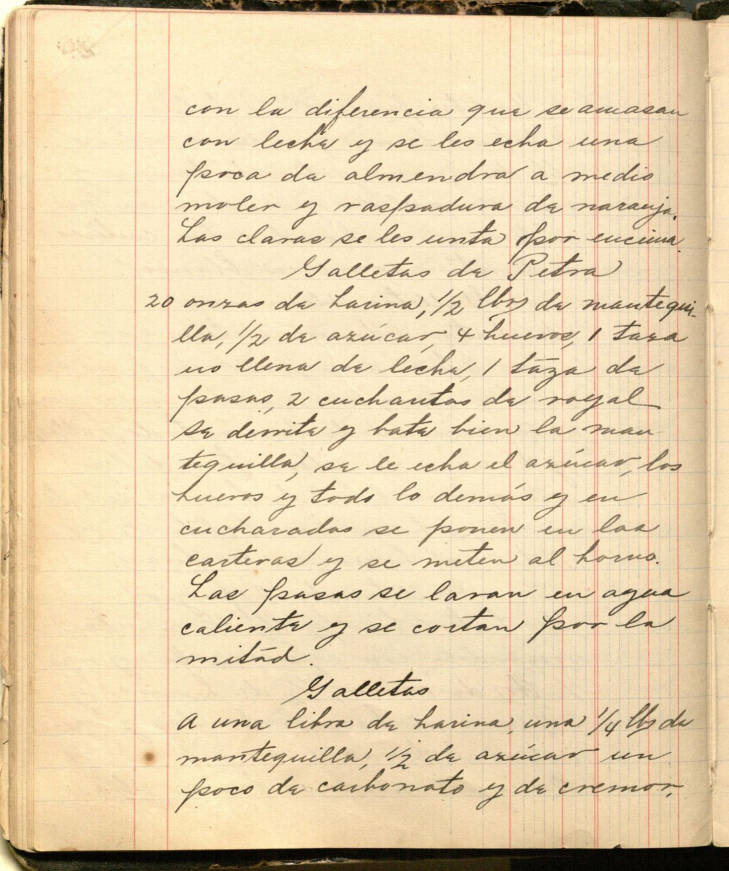
Recipe collections are also sites of cultural exchange and conflict. Such has been the case in the long struggle to define the essence of authentic Mexican food. You can learn more about that argument in our previous post on a collection of traditional (and some not-so-traditional) Mexican cookbooks which are being digitized and put online by researchers at the University of Texas San Antonio (UTSA). Their collection of over 2,000 titles dates from 1789 to the present and represents a vast repository of knowledge for scholars of Mexican cuisine.
But let’s be honest, what most of us want, and need, is a good meal. It just so happens, as chefs now serving curbside will tell you, that the best cooking (and baking) learns from the cooking of the past. In observance of the times we live in, the UTSA Libraries Special Collections has curated many of the historic Mexican recipes in their collection as what they call “a series of mini-cookbooks” titled “Recetas: Cocindando en los Tiempos del Coronavirus.”
Because many in our communities have found themselves in the kitchen during the COVID-19 pandemic during stay-at-home orders, we hope to share the collection and make it even more accessible to those looking to explore Mexican cuisine.
These recipes, now being made available as e‑cookbooks, have been transcribed and translated from handwritten manuscripts by archivists who are passionate about this food. Perhaps in honor of Laura Esquivel’s Like Water for Chocolate—whose novel “paints a narrative of family and tradition using Mexico’s deep connection to cuisine”—the collection has “saved the best for first” and begun with the dessert cookbook. They’ll continue the reverse order with Volume 2, main courses, and Volume 3, appetizers & drinks.
Endorsed by Chef Torres, the first mini-cookbook modernizes and translates the original Spanish into English, and is available in pdf or epub. It does not modernize more traditional ways of cooking. As the Preface points out, “many of the manuscript cookbooks of the early 19th century assume readers to be experienced cooks.” (It was not an occupation undertaken lightly.) As such, the recipes are “often light on details” like ingredient lists and step-by-step instructions. As Atlas Obscura notes, the recipe above for “ ‘Petra’s cookies’ calls for “‘one cup not quite full of milk.’ ”
“We encourage you to view these instructions as opportunities to acquire an intuitive feel for your food,” the archive writes. It’s good to learn new habits. Whatever else it is now—community service, chore, an exercise in self-reliance, self-improvement, or stress relief—cooking is also creating new ways of remembering and connecting across new distances of time and space, working with the raw materials we have at hand. Download the first Volume of the UTSA cookbook series, Postres: Guardando Lo Mejor Para el Principio, here and look for more “Cooking in the Time of Coronavirus” recipes coming soon.

Related Content:
An Archive of Handwritten Traditional Mexican Cookbooks Is Now Online
An Archive of 3,000 Vintage Cookbooks Lets You Travel Back Through Culinary Time
Josh Jones is a writer and musician based in Durham, NC. Follow him at @jdmagness
Read More...Édith Piaf’s Moving Performance of ‘La Vie en Rose’ on French Television (1954)
Édith Piaf’s life was anything but rosy. Born in a Parisian slum, she was abandoned by her mother and lived for awhile in a brothel run by her grandmother. As a teenager she sang on the streets for money. She was addicted to alcohol and drugs for much of her life, and her later years were marred by chronic pain. Through it all, Piaf managed to hold onto a basically optimistic view of life. She sang with a lyrical abandon that seemed to transcend the pain and sorrow of living.
On April 3, 1954 Piaf was the guest of honor on the French TV show La Joie de Vivre. She was 38 years old but looked much older. She had recently undergone a grueling series of “aversion therapy” treatments for alcoholism, and was by that time in the habit of taking morphine before going onstage. Cortisone treatments for arthritis made the usually wire-thin singer look puffy. But when Piaf launches into her signature song, “La Vie en Rose” (see above), all of that is left behind.
Nine years after this performance, when Piaf died, her friend Jean Cocteau said of her: “Like all those who live on courage, she didn’t think about death–she defied it. Only her voice remains, that splendid voice like black velvet.”
Note: An earlier version of this post originally appeared on our site in February 2013.
If you would like to support the mission of Open Culture, consider making a donation to our site. It’s hard to rely 100% on ads, and your contributions will help us continue providing the best free cultural and educational materials to learners everywhere. You can contribute through PayPal, Patreon, and Venmo (@openculture). Thanks!
Related Content:
Iggy Pop Sings Edith Piaf’s “La Vie En Rose” in an Artfully Animated Video
Serge Gainsbourg & Brigitte Bardot Perform Outlaw-Inspired Love Song, ‘Bonnie and Clyde’ (1968)
French Couple Sings an Achingly Charming Version of VU’s “Femme Fatale”
Read More...Hear the Cristal Baschet, an Enchanting Organ Made of Wood, Metal & Glass, and Played with Wet Hands
Playing a musical instrument with wet hands usually falls somewhere between a bad idea and a very bad idea indeed. The Cristal Baschet, however, requires its players to keep their hands wet at all times, and that’s hardly the only sense in which it’s an exceptional musical instrument. Have a listen to the performance above, Erik Satie’s Gnossienne No. 1 by Marc Antoine Millon and Frédéric Bousquet, and you’ll understand at once how exceptional it sounds. Both ideally suited to Satie’s composition and like nothing else in the history of music — a history which may ultimately remember it as, among other things, one of the most French musical devices ever created.
“It was invented in France, so perhaps that’s why I have one,” says composer Marc Chouarain as he prepares to demonstrate his Cristal Baschet in the video above. “I put water on my finger and I have to put pressure on the glass rods, and the sound is amplified.” That amplification happens, like every other process within the instrument, without the involvement of electricity. Despite being fully acoustic, the Cristal Baschet produces sounds so loud and otherworldly that few could hear them without instinctively imagining a sci-fi movie to go along with the soundtrack.
Perhaps it’s no coincidence that Chouarain is a film composer, nor that the Cristal Baschet was invented in the early 1950s, when the cinematic visions of the future as we know them began to take shape. That era also saw the dawn of musique concrète (1964), with its use of recorded sounds as compositional elements, and the influence of the early Moog synthesizer, which would go on to change the sound of music forever. What influence the brothers Bernard and François Baschet expected of the Cristal Baschet when they invented it is unclear, but it has surely left more of a legacy than their other creations like the inflatable guitar and aluminum piano.
“Ravi Shankar, Damon Albarn (Gorillaz), Daft Punk, Radiohead, Tom Waits, and Manu Dibango are among the musical acts who have used the Cristal Baschet,” writes Colossal’s Andrew Lasane, citing the official Baschet Sound Structures Association brochure. The instrument also continues to get respect from adventurous film composers like Cliff Martinez, who tickles the glass rods in the video above. According to an interview at Vulture, Martinez first encountered the instrument when composing for the Steven Soderbergh remake of Andrei Tarkovsky’s Solaris. He seems to have become a serious Cristal Baschet fan since: the video’s notes mentions that he now “incorporates the instrument in all of his scores,” for more pictures by Soderbergh, as well as by Nicolas Winding Refn — another director of possessed of distinctive visions, and thus always in need of sounds to match.
via Colossal
Related Content:
Hear a 9,000 Year Old Flute—the World’s Oldest Playable Instrument—Get Played Again
How the Moog Synthesizer Changed the Sound of Music
Based in Seoul, Colin Marshall writes and broadcasts on cities, language, and culture. His projects include the book The Stateless City: a Walk through 21st-Century Los Angeles and the video series The City in Cinema. Follow him on Twitter at @colinmarshall, on Facebook, or on Instagram.
Read More...Watch Manhatta, the First American Avant-Garde Film (1921)
Every city needs its ideal observer. Moreover, a city needs an ideal observer for each of its eras, and ideally each of its eras will have an ideal observer in each major medium. Booming with industry in the mid-19th century and daily absorbing more of what must have seemed like the entire world, New York fairly demanded the celebratory poetic capacity of Walt Whitman. In time, Whitman’s 1860 poem “Mannahatta” would inspire two visual artists to capture the city in another time, and through a brand new medium. Begun in 1920 as a collaboration by photographer-painter Charles Sheeler and photographer Paul Strand, Manhatta (note the slightly different spelling) made cinematic history as the first American avant-garde film.
It also delivered a kind overture for the “city symphony,” a genre of film that would, over the rest of the decade, test the potential of the motion picture by using it to capture the unprecedented dynamism of metropolises around the world. (You can see many more of them here at Open Culture.)
Manhatta is poetic in its use of imagery — Strand, after all, was the author of the iconic 1915 photograph Wall Street, New York — but as the Museum of Modern Art says, “for all its art, Manhatta is also documentary. It leads viewers through a day in the life of Manhattan, introduced by lines from one of Whitman’s many odes to his beloved home: ‘City of the world (for all races are here) / City of tall facades of marble and iron, / Proud and passionate city.’ ”
Whitman’s words appear on intertitles throughout the film, paying tribute to “the shovel, the derrick, the wall scaffold, the work of walls and ceilings” and “shapes of the bridges, vast frameworks, girders, arches” between shots of New York Harbor, the Staten Island Ferry terminal, the Brooklyn Bridge, and other of the city’s marvels of infrastructure and architecture. (Above, thanks to Aeon, you can watch a digitally-restored version of Manhatta, with a newly commissioned score by composer William Pearson.) The last of these 65 shots captures a sunset view from a skyscraper, a kind of building that Whitman, who died in 1892, would scarcely have imagined. But he surely believed that this “modern Babylon-on-the-Hudson,” as Manhatta bills it, would never cease to grow fuller, taller, and mightier, taking forms in the future unpredictable even by the ideal observers of its past.
Manhatta will be added to our collection, 4,000+ Free Movies Online: Great Classics, Indies, Noir, Westerns, Documentaries & More.
Related Content:
Great New Archive Lets You Hear the Sounds of New York City During the Roaring 20s
1905 Video Shows New York City Subway Traveling From 14th St. to 42nd Street
Eight Free Films by Dziga Vertov, Creator of Soviet Avant-Garde Documentaries
Based in Seoul, Colin Marshall writes and broadcasts on cities, language, and culture. His projects include the book The Stateless City: a Walk through 21st-Century Los Angeles and the video series The City in Cinema. Follow him on Twitter at @colinmarshall, on Facebook, or on Instagram.
Read More...How Ornette Coleman Freed Jazz with His Theory of Harmolodics
The term free jazz may have existed before Ornette Coleman’s The Shape of Jazz to Come arrived in 1959. Yet, however innovative the modal experiments of Coltrane or Davis, jazz still adhered to its most fundamental formulas before Coleman. “Conventional jazz harmony is religiously chord-based,” writes Josephine Livingstone at New Republic, “with soloists improvising within each key like balls pinging through a pinball machine. Coleman, in contrast, imagined harmony, melody, and rhythm as equal constituents.”
This philosophy, jazz critic Martin Williams wrote upon hearing Coleman’s debut, was necessary to free jazz from its formal constraints. “Someone had to break through the walls that those harmonies have built and restore melody.” Melody was everything to Coleman—even drummers can play like melodic instrumentalists. In a 1987 interview, he described how Ed Blackwell “plays the drums as if he’s playing a wind instrument. Actually, he sounds more like a talking drum. He’s speaking a certain language that I find is very valid in rhythm instruments.”
Coleman connected his musical theory back to the origins of rhythmic music: “the drums, in the beginning, used to be like the telephone—to carry the message.” Interviewer Michael Jarrett ventures that Coleman’s ensemble recordings are more like a “party line,” to which the saxophonist agrees. Music, he believed, was a radically democratic—“beyond democratic”—form of communication. “If you decided to go out today and get you an instrument,” he says, “and do whatever it is that you do, no one can tell you how you’re going to do it but when you do it.”
This approach seemed irresponsible to many of Coleman’s peers. Alto saxophonist Jackie McLean described the general reaction as “spend[ing] your whole life making a three-piece suit that’s incredible, and this guy comes along with a jumpsuit, and people find that it’s easier to step into a jumpsuit than to put on three pieces.” Collective improvisation, however, cannot in any way be described as “easy,” and Coleman was a brilliant player who could do it all.
“I could play and sound like Charlie Parker note-for-note,” he has said, “but I was only playing it from method. So I tried to figure out where to go from there,” Loosening the constrictions did not mean that Coleman lacked “requisite virtuosity,” as Maria Golia writes in a new Coleman biography. Instead, he “proposed an alternative means for its expression.” (In Thomas Pynchon’s V, a character says of a Coleman-like saxophonist, “he plays all the notes Bird missed.”) This emerged in experimental improvisations like 1961’s landmark Free Jazz, an album that “practically defies superlatives in its historical importance,” Steve Huey writes at Allmusic.
The album features players like Blackwell, Don Cherry, and Eric Dolphy in a “double-quartet format,” with two rhythm sections playing simultaneously, one on the right stereo channel, one on the left. Composed on the spot, “there was no road map for this kind of recording.” But there was a theory that held it all together. Coleman eventually called the theory “Harmolodics,” a word that sums up his ideas about the equality of rhythm, harmony, and melody—a compositional method that freed jazz from its dependence on European forms and returned it, in a way, to its roots in a call-and-response tradition.
Coleman described his long-simmering ideas in a 1983 manifesto titled “Prime Time for Harmolodics.” The title references the band, Prime Time, he formed in 1975 that featured two bassists, two guitarists, and—like his ensemble on Free Jazz, or like the Grateful Dead—two drummers. Jerry Garcia joined the band for its 1988 album Virgin Beauty, expanding Coleman’s fanbase—already significant in various rock circles—to Deadheads. (See Prime Time in Germany in 1981 below.) Harmolodic playing could be dissonant, atonal, and cacophonous, and it could be sublime, often in the same moment.
Simultaneity, radical democracy, intimate communication—these were the principles of “unison” that Coleman found essential to his improvisations.
Question: “Where can/will I find a player who can read (or not read) who can play their instrument to their own satisfaction and accept the challenge of the music environment?” For Harmolodic Democracy — the player would need the freedom to express what Harmolodic information they found to work in composed music. There is always a rhythm — melody — harmony concept. All ideas have lead resolutions. Each player can choose any of the connections from the composers work for their personal expression, etc. Prime Time is not a jazz, classical, rock or blues ensemble. It is pure Harmolodic where all forms that can, or could exist yesterday, today, or tomorrow can exist in the now or moment without a second.
In harmolodic improvisation musicians contribute equally on their own terms, Coleman believed. “From Ornette’s point of view,” writes Robert Palmer in liner notes to the Complete Atlantic Recordings, “each contribution is equally essential to the whole. One tends to hear the horn player as a soloist, backed by a rhythm section, but this is not Coleman’s perspective. ‘In the music we play,’ he said of the performances collected in this box, ‘no one player has the lead. Anyone can come out with it at any time.’ ” Jerry Garcia remembers feeling confused when first recording with the saxophonist. “Finally,” says Garcia, “he said, ‘Oh, just go ahead and play, man.’ And I thought, ‘Oh, I get it now.’”
But of course, Garcia was the kind of musician who could “just go ahead and play.” This was the essential element, and it was here, perhaps, that Coleman differed least from his fellow jazz artists—in his sense of having just the right ensemble. “You really have to have players with you who will allow your instincts to flourish in such a way that they will make the same order as if you had sat down and written a piece of music,” he writes. “To me, that is the most glorified goal of the improvising quality of playing – to be able to do that.”
In “harmolodic democracy” no one ever takes the lead, or not for long, and there are no “sidemen.” Rather than following a chord chart or bandleader, the musicians must all listen closely to each other. Conventional riffs and progressions pop up, only to veer wildly in unexpected directions. “Its clear that [harmolodics] is based on taking motifs,” says avant-garde guitarist Marc Ribot, “and freeing it up to become polytonal, melodically and rhythmically.” Rather than abandoning form, Coleman invented new ways to compose and new ways, he wrote, to play.
I was out at Margaret Mead’s school and was teaching some kids how to play instantly. I asked the question, ‘How many kids would like to play music and have fun?’ And all the little kids raised up their hands. And I asked,‘Well, how do you do that?’ And one little girl said, ‘You just apply your feelings to sound.’ She was right — if you apply your feelings to sound, regardless of what instrument you have, you’ll probably make good music.
Coleman formed a label called Harmolodic in 1995 with his son and drummer Denardo. In 2005, he recorded the live album Sound Grammar in Germany, which would go on to win a Pulitzer Prize two years later. The record became the first release on his new label, also called Sound Grammar, and represented a refinement of the harmolodic theory, now called “sound grammar,” in which Coleman re-emphasizes the importance of music as the ur-form of human communication. “Music,” he says, “is a language of sounds that transforms all human languages.”
Related Content:
How Ornette Coleman Shaped the Jazz World: An Introduction to His Irreverent Sound
Josh Jones is a writer and musician based in Durham, NC. Follow him at @jdmagness.
Read More...When Astronomer Johannes Kepler Wrote the First Work of Science Fiction, The Dream (1609)
The point at which we date the birth of any genre is apt to shift depending on how we define it. When did science fiction begin? Many cite early masters of the form like Jules Verne and H.G. Wells as its progenitors. Others reach back to Mary Shelley’s 1818 Frankenstein as the genesis of the form. Some few know The Blazing World, a 1666 work of fiction by Margaret Cavendish, Duchess of Newcastle, who called her book a “hermaphroditic text.” According to the judgment of such experts as Isaac Asimov and Carl Sagan, sci-fi began even earlier, with a novel called Somnium (“The Dream”), written by none other than German astronomer and mathematician Johannes Kepler. Maria Popova explains at Brain Pickings:
In 1609, Johannes Kepler finished the first work of genuine science fiction — that is, imaginative storytelling in which sensical science is a major plot device. Somnium, or The Dream, is the fictional account of a young astronomer who voyages to the Moon. Rich in both scientific ingenuity and symbolic play, it is at once a masterwork of the literary imagination and an invaluable scientific document, all the more impressive for the fact that it was written before Galileo pointed the first spyglass at the sky and before Kepler himself had ever looked through a telescope.
The work was not published until 1634, four years after Kepler’s death, by his son Ludwig, though “it had been Kepler’s intent to personally supervise the publication of his manuscript,” writes Gale E. Christianson. His final, posthumous work began as a dissertation in 1593 that addressed the question Copernicus asked years earlier: “How would the phenomena occurring in the heavens appear to an observer stationed on the moon?” Kepler had first come “under the thrall of the heliocentric model,” Popova writes, “as a student at the Lutheran University of Tübingen half a century after Copernicus published his theory.”
Kepler’s thesis was “promptly vetoed” by his professors, but he continued to work on the ideas, and corresponded with Galileo 30 years before the Italian astronomer defended his own heliocentric theory. “Sixteen years later and far from Tübingen, he completed an expanded version,” says Andrew Boyd in the introduction to a radio program about the book. “Recast in a dreamlike framework, Kepler felt free to probe ideas about the moon that he otherwise couldn’t.” Not content with cold abstraction, Kepler imagined space travel, of a kind, and peopled his moon with aliens.
And what an imagination! Inhabitants weren’t mere recreations of terrestrial life, but entirely new forms of life adapted to lunar extremes. Large. Tough-skinned. They evoked visions of dinosaurs. Some used boats, implying not just life but intelligent, non-human life. Imagine how shocking that must have been at the time.
Even more shocking to authorities were the means Kepler used in his text to reveal knowledge about the heavens and travel to the moon: beings he called “daemons” (a Latin word for benign nature spirits before Christianity hijacked the term), who communicated first with the hero’s mother, a witch practiced in casting spells.
The similarities between Kepler’s protagonist, Duracotus, and Kepler himself (such as a period of study under Danish astronomer Tycho Brahe) led the church to suspect the book was thinly veiled autobiographical occultism. Rumors circulated, and Kepler’s mother was arrested for witchcraft and subjected to territio verbalis (detailed descriptions of the tortures that awaited her, along with presentations of the various devices). It took Kepler five years to free her and prevent her execution.
Kepler’s story is tragic in many ways, for the losses he suffered throughout his life, including his son and his first wife to smallpox. But his perseverance left behind one of the most fascinating works of early science fiction—published hundreds of years before the genre is supposed to have begun. Despite the fantastical nature of his work, “he really believed,” says Sagan in the short clip from Cosmos above, “that one day human beings would launch celestial ships with sails adapted to the breezes of heaven, filled with explorers who, he said, would not fear the vastness of space.”
Astronomy had little connection with the material world in the early 17th century. “With Kepler came the idea that a physical force moves the planets in their orbits,” as well as an imaginative way to explore scientific ideas no one would be able to verify for decades, or even centuries. Hear Somnium read at the top of the post and learn more about Kepler’s fascinating life and achievements at Brain Pickings.
Related Content:
The Encyclopedia of Science Fiction: 17,500 Entries on All Things Sci-Fi Are Now Free Online
Free Science Fiction Classics Available on the Web (Updated)
Josh Jones is a writer and musician based in Durham, NC. Follow him at @jdmagness
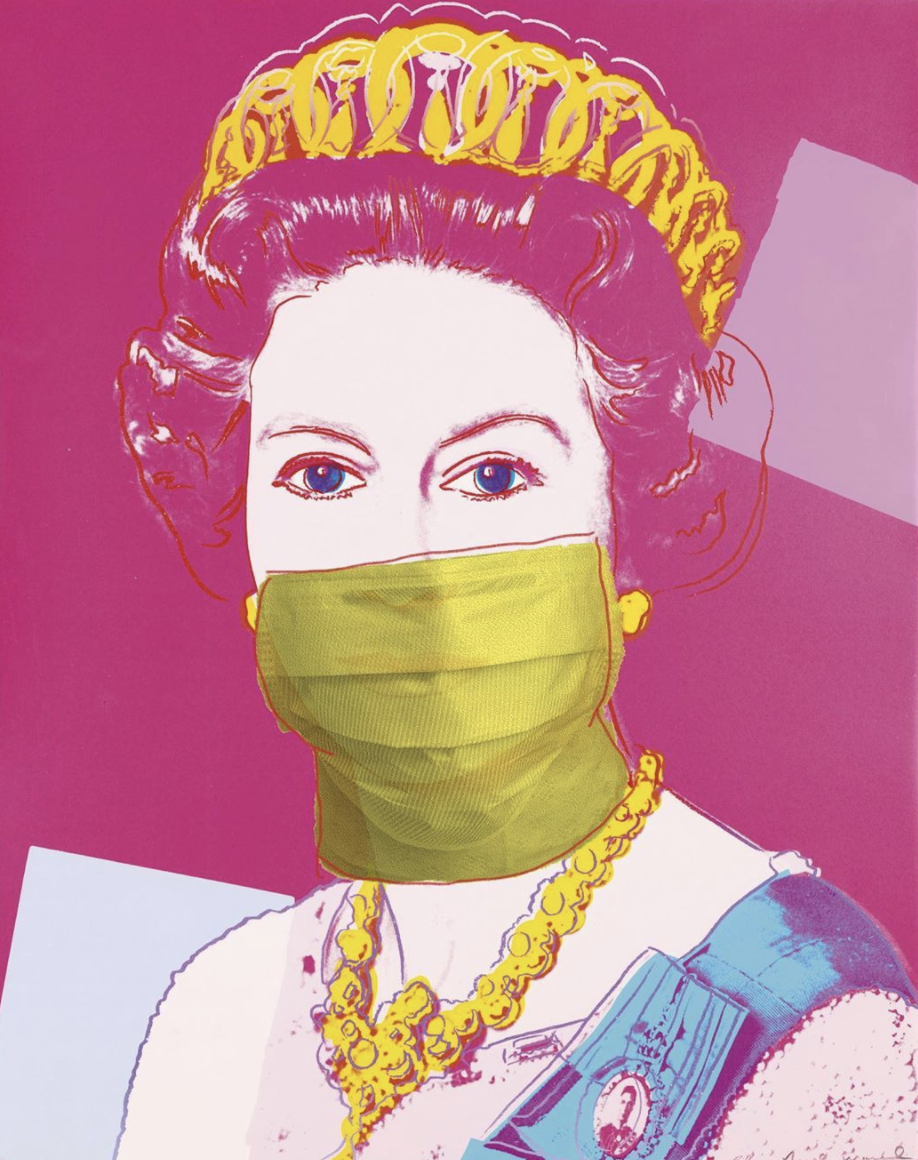
Read More...Icons of Art Wearing Masks: Frida Kahlo, Mona Lisa, Girl with the Pearl Earring & More
We hear the phrase “unprecedented times” every day now, but the truth is few calamities in human history are more precedented than plagues and pestilences. In Western history, at least, disease epidemics seem always to have been followed by Machiavellian opportunism and cultish conspiracy theories that only made things worse.
During the 14th century, almost six hundred years before Naomi Klein defined the shock doctrine, the Black Death “strengthened the power of the state and accelerated the domination of key markets by a handful of large companies,” write Eleanor Russell and Martin Parker at The Conversation (hello, Amazon). In their argument, disaster capitalism may have preceded actual capitalism, and it started with the plague.

In his history of the Great Plague of 1665, Daniel Defoe described how “everyone behaved badly, though the rich behaved the worst,” as Jill Lepore writes at The New Yorker, forcing their servants to put their lives at risk to provision the great houses. “This Necessity…,” writes Defoe, “was in a great Measure the Ruin of the whole City,” though few in London then understood how to slow transmission of the disease.
That was not the case when the Influenza epidemic took the lives of hundreds of millions around the world between 1918 and 1920. Doctors understood how the flu spread and recommended that everyone wear a mask in public. Cities passed ordinances and immediately resistance sprang up, leading to organizations like San Francisco’s Anti-Mask League, whose rhetoric sounds like that of anti-mask protestors of today.
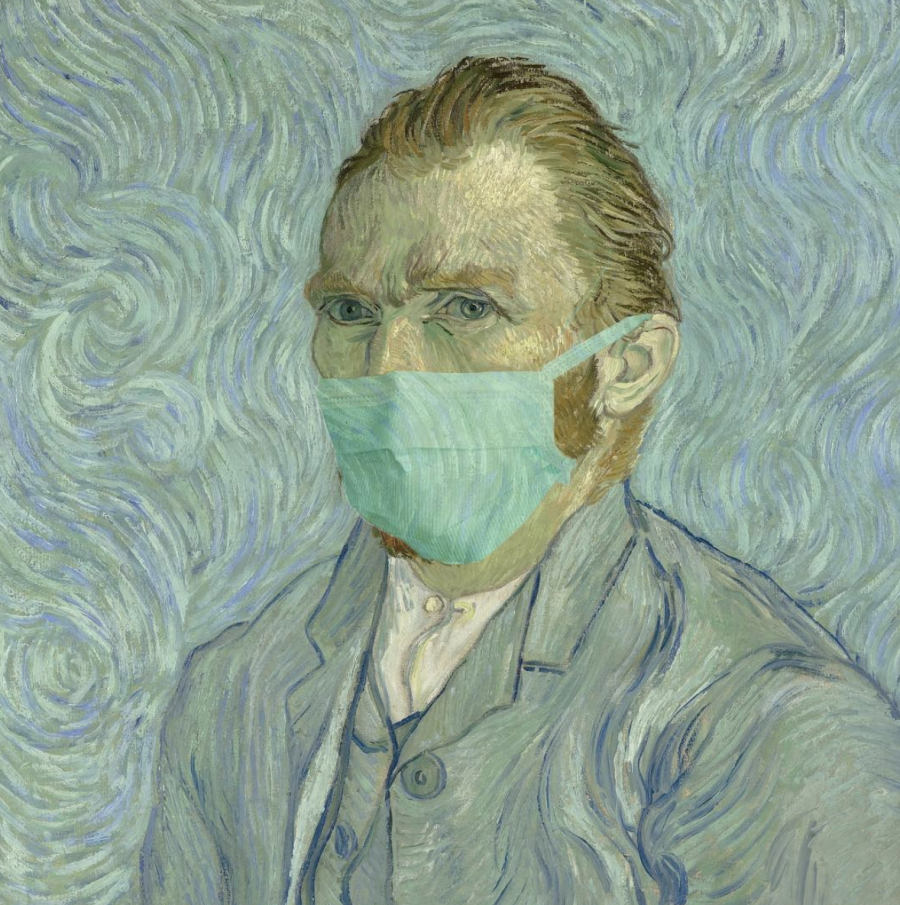
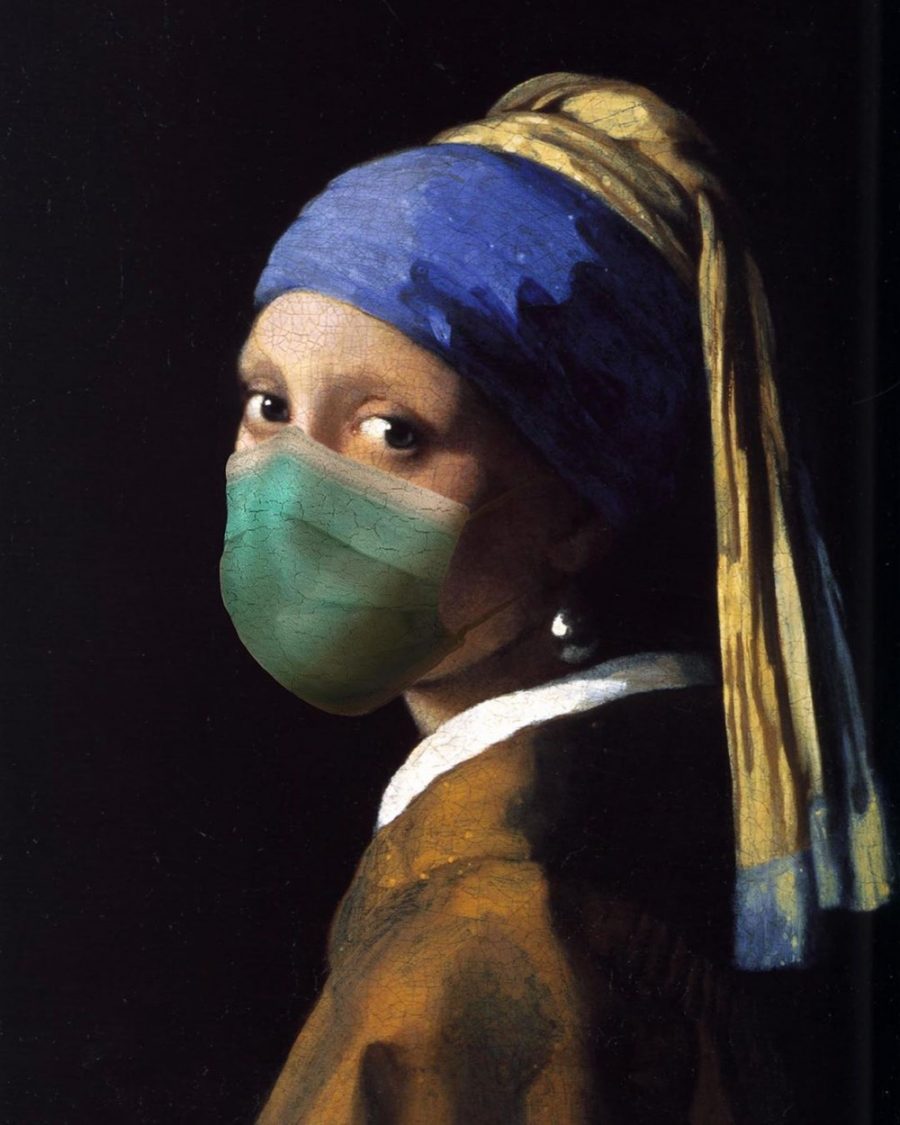
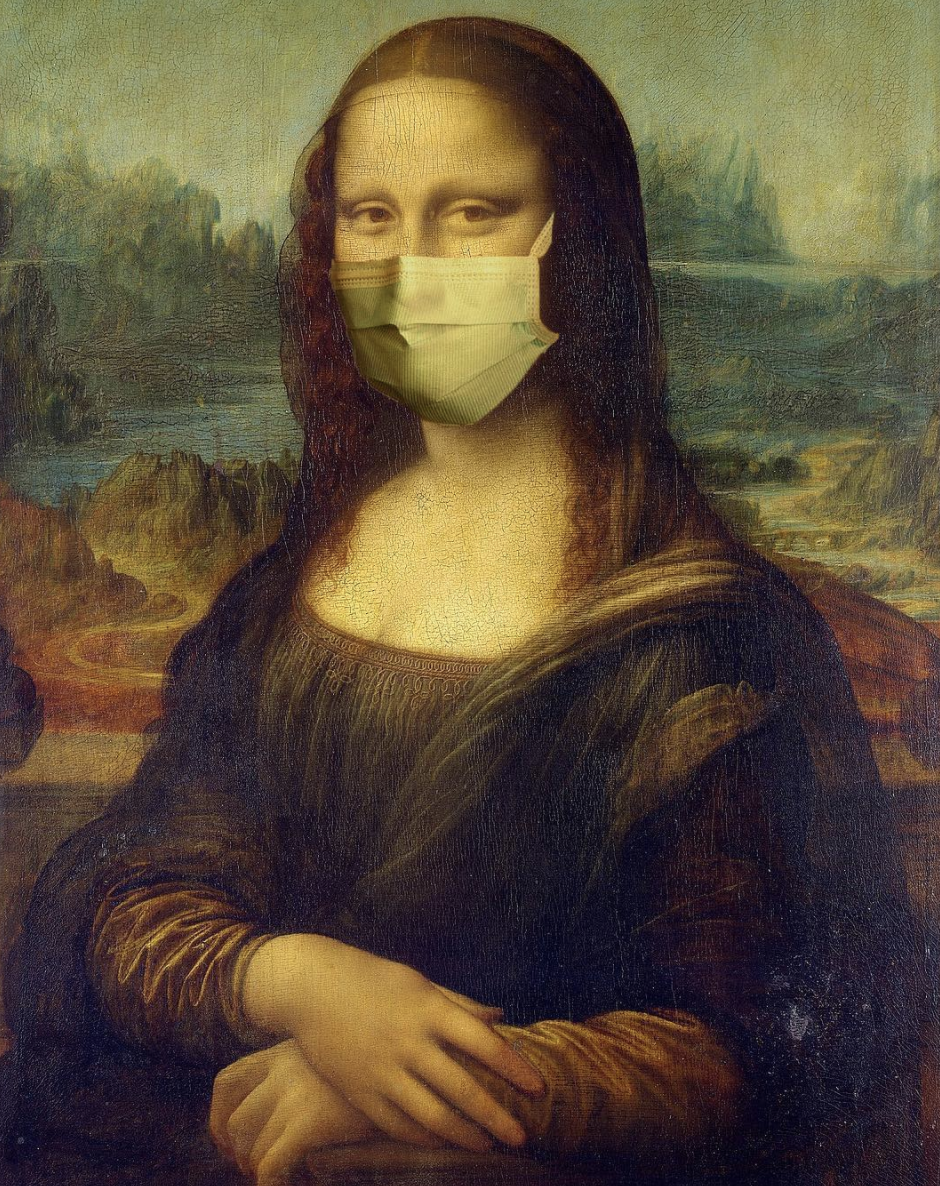
The times may be unique—for the speed at which COVID-19 spread around the world, for instance, along with the disinformation—but humans have lived through many versions of pandemic, and many disastrously selfish, opportunistic, and short-sighted responses to it. We may contemplate these historical repetitions as we admire the Instagram creations of artist Genevieve Blais, who has been posting images of famous paintings, statues, and photographs with their subjects wearing masks.
More than novelty memes or highbrow public service announcements, Blais’ creations are part-whimsical/part-sobering reminders of the persistence of plagues throughout history—their influence on the rise and fall of dynasties and powerful patrons, and the ignorance and folly that led to so much preventable death. Technologically speaking, humans are better positioned than ever before to combat epidemics of disease. But it’s worth remembering the precedents for our current conditions. Plagues have shaped human history. We don’t always have to respond to them the same way. See all of Blais’s masked fine art images at her Plague History Instagram page. If you DM her, she will make you a print.

via Kottke
Related Content:
What Happened When Americans Had to Wear Masks During the 1918 Flu Pandemic
Download Classic Works of Plague Fiction: From Daniel Defoe & Mary Shelley, to Edgar Allan Poe
Josh Jones is a writer and musician based in Durham, NC. Follow him at @jdmagness
Read More...Support Us
We're hoping to rely on loyal readers, rather than erratic ads. Please click the Donate button and support Open Culture. You can use Paypal, Venmo, Patreon, even Crypto! We thank you!

About Us

Open Culture scours the web for the best educational media. We find the free courses and audio books you need, the language lessons & educational videos you want, and plenty of enlightenment in between.
Advertise With Us

FREE UPDATES!
GET OUR DAILY EMAIL
Get the best cultural and educational resources on the web curated for you in a daily email. We never spam. Unsubscribe at any time.
FOLLOW ON SOCIAL MEDIA

Open Culture editor Dan Colman scours the web for the best educational media. He finds the free courses and audio books you need, the language lessons & movies you want, and plenty of enlightenment in between.
Advertise With Us

