An Archive of Handwritten Traditional Mexican Cookbooks Is Now Online
“The search for authentic Mexican food—or rather, the struggle to define what that meant—has been going on for two hundred years,” writes Jeffrey Pilcher at Guernica. Arguments over national cuisine first divided into factions along historical lines of conquest. Indigenous, corn-based cuisines were pitted against wheat-based European foods, while Tex-Mex cooking has been “industrialized and carried around the world,” its processed commodification posing an offense to both indigenous peoples and Spanish elites, who themselves later “sought to ground their national cuisine in the pre-Hispanic past” in order to fend off associations with globalized Mexican food of the chain restaurant variety.
Stephanie Noell, Special Collections Librarian at the University of Texas San Antonio (UTSA), explains how these lines were drawn centuries earlier during the “culinary cultural exchange” of the colonial period: “[C]onquistador Bernal Diaz del Castillo referred to corn dishes as the ‘misery of maize cakes.’ On the other side, the Nahuas were not impressed by the Spaniards’ wheat bread, describing it as ‘famine food.’” Whatever we point to—corn, wheat, etc.—and call “Mexican food,” we are sure to be corrected by someone in the know.
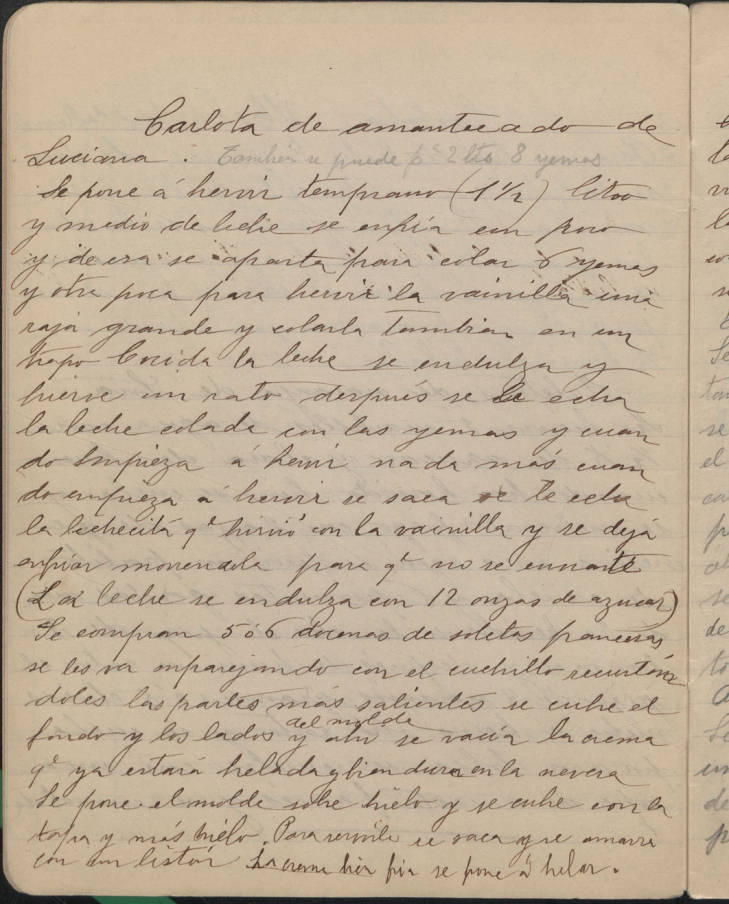
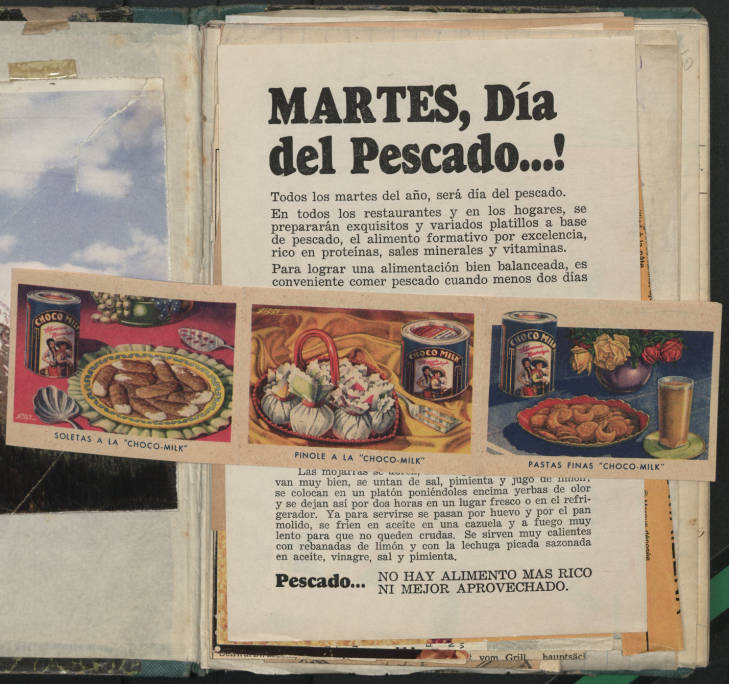
Cooking, as everyone knows, is not only regional and political, but also deeply personal– tied to family gatherings and passed through generations in handwritten recipes, sometimes jealously guarded lest they be stolen and turned into fast food. But thanks to UTSA Libraries, we have access to hundreds of such recipes. An initial donation of 550 cookbooks has grown to include “over 2,000 titles in English and Spanish,” notes UTSA, “documenting the history of Mexican cuisine from 1789 to the present, with most books dating from 1940–2000.” Many of the books, like that below from 1960, consist of handwritten content next to cut-and-paste recipes and ideas from magazines.
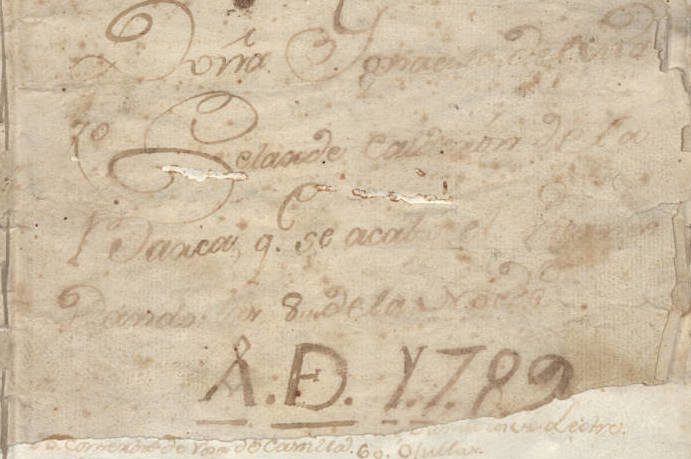
The collection spans “regional cooking, healthy and vegetarian recipes, corporate advertising cookbooks, and manuscript recipe books.” The oldest cookbook, belonging to someone named “Doña Ignacita,” whom Noell believes to have been the kitchen manager of a wealthy family, “is a handwritten recipe collection in a notebook,” writes Nils Bernstein at Atlas Obscura, “complete with liquid stains, doodles, and pages that naturally fall open to the most-loved recipes.” Like the other manuscript cookbooks in the collection, “never intended for public scrutiny,” this one “provides essential insight on how real households cooked on a regular basis.”
“I’ve had students in tears going through these,” says Noell, “because it’s so powerful to see that connection with how their family makes certain dishes and where they originated.” On the other hand, we also have generic “Corporate Cookbooks” like Recetario Bimbo, a book of sandwich recipes from the well-known bread company Bimbo. Recent publications like the ultra-hip, 2017 Fiesta: Vegan Mexican Cookbook, which promises “over 75 authentic vegan-Mexican food recipes included,” strain the word “authentic” to its breaking point. (“Want to feel all the great benefits from the ketogenic diet?” the book’s blurb asks, a question that probably never occurred to either Aztecs or Conquistadors.)
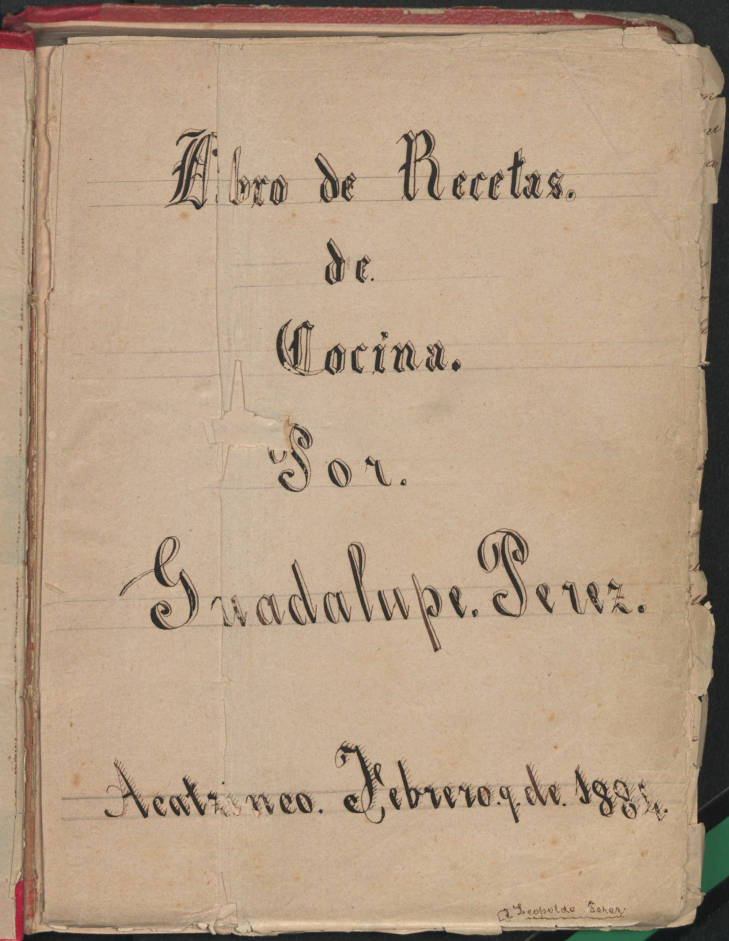
The UTSA Mexican Cookbooks collection is open to the public and anyone can visit it in person, but Noell wants “anybody with an internet connection to be able to see these works.” UTSA has been busy digitizing the 100 manuscript cookbooks in the collection, and has scanned about half so far, with Doña Ignacita’s 1789 notebook coming soon. While these aren’t likely to resolve debates about what constitutes authentic Mexican cooking—as if such a thing existed in a monolithic, timeless form—they are sure to be of very keen interest to chefs, home cooks, historians, and enthusiasts of the history of Mexican food. Enter the digital collection of manuscript cookbooks here.
Related Content:
An Archive of 3,000 Vintage Cookbooks Lets You Travel Back Through Culinary Time
The Futurist Cookbook (1930) Tried to Turn Italian Cuisine into Modern Art
Josh Jones is a writer and musician based in Durham, NC. Follow him at @jdmagness
Read More...36,000 Flash Games Have Been Archived and Saved Before Flash Goes Extinct: Play Them Offline
Adobe has announced that the Flash Player will come to the official end of its life on the last day of this year, December 31, 2020. News of the demise of an obsolete internet multimedia platform presumably bothers few of today’s web-surfers, but those of us belonging to a certain generation feel in it the end of an era. First introduced by Macromedia in 1996, Flash made possible the kind of animation and sound we’d seldom seen and heard — assuming we could manage to load it through our sluggish connections at all — on the internet before. By the early 2000s, Flash seemed to power most everything fun on the internet, especially everything fun to the kids then in middle and high school who’d grown up alongside the World Wide Web.
Though now deep into adulthood, we all remember the hours of the early 21st century we happily whiled away on Flash games, racing cars, solving puzzles, shooting zombies, dodging comets, firing cannons, and piloting helicopters on classroom computers. We could, in theory, find many of these games and play them still today, but that may become impossible next year when all major web browsers will discontinue their support for Flash.
“That’s where Flashpoint comes in to save a huge chunk of gaming history,” writes Kotaku’s Zack Zwiezen. “Flashpoint uses open-source tech to allow folks to download and play a large list of games and animations. The full list contains just over 36,000 games and you can suggest new games to be added if something you love isn’t on here.”
On Flashpoint’s download page you’ll find its full 290-gigabyte collection of Flash games, as well as a smaller version that only downloads games as you play them. “While Flash games might not be as impressive today, they are still an important part of gaming history,” writes Zwiezen. “These small web games can be directly linked to the later rise of mobile and indie games and helped many creators get their feet wet with building and creating video games.” In other words, the simple Flash amusements of our schooldays gave rise to the graphically and sonically intense games that we play so compulsively today. Now we have kids who play those sorts of games too, but who among us will initiate the next generation into the ways of Crush the Castle, Age of War, and Bubble Trouble?
You can find more information on the flash video game archive on this FAQ page.
via Kotaku
Related Content:
1,100 Classic Arcade Machines Added to the Internet Arcade: Play Them Free Online
Based in Seoul, Colin Marshall writes and broadcasts on cities, language, and culture. His projects include the book The Stateless City: a Walk through 21st-Century Los Angeles and the video series The City in Cinema. Follow him on Twitter at @colinmarshall or on Facebook.
Read More...Why the Soviets Doctored Their Most Iconic World War II Victory Photo, “Raising a Flag Over the Reichstag”
No photograph symbolizes American victory more recognizably than Joe Rosenthal’s Pulitzer Prize-winning Raising the Flag on Iwo Jima. Taken on February 23, 1945, it shows six U.S. Marines raising their country’s flag during the battle — a bloody one even by the standards of the Second World War — for control of that Japanese island. The Soviet Union had an equivalent image: Yevgeny Khaldei’s Raising a Flag over the Reichstag, which shows a Russian soldier raising the Soviet flag on the roof of the former German parliament on May 2, 1945, during the Battle of Berlin. The similarities are obvious, but the difference isn’t: the Soviet photo was faked.
To be more specific, Khaldei’s picture was “staged,” and “parts of it were altered before it was published.” So says Vox’s Coleman Lowndes in the video above, which reveals all the pre-Photoshop image manipulation — a specialty of Soviet propagandists even then — performed on Raising a Flag over the Reichstag.
“Khaldei superimposed some black smoke from another photo and manipulated the contrast to give the scene a little more drama,” which in itself may be an understandable choice. But he also erased the wristwatch of one of the soldiers brought in to pose with the flag, a detail you might not notice even holding the original and the doctored version side by side. As Lowndes explains, “The soldier supporting the flag-bearer was wearing two watches, suggesting he had been looting, a stain that didn’t fit the image of Soviet heroism that Stalin wanted.”
A look at the preceding few years of the war goes some way to explaining this. Germany had brutally invaded Russia in 1941, instilling in Russia a thirst for revenge that began to seem satiable when the tables began to turn on Germany the following year. In and on their way to Germany, the Red Army, too, committed crimes against the civilians in their path, looting surely being among the least of them. Raising a Flag over the Reichstag does its job in capturing a moment of Soviet victory, but as Lowndes says, “it also captures, and then conceals, a story of vengeance and mutual brutality, of murder, organized destruction, and pillaging, all culminating in this iconic moment.” And the more iconic the moment, the more potentially revelatory its details — even more so in the case of false ones.
Related Content:
Joseph Stalin, a Lifelong Editor, Wielded a Big, Blue, Dangerous Pencil
The First Faked Photograph (1840)
Based in Seoul, Colin Marshall writes and broadcasts on cities, language, and culture. His projects include the book The Stateless City: a Walk through 21st-Century Los Angeles and the video series The City in Cinema. Follow him on Twitter at @colinmarshall or on Facebook.
Read More...How the Psychedelic Mellotron Works: An In-Depth Demonstration
Recorded music history is filled with instruments that appeared for a brief time, then were never heard from again—relegated to the dustbin of too-quirky, heavy, awkward, tonally-unpleasant, or impossible-to-tune-and-maintain. Then there are instruments—once they assumed their basic shape and form—that have persisted largely unchanged for centuries. The Mellotron falls into neither of these categories. But it may in time transcend them both in a strange way.
“Of all of the strange instruments that’ve worked the edges of popular music,” writes Gareth Branwyn at Boing Boing, “the Mellotron is probably the oddest. Basically an upright organ cabinet filled the tape heads and recorded tape strips that you trigger through the keyboard, the Mellotron is like some crazy one-off contraption that caught on and actually got manufactured.”
First made in England in 1963, it appeared in various models throughout the seventies and eighties. It has reappeared in the nineties and 2000s in improved and upgraded versions, all leading up to what Sound on Sound called “the most technologically sophisticated Mellotron ever,” the 2007 M4000. In the video above Allison Stout from Bell Tone Synth Works, a music shop in Philadelphia, PA, demonstrates a much earlier, far less advanced M400 from 1976.
Not only did the Mellotron beat the odds of remaining an unworkable prototype; the proto-sampler became a psychedelic signature: from “Strawberry Fields Forever” to the Moody Blues and David Bowie’s “Space Oddity.” It populated early prog rock, thanks to Yes’s Rick Wakeman, who played on Bowie’s space rock classic in 1969, and to Ian McDonald, who fell for the instrument that same year as a founding member of King Crimson. (See enthusiastic YouTuber “Doctor Mix” play Mellotron parts from well-known songs above.)
The instrument’s slightly cheesy, Lawrence-Welk-orchestra-like sounds somehow fit perfectly with the loose, spacious instrumentation of prog and psych rock; its sound will live as long as the music of The Beatles, Bowie, and everyone else who put a microphone in front of a Mellotron. Yet in most of its iterations, the Mellotron has lacked the characteristics of a melodic instrument that survives the test of time. It is finicky and prone to frequent breakdowns. It is limited in its tonal range to a series of tape recordings of a limited number of instruments.
In the case of the Mellotron M400 at the top, those instruments are violin, flute, and cello. Do the sounds coming from the Mellotron in any way improve upon or even approximate the qualities of their originals? Of course not. Why would musicians choose to record with a Mellotron at a time when analogue synthesizers were becoming affordable, portable, and capable of an expressive range of tones? The answer is simple. Nothing else makes the weird, warm, warbly, whirring, and entirely otherworldly sound of a Mellotron, and nothing ever will.
Related Content:
Visit an Online Collection of 61,761 Musical Instruments from Across the World
Josh Jones is a writer and musician based in Durham, NC. Follow him at @jdmagness
Read More...The e‑Book Imagined in 1935
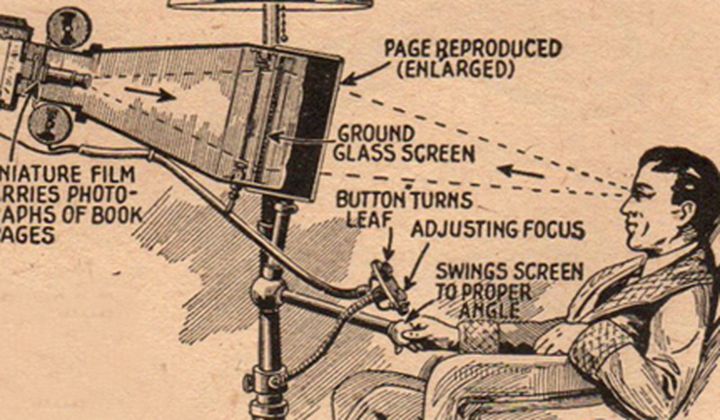
What is the future of the book? Will it retain more or less the same basic paper-between-covers form as it has since the days of the Gutenberg Bible? Will it go entirely digital, becoming readable only with compatible electronic devices? Or will we, in the comfort of our armchairs, read them on glass-screened microfilm projectors? That last is the bet made, and illustrated as above, by the April 1935 issue of Everyday Science and Mechanics magazine. “It has proved possible to photograph books, and throw them on a screen for examination,” says the article envisioning “a device for applying this for home use and instruction,” exhumed by Matt Novak at Smithsonian.com.
As The Atlantic’s Megan Garber writes, “The whole thing, to our TV-and-tablet-jaded eyes, looks wonderfully quaint. (The projector! The knobs! The semi-redundant reading lamp! The smoking jacket!)” But then, “what speaks to our current, hazy dreams of convergence more eloquently than the ability to sit back, relax, and turn books into television?”
And indeed, the original illustration includes a caption telling us how such a device will allow you to “read a ‘book’ (which is a roll of miniature film), music, etc., at your ease.” That may sound familiar to those of us who think nothing of flipping back and forth between books, web sites, movies, television shows, and social media — all to our customized music-and-podcast soundtrack of choice — on our computers, tablets, and phones today.
Everyday Science and Mechanics wasn’t looking into the distant future. As Novak notes, microfilm had been patented in 1895 and first practically used in 1925; the New York Times began copying its every edition onto microfilm in 1935, the same year this article appeared. As impractical as it may look now, this home “e‑reader” could theoretically have been put into use not long thereafter. As it happened, the first e‑readers — the handheld digital ones of the kind we know today — wouldn’t come on the market for another 70 years, and their widespread adoption has only occurred in the past decade. But for many, good old Gutenberg-style paper-between-covers remains the way to read. It may be that the book has no one future form, but a variety that will exist at once — a variety that, absent a much stronger retrofuturism revival, will probably not include microfilm, ground-glass screens, and smoking jackets.
via Smithsonian.com
Related Content:
Readers Predict in 1936 Which Novelists Would Still Be Widely Read in the Year 2000
1930s Fashion Designers Predict How People Would Dress in the Year 2000
Did Stanley Kubrick Invent the iPad in 2001: A Space Odyssey?
Napoleon’s Kindle: See the Miniaturized Traveling Library He Took on Military Campaigns
Based in Seoul, Colin Marshall writes and broadcasts on cities, language, and culture. His projects include the book The Stateless City: a Walk through 21st-Century Los Angeles and the video series The City in Cinema. Follow him on Twitter at @colinmarshall or on Facebook.
Read More...The Secret of the “Perfect Montage” at the Heart of Parasite, the Korean Film Now Sweeping World Cinema
For nearly as long as mankind has tried to commit the perfect crime, mankind has tried to tell stories of the perfect crime. Both endeavors demand intensive planning, the story of the crime perhaps even more rigorously so than the crime itself. No less obsessive a teller and reteller of “perfect crime” stories than Alfred Hitchcock knew that well, and so he remains an icon of such storytelling in cinema. Hence the visual reference, albeit a vanishingly brief one, to the master of suspense in Korean blockbuster auteur Bong Joon-ho’s Parasite, which has run victory laps around the world ever since winning the Palme d’Or last year. Or so Evan Puschak, better known as the Nerdwriter, tells it in his new video essay on Parasite’s “perfect montage.”
This montage comes at the end of the film’s first act, about 40 minutes in, at which point Bong has clearly established the plot, both in the sense of the sequence of events that sets the story in motion, and of the devious plan devised by the main characters. Those main characters are the Kims, a poor family in Seoul who, one by one, ingratiate themselves with and obtain employment within the household of a rich family, the Parks — all while pretending not to be related. After the father becomes the Parks’ chauffeur, the son becomes their English tutor, the daughter becomes their art therapist, the Kims all work together to get the mother hired as the housekeeper. But this requires the displacement of the rich family’s existing housekeeper, who’s worked in the home ever since it was first built.
That displacement is the subject of the montage, which over five minutes relays to the viewer both how the Kims devise their plan — which involves turning the old housekeeper’s peach allergy into a seeming case of tuberculosis — and how they pull it off. Puschak underscores “how balletic everything is, helped along by a classical piece from Handel’s Rodelinda,” as well as the “mesmeric” quality enriched by Bong’s use of “both slow-motion and linear camera moves.” Presenting new information in each and every one of its 60 shots, the montage also foreshadows coming events and references previous ones within itself, inspiring Puschak to compare it to a conversation, and later to “an organism all its own.”
All well and good as a demonstration of cinematic technique, and indeed “a testament to Bong Joon-ho’s control of his craft.” But unless form aligns with substance, no art can attain greatness; what makes this a “perfect montage” is how its very perfection reflects that of the Kim family’s machinations — at least at the point in the film at which it arrives. As with most stories of the perfect crime, things start to fall apart thereafter, though even as they do, Bong’s hand (as well as that of his editor Yang Jin-mo) never falters. This sequence, and Parasite as a whole, would surely command the respect of Alfred Hitchcock. But Hitchcock would also recognize, as Bong himself must, that a montage can always be more finely tuned. There may be no such thing as the perfect crime, but it remains a promising thematic vehicle for getting ever closer to perfection in cinema.
Below, as an added bonus, you can watch the director himself break down Parasite’s opening scene:
Related Content:
How David Lynch Manipulates You: A Close Reading of Mulholland Drive
Martin Scorsese Introduces Filmmaker Hong Sangsoo, “The Woody Allen of Korea”
The Five Best North Korean Movies: Watch Them Free Online
Based in Seoul, Colin Marshall writes and broadcasts on cities, language, and culture. His projects include the book The Stateless City: a Walk through 21st-Century Los Angeles and the video series The City in Cinema. Follow him on Twitter at @colinmarshall or on Facebook.
Read More...Fellini’s Fantastic TV Commercials for Barilla, Campari & More: The Italian Filmmaker Was Born 100 Years Ago Today
To help celebrate the 100th anniversary of the birth of the great Italian filmmaker Federico Fellini, we present a series of lyrical television advertisements made during the final decade of his life.
In 1984, when he was 64 years old, Fellini agreed to make a miniature film featuring Campari, the famous Italian apéritif. The result, Oh, che bel paesaggio! (“Oh, what a beautiful landscape!”), shown above, features a man and a woman seated across from one another on a long-distance train.
The man (played by Victor Poletti) smiles, but the woman (Silvia Dionisio) averts her eyes, staring sullenly out the window and picking up a remote control to switch the scenery. She grows increasingly exasperated as a sequence of desert and medieval landscapes pass by. Still smiling, the man takes the remote control, clicks it, and the beautiful Campo di Miracoli (“Field of Miracles”) of Pisa appears in the window, embellished by a towering bottle of Campari.
“In just one minute,” writes Tullio Kezich in Federico Fellini: His Life and Work, “Fellini gives us a chapter of the story of the battle between men and women, and makes reference to the neurosis of TV, insinuates that we’re disparaging the miraculous gifts of nature and history, and offers the hope that there might be a screen that will bring the joy back. The little tale is as quick as a train and has a remarkably light touch.”
Also in 1984, Fellini made a commercial titled Alta Societa (“High Society”) for Barilla rigatoni pasta (above). As with the Campari commercial, Fellini wrote the script himself and collaborated with cinematographer Ennio Guarnieri and musical director Nicola Piovani. The couple in the restaurant were played by Greta Vaian and Maurizio Mauri. The Barilla spot is perhaps the least inspired of Fellini’s commercials. Better things were yet to come.
In 1991 Fellini made a series of three commercials for the Bank of Rome called Che Brutte Notti or “The Bad Nights.” “These commercials, aired the following year,” writes Peter Bondanella in The Films of Federico Fellini, “are particularly interesting, since they find their inspiration in various dreams Fellini had sketched out in his dream notebooks during his career.”
In the episode above, titled “The Picnic Lunch Dream,” the classic damsel-in-distress scenario is turned upside down when a man (played by Paolo Villaggio) finds himself trapped on the railroad tracks with a train bearing down on him while the beautiful woman he was dining with (Anna Falchi) climbs out of reach and taunts him. But it’s all a dream, which the man tells to his psychoanalyst (Fernando Rey). The analyst interprets the dream and assures the man that his nights will be restful if he puts his money in the Banco di Roma.
The other commercials (watch here) are called “The Tunnel Dream” and “The Dream of the Lion in the Cellar.” (You can watch Roberto Di Vito’s short, untranslated film of Fellini and his crew working on the project here.)
The bank commercials were the last films Fellini ever made. He died a year after they aired, at age 73. In Kezich’s view, the deeply personal and imaginative ads amount to Fellini’s last testament, a brief but wondrous return to form. “In Federico’s life,” he writes, “these three commercial spots are a kind of Indian summer, the golden autumn of a patriarch of cinema who, for a moment, holds again the reins of creation.”
If you would like to support the mission of Open Culture, consider making a donation to our site. It’s hard to rely 100% on ads, and your contributions will help us continue providing the best free cultural and educational materials to learners everywhere. You can contribute through PayPal, Patreon, and Venmo (@openculture). Thanks!
Note: An earlier version of this post appeared on our site in 2012.
Related Content:
Fellini’s Three Bank of Rome Commercials, the Last Thing He Did Behind a Camera (1992)
Watch All of the Commercials That David Lynch Has Directed: A Big 30-Minute Compilation
Ingmar Bergman’s 1950s Soap Commercials Wash Away the Existential Despair
Read More...
Hear Christopher Tolkien (RIP) Read the Work of His Father J.R.R. Tolkien, Which He Tirelessly Worked to Preserve
J.R.R. Tolkien is responsible for the existence of Middle-earth, the richly realized fictional setting of the Lord of the Rings novels. But he also did his bit for the existence of the much less fictional Christopher Tolkien, his third son as well as, in J.R.R.‘s own words, his “chief critic and collaborator.” Christopher spent much of his life returning the favor, dedicating himself to the organization, preservation, and publication of his father’s notes on Middle-earth’s elaborate geography, history, and mythology until his own death this past Wednesday at the age of 95.
Most fans of Tolkien père came to know the work of Tolkien fils through The Silmarillion, the collection of the former’s previously unpublished mythopoeic writings on Middle-Earth and the universe that contains it. That book came out in 1977, four years after J.R.R. Tolkien’s death, and for a time thereafter, write The New York Times’ Katharine Q. Seelye and Alan Yuhas, “Tolkien fans and scholars wondered how much of The Silmarillion was the work of the father and how much was the work of the son.”
In response, “Christopher produced the 12-volume The History of Middle-Earth (1996), a compilation of drafts, fragments, rewrites, marginal notes and other writings culled from 70 boxes of unpublished material.”
Christopher Tolkien didn’t just take over J.R.R. Tolkien’s duties as the steward of Middle-earth; he more or less grew up in the place, and even provided comments, at his father’s request, on the work that would become The Lord of the Rings. The power of J.R.R. Tolkien’s storytelling, one often hears, owes in part to the writer’s thorough grounding in literary and linguistic subjects like English and Germanic philology, heroic verse, Old Norse, Old Icelandic, and medieval Welsh. Christopher Tolkien, in turn, made himself into what Seelye and Yhuas call “an authority, above all, on the reams of writing that his father produced.” You can hear Christopher Tolkien read authoritatively from the work of J.R.R. Tolkien in the videos presented here.
The first three clips from the top come two vinyl LPs released in 1977 and 1988 by Caedmon Records (the proto-audiobook label that also put out Edgar Allan Poe read by Vincent Price and Basil Rathbone as well as Hemingway and Faulkner read by Hemingway and Faulkner). All of their selections come from The Silmarillion, the Tolkien text that would never have seen the light of day if not for Christopher’s efforts (and those of Guy Gavriel Kay, who would later become a fantasy novelist himself). But as a tribute to the man’s life so rigorously devoted to a body of work that has fascinated so many, what could be more suitable than the video above, his reading of the very end of the final book in the Lord of the Rings trilogy, The Return of the King. Christopher Tolkien kept his father’s flame alive, and thanks to his work that flame will survive him — and generations of Tolkien readers to come.
Related Content:
110 Drawings and Paintings by J.R.R. Tolkien: Of Middle-Earth and Beyond
Map of Middle-Earth Annotated by Tolkien Found in a Copy of Lord of the Rings
Based in Seoul, Colin Marshall writes and broadcasts on cities, language, and culture. His projects include the book The Stateless City: a Walk through 21st-Century Los Angeles and the video series The City in Cinema. Follow him on Twitter at @colinmarshall or on Facebook.
Read More...How Sam Mendes’ WWI Film 1917 Was Made to Look Like One Long, Harrowing Shot
Film editing goes back to the late 1890s. The decades upon decades of technological improvement and artistic refinement of the craft since then have tempted certain filmmakers to see if they can do without it entirely, or at least to look as if they can. Alfred Hitchcock gave it a try in 1948 with Rope, a film typical of his work in that it fit into the genre of the psychological thriller, but quite atypical in that its main action played out as a single long shot. But as we’ve previously featured here on Open Culture, Rope actually contained ten artfully hidden cuts. Last year saw the release of Sam Mendes’ 1917, which did more or less the same thing, but at a much greater length — and across the battlefields and through the trenches of World War I.
As portrayed in the Insider video above, the shooting of 1917 must rank among the most formidable logistical achievements in film history. It also had the good fortune to be overseen by Roger Deakins, one of the most formidable cinematographers in film history. But even before capturing the first frame, Mendes, Deakins, and their many collaborators had to plan every detail of the harrowing journey taken by the picture’s protagonists, two British soldiers sent across the Western Front to deliver a message to another battalion.
This entailed first building and lighting models of every single set, and when constructing the real thing making sure to include paths (and strategically removable obstacles) for the constantly forward-moving camera and its crew as well as for the characters.
The war movie is among the oldest of film genres, but a “one-shot” war movie like 1917 entered the realm of possibility thanks to recent technological advances. These include cameras light enough to be detached from one crane, run across a field, and attached to another all while shooting; drones to capture moving aerial shots impossible by more traditional cinematographic means; and advanced digital effects to smooth — and indeed conceal — the transitions between one shot and the next. The Insider video shows an actor taking a running leap off a bridge and onto a mat below, followed by the seamless-looking final sequence in which he plunges into a river instead, and the camera unhesitatingly follows him right into the water. This sort of visual wizardry reminds even the most jaded viewer that movie magic is alive and well, but also makes one wonder: what could Hitchcock have done with it?
Related Content:
Watch World War I Unfold in a 6 Minute Time-Lapse Film: Every Day From 1914 to 1918
The Great War: Video Series Will Document How WWI Unfolded, Week-by-Week, for the Next 4 Years
The First Color Photos From World War I: The German Front
The 10 Hidden Cuts in Rope (1948), Alfred Hitchcock’s Famous “One-Shot” Feature Film
Based in Seoul, Colin Marshall writes and broadcasts on cities, language, and culture. His projects include the book The Stateless City: a Walk through 21st-Century Los Angeles and the video series The City in Cinema. Follow him on Twitter at @colinmarshall or on Facebook.
Read More...How a Philip Glass Opera Gets Made: An Inside Look
Most fever dreams require very little pre-planning and coordination. All it takes is the flu and a pillow, and perhaps a shot of Ny-Quil.
A fever dream on the order of composer Philip Glass’ 1984 opera, Akhnaten, is a horse of an entirely different color, as “How An Opera Gets Made,” above, makes clear.
For those in the performing arts, the revelations of this eyepopping Vox video will come as no surprise, though the formidable resources of New York City’s Metropolitan Opera, where the piece was recently restaged by director Phelim McDermott, may be cause for envy.
The costumes!
The wigs!
The set!
The orchestra!
The jugglers!
… wait, jugglers?
Yes, a dozen, whose carefully coordinated efforts provide a counterpoint to the stylized slow motion pace the rest of the cast maintains for the duration of the three and half hour long show.
This maximalist approach to minimalist modern opera has proved a hit, though the New York Times’ critic Anthony Tommasini opined that he could have done with less juggling…
We presume everyone gets that bringing an opera to the stage involves many more departments, steps, and heavy labor than can be squeezed into a 10-minute video.
Perhaps the biggest surprise awaiting the uninitiated is the playful offstage manner of Anthony Roth Costanzo, the supremely gifted countertenor in the title role. As the pharaoh who reduced ancient Egypt’s pantheon to a single god, Aten, aka the sun, he makes his first entrance completely nude, head shaved, flecked in gold, facing the audience for the entirety of his four-minute descent down a 12-step staircase.
(One step the video doesn’t touch on is the workout regimen he embarked on in preparation for his nude debut, a 6‑day-a-week commitment that inspired him to found one of the first American businesses to offer fitness buffs training sessions using Electrical Muscle Stimulation.)
His dedication to his craft is obviously extraordinary. It has to be for him to handle the score’s demanding arpeggios and intricate repetitions, notably the six-minute segment whose only lyric is “ah.” His breath control on that section earns high praise from his longtime vocal coach Joan Patenaude-Yarnell.
But—and this will come as a shock to those of us whose concept of male opera stars is informed nearly exclusively by Bugs Bunny cartoons and the late Luciano Pavarotti—his outsized talent does not seem to be reflected in outsized self-regard.
He treats viewers to a self-deprecating peek inside the Met’s wig room while clad in a decidedly anti-primo uomo sweatshirt, gamely dons his styrofoam khepresh for close range inspection, and cracks himself up by high-fiving his own pharaonic image in the lobby.
There’s incredible lightness to this being.
As such, he may be more effective at attracting a new generation of admirers to the art form than any discounts or pre-show mixer for patrons 35-and-under.
For further insights into how this musical sausage got made, have a gander at the Metropolitan Opera’s pre-production videos and read star Anthony Roth Costanzo’s essay in the Guardian.
Related Content:
Is Opera Part of Pop Culture? Pretty Much Pop #15 with Sean Spyres
Hear the Highest Note Sung in the 137-Year History of the Metropolitan Opera
Hear Singers from the Metropolitan Opera Record Their Voices on Traditional Wax Cylinders
Ayun Halliday is an author, illustrator, theater maker and Chief Primatologist of the East Village Inky zine. Join her in NYC on Monday, January 6 when her monthly book-based variety show, Necromancers of the Public Domain celebrates New York: The Nation’s Metropolis (1921). Follow her @AyunHalliday.
Read More...Support Us
We're hoping to rely on loyal readers, rather than erratic ads. Please click the Donate button and support Open Culture. You can use Paypal, Venmo, Patreon, even Crypto! We thank you!

About Us

Open Culture scours the web for the best educational media. We find the free courses and audio books you need, the language lessons & educational videos you want, and plenty of enlightenment in between.
Advertise With Us

FREE UPDATES!
GET OUR DAILY EMAIL
Get the best cultural and educational resources on the web curated for you in a daily email. We never spam. Unsubscribe at any time.
FOLLOW ON SOCIAL MEDIA

Open Culture editor Dan Colman scours the web for the best educational media. He finds the free courses and audio books you need, the language lessons & movies you want, and plenty of enlightenment in between.
Advertise With Us

