Vincent Van Gogh’s Favorite Books
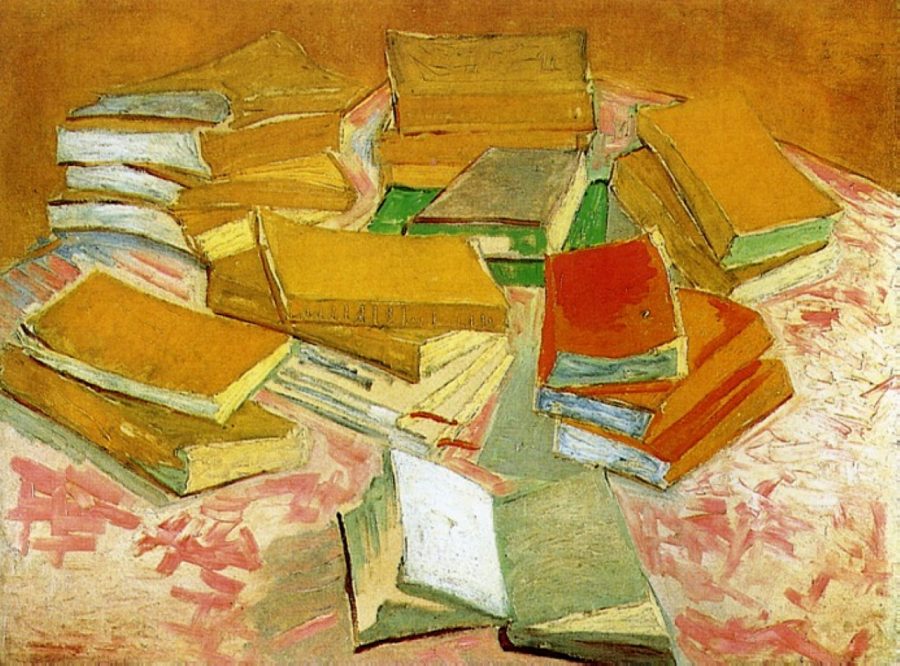
Piles of French Novels, Vincent Van Gogh, 1887
Among lovers of Vincent van Gogh, the Dutch artist is as well known for his letter writing as for his extraordinary painting. “The personal tone, evocative style and lively language” of his correspondence, writes the Van Gogh Museum, “prompted some people who were in a position to know to accord the correspondence the status of literature. The poet W.H. Auden, who published an anthology with a brief introduction, wrote: ‘there is scarcely one letter by Van Gogh which I, who am certainly no expert, do not find fascinating.’”
Auden was, of course, an expert on the written word, though maybe not on Van Gogh, and he refined his literary expertise the same way the painter did: by reading as copiously as he wrote. “When it was too dark to paint,” writes University of Puerto Rico professor of humanities Jeffrey Herlihy Mera at the Chronicle of Higher Education, “Van Gogh read prodigiously and compiled a tremendous amount of personal correspondence.” Much of his writing, especially his letters to his brother Theo, was in French, a language he learned in his teens and spoke in Belgium, Paris, and Arles.
Van Gogh’s command of written French, however, came from his reading of Victor Hugo, Guy de Maupassant, and Émile Zola. “Vincent loved literature,” the Van Gogh Museum writes. “In general, the books he read reflected what was going on in his own life. When he wanted to follow in his father’s footsteps and become a minister, he read books of a religious nature. He devoured Parisian novels when he was considering moving to the French capital.”
In his letters to Theo, he weaves together the sacred and profane, describing his spiritual and creative strivings and his unrequited obsessions. In his reading, he tested his values and desires. We get a sense of how Van Gogh’s reading complemented his pious, yet romantic nature in the list of some of his favorites, below, compiled by the Van Gogh Museum.
- Charles Dickens, A Christmas Carol (1843)
- Jules Michelet, L’amour (1858)
- Émile Zola, L’Oeuvre (1886)
- Alphonse Daudet, Tartarin de Tarascon (1887)
- The Bible
- John Keats, The Eve of St. Agnes (1820)
- George Eliot, Scenes of Clerical Life (1857)
- Henry Wadsworth Longfellow, The Poetical Works of Henry Wadsworth Longfellow (1887)
- Hans Christian Andersen, What the Moon Saw (1862)
- Thomas a Kempis, The Imitation of Christ (1471–1472)
- Harriet Beecher Stowe, Uncle Tom’s Cabin (1851–1852)
- Edmond de Goncourt, Chérie (1884)
- Victor Hugo, Les misérables (1862)
- Honoré de Balzac, Le Père Goriot (1835)
- Guy de Maupassant, Bel-Ami (1885)
- Pierre Loti, Madame Chrysanthème (1888)
- Voltaire, Candide (1759)
- Shakespeare, Macbeth (c. 1606–1607)
- Shakespeare, King Lear (1606–1607)
- Charles Dickens, Hard Times (1854)
- Emile Zola, Nana (1880)
- Emile Zola, La joie de vivre (1884)
“Vincent read moralistic books often favoured among members of the Protestant Christian community” in which he was raised by his minister father. He looked also to the morality of Charles Dickens, whose works he “read and reread… throughout his life.” Zola’s “rough, direct naturalism” appealed to Van Gogh’s desire “to give an honest depiction of what he saw around him: farm labourers, a weathered little old man, dejected or working women, a soup kitchen, a tree, dunes and fields.”
In Alphonse Daudet’s 1887 Tartarin de Tarascon, “an entertaining caricature of the southern Frenchman,” Van Gogh satisfied his “need for humor and satire.” Despite the stereotype of the artist as perpetually tortured, his letters consistently reveal his good-natured sense of humor. From French historian Jules Michelet’s 1858 L’amour, the artist “found wisdom he could apply to his own love life,” tumultuous as it was. He used Michelet’s insights “to justify his choices,” such as “when he fell in love with his cousin Kee Vos.”
In a letter to Theo, Vincent expressed his emotional struggles over Vos’s rejection of him as “a great many ‘petty miseries of human life,’ which, if they were written down in a book, could perhaps serve to amuse some people, though they can hardly be considered pleasant if one experiences them oneself.” He is at a loss for what to do with himself, he writes, but “‘wandering we find our way,’ and not by sitting still.” For Van Gogh, “wandering” just as often took the form of sitting still with a good book.
Related Content:
Download Hundreds of Van Gogh Paintings, Sketches & Letters in High Resolution
13 Van Gogh’s Paintings Painstakingly Brought to Life with 3D Animation & Visual Mapping
Josh Jones is a writer and musician based in Durham, NC. Follow him at @jdmagness
Read More...The Art & Philosophy of Bonsai
We all know what to think of when we hear the term bonsai: dwarf trees. Or so Shinobu Nozaki titled his book, the very first major publication on the subject in English. Dwarf Trees came out in the 1930s, not long after the Japanese art of bonsai started drawing serious international attention. But the art itself goes back as far as the sixth century, when Japanese embassy employees and students of Buddhism returning from sojourns in China brought back all the latest things Chinese, including plants growing in containers. By six or seven centuries later, as scrolls show us today, Japan had taken that horticultural technique and refined it into a practice based on not just miniaturization but proportion, asymmetry, poignancy, and erasure of the artist’s traces, one that produces the kind of trees-in-miniature we recognize as artworks, and even masterworks, today.
It hardly needs saying that bonsai trees don’t take shape by themselves. As the name, which means “tray planting” (盆栽), suggests, a work of bonsai must begin by planting a specimen in a small container. From then on, it demands daily attention in not just the provision of the proper amounts of water and sunlight but also careful trimming and adjustment with trimmers, hooks, wire, and everything else in the bonsai cultivator’s surprisingly large suite of tools.
You can see a Japanese master of the art named Chiako Yamamoto in action in “Bonsai: The Endless Ritual,” the BBC Earth Unplugged video at the top of the post. “Shaping nature in this way demands everlasting devotion without the prospect of completion,” says its narrator, a point underscored by one bonsai under Yamamoto’s care, originally planted by her grandfather over a century ago.
You’ll find even older bonsai at the National Bonsai Museum at the U.S. National Arboretum in Washington D.C. In the video “Bonsai Will Make You a Better Person,” curator Jack Sustic — an American first exposed to bonsai in the military, while stationed in Korea — shows off a Japanese white pine “in training” since the year 1625. That unusual terminology reflects the fact that no work of bonsai even attains a state of completeness. “They’re always growing,” say Sustic. “They’re always changing. It’s never a finished artwork.” In National Geographic’s “American Shokunin” just above, the titular bonsai cultivator (shokunin has a meaning similar to “craftsman” or “artisan”), Japan-trained, Oregon-based Ryan Neil, expands on what bonsai teaches: not just how to artistically grow small trees that resemble big ones, but what it takes to commune with nature and attain mastery.
“A master is somebody who, every single day, tries to pursue perfection at their chosen endeavor,” says Neil. “A master doesn’t retire. A master doesn’t stop. They do it until they’re dead.” And as a work of bonsai literally outlives its creator, the pursuit continues long after they’re dead. The bonsai master must be aware of the aesthetic and philosophical values held by the generations who came before them as well as the generations that will come after. Wabi sabi, as bonsai practitioner Pam Woythal defines it, is “the Japanese art of finding beauty in imperfection and profundity in nature, of accepting the natural cycle of growth, decay, and death.” Shibumi (or in its adjectival form shibui) is, in the words of I Am Bonsai’s Jonathan Rodriguez, “the simple subtle details of the subject,” manifest for example in “the apparent simple texture that balances simplicity and complexity.” Looked at correctly, a bonsai tree — leaves, branches, pot, and all — reminds us of the important elements of life and the important elements of art, and of the fact that those elements aren’t as far apart as we assume.
Related Content:
Wabi-Sabi: A Short Film on the Beauty of Traditional Japan
Discover the Japanese Museum Dedicated to Collecting Rocks That Look Like Human Faces
Based in Seoul, Colin Marshall writes and broadcasts on cities, language, and culture. His projects include the book The Stateless City: a Walk through 21st-Century Los Angeles and the video series The City in Cinema. Follow him on Twitter at @colinmarshall or on Facebook.
Read More...A Map of the Disney Entertainment Empire Reveals the Deep Connections Between Its Movies, Its Merchandise, Disneyland & More (1967)
We all remember the first Disney movie we ever saw. In most of our childhoods, one Disney movie led to another, which stoked in us the desire for Disney toys, Disney games, Disney comics, Disney music, and so on. If we were lucky, we might also take a trip to Disneyland or one of its descendants elsewhere in the world. Many of us spent the bulk of our youngest years as happy residents of the Disney entertainment empire; some of us, into adulthood or even old age, remain there still.
Die-hard Disney fans appreciate that the world of Disney — comprising not just films and theme parks but television shows, printed matter, attractions on the internet, and merchandise of nearly every kind — is too vast ever to comprehend, let alone fully explore.
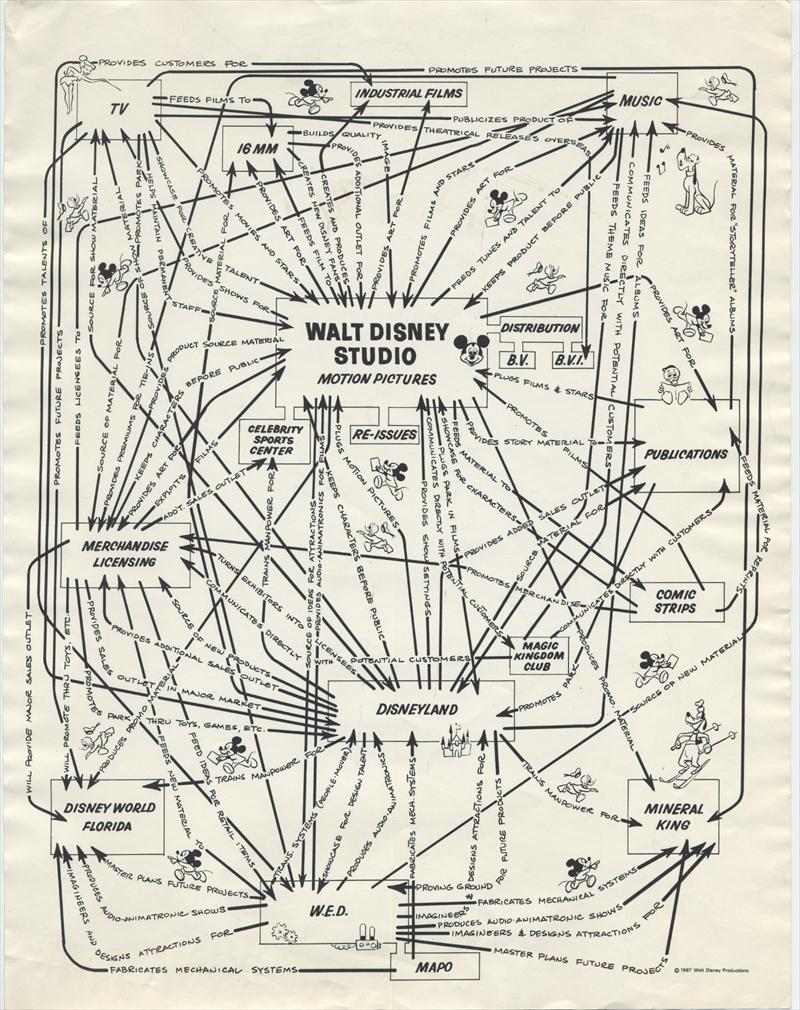
It was already big half a century ago, but not too big to grasp. You can see the whole of the operation laid out in this organizational synergy diagram created by Walt Disney Productions in 1967. Depicting “the many and varied synergistic relationships between the divisions of Walt Disney Productions,” the information graphic reveals the links between each division.
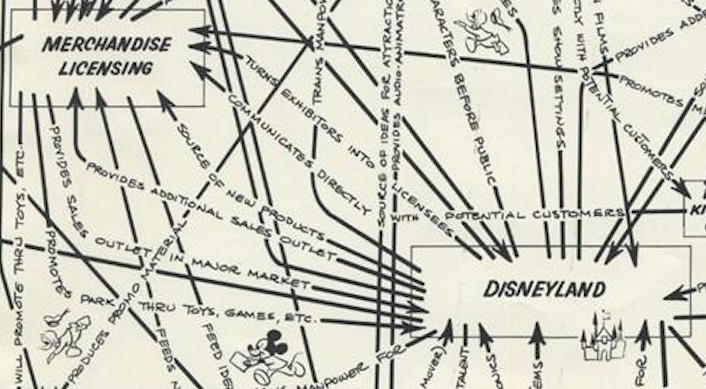
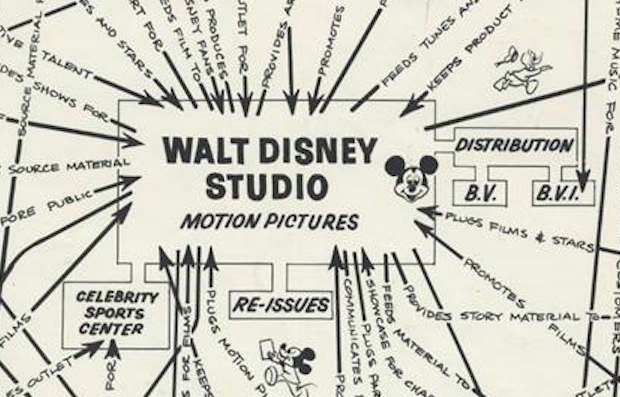
Along the arrowheaded lines indicating the flows of manpower, material, and intellectual property, “short textual descriptions show what each division supplies and contributes to the others.” The motion picture division “feeds tunes and talent” to the music division, for example, which “promotes premiums for tie-ins” to the merchandise licensing department, which “feeds ideas for retail items” to WED Enterprises (the holding company founded by Walt Disney in 1950), which produces “audio-animatronics” for Disneyland.
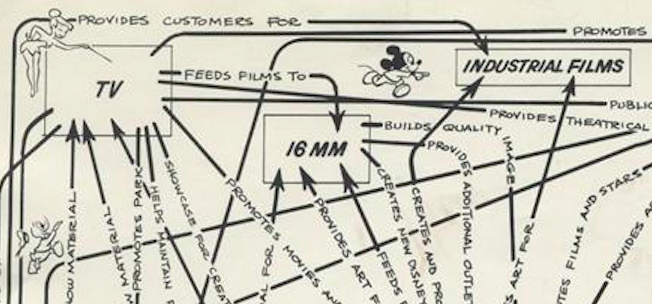
Some of the nexuses on the diagram will be as familiar as Mickey Mouse, Goofy, Tinkerbell, and the characters cavorting here and there around it. Others will be less so: the 16-millimeter films division, for instance, which would eventually be replaced by a colossal home-video division (itself surely being eaten into, now, by streaming). The Celebrity Sports Center, an indoor entertainment complex outside Denver, closed in 1994. MAPO refers to a theme-park animatronics unit formed in the 1960s with the profits of Mary Poppins (hence its name) and dissolved in 2012. And as for Mineral King, a proposed ski resort in California’s Sequoia National Park, it was never even built.
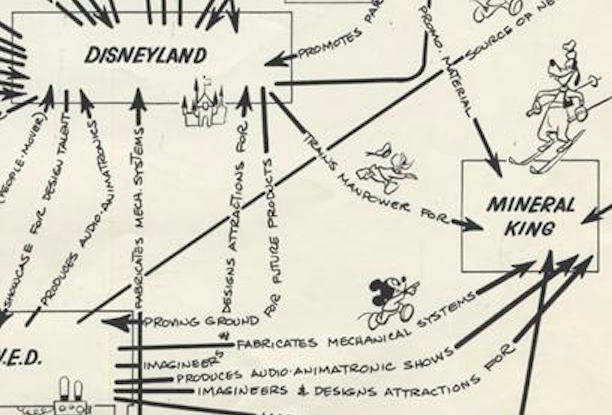
“The ski resort was one of several ambitious projects that Walt Disney spearheaded in the years before his death in 1966,” writes Nathan Masters at Gizmodo. But as the size of the Mineral King plans grew, wilderness-activist opposition intensified. After years of opposition by the Sierra Club, as well as the passage of the National Environmental Policy Act 1970 and the National Parks and Recreation Act of 1978, corporate interest in the project finally fizzled out. Though that would no doubt have come as a disappointment to Walt Disney himself, he might also have known to keep the failure in perspective. As he once said of the empire bearing his name, “I only hope that we never lose sight of one thing — that it was all started by a mouse.”
h/t Eli and via Howard Lowery
Related Content:
Disneyland 1957: A Little Stroll Down Memory Lane
How Walt Disney Cartoons Are Made: 1939 Documentary Gives an Inside Look
Walt Disney Presents the Super Cartoon Camera
Disney’s 12 Timeless Principles of Animation
Based in Seoul, Colin Marshall writes and broadcasts on cities, language, and culture. His projects include the book The Stateless City: a Walk through 21st-Century Los Angeles and the video series The City in Cinema. Follow him on Twitter at @colinmarshall or on Facebook.
Read More...A Brief Animated History of Alcohol
Almost anything can be preserved in alcohol, except health, happiness and money…
Roderick Phillips’ Ted-Ed lesson, a Brief History of Alcohol, above, opens with a bon mot from early 20th-century quote maven Mary Wilson Little, after which, an unwitting chimpanzee quickly discovers the intoxicating effects of overripe plums.
His eyes pinwheel, he falls off a branch, and grins, drunk as a monkey’s uncle.
And though the subject is alcohol, this primate is the only character in Anton Bogaty’s 5‑minute animation who could be hauled in on a drunk and disorderly charge.
The others take a more sober, industrious approach, illustrating alcohol’s prominent role in early medicine, religious rituals, and global trading.
Ancient Egyptians harvest the cereal grains that will produce beer, included as part of workers’ rations and available to all classes.
A native of South America stirs a kettle of chicha, a fistful of hallucinogenic herbs held at the ready.
A Greek physician tends to a patient with a goblet of wine, as a nearby poet prepares to deliver an ode on its creative properties.
Students with an interest in the science of alcohol can learn a bit about the fermentation process and how the invention of distillation allowed for much stronger spirits.
Alcohol was a welcome presence aboard seafaring vessels. Not only did this valuable trading commodity spark lively parties on deck, it sanitized the sailors’ drinking water, making longer voyages possible.
Cheers to that.
Educators can customize the lesson here.
Related Content:
Beer Archaeology: Yes, It’s a Thing
5,000-Year-Old Chinese Beer Recipe Gets Recreated by Stanford Students
How Carl Jung Inspired the Creation of Alcoholics Anonymous
Ayun Halliday is an author, illustrator, theater maker and Chief Primatologist of the East Village Inky zine. Join her in NYC tongight, Monday, January 6 when her monthly book-based variety show, Necromancers of the Public Domain celebrates Cape-Coddities (1920) by Roger Livingston Scaife. Follow her @AyunHalliday.
Read More...The Names of 1.8 Million Emancipated Slaves Are Now Searchable in the World’s Largest Genealogical Database, Helping African Americans Find Lost Ancestors
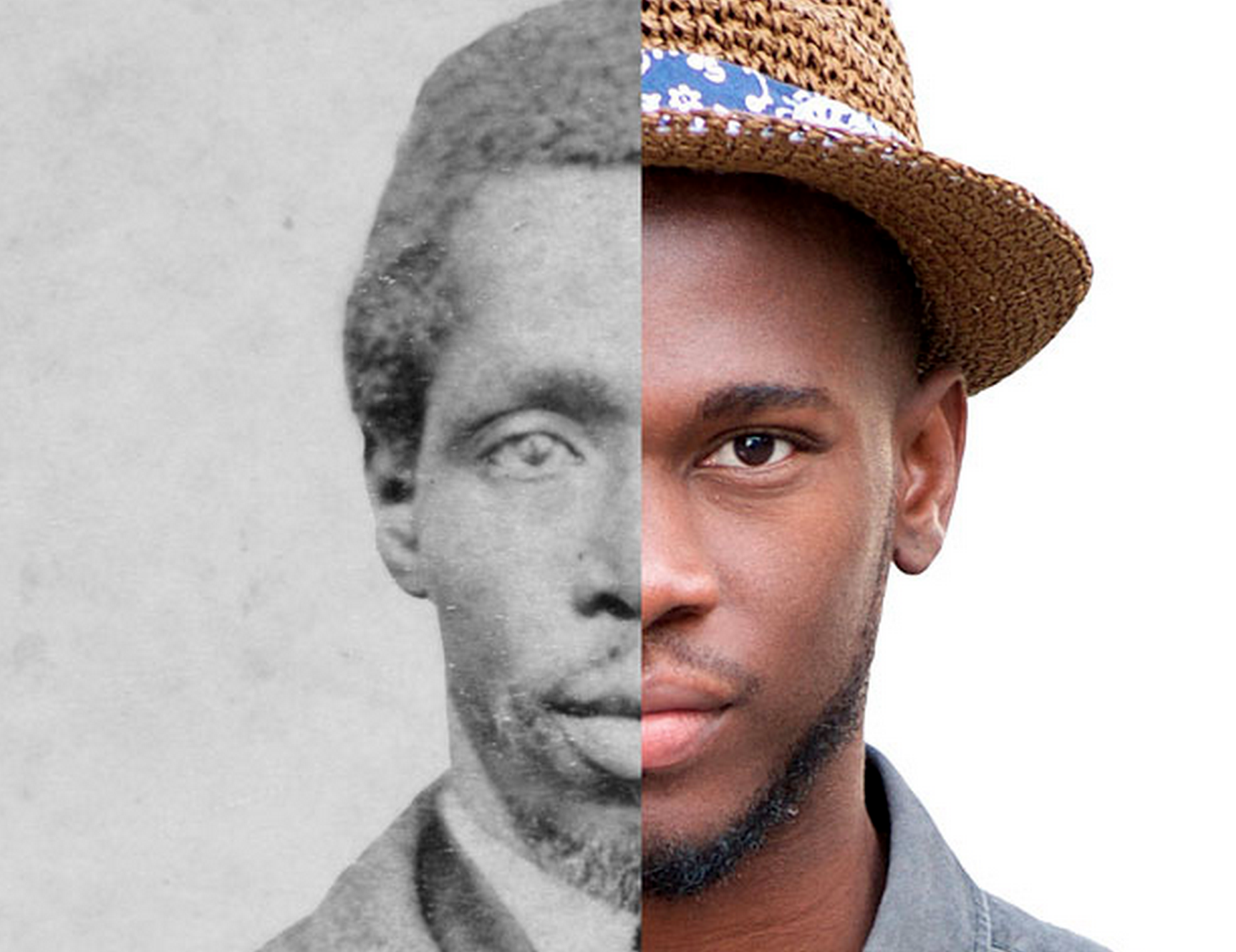
The successes of the Freedman’s Bureau, initiated by Abraham Lincoln in 1865 and first administered under Oliver Howard’s War Department, are all the more remarkable considering the intense popular and political opposition to the agency. Under Lincoln’s successor, impeached Southern Democrat Andrew Johnson, the Bureau at times became a hostile entity to the very people it was meant to aid and protect—the formerly enslaved, especially, but also poor whites devastated by the war. After years of defunding, understaffing, and violent insurgency the Freedman’s Bureau was officially dissolved in 1872.
In those first few years after emancipation, however, the Bureau built several hospitals and over a thousand rural schools in the South, established the Historically Black College and University system, and “created millions of records,” notes the National Museum of African American History and Culture (NMAAHC), “that contain the names of hundreds of thousands of formerly enslaved individuals and Southern white refugees.” Those records have enabled historians to reconstruct the lives of people who might otherwise have disappeared from the record and helped genealogists trace family connections that might have been irrevocably broken.
As we noted back in 2015, those records have become part of a digitization project named for the Bureau and spearheaded by the Smithsonian, the National Archives, the Afro-American Historical and Genealogical Society, and the Church of Jesus Christ of Latter Day Saints, whose FamilySearch is the largest genealogy organization in the world. “Using modern, digital and web-based technology and the power of [over 25,000!] volunteers,” says Hollis Gentry, a genealogical specialist at the NMAAHC, the Freedman’s Bureau Project “is unlocking information from a transformative era in the history of African American families and the American nation.”
That information is now available to the general public, “globally via the web” here, as of June 20th, 2016, allowing “all of us to enlarge our understanding of the past.” More specifically, the Freedman’s Bureau Project and FamilySearch allows African Americans to recover their family history in a database that now includes “the names of nearly 1.8 million men, women and children” recorded by Freedman’s Bureau workers and entered by Freedman’s Bureau Project volunteers 150 years later. This incredible database will give millions of people descended from both former slaves and white Civil War refugees the ability to find their ancestors.
There’s still more work to be done. In collaboration with the NMAAHC, the Smithsonian Transcription Center is currently relying on volunteers to transcribe all of the digital scans provided by FamilySearch. “When completed, the papers will be keyword searchable. This joint effort will help increase access to the Freedmen’s Bureau collection and help the public learn more about the United States in the Reconstruction Era,” a critical time in U.S. history that is woefully underrepresented or deliberately whitewashed in textbooks and curricula.
“The records left by the Freedmen’s Bureau through its work between 1865 and 1872 constitute the richest and most extensive documentary source available for investigating the African American experience in the post-Civil War and Reconstruction eras,” writes the National Archives. Soon, all of those documents will be publicly available for everyone to read. For now, those with roots in the U.S. South can search the Freedman’s Bureau Project database to discover more about their family heritage and history.
And while the Smithsonian’s transcription project is underway, those who want to learn more can visit the Freedman’s Bureau Online, which has transcribed hundreds of documents, including labor records, narratives of “outrages committed on freedmen,” and marriage registers.
Related Content:
Visualizing Slavery: The Map Abraham Lincoln Spent Hours Studying During the Civil War
The Civil War and Reconstruction: A Free Course
Josh Jones is a writer and musician based in Durham, NC. Follow him at @jdmagness
Read More...How Anna Karina (RIP) Became the Mesmerizing Face of the French New Wave
If the French New Wave hadn’t crashed over cinema in the 1950s and 60s, could any of the film movements since have come about? Without auteurs like François Truffaut, Agnès Varda, and most of all Jean-Luc Godard, could the French New Wave itself have happened? And without Anna Karina, would Jean-Luc Godard have become Jean-Luc Godard? Though he did make Breathless, his first and most enduring feature, without Karina, it wasn’t for lack of desire: when he tried to bring the still-teenaged Danish actress onboard the project after spotting her in a soap commercial, she turned down his offer because it would involve a nude scene. But she made less of an objection to political themes, demonstrated by her agreement to participate in Godard’s next movie, the controversial Le Petit Soldat.
In total, Karina would appear in eight of Godard’s films, including A Woman Is a Woman, My Life to Live, Band of Outsiders, Alphaville, and Pierrot le Fou — more than enough to make her the nouvelle vague’s most captivating screen presence. This status has transcended culture and time, as evidenced by “Anna Karina’s Guide to Being Mesmerizing,” the short tribute video by the British Film Institute at the top of the post.
To Godard she was first an actress, then a muse; soon she became his wife, and then nearly the mother of his child. Godard, l’amour, la poésie, the above documentary on Godard and Karina’s professional and personal relationship, argues that her miscarriage became the implicit subject of My Life to Live. From then on their relationship, always described as “tumultuous,” deteriorated; they divorced in 1965, the year before their final collaboration, Made in USA.
“I can’t speak badly of him,” Karina says of Godard in a clip of an interview recorded much later. “He was my teacher, my love, my husband, my Pygmalion.” In her work with Godard, writes New Yorker film critic and Godard biographer Richard Brody, “Karina identified not with characters but with herself, perhaps even more fully on camera than in private life — to create an enduring idea of herself. Karina didn’t become the characters she played; they became her.” Throughout her career, she was thus “marked by the distinctiveness of those early performances, by their difference from all other performances, and she became a living emblem not only of herself but of the French New Wave and of the spirit of the nineteen-sixties over all.” As Brody notes, Karina went on to work with such cinematic luminaries as Luchino Visconti, Jacques Rivette, Rainer Werner Fassbinder, Raúl Ruiz, and Jonathan Demme.
She also became a filmmaker herself, directing Living Together in 1973 and the French-Canadian musical road movie Victoria in 2006, and in that same span of time published four novels as well. But since her death last month at the age of 79, it is Karina’s work with Godard in the early 1960s to which cinephiles have instinctively returned and most lovingly celebrated. Both she and he, each in their distinctive artistic fashion, embodied a short time in cinema when all rules seemed broken and all possibilities open. In Godard, l’amour, la poésie, the critic Jean Douchet, a colleague of Godard’s at Cahiers du cinéma, puts it differently: “They met, they fell in love, they broke up. End of story. They were a couple like many others, but it’s true that Anna Karina is magnificent in that period with Godard.” And as the French New Wave recedes farther into the distance, that magnificence will only intensify.
Related Content:
An Introduction to Jean-Luc Godard’s Innovative Filmmaking Through Five Video Essays
Based in Seoul, Colin Marshall writes and broadcasts on cities, language, and culture. His projects include the book The Stateless City: a Walk through 21st-Century Los Angeles and the video series The City in Cinema. Follow him on Twitter at @colinmarshall or on Facebook.
Read More...Love the Art, Hate the Artist: How to Approach the Art of Disgraced Artists
As a culture, we’ve largely stepped away from the sentiment described by the famed lawyer’s 1924 defense of murderers Leopold and Loeb.
Apply it to one of the many male artists whose exalted reputations have been shattered by allegations of sexual impropriety and other ruinous behaviors and you won’t find yourself celebrated for your virtue in the court of public opinion.
But what of those artists’ creative output?
Does that get bundled in with hating both sin and sinner?
It’s a question that historian and former curator Sarah Urist Green is well equipped to tackle.
Green’s PBS Digital Studios web series, The Art Assignment, explores art and art history through the lens of the present.
In the episode titled Hate the Artist, Love the Art, above, Green takes a more temperate approach to the subject than comedian Hannah Gadsby, whose solo show, Nanette, included an incendiary takedown of Picasso:
I hate Picasso. and you can’t make me like him. I know I should be more generous about him too, because he suffered a mental illness. But nobody knows that, because it doesn’t fit with his mythology. Picasso is sold to us as this passionate, tormented, genius, man-ball-sack. But Picasso suffered the mental illness…of misogyny.
Don’t believe me? He said, “Each time I leave a woman, I should burn her. Destroy the woman, you destroy the past she represents.” Cool guy. The greatest artist of the 20th century. Picasso fucked an underage girl. That’s it for me, not interested.
But Cubism! He made it! Marie-Thérèse Walter, she was 17 when they met: underage. Picasso, he was 42, at the height of his career. Does it matter? It actually does matter. But as Picasso said, “It was perfect—I was in my prime, she was in her prime.” I probably read that when I was 17. Do you know how grim that was?
Grim.
A different sort of grim than the horrors he depicted in Guernica, still an incredibly potent condemnation of the human cost of war.
Should exemptions be made, then, for works of great genius or lasting social import?
Up to you, says Green, advocating that every viewer should pause to consider the ripples caused by their continued embrace of a disgraced artist.
But what if we don’t know that the artist’s been disgraced?
That seems unlikely as curators scramble to acknowledge the offender’s transgressions on gallery cards, and emergent artists attempt to set the record straight with response pieces displayed in proximity.
Green notes that even without such overt cues, it’s very difficult to get a “pure” reading of an established artist’s work.
Anything we may have gleaned about the artist’s personal conduct, whether good or ill, proven, unproven, or disproven, factors into the way we experience that artist’s work. The source can be a paper of record, the Internet, a guest at a party repeating a personal anecdote…
It can also be painful to relinquish our youthful favorites’ hold on us, especially when the attachment was formed of our own free will.
What would Hannah Gadsby say to my reluctance to sever ties completely with Gauguin’s Tahiti paintings, encountered for the first time when I was approximately the same age as the brown-skinned teenaged muses he painted and took to bed?
The behavior that was once framed as evidence of an artistic spirit that could not be fettered by societal expectations, seems beyond justification today. Still, it’s unlikely Gauguin will be banished from major collections, or for that matter, the history of art, any time soon.
As Julia Halperin, executive editor of Artnet News observed shortly after Nanette became a viral sensation:
A Netflix comedy special is not going to compel museums to throw out their Picassos. Nor should they! You can’t tell the story of 20th-century art without him…. Although glossing over, whitewashing, or shoe-horning stories of Picasso’s abuse into a comfortable narrative about passionate genius may be useful to maintain his market value and his bankability as a tourist attraction, it also does everyone a disservice… we can understand Picasso’s contributions better if we can hold these two seemingly incompatible truths in our minds at once. It’s not as uplifting as a straightforward tale about a visionary creative whose flaws were only in service to its genius. But it is more honest—and it might even help us understand the evolution of our own culture, and how we got to where we are today, a lot better.
Green provides a list of questions that can help individual viewers who are reevaluating the output of “problematic” artists:
Is the work a collaborative effort?
Does the work reflect the value system of the offender?
Are we to apply the same standard to the work of scientists whose conduct is similarly offensive?
Who suffers when the offender’s work remains accessible?
Who suffers when the offender’s work is erased?
Who reaps the reward of our continued attention?
As Green points out, the shades of grey are many, though the choice of whether to entertain those shades varies from individual to individual.
Readers, where do you fall in this ever-evolving debate. Is there an artist you have sworn off of, entirely or in part? Tell us who and why in the comments.
Watch more episodes of the Art Assignment here.
Related Content:
Ayun Halliday is an author, illustrator, theater maker and Chief Primatologist of the East Village Inky zine. Join her in NYC on Monday, January 6 when her monthly book-based variety show, Necromancers of the Public Domaincelebrates Cape-Coddities (1920) by Roger Livingston Scaife. Follow her @AyunHalliday.
Read More...A Recently-Discovered 44,000-Year-Old Cave Painting Tells the Oldest Known Story
Where did art begin? In a cave, most of us would say — especially those of us who’ve seen Werner Herzog’s Cave of Forgotten Dreams — and specifically on the walls of caves, where early humans drew the first representations of landscapes, animals, and themselves. But when did art begin? The answer to that question has proven more subject to revision. The well-known paintings of the Lascaux cave complex in France go back 17,000 years, but the paintings of that same country’s Chauvet cave, the ones Herzog captured in 3D, go back 32,000 years. And just two years ago, Griffith University researchers discovered artwork on a cave on the Indonesian island of Sulawesi that turns out to be about 44,000 years old.
Here on Open Culture we’ve featured the argument that ancient rock-wall art constitutes the earliest form of cinema, to the extent that its unknown painters sought to evoke movement. But cave paintings like the one in Sulawesi’s cave Leang Bulu’ Sipong 4, which you can see in the video above, also shed light on the nature of the earliest known forms of storytelling.
The “fourteen-and-a-half-foot-wide image, painted in dark-red pigment,” writes The New Yorker’s Adam Gopnik, depicts “about eight tiny bipedal figures, bearing what look to be spears and ropes, bravely hunting the local wild pigs and buffalo.” This first known narrative“tells one of the simplest and most resonant stories we have: a tale of the hunter and the hunted, of small and easily mocked pursuers trying to bring down a scary but vulnerable beast.”
Like other ancient cave art, the painting’s characters are therianthropes, described by the Griffith researchers’ Nature article as “abstract beings that combine qualities of both people and animals, and which arguably communicated narrative fiction of some kind (folklore, religious myths, spiritual beliefs and so on).” Given the apparent importance of their roles in early stories, how much of a stretch would it be to call these figures the first superheroes? “Indeed, the cave painting could be entered as evidence into a key aesthetic and storytelling argument of today — the debate between the paladins of American film, Martin Scorsese and Francis Ford Coppola, and their Marvel Cinematic Universe contemporaries,” writes Gopnik.
If you haven’t followed this struggle for the soul of storytelling in the 21st century, Scorsese wrote a piece in The New York Times claiming that today’s kind of blockbuster superhero picture isn’t cinema, in that it shrinks from “the complexity of people and their contradictory and sometimes paradoxical natures, the way they can hurt one another and love one another and suddenly come face to face with themselves.” (“He didn’t say it’s despicable,” Coppola later added, “which I just say it is.”) And yet, as Gopnik puts it, “our oldest picture story seems to belong, whether we want it to or not, more to the Marvel universe than to Marty Scorsese’s.” If we just imagine how those therianthropes — “A human with the strength of a bull! Another with the guile of a crocodile!” — must have thrilled their contemporary viewers, we’ll understand these cave paintings for what they are: early art, early storytelling, early cinema, but above all, early spectacle.
Related Content:
Was a 32,000-Year-Old Cave Painting the Earliest Form of Cinema?
40,000-Year-Old Symbols Found in Caves Worldwide May Be the Earliest Written Language
Hear the World’s Oldest Instrument, the “Neanderthal Flute,” Dating Back Over 43,000 Years
Based in Seoul, Colin Marshall writes and broadcasts on cities, language, and culture. His projects include the book The Stateless City: a Walk through 21st-Century Los Angeles and the video series The City in Cinema. Follow him on Twitter at @colinmarshall or on Facebook.
Read More...Bob Ross’ Christmas Special: Celebrate, Relax, Nod Off
I don’t know if you got everything you wanted on Christmas, but we here at Open Culture have what you need. And that’s a very special Bob Ross Christmas Special. No special guests, no musical numbers. Just Bob, his palette filled with phthalo blue, Van dyke Brown, and other favorite paints, and a solid black canvas which Bob turns into a Christmas Eve snow scene. (In 2018, Ross’ official YouTube Channel posted all 31 seasons of The Joy of Painting online, a total of 403 episodes.)
While watching (and maybe following along at home), consider that Bob Ross accidentally invented ASMR with his shows, all those years ago. His pleasant, slightly gruff southern accent complements the sound of the swishing brush and scraping knife on canvas. Consider also the percentage of people who watch these not to paint, but to meditate or go to sleep. (There’s an app for that.)
Bob Ross *is* the sound of a Christmas Eve nocturne, a moment when the air is crisp and clean, a little bit of peace falls over the world, and there’s a chance to reflect. It’s time to start a new canvas. The possibilities are endless, and you can always change as you go. Heed Ross’ famous words: “We don’t make mistakes. We have happy accidents.”
Related Content:
Mr. Rogers Goes to Congress and Saves PBS: Heartwarming Video from 1969
Puppet Making with Jim Henson: A Priceless Primer from 1969
A Big List of Free Art Lessons on YouTube
Ted Mills is a freelance writer on the arts who currently hosts the artist interview-based FunkZone Podcast and is the producer of KCRW’s Curious Coast. You can also follow him on Twitter at @tedmills, read his other arts writing at tedmills.com and/or watch his films here.
Read More...When Salvador Dalí Created Christmas Cards That Were Too Avant Garde for Hallmark (1960)
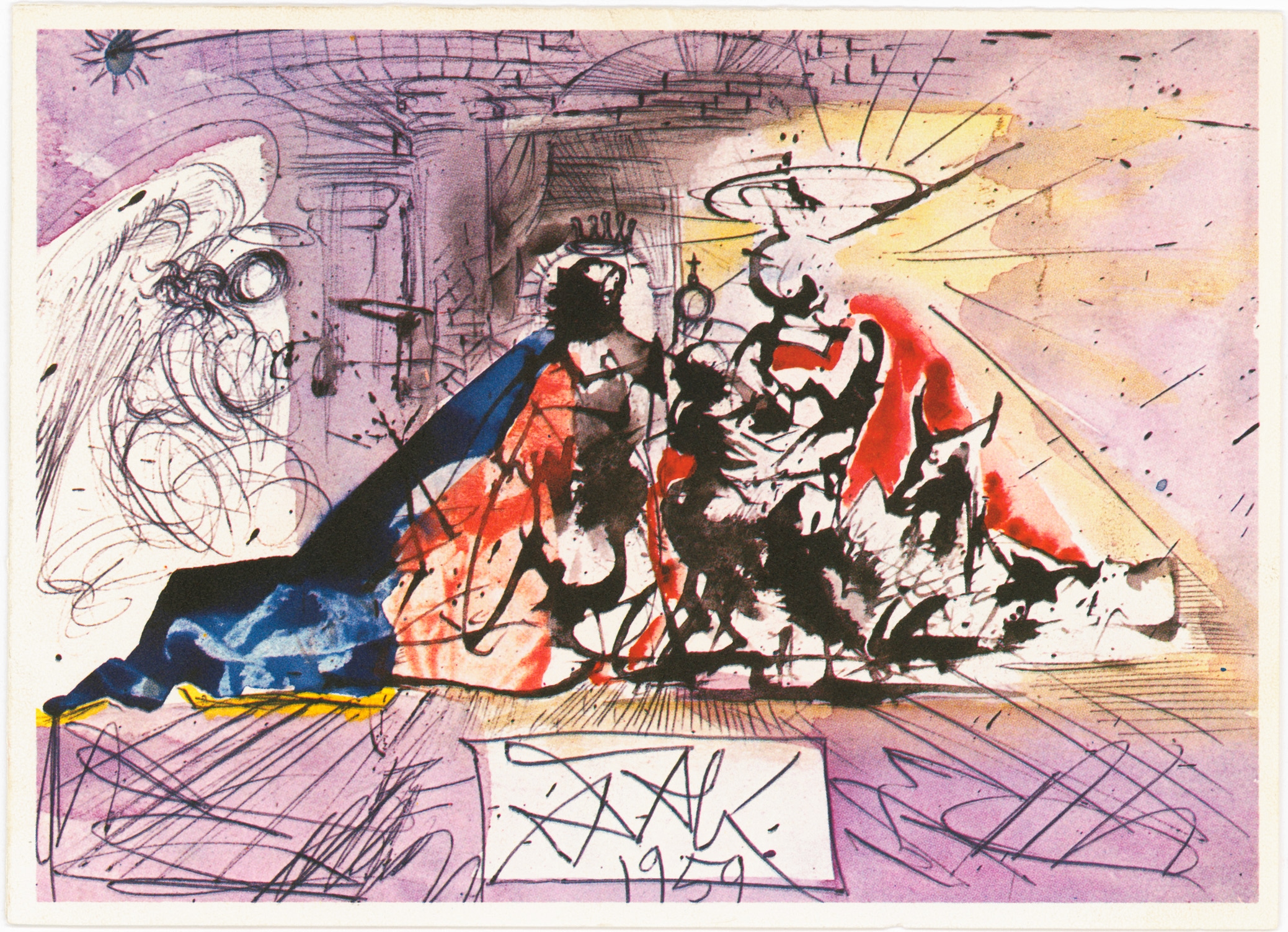
The nature of marketing in the nearly-over 2010s, with all its unexpected brand crossovers and collaborations, gave rise to many strange commercial bedfellows. But for sheer artistic shock value, did any of them surpass Christmas of 1960, when Salvador Dalí designed holiday greeting cards for Hallmark? It was the rare intersection of the kind of company that has built an empire on broadly appealing, inoffensive expressions of love and festivity and an artist who once said, “I don’t do drugs. I am drugs.”
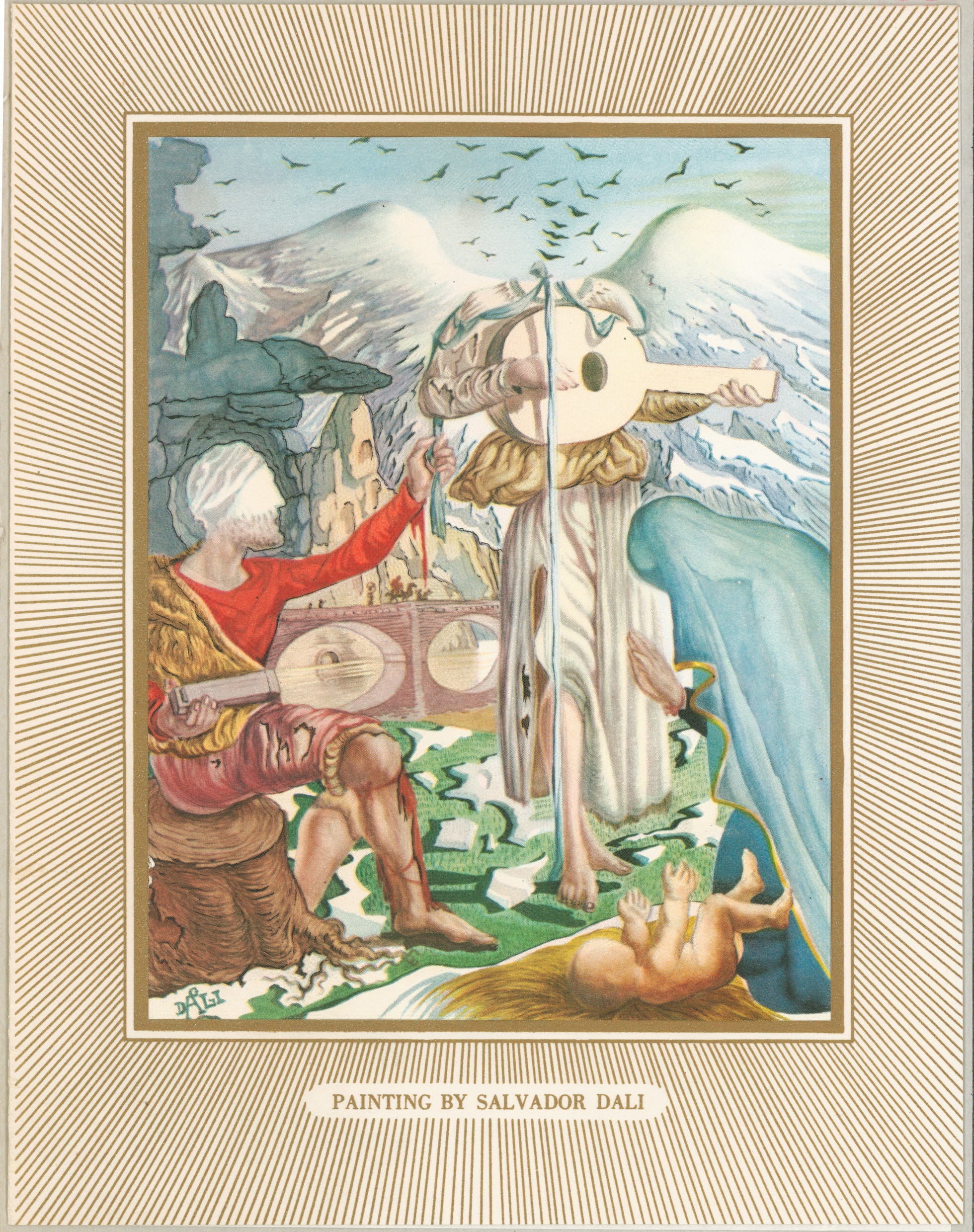
“Hallmark began reproducing the paintings and designs of contemporary artists on its Christmas cards in the late 1940s, an initiative that was led by company founder Joyce Clyde Hall,” writes the Washington Post’s Ana Swanson.
“The art of Pablo Picasso, Paul Cezanne, Paul Gauguin, Vincent Van Gogh and Georgia O’Keeffe all took a turn on Hallmark’s Christmas cards.” And so, Swanson quotes Hall as writing in his autobiography, “through the ‘unsophisticated art’ of greeting cards, the world’s greatest masters were shown to millions of people who might otherwise not have been exposed to them.”
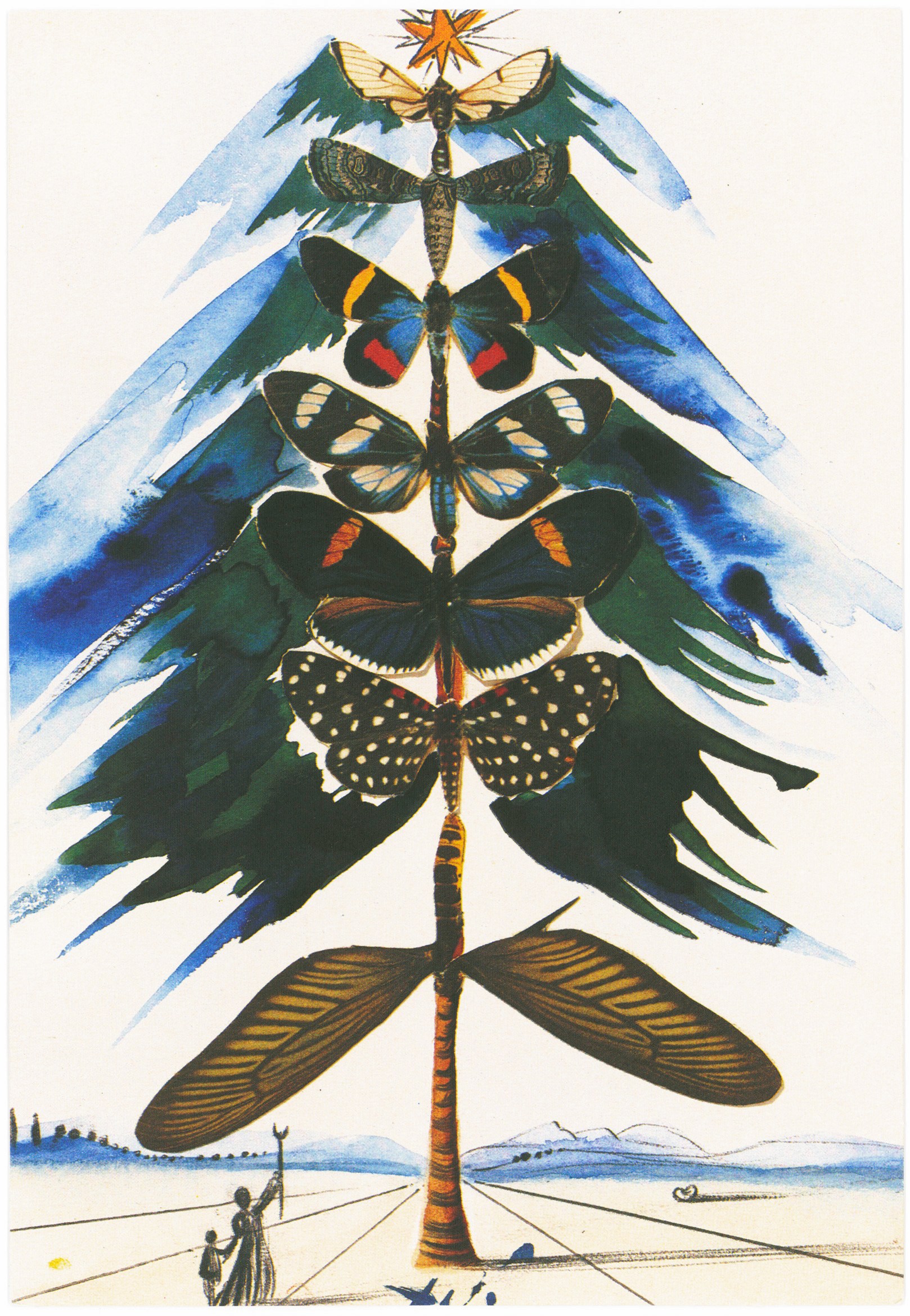
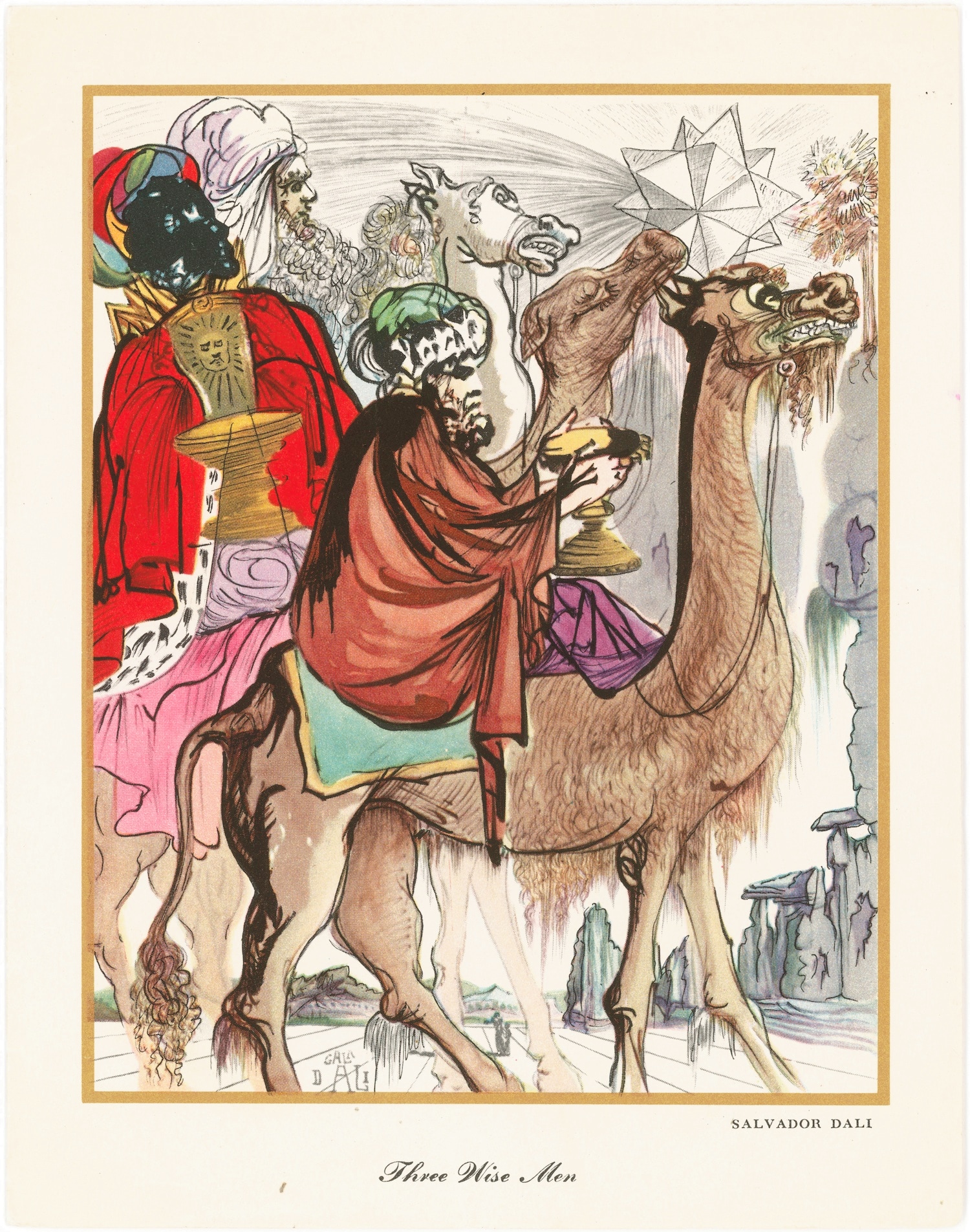
Hallmark signed Dalí on in 1959. The painter of The Persistence of Memory and Crucifixion (Corpus Hypercubus) asked the greeting-card giant for “$15,000 in cash in advance for 10 greeting card designs, with no suggestions from Hallmark for the subject or medium, no deadline and no royalties.” The designs Dalí came up with included “Surrealist renditions of the Christmas tree and the Holy Family,” as well as some “vaguely unsettling” images, such as a headless angel playing a lute and the three wise men atop some insane-looking camels. Ultimately, Hallmark only produced two of the Dalí cards, a nativity scene and a depiction of the Madonna and Child. Alas, even those relatively tame images didn’t go over well.
Dalí’s “take on Christmas,” as Patrick Regan writes in Hallmark: A Century of Caring, was “a bit too avant garde for the average greeting card buyer,” and the negative public response soon convinced Hallmark to drop Dalí’s cards from their product line — thus ensuring their future as sought-after collector’s items. As inauspicious as the marriage of Dalí and Hallmark might seem, the artist did possess a commercial sense more in line with Joyce Clyde Hall’s than not: in his lifetime Dalí created a range of products ranging from prints to books (including a cookbook) to tarot decks, and even appeared in television commercials. Not all of his ventures were successful, but as with his Hallmark Christmas cards — about which you can learn more at the site of Spanish language and literature professor Rebecca M. Bender — sometimes the failures are more memorable than the successes.
The images above come courtesy of the Hallmark Archives.
Related Content:
John Waters Makes Handmade Christmas Cards, Says the “Whole Purpose of Life is Christmas”
Watch Terry Gilliam’s Animated Short, The Christmas Card (1968)
Salvador Dalí Goes Commercial: Three Strange Television Ads
Salvador Dalí’s 1973 Cookbook Gets Reissued: Surrealist Art Meets Haute Cuisine
Based in Seoul, Colin Marshall writes and broadcasts on cities, language, and culture. His projects include the book The Stateless City: a Walk through 21st-Century Los Angeles and the video series The City in Cinema. Follow him on Twitter at @colinmarshall or on Facebook.
Read More...Support Us
We're hoping to rely on loyal readers, rather than erratic ads. Please click the Donate button and support Open Culture. You can use Paypal, Venmo, Patreon, even Crypto! We thank you!

About Us

Open Culture scours the web for the best educational media. We find the free courses and audio books you need, the language lessons & educational videos you want, and plenty of enlightenment in between.
Advertise With Us

FREE UPDATES!
GET OUR DAILY EMAIL
Get the best cultural and educational resources on the web curated for you in a daily email. We never spam. Unsubscribe at any time.
FOLLOW ON SOCIAL MEDIA

Open Culture editor Dan Colman scours the web for the best educational media. He finds the free courses and audio books you need, the language lessons & movies you want, and plenty of enlightenment in between.
Advertise With Us

