Ram Dass (RIP) Offers Wisdom on Confronting Aging and Dying
After his dismissal from Harvard for researching LSD with Timothy Leary, Richard Alpert left the U.S. for India in 1967. He devoted himself to the teachings of Hindu teacher Neem Karoli Baba and returned to the States a permanently changed man, with a new name and a message he first spread via the collaboratively-edited and illustrated 1971 classic Be Here Now.
In the “philosophically misty, stubbornly resonant Buddhist-Hindu-Christian mash-up,” writes David Marchese at The New York Times, Ram Dass “extolled the now-commonplace, then-novel (to Western hippies, at least) idea that paying deep attention to the present moment—that is, mindfulness—is the best path to a meaningful life.” We’ve grown so used to hearing this by now that we’ve likely become a little numb to it, even if we’ve bought into the premise and the practice of meditation.
Ram Dass discovered that mindful awareness was not part of any self-improvement project but a way of being ordinary and abandoning excess self-concern. “The more your awareness is expanded, the more it becomes just a natural part of your life, like eating or sleeping or going to the toilet” he says in the excerpt above from a talk he gave on “Conscious Aging” in 1992. “If you’re full of ego, if you’re full of yourself, you’re doing it out of righteousness to prove you’re a good person.”
To really open ourselves up to reality, we must be willing to put desire aside and become “irrelevant.” That’s a tough ask in a culture that values few things more highly than fame, youth, and beauty and fears nothing more than aging, loss, and death. Our culture “denigrates non-youth,” Ram Dass wrote in 2017, and thus stigmatizes and ignores a natural process everyone must all endure if they live long enough.
[W]hat I realized many years ago was I went into training to be a kind of elder, or social philosopher, or find a role that would be comfortable as I became irrelevant in the youth market. Now I’ve seen in interviewing old people that the minute you cling to something that was a moment ago, you suffer. You suffer when you have your face lifted to be who you wish you were then, for a little longer, because you know it’s temporary.
The minute you pit yourself against nature, the minute you pit yourself with your mind against change, you are asking for suffering.
Older adults are projected to outnumber children in the next decade or so, with a healthcare system designed to extract maximum profit for the minimal amount of care. The denial of aging and death creates “a very cruel culture,” Ram Dass writes, “and the bizarre situation is that as the demographic changes, and the baby boomers come along and get old, what you have is an aging society and a youth mythology”—a recipe for mass suffering if there ever was one.
We can and should, Ram Dass believed, advocate for better social policy. But to change our collective approach to aging and death, we must also, individually, confront our own fears of mortality, no matter how old we are at the moment. The spiritual teacher and writer, who passed away yesterday at age 88, confronted death for decades and helped students do the same with books like 2001’s Still Here: Embracing Aging, Changing, and Dying and his series of talks on “Conscious Aging,” which you can hear in full further up.
“Recorded at the Conscious Aging conference sponsored by the Omega Institute in 1992,” notes the Ram Dass Love Serve Remember Foundation, the conference “was the first of its kind on aging. Ram Dass had just turned sixty.” He begins his first talk with a joke about purchasing his first senior citizen ticket and says he felt like a teenager until he hit fifty. But joking aside, he learned early that really living in the present means facing aging and death in all its forms.
Ram Dass met aging with wisdom, humor, and compassion, as you can see in the recent video above. As we remember his life, we can also turn to decades of his teaching to learn how to become kinder to ourselves and others (a distinction without a real difference, he argued), as we all face the inevitable together.
Related Content:
Josh Jones is a writer and musician based in Durham, NC. Follow him at @jdmagness
Read More...Discover the Stendhal Syndrome: The Condition Where People Faint, or Feel Totally Overwhelmed, in the Presence of Great Art
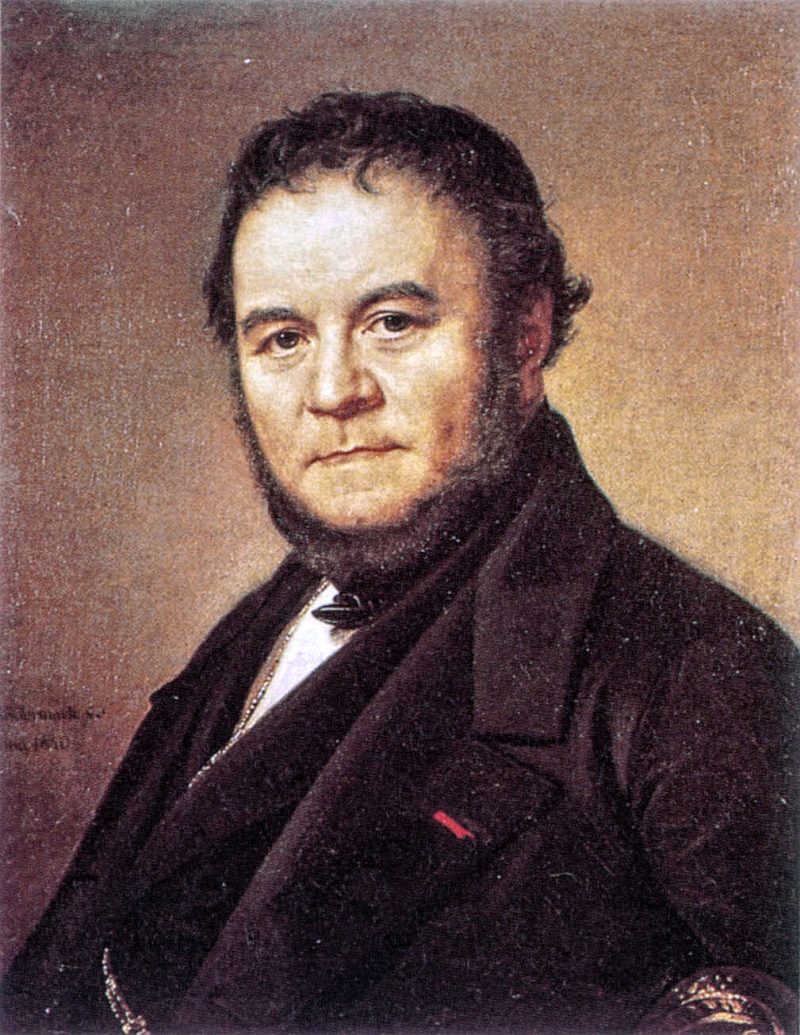
Clutch imaginary pearls, rest the back of your hand on your forehead, look wan and stricken, begin to wilt, and most people will recognize the symptoms of your sarcasm, aimed at some pejoratively feminized qualities we’ve seen characters embody in movies. The “literary swoon” as Iaian Bamforth writes at the British Journal of General Practice, dates back much further than film, to the early years of the modern novel itself, and it was once a male domain.
“Somewhere around the time of the French Revolution (or perhaps a little before it) feelings were let loose on the world.” Rationalism went out vogue and passion was in—lots of it, though not all at once. It took some decades before the discovery of emotion reached the climax of Romanticism and denouement of Victorian sentimentality:
Back in 1761, readers had swooned when they encountered the ‘true voice of feeling’ in Jean-Jacques Rousseau’s novel La Nouvelle Héloïse; by the end of the decade, all of Europe was being sentimental in the manner made fashionable a few years later by Laurence Sterne in his A Sentimental Journey. Then there was Goethe’s novella, The Sorrows of Young Werther (1774), which made its author a celebrity.
It’s impossible to overstate how popular Goethe’s book became among the aristocratic young men of Europe. Napoleon “reputedly carried a copy of the novel with him on his military campaign.” Its swooning hero, whom we might be tempted to diagnose with any number of personality and mood disorders, develops a disturbing and debilitating obsession with an engaged woman and finally commits suicide. The novel supposedly inspired many copycats and “the media’s first moral panic.”
If we can feel such exaltation, disquiet, and fear when in the grip of romantic passion, or when faced with nature’s implacable behemoths, as in Kant’s Sublime, so too may we be overcome by art. Napoleonic novelist Stendhal suggested as much in a dramatic account of such an experience. Stendhal, the pen name of Marie-Henri Beyle, was no inexperienced dreamer. He had traveled and fought extensively with the Grand Army (including that fateful march through Russia, and back) and had held several government offices abroad. His realist fiction didn’t always comport with the more lyrical tenor of the times.

Photo of the Basilica of Santa Croce by Diana Ringo, via Wikimedia Commons
But he was also of the generation of young men who read Werther while touring Europe, contemplating the varieties of emotion. He had held a similarly unrequited obsession for an unavailable woman, and once wrote that “in Italy… people are still driven to despair by love.” During a visit to the Basilica of Santa Croce in 1817, he “found a monk to let him into the chapel,” writes Bamforth, “where he could sit on a genuflecting stool, tilt his head back and take in the prospect of Volterrano’s fresco of the Sibyls without interruption.” As Stendhal described the scene:
I was already in a kind of ecstasy by the idea of being in Florence, and the proximity of the great men whose tombs I had just seen. Absorbed in contemplating sublime beauty, I saw it close-up—I touched it, so to speak. I had reached that point of emotion where the heavenly sensations of the fine arts meet passionate feeling. As I emerged from Santa Croce, I had palpitations (what they call an attack of the nerves in Berlin); the life went out of me, and I walked in fear of falling.
With the recording of this experience, Stendhal “brought the literary swoon into tourism,” Bamforth remarks. Such passages became far more commonplace in travelogues, not least those involving the city of Florence. So many cases similar to Stendhal’s have been reported in the city that the condition acquired the name Stendhal syndrome in the late seventies from Dr. Graziella Magherini, chief of psychiatry at the Santa Maria Nuova Hospital. It presents as an acute state of exhilarated anxiety that causes people to feel faint, or to collapse, in the presence of art.
Magherini and her assistants compiled studies of 107 different cases in 1989. Since then, Santa Maria Nuova has continued to treat tourists for the syndrome with some regularity. “Dr. Magherini insists,” writes The New York Times, that “certain men and women are susceptible to swooning in the presence of great art, especially when far from home.” Stendhal didn’t invent the phenomenon, of course. And it need not be solely caused by sufferers’ love of the 15th century.
The stresses of travel can sometimes be enough to make anyone faint, though further research may rule out other factors. The effect, however, does not seem to occur with nearly as much frequency in other major cities with other major cultural treasures. “It is surely the sheer concentration of great art in Florence that causes such issues,” claims Jonathan Jones at The Guardian. Trying to take it all in while navigating unfamiliar streets and crowds.… “More cynically, some might say the long queues do add a layer of stress on the heart.”
There’s also no discounting the effect of expectation. “It is among religious travelers that Stendhal’s syndrome seems to have found its most florid expression,” notes Bamforth. Stendhal admitted that his “ecstasy” began with an awareness of his “proximity of the great men whose tombs I had just seen.” Without his prior education, the effect might have disappeared entirely. The story of the Renaissance, in his time and ours, has impressed upon us such a reverence for its artists, statesmen, and engineers, that sensitive visitors may feel they can hardly stand in the actual presence of Florence’s abundant treasures.
Perhaps Stendhal syndrome should be regarded as akin to a spiritual experience. A study of religious travelers to Jerusalem found that “otherwise normal patients tended to have ‘an idealistic subconscious image of Jerusalem’” before they succumbed to Stendhal syndrome. Carl Jung described his own such feelings about Pompeii and Rome, which he could never bring himself to visit because he lived in such awe of its historical aura. Those primed to have symptoms tend also to have a sentimental nature, a word that once meant great depth of feeling rather than a callow or mawkish nature.
We might all expect great art to overwhelm us, but Stendhal syndrome is rare and rarified. The experience of many more travelers accords with Mark Twain’s 1869 The Innocents Abroad, or The New Pilgrim’s Progress, a fictionalized memoir “lampooning the grandiose travel accounts of his contemporaries,” notes Bamforth. It became “one of the best-selling travel books ever” and gave its author’s name to what one researcher calls Mark Twain Malaise, “a cynical mood which overcomes travelers and leaves them totally unimpressed with anything UNESCO has on its universal heritage list.” Sentimentalists might wish these weary tourists would stay home and let them swoon in peace.
Related Content:
Your Brain on Art: The Emerging Science of Neuroaesthetics Probes What Art Does to Our Brains
1.8 Million Free Works of Art from World-Class Museums: A Meta List of Great Art Available Online
The Metropolitan Museum of Art Puts 400,000 High-Res Images Online & Makes Them Free to Use
Josh Jones is a writer and musician based in Durham, NC. Follow him at @jdmagness
Read More...Seven Videos Explain How Edward Hopper’s Paintings Expressed American Loneliness and Alienation
Though born in the late 19th century and partially shaped by a few sojourns to Europe, Edward Hopper was an artist fundamentally of early 20th-century America. He took life in that time and place as his subject, but he also once said that “an artist paints to reveal himself through what he sees in his subject,” meaning that he in some sense embodied early 20th-century America. Royal Academy of the Arts Artistic Director Tim Marlow quotes that line in the 60-second introduction to Hopper above, then points to a common thread in the painter’s “enigmatic works”: a “profound contemplation of the world around us” that turns each of his paintings into one captured “moment of stillness in a frantic world.”
Much of Hopper’s work came out of the Great Depression, “a period of great uncertainty and anxiety, but also a time of deep national self-imagination about the very idea of American-ness.” To look at the figures who inhabit Hopper’s thoroughly American settings — a gas station, a hotel room, inside a train car, an all-night diner — self-reflection would seem to be their main pastime.
“A woman sits alone drinking a cup of coffee,” says the School of Life’s head of Art and Architecture Hanna Roxburgh of Hopper’s 1927 Automat in the video above. “She seems slightly self-conscious and a little afraid. Perhaps she’s not used to sitting alone in a public space. Something seems to have gone wrong. The view is invited to invent stories for her of betrayal or loss.”
Loneliness, isolation, even despair: these words tend to come up in discussion of the moods of Hopper’s characters, as well as of his paintings themselves. In the in-depth exploration above, Colin Wingfield focuses on a single emotion expressed in Hopper’s work: alienation. A product of the “machine age” in late 19th- and early 20th century America, Hopper expressed an uneasy view of the ways in which accelerating industrialization and automation were altering the lives lived around him into unrecognizability. This view would turn out to have an enormous cultural resonance, as detailed in Edward Hopper and the Blank Canvas, the hourlong documentary below.
Touching on the Hopper influences seen in the work of directors like Alfred Hitchcock and Terrence Malick as well as television shows like Mad Men and The Simpsons, Edward Hopper and the Blank Canvas also brings in cultural figures like the German filmmaker Wim Wenders, an avowed Hopper enthusiast with much to say about the painter’s vision in America. More creators from the world of cinema appear in the video below to offer their personal perspectives on Hopper’s considerable influence on their art form — an art form that had considerable influence on Hopper, an avid moviegoer since he first watched a motion picture in Paris in 1909.
No single painting of Hopper’s has had as much influence on film as 1942’s Nighthawks, by far the painter’s best-known work. How exactly he achieved his own cinematic effects in a still image, such as the “storyboarding” technique with which he developed its composition, is a subject we’ve featured before here on Open Culture. In the video essay “Nighthawks: Look Through the Window,” Evan Puschak — better known as the Nerdwriter — seeks out the sources of the painting’s enduring power, from its “clean, smooth, and almost too real” aesthetic to its rigorous composition to its host of visual elements meant to both compel and unsettle the viewer.
Hopper explains his way of working in his own words in the short video from the Walker Art Center below. “It’s a long process of gestation in the mind and a rising emotion,” he says, followed by “drawings, quite often many drawings”: “various small sketches, sketches of the thing that i wish to do, also sketches of details in the picture.” As for the themes of “loneliness, isolation, modern man and his man-made environment” so often ascribed to the final products, “those are the words of critics. It may be true and it may not be true. It’s how the viewer looks at the pictures, what he sees in them.”
Related Content:
How Edward Hopper “Storyboarded” His Iconic Painting Nighthawks
Edward Hopper’s Iconic Painting Nighthawks Explained in a 7‑Minute Video Introduction
9‑Year-Old Edward Hopper Draws a Picture on the Back of His 3rd Grade Report Card
Based in Seoul, Colin Marshall writes and broadcasts on cities, language, and culture. His projects include the book The Stateless City: a Walk through 21st-Century Los Angeles and the video series The City in Cinema. Follow him on Twitter at @colinmarshall or on Facebook.
Read More...Steve Martin on How to Look at Abstract Art
The standard “anyone could do that” response to abstract art generally falls apart when the person who says it tries their hand at making something like a Kandinsky or Miró. Not only were these artists highly trained in techniques and materials, but both possessed their own specific theories of abstract art—the role of line, color, shape, negative space, etc., along with grander ideas about the role of art itself. Few of us walk around with such considered opinions and the ability to turn them into artworks. The abstraction begins in the mind before it reaches the canvas.
For his appearance on the Museum of Modern Art and BBC web series The Way I See It, Steve Martin chose two obscure American abstract artists who perfectly illustrate the relationship between the theory and practice of abstraction.
“I don’t generally care about theories,” Martin says. “They kind of get in the way of looking at the picture. But I think the result of working from a theory can be fantastic.” We may not need to know that these two artists, Morgan Russell and Stanton Macdonald Wright, painted in accordance with a theory they called Synchromism, but it certainly helps.
“The resulting paintings, called Synchromies,” explains The Art Story, “used the color scale in the way notes might be arranged in a musical piece. As the two artists wrote, ‘Synchromism simply means ‘with color’ as symphony means ‘with sound’.…” And as composer and pianist Jason Moran demonstrates in his The Way I See It episode, above, Piet Mondrian went even further in this direction with his Broadway Boogie Woogie, which represents, in its arrangement of colored squares, the very essence of the musical form from which it takes its title. Moran can even play the painting like a musical score.
The kind of abstraction Martin and Moran gravitate toward turns sound into visual pleasure and stimulates the thinking mind. Commenting on one of his selections, Martin says, “I think of this as an intellectual painting.” When it came time for John Waters to make his choice, he went for the gut (and the unconscious), with “a giant, two-paneled painting of a hammer,” he says, “a very butch painting by a heterosexual woman. I love the idea of how scary it is and how powerful.” It’s an image, he says, that reminds him of personal trauma—though nothing so gruesome as one might think.
Waters seeks a kind of catharsis from art by looking at work that scares him. Lee Lozano’s untitled 1963 painting, he says, is “threatening…. All the art I like makes me angry at first…. That’s part of its job, to make you angry.” Paintings of this size have traditionally been “reserved for lofty subjects,” notes the MoMA. “In this painting—and in others, of wrenches, clamps, and screwdrivers—Lozano weds the mundane with the grand.” As Waters delightedly points out, her work, like his own, deals a heavy blow, pun intended, to canons of taste.
The Way I See It series acts as a teaser for a BBC podcast of the same name, which interviews 30 creatives and scientists on their responses to pieces of art in the MoMA’s collection. See more of these short videos at the MoMA’s YouTube channel. Download episodes of the podcast here.
Related Content:
Steve Martin Teaches His First Online Course on Comedy
Josh Jones is a writer and musician based in Durham, NC. Follow him at @jdmagness
Read More...Bill Gates Recommends Books for the Holidays
For the holiday season, Bill Gates has selected five book titles that you’ll hopefully enjoy reading. Here they are, listed in his own words:
An American Marriage, by Tayari Jones. My daughter Jenn recommended that I read this novel, which tells the story of a black couple in the South whose marriage gets torn apart by a horrible incident of injustice. Jones is such a good writer that she manages to make you empathize with both of her main characters, even after one makes a difficult decision. The subject matter is heavy but thought-provoking, and I got sucked into Roy and Celestial’s tragic love story.
These Truths, by Jill Lepore. Lepore has pulled off the seemingly impossible in her latest book: covering the entire history of the United States in just 800 pages. She’s made a deliberate choice to make diverse points of view central to the narrative, and the result is the most honest and unflinching account of the American story I’ve ever read. Even if you’ve read a lot about U.S. history, I’m confident you will learn something new from These Truths.
Growth, by Vaclav Smil. When I first heard that one of my favorite authors was working on a new book about growth, I couldn’t wait to get my hands on it. (Two years ago, I wrote that I wait for new Smil books the way some people wait for the next Star Wars movie. I stand by that statement.) His latest doesn’t disappoint. As always, I don’t agree with everything Smil says, but he remains one of the best thinkers out there at documenting the past and seeing the big picture.
Prepared, by Diane Tavenner. As any parent knows, preparing your kids for life after high school is a long and sometimes difficult journey. Tavenner—who created a network of some of the best performing schools in the nation—has put together a helpful guidebook about how to make that process as smooth and fruitful as possible. Along the way, she shares what she’s learned about teaching kids not just what they need to get into college, but how to live a good life.
Why We Sleep, by Matthew Walker. I read a couple of great books this year about human behavior, and this was one of the most interesting and profound. Both Jenn and John Doerr urged me to read it, and I’m glad I did. Everyone knows that a good night’s sleep is important—but what exactly counts as a good night’s sleep? And how do you make one happen? Walker has persuaded me to change my bedtime habits to up my chances. If your New Year’s resolution is to be healthier in 2020, his advice is a good place to start.
Previous books recommended by Gates can be found in the relateds below.
Related Content:
Bill Gates Names 5 Books You Should Read This Summer
Bill Gates Recommends Five Books for Summer 2017
5 Books Bill Gates Wants You to Read This Summer (2016)
Bill Gates, Book Critic, Names His Top 5 Books of 2015
Read More...Malcolm Gladwell Admits His Insatiable Love for Thriller Novels and Recommends His Favorites
When Malcolm Gladwell appeared on The Joe Rogan Experience last month, he admitted something about himself that may surprise many of his readers. “I read so many thrillers,” he says to Rogan toward the end of the conversation. “How many do I read a year? Fifty, sixty, seventy? You know when you go in the airport, into the Hudson News, and you see there’s a whole wall of thrillers? I have read every single one.” But it will surprise exactly none of his readers that he’s also come up with a categorization system of thrillers: we all know what a “Western” is, but the Gladwell theory of thrillers also encompasses the distinct sensibilities of the “Eastern,” the “Northern,” and the “Southern.”
A Western takes place in “a world in which there is no law and order, and a man shows up and imposes, personally, law and order on the territory, the community.” An Eastern is “a story where there is law and order, so there are institutions of justice, but they have been subverted by people from within.” In a Northern, “law and order exists, and law and order is morally righteous, the system works.” (A prime example is, of course, Law and Order.) A Southern is “where the entire apparatus is corrupt, and where the reformer is not an insider but an outsider.” Gladwell describes each and every John Grisham novel as a Southern, then hastens to add, “I love John Grisham.” But he seems to have an even greater love for the modern-day Western in the form of Lee Child’s Jack Reacher novels.
“The Reacher books are Westerns,” Gladwell writes in a 2015 New Yorker piece. “The traditional Western was a fantasy about lawfulness: it was based on a longing for order among those who had been living without it for too long.” But in today’s world, where “we have too much order,” our “contemporary fantasy is about lawlessness: about what would happen if the institutions of civility melted away and all we were left with was a hard-muscled, rangy guy who could do all the necessary calculations in his head to insure that the bad guy got what he had coming.” Gladwell had already mentioned the Reacher books in the magazine once before: “Child’s B‑pluses are everyone else’s A‑pluses,” he writes in a 2010 year-in-reading piece in which he describes himself as “first and foremost, a fan of thrillers and airport literature.”
Gladwell also vouches for Stephen Hunter and his sniper hero Bob Lee Swagger (“They’re fantastically well written,” he says to Rogan of Hunter’s work, also noting that “anything with the word ‘sniper’ in it is generally one of his books”) as well as Olen Steinhauer and his “conflicted and neurotic and hopelessly sentimental” Milo Weaver. “I have — by conservative estimate — several hundred novels with the word ‘spy’ in the title,” Gladwell tells the New York Times in a 2013 interview. That must owe in part to his status as a longtime fan of John le Carré’s novels starring unassuming British intelligence office George Smiley. “I’d like to go for a long walk on the Hampstead Heath with George Smiley,” Gladwell says. “It would be drizzling. We would end up having a tepid cup of tea somewhere, with slightly stale biscuits. I would ask him lots of questions about Control, and he would evade them, gracefully.”
Gladwell discusses le Carré’s The Spy Who Came In from the Cold, the 1963 novel in which Smiley first appears, in an appearance this year on the podcast 3 Books. “It’s simultaneously a spy thriller, a kind of critique of postwar England, a kind of critique of the world of espionage and the business of espionage, and an extraordinary and brilliantly bleak picture of human nature,” he says, naming as one of the novel’s innovations its portrayal of Western and Communist spy operations as “essentially equivalent,” whereas “previously these kinds of books had good guys and bad guys.” But whatever its particular strengths, “for those of us who tell stories for a living, a good thriller is incredibly instructive.” Being “overwhelmingly about plot,” the thriller genre holds each plot to a high standard, and “when somebody manages to pull it off successfully, that’s intellectually of enormous interest to a storyteller.”
Asked recently by the Guardian to name a book that changed his life, Gladwell came up with Agatha Christie’s The Murder of Roger Ackroyd. “I was 12 or so when I read it,” he says. “I will never forget the sheer delicious shock of that ending, and realizing – maybe for the first time – that it was possible to tell a story in a way that made the reader gasp. I’ve been chasing that same result (not nearly as successfully) ever since.” And like any addict, he’s surely been chasing that Christie-induced first gasp as a reader ever since. Hence his seemingly comprehensive knowledge of the work of le Carré, Steinhauer, Hunter, Child, and all the other thriller and mystery writers he tends to brings up when asked, a group including names like Iain Pears and David Ignatius. To Gladwell’s mind, they all have much to teach us — even if the stories we tell involve muscular vigilantism and international espionage less than they do meritocracy and spaghetti sauce.
Related Content:
Malcolm Gladwell Explains Where His Ideas Come From
The Case for Writing in Coffee Shops: Why Malcolm Gladwell Does It, and You Should Too
Based in Seoul, Colin Marshall writes and broadcasts on cities, language, and culture. His projects include the book The Stateless City: a Walk through 21st-Century Los Angeles and the video series The City in Cinema. Follow him on Twitter at @colinmarshall or on Facebook.
Read More...The Trick That Made Animation Realistic: Watch a Short History of Rotoscoping
Can we run a line of influence from the Incredible Hulk back through Superman all the way to…Koko the Clown? If we’re talking about rotoscoping we are.
Vox has returned with another fascinating mini-doc in their “Hollywouldn’t” series, exploring revolutionary film inventions created outside the main studio system.
If you don’t know rotoscoping as a word, you’ve no doubt seen it: essentially it is a way for animators to create more realistic movement by tracing over live action, one frame at a time.
The man who invented it was Max Fleischer, who also created Betty Boop and animated Segar’s Popeye and Superman. As the Vox doc shows, Fleischer saw that early animation was stiff and lacking in realism, and so he invented a device to project a live action frame of film onto the back of a glass drawing board so a figure could be traced. With his brother Dave dressed up and filmed as Koko the Clown, Fleischer was able to bring an uncanny realism to his “Out of the Inkwell” cartoons, as Koko moved just like a human (when he needed to do so), a feat that attracted the attention of the New York Times and others.
Fleischer was constantly pushing the technique. Not satisfied with realism, he used footage of singer/band leader Cab Calloway and turned him into a dancing walrus. Whatever the transformation, Calloway’s moonwalking, slinky gate is maintained, and the Betty Boop cartoon from which it hails, “Minnie the Moocher,” along with its sequel “Snow White,” are two of the weirdest, spookiest bits of animation out there still to this day.
You can see more rotoscoping in the subsequent color “Superman” cartoons and the realistic Gulliver’s Travels, which would go on to bankrupt the studio.
Disney would use rotoscoping in Snow White and the Seven Dwarves and all subsequent Disney princesses of the classic era were animated in part from live action sources.
Experimental animators used rotoscoping to all different effects, not always wanting to attempt realism. Ralph Bakshi used some very odd rotoscoping in sections of his animated Lord of the Rings feature and American Pop, and strangely, as he got closer to realism, the faker and more lethargic it looked. Once computer graphics entered the picture, rotoscoping took a back seat, but motion capture is a three-dimensional version of the concept, essentially overlaying computer animation on a filmed actor.
However, a form of rotoscoping can be seen in Richard Linklater’s Waking Life and A Scanner Darkly, where, assisted by computers to do most of the hard work, it was christened Rotoshop by animator and MIT scientist Bob Sabiston.
And to bring it all back home to your pocket, the video filters on your phone that can turn your face into a dog or a wizard or a glamor model…that all started just over a century ago by one plucky inventor and his brother, dressed as a clown.
Related Content:
The Original 1940s Superman Cartoon: Watch 17 Classic Episodes Free Online
The Harlem Jazz Singer Who Inspired Betty Boop: Meet the Original Boop-Oop-a-Doop, “Baby Esther”
Why Cartoon Characters Wear Gloves: A Curious Trip Through the History of Animation
Tom Waits For No One: Watch the Pioneering Animated Tom Waits Music Video from 1979
Free Animated Films: From Classic to Modern
Ted Mills is a freelance writer on the arts who currently hosts the artist interview-based FunkZone Podcast and is the producer of KCRW’s Curious Coast. You can also follow him on Twitter at @tedmills, read his other arts writing at tedmills.com and/or watch his films here.
Read More...Watch 21 Animated Ideas from Big Thinkers: Steven Pinker, Carol Dweck, Philip Zimbardo, David Harvey & More
The Royal Society for the Encouragement of Arts, Manufactures and Commerce, better known as the Royal Society for the Arts, and best known simply as the RSA, was founded in 1754. At the time, nobody could have imagined a world in which the people of every land, no matter how far-flung, could hear the same talks by well-known scholars and speakers, let alone see them animated as if on a conference-room whiteboard. Yet even back then, in an era before the invention of animation and whiteboards, let alone computers and the internet, people had an appetite for strong, often counterintuitive or even contrarian ideas to diagnose and potentially even solve social problems — an appetite for which the RSA Animate series of videos was made.
We can’t understand what goes right and what goes wrong in our societies without understanding how we think. To that end the RSA has commissioned animated videos based on talks by psychiatrist Iain McGilchrist on our “divided brain,” former political strategist (and current RSA Chief Executive) Matthew Taylor on how our left and right brains shape our politics, psychologist Steven Pinker on language as a window into human nature, philosopher-sociologist Renata Salecl on the paradoxical downside of choice, psychologist Philip Zimbardo on our perception of time, “social and ethical prophet” Jeremy Rifkin on empathy, philosopher Roman Krznaric on “outrospection,” journalist Barbara Ehrenreich on “the darker side of positive thinking,” and behavioral-economics researcher Dan Ariely on drive and dishonesty.
Economics is another field that has provided the RSA with a surfeit of animatable material — even of the kind “economists don’t want you to see,” as the RSA promotes economist Ha-joon Chang’s talk on “why every single person can and SHOULD get their head around basic economics” and “how easily economic myths and assumptions become gospel.”
Freakonomics co-authors Steven Levitt and Stephen Dubner make an appearance to break down altruism, and “economic geographer” David Harvey attempts to envision a system beyond capitalism. And on the parts of the intellectual map where economics overlaps politics, the RSA brings us figures like Slavoj Žižek, who “investigates the surprising ethical implications of charitable giving.”
As, in essence, an educational enterprise, RSA Animate videos also look into new ways to think about education itself. Educationalist Carol Dweck examines the issues of “why kids say they’re bored at school, or why they stop trying when the work gets harder” by looking at what kind of praise helps young students, and what kind harms them.
Education and creativity expert Sir Ken Robinson explains the need to change our very paradigms of education. And according to the RSA’s speakers, those aren’t the only paradigms we should change: Microsoft Chief Envisioning Officer Dave Coplin argues that we should re-imagine work, and technology critic Evgeny Morozov argues that we should rethink the “cyber-utopianism” that has exposed harmful side-effects of our digital world.
httvs://www.youtube.com/watch?v=zDZFcDGpL4U&list=PL39BF9545D740ECFF&index=11&t=0s
But it is in this world that the RSA promotes “21st-century enlightenment,” a concept further explored in another talk by Matthew Taylor — and one of which you can get a few doses, ten minutes at a time, on the full RSA Animate Youtube playlist. Watch the complete playlist of 21 videos, from start to finish, below.
Related Content:
The Decline of Civilization’s Right Brain: Animated
Dan Ariely’s Animated Talk Reveals How and Why We’re All Dishonest
The History of Music Told in Seven Rapidly Illustrated Minutes
48 Animated Videos Explain the History of Ideas: From Aristotle to Sartre
Based in Seoul, Colin Marshall writes and broadcasts on cities, language, and culture. His projects include the book The Stateless City: a Walk through 21st-Century Los Angeles and the video series The City in Cinema. Follow him on Twitter at @colinmarshall or on Facebook.
Read More...Sacha Baron Cohen Links the Decline of Democracy to the Rise of Social Media, “the Greatest Propaganda Machine in History”
Presenting a keynote address at an ADL conference, comedian Sacha Baron Cohen wasn’t kidding around when he painted a bleak picture of our emerging world: “Today … demagogues appeal to our worst instincts. Conspiracy theories once confined to the fringe are going mainstream. It’s as if the Age of Reason—the era of evidential argument—is ending, and now knowledge is delegitimized and scientific consensus is dismissed. Democracy, which depends on shared truths, is in retreat, and autocracy, which depends on shared lies, is on the march. Hate crimes are surging, as are murderous attacks on religious and ethnic minorities.”
What’s leading to these destabilizing changes? Baron Cohen could cite many reasons. But if pushed, he’ll emphasize one:
But one thing is pretty clear to me. All this hate and violence is being facilitated by a handful of internet companies that amount to the greatest propaganda machine in history.
The greatest propaganda machine in history.
Think about it. Facebook, YouTube and Google, Twitter and others—they reach billions of people. The algorithms these platforms depend on deliberately amplify the type of content that keeps users engaged—stories that appeal to our baser instincts and that trigger outrage and fear. It’s why YouTube recommended videos by the conspiracist Alex Jones billions of times. It’s why fake news outperforms real news, because studies show that lies spread faster than truth. And it’s no surprise that the greatest propaganda machine in history has spread the oldest conspiracy theory in history—the lie that Jews are somehow dangerous. As one headline put it, “Just Think What Goebbels Could Have Done with Facebook.”
On the internet, everything can appear equally legitimate. Breitbart resembles the BBC. The fictitious Protocols of the Elders of Zion look as valid as an ADL report. And the rantings of a lunatic seem as credible as the findings of a Nobel Prize winner. We have lost, it seems, a shared sense of the basic facts upon which democracy depends.
You can watch his sobering talk above, or read the transcript here.
If you would like to support the mission of Open Culture, consider making a donation to our site. It’s hard to rely 100% on ads, and your contributions will help us continue providing the best free cultural and educational materials to learners everywhere. You can contribute through PayPal, Patreon, and Venmo (@openculture). Thanks!
Related Content:
New Animation Explains Sherry Turkle’s Theories on Why Social Media Makes Us Lonely
Read More...Lynda Barry’s New Book Offers a Master Class in Making Comics
In the same way you don’t have to like the way your liver looks for it to be able to function, you don’t have to like the way your drawings look for them to start to work. —Lynda Barry
Want to feel more alive in the world?
Get back in touch with your inner four-year-old artist, using methods put forward by artist, educator, and g*ddamn national treasure Lynda Barry.
Making Comics, the latest book from the University of Wisconsin associate professor, MacArthur Genius, and Omega Institute faculty member, bypasses standardized professional skills such as inking, storyboarding, and lettering, in order to foment a deeper emotional connection between cartoonist and comic.
First things first, you can draw. Stop saying you can’t. You can.
Stop saying your drawings look like they were made by a four-year-old.
In Barry’s experience, the unfettered drawings of four-year-old artists are something to aim for.
As author and comics historian Chris Gavaler notes in his Pop Matters review:
Making Comics is a love letter to every child who ever picked up a crayon and started making marks with unselfconscious intensity. Those children include her college students. Like her readers, some arrive at class with artistic training and some arrive with none at all. The latter arrive having long forgotten the uninhibited style of image-making they understood instinctively as children. Finding each of those children is Barry’s mission, and she is very very good at it.
Barry, who is childless, is keenly attuned to the sort of playful assignments that hold immediate appeal for children of all ages.
And she doles out instructions on a need to know basis, disarming the self-doubt and excuse-making that plague adult students who are presented with the big picture too early in the process.
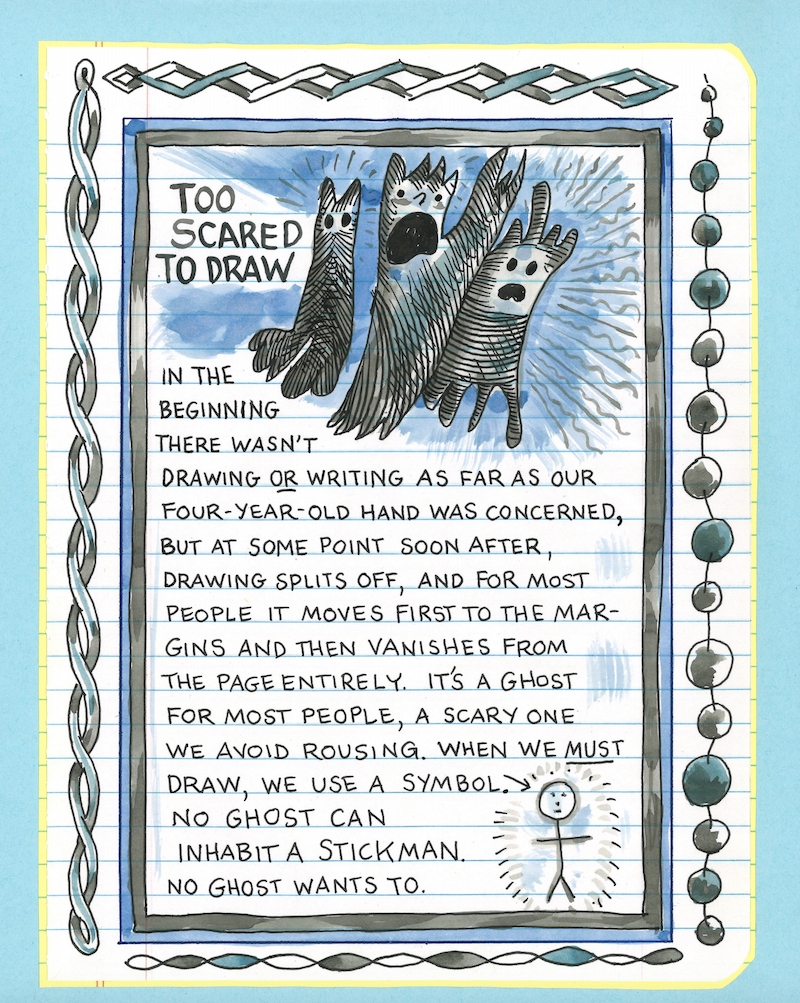
In Making Comics, exercises include drawing with eyes closed, drawing with the non-dominant hand, two-handed drawing, simultaneous partner drawing, Exquisite Corpse, and transforming scribbles and coffee stains by teasing out whatever image they may suggest.
Barry also conveys precise instructions with regard to speed and materials, knowing that those can close as many windows as they open.
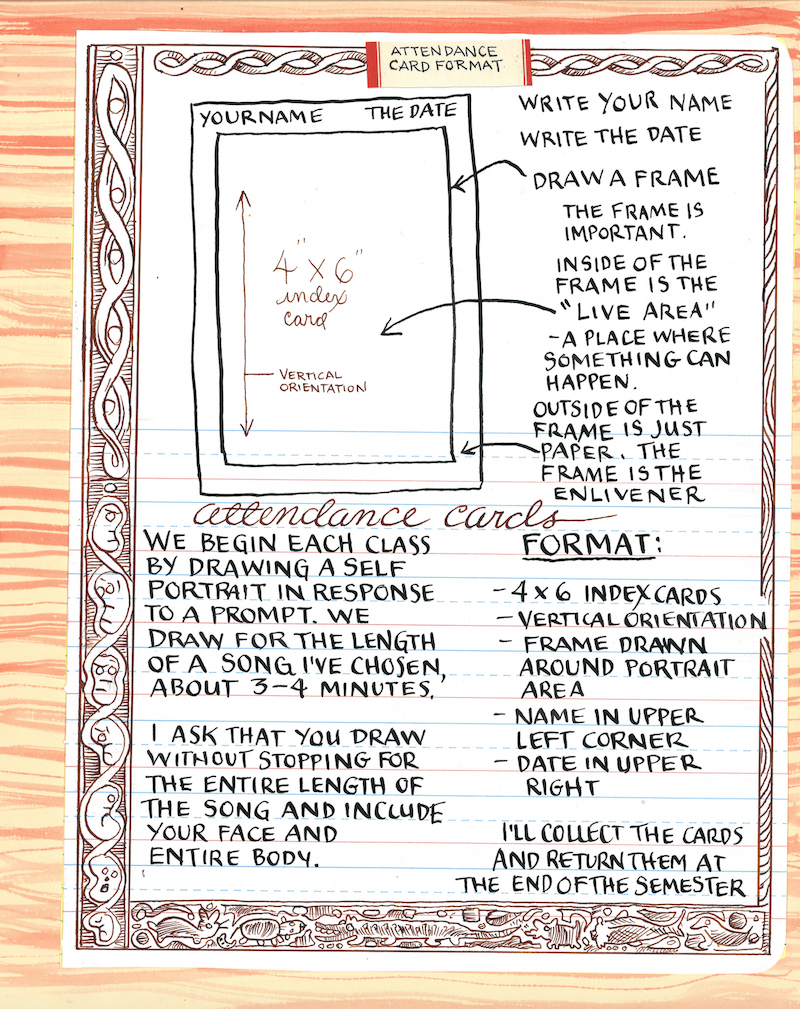
She’s battling the stifling impulse toward perfection, the impossible standards that cause so many to turn away from making pictures and stories as they mature.
Don’t sweat it! More rock, less talk! Unleash the monsters of your id! Invite unforeseen ghosts into the frame!
As Barry says:
….there are two working languages in human life. One is sort of top of the mind, what we’re conscious of. The other is this unconscious stuff that we might not know about or have access to. The way we access it is usually through this thing we call ‘the arts.’ Unfortunately, that has gotten removed from the regular daily experience of human life. What I’m trying to do is to show that there is a way that they can come together, and that you can make things in a way that makes you actually feel alive and present.
Read an excerpt of Lynda Barry’s Making Comics. Or purchase your own copy of Making Comics here.
Video at the top of the page courtesy of Art Book Walk-throughs & Reviews.
Related Content:
Cartoonist Lynda Barry Teaches You How to Draw
Ayun Halliday is an author, illustrator, theater maker and Chief Primatologist of the East Village Inky zine. Join her in NYC on Monday, December 9 when her monthly book-based variety show, Necromancers of the Public Domain celebrates Dennison’s Christmas Book (1921). Follow her @AyunHalliday.
Read More...Support Us
We're hoping to rely on loyal readers, rather than erratic ads. Please click the Donate button and support Open Culture. You can use Paypal, Venmo, Patreon, even Crypto! We thank you!

About Us

Open Culture scours the web for the best educational media. We find the free courses and audio books you need, the language lessons & educational videos you want, and plenty of enlightenment in between.
Advertise With Us

FREE UPDATES!
GET OUR DAILY EMAIL
Get the best cultural and educational resources on the web curated for you in a daily email. We never spam. Unsubscribe at any time.
FOLLOW ON SOCIAL MEDIA

Open Culture editor Dan Colman scours the web for the best educational media. He finds the free courses and audio books you need, the language lessons & movies you want, and plenty of enlightenment in between.
Advertise With Us


