Stephen Hawking’s Black Hole Paradox Explained in Animation
Many of us have heard of Stephen Hawking but know him only as a symbol of a powerful mind dedicated for a lifetime to the thorniest problems in astrophysics. Even more of us have heard of black holes but know of them only as those dangerous things in sci-fi movies that suck in spaceships. But if we gain an understanding of Hawking’s work on black holes, however basic, we gain a much clearer view of both entities and what they mean to the human endeavor of grasping the workings of reality. What it all has to do with “one of the biggest paradoxes in the universe,” and why that paradox “threatens to unravel modern science,” provide the subject matter for the animated TED-Ed lesson above.
In order to explain what’s called the “Black Hole Information Paradox,” astrophysicist Fabio Pacucci must first explain “information,” which in this usage constitutes every part of the reality in which we live. “Typically, the information we talk about is visible to the naked eye,” he says. “This kind of information tells us that an apple is red, round, and shiny.” But what physicists care about is “quantum information,” which “refers to the quantum properties of all the particles that make up that apple, such as their position, velocity and spin.” The particles that make up every object of the universe have “unique quantum properties,” and the laws of physics as currently understood hold that “the total amount of quantum information in the universe must be conserved.”
Smash the apple into sauce, in other words, and you don’t create or destroy any quantum information, you just move it around. But in the parts of spacetime with gravity so strong that nothing can escape them, better known as black holes, that particular law of physics may not apply. “When an apple enters a black hole, it seems as though it leaves the universe, and all its quantum information becomes irretrievably lost,” says Pacucci. “However, this doesn’t immediately break the laws of physics. The information is out of sight, but it might still exist within the black hole’s mysterious void.”
Then we have Hawking Radiation, the eponymous genius’ contribution to the study of black holes, which shows that “black holes are gradually evaporating,” losing mass over “incredibly long periods of time” in such a way that suggests that “a black hole and all the quantum information it contains could be completely erased” in the process. What might go into the black hole as an apple’s information doesn’t come out looking like an apple’s information. Quantum information seems to be destroyed by black holes, yet everything else about quantum information tells us it can’t be destroyed: like any paradox, or contradiction between two known or probable truths, “the destruction of information would force us to rewrite some of our most fundamental scientific paradigms.”
But for a scientist in the Hawking mold, this difficulty just makes the chase for knowledge more interesting. Pacucci cites a few hypotheses: that “information actually is encoded in the escaping radiation, in some way we can’t yet understand,” that “the paradox is just a misunderstanding of how general relativity and quantum field theory interact, that “a solution to this and many other paradoxes will come naturally with a ‘unified theory of everything,’ ” and most boldly that, because “the 2D surface of an event horizon” — the inescapable edge of a black hole — “can store quantum information,” the boundary of the observable universe “is also a 2D surface encoded with information about real, 3D objects,” implying that “reality as we know it is just a holographic projection of that information.” Big if true, as they say, but as Hawking seems to have known, the truth about our reality is surely bigger than any of us can yet imagine.
via Brain Pickings
Related Content:
Stephen Hawking’s Lectures on Black Holes Now Fully Animated with Chalkboard Illustrations
Watch A Brief History of Time, Errol Morris’ Film About the Life & Work of Stephen Hawking
The Largest Black Holes in the Universe: A Visual Introduction
Watch a Star Get Devoured by a Supermassive Black Hole
Based in Seoul, Colin Marshall writes and broadcasts on cities, language, and culture. His projects include the book The Stateless City: a Walk through 21st-Century Los Angeles and the video series The City in Cinema. Follow him on Twitter at @colinmarshall or on Facebook.
Read More...82 Animated Interviews with Living, Dead, Celebrated & Sometimes Disgraced Celebrities
Who wants to live in the present? It’s such a limiting period, compared to the past.
Were Ebert alive today would he still express himself thusly in a recorded interview? His remarks are specific to his cinematic passion, but still. As a smart Midwesterner, he would have realized that the corn has ears and the potatoes have eyes. Remarks can be taken out of context. (Witness the above.)
Recent history has shown that not everyone is keen to roll back the clock—women, people of color, and gender non-conforming individuals have been reclaiming their narratives in record numbers, airing secrets, exposing injustice, and articulating offenses that can no longer stand.
If powerful, older, white heterosexual men in the entertainment business are exercising verbal caution these days when speaking as a matter of public record, there’s some goodly cause for that.
It also makes the archival celebrity interviews excerpted for Quoted Studios’ animated series, Blank on Blank, feel very vibrant and uncensored, though be forewarned that your blood may boil a bit just reviewing the celebrity line up—Michael Jackson, Woody Allen, Clint Eastwood holding forth on the Pussy Generation 10 years before the Pussyhat Project legitimized common usage of that charged word….
(In full disclosure, Blank on Blank is an oft-reported favorite here at Open Culture.)
Here’s rapper Tupac Skakur, a year and a half before he was killed in a drive by shooting, casting himself as a tragic Shakespearean hero,
His musings on how differently the public would have viewed him had he been born white seem even more relevant today. Readers who are only passingly acquainted with his artistic output and legend may be surprised to hear him tracing his allegiance to “thug life” to the positive role he saw the Black Panthers playing in his single mother’s life when he was a child.
On the other hand, Shakur’s lavish and freely expressed self pity at the way the press reported on his rape charge (for which he eventually served 9 months) does not sit at all well in 2019, nor did it in 1994.
Like the majority of Blank on Blank entries, the recording was not the interview’s final form, but rather a journalistic reference. Animator Patrick Smith may add a layer of visual editorial, but in terms of narration, every subject is telling their own undiluted truth.
It is interesting to keep in mind that this was one of the first interviews the Blank on Blank team tackled, in 2013.
Six years later, it’s hard to imagine they would risk choosing that portion of the interview to animate. Had Shakur lived, would he be cancelled?
Guess who was the star of the very first Blank on Blank to air on PBS back in 2013?
Broadcaster and television host Larry King. While King has steadfastly rebutted accusations of groping, we suspect that if the Blank on Blank team was just now getting around to this subject, they’d focus on a different part of his 2001 Esquire profile than the part where he regales interviewer Cal Fussman with tales of pre-cellphone “seduction.”
It’s only been six years since the series’ debut, but it’s a different world for sure.
If you’re among the easily triggered, living legend Meryl Streep’s thoughts on beauty, harvested in 2014 from a 2008 conversation with Entertainment Weekly’s Christine Spines, won’t offer total respite, but any indignation you feel will be in support of, not because of this celebrity subject.
It’s actually pretty rousing to hear her merrily exposing Hollywood players’ piggishness, several years before the Harvey Weinstein scandal broke.
For even more evidence of “a different world,” check out interviewer Howard Smith’s remark to Janis Joplin in her final interview-cum-Blank-on-Blank episode, four days before here 1970 death:
A lot of women have been saying that the whole field of rock music is nothing more than a big male chauvinist rip off and when I say, “Yeah, what about Janis Joplin? She made it,” they say, “Oh…her.” It seems to bother a lot of women’s lib people that you’re kind of so up front sexually.
Joplin, stung, unleashes a string of invectives against feminists and women, in general. One has to wonder if this reaction was Smith’s goal all along. Or maybe I’m just having flashbacks to middle school, when the popular girls would always send a delegate disguised as a concerned friend to tell you why you were being shunned, preferably in a highly public gladiatorial arena such as the lunchroom.
I presume that sort of stuff occurs primarily over social media these days.
Good on the Blank on Blank staff for picking up on the tenor of this interview and titling it “Janis Joplin on Rejection.”
You can binge watch a playlist of 82 Blank on Blank episodes, featuring many thoughts few express so openly anymore, here or right below.
When you’re done with that, you’ll find even more Blank on Blank entries on the creators’ website.
Related Content:
Alfred Hitchcock Meditates on Suspense & Dark Humor in a New Animated Video
Joni Mitchell Talks About Life as a Reluctant Star in a New Animated Interview
Ayun Halliday is an author, illustrator, theater maker and Chief Primatologist of the East Village Inky zine. Join her in NYC on Monday, December 9 when her monthly book-based variety show, Necromancers of the Public Domain celebrates Dennison’s Christmas Book (1921). Follow her @AyunHalliday.
Read More...The Seven Road-Tested Habits of Effective Artists
Fifteen years ago, a young construction worker named Andrew Price went in search of free 3d software to help him achieve his goal of rendering a 3D car.
He stumbled onto Blender, a just-the-ticket open source software that helps users with every aspect of 3D creation—modeling, rigging, animation, simulation, rendering, compositing, and motion tracking.
Price describes his early learning style as “playing it by ear,” sampling tutorials, some of which he couldn’t be bothered to complete.
Desire for freelance gigs led him to forge a new identity, that of a Blender Guru, whose tutorials, podcasts, and articles would help other new users get the hang of the software.
But it wasn’t declaring himself an expert that ultimately improved his artistic skills. It was holding his own feet over the fire by placing a bet with his younger cousin, who stood to gain $1000 if Price failed to rack up 1,000 “likes” by posting 2D drawings to ArtStation within a 6‑month period.
(If he succeeded—which he did, 3 days before his self-imposed deadline—his cousin owed him nothing. Loss aversion proved to be a more powerful motivator than any carrot on a stick…)
In order to snag the requisite likes, Price found that he needed to revise some habits and commit to a more robust daily practice, a journey he detailed in a presentation at the 2016 Blender Conference.
Price confesses that the challenge taught him much about drawing and painting, but even more about having an effective artistic practice. His seven rules apply to any number of creative forms:
Andrew Price’s Rules for an Effective Artist Practice:
- Practice Daily
A number of prolific artists have subscribed to this belief over the years, including novelist (and mother!) JK Rowling, comedian Jerry Seinfeld, autobiographical performer Mike Birbligia, and memoirist David Sedaris.
If you feel too fried to uphold your end of the bargain, pretend to go easy on yourself with a little trick Price picked up from music producer Rick Rubin: Do the absolute minimum. You’ll likely find that performing the minimum positions you to do much more than that. Your resistance is not so much to the doing as it is to the embarking.
- Quantity over Perfectionism Masquerading as Quality
This harkens back to Rule Number One. Who are we to say which of our works will be judged worthy. Just keep putting it out there—remember it’s all practice, and law of averages favors those whose output is, like Picasso’s, prodigious. Don’t stand in the way of progress by splitting a single work’s endless hairs.
- Steal Without Ripping Off
Immerse yourself in the creative brilliance of those you admire. Then profit off your own improved efforts, a practice advocated by the likes of musician David Bowie, computer visionary Steve Jobs, and artist/social commentator Banksy.
- Educate Yourself
As a stand-alone, that old chestnut about practice making perfect is not sufficient to the task. Whether you seek out online tutorials, as Price did, enroll in a class, or designate a mentor, a conscientious commitment to study your craft will help you to better master it.
- Give yourself a break
Banging your head against the wall is not good for your brain. Price celebrates author Stephen King’s practice of giving the first draft of a new novel six weeks to marinate. Your break may be shorter. Three days may be ample to juice you up creatively. Just make sure it’s in your calendar to get back to it.
- Seek Feedback
Filmmaker Taika Waititi, rapper Kanye West, and the big gorillas at Pixar are not threatened by others’ opinions. Seek them out. You may learn something.
- Create What You Want To
Passion projects are the key to creative longevity and pleasurable process. Don’t cater to a fickle public, or the shifting sands of fashion. Pursue the sorts of things that interest you.
Implicit in Price’s seven commandments is the notion that something may have to budge—your nightly cocktails, the number of hours spent on social media, that extra half hour in bed after the alarm goes off… Don’t neglect your familial or civic obligations, but neither should you shortchange your art. Life’s too short.
Read the transcript of Andrew Price’s Blender Conference presentation here.
Related Content:
The Daily Habits of Famous Writers: Franz Kafka, Haruki Murakami, Stephen King & More
The Daily Habits of Highly Productive Philosophers: Nietzsche, Marx & Immanuel Kant
Ayun Halliday is an author, illustrator, theater maker and Chief Primatologist of the East Village Inky zine. Join her in NYC on Monday, December 9 when her monthly book-based variety show, Necromancers of the Public Domain celebrates Dennison’s Christmas Book (1921). Follow her @AyunHalliday.
Read More...Why David Sedaris Hates America’s Favorite Word, “Awesome”
David Sedaris has made his name as a humorist, noting the absurdities of everything from life with his parents and siblings to the perpetual cycle of world travel and book-signing into which fame has launched him. But as his longtime readers know, he’s really a student of language: not only has his own voice on the page been shaped by close observation of English, he’s studied and continues to study a host of foreign languages as well. Longtime readers will remember how much material he got out of the French classes that gave his book Me Talk Pretty One Day its title, and he has more recently written of his struggles to get a handle on such diverse tongues as German, Japanese, and Slovene. (I myself wrote an essay about Sedaris’ language-learning in the Los Angeles Review of Books.)
Though he’s never explicitly cited it as part of his writing process, these studies have clearly honed Sedaris’ ear for language in general, especially when it comes to its local tics and eccentricities. “In France the most often used word is ‘connerie,’ which means ‘bullshit,’ ” he says in the audiobook clip at the top of the post from his latest collection Calypso, “and in America it’s hands-down ‘awesome,’ which has replaced ‘incredible,’ ‘good,’ and even ‘just OK.’ Pretty much everything that isn’t terrible is awesome in America now.” What once denoted a sight or experience filled with the emotion of “dread, veneration, and wonder that is inspired by authority or by the sacred or sublime” has become, in Sedaris’ view, a synonym for “fine.”
“It just got out of hand to me,” Sedaris explains to USA Today. “Everything’s awesome all the time. I was in Boulder, Colorado” — a city he has elsewhere described as “the ‘awesome’ capital” — “and someone said, ‘I’ll have a double espresso, awesome,’ and the other person said, ‘Awesome.’ ”
(In another interview, he mentions that he often fines people “a dollar a time at events for using the A‑word. I warn them first, because it’s only fair, but I can make pretty good money that way.”) This may sound like a futile objection to inevitable linguistic change, but only to those who haven’t noticed the underlying debasement of meaning. If “awesome” can now describe a coffee, what word, if any, indicates genuine awe?
A similar fate has befallen other English words and expressions. “Great” preceded “awesome” into the semantic haze, and “to beg the question” has become a standard example of a phrase to whose original meaning only a pedant would cling. People now often use it synonymously with “raising the question,” but if we accept that as its meaning, we’re left with no way to refer to question-begging itself, a rhetorical practice still as rampant as ever. To criticize the modern loosening of these usages is to keep sharp and complete one’s array of tools for expression and communication; we condemn the overuse of a word not out of pure hatred but out of understanding the necessity of its true meaning. Even David Sedaris grants “awesome” its proper time and place: “I went to the Great Wall of China once, and I have to say, that was awesome. But that’s the only thing I can think of. Not a latte.”
Related Content:
20 Free Essays & Stories by David Sedaris: A Sampling of His Inimitable Humor
Bertrand Russell Lists His 20 Favorite Words in 1958 (and What Are Some of Yours?)
Based in Seoul, Colin Marshall writes and broadcasts on cities, language, and culture. His projects include the book The Stateless City: a Walk through 21st-Century Los Angeles and the video series The City in Cinema. Follow him on Twitter at @colinmarshall, on Facebook, or on Instagram.
Read More...A Map of How the Word “Tea” Spread Across the World
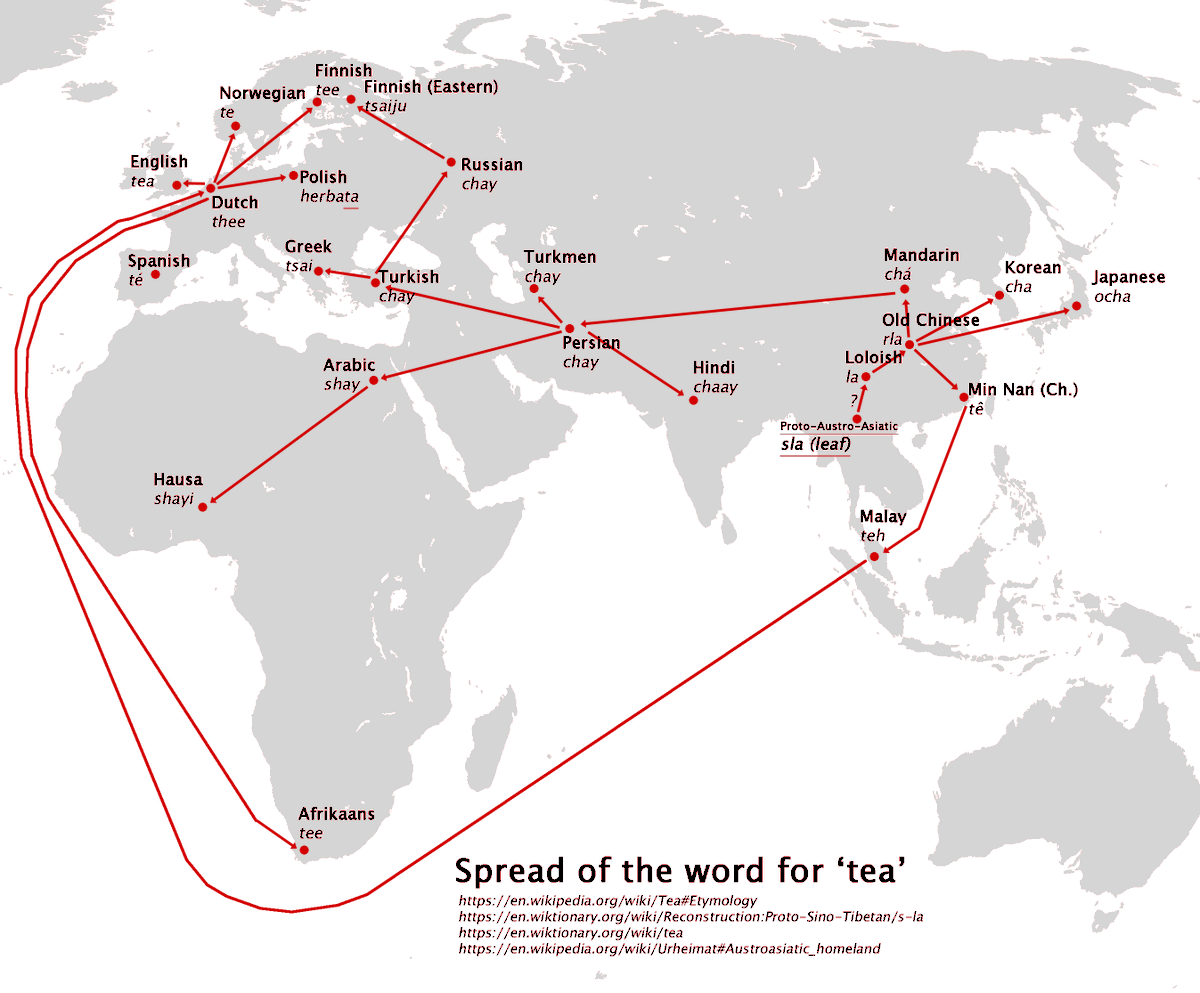
When I order a cup of tea in Korea, where I live, I ask for cha (차); when traveling in Japan, I ask for the honorific-affixed ocha (お茶). In Spanish-speaking places I order té, which I try to pronounce as distinctly as possible from the thé I order in French-speaking ones. And on my trips back to United States, where I’m from, I just ask for tea. Not that tea, despite its awe-inspiring venerability, has ever quite matched the popularity of coffee in America, but you can still find it most everywhere you go. And for decades now, no less an American corporate coffee juggernaut than Starbucks has labeled certain of its teas chai, which has popularized that alternative term but also created a degree of public confusion: what’s the difference, if any, between chai and tea?
Both words refer, ultimately, to the same beverage invented in China more than three millennia ago. Tea may now be drunk all over the world, but people in different places prefer different kinds: flavors vary from region to region within China, and Chinese teas taste different from, say, Indian teas. Starbucks presumably brands its Indian-style tea with the word chai because it sounds like the words used to refer to tea in India.
It also sounds like the words used to refer to tea in Farsi, Turkish, and even Russian, all of them similar to chay. But other countries’ words for tea sound different: the Maylay teh, the Finnish tee, the Dutch thee. “The words that sound like ‘cha’ spread across land, along the Silk Road,” writes Quartz’s Nikhil Sonnad. “The ‘tea’-like phrasings spread over water, by Dutch traders bringing the novel leaves back to Europe.”
“The term cha (茶) is ‘Sinitic,’ meaning it is common to many varieties of Chinese,” writes Sonnad. “It began in China and made its way through central Asia, eventually becoming ‘chay’ (چای) in Persian. That is no doubt due to the trade routes of the Silk Road, along which, according to a recent discovery, tea was traded over 2,000 years ago.” The te form “used in coastal-Chinese languages spread to Europe via the Dutch, who became the primary traders of tea between Europe and Asia in the 17th century, as explained in the World Atlas of Language Structures. The main Dutch ports in east Asia were in Fujian and Taiwan, both places where people used the te pronunciation. The Dutch East India Company’s expansive tea importation into Europe gave us the French thé, the German Tee, and the English tea.”
And we mustn’t leave out the Portuguese, who in the 1500s “travelled to the Far East hoping to gain a monopoly on the spice trade,” as Culture Trip’s Rachel Deason writes, but “decided to focus on exporting tea instead. The Portuguese called the drink cha, just like the people of southern China did,” and under that name shipped its leaves “down through Indonesia, under the southern tip of Africa, and back up to western Europe.” You can see the global spread of tea, tee, thé, chai, chay, cha, or whatever you call it in the map above, recently tweeted out by East Asia historian Nick Kapur. (You may remember the fantastical Japanese history of America he sent into circulation last year.) Study it carefully, and you’ll be able to order tea in the lands of both te and cha. But should you find yourself in Burma, it won’t help you: just remember that the word there is lakphak.
Related Content:
An Animated History of Tea
1934 Map Resizes the World to Show Which Country Drinks the Most Tea
10 Golden Rules for Making the Perfect Cup of Tea (1941)
George Orwell’s Rules for Making the Perfect Cup of Tea: A Short Animation
Epic Tea Time with Alan Rickman
Based in Seoul, Colin Marshall writes and broadcasts on cities, language, and culture. His projects include the book The Stateless City: a Walk through 21st-Century Los Angeles and the video series The City in Cinema. Follow him on Twitter at @colinmarshall, on Facebook, or on Instagram.
Read More...Martin Scorsese Explains the Difference Between Cinema and Movies

Image by “Siebbi,” Wikimedia Commons
There is a battle raging on the internet, and you may count yourself lucky if you’ve heard nothing about it since it involves the usual unnecessary escalations and knee-jerk reactions: the battle of superhero movies versus the art form known as “cinema.” The first shot, one might say, was fired by Martin Scorsese, who has certainly earned the right to make pronouncements on the subject. Asked for his thoughts on the MCU (that’s Marvel Cinematic Universe for the uninitiated) during an interview with Empire magazine, Scorsese opined, “that’s not cinema. Honestly, the closest I can think of them, as well made as they are, with actors doing the best they can under the circumstances, is theme parks.”
This writer is of the opinion that one can enjoy film both as art and as pure spectacle, while recognizing clear differences between them. They share a medium, but they aim at and produce different effects. Comparing the experience of watching Avengers: Endgame or most any other Marvel film to riding a rollercoaster seems perfectly apposite to me. Still, comic film fans went wild online, lobbing all sorts of accusations at Scorsese and fellow directors who delivered even less charitable takes on the Marvel movie phenom. Twitter memes and jokes proliferated; Disney’s CEO weighed in with what must surely be a disinterested critical opinion.
Let’s look past distracting hot takes, marketing strategies, and generational warfare. Scorsese has eloquently clarified his position in a New York Times op-ed, and his arguments are worth our attention. For one thing, the director approaches the subject with humility, admitting his own biases. “The fact that [Marvel] films don’t themselves interest me is a matter of personal taste and temperament,” he writes. “I know that if I were younger, if I’d come of age at a later time, I might have been excited by these pictures and maybe even wanted to make one myself.”
He details his own sense of what cinema should be, one drawn principally from his influences: Bergman, Godard, Hitchcock (whose movies might also be called theme parks in a way, Scorsese grants, but rely more on characterization than grand set pieces and special effects). He also lists current favorites: Ari Aster, Spike Lee, Kathryn Bigelow, Paul Thomas Anderson. As an auteur himself, he has a clear bias in favor of other auteurs. Yet there’s more at stake than taste or what some have seen as elitism. “Why not just let superhero films and other franchise films be?” he asks. “The reason is simple. In many places around this country and around the world, franchise films are now your primary choice if you want to see something on the big screen.”
Superhero movies have dominated the market, edging out other kinds of films with other kinds of aspirations. The “financial dominance” of what Scorsese calls “worldwide audiovisual entertainment” is “being used to marginalize and even belittle the existence” of cinema—of smaller films that take creative risks and are not computer-generated products of market research and audience testing for maximum box-office consumption. Having grown up himself in the Hollywood studio system, Scorsese doesn’t dismiss film as a business, but he laments the loss of a “productive tension” between “the artists and the people who ran the business.” Without that tension, the industry becomes an efficient, but inhuman, machine.
It’s a problem, in other words, of a power imbalance in which studios—vertically integrated into mega-corporations like Disney—push profit over most other considerations. This severely limits the risks they’re willing to take, and it pushes independent and experimental filmmakers further into the margins, and out of theaters altogether, where their works were meant to be seen. Netflix and other streaming services may open up unique opportunities, but they diminish film by relegating it to television screens (and, worse, tablets and phones).
Scorsese’s argument is only partly an aesthetic one—he may object to Marvel movies on the grounds that they’re forgettable and predictable. But the primary concern he voices in his essay is a problem of proportion. The Marvel Cinematic Universe—like the villain in Avengers: Endgame (which Scorsese hasn’t seen)—threatens to take over and half-destroy the universe of cinema in all its variety of forms and expressions. It is largely succeeding. “For anyone who dreams of making movies or who is just starting out, the situation at this moment is brutal and inhospitable to art,” Scorsese writes. “And the act of simply writing those words fills me with terrible sadness.” Read his essay here.
Related Content:
Martin Scorsese to Teach His First Online Course on Filmmaking
Martin Scorsese Makes a List of 85 Films Every Aspiring Filmmaker Needs to See
Frank Zappa Explains the Decline of the Music Business (1987)
Josh Jones is a writer and musician based in Durham, NC. Follow him at @jdmagness
Read More...Behold Félix Nadar’s Pioneering Photographs of the Paris Catacombs (1861)

As a tourist in England, one may be persuaded to pick a piece of merchandise with the now-ubiquitous slogan “Keep Calm and Carry On,” from a little-displayed World War II motivational poster rediscovered in 2000 and turned into the 21st-century’s most cheeky emblem of stiff-upper-lip-ness. Travel across the Channel, however, and you’ll find another version of the sentiment, drawn not from war memorabilia but the ancient warning of memento mori.
“Keep Calm and Remember You Will Die” say magnets, key chains, and other souvenirs emblazoned with the logo of the Paris Catacombs, a major tourist attraction that sells timed tickets “to manage the large queue that forms daily outside the nondescript entrance on the Place Denfert-Rochereau (formerly called the Place d’Enfer, or Hell Square),” writes Allison Meier at Public Domain Review. Still profoundly creepy, the Catacombs were once as forbidding to descend into as their walls of skulls and bones are to gaze upon, requiring visitors to carry flaming torches into their depths.
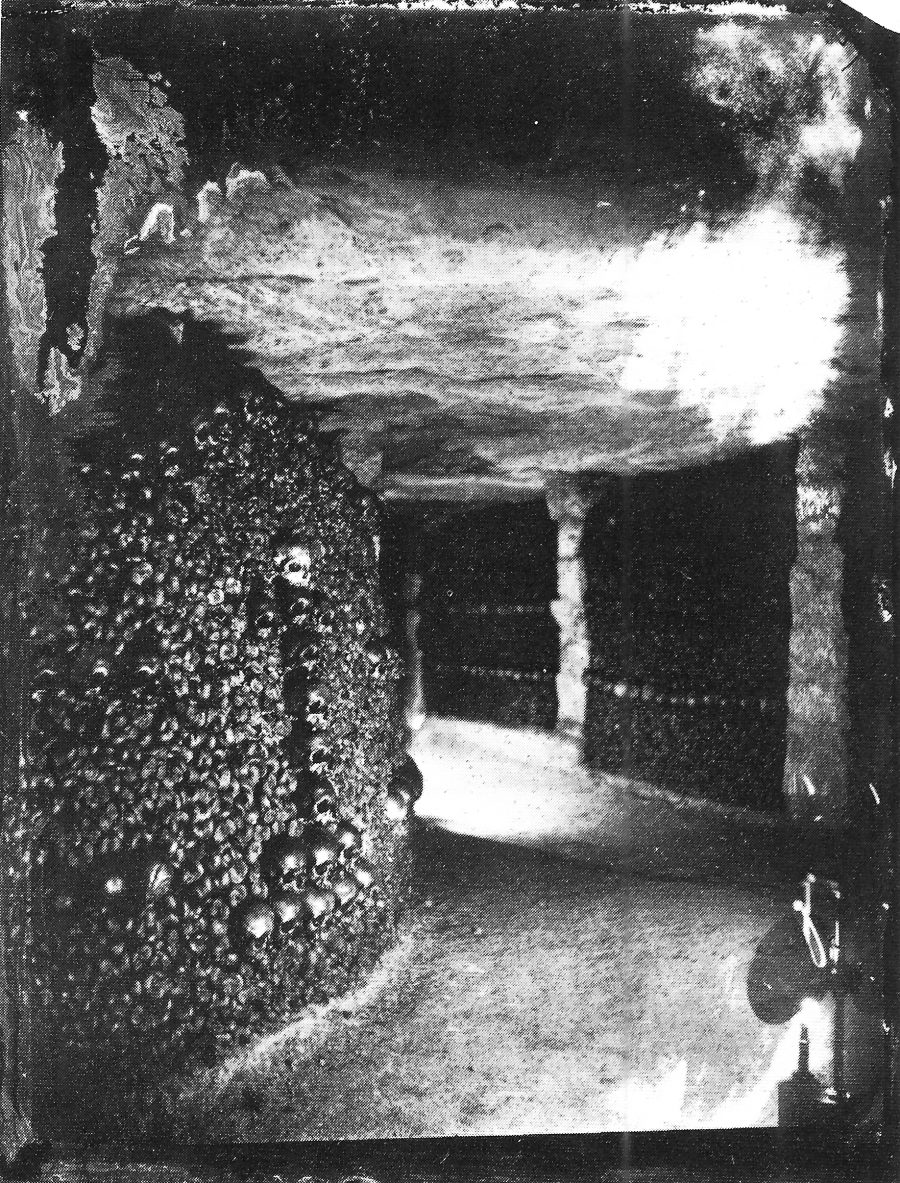
When pioneering photographer Félix Nadar “descended into this ‘empire of death’ in the 1860s artificial lighting was still in its infancy.” Using Bunsen batteries “and a good deal of patience,” Nadar captured the Catacombs as they had never been seen. He also documented the completion of “artistic facades” of skulls and long bones, built “to hide piles of other bones,” notes Strange Remains, from an estimated six million corpses exhumed from overcrowded Parisian cemeteries in the 18th and 19th centuries.
Nadar (the pseudonym of Gaspard-Félix Tournachon, born 1820), helped turn the Catacombs into the globally famous destination they became. His “subterranean photographs,” writes Matthew Gandy in The Fabric of Space: Water, Modernity, and the Urban Imagination, “played a key role in fostering the growing popularity of sewers and catacombs among middle-class Parisians, and from the 1867 Exposition onward the city authorities began offering public tours of underground Paris.” The Catacombs became, in Nadar’s own words, “one of those places that everyone wants to see and no one wants to see again.”
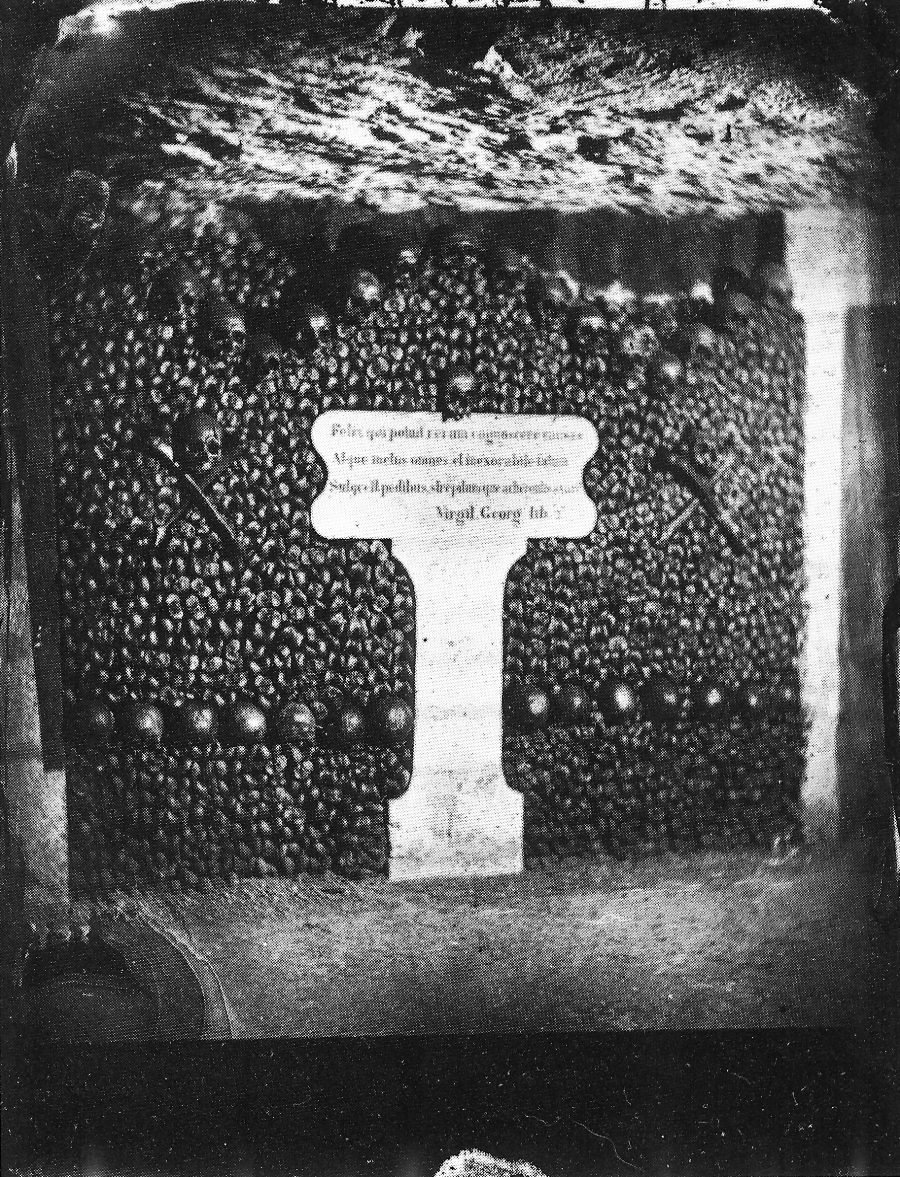
Visitors came seeking the grim fascinations they had seen in Nadar’s photos, taken during a “single three-month campaign,” Meier notes, sometime in 1861, after the photographer “pioneered new approaches to artificial light.” The project was an irresistible photographic essay on the leveling force of mortality. In an essay titled “Paris Above and Below,” published in the 1867 Exposition guide, Nadar described the “egalitarian confusion of death,” in which “a Merovingian king remains in eternal silence next to those massacred in September ’92.”
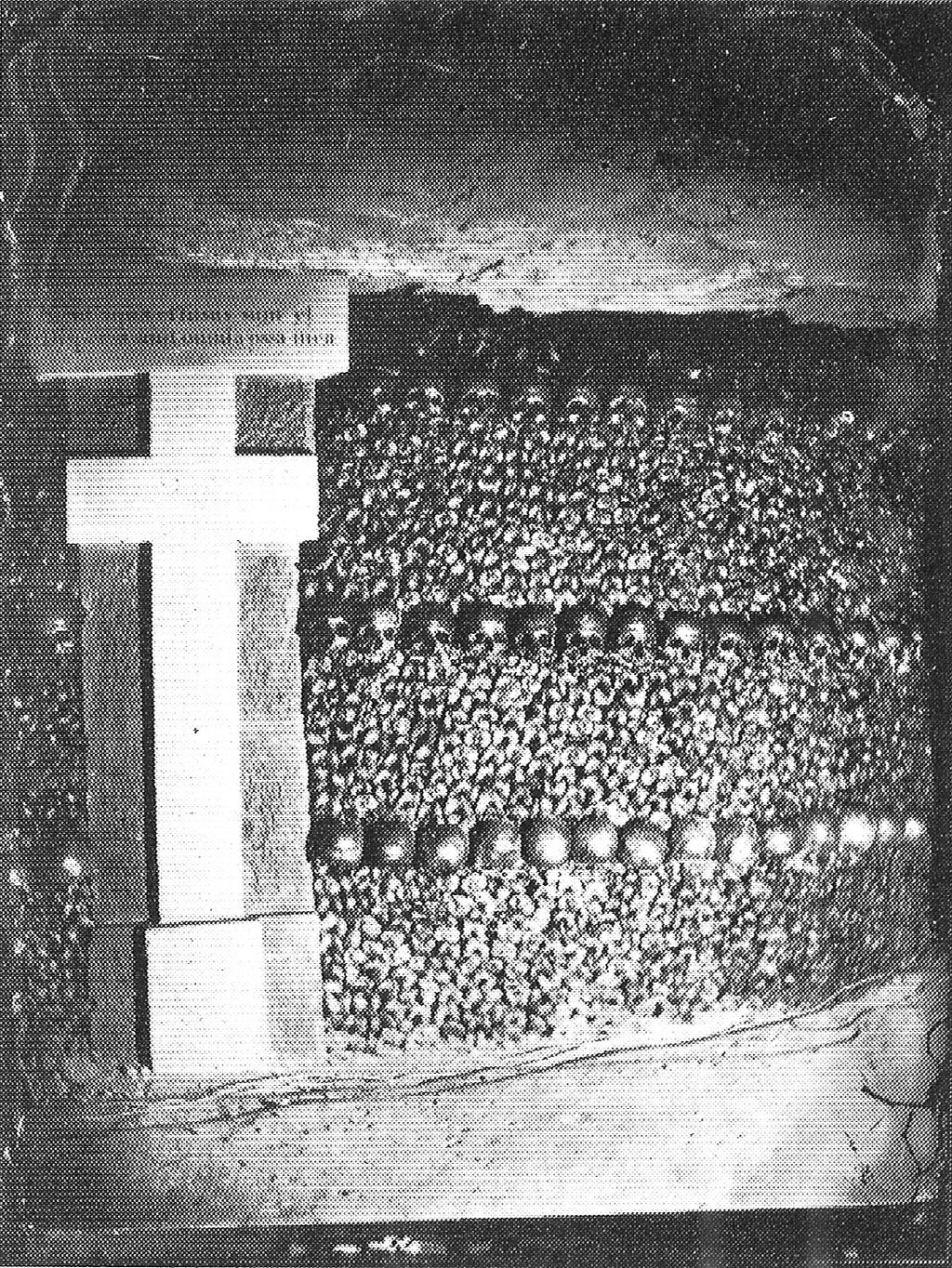
The ancient and the modern dead, peasants, aristocrats, victims of the Revolutionary terror all piled together, “every trace implacably lost in the unaccountable clutter of the most humble, the anonymous.” The huge necropolis initially had no shape or order. Its 19th century redesign reflected that of the Parisian streets above. In 1810, Napoleon authorized quarries inspector Héricart de Thury to undertake a renovation that accounted for what Thury called “the intimate rapport that will surely exist between the Catacombs and the events of the French Revolution.”
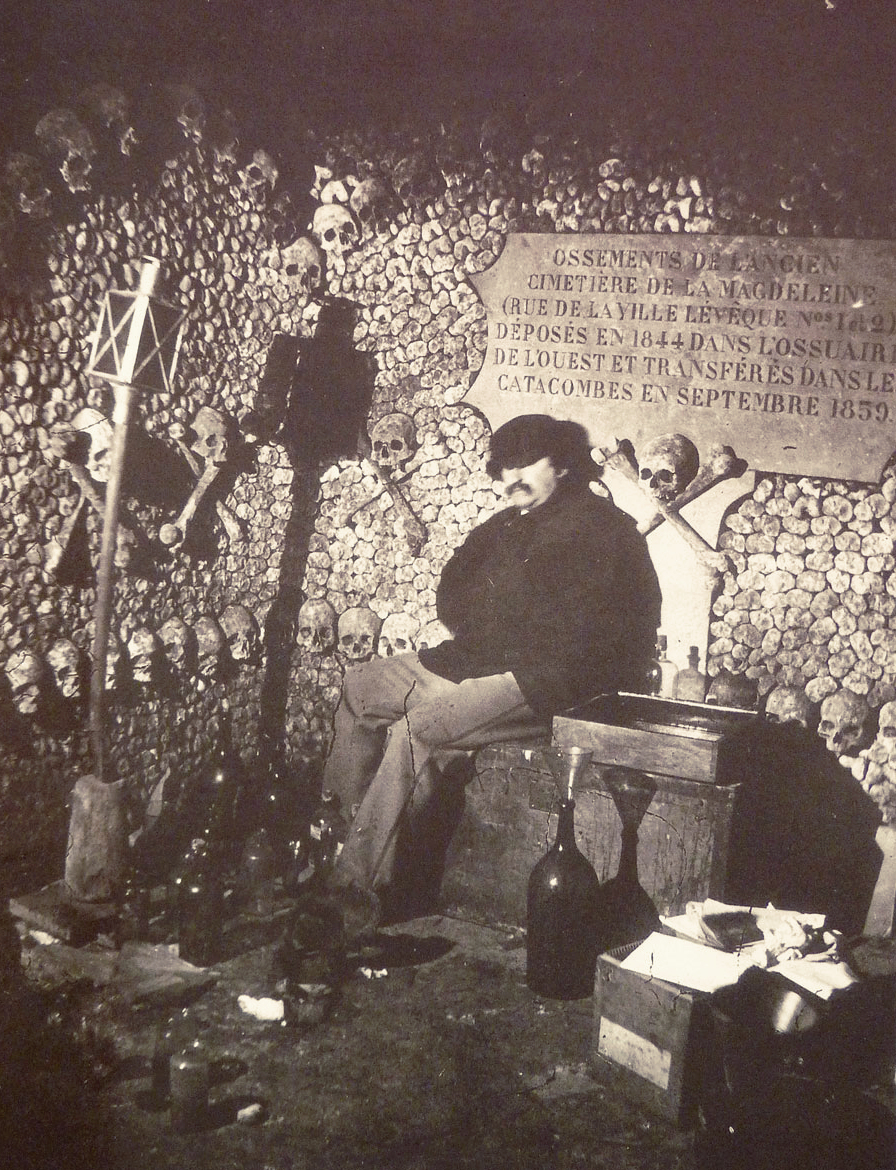
This “rapport” not only included the “mass burial of the victims of the 1792 September Massacres” Nadar references in his essay, but also, Meier points out, the arrangement of bones in “patterns, rows, and crosses; altars and columns were installed below the earth. Plaques with evocative quotations were added to encourage visitors to reflect on mortality.” Because of the long exposure times the photographs required, Nadar used mannequins to stand in for the living workers who completed this work. The only living body he captured was his own, in the self-portrait above.
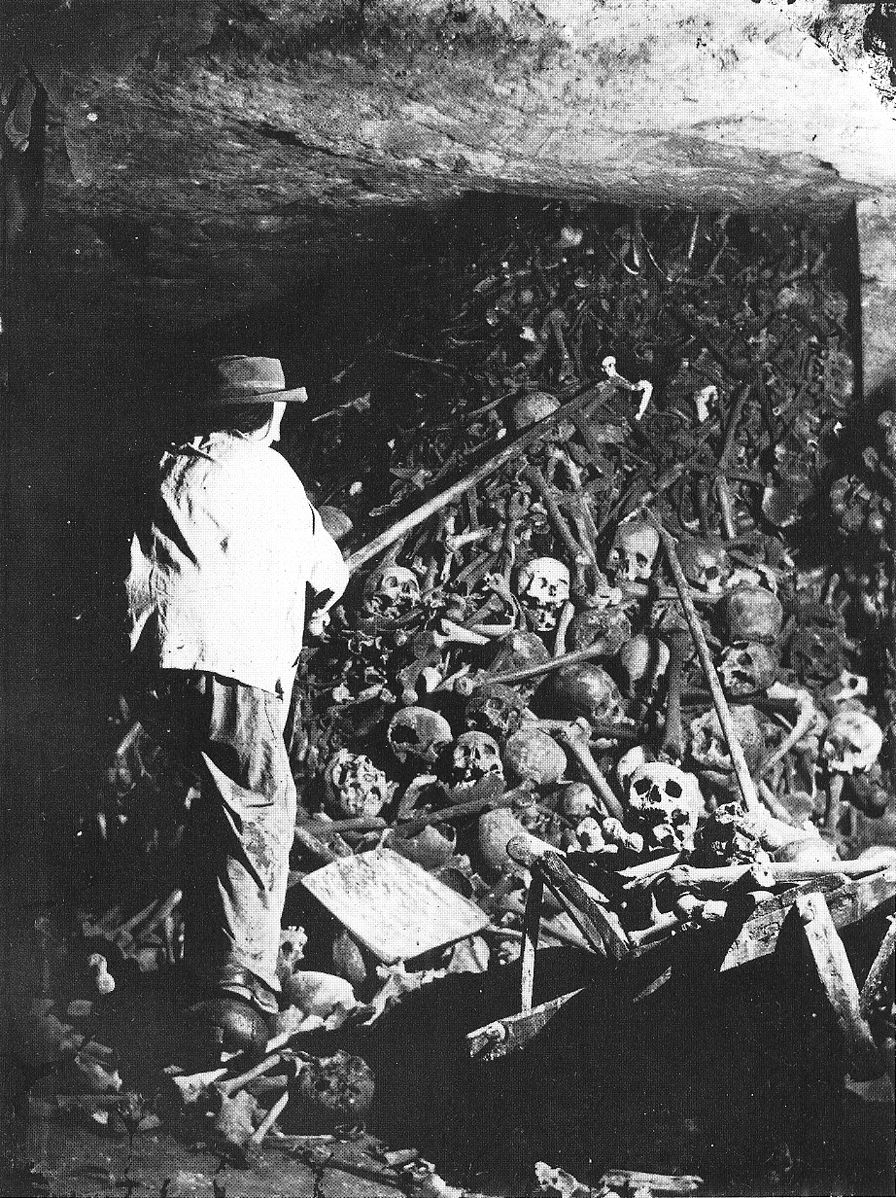
Learn more about the history of the Catacombs and Nadar’s now-legendary photographic project at Public Domain Review and see many more memento mori images here.
Related Content:
Notre Dame Captured in an Early Photograph, 1838
Take a Visual Journey Through 181 Years of Street Photography (1838–2019)
Josh Jones is a writer and musician based in Durham, NC. Follow him at @jdmagness
Read More...How to Find Silence in a Noisy World
“Take a walk at night,” wrote avant-garde composer Pauline Oliveros in her 1974 “Sonic Meditations,” a set of instructions for what she called deep listening. “Walk so silently that the bottom of your feet become ears.” Listening to silence opens up rich new worlds of sound. It can be a life-changing experience.
“It’s hard to imagine that a sound can transform someone’s life, but it happened to me,” says acoustic ecologist Gordon Hempton in the short 360-degree documentary above, “How to Find Silence in a Noisy World.” Hempton learned to walk silently while carrying a microphone, documenting his listening journey through remote places like the Hoh Rainforest in Washington state, considered one of the quietest places in North America.
“By holding a microphone, I became a better listener. I learned that the microphone doesn’t listen for what’s important, it doesn’t judge, it doesn’t interfere.” The microphone, that is, has no ego. Recorded and amplified, the silence of the Hoh becomes cacophony, or a symphony, depending on how we describe it. Maybe any description gets in the way of listening. “Just listen,” says Hempton. “Silence is the poetics of space. What it means to be in a place… Silence isn’t the absence of something, but the presence of everything
If silence is full of sound, why might we crave it when we’re stressed? Because we are bombarded by noise pollution, “sounds that have nothing to do with the natural acoustic system.” These sounds have been encroaching on places like the Hoh Rainforest for many decades, and Hempton has documented their incursion over the past 30 years, building a collection of over 100 recordings “equipped with a 3‑D microphone system that replicates human hearing,” notes Brain Pickings.
“Emanating from his collection… is the idea that ‘there is a fundamental frequency for each habitat’—a tonal quality that shapes the sense of place and quality of presence.” Hempton’s work complements the nature recordings of Bernie Krause, former musician turned renowned expert on natural sound, whose theory of biophony describes how natural sounds work together to fill in the spectrum, each one establishing its own specific bandwidth so as not to drown out the others.
Natural sounds create a kind of self-regulating harmony. In order to fully inhabit the space we’re in, we must be able to hear them. But as the recordings made by Hempton and Krause show us, humans have a unique ability to feel ourselves deeply immersed in other places, too, by listening to recordings of their silences. Hempton implies that recordings may soon be all we have left.
“Silence,” he says, “is on the verge of extinction. There is not one place left on planet Earth that is set aside and off limits to noise pollution.” It interferes with the cycles of mating animals, disrupts call and response patterns ecosystems use to coordinate themselves. Silence is part of a global biofeedback system, telling us to quiet down, slow down, and become part of all that’s happening around us. We ignore it to our great detriment.
via Brain Pickings
Related Content:
Free: Download the Sublime Sights & Sounds of Yellowstone National Park
10 Hours of Ambient Arctic Sounds Will Help You Relax, Meditate, Study & Sleep
Josh Jones is a writer and musician based in Durham, NC. Follow him at @jdmagness
Read More...The Entire History of the British Isles Animated: 42,000 BCE to Today
The United Kingdom is a confusing place for many people, and their not-quite-answered questions about it go all the way to what does and does not constitute the United Kingdom in the first place. Not to give the ending away, but the animated map above by historical-cartographical Youtuber Ollie Bye eventually reveals that, if you’re looking at the British Isles, you’re looking at the UK — unless, of course, you’re looking at the Republic of Ireland. But taking the long view, the political division of the British Isles has seldom been so simple. We know they were populated by what we now call caucasoids at least 44,000 years ago, but by 700 BC three groups had divided them up: the Britons, the Picts, and the Gaels.
The complications really start at the time of the Roman Empire, when, depending on where in the British Isles you went, you’d have encountered the Icenii, the Parisi, the Caledonii, the Iverni, and many other distinct peoples besides. When the Roman Empire gave way to the Roman Republic, Britannia, or Roman Britain, began its expansion (and its road-building) across the Isles, starting from the southeast.
But with Rome’s withdrawal in 410 a great many new borders appear like spiderweb cracks across the land. For centuries thereafter, the British Isles is a place of many kingdoms: Mercia, Wessex, Northumbria, Gwynedd, and Deheubarth, to name but a few. (Not to mention the Vikings.) And then you have a year like 1066, when the Norman conquest redraws a large chunk of the map at a stroke.
Even those most ignorant of British history will recognize a few of the kingdoms that arise later on in this period: the Kingdom of Scotland, for example, or the Kingdom of Wales. Starting from the mid-12th century, a certain Kingdom of England begins to paint the map red. By 1604, the British Isles are cleanly divided between the Kingdom of England and the Kingdom of Scotland; by 1707, the Kingdom of Great Britain is running the whole place. The situation hasn’t changed much since, though anyone who has traveled across the British Isles knows that the ostensible lack of political fractiousness masks many enduring cultural divisions subtle to the outsider: while everyone living everywhere from John o’ Groats to Land’s End may officially be British, few would countenance being lumped together with all the rest of them.
If you would like to support the mission of Open Culture, consider making a donation to our site. It’s hard to rely 100% on ads, and your contributions will help us continue providing the best free cultural and educational materials to learners everywhere. You can contribute through PayPal, Patreon, and Venmo (@openculture). Thanks!
Related Content:
The Roman Roads of Britain Visualized as a Subway Map
Watch the History of the World Unfold on an Animated Map: From 200,000 BCE to Today
The History of Civilization Mapped in 13 Minutes: 5000 BC to 2014 AD
5‑Minute Animation Maps 2,600 Years of Western Cultural History
A History of the Entire World in Less Than 20 Minutes
Based in Seoul, Colin Marshall writes and broadcasts on cities, language, and culture. His projects include the book The Stateless City: a Walk through 21st-Century Los Angeles and the video series The City in Cinema. Follow him on Twitter at @colinmarshall or on Facebook.
Read More...Anne Frank’s Diary: The Graphic Novel Adaptation
The human imagination can be an extraordinary coping device in times of trouble, a tiny window providing mental escape from whatever cell fate has consigned us to.
Diarist and aspiring professional writer Anne Frank, who died in the Bergen-Belsen concentration camp at the age of 15, chafed at her now-universally-known confinement in the Secret Annex. She chafed at her mother’s authority and the seemingly effortless saintliness of her older sister. Documenting her daily physical and emotional reality offered temporary respite from it.
The liberating power of the creative mind is one of the aspects writer Ari Folman and illustrator David Polonsky sought to tease out when adapting Anne Frank: The Diary of a Young Girl as a graphic novel.
The graphic novel format decreed that entire passages would be cut or condensed. Polonsky can use a single panel to show logistics it took Anne paragraphs to describe. The interpersonal conflicts she dwelt on are now conveyed by facial expressions and body language.
As with Sid Jacobson and Ernie Colón’s 2010 Anne Frank: The Anne Frank House Authorized Graphic Biography, the diary’s small stage is expanded to give readers, particularly those unacquainted with the original text, a historical context for understanding the wider social implications of Anne’s tragedy.
But this graphic retelling is unique in that it traffics in magic realist visuals that should play well with 21st-century youth, who cut their teeth on CGI, fast-paced edits, and streaming teen-focused entertainments wherein characters are apt to break the fourth wall or break into song.
These are the readers to whom the project is most intentionally pitched. As Folman told Teen Vogue’s Emma Sarran Webster:
I truly believe that in a few years, when the very last survivors will have died, the angle that will be taken from the story will be that with every year, we are 10 years further away from the original. […] There is a severe threat that the things we have to learn from it will not be taught and learned if we don’t find a new language for them. So any new language in my opinion is blessed, as long as it stays within the framework and reaches young audiences by means of their tools, which are now very visual.
Ergo, Kitty, Anne’s nickname for her diary, has been personified, emerging from the little plaid book’s pages like Peter Pan’s shadow, ear attentively cocked toward the secrets Anne whispers into it.
The melodramatic Mrs. van Daan’s prized fur coat has an anthropomorphized rabbit head collar, capable of joining in the dialogue.
Polonsky pays homage to artists Edvard Munch, whose “degenerative” work Hitler had removed from German museums, and Gustav Klimt, who painted many works that were confiscated from their Jewish owners by Nazi decree.
Young readers’ modern sensibilities also guided Folman’s approach to the text. The spirit of the original is preserved, but certain phrasings have been given a 21st century update.
The snarky Secret Annex menus and diet tips he allows his heroine harken to the direct address of various meta teen comedies, as well as the blistering parody of the Sarajevo Survival Guide, a purported travel guide written during the Siege.
Noble goal of engaging the next generation aside, there are no doubt some purists who will view these innovations as imposition. Rest assured that Anne Frank’s Diary: The Graphic Adaptation is sanctioned by Anne Frank Fonds, the charitable foundation established by Anne’s father, Otto.
Related Content:
Watch the Only Known Footage of Anne Frank
How Art Spiegelman Designs Comic Books: A Breakdown of His Masterpiece, Maus
Ayun Halliday is an author, illustrator, theater maker and Chief Primatologist of the East Village Inky zine. Join her in NYC on Monday, November 4 when her monthly book-based variety show, Necromancers of the Public Domain celebrates Louise Jordan Miln’s “Wooings and Weddings in Many Climes (1900). Follow her @AyunHalliday.
Read More...Support Us
We're hoping to rely on loyal readers, rather than erratic ads. Please click the Donate button and support Open Culture. You can use Paypal, Venmo, Patreon, even Crypto! We thank you!

About Us

Open Culture scours the web for the best educational media. We find the free courses and audio books you need, the language lessons & educational videos you want, and plenty of enlightenment in between.
Advertise With Us

FREE UPDATES!
GET OUR DAILY EMAIL
Get the best cultural and educational resources on the web curated for you in a daily email. We never spam. Unsubscribe at any time.
FOLLOW ON SOCIAL MEDIA

Open Culture editor Dan Colman scours the web for the best educational media. He finds the free courses and audio books you need, the language lessons & movies you want, and plenty of enlightenment in between.
Advertise With Us


