Bowie’s Bookshelf: A New Essay Collection on The 100 Books That Changed David Bowie’s Life
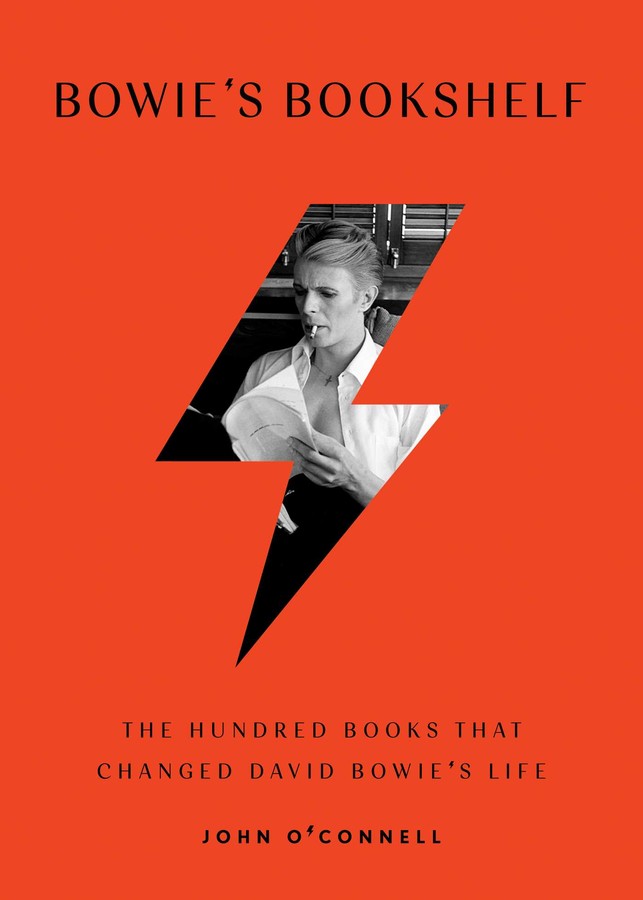
Like some rock stars of his generation, David Bowie had a literary cast of mind; unlike most of those colleagues, he also made his association with books explicit. (Not for nothing did he appear on that READ poster.) Whenever this subject arises, it’s tempting to bring up the story of how The Man Who Fell to Earth director Nicolas Roeg poked fun at the extreme number of books with which Bowie surrounded himself during the time he was acting in that film, as we did when we posted about the David Bowie book club. Launched by Bowie’s son, the filmmaker Duncan Jones, that project was meant to read through Bowie’s own list of top 100 books, previously featured here on Open Culture. Now, thanks to the work of music journalist John O’Connell, Bowie’s love of books has a book of its own.
Published in the UK as Bowie’s Books and in the US as Bowie’s Bookshelf, O’Connell’s essay collection takes the 100 books the man who was Ziggy Stardust, Aladdin Sane, and The Thin White Duke named as favorites. In each he finds the relevant questions (or at least fascinating ones) to ask about each book’s relationship to Bowie’s life and work: “How did the power imbued in a single suit of armor in The Iliad impact a man who loved costumes, shifting identity, and the siren song of the alter-ego?” Or, “How did the poems of T.S. Eliot and Frank O’Hara, the fiction of Vladimir Nabokov and Anthony Burgess, the comics of The Beano and The Viz, and the groundbreaking politics of James Baldwin influence Bowie’s lyrics, his sound, his artistic outlook?”
Kirkus Reviews notes that “many of Bowie’s selections speak to his obvious passion for music, especially early rock ’n’ roll and R&B (Greil Marcus, Gerri Hershey), his famous Japanophilia (Yukio Mishima, Tadanori Yokoo), and his stint in Germany (Alfred Döblin, Otto Friedrich).” O’Connell’s completist analysis of Bowie’s top-100-books list, composed for an exhibition at the Victoria & Albert Museum just six years ago, also reveals “the range and playfulness in Bowie’s reading, from hefty tomes on the Russian Revolution to laddish comic books like The Beano.” Other essays cover Lolita, The Gnostic Gospels, A Confederacy of Dunces, and White Noise, all part of a mixture that would tantalize any cultural critic — much like the work of David Bowie, who still constitutes a culture unto himself.
Bowie’s Bookshelf: The Hundred Books that Changed David Bowie’s Life can be ordered now.
Related Content:
David Bowie Urges Kids to READ in a 1987 Poster Sponsored by the American Library Association
The Story of How David Jones Became David Bowie Gets Told in a New Graphic Novel
David Bowie Picks His 12 Favorite David Bowie Songs: Listen to Them Online
Based in Seoul, Colin Marshall writes and broadcasts on cities, language, and culture. His projects include the book The Stateless City: a Walk through 21st-Century Los Angeles and the video series The City in Cinema. Follow him on Twitter at @colinmarshall or on Facebook.
Read More...A 108-Year-Old Woman Recalls What It Was Like to Be a Woman in Victorian England
The perils of old age—dementia, economic insecurity, social isolation—are receiving a lot of attention these days.
How refreshing to spend three minutes in the company of a sharp-witted 108-year-old, who, responding to a question about what life was like for women in Victorian England, acts out a couple of socially relevant, period Punch cartoons, deliberately drawing attention to her shockingly well-preserved ankles in the process.
Florence Pannell was born in London in 1868, 3 years after the US abolished slavery and eleven before the advent of the electric lightbulb.
Her appearance on Thames Television’s Money-Go-Round program appears to be her only public recording. The Kensington Post captured her leaving her polling place, after casting her ballot in a 1971 election at the age of 102.
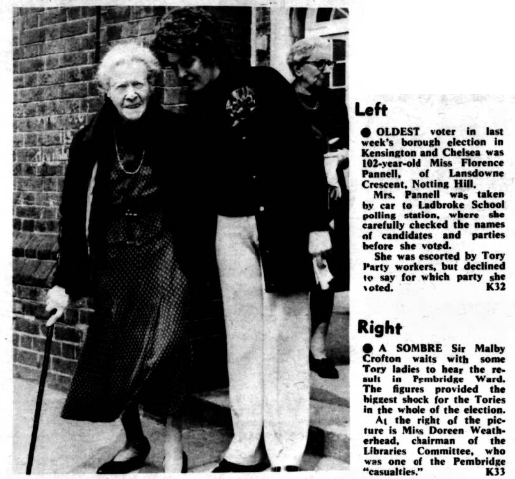
It’s a pity there’s not more of an online presence, as this captivating storyteller clearly relishes the opportunity to revisit the past.
A pity too, that she was stuck with a dud of an interviewer, Joan Shenton, who has gone on to find fame as a prominent AIDS denialist.
The AIDS crisis is one event of global historical importance that Mrs. Pannell missed—barely—she died in 1980, a few months shy of her 112th birthday.
We learn that she founded a successful beauty care business that took her to Paris for a time, but other than that, the details of her private life are left to our speculation. She was married. Did she have children, and if so, did she survive them?
Did she ever get the chance to go up in an airplane? As of 1977, she hadn’t, but was open to the idea, implying that the risk had outweighed the potential thrill in the early days of aviation.
Most striking is her hearty reply concerning the biggest change she had witnessed over the years:
Everything! Nothing is the same! Everything’s changed!
Some of the milestones she was alive for, as noted by various YouTube and Reddit commenters:
The coronation of the five monarchs to follow Queen Victoria: Edward VII, George V, Edward VIII, George VI and Elizabeth II (whose 93 years on the planet she makes seem marginally less impressive)
Jack the Ripper’s terrorization of London
The sinking of the Titanic
Both World Wars
The Great Depression
The telephone
Television
The hippie movement
The moon landing
Another commenter suggested that it would have been mathematically possible for Mrs. Pannell to have heard stories about Napoleon at her grandpa’s knee.
Readers, what are you boggled by, with regard to the significant events transpiring within this woman’s lifetime?
(And for those curious as to her formidable accent, there’s a wealth of linguistic information here.)
Related Content:
Ayun Halliday is an author, illustrator, theater maker and Chief Primatologist of the East Village Inky zine. Join her in NYC on Monday, November 4 when her monthly book-based variety show, Necromancers of the Public Domain celebrates Louise Jordan Miln’s “Wooings and Weddings in Many Climes (1900). Follow her @AyunHalliday.
Read More...Werner Herzog Offers 24 Pieces of Filmmaking and Life Advice

Image by Erinc Salor via Wikimedia Commons
There are few filmmakers alive today who have the mystique of Werner Herzog. His feature films and his documentaries are brilliant and messy, depicting both the ecstasies and the agonies of life in a chaotic and fundamentally hostile universe. And his movies seem very much to reflect his personality – uncompromising, enigmatic and quite possibly crazy. How else can you explain his willingness to risk life and limb to shoot in such forbidding places as the Amazonian rain forest or Antarctica?
In perhaps his greatest film, Fitzcarraldo — which is about a dreamer who hatches a scheme to drag a riverboat over a mountain — Herzog decides, for the purposes of realism, to actually drag a boat over a mountain. No special effects. No studios. In the middle of the Peruvian jungle.
The production, perhaps the most miserable in the history of film, is the subject of the documentary The Burden of Dreams. After six punishing months, a weary-looking Herzog described his surroundings:
I see it more full of obscenity. It’s just — Nature here is vile and base. I wouldn’t see anything erotical here. I would see fornication and asphyxiation and choking and fighting for survival and… growing and… just rotting away. Of course, there’s a lot of misery. But it is the same misery that is all around us. The trees here are in misery, and the birds are in misery. I don’t think they — they sing. They just screech in pain. […] But when I say this, I say this all full of admiration for the jungle. It is not that I hate it, I love it. I love it very much. But I love it against my better judgment.
His worldview brims with a heroic pessimism that is pulled straight out of the German Romantic poets. Nature is not some harmonious anthropomorphized playground. It is instead nothing but “chaos, hostility and murder.” For those sick of the cynical dishonesty of Hollywood’s current crop of Award-ready fare (hello, The Imitation Game), Herzog comes as a bracing tonic. An icon of what independent cinema should be rather than what it has largely become.
Below is Herzog’s list of advice for filmmakers, found on the back of his latest book Werner Herzog – A Guide for the Perplexed. (Hat tip goes to Jason Kottke for bringing it to our attention.) Some maxims are pretty specific to the world of moviemaking – “That roll of unexposed celluloid you have in your hand might be the last in existence, so do something impressive with it.” Other points are just plain good lessons for life — “Always take the initiative,” “Learn to live with your mistakes.” Read along and you can almost hear Herzog’s malevolent Teutonic lilt.
1. Always take the initiative.
2. There is nothing wrong with spending a night in jail if it means getting the shot you need.
3. Send out all your dogs and one might return with prey.
4. Never wallow in your troubles; despair must be kept private and brief.
5. Learn to live with your mistakes.
6. Expand your knowledge and understanding of music and literature, old and modern.
7. That roll of unexposed celluloid you have in your hand might be the last in existence, so do something impressive with it.
8. There is never an excuse not to finish a film.
9. Carry bolt cutters everywhere.
10. Thwart institutional cowardice.
11. Ask for forgiveness, not permission.
12. Take your fate into your own hands.
13. Learn to read the inner essence of a landscape.
14. Ignite the fire within and explore unknown territory.
15. Walk straight ahead, never detour.
16. Manoeuvre and mislead, but always deliver.
17. Don’t be fearful of rejection.
18. Develop your own voice.
19. Day one is the point of no return.
20. A badge of honor is to fail a film theory class.
21. Chance is the lifeblood of cinema.
22. Guerrilla tactics are best.
23. Take revenge if need be.
24. Get used to the bear behind you.
Note: An earlier version of this post appeared on our site in January 2015.
Related Content:
Portrait Werner Herzog: The Director’s Autobiographical Short Film from 1986
Werner Herzog Picks His 5 Top Films
Werner Herzog and Cormac McCarthy Talk Science and Culture
Werner Herzog’s Eye-Opening New Film Reveals the Dangers of Texting While Driving
Jonathan Crow is a Los Angeles-based writer and filmmaker whose work has appeared in Yahoo!, The Hollywood Reporter, and other publications. You can follow him at @jonccrow. And check out his blog Veeptopus, featuring lots of pictures of badgers and even more pictures of vice presidents with octopuses on their heads. The Veeptopus store is here.
Read More...F. Scott Fitzgerald Creates a List of 22 Essential Books (1936)

In 1936 — perhaps the darkest year of his life — F. Scott Fitzgerald was convalescing in a hotel in Asheville, North Carolina, when he offered his nurse a list of 22 books he thought were essential reading. The list, above, is written in the nurse’s hand.
Fitzgerald had moved into Asheville’s Grove Park Inn that April after transferring his wife Zelda, a psychiatric patient, to nearby Highland Hospital. It was the same month that Esquire published his essay “The Crack Up”, in which he confessed to a growing awareness that “my life had been a drawing on resources that I did not possess, that I had been mortgaging myself physically and spiritually up to the hilt.”
Fitzgerald’s financial and drinking problems had reached a critical stage. That summer he fractured his shoulder while diving into the hotel swimming pool, and sometime later, according to Michael Cody at the University of South Carolina’s Fitzgerald Web site, “he fired a revolver in a suicide threat, after which the hotel refused to let him stay without a nurse. He was attended thereafter by Dorothy Richardson, whose chief duties were to provide him company and try to keep him from drinking too much. In typical Fitzgerald fashion, he developed a friendship with Miss Richardson and attempted to educate her by providing her with a reading list.”
It’s a curious list. Shakespeare is omitted. So is James Joyce. But Norman Douglas and Arnold Bennett make the cut. Fitzgerald appears to have restricted his selections to books that were available at that time in Modern Library editions. At the top of the page, Richardson writes “These are books that Scott thought should be required reading.”
- Sister Carrie, by Theodore Dreiser
- The Life of Jesus, by Ernest Renan
- A Doll’s House, by Henrik Ibsen
- Winesburg, Ohio, by Sherwood Anderson
- The Old Wives’ Tale, by Arnold Bennett
- The Maltese Falcon, by Dashiel Hammett
- The Red and the Black, by Stendhal
- The Short Stories of Guy De Maupassant, translated by Michael Monahan
- An Outline of Abnormal Psychology, edited by Gardner Murphy
- The Stories of Anton Chekhov, edited by Robert N. Linscott
- The Best American Humorous Short Stories, edited by Alexander Jessup
- Victory, by Joseph Conrad
- The Revolt of the Angels, by Anatole France
- The Plays of Oscar Wilde
- Sanctuary, by William Faulkner
- Within a Budding Grove, by Marcel Proust
- The Guermantes Way, by Marcel Proust
- Swann’s Way, by Marcel Proust
- South Wind, by Norman Douglas
- The Garden Party, by Katherine Mansfield
- War and Peace, by Leo Tolstoy
- John Keats and Percy Bysshe Shelley: Complete Poetical Works
via The University of South Carolina
Related Content:
Ernest Hemingway Creates a Reading List for a Young Writer, 1934
Seven Tips From F. Scott Fitzgerald on How to Write Fiction
Rare Footage of Scott and Zelda Fitzgerald From the 1920s
Read More...The Night When John Coltrane Soloed in a Bathroom and David Crosby, High as a Kite, Nearly Lost His Mind
David Crosby is not only one of rock’s great songwriters; he is also one of rock’s great raconteurs—always ready with a story, told as only he can tell it, about life in not just one, but two of the most influential bands of the 1960s, the Byrds and Crosby, Stills & Nash and sometimes Young. Few people have lived a life as colorful as his and lived to tell about it. Even fewer possess Crosby’s wit and eye for detail.
He came by his wealth of anecdotes at a significant cost, however, to himself and the people around him, as he readily admits in the newly released (on Blu-ray) Cameron Crowe-produced documentary Remember My Name. Now a wizened 78-years-old and still prolific and raising hell (on Twitter, at least) Crosby reached far back in the memory vault to tell the tale of his life, from childhood to his 60s heyday to his stints in jail and rehab and through every sordid stage of full blown addiction.
Drugs will seriously mess up your life, says Crosby, in no uncertain terms, but it’s also clear his life would have been much less eventful, and less interesting, without them. Take the story he tells of running into John Coltrane in the men’s room of the South Side Chicago club called McKie’s in 1963. Incredibly high, Crosby finds himself blown out of his seat and against the wall by Elvin Jones’ drum solo. He retreats to the bathroom and promptly hits the floor. “I’ve got my head against this puke green tile,” he says in the clip above from Remember My Name (see the trailer below).
While Crosby tried to pull himself together, who should walk in but Coltrane, still playing:
He never stopped soloing. He’s still soloing. And he’s like burning in this bathroom. He doesn’t even know I’m there. He never even saw me. I’m thinking I’m gonna slide right down this tile. I’m thinking my nose is gonna open and my brain is gonna rush out onto the floor. It was so intense. I never heard anyone be more intense with music than that in my life.
Crosby gets into more detail in an interview with JazzTimes. Coltrane, he says, “played in the [restroom] for a couple of minutes because the sound was good—it was echoey—and he was… as good as you think he was.” He also talks at length about his long relationship with jazz, from his discovery of late-50s records by Dave Brubeck, Chet Baker, and Bill Evans, to Miles Davis recording a version of his song “Guinnevere.” (Davis was apparently instrumental in getting the Byrds signed to Columbia Records.)
The influence of Davis and Coltrane on Crosby’s songwriting is perhaps less evident than in, say, the work of Joni Mitchell, but Crosby admits that his “phrasing and melody choice” derived from “really good horn players.” It’s interesting to note just how much impact late-50s/early 60s jazz had on not only Crosby and Mitchell, but also 60s icons like Grace Slick. Listening to these classic rock survivors describe how Miles and Coltrane helped shape their sound shows just how much the mid-century jazz revolution fueled the rock revolution that followed.
Now that he’s sober, Crosby’s stories don’t involve nearly as much floor tile and brains sliding out of noses, but they’re still full of jazz encounters, including his recent collaborations with Wynton Marsalis and jazz collective Snarky Puppy. Read more about his recent projects and history with jazz over at JazzTimes.
Related Content:
Jazz Deconstructed: What Makes John Coltrane’s “Giant Steps” So Groundbreaking and Radical?
Kind of Blue: How Miles Davis Changed Jazz
Josh Jones is a writer and musician based in Durham, NC. Follow him at @jdmagness
Read More...The First Faked Photograph (1840)
The photograph was invented in the early 19th century, but who invented it? Histories of photography point to several different independent inventors, most of them French: Nicéphore Niépce, for example, who in 1826 made the first work recognizable as a photograph, or more famously Louis Daguerre, honored for his invention of the daguerreotype photographic process by the French Academy of Sciences and the Académie des Beaux Arts in 1839. But what about Daguerre’s contemporary Hippolyte Bayard, who had also been developing and refining his own form of photography? After going unacknowledged by the Academy, he had only one option left: suicide.
The Vox Darkroom video above tells the story of Bayard’s 1840 Self Portrait as a Drowned Man, which depicts exactly what its title suggests: Bayard’s corpse, retrieved from the water and propped up unclaimed at the morgue. “The Government which has been only too generous to Monsieur Daguerre, has said it can do nothing for Monsieur Bayard, and the poor wretch has drowned himself,” reads the note on the back of the photograph. “Oh the vagaries of human life.…!”

A sorry tale, to be sure, and of a kind not unknown in the history of invention. But wait: how could a dead man shoot a “self-portrait”? And if indeed “no-one has recognized or claimed him,” as the note adds, who would have bothered to write the note itself?
Bayard, still very much alive, made Self Portrait as a Drowned Man as a kind of artistic stunt, the latest in a series of self-portraits testing his photographic process. The “morgue” shot contains some of the artifacts in its predecessors, including a garden statue, a floral vase, and Bayard’s signature broad straw hat. (Even the expression of death was of a piece with his previous self-portraits: the long exposure time meant he’d had to hold absolutely still with his eyes closed in all of them as well.) Until his death in 1887 — long after Daguerre had passed — Bayard continued experimenting with photography, creating reality-departing images including “double self portraits.” If he couldn’t go down as the inventor of the photograph, at least he could go down as the inventor of the fake photograph — a still-relevant invention, to say the least, given our increasingly complicated relationship with the truth in the 21st century.
Related Content:
The First Photograph Ever Taken (1826)
See the First Photograph of a Human Being: A Photo Taken by Louis Daguerre (1838)
See The First “Selfie” In History Taken by Robert Cornelius, a Philadelphia Chemist, in 1839
Artificial Intelligence Creates Realistic Photos of People, None of Whom Actually Exist
The History of Photography in Five Animated Minutes: From Camera Obscura to Camera Phone
Based in Seoul, Colin Marshall writes and broadcasts on cities, language, and culture. His projects include the book The Stateless City: a Walk through 21st-Century Los Angeles and the video series The City in Cinema. Follow him on Twitter at @colinmarshall or on Facebook.
Read More...The Best of the Edward Gorey Envelope Art Contest
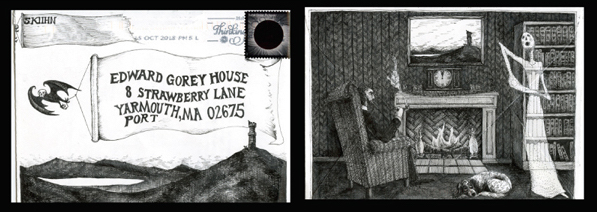
What a delight it must have been to have been one of Edward Gorey’s correspondents, or even a postal worker charged with handling his outgoing mail.
The late author and illustrator had a penchant for embellishing envelopes with the hairy beasts, poker-faced children, and cats who are the mainstays of his darkly humorous aesthetic.
(A number of these envelopes and some 60 postcards and sketches are included in Floating Worlds: The Letters of Edward Gorey and Peter F. Neumeyer, which documents the correspondence-based friendship between Gorey and the author with whom he collaborated on three children’s books, including the delightfully macabre Donald Has a Difficulty.)
The Edward Gorey House, a beloved Cape Cod residence turned museum, has been keeping the tradition alive with its annual Halloween Envelope Art Contest.
Competitors of all ages vie for the opportunity to have their winning (and runners up and “very-close-to-being-runners-up”) Gorey-inspired entries displayed in the Gorey House and its digital extensions.
2019’s theme is the highly evocative “Uncomfortable Creatures” … and depending on the speed with which you can execute a brilliant idea and deliver it to the post office, you may still have a shot—entries must be postmarked by Monday, October 21, with winners to be announced on Halloween.
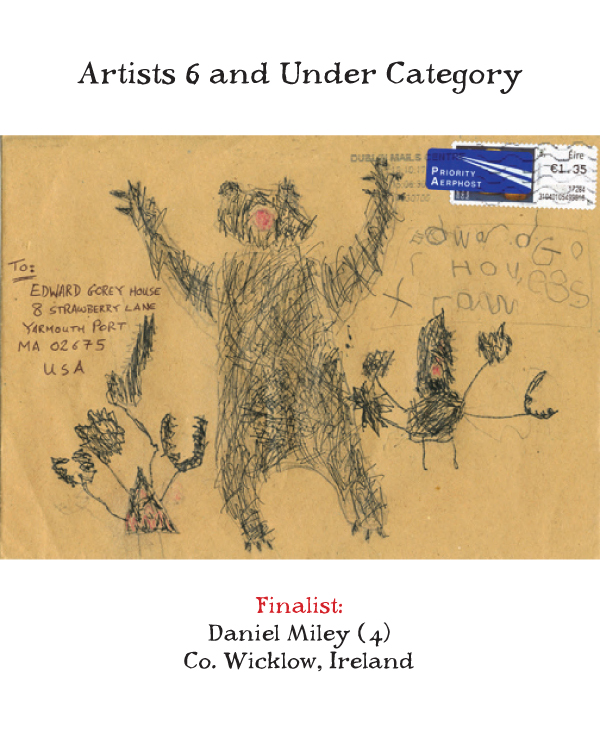
In addition to Stef Kiihn Aschenbrenner’s winning envelope from the 2018 contest’s over-18 category (top), some of our favorites from past years are reproduced here. Our inky-black hearts are especially warmed to see the spirit of the master kindling the imaginations of the youngest entrants—special shout out to Daniel Miley, aged 4.
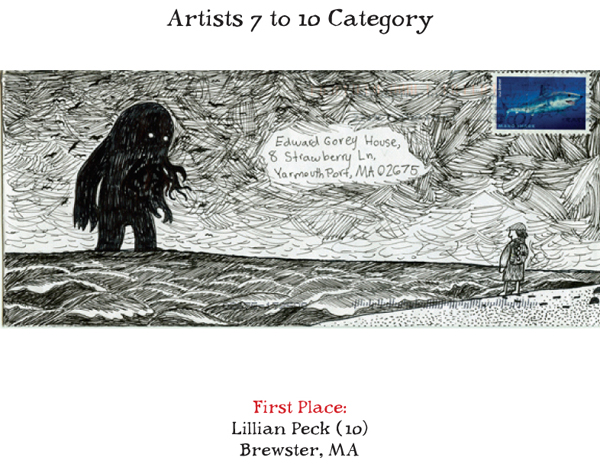

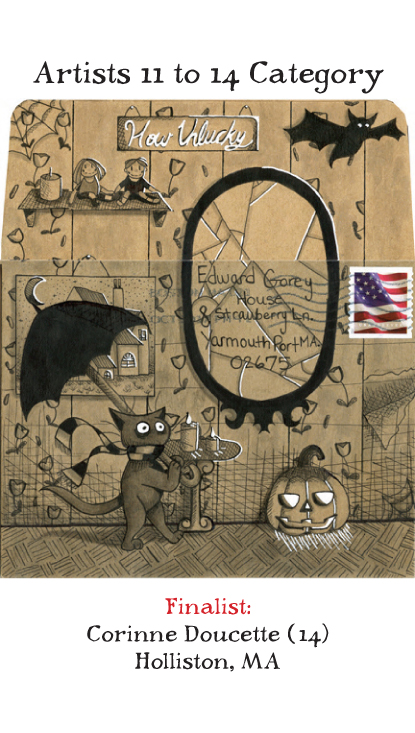
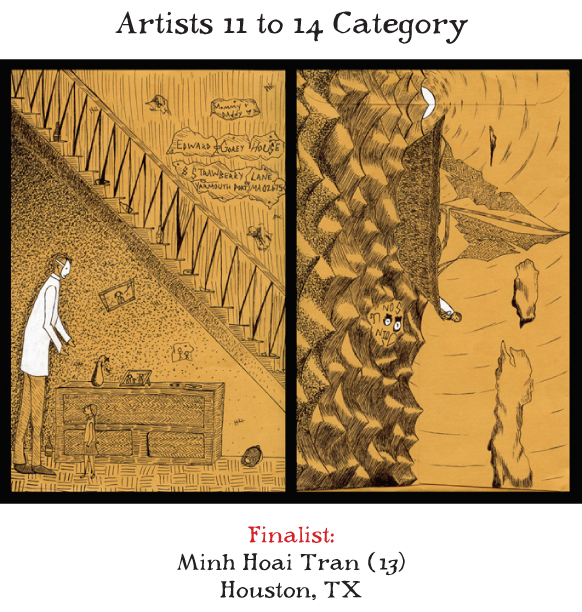


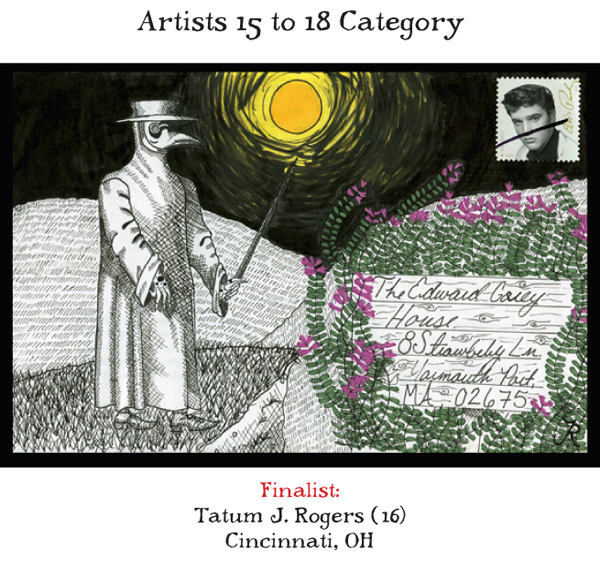
View five years’ worth of notable Halloween Envelope Contest entries on the Edward Gorey House website (2018, 2017, 2016, 2015, 2014) or download the official entry form and race to the post office with your bid for 2019 glory.
Entries must be postmarked by Monday, October 21 and addressed to Edward Gorey House, 8 Strawberry Lane, Yarmouth Port, MA 02675 USA.
Related Content:
Lemony Snicket Reveals His Edward Gorey Obsession in an Upcoming Animated Documentary
Edward Gorey Talks About His Love Cats & More in the Animated Series, “Goreytelling”
Edward Gorey Illustrates H.G. Wells’ The War of the Worlds in His Inimitable Gothic Style (1960)
Ayun Halliday is an author, illustrator, theater maker and Chief Primatologist of the East Village Inky zine. Join her in NYC on Monday, November 4 when her monthly book-based variety show, Necromancers of the Public Domain celebrates Louise Jordan Miln’s “Wooings and Weddings in Many Climes (1900). Follow her @AyunHalliday.
Read More...Stream Dozens of Classic & Contemporary Horror Movies Free Online in October
There is a paradox in the genre we call horror. Its main engine has remained constant for millennia—primal fears of death (and afterlife), and relatedly inescapable phenomena like birth, aging, and sickness. At the same time, horror is always contemporary, reflecting “society’s collective anxieties throughout the decades,” writes Lauren McGrail at the Lights Film School blog.
We can see this in horror movies, dividing them by decade according to their most pressing concerns. 1920s German expressionism recoiled from the growing threat of fascism. The 1930s and 40s created a cult of personality around deathless horror icons.
“In the 1950s,” McGrail writes, “the fear of invasion and atomic war fueled films in which the effects of radiation created larger-than-life monsters.” The 60s saw deviancy everywhere, especially among the supposedly normal.
“In the 1970s, Hollywood looked inward, inventing threats that sprung from within,” sometimes quite literally. The ‘80s dealt in panic over satanism, teenage promiscuity, and childhood abuse. The ‘90s gave us charming sociopathic killers, horror parodies, (and bees). “More recently, an uptick in prestigious ‘elevated horror’ films is tackling modern social issues head-on.” Get Out uses disorienting shocks and scares for a heady examination of racism. Midsommer represents the fear of isolationist, homogeneous communities (ethnostate horror, if you will).
Kanopy, the free film streaming service, has made its horror film catalogue available online, allowing us to test this theory by watching classic movies from nearly every decade of cinema history. They’ve included a generous portion of recent highly acclaimed horror films, like Ari Aster’s Hereditary, Robert Eggers’ The Witch, and Tomas Alfredson’s Let the Right One In. There are classic subgenre-defining films like George Romero’s Night of the Living Dead and Robert Wiene’s Cabinet of Dr. Caligari.
Even the oldest of horror movie tropes get updated every few years to illustrate contemporary social conflicts. Frankenstein and his monster, Dracula: such 19th century literary characters came to life on celluloid again and again in the first half of the 20th century, when Hollywood horror was still figuring itself out. These oft-campy characters aren’t well-represented in the Kanopy collection. But there are offbeat psychological thrillers like Denis Villeneuve’s Enemy, crime thrillers about real monsters like David Fincher’s Zodiac, and horror comedies like Kevin Smith’s Tusk.
The horror film arrived before the 19th century ended, with Georges Méliès’ 1896 The Haunted Castle, a visual effects feast for 1890s filmgoers’ eyes. Its imagery now calls to mind a seasonal candy aisle—bats, witches, devils, skeletons, and a bubbling cauldron. Fall is a commercial bonanza for fun-sized candy bars and scary movies. Like pharmacies stocking giant bags of candy come summer’s end, no major studio should find itself without a horror release—or re-release—this time of year.
Halloween—the harvest-festival-turned-quasi-Christian/occult-ceremony-turned-major-shopping-season—may do as much to keep horror alive in popular culture as Christmas does for films about family dysfunction. Whether they’re digging up the corpses of ancient evils or inventing new metaphors for old-fashioned fears, horror films give Halloween its best costume ideas, and the best reason to gather up friends and family and get scared out of your wits together (ideally).
Should you be hosting such a gathering, or looking to freak yourself out, you’ll find contemporary horror aplenty free to stream at Kanopy. All you’ll need is your local library card. (To check and see whether your library–or university–is among Kanopy’s partners, just type it into the search window on this page.) “We stream thoughtful entertainment to your preferred device with no fees and no commercials by partnering with public libraries and universities,” says Kanopy’s about page, explaining that you need only “log in with your library membership and enjoy our diverse catalog with new titles added every month.” A very small price to pay indeed for such high-quality content. Enter Kanopy’s horror collection here.
Related Content:
The First Horror Film, George Méliès’ The Haunted Castle (1896)
Martin Scorsese Creates a List of the 11 Scariest Horror Films
Stephen King’s 22 Favorite Movies: Full of Horror & Suspense
Josh Jones is a writer and musician based in Durham, NC. Follow him at @jdmagness.
Read More...H.G. Wells’ The War of the Worlds Becomes a New BBC Miniseries Set in Edwardian England
H.G. Wells began writing the novel that would become The War of the Worlds in the England of the mid-1890s. As a setting for this tale of invasion from outer space, he chose the place he knew best: England of the mid-1890s. Staging spectacles of unfathomable malice and fantastical destruction against such an ordinary backdrop made The War of the Worlds, first as a magazine serial and then as a standalone book, a chillingly compelling experience for its readers. Orson Welles understood the effectiveness of that choice, as evidenced by the fact that in his famously convincing 1938 radio adaptation of Wells’ novel, the hostile aliens land in modern-day New Jersey.
Subsequent adaptations have followed the same principle: in 1953, the first War of the Worlds Hollywood film set the action in 1950s Los Angeles; the latest, a Steven Spielberg-directed Tom Cruise vehicle that came out in 2005, set it in the New York and Boston of the 2000s. But now, set to premiere later this year on BBC One, we have a three-part miniseries that returns the story to the place and time in which Wells originally envisioned it — or rather, the place and very nearly the time. Shot in Liverpool, the production recreates not the Victorian England in which The War of the Worlds was first published but the brief Edwardian period, lasting roughly the first decade of the 20th century, that followed it.
In a way, a period War of the Worlds reflects our time as clearly as the previous War of the Worlds adaptations reflect theirs: television viewers of the 2010s have shown a surprisingly hearty appetite for historical drama, and often British historical drama at that. Think of the success earlier this decade of Downton Abbey, whose upstairs-downstairs dynamics proved gripping even for those not steeped in the British class system. This latest War of the Worlds, whose trailer you can watch at the top of the post, uses similar themes, telling the story of a man and woman who dare to be together despite their class differences — and, of course, amid an alien invasion that threatens to destroy the Earth. It remains to be seen whether the miniseries will rise to the central challenge of adapting The War of the Worlds: will the emotions at the center of the story be as convincing as the mayhem surrounding them?
Related Content:
Hear Orson Welles’ Iconic War of the Worlds Broadcast (1938)
Ray Harryhausen’s Creepy War of the Worlds Sketches and Stop-Motion Test Footage
Edward Gorey Illustrates H.G. Wells’ The War of the Worlds in His Inimitable Gothic Style (1960)
Based in Seoul, Colin Marshall writes and broadcasts on cities, language, and culture. His projects include the book The Stateless City: a Walk through 21st-Century Los Angeles and the video series The City in Cinema. Follow him on Twitter at @colinmarshall or on Facebook.
Read More...How Grace Slick Wrote “White Rabbit”: The 1960s Classic Inspired by LSD, Lewis Carroll, Miles Davis’ Sketches of Spain, and Hypocritical Parents
I never know what to do with the fact that Jefferson Airplane became Jefferson Starship became Starship—purveyors of “We Built This City,” a “barnacle made of synthesizers and cocaine,” writes GQ, and an honored guest on worst-of lists everywhere. (Also a song co-written by none other than Elton John lyricist Bernie Taupin).
It might seem peevish to get so worked up over how bad “We Built this City” is, if it didn’t derive from the legacy of one of the best bands of the 1960s. Even Grace Slick disavows it. “This is not me,” she says.
Of course, by 1985, all of Slick’s best collaborators—the great Jorma Kaukonen, Jack Cassidy, Paul Kantner, Marty Balen, Spencer Dryden, et al.—had moved on, and it was that volatile collection of musical personalities that made psych rock classics like “Somebody to Love” and the slinky, druggy, Lewis Carroll-inspired bolero “White Rabbit” so essential.
Grace Slick is a great singer and songwriter, but she needed a band as uncannily talented as Jefferson Airplane to fully realize her eccentric vision, such as the acid rock song about drug references in Alice in Wonderland, played in the style of Spanish folk music and Miles Davis’ Sketches of Spain.
Before she wrote “White Rabbit,” Slick dropped acid and listened to Davis’ jazz/folk/classical experiment “over and over for hours,” she told The Wall Street Journal in 2016. “Sketches of Spain was drilled into my head and came squirting out in various ways as I wrote ‘White Rabbit.’”
No lesser band could have taken this swirl of influences and turned into what the Polyphonic video at the top calls a distillation of the entire era. But “White Rabbit” didn’t always have the perfectly executed intensity we know from 1967’s Surrealistic Pillow and Jefferson Airplane’s commanding performance at Woodstock (above).
In 1965, LSD was still legal. Grace Slick was working, she tells WSJ, “as a couture model at I. Magnin in San Francisco.” Before signing on as the singer for Jefferson Airplane, she formed The Great Society with her then-husband Jerry Slick. She wrote “White Rabbit” for that ensemble and the band first performed it “in early ’66,” she says, “at a dive bar on Broadway in San Francisco.”
Below, you can hear a 6‑minute live version of The Great Society’s “White Rabbit.” It’s unrecognizable until Slick starts to sing over four minutes into the song. We are not likely to be reminded of Miles Davis. But when Slick brought “White Rabbit” to Jefferson Airplane, as the Polyphonic video demonstrates, they realized its full potential, references to Sketches of Spain and all.
Recorded in 1966, the single “kicked off” the following year’s Summer of Love, “celebrating the growing psychedelic culture” and freaking out parents, who passionately hated “White Rabbit.” These were the very people Slick wanted to pay attention. “I always felt like a good-looking schoolteacher singing ‘White Rabbit,’ ” she says. “I sang the words slowly and precisely, so the people who needed to hear them wouldn’t miss the point. But they did.”
Slick’s own parents were a little freaked out when she started her first band, after an interview she gave the San Francisco Chronicle got back to them. “I argued in favor of marijuana and LSD,” she says. “It was painful for them, I’m sure, but I didn’t care whether they minded. Parents were criticizing a generation’s choices while sitting there with their glasses of scotch.” They were also regularly popping pills, although “the ones that mother gives you,” she sang, “don’t do anything at all.”
“To this day,” she says, “I don’t think most people realize the song was aimed at parents who drank and told their kids not to do drugs. I felt they were full of crap, but write a good song, you need a few more words than that.” And to turn a good song into an instant classic, you need a band like Jefferson Airplane.
Related Content:
Listen to Grace Slick’s Hair-Raising Vocals in the Isolated Track for “White Rabbit” (1967)
Jefferson Airplane Plays on a New York Rooftop; Jean-Luc Godard Captures It (1968)
Josh Jones is a writer and musician based in Durham, NC. Follow him at @jdmagness.
Read More...Support Us
We're hoping to rely on loyal readers, rather than erratic ads. Please click the Donate button and support Open Culture. You can use Paypal, Venmo, Patreon, even Crypto! We thank you!

About Us

Open Culture scours the web for the best educational media. We find the free courses and audio books you need, the language lessons & educational videos you want, and plenty of enlightenment in between.
Advertise With Us

FREE UPDATES!
GET OUR DAILY EMAIL
Get the best cultural and educational resources on the web curated for you in a daily email. We never spam. Unsubscribe at any time.
FOLLOW ON SOCIAL MEDIA

Open Culture editor Dan Colman scours the web for the best educational media. He finds the free courses and audio books you need, the language lessons & movies you want, and plenty of enlightenment in between.
Advertise With Us