Patti Smith Sings “People Have the Power” with a Choir of 250 Fellow Singers
…people have the power
To redeem the work of fools
—Patti Smith
As protest songs go, “People Have the Power” by Godmother of Punk Patti Smith and her late husband Fred Sonic Smith is a true upper.
The goal was to recapture some of the energy they’d felt as youth activists, coming together to protest the Vietnam War. As Patti declared in an NME Song Stories segment:
… what we wanted to do was remind the listener of their individual power but also of the collective power of the people, how we can do anything. That’s why at the end it goes, “I believe everything we dream can come to pass, through our union we can turn the world around, we can turn the earth’s revolution.” We wrote it consciously together to inspire people, to inspire people to come together.
Sadly, Fred Smith, who died in 1994, never saw it performed live. But his widow has carried it around the world, and witnessed its joyful transformative power.
Witness the glowing faces of 250 volunteer singers who gathered in New York City’s Public Theater lobby to perform the song as part of the Onassis Festival 2019: Democracy Is Coming last spring.
The event was staged by Choir! Choir! Choir!, a Canadian organization whose commitment to community building vis-à-vis weekly drop-in singing sessions at a Toronto tavern has grown to include some starry names and world-renowned venues, raising major charitable funds along the way.
As per Choir! Choir! Choir!’s operating instructions, there were no auditions. The singers didn’t need to know how to read music, or even sing particularly well, as participant Elyse Orecchio described in a blog post:
The man behind me exuberantly delivered his off-pitch notes loudly into my ear. But to whine about that sort of thing goes against the spirit of the night. This was a democracy: the people’s chorus.
Director Sarah Hughes had been having “one of those theater nerd Saturdays,” and was grabbing a post-Public-matinee salad prior to an evening show uptown, when she bumped into friends who asked if she wanted to sing with Patti Smith and a community choir:
I’m working on playwright Chana Porter and composer Deepali Gupta’s Dearly Beloved, a meditation on productive despair for community choir, and have been having beautiful, enlightening experiences making music with large groups of non-singers, so I was curious about what this might be like.
And it was lovely. Just singing at all is always very great, even though I am not “good at it.” Singing along with all the other people in the room felt especially good.
The Choir! Choir! Choir! leaders were generous, had a sense of humor, and weren’t afraid to tell us when we sounded terrible, which was refreshing.
We learned our parts and then I ate my salad standing in the Public lobby while we waited for Patti. She took a longer time to arrive than they’d planned for, I think, but it was because she was at a climate crisis rally so we weren’t mad. And she was just very fully herself.
I’m not like a die-hard Patti Smith fan, but I sort of fell in love with her after reading her beautiful recounting of messing up while singing “A Hard Rain’s Gonna Fall” at Dylan’s Nobel Prize ceremony. This experience made me appreciate her even more—her humanity, her vulnerability, the strangeness of being famous or recognized or heroic to many many people. And she really did lead us, in this very special, simple, real way. It reminded me of how little we really need in the way of money or production values or even talent for a performance or public event to feel worth our time.
The film reflects that sense of the extraordinary co-existing gloriously with the ordinary:
An unimpressed little girl eats a peach.
Two young staffers in Public Theater t‑shirts seem both sheepish and thrilled when the film crew zeroes in on them singing along.
Guitarist and Choir! Choir! Choir! co-founder Daveed Goldman nearly bonks Patti in the head with the neck of his instrument.
Also? That’s the Police’s Stewart Copeland playing the frying pan.
Next up on Choir! Choir! Choir!’s agenda is an October 13th concert at California’s Boarder Field State Park, with some 300 people on the Tijuana side and 500 on the San Diego side raising their voices together on Lennon and McCartney’s “With a Little Help from My Friends.” More information on that, and other stops on their fall tour, here.
Sign up to be notified next time Choir! Choir! Choir! is looking for singers in your area here.
Related Content:
Patti Smith, The Godmother of Punk, Is Now Putting Her Pictures on Instagram
Patti Smith’s 40 Favorite Books
Ayun Halliday is an author, illustrator, theater maker and Chief Primatologist of the East Village Inkyzine. Join her in NYC on Monday, October 7 when her monthly book-based variety show, Necromancers of the Public Domaincelebrates the art of Aubrey Beardsley. Follow her @AyunHalliday.
Read More...The Morals That Determine Whether We’re Liberal, Conservative, or Libertarian
An old friend once wrote a line I’ll never forget: “There are two kinds of people in the world, then there are infinitely many more.” It always comes to mind when I confront binary generalizations that I’m told define two equally opposing positions, but rarely capture, with any accuracy, the complexity and contrariness of human beings—even when said humans live inside the same country.
Voting patterns, social media bubbles, and major network infotainment can make it seem like the U.S. is split in two, but it is split into, if not an infinity, then a plurality of disparate ideological dispositions. But let’s say, for the sake of argument, that there are two kinds of people. Let’s say the U.S. divides neatly into “liberals” and “conservatives.” What makes the difference between them? Fiscal policy? Education? Views on “law and order,” social welfare, science, religion, public versus private good? Yes, but….
Best-selling NYU psychologist Jonathan Haidt has controversially claimed that morality—based in emotion—really drives the wedge between competing “tribes” engaged in pitched us-versus-them war. The real contest is gut-level, mostly centered on disgust these days, one of the most primitive of emotional responses (we learn in the hand-drawn animation of a Haidt lecture below). Haidt argues that our sense of us and them is rooted, irrevocably, in our earliest cognitions of physical space.
Haidt situates his analysis under the rubric of “moral foundations theory,” a school of thought “created by a group of social and cultural psychologists to understand why morality varies so much across cultures yet still shows so many similarities and recurrent themes.” Another moral foundations theorist, Peter Ditto, professor of Psychology and Social Behavior at the University of California, Irvine, uses his research to draw similar conclusions about “hyperpartisanship” in the U.S. According to Ditto, as he describes in the short video at the top, “morals influence if you’re liberal or conservative.”
How? Ditto identifies five broad, universal moral categories, or “pillars,” that predict political thought and behavior: harm reduction, fairness, loyalty, authority/tradition, and purity. These concerns receive different weighting between self-identified liberals and conservatives in surveys, with liberals valuing harm reduction and fairness highly and generally overlooking the other three, and conservatives giving equal weight to all five (on paper at least). Ditto does step outside the binary in the last half of the segment, noting that his studies turned up a significant number of people who identified as libertarians.
He takes a particular interest in this category. Libertarians, says Ditto, don’t rank any moral value highly, marking their worldview as “pragmatic” and strikingly amoral. They appear to be intensely self-focused and lacking in empathy. Other strains—from democratic socialism to anarchism to fascism—that define American politics today, go unmentioned, as if they didn’t exist, though they are arguably as influential as libertarianism in the strange flowerings of the American left and right, and inarguably as deserving of study.
The idea that one’s morals define one’s politics doesn’t seem particularly novel, but the research of psychologists like Haidt and Ditto offers new ways to think about morality in public life. It also raises pertinent questions about the gulf between what people claim to value and what they actually, consistently, support, and about how the evolution of moral sensibilities seems to sort people into groups that also share historical identities, zip codes, and economic interests. Nor can we cannot discount the active shaping of public opinion through extra-moral means. Finally, in a two-party system, the options are as few as they can be. Political allegiance can be as much convenience, or reaction, as conviction. We might be right to suspect that any seeming political—or moral—unity on one side or the other could be an effect of amplified oversimplification.
Related Content:
Do Ethicists Behave Any Better Than the Rest of Us?: Here’s What the Research Shows
Josh Jones is a writer and musician based in Durham, NC. Follow him at @jdmagness
Read More...Novelist Cormac McCarthy Gives Writing Advice to Scientists … and Anyone Who Wants to Write Clear, Compelling Prose
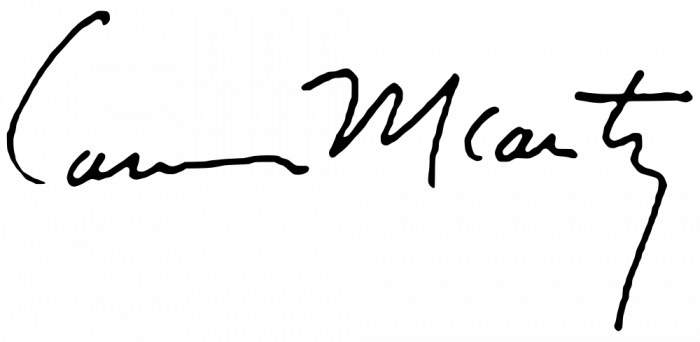
As we pointed out back in 2017, Cormac McCarthy, author of such gritty, blood-drenched novels as Blood Meridian, Child of God, The Road, and No Country for Old Men, prefers the company of scientists to fellow writers. Since the mid-nineties, he has maintained a desk at the Santa Fe Institute, an interdisciplinary scientific think tank, and has served as a volunteer copy-editor for several scientists, including Lisa Randall, Harvard’s first female tenured theoretical physicist, and physicist Geoffrey West, author of the popular science book Scale.
One of McCarthy’s first such academic collaborations came after a friend, economist W. Brian Arthur, mailed him an article in 1996. McCarthy helped Arthur completely revise it, which sent the editor of the Harvard Business Review into a “slight panic,” the economist remembers. I can’t imagine why, but then I’d rather read any of McCarthy’s novels than most academic papers. Not that I don’t love to be exposed to new ideas, but it’s all about the quality of the writing.
Scholarly writing has, after all, a reputation for obscurity, and obfuscation for a reason, and not only in postmodern philosophy. Scientific papers also rely heavily on jargon, overly long, incomprehensible sentences, and disciplinary formalities that can feel cold and alienating to the non-specialist. McCarthy identified these problems in the work of associates like biologist and ecologist Van Savage, who has “received invaluable editing advice from McCarthy,” notes Nature, “on several science papers published over the past 20 years.”
During “lively weekly lunches” with the author during the winter of 2018, Savage discussed the finer points of McCarthy’s editing advice. Then Savage and evolutionary biologist Pamela Yeh presented the condensed version at Nature for a wider audience. Below, we’ve excerpted some of the most striking of “McCarthy’s words of wisdom.” Find the complete compilation of McCarthy’s advice over at Nature.
- Use minimalism to achieve clarity…. Remove extra words or commas whenever you can.
- Decide on your paper’s theme and two or three points you want every reader to remember…. If something isn’t needed to help the reader to understand the main theme, omit it.
- Limit each paragraph to a single message.
- Keep sentences short, simply constructed and direct.
- Try to avoid jargon, buzzwords or overly technical language. And don’t use the same word repeatedly—it’s boring.
- Don’t over-elaborate. Only use an adjective if it’s relevant…. Don’t say the same thing in three different ways in any single section.
- Choose concrete language and examples.
- When you think you’re done, read your work aloud to yourself or a friend. Find a good editor you can trust and who will spend real time and thought on your work.
- Finally, try to write the best version of your paper—the one that you like. You can’t please an anonymous reader, but you should be able to please yourself.
- When you make your writing more lively and easier to understand, people will want to invest their time in reading your work.
As Kottke points out, “most of this is good advice for writing in general.” This is hardly a surprise given the source, though, as McCarthy’s primary body of work demonstrates, literary writers are free to tread all over these guidelines as long as they can get away with it. Still, his straightforward advice is an invitation for writers of all kinds—academic, popular, aspiring, and professional—to remind themselves of the fundamental principles of clear, compelling communicative prose.
Related Content:
Cormac McCarthy’s Three Punctuation Rules, and How They All Go Back to James Joyce
Josh Jones is a writer and musician based in Durham, NC. Follow him at @jdmagness
Read More...The Proper Way to Eat Ramen: A Meditation from the Classic Japanese Comedy Tampopo (1985)
There is a right way to eat every dish, as an ever-increasing abundance of internet videos daily informs us. But how did we navigate our first encounters with unfamiliar foods thirty, forty, fifty years ago? With no way to learn online, we had no choice but to learn in real life, assuming we could find a trusted figure well-versed in the ways of eating from whom to learn — a sensei, as they say in Japanese, the kind of wise elder depicted in the film clip above, a scene that takes place in a ramen shop. “Master,” asks the young student, “soup first or noodles first?” The ramen master’s reply: “First, observe the whole bowl. Appreciate its gestalt. Savor the aromas.”
Behold the “jewels of fat glittering on its surface,” the “shinachiku roots shining,” the “seaweed lowly sinking, the “spring onions floating.” The eater’s first action must be to “caress the surface with the chopstick tips” in order to “express affection.” The second is to “poke the pork” — don’t eat it, just touch it — then “pick it up and dip it into the soup on the right of the bowl.” The most important part? To “apologize to the pork by saying, ‘See you soon.’ ” Then the eating can commence, “noodles first,” but “while slurping the noodles, look at the pork. Eye it affectionately.” After then sipping the soup three times, the master picks up a slice of pork “as if making a major decision in life,” and taps it on the side of the bowl. Why? “To drain it.” To those who know Japanese food culture for the value it places on aesthetic sensitivity and adherence to form, this scene may look perfectly realistic.
But those who know Japanese cinema will have recognized immediately the opening of Tampopo, the beloved 1985 comedy that satirizes through food both Japanese culture and humanity itself. In his review of the film, Roger Ebert describes the ramen-master vignette as depicting “a kind of gastronomic religion, and director Juzo Itami creates a scene that makes noodles in this movie more interesting than sex and violence in many another.” Not that Tampopo, for all its cheerfulness (Ebert calls it “a bemused meditation on human nature in which one humorous situation flows into another offhandedly, as if life were a series of smiles”) doesn’t also contain plenty of sex and violence. Walter Benjamin once said that every great work of art destroys or creates a genre. Tampopo creates the “ramen Western,” rolling a couple of cowboyish truckers (seen briefly in the clip above) into booming 1980 Tokyo to get a widow’s failing ramen shop into shape.
Through parody and slyer forms of allusion, Tampopo references cinema both Western and Eastern, and its cast includes actors who were or would become iconic: the student of ramen is played by Ken Watanabe, now known to audiences worldwide for his roles in Hollywood pictures like The Last Samurai and Inception. The master is played by Ryûtarô Ôtomo, a mainstay of samurai films from the late 1930s through the 1960s, who chose this as his very last role: the very day after shooting his scene, he committed suicide by jumping from the top of a building. (Itami would die under similar circumstances in 1997, some say with the involvement of the Yakuza.) Now that internet videos and other forms of 21st-century media are disseminating the relevant knowledge, we can all study to become masters of ramen, or for that matter of any dish we please — but can any of us hope to rise to the example of elegance, and hilariousness, laid down by Ôtomo’s final act on film?
Related Content:
The Right and Wrong Way to Eat Sushi: A Primer
How to Make Sushi: Free Video Lessons from a Master Sushi Chef
Cookpad, the Largest Recipe Site in Japan, Launches New Site in English
In Japanese Schools, Lunch Is As Much About Learning As It’s About Eating
Based in Seoul, Colin Marshall writes and broadcasts on cities, language, and culture. His projects include the book The Stateless City: a Walk through 21st-Century Los Angeles and the video series The City in Cinema. Follow him on Twitter at @colinmarshall or on Facebook.
Read More...Watch 15 Films by Designers Charles & Ray Eames
If you’re reading this, chances are good that you live in the modern world, or at least visit it from time to time. But what do I mean by “modern”? It’s a too-broad term that always requires a definition. Sometimes, for brevity’s sake, we settle for listing the names of artists who brought modernity into being. When it comes to the truly modern in industrial design, we get two names in one—the husband and wife team of Charles and Ray Eames.
The design world, at least in the U.S., may have been slower to catch up to other modernist trends in the arts. That changed dramatically when several European artists like Walter Gropius immigrated to the country before, during and after World War II. But the American Eames left perhaps the most lasting impact of them all.
The first home they designed and built together in 1949 as part of the Case Study House Program became “a mecca for architects and designers from both near and far,” notes the Eames Office site. “Today it is considered one of the most important post-war residences anywhere in the world.” “Famous for their iconic chairs,” writes William Cook at the BBC, the streamlined objets that “transformed our idea of modern furniture,” they were also “graphic and textile designers, architects and filmmakers.”
The Eames’ film legacy may be less well-known than their revolutions in interior design. We’ve all seen or interacted with innumerable versions of Eames-inspired designs, whether we knew it or not. The pair stated their desire to make universally useful creations in their succinct mission statement: “We want to make the best for the most for the least.” They meant it. “What works good,” said Ray, “is better than what looks good because what works good lasts.”
When design “works good,” the Eames understood, it might be attractive, or purely functional, but it will always be accessible, unobtrusive, comfortable, and practical. We might notice its contours and wonder about its principles, but it works equally well, and maybe better, if we do not. The Eames films explain how one accomplishes such design. “Between 1950 and 1982,” the Eames “made over 125 short films ranging from 1–30 minutes in length,” notes the Eames Office site, declaring: “The Eames Films are the Eames Essays.”
If this statement has prepared you for dry, didactic short films filled with jargon, prepare to be surprised by the breadth and depth of the Eames’ curiosity and vision. Here, we have compiled some of the Eames films, and you can see many, many more (15 in total) with the playlist embedded at the bottom of the post. At the top, see a brief introduction the designers’ films. Then, further down, we have the “brilliant tour of the universe” that is 1977’s Powers of Ten; 1957’s Day of the Dead, their exploration of the Mexican holiday; and 1961’s “Symmetry,” one of five shorts in a collection made for IBM called Mathematica Peep Shows.
Just above, see the Eames short House, made after five years of living in their famed Case Study House #8. The design on display here shows how the Eames “brought into the world a new kind of Californian indoor-outdoor Modernism,” as Colin Marshall wrote in a recent post here on famous architects’ homes. Their house is “a kind of Mondrian painting made into a livable box filled with an idiosyncratic arrangement of artifacts from all over the world.” Unlike most of the Eames designs, the Case Study house was never put into production, but in its elegant simplicity, we can see all of the creative impulses the Eames brought to their redesign of the modern world.
See many more of the Eames filmic essays in this YouTube playlist. There are 15 in total.
Related Content:
How the Iconic Eames Lounge Chair Is Made, From Start to Finish
Josh Jones is a writer and musician based in Durham, NC. Follow him at @jdmagness
Read More...A Brief History of the Great American Road Trip
I live in Asia, where no few people express an interest in traveling to my homeland, the United States of America. When I meet such people, I always give them the same advice: if you go, make sure to take a cross-country road trip. But then I would say that, at least according to the premise of the PBS Idea Channel video above, “Why Do Americans Love Road Trips?” While driving from New York to Louisville, Nashville, and then Philadelphia, host Mike Rugnetta theorizes about the connection between the road trip and the very concept of America. It begins with physical suitability, what with the U.S.’ relatively low gas prices, amenable terrain, and sheer size: “America is big,” Rugnetta points out. “Some might say too big.”
As Rugnetta drives farther, he goes deeper: for quite a long stretch of U.S. history, “progress and mobility were peas in a pod, and mobility has always been a subtext of America’s favorite societal bulwark, freedom.” In other words, “America’s idea of its own awesomeness” — and does any word more clearly mark modern American speech? — “is very much built on metaphors having to do with movement.”
In the 20th century, movement came to mean cars, especially as the end of the Second World War and the beginning of the 1950s came around, at which time President Eisenhower, “inspired by the awesome system of roads he saw in Germany,” authorized the construction of a national highway system, the replacement for storied but non-comprehensive interstate roads like Route 66.
From then on, the United States saw an enormous surge in both car ownership, auto-industry employment, “the middle class, suburbia, fast food,” and a host of other phenomena still seen as characteristically American. “To say that modern America was built both by and for the car,” as Rugnetta puts it, “would not be an insane overstatement.” But he also notes that the idea of the road trip itself goes back to 1880s Germany, when Bertha Benz, wife of Benz Moterwagen founder Karl Benz, took her husband’s then-experimental car on a then-illegal 66-mile drive through the countryside. The first American road trip was taken in 1903 by a doctor named Horatio Jackson and, as the Rough Guides video above tells it, involved a bet, a dog, and — the whole way from San Francisco to New York — no signage at all.
Rugnetta also presents a philosophical question, derived from the Sorites Paradox: at what point does a “drive” turn into a “road trip?” Does it take a certain number of miles, of gas-tank refills, of roadside attractions? A coast-to-coast drive of the kind pioneered by Jackson unquestionably qualifies as a road trip. So does the automobile journey taken by Dutchman Henny Hogenbijl in the summer of 1955, his color film of which you can see above. Beginning with footage of Amsterdam’s Schiphol Airport, New World Symphony shows off the sights Hogenbijl saw while driving from New York to Los Angeles, with places like Niagara Falls, Chicago, Mount Rushmore, Yellowstone National Park, and Salt Lake City as the stops in between — or the places, to use the phrase Rugnetta credits with great importance in American myth, Hogenbijl was just “passin’ through.”
Not long ago, a modern-day Hogenbijl made that great American road trip with the destinations reversed. Like Hogenbijl, he filmed it; unlike Hogenbijl, he filmed not the stops but the driving itself, and every single minute it took him to get across the United States at that. Lucky for the busy viewer, the video compresses this eight days of footage into a mere seven hours, adding an indicator of the state being passed through in the lower-left corner of the frame. Even sped up, the viewing experience underscores a point I try to make to all the hopeful road-trippers I meet on this side of the world: you must drive across America not just to experience how interesting the country is, but at the same time how boring it is. Allow me one use that most characteristically American locution when I say that both America’s interestingness and its boringness, as well as its many other qualities best seen on the road, inspire awe — that is, they’re awesome.
Related Content:
Why Route 66 Became America’s Most Famous Road
If You Drive Down a Stretch of Route 66, the Road Will Play “America the Beautiful”
12 Classic Literary Road Trips in One Handy Interactive Map
Four Interactive Maps Immortalize the Road Trips That Inspired Jack Kerouac’s On the Road
Based in Seoul, Colin Marshall writes and broadcasts on cities, language, and culture. His projects include the book The Stateless City: a Walk through 21st-Century Los Angeles and the video series The City in Cinema. Follow him on Twitter at @colinmarshall or on Facebook.
Read More...Wes Anderson Explains How He Writes and Directs Movies, and What Goes Into His Distinctive Filmmaking Style
“I do feel kind of like I’ve got my own style and voice,” Wes Anderson says in the Director’s Chair profile video above. Both his fans and his critics will take that as a vast understatement. Viewers in the former group can’t get enough time in his cinematic world, built out of places, costumes, fonts, cultural artifacts, and filmmaking techniques meticulously selected and arranged; viewers in the latter group see all those things as adding up to the same film over and over again. But the man who directed Rushmore, The Royal Tenenbaums, and The Grand Budapest Hotel knows exactly what he’s doing, as evidenced by interviews and clips of him in action. “Whatever is coming from my imagination is inspired by my background and my own psychology,” he says. “Without me controlling it or choosing to, I’m in the movies.”
In a Studio Binder breakdown of Anderson’s style, SC Lannom encapsulates what Anderson does as “direct-directing.” In other words, “laced throughout his films are nuanced production design elements and visual gags, but executed in such a deliberate manner that the viewer always ‘catches’ these little easter eggs that inform our mood.” His audience “knows what he wants them to know,” “sees what he wants them to see,” and “feels what he wants them to feel.” The average Hollywood hack might use this directorial superpower to formulaic and cynical ends, but Anderson goes his own way. “The Wes Anderson style is Wes Anderson himself,” Lannom writes. “A hard-working, thoughtful human who is focused on his imagination. His visuals are an extension of his own psychology. Anderson is those clothes, those Zissou Adidas, those record players… those memories.”
Growing up in Texas, Anderson first dreamed of becoming an architect, then a writer. Though he has ended up devoting his life to film, those early interests in mastering space and narrative clearly never left him — nor has the porousness between imagination and reality that characterizes childhood. “Wes Anderson tells stories from the perspective of a 12-year-old boy,” Lannom writes. “More specifically, he tells stories from his perspective as a 12-year-old. His films capture the essence of a board game or story book, and the world he builds in each film resembles a snapshot from his childhood.” So do the places that constitute that world, shot in symmetrical compositions by his longtime director of photography Robert Yeoman: “Even if he is using an established location, you get the feeling that the whole place was built for the film, and that is not done by accident.”
All this makes Wes Anderson perhaps the most obvious living example of an auteur, the kind of director who, despite working with countless collaborators, nevertheless leaves an immediately recognizable aesthetic and narrative signature on all his films. Naturally, his list of influences includes many auteurs before him, like Alfred Hitchcock, Stanley Kubrick, Martin Scorsese, and Jean-Luc Godard. And though “learning from Anderson is one of the most important things you can do as a filmmaker,” Lannom writes, “replicating his style is one of the more questionable things you can do as a filmmaker.” Far better, in other words, to make films that reflect the various forces that have shaped you, whatever those forces may be, than to make knock-off Wes Anderson movies. And how does Wes Anderson himself regard the concept of the “Wes Anderson movie”? “The more I think about it, the more confused I get.”
Related Content:
A Complete Collection of Wes Anderson Video Essays
Wes Anderson’s First Short Film: The Black-and-White, Jazz-Scored Bottle Rocket (1992)
Wes Anderson’s Cinematic Debt to Stanley Kubrick Revealed in a Side-By-Side Comparison
Wes Anderson Movie Sets Recreated in Cute, Miniature Dioramas
Based in Seoul, Colin Marshall writes and broadcasts on cities, language, and culture. His projects include the book The Stateless City: a Walk through 21st-Century Los Angeles and the video series The City in Cinema. Follow him on Twitter at @colinmarshall or on Facebook.
Read More...Martin Scorsese Makes a List of 85 Films Every Aspiring Filmmaker Needs to See

Image by “Siebbi,” Wikimedia Commons
Before the rise of institutional film schools—ensconced in university walls with all the formality that entails—those seeking to learn the craft did so by apprenticing themselves to studios and master directors, and by watching lots and lots of movies. If we take the example of some of the most interesting filmmakers working today, this still may be the best way to become a filmmaker. Werner Herzog’s Rogue Film School, for example, forgoes the trappings of classrooms for a much more rough-and-tumble approach—and a direct confrontation with the medium. Kevin Smith dropped out of film school, as did Paul Thomas Anderson, spurred on partly by a love of Terminator 2. “My filmmaking education,” revealed Anderson, “consisted of finding out what filmmakers I liked were watching, then seeing those films.” It’s more or less how Quentin Tarantino learned to make movies too.
You could hardly do better—if you’ve decided to take this independent route toward a cinematic education—than apprentice yourself under Martin Scorsese. Or at least find out what films he loves, and watch them all yourself.
Last year, we featured a list of 39 foreign films the estimable director of Taxi Driver, Raging Bull, Hugo, Goodfellas (etc., etc., etc.) recommended to a young filmmaker. Today, we bring you a list of 85 films Scorsese referenced in the course of a four-hour interview he gave to Fast Company. “Some of the movies he discussed,” writes FastCo, “Others he just mentioned. But the cumulative total reflects a life lived entirely within the confines of movie making.” Shoot on over to Fast Company to read Scorsese’s commentary on each of the films below, and see an aesthetically pleasing version of his list over at MUBI as well.
Like I said, you could hardly do better.
- Ace in the Hole
- All that Heaven Allows
- America, America
- An American in Paris
- Apocalypse Now
- Arsenic and Old Lace
- The Bad and the Beautiful
- The Band Wagon
- Born on the Fourth of July
- Cape Fear
- Cat People
- Caught
- Citizen Kane
- The Conversation
- Dial M for Murder
- Do the Right Thing
- Duel in the Sun
- The Four Horsemen of the Apocalypse
- Europa ’51
- Faces
- The Fall of the Roman Empire
- The Flowers of St. Francis
- Force of Evil
- Forty Guns
- Germany Year Zero
- Gilda
- The Godfather
- Gun Crazy
- Health
- Heaven’s Gate
- House of Wax
- How Green Was My Valley
- The Hustler
- I Walk Alone
- The Infernal Cakewalk
- It Happened One Nght
- Jason and the Argonauts
- Journey to Italy
- Julius Caesar
- Kansas City
- Kiss Me Deadly
- Klute
- La Terra Trema
- The Lady From Shanghai
- The Leopard
- Macbeth
- The Magic Box
- M*A*S*H
- A Matter of Life and Death
- McCabe & Mrs. Miller
- The Messiah
- Midnight Cowboy
- Mishima
- Deeds Goes to Town
- Smith Goes to Washington
- Nashville
- Night and the City
- One, Two, Three
- Othello
- Paisa
- Peeping Tom
- Pickup on South Street
- The Player
- The Power and the Glory
- Stagecoach
- Raw Deal
- The Red Shoes
- The Rise of Louis XIV
- The Roaring Twenties
- Rocco and his Brothers
- Rome, Open City
- Secrets of the Soul
- Senso
- Shadows
- Shock Corridor
- Some Came Running
- Stromboli
- Sullivan’s Travels
- Sweet Smell of Success
- Tales of Hoffman
- The Third Man
- T‑Men
- Touch of Evil
- The Trial
- Two Weeks in Another Town
Note: An earlier version of this post appeared on our site in 2015.
If you would like to support the mission of Open Culture, consider making a donation to our site. It’s hard to rely 100% on ads, and your contributions will help us continue providing the best free cultural and educational materials to learners everywhere. You can contribute through PayPal, Patreon, and Venmo (@openculture). Thanks!
Related Content:
Martin Scorsese Creates a List of 39 Essential Foreign Films for a Young Filmmaker
Martin Scorsese Reveals His 12 Favorite Movies (and Writes a New Essay on Film Preservation)
Quentin Tarantino Lists His Favorite Films Since 1992
Akira Kurosawa’s List of His 100 Favorite Movies
Josh Jones is a writer and musician based in Durham, NC. Follow him at @jdmagness
Read More...What Did People Eat in Medieval Times? A Video Series and New Cookbook Explain
A couple days ago, Open Culture’s Ayun Halliday brought us the delightfully amusing medieval comics of artist Tyler Gunther. With references to Game of Thrones and a piece of women’s headgear called “Planetary Realness,” the single-panel gags use seemingly-period-correct imagery to play with our presentist biases. The “Medieval Peasant Food Pyramid,” for example, shows a diet based on copious amounts of ale, bread, and cheese, with goose pie once a year and nary a fruit or vegetable in sight.
Stereotypes of medieval European nutrition seem comparatively benign, derived as much from fantasy entertainment as from misunderstandings of history. But while it’s true people in Europe hundreds of years ago died young and in huge numbers from plague, famine, war, and, yes, bad food, they also survived long enough to pass on genes and build cities and towns that still exist today. They didn’t do so strictly on a diet of beer and bread.
If we want to know what people really ate in, say, 12th century England, we’ll find that their diets varied widely from region to region, depending on what cooks could grow, forage, or purchase from other locals. Everyone, in other words, was a localvore. Each region had its recipes for breads and cheeses, and each its own dishes made with its own animals, herbs, spices, and roughage. And we’ll find that major historical events could radically alter diets, as foods—and arable land—became scarcer or more plentiful.
Such were the findings of non-profit volunteer history group Iron Shepherds, who used primary texts, images, and cooking methods to reconstruct ten 12th-century recipes from their native “home county of Cumbria, in the North of England,” reports Atlas Obscura. “[W]hile the country became embroiled in a bloody civil war” over succession during a time known as The Anarchy, Cumbria became a part of Scotland, and lived in relative stability, “home to cultures ranging from the invading Flemish and Frenchman to Celts and even Norse Vikings.”
Needless to say, this diversity of cultures contributed to a diversity of tastes, and a colorful range of dishes with names like frumenty, plumentum, and tardpolene. “Cumbria’s peasants, it turns out, ate much as we strive to today—though for vastly different reasons…..” The peasants’ “diets consisted of plant-based, low-sugar meals of locally-sourced, if not home-grown ingredients.” Involuntary fasting might have been a feature for many peasants, but so too was “voluntary, intermittent fasting…. In the name of religious self-discipline.”
What about the upper classes? How might, say, a landed knight eat, once he finished roaming his demesne and rested safe at home with his staff and entourage? In the video at the top, Modern History TV’s Jason Kingsley and food historian Chris Carr discuss the dietary practices of the privileged in medieval times. Again, here we find more surprisingly forward-thinking preventative nutrition, though limited by the medicine of the time. Cooks would consult with the knight’s personal physician, who himself would monitor his patient’s vitals—going so far as to taste the knight’s urine, a way of detecting what we now know as diabetes. Too sweet? Cut out the sugar.
Iron Shepherd’s Medieval Meals cookbook has proven so popular that it’s currently sold out, but you can see many more episodes of Modern History TV’s medieval series devoted to food at their channel on YouTube, including the videos above on the diets of peasants, nobles, and knight’s vassals. There are also vlogs on “Hearty Food vs. Posh Food,” “Good Eating,” and—in answer to that age-old question—“What did medieval peasants use instead of plastic wrap” to store their leftovers? Come for the food, stay for the lively videos on weaponry, hoods, and hay making.
via Atlas Obscura
Related Content:
How to Bake Ancient Roman Bread Dating Back to 79 AD: A Video Primer
An Archive of 3,000 Vintage Cookbooks Lets You Travel Back Through Culinary Time
Josh Jones is a writer and musician based in Durham, NC. Follow him at @jdmagness
Read More...John Milton’s Hand Annotated Copy of Shakespeare’s First Folio: A New Discovery by a Cambridge Scholar
Perhaps the most well-read writer of his time, English poet John Milton “knew the biblical languages, along with Homer’s Greek and Vergil’s Latin,” notes the NYPL. He likely had Dante’s Divine Comedy in mind when he wrote Paradise Lost. His own Protestant epic, if not a theological response to the Divine Comedy, had as much literary impact on the English language as Dante’s poem did on Italian. Milton would also have as much influence on English as Shakespeare, his near contemporary, who died eight years after the Paradise Lost author was born.
In some sense, Milton can be called a direct literary heir of Shakespeare, though he wrote in a different medium and idiom (almost a different language), and with a very different set of concerns.
Milton’s father was a trustee of the Blackfriar’s Theatre, where Shakespeare’s company of actors, the King’s Men, began performing in 1609, the year after Milton’s birth. And Milton’s first published poem appeared anonymously in the 1632 second folio of Shakespeare’s plays under the title “An Epitaph on the admirable Dramaticke Poet, W. Shakespeare.”
Now known as “On Shakespeare,” the poem laments the sorry state of Shakespeare’s legacy—his monument a “weak witness,” his work an “unvalued book.” It may be difficult to imagine a time when Shakespeare wasn’t revered, but his reputation only began to spread beyond the theater in the early 17th century. Milton’s poem was one of the first to proclaim Shakespeare’s greatness, as a poet who should lie “in such pomp” that “kings for such a tomb would wish to die.”
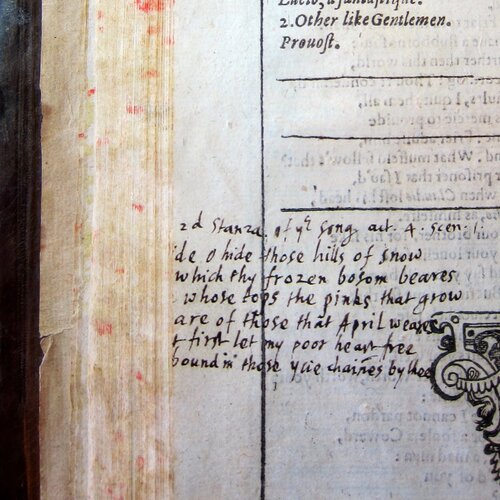
Now, it seems that significant further evidence of Milton’s admiration, and critical appreciation, of Shakespeare has emerged: in the form of Milton’s own, personal copy of the 1623 First Folio edition of Shakespeare’s plays, with annotations in Milton’s own hand. Moreover, it seems this evidence has been sitting under scholar’s noses for decades, housed in the public Free Library of Philadelphia’s Rare Book Department, one of over 230 extant copies of the First Folio.
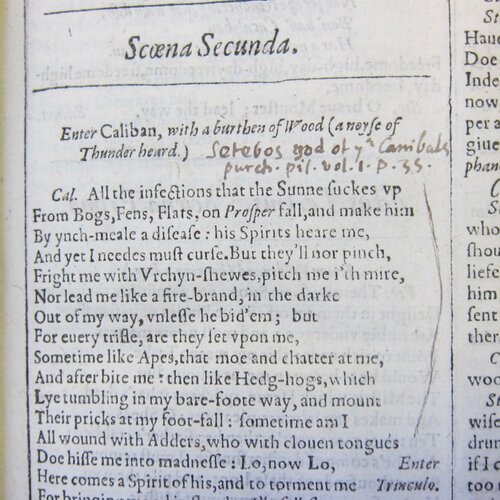
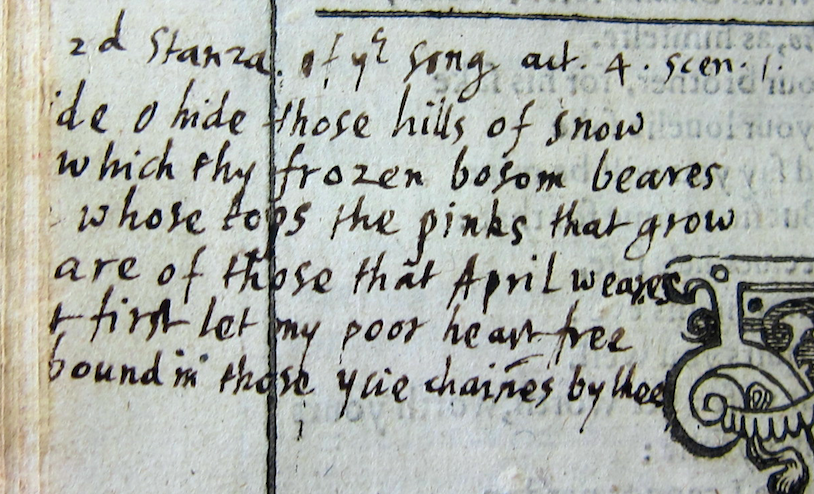
In a blog post at the Centre for Material Texts, the University of Cambridge’s Jason Scott-Warren makes his case that the annotated First Folio is Milton’s own, primarily, he writes, on the basis of paleography, or handwriting analysis. “This just looks like Milton’s hand,” he says, then walks through several comparisons with other known Milton manuscripts, such as his commonplace book and annotated Bible.
There is also the copious evidence for dating the book to the time Milton would have owned it, from the many marginal references to contemporary works like Samuel Purchas’ 1625 Pilgrimes and John Fletcher’s The Bloody Brother. Milton “added marginal markings to all of the plays except for Henry VI 1–3 and Titus Andronicus,” notes Scott-Warren. His corrections—from the Quarto—emendations, and “smart cross-references” are “intelligent and assiduous.”
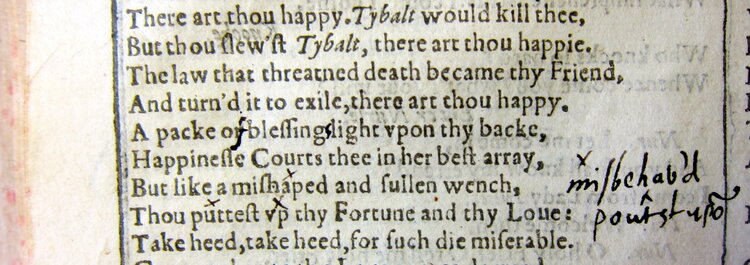
Anticipating blowback for his Milton theory, Scott-Warren asks, “wouldn’t his copy be bristling with cross-references, packed with smart observations and angrily censorious comments?” It would indeed, and “several distinguished Miltonists” have agreed with Scott-Warren’s analysis, many contacting him, he writes in a postscript, to say they’re “confident that this identification is correct.” He adds that he has “been roundly rebuked for understating the significance of the discovery.”
This kind of self-reported validation isn’t exactly peer review, but we don’t have to take his word for it. Said scholars have made their approval publicly, enthusiastically, known on Twitter. And Penn State Assistant Professor of English Claire M.L. Bourne has written a congratulatory essay on her blog. It was Bourne who spurred on Scott-Warren’s investigation with her own essay “Vide Supplementum: Early Modern Collation as Play-Reading in the First Folio,” published just months earlier this year.
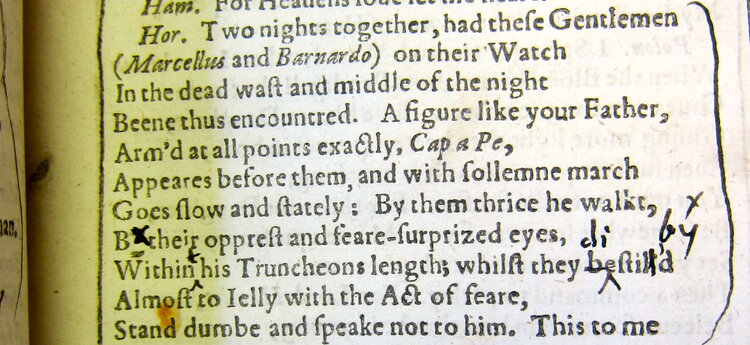
Bourne was one of the first few scholars to thoroughly examine the Free Library of Philadelphia’s copy of the First Folio. But, she admits, she completely missed the Milton connection. “You can work for a decade,” she writes ruefully, “as I did, on a single book… and still be left with gaping holes in the narrative.” This new scholarship may not only have filled in the mystery of the book’s first owner and annotator; it may also show the full degree to which Milton engaged with Shakespeare, and give Milton scholars “a new and significant field of reference” for reading his work.
via MetaFilter
Related Content:
William Blake’s Hallucinatory Illustrations of John Milton’s Paradise Lost
Spenser and Milton (Free Course)
Josh Jones is a writer and musician based in Durham, NC. Follow him at @jdmagness
Read More...Support Us
We're hoping to rely on loyal readers, rather than erratic ads. Please click the Donate button and support Open Culture. You can use Paypal, Venmo, Patreon, even Crypto! We thank you!

About Us

Open Culture scours the web for the best educational media. We find the free courses and audio books you need, the language lessons & educational videos you want, and plenty of enlightenment in between.
Advertise With Us

FREE UPDATES!
GET OUR DAILY EMAIL
Get the best cultural and educational resources on the web curated for you in a daily email. We never spam. Unsubscribe at any time.
FOLLOW ON SOCIAL MEDIA

Open Culture editor Dan Colman scours the web for the best educational media. He finds the free courses and audio books you need, the language lessons & movies you want, and plenty of enlightenment in between.
Advertise With Us


