How Eric Clapton Created the Classic Song “Layla”
The story of Eric Clapton and “Layla” has always bothered me because to understand it is to understand how fallible and crazed any of us can be when it comes to love. We understand that our rock gods are human, but there’s something about Clapton falling in love with the wife (Pattie Boyd) of one of his best mates (George Harrison, a freakin’ Beatle, man!) and then writing a whole album about it, that is just unsettling. Is this something tawdry writ epic? Or is this something epic that has the wafting aroma of tawdriness?
Polyphonic takes on the behind the scenes story of this rock masterpiece and rewinds several centuries to the source of Layla’s name: “Layla and Majnun,” a romantic poem from 12th century Persian poet Niẓāmi Ganjavi based on an actual woman from the 6th Century who drove her poet paramour mad. Lord Byron called the tragic poem “The Romeo and Juliet of the East,” as unrequited love leaves both Majnun and Layla dead after the latter’s father forbids her to be with the poet.
Eric Clapton heard of the poem from his Sufi friend Abdalqadir as-Sufi (formerly Ian Dallas), and so when he wrote a slow ballad about his unrequited love for Patti, “Layla” made perfect sense as a name.
The song might have stayed a ballad–think of Clapton’s slowed down version from his MTV “Unplugged” special–if it wasn’t for Duane Allman of the Allman Brothers. The two had yet to meet, but were aware of each other. Allman had grabbed Clapton’s attention with his fiery solo work at the end of Wilson Pickett’s cover of “Hey Jude”:
When Clapton and Allman did meet, the two set to jamming and Allman made the history-changing decision to speed up Clapton’s ballad and use a riff taken from Albert King. “Layla” was born. Allman’s bottleneck slide style met Clapton’s string bending, and the track is a conversation between the two, where no words are needed.
“It’s in the tip of their fingers,” says engineer Tom Dowd, listening to the isolated tracks in the video below. “It’s not in a knob, it’s not in how loud they play, it’s touch.”
Over this, Clapton delivers his desperate lyrics, sung by a man at his wits end, much like Majnun of the poem.
And then, that coda, which takes up half the song. Drummer Jim Gordon was working on the piano piece for a solo album in secret. When Clapton discovered Gordon was recording on the sly, he wasn’t angry. Instead he insisted it be added to the end of the rocking first half. The song is a perfect balance between frantic rock and romantic ballad.
But in the real world, “Layla” didn’t do the job. Clapton played the album for Pattie Boyd three weeks later, and though she understood its beauty, Boyd was embarrassed by its message.
“I couldn’t believe I was the inspiration for putting this together,” she said in an interview. “I didn’t want this to happen.” She was also mortified thinking that everybody would know exactly who “Layla” was about.
“It didn’t work,” Clapton recalled. “It was all for nothing.”
The song was a flop in the charts, especially as it was cut in half for the single. It would find its audience three years later when the full version appeared on both a Clapton anthology and a best of collection of Duane Allman’s work. Finally it rocketed up the charts, and it’s kind of stayed in classic rock playlists ever since.
And as for Boyd, she actually did leave George Harrison in 1974 to marry Clapton in 1979, a marriage that lasted 10 years. Not all marriages last. The original flame dies out. It’s just that, in “Layla“ ‘s case, the flame is there every time the needle drops into the groove.
Related Content:
23-Year-Old Eric Clapton Demonstrates the Elements of His Guitar Sound (1968)
Ted Mills is a freelance writer on the arts who currently hosts the artist interview-based FunkZone Podcast and is the producer of KCRW’s Curious Coast. You can also follow him on Twitter at @tedmills, read his other arts writing at tedmills.com and/or watch his films here.
Read More...American Cities Then & Now: See How New York, Los Angeles & Detroit Look Today, Compared to the 1930s and 1940s
Palimpsest has become clichéd as a descriptor of cities, but only due to its truth. Repeatedly erasing and rewriting parts of cities over years, decades, and centuries has left us with built environments that reflect every period of urban history at once. Or at least in an ideal world they do: we’ve all felt the dullness of new cities built whole, or of old cities that have barely changed in living memory, dullness that underscores the value of places in which a variety of forms, styles, and eras all coexist. Take New York, which even in the 1930s presented the genteelly historical alongside the thoroughly modern. The New Yorker video above places driving footage from that era alongside the same places — the Brooklyn Bridge, Central Park, Harlem, the West Side Highway— shot in 2017, highlighting what has changed, and even more so what hasn’t.
Los Angeles has undergone a more dramatic transformation, as Kevin McAlester’s side-by-side video of Bunker Hill in the 1940s and 2016 reveals. “An area of roughly five square blocks in downtown Los Angeles,” says The New Yorker, Bunker Hill was from 1959 “the subject of a massive urban-renewal project, in which ‘improvement’ was generally defined by the people who stood to profit from it, as well as their backers at City Hall, at the expense of anyone standing in their way.”
The 53-year process turned a neighborhood of “some of the city’s most elegant mansions and hotels,” later subdivided and “populated by a mix of pensioners, immigrants, workers, and people looking to get lost,” into an attempted acropolis of works by architectural superstars, including Frank Gehry’s Disney Concert Hall, recent Pritzker-winner Arata Isozaki’s Museum of Contemporary Art, and John Portman’s (movie-beloved) Bonaventure Hotel.
Above the classic American buildings of Detroit stands another of Portman’s signature glass-and-steel cylinders: the Renaissance Center, commissioned in the 1970s by Henry Ford II as the centerpiece of the city’s hoped-for revival. Three decades earlier, says The New Yorker, “Detroit was the fourth-largest city in America, drawing in workers with opportunities for stable employment on the assembly lines at the Ford, General Motors, and Chrysler plants.” But soon “factories closed, and jobs vanished from the city that had been the center of the industry.” The Motor City’s downward slide continued until its 2013 bankruptcy, but some auto manufacturing remains, as shown in this split-screen video of Detroit over the past century alongside Detroit in 2018. It even includes footage of the QLine, the streetcar that opened in the previous year amid the latest wave of interest in restoring Detroit to its former glory. As in any city, the most solid future for Detroit must be built, in part, with the materials of its past.
Related Content:
London Mashed Up: Footage of the City from 1924 Layered Onto Footage from 2013
Paris, New York & Havana Come to Life in Colorized Films Shot Between 1890 and 1931
Immaculately Restored Film Lets You Revisit Life in New York City in 1911
The Oldest Known Footage of London (1890–1920) Features the City’s Great Landmarks
Based in Seoul, Colin Marshall writes and broadcasts on cities, language, and culture. His projects include the book The Stateless City: a Walk through 21st-Century Los Angeles and the video series The City in Cinema. Follow him on Twitter at @colinmarshall or on Facebook.
Read More...Monty Python’s Eric Idle Breaks Down His Most Iconic Characters
When I first saw Monty Python’s Flying Circus, late at night on PBS and in degraded VHS videos borrowed from friends, I assumed the show’s concepts must have come out of bonkers improv sessions. But the troupe’s many statements since the show’s end, in the form of books, documentaries, interviews, etc., have told us in no uncertain terms that Monty Python’s creators always put writing first. “I’m not an actor at all,” says Eric Idle in the GQ video above. “I’m really a writer who just acts occasionally.”
Likewise, in the PBS series Monty Python’s Personal Best, Idle discusses the joy of writing for the show—and compares creating Monty Python to fishing, of all things: “You go to the riverbank every day, you don’t know what you’re going to catch.” This idyllic scene may be the last thing you’d associate with the Pythons, though you may recall their take on fishing in the second season sketch “Fish License,” in which John Cleese’s character, Eric, tries to buy a license for his pet halibut, Eric.
Idle’s protestations notwithstanding, none of the show’s writing would have worked as well as it did onscreen without the considerable acting talents of all five performers. (Idle modestly ascribes his own ability to being “lifted up” by the others.) Above, he talks about the most iconic characters he embodied on the show, beginning with the “wink, wink, nudge, nudge, know what I mean?” guy: a character, we learn, based on Vivian Stanshall of the Bonzo Dog Doo-Dah Band crossed with a regular from Idle’s local pub named Monty, from whom the troupe took their first name.
We also learn that the character was so popular in the States that “Elvis called everybody ‘squire’ because of that f*cking sketch!” Presley’s’ penchant for doing Monty Python material while in bed with his girlfriend (“if only there was footage”) is but one of the many fascinating anecdotes Idle casually tosses off in his commentary on characters like the Australian Bruces, who went on to sing “The Philosopher’s Song”; Mr. Smoketoomuch, who delivers a ten-minute monologue written by John Cleese and Graham Chapman; and Idle’s characters in the non-Python mocumentary All You Need Is Cash, which he created and co-wrote, about a parody Beatles band called The Rutles.
Idle is steadfast in his description of himself as a competent “caricaturist,” and not a “comic actor.” But his song and dance routines, sly subtle wit and broad gestures, and forever funny turn as cowardly Sir Robin in Monty Python and the Holy Grail should leave his fans with little doubt about his skill in front of the camera.
Related Content:
Terry Gilliam Reveals the Secrets of Monty Python Animations: A 1974 How-To Guide
The Monty Python Philosophy Football Match: The Ancient Greeks Versus the Germans
Josh Jones is a writer and musician based in Durham, NC. Follow him at @jdmagness
Read More...Hear the Very Moment When World War I Came to an End
Robert Graves’ poem “Armistice Day, 1918” begins with a riot of sound in a town in North East England. “What’s all this hubbub and yelling, / Commotion and scamper of feet,” he writes, “With ear-splitting clatter of kettles and cans, / Wild laughter down Mafeking Street?” The poem grows somber, then embittered, ending in a chilling silence for the “boys who were killed in the trenches, / Who fought with no rage and no rant.” It’s a familiar contrast from much World War I poetry—the hooting civilian crowds and the grim, silent soldiers counting their losses.
One project, created as part of the 100th anniversary of the Armistice last year, gave us a different take on this WWI theme of sound and silence —using innovative techniques from 1918 that turned the final shelling of the war into visual data, then translating that data back into sound a century later. Rather than celebration, the “ear-splitting clatter” is the sound of mass death, and the silence, though surely “uneasy,” as Matt Novak writes, must also have been revelatory.
In the “graphic record” of the Armistice, just below, we can “see” the deafening sounds of war and the first three silent seconds of its end, at 11 A.M. November 11th, 1918. The film strip records six seconds of vibration from six different sources, as the graphic, from the Army Corps of Engineers, informs us. “The broken character of the records on the left indicates great artillery activity; the lack of irregularities on the right indicates almost complete cessation of firing.”
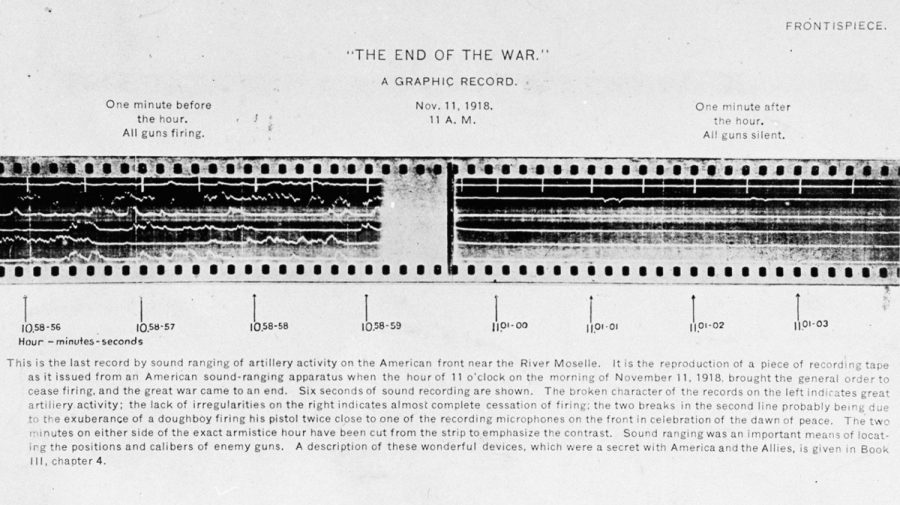
You might notice a couple little breaks in one line on the right—likely the result of an exuberant “doughboy firing his pistol twice close to one of the recording microphones on the front in celebration of the dawn of peace.” But this was 1918—field recording technology barely existed, though a few battlefield attempts were made (at least one survives). The “microphones” in question were actually “barrels of oil dug into the ground,” notes Jason Daley at Smithsonian.
This technique, called “sound ranging,” worked by registering vibration, similar to a seismograph’s operation, and helped special units locate enemy fire, using “photographic film to visually record noise intensity.” The film above was part of the centenary exhibition at London’s Imperial War Museum, which also commissioned sound designers Coda to Coda to reconstruct the dramatic moment with an audio interpretation. At the top of the post, hear what the seconds before and after the Armistice likely sounded like, as recorded on the American front at the River Moselle.
Listening to the seconds of the war’s end from the battlefield perspective—rather than streets filled with cheering crowds—is rather chilling, “a sudden reprieve from the staccato of weapons blasting,” Novak writes. The “graphic record” of the Armistice also shows us “just how horrifically precise and cruel war can be.” The slaughter could have been stopped in an instant, by the mutual decree of world leaders, at maybe any time during those harrowing four years.
On November 11 at 11 A.M., “the guns fell silent,” writes the Imperial War Museum, and “a new world began.” But as artists like Graves remind us, for the returning maimed and traumatized soldiers and the hundreds of thousands of bereaved families, the war didn’t end when the noise finally stopped.
Related Content:
Watch World War I Unfold in a 6 Minute Time-Lapse Film: Every Day From 1914 to 1918
Josh Jones is a writer and musician based in Durham, NC. Follow him at @jdmagness
Read More...Nigerian Teenagers Are Making Slick Sci Fi Films With Their Smartphones
Someone should really snap up the rights for a movie about The Critics, a collective of self-taught teenage filmmakers from northwestern Nigeria.
The boys’ dedication, ambition, and no-budget inventiveness calls to mind other filmmaking fanatics, from the sequestered, homeschooled brothers of The Wolfpack to the fictional Sweding specialists of Me and Earl and the Dying Girl and Be Kind, Rewind.
While smartphones and free editing apps have definitely made it easier for aspiring filmmakers to bring their fantasies to fruition, it’s worth noting that The Critics saved for a month to buy the green fabric for their chroma key effects.
Their productions are also plagued with the internet and power outages that are a frequent occurrence in their home base of Kaduna, slowing everything from the rendering process to the Youtube visual effects tutorials that have advanced their craft.
To date they’ve filmed 20 shorts on a smart phone with a smashed screen, mounted to a broken microphone stand that’s found new life as a homemade tripod.
Their simple set up will be coming in for an upgrade, however, now that Nollywood director Kemi Adetiba has brought their efforts to the attention of a much wider audience, who donated $5,800 in a fundraising campaign.
It’s easy to imagine the young male demographic flocking to a feature-length, big-budget expansion of Z: The Beginning. It’s possible even the art house crowd could be lured to a summer blockbuster whose setting is Nigeria, thirty years into the future, a novelty for those of us unversed in Nollywood’s prodigious output.
The post-apocalyptic short, above, took the crew 7 months to film and edit. The stars also inhabited a number of offscreen roles: stunt coordinator, gaffer, prop master, composer, continuity…
What’s next? Earlier this month, Africa News revealed that the boys are busy with a new film whose plot they aren’t at liberty to reveal. We’re guessing a sequel, to go by a not so subtle hint following Z’s final credits and a moving dedication to “the ones we’ve lost.”
“Horror, comedy, sci-fi, action, we do all,” The Critics’ proclaim on their Youtube channel, carefully categorizing their work as “films not skits.” (Their films’ length has thus far been dictated by the unpredictability of their wifi situation—Chase, below, is five minutes long and took two days to render.
“One of the targets we aim for in the years to come is to make the biggest film in Nigeria and probably beyond,” Godwin Josiah, Z’s 19-year-old writer-director told Channels Television, Lagos’ 24-hour news channel:
We want to do something crazy, we want to do something great, something that has not been done before, and from what has been going on now, we believe quite well that it is going to happen soon enough.
Watch The Critics’ films and making-ofs on their Youtube channel.
Support their work with a pledge to their recently launched Patreon.
Related Content:
The Strange and Wonderful Movie Posters from Ghana: The Matrix, Alien & More
High School Kids Stage Alien: The Play and You Can Now Watch It Online
Director Robert Rodriguez Teaches The Basics of Filmmaking in Under 10 Minutes
Hear Kevin Smith’s Three Tips For Aspiring Filmmakers (NSFW)
Ayun Halliday is an author, illustrator, theater maker and Chief Primatologist of the East Village Inkyzine. Join her in NYC on Monday, September 9 for another season of her book-based variety show, Necromancers of the Public Domain. Follow her @AyunHalliday.
Read More...Where Zombies Come From: A Video Essay on the Origin of the Horrifying, Satirical Monsters
Will zombies ever die? To zombie enthusiasts, of course, that question makes no sense: zombies are already dead, drained of life and reanimated by some magical, biological, or even technological force. Most of us have never known a world without zombies, in the sense of zombies as a presence in film, television, literature, and video games. In the video essay “Where Zombies Come From,” video essayist Evan Puschak, better known as the Nerdwriter, goes back to the dawn of these dead figures to pinpoint the origin of this robust “modern myth.”
The first mention of zombies appears in 1929’s The Magic Island, a book on Haiti by “journalist, occultist, and generally eccentric minor celebrity” William Seabrook. “The zombie, they say, is a soulless human corpse, still dead, but taken from the grave and endowed by sorcery with a mechanical semblance of life — it is a dead body which is made to walk and act and move as if it were alive.”
That 90-year-old description may sound more or less like the zombies that continue to scare and amuse us today, but the modern image of the zombie didn’t emerge fully formed; 1932’s Bela Lugosi-starring White Zombie, the very first zombie film, may not strike us today as fully representative of the genre it founded.
But “in 1968 everything changed.” That year, the young filmmaker George A. Romero’s Night of the Living Dead (watch it online) laid down the rules for zombies: they “devour living human beings. They hobble forward awkwardly but relentlessly. They’re dumb, able to use objects as blunt-force instruments but nothing else. They can only be killed by being shot in the head or burned, and if one bites or scratches you, you’ll die not long after, then transform into one and pursue whomever is nearby, family or not.” To Puschak’s mind, the film holds up not just as a zombie movie, but as a movie: “In its neorealist, black-and-white style, it is a smart, tightly crafted story made on a shoestring budget with a third act that is absolutely brutal and punishing even now, 50 years later.”
Night of the Living Dead didn’t call its zombies zombies, but its sequel, 1978’s Dawn of the Dead, put the label of zombie on not just them but us: “The film, which takes place almost entirely in a mall, uses zombies to critique consumerism: as the zombies lumber through this familiar place, we see our own behavior as a grotesque reflection. A zombie’s thoughtlessness, Romero understood, is the perfect mirror for our own.” Dawn of the Dead bolstered the potential of zombies not just as as “creative, primal monsters,” but as satirical devices, and the finest zombie movies know how to use them as both at once. (So far I’ve seen that balance no more impressively struck than in a Korean zombie movie, Yeon Sang-ho’s Train to Busan.)
Over the past half-century, post-Night of the Living Dead zombie stories have made all manner of tweaks on and variations to the standard zombie formula. Danny Boyle’s 28 Days Later, for example, popularized the fast-moving zombie, and Edgar Wright’s Shaun of the Dead pioneered the full-on zombie comedy. Most recently, no less astute an observer of American culture and re-animator of seemingly dead cinematic tropes than Jim Jarmusch has offered us his own entry into the zombie canon, The Dead Don’t Die. Jarmuschian zombies shamble compulsively toward that which they desired in life: coffee, wi-fi, chardonnay, Xanax. As long as we can still see these ourselves in these both funny and terrifying creatures, the zombie apocalypse will always seem dead ahead.
Related Content:
Watch Night of the Living Dead, the Seminal Zombie Movie, Free Online
How to Survive the Coming Zombie Apocalypse: An Online Course by Michigan State
Decay: Zombies Invade the Large Hadron Collider in Movie Made by Ph.D. Students
Martin Scorsese Creates a List of the 11 Scariest Horror Films
Based in Seoul, Colin Marshall writes and broadcasts on cities, language, and culture. His projects include the book The Stateless City: a Walk through 21st-Century Los Angeles and the video series The City in Cinema. Follow him on Twitter at @colinmarshall or on Facebook.
Read More...Philip K. Dick Tarot Cards: A Tarot Deck Modeled After the Visionary Sci-Fi Writer’s Inner World
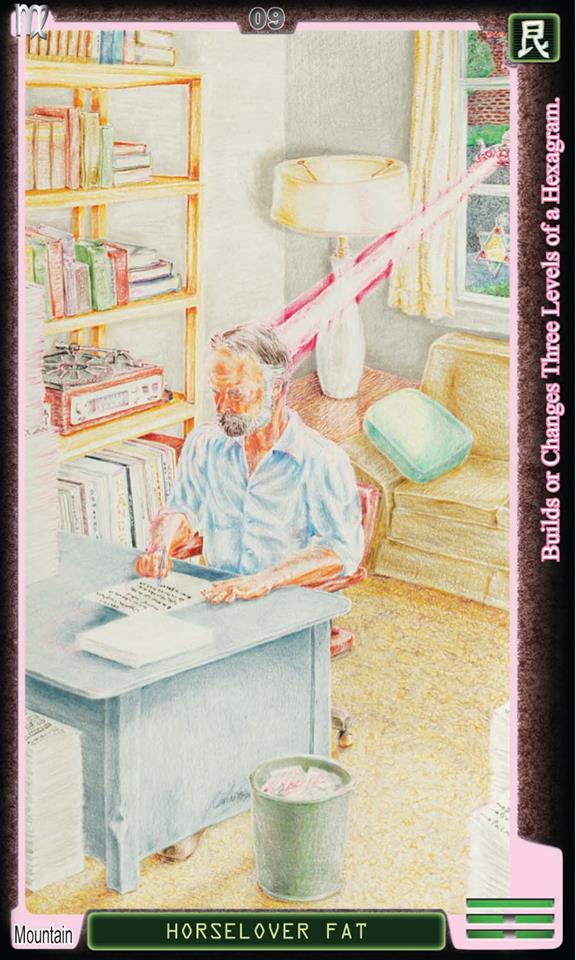
What does Philip K. Dick have in common with Jorge Luis Borges, Hermann Hesse, and John Cage? Fans of all three twentieth-century visionaries will have much to say on the matter of what deep resonances exist between their bodies of work and the worldviews that produced them. But they can’t overlook the fact that Dick, Borges, Hesse, and Cage all, at one time or another, enthusiastically consulted the ancient Chinese divination text known as the I Ching. Also known as The Book of Changes, it became a must-have countercultural volume in the 1960s, and the words of guidance it provided, in all their openness to interpretation, surely influenced no small number of decisions made in that era.
What the I Ching had to say certainly influenced the decisions of Philip K. Dick, in life as well as in writing. Not only did he use the book to write The Man in the High Castle, his 1962 novel portraying a world in which the Axis powers won World War II, he also included it as a plot element in the story itself.
And speaking of alternate histories, we might ask: could Dick have written The Man in the High Castle without the I Ching? Or could he have written it using another divination tool, perhaps one from the West rather than the East? What would the novel have looked like if written while harnessing the perceptive power of tarot, the 15th-century European card game whose decks also have a long history as windows onto human destiny?
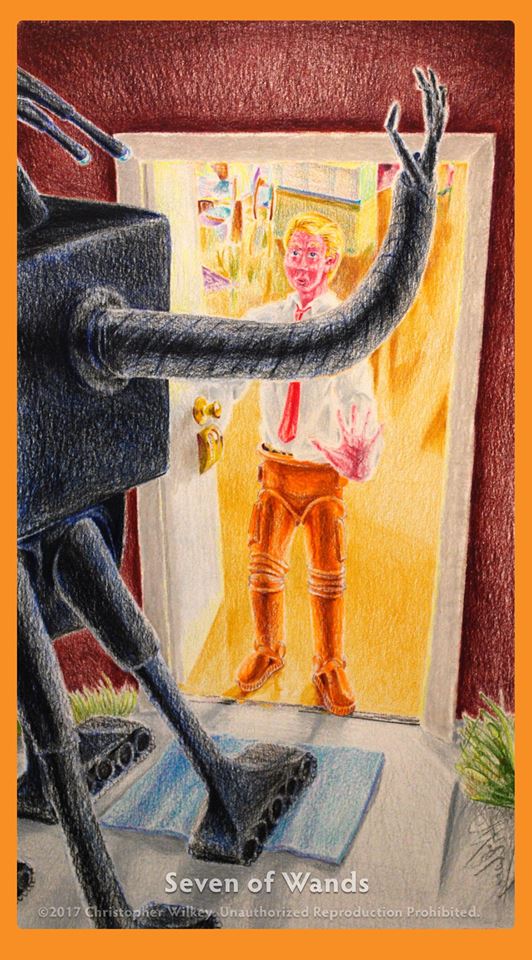
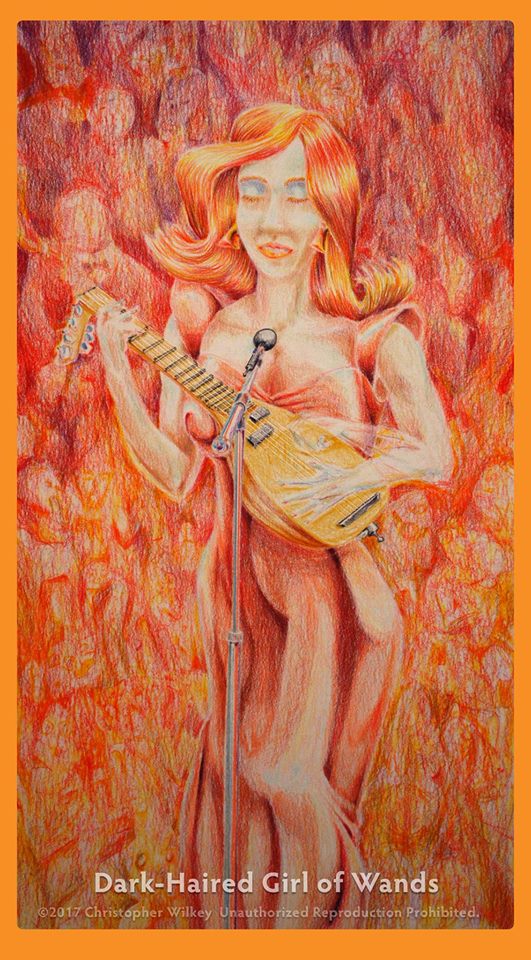
Recently the world of tarot, the world of the I Ching, and the world of Philip K. Dick collided, resulting in The Fool’s Journey of Philip K. Dick, a tarot deck published by Wide Books. “PKD scholar Ted Hand and tarot artist Christopher Wilkey have brought together a new vision of tarot and the great works of Philip K. Dick,” says Wide Books’ site. “Ideal for advanced students of tarot as well as novices to the I Ching,” the deck “takes the seeker through an initiation into the life and writings of one of the greatest writers of recent times.” In addition to its 80 cards, each drawing from some element of Dick’s body of work, the deck includes “four rule cards for two I Ching inspired card games and an eight-sided folding booklet about tarot as Gnostic Allegory, with beginning exercises contrasting tarot to the I Ching.”
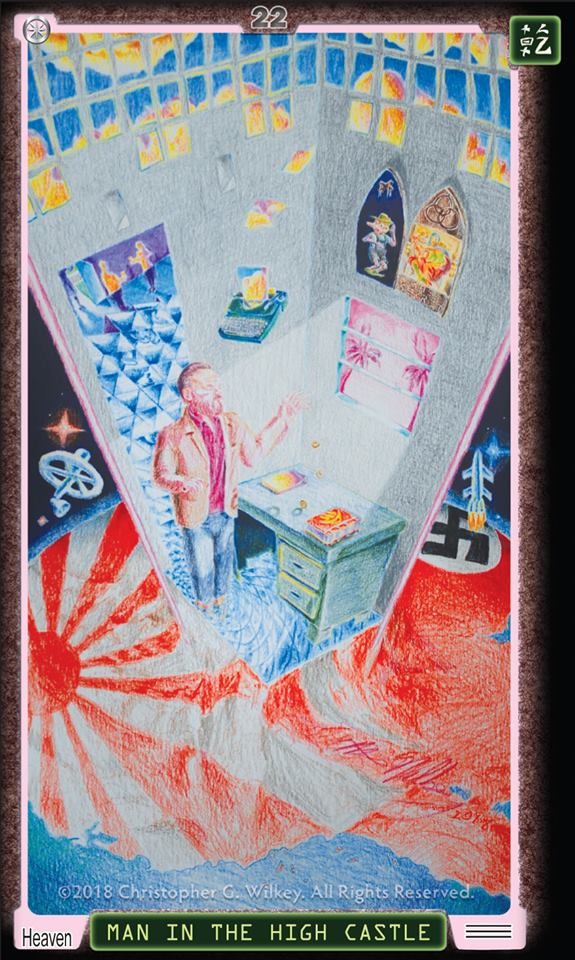
Two of the games pay tribute to particular Dick novels: A Maze of Death and its “domino-type game” that “familiarizes players with the trigrams of which I Ching hexagrams are composed,” and Ubik, which has “players either hoping to avoid accumulating entropy or trying to capture all the energy you can from the deck and other players to be the last standing at the end of the game.” If that sounds like a good time to you, you’ll have to register your interest in ordering a copy of The Fool’s Journey of Philip K. Dick on Wide Books’ contact form, since the initial run has sold out. That won’t come as a surprise to Dick’s fans, who know the addictive power of one glimpse into his inner world, with its rich mixture of the supernatural, the scientific, the paranormal, and the paranoid. But what kind of books will they use his tarot deck to write?
Related Content:
Behold the Sola-Busca Tarot Deck, the Earliest Complete Set of Tarot Cards (1490)
The Tarot Card Deck Designed by Salvador Dalí
The Thoth Tarot Deck Designed by Famed Occultist Aleister Crowley
Twin Peaks Tarot Cards Now Available as 78-Card Deck
Robert Crumb Illustrates Philip K. Dick’s Infamous, Hallucinatory Meeting with God (1974)
Based in Seoul, Colin Marshall writes and broadcasts on cities, language, and culture. His projects include the book The Stateless City: a Walk through 21st-Century Los Angeles and the video series The City in Cinema. Follow him on Twitter at @colinmarshall or on Facebook.
Read More...Leonard Cohen’s Cocktail Recipe: Learn How to Make “The Red Needle”

Image by Jarkko Arjatsalo, The Leonard Cohen Files
Back in 1975, poet and singer-songwriter Leonard Cohen created a cocktail that he called The Red Needle. According to the website, “The Hitchhiker’s Guide to the Galaxy,” here’s how to make it:
If you’d like to entertain your friends with a few Red Needles, and you feel you must have a recipe, here’s something too smooth to go by:
Into one very tall glass about half full of crushed ice pour and drop:
2 oz tequila (that’s 2½ English measures or about 60ml)
1 slice lemon
enough cranberry juice to top up the glassRepeat for each friend.
Serve with Montreal smoked meat sandwiches accompanied by Leonard Cohen’s Various Positions.
If you don’t want to make it at home, you can always visit NYC and head to the Jewish Museum, where, notes the NYTimes, “the drink is being served on Thursdays in August in the museum lobby.”
If you would like to support the mission of Open Culture, consider making a donation to our site. It’s hard to rely 100% on ads, and your contributions will help us continue providing the best free cultural and educational materials to learners everywhere. You can contribute through PayPal, Patreon, and Venmo (@openculture). Thanks!
Related Content:
F. Scott Fitzgerald Conjugates “to Cocktail,” the Ultimate Jazz-Age Verb (1928)
Drinking with William Faulkner: The Writer Had a Taste for The Mint Julep & Hot Toddy
Read More...What the First Movies Really Looked Like: Discover the IMAX Films of the 1890s
Cinematic legend has it that, back in the early days of motion pictures, audiences would see a train coming toward them on the screen and dive out of the way in a panic. “There turns out to be very little confirmation of that in the actual newspaper reports of the time,” says critic and Museum of Modern Art film curator Dave Kehr in the video above, “but you can still sense the excitement in seeing these gigantic, incredibly sharp, lifelike images being projected.” But aren’t they only sharp and lifelike by the standards of the late-19th century dawn of cinema, an era we filmgoers of the 21st century, now used to 4K digital projection, imagine as one of unrelieved blurriness, graininess, and herky-jerkiness?
By no means. The footage showcased in this video, a MoMA production on “the IMAX of the 1890s,” was shot on 68-millimeter film, a greater size and thus a higher definition than the 35-millimeter prints most of us have watched in theaters for most of our lives.
Only the most ambitious filmmakers, like Paul Thomas Anderson making The Master, have used such large-format films in recent years, but 120 years ago an outfit like the Biograph Company could, in Kehr’s words, “send camera crews around the world, as the Lumière Company had,” and what those crews captured would end up in movie theaters: “Suddenly the world was coming to you in ways that people just could not have imagined. That you could go to Europe, that you could meet the crowned heads, that you could go to see elephants in India…”
Thanks to the efforts of film archivists and preservationists, a few of whom appear in this video to show and explain just what degradation befalls these cinematic time capsules without the kind of work they do, much of this footage still looks and feels remarkably lifelike. “It’s worth returning to these images to remind us that movies used to be analog,” Kehr says. “They saw things in front of the camera in a one-on-one relationship. This was the world. It was an image you could trust. It was an image of physical substance, of reality. Nowadays we tend not to trust images, because we know how easily manipulated they are.” We’ve gained an unfathomable amount of imagery, in terms of both quantity and quality, in our digital age. But as the sheer “ontological impact” of these old 68-millimeter clips reminds us, even when felt in streaming-video reproduction, our images have lost something as well.
via Aeon
Related Contents:
The Art of Creating Special Effects in Silent Movies: Ingenuity Before the Age of CGI
Enjoy the Greatest Silent Films Ever Made in Our Collection of 101 Free Silent Films Online
Hollywood, Epic Documentary Chronicles the Early History of Cinema
The History of the Movie Camera in Four Minutes: From the Lumiere Brothers to Google Glass
Based in Seoul, Colin Marshall writes and broadcasts on cities, language, and culture. His projects include the book The Stateless City: a Walk through 21st-Century Los Angeles and the video series The City in Cinema. Follow him on Twitter at @colinmarshall, on Facebook, or on Instagram.
Read More...An Artist Crochets a Life-Size, Anatomically-Correct Skeleton, Complete with Organs

How to make a life-sized facsimile of a human skeleton:
- Download files published under a Creative Commons license, and arrange to have them 3‑D printed.
or
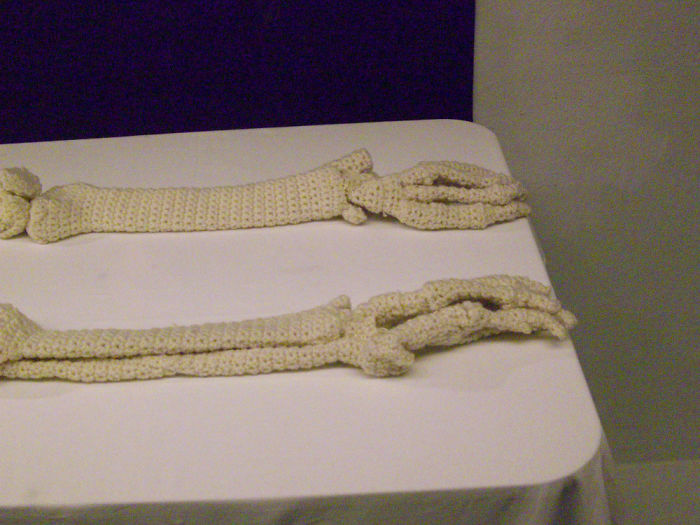
- Do as artist Shanell Papp did, above, and crochet one.
The latter will take considerably more time and attention on your part. Papp gave up all extracurricular activities for four months to hook the woolen skeleton around her work and school schedule. Equipping it with internal organs ate up another four.
To ensure accuracy, Papp armed herself with anatomical textbooks and an actual human skeleton on loan from the University of Lethbridge, where she was an undergrad. The brain has gray and white matter, there’s marrow in the bones, the stomach contains half-digested wool food, and the intestines can be unspooled to a realistic length.
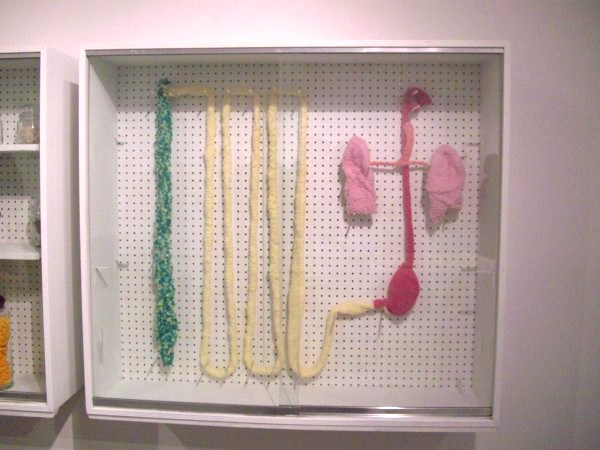
The grueling 2006 project did not exhaust her fascination for the intricacies of human anatomy. The University of Saskatchewan granted her open access to draw in the gross anatomy lab while she pursued her MFA.
As she told MICE magazine:
I wanted this work to illustrate all of the organs and bones everyone shares and to not highlight differences. Much of anatomical history is about defining difference, by comparative analysis. This can set up strange taxonomies and hierarchies. I wasn’t interested in participating in that; I wanted to expose the fragile, common, and unseen things in all of us.
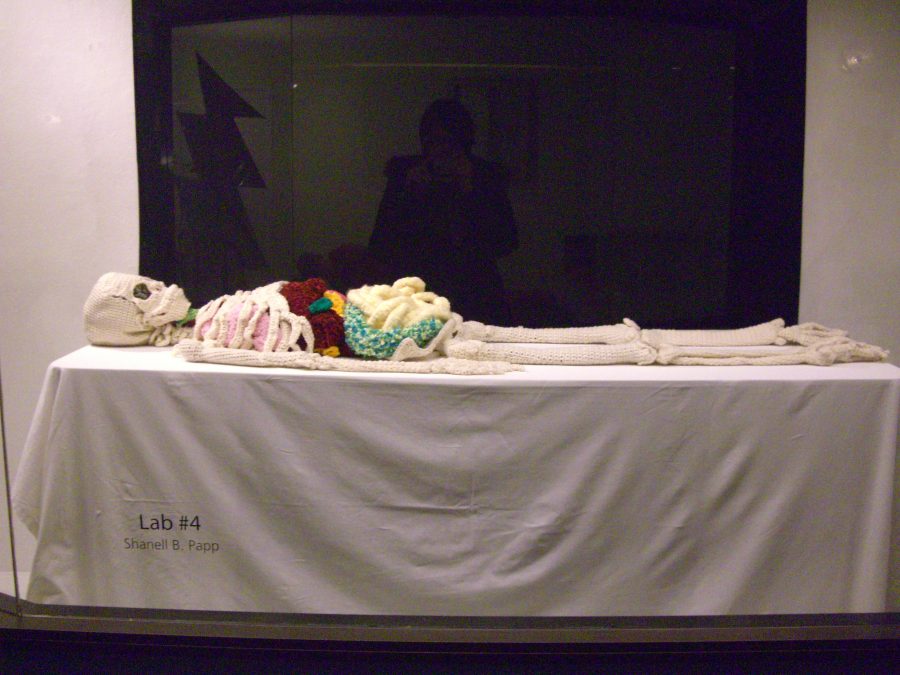
The finished piece, which is displayed supine on a gurney she nabbed for free during a mortuary renovation, incorporates many of Papp’s other abiding interests: horror, medical history, Frankenstein, crime investigation, and mortuary practices.
Papp, who taught herself how to crochet from books as a child, using whatever yarn found its way to her grandma’s junk shop, appreciates how her chosen medium adds a layer of homey softness and familiarity to the macabre.
It’s also not lost on her that fiber arts, often dismissed as too “crafty” by the establishment, were an important component of 70s-era feminist art, though in her view, her work is more of a statement on the history of textile manufacturing, which is to say the history of labor and class struggle.

See more of Shanell Papp’s work here.
All images in this post by Shanell Papp.
Related Content:
Behold an Anatomically Correct Replica of the Human Brain, Knitted by a Psychiatrist
The Beautiful Math of Coral & Crochet
Ayun Halliday is an author, illustrator, theater maker and Chief Primatologist of the East Village Inkyzine. Join her in NYC on Monday, September 9 for another season of her book-based variety show, Necromancers of the Public Domain. Follow her @AyunHalliday.
Read More...Support Us
We're hoping to rely on loyal readers, rather than erratic ads. Please click the Donate button and support Open Culture. You can use Paypal, Venmo, Patreon, even Crypto! We thank you!

About Us

Open Culture scours the web for the best educational media. We find the free courses and audio books you need, the language lessons & educational videos you want, and plenty of enlightenment in between.
Advertise With Us

FREE UPDATES!
GET OUR DAILY EMAIL
Get the best cultural and educational resources on the web curated for you in a daily email. We never spam. Unsubscribe at any time.
FOLLOW ON SOCIAL MEDIA

Open Culture editor Dan Colman scours the web for the best educational media. He finds the free courses and audio books you need, the language lessons & movies you want, and plenty of enlightenment in between.
Advertise With Us

