What Happens When Artificial Intelligence Listens to John Coltrane’s Interstellar Space & Starts to Create Its Own Free Jazz
Some enjoy free jazz as soon as they first hear it; others think it sounds like music from an alien civilization, a listening experience fit only for a jazz fan as high as a kite. But how about as high as a space probe? Outerhelios, a 24/7 stream of artificial intelligence-generated free jazz, comes designed for broadcast into outer space by Dadabots, a collaboration between musicians-turned-programmers CJ Carr and Zack Zukowski (or, according to their about page, “a cross between a band, a hackathon team, and an ephemeral research lab”). Having previously built an AI-generated death metal stream (about whose creation you can read in this computer science paper), they’ve looked to the skies and trained their neural network on John Coltrane’s Interstellar Space.
“These duets between Coltrane on tenor (and bells) and Rashied Ali on drums sound like an annoyance until you concentrate on them,” writes Robert Christgau in his original review of the 1974 album, “at which point the interactions take on pace and shape.” The neural network “listened to the album 16 times,” says the official Databots description on the Outerhelios stream, “then continued to make music in the style.”
The project draws inspiration from NASA’s probes Voyager 1 and 2, which “launched in 1977 carrying a mixtape Carl Sagan made called The Sounds of Earth. It featured Blind Willie Johnson, Chuck Berry, recordings of laughter, Beethoven, Bach, Stravinsky, along with diagrams of human reproductive organs,” all “intended for an audience of intelligent extraterrestrial lifeforms.”
Whereas The Sounds of Earth “used a static music format previously recorded by people,” Outerhelios follows on Brian Eno’s ideas about generative music by inventing a Coltrane album that never sounds the same twice. “For a few minutes, it’ll produce plausible-sounding free jazz,” writes Futurism.com’s Jon Christian. “Then the drums will segue into an inhuman trill, or the horns will disintegrate into a cacophonous wash of sound. Let’s just say that it’s not your dad’s jazz” — even if your dad happens to be John Coltrane, or indeed Brian Eno. But perhaps it will give NASA just the inspiration it needs to get the next Voyager launched. The sound of the original Interstellar Space got Christgau thinking beyond nations: “European, Oriental, African — I don’t know. But amazing.” Could the likes of Outerhelios get us thinking beyond the solar sytem?
Related Content:
Hear the Declassified, Eerie “Space Music” Heard During the Apollo 10 Mission (1969)
Artificial Intelligence Program Tries to Write a Beatles Song: Listen to “Daddy’s Car”
Space Jazz, a Sonic Sci-Fi Opera by L. Ron Hubbard, Featuring Chick Corea (1983)
Based in Seoul, Colin Marshall writes and broadcasts on cities, language, and culture. His projects include the book The Stateless City: a Walk through 21st-Century Los Angeles and the video series The City in Cinema. Follow him on Twitter at @colinmarshall, on Facebook, or on Instagram.
Read More...The Piano Played with 16 Increasing Levels of Complexity: From Easy to Very Complex
Remember the feeling of accomplishment as a child, picking out a simple tune after your first piano lesson?
Then the day you begin to play with both hands? So grown up.
Eventually you start using more than two fingers.
And then comes the party where a proud parent, possibly with a drink or two in him, commands you to play for the guests, who indulge your efforts with applause and the suggestion that perhaps their child, a contemporary of yours, take a turn at the keyboard.
Mozart.
Beethoven.
Maximum humiliation.
How soon can you bail on those damn piano lessons?
I flashed on that universal experience whilst listening to pianist and composer Nahre Sol demonstrate the “endless possibilities” of piano composition and interpretation by subjecting “Happy Birthday” to sixteen levels of increasing complexity.
‘Round about level five is where our respective talents began to part ways.
After a lot of practice and false starts, I can sometimes manage a simple arpeggio.
That’s greasy kid stuff to Nahre, whose YouTube channel abounds with expert advice on how to sound like various classical composers and robust investigations of genres—flamenco, ragtime, Bossa nova, the Blues…
Now I know what made the visitors’ kid so much more advanced than me—broken octaves, glissandos, great muscular spans, a confident command of harmonies and rhythm…
Sol blows that performance out of the water, with seemingly very little effort, breezily explaining what she’s doing each time she takes things up a notch, culminating in level 16, which encompasses all previous steps.
As homelessricegum observes in the comment section of the video, “Level 17: you will now need your third hand.”
Related Content:
Learn How to Read Sheet Music: A Quick, Fun, Tongue-in-Cheek Introduction
Ayun Halliday is an author, illustrator, theater maker and Chief Primatologist of the East Village Inkyzine. Join her in NYC on September 9 for another monthly installment of her book-based variety show, Necromancers of the Public Domain. Follow her @AyunHalliday.
Read More...
What Happened to the 1200 Paintings Painted by Bob Ross? The Mystery Has Finally Been Solved
Very few artists enjoy the degree of recognition that’s been conferred upon the late television educator Bob Ross, though sales of his work hover around zero.
It’s not due to scarcity. Ross pumped out three nearly-identical paintings per episode of his series, The Joy of Painting (watch them online here). That’s 403 episodes over the course of 31 seasons on public television—or 1209 canvases of clouds, mountains, and “happy little trees.”
Shouldn’t economics dictate that these would have only increased in value following their creator’s untimely death from lymphoma in 1995?
A handful have been donated to the Smithsonian National Museum Of American History’s permanent collection. Leaving those aside, why are there no Bob Rosses fetching high prices on the auction block?
Is the painter’s legendary hypnotic appeal a factor? Did he subconsciously manipulate even the most cutthroat collectors into a state of sentimental attachment wherein profit matters not a jot?
As The New York Times-produced video above points out, Ross’ great mission in life was to get others painting—quickly and joyfully.
Which is not to say he blithely tossed the fruits of his labor into the incinerator after that purpose had been served.
The reason Ross’ paintings aren’t on the market is they’re neatly stacked in cardboard cartons at Bob Ross Inc. in Herndon, Virginia. It hardly constitutes archival storage, but the boxes are neatly numbered, and everything is accounted for.
And that is where they’re likely to remain, according to executive assistant Sarah Strohl and president Joan Kowalski, the daughter of Ross’ longtime business partner. (Her mother, Annette is Ross’ former student and the foremost authenticator of his work.)
For now, if anyone endeavors to sell you a Bob Ross original, it’s safe to assume it’s a fake.
Better yet, paint your own. Bob Ross Inc. tends to both the master’s reputation and his lucrative off-screen business, selling instructional books and painting supplies.
Be forewarned, though, it’s won’t be as easy as the ever-placid master made it seem. Have a look at these comedians scrambling to keep up with his moves for the Bob Ross Challenge, a fundraiser for the Leukemia & Lymphoma Society.
Ross, of course, never broke a sweat on camera, which lends a bit of cognitive dissonance to the Times’ video’s frenetic editing. (I never thought I’d have to issue a seizure warning for something Bob Ross-related, but those canvases flash by awfully quickly at the 1:09 mark and again at 10:36. )
Related Content:
A Big List of Free Art Lessons on YouTube
Ayun Halliday is an author, illustrator, theater maker and Chief Primatologist of the East Village Inkyzine. Join her in NYC on September 9 for the kick off of another season of her book-based variety show, Necromancers of the Public Domain. Follow her @AyunHalliday.
Read More...
The New David Bowie Barbie Doll Released to Commemorate the 50th Anniversary of “Space Oddity”
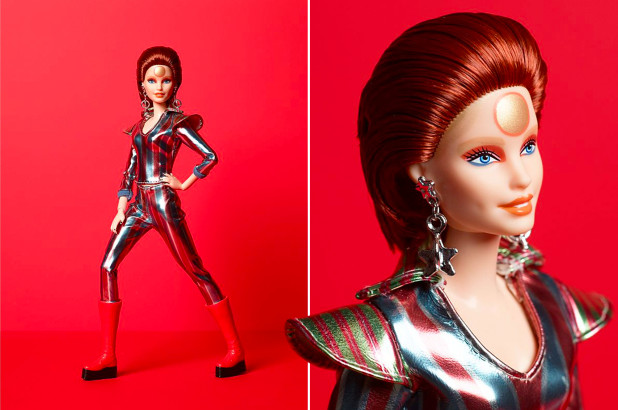
This week Open Culture commemorated the 50th anniversary of the release of David Bowie’s “Space Oddity” by exploring the song’s relationship to the Apollo 11 moon landing and Stanley Kubrick’s 2001: A Space Odyssey. Mattel, they handled things a little differently, releasing a new David Bowie Barbie Doll. Here’s their spiel:
- In the definitive celebration of two pop culture icons, Barbie honors the ultimate pop chameleon, English singer, songwriter and actor, David Bowie.
- This collectible Barbie doll wears the metallic Ziggy Stardust ‘space suit’ with red and blue stripes, flared shoulders and Bowie’s signature cherry-red platform boots.
- Special details include bold makeup — featuring the famed astral sphere forehead icon — and a hairstyle inspired by Bowie’s fiery-red locks.
- Specially designed packaging makes Barbie David Bowie the ultimate collector’s item for Bowie and Barbie fans alike.
- Honor David Bowie’s extraordinary talent and undeniable influence with Barbie David Bowie doll.
Related Content
Hear Demo Recordings of David Bowie’s “Ziggy Stardust,” “Space Oddity” & “Changes”
Read More...The Restoration of Rembrandt’s The Night Watch Begins: Watch the Painstaking Process On-Site and Online
Are collectibles markets driven by arbitrary standards? Of course. Just note the comparisons between the art world and world of vintage baseball cards. Don’t see any significant similarities? You must not be an economist. As Tim Schneider points out at Artnet, the two markets may be more alike than not, but they “diverge violently when it comes to the concept of restoration.” Baseball cards, no matter how tattered, stained, and torn, should never be tampered with to improve their condition one bit. One could say the same of many other “positional goods,” to use the properly economistic term.
But economists don’t make categories with aesthetic criteria in mind, and most of us aren’t gallery owners, curators, or billionaire collectors, but lovers and appreciators of art. Do the vast majority of people who visit Rembrandt’s monumentally famous The Night Watch at the Rijksmuseum care about the fluctuations in the painting’s market value? Likely not, especially since a work as treasured as the officially-titled Militia Company of District II under the Command of Captain Frans Banninck Cocq has no market value. “It will never be sold,” writes travel writer Kieran Meeke. The Night Watch is “literally ‘priceless.’
“Like many other such paintings in national collections, there is also no reason to insure it as it makes more financial sense to spend the premiums on improving security.” Other reasons to spend on security include the three violent attacks the painting has endured at the hands of angry and troubled would-be art assassins allowed to get too close. This damage, ranging from severe to mild, and the ravages of time, have also necessitated many expensive restoration efforts, and the latest undertaking is the biggest yet, especially since it has been turned into a heavily-promoted live event called “Operation Night Watch.”
Last year, we brought you news of this upcoming opportunity to see the painting’s vibrant colors emerge from the accumulated grime; this month, the project began, with an introduction on Monday by museum director Taco Dibbets. This is “the largest research and restoration project ever for ‘the Night Watch,’” the Rijksmuseum reports, “and you can be part of it.” You do not need a ticket to the Netherlands, though if you buy one, you’ll also need to buy a ticket for entry to the museum, where the painting will be on full display during its restoration. If, however, you decide to watch from home, your seats are free.
The project’s name is only partly tongue-in-cheek. “It is like a military operation in the planning,” said Dibbets, and it has required the utmost precision and expert teams of restorers, data experts, art historians, and the professionals who moved the enormous painting into the glass case it will occupy during this intense period. The crew of restorers will work from digital images taken with a macro X‑ray fluorescence scanner, a technique, says Dibbets, that allowed them to “make a full body scan” and “discover which pigments [Rembrandt] used.”
This restoration project will greatly expand our understanding of the painting’s creation, and renew our awe for its grandeur. There may be no way to calculate The Night Watch’s monetary value, outside of the unlikely event that the Rijksmuseum decides to sell, but what restorers, historians, gallery visitors—and millions of art lovers around the world, who only know the painting in reproductions—truly want to know is: what exactly did this beloved artwork look like when it was first made, and what might we have been missing in the almost 400 years we’ve been admiring it?
We’ll get the chance to see not only the finished product of the restoration, but every painstaking step of the process as well. You can monitor the progress of the restoration online, and, further up, see a time-lapse video of the labor-intensive operation required to move the massive canvas.
Related Content:
300+ Etchings by Rembrandt Now Free Online, Thanks to the Morgan Library & Museum
What Makes The Night Watch Rembrandt’s Masterpiece
Late Rembrandts Come to Life: Watch Animations of Paintings Now on Display at the Rijksmuseum
Josh Jones is a writer and musician based in Durham, NC. Follow him at @jdmagness
Read More...Arnold Schoenberg, Avant-Garde Composer, Creates a System of Symbols for Notating Tennis Matches
This time each summer, as the conclusion of this year’s fortnight-long championship at Wimbledon approaches, even the most private of the tennis enthusiasts in all of our circles make themselves known. Love of that particular game runs down all walks of life, but seems to exist in particularly high concentrations among cultural creators: not just writers like Martin Amis, Geoff Dyer, and David Foster Wallace, all of whose bodies of work contain eloquent thoughts on tennis, but composers of music as well.
Take Arnold Schoenberg, who well into his old age continued not just to create the innovative music for which we remember him, but to spend time on the court as well. Though born in Vienna, Schoenberg eventually landed in the right place to enjoy tennis on the regular: southern California, to which he fled in 1933 after being informed of how inhospitable his homeland would soon become to persons of Jewish heritage. Few famous composers of that time had less in common than Schoenberg and George Gershwin, but their shared enjoyment of tennis made them into fast partners.
According to Howard Pollack’s life of Gershwin, fellow composer Albert Sendrey left a “revealing account” of one of the weekly matches between “the thirty-eight-year-old Gershwin and the sixty-two-year-old Schoenberg, contrasting the alternately ‘nervous’ and ‘nonchalant,’ ‘relentless’ and ‘chivalrous’ Gershwin, ‘playing to an audience,’ with the ‘overly eager’ and ‘choppy’ Schoenberg who ‘has learned to shut his mind against public opinion.’ ” Any parallels between playing style and musical sensibility are, of course, entirely coincidental.
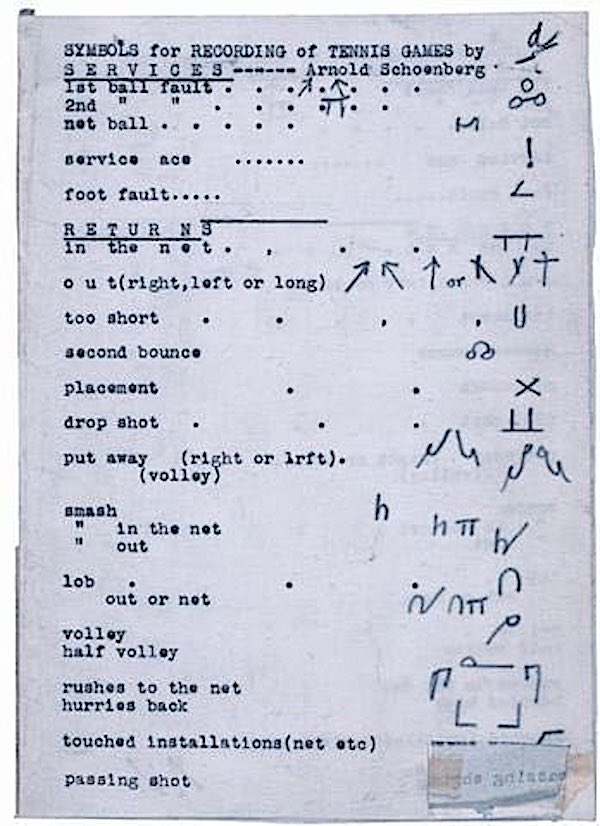
The cerebral nature of Schoenberg’s compositions may not suggest a temperament suited for physical activity of any kind, but even in Austria Schoenberg had been a keen sportsman. And as a fair few tennis-loving writers have explained, the game does possess an intellectual side, and one made more easily analyzable, at least in theory, by a system of Schoenberg’s invention. “Toward the end of his life, Schoenberg — always fascinated by rules, analysis, and invention — would come up with a form of notation to transcribe the tennis matches of his athlete son Ronald,” writes Mark Berry in Arnold Schoenberg. You can see this system laid out on the sheet above, recently posted on Twitter by Henry Gough-Cooper.
The marks look vaguely similar to those of certain dance notation systems, a natural enough resemblance considering the kind of footwork tennis demands. But ideally, Schoenberg’s notation would also have rendered a game of tennis as comprehensible as one of chess — another pursuit to which Schoenberg applied his mind. He came up with “an expanded four-player, ten-square version of the traditional game,” writes Berry, “involving superpowers and lesser powers all compelled to forge alliances, with new pieces such as airplanes, tanks, submarines, and so forth.” Schoenberg’s “coalition chess,” as he called it, seems to have caught on no more than his tennis notation system did. But then, the man who pioneered the twelve-tone technique never did go in for mass acceptance.
via @NotationIsGreat and Henry Gough-Cooper on Twitter
Related Content:
Vi Hart Uses Her Video Magic to Demystify Stravinsky and Schoenberg’s 12-Tone Compositions
John Coltrane Draws a Picture Illustrating the Mathematics of Music
Bob Dylan and George Harrison Play Tennis, 1969
Based in Seoul, Colin Marshall writes and broadcasts on cities, language, and culture. His projects include the book The Stateless City: a Walk through 21st-Century Los Angeles and the video series The City in Cinema. Follow him on Twitter at @colinmarshall, on Facebook, or on Instagram.
Read More...A Witty Dictionary of Victorian Slang (1909)
In the introduction to his Dictionary of Contemporary Slang, Tony Thorne writes of the difficulty of defining informal speech: “A symposium on slang held in France in 1989 broke up after several days without having arrived at a definition acceptable to even the majority of participants.” If you’re thinking maybe this seems like taking the subject a little too seriously, I’d agree. But if we travel back eighty years in time and across the English Channel, we’ll meet an eccentric lexicographer who approached the task in the right spirit.
“Here is a numerically weak collection of ‘Passing English.’ ” writes James Redding Ware in the Preface to his posthumously-published 1909 Passing English of the Victorian Era, A Dictionary of Heterodox English, Slang and Phrase.
“It may be hoped that there are errors on every page, and also that no entry is ‘quite too dull.’” He goes on in a more serious tone to summarize the rapid language change occurring in England in the last few decades of the 19th century:
Thousands of words and phrases in existence in 1870 have drifted away, or changed their forms, or been absorbed, while as many have been added or are being added. ‘Passing English’ ripples from countless sources, forming a river of new language which has its tide and its ebb, while its current brings down new ideas and carries away those that have dribbled out of fashion. Not only is ‘Passing English’ general ; it is local ; often very seasonably local.
Ware—a pen name of British writer Andrew Forrester—goes on to get very local indeed in his descriptions, from “Petty Italia behind Hatton Garden” to “Anglo-Yiddish.” The Public Domain Review highlights the following quirky entries.
Got the Morbs – temporary melancholy
Mutton Shunter – the police
Batty-Fang – to thrash thoroughly
Doing the Bear – courting that involves hugging
Mafficking – getting rowdy in the streets
Orf Chump – no appetite
Poked Up – embarrassed
Nanty Narking – great fun
Ware’s attitude may be appropriately informal, but his methodology is suitably rigorous, and this comprehensive lexicon was clearly a labor of love. His book is a serious resource for scholars of the period, and, hell, it’s also just great fun. Read and download the full dictionary at the Internet Archive.
Related Content:
The Very First Written Use of the F Word in English (1528)
Josh Jones is a writer and musician based in Durham, NC. Follow him at @jdmagness
Read More...3 Iconic Paintings by Frida Kahlo Get Reborn as Vans Skate Shoes
Attention Frida Kahlo tchotchke hounds.
You can scratch that itch, even if your summer itinerary doesn’t include Mexico City (or Nashville, Tennessee, where the Frist Museum is hosting Frida Kahlo, Diego Rivera, and Mexican Modernism from the Jacques and Natasha Gelman Collection through September 2).

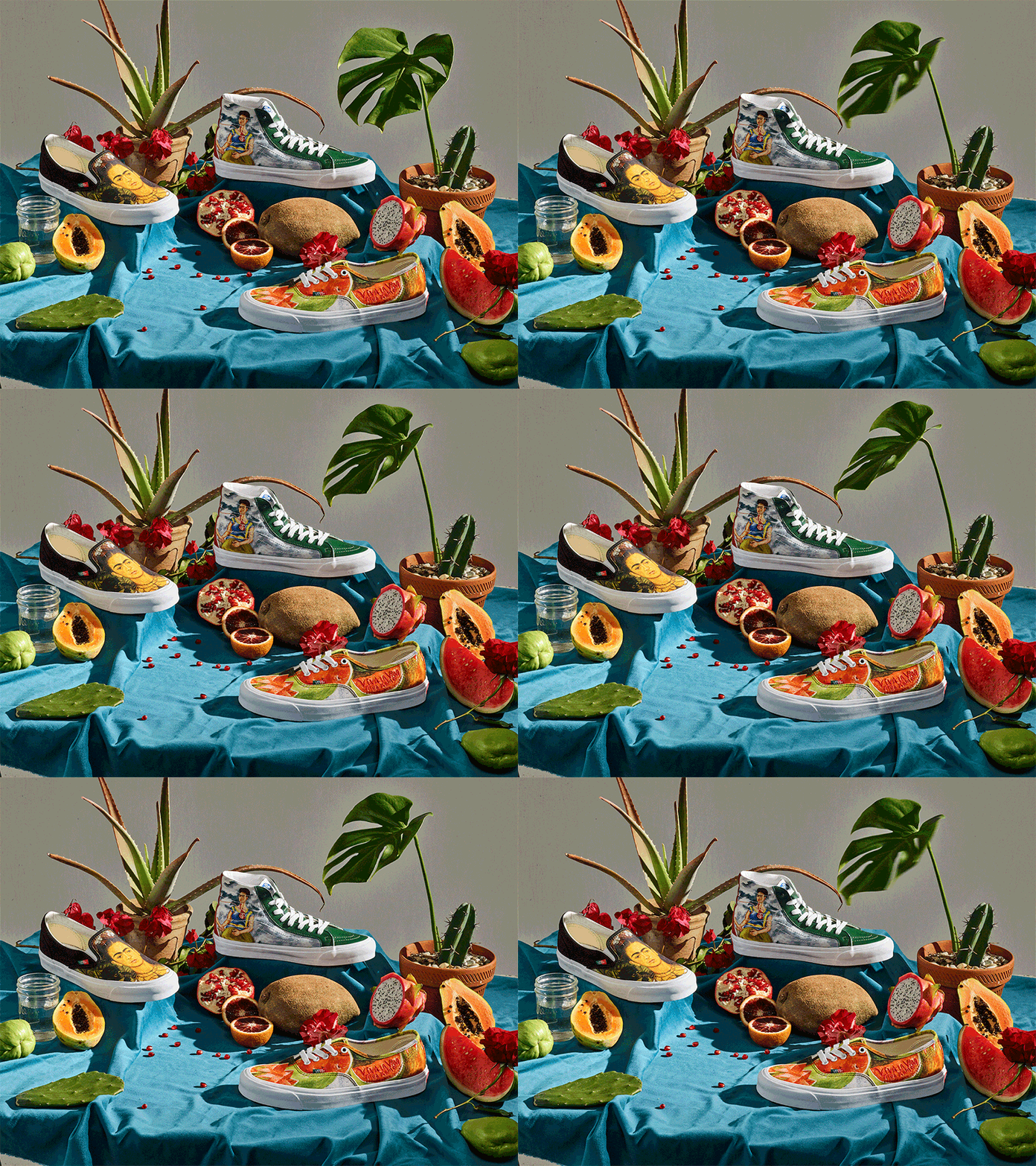
Taking its cue from Doc Marten’s Museum Collection, Vans is releasing three shoes inspired by some of the painter’s most iconic works, 1939’s The Two Fridas, 1940’s Self-Portrait with Thorn Necklace and Hummingbird, and—for those who prefer a more subtly Frida-inspired shoe, 1954’s refreshingly fruity Viva la Vida.
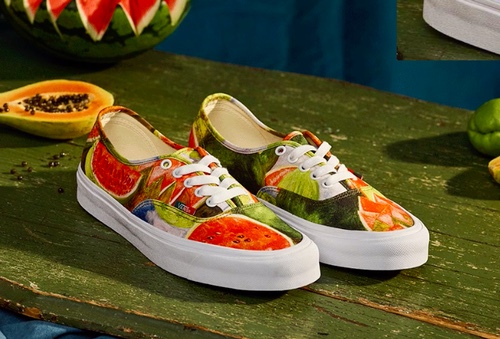
Vans’ limited edition Frida Kahlo collection hits the shelves June 29. Expect it to be snapped up quickly by the Waffleheads, Vans’ dedicated group of collectors and customizers, so don’t delay.

If this line doesn’t tickle your fancy, there is of course an abundance of Frida Kahlo tribute footwear on Etsy, everything from huaraches and Converse All-Stars to socks and baby booties.
Related Content:
A Brief Animated Introduction to the Life and Work of Frida Kahlo
Ayun Halliday is an author, illustrator, theater maker and Chief Primatologist of the East Village Inky zine. Follow her @AyunHalliday.
Read More...The Atlas of Space: Behold Brilliant Maps of Constellations, Asteroids, Planets & “Everything in the Solar System Bigger Than 10km”
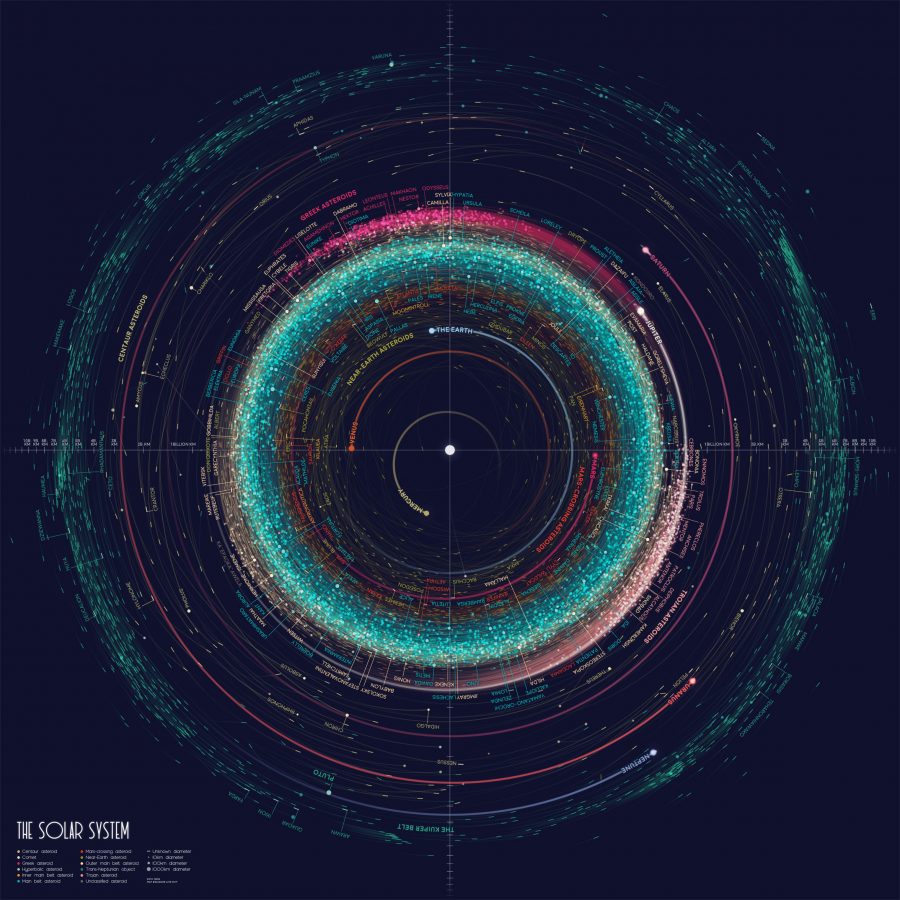
A great deal remains to be learned about our solar system, but a great deal has already been learned about it as well. Yet huge amounts of data such as those produced by outer-space research so far can’t do much for us unless we can interpret them. Luckily, the age of the internet has made possible unprecedentedly easy access to data as well as unprecedentedly easy distribution of interpretations of that data. Eleanor Lutz, a biology graduate student at the University of Washington and the creator of the science illustration blog Tabletop Whale, has taken advantage of both conditions to wow her ever-growing fan base with her maps of the realms beyond Earth.
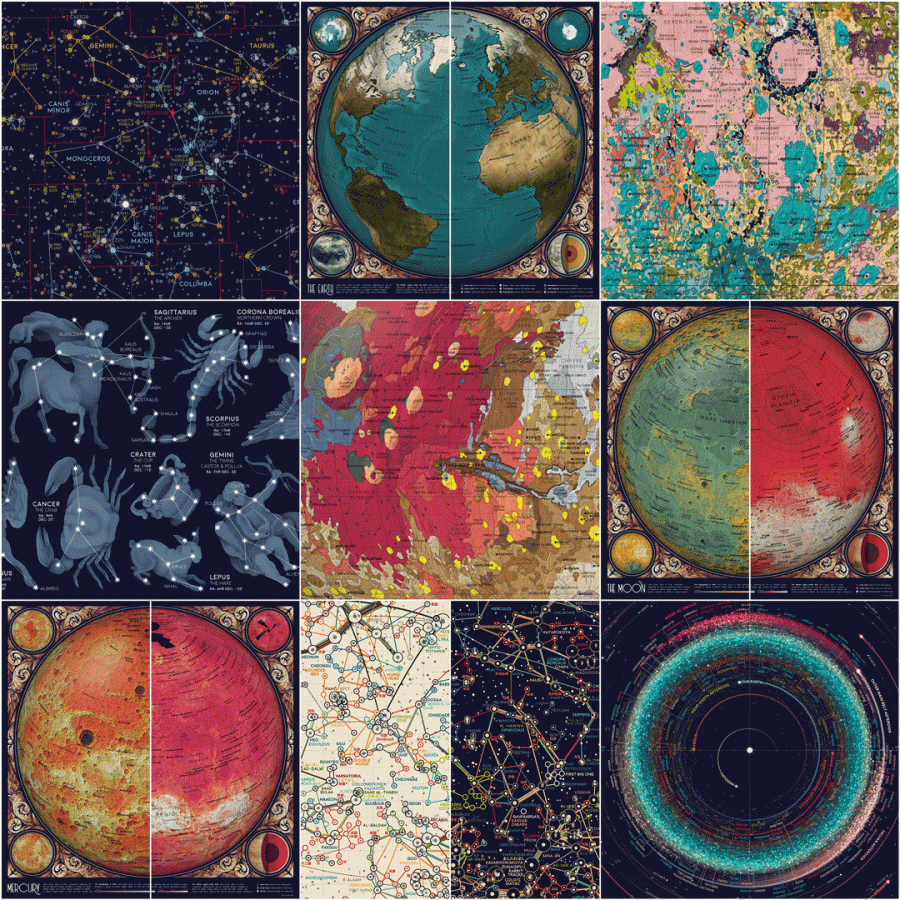
“Atlas of Space, her latest project, is all about the solar system,” writes Wired’s Sara Harrison. “She plumbed the depths of publicly available data sets from agencies like NASA and the US Geological Survey and used them to create vivid maps of constellations, asteroids, and planets. In one image, luminescent bands of fuchsia and aquamarine asteroids swirl around the bright, white point of the Sun. In another, Earth seems to pulsate as an animation of Arctic sea ice shows how it extends down the continents during the winter and then retracts back to the poles in summer.”
Lutz plans to release all the images she has created for her Atlas of Space over the next few weeks, along with instructions teaching readers how to create similar illustrations themselves. In her introductory post to the project, she promises “an animated map of the seasons on Earth, a map of Mars geology, and a map of everything in the solar system bigger than 10km.”
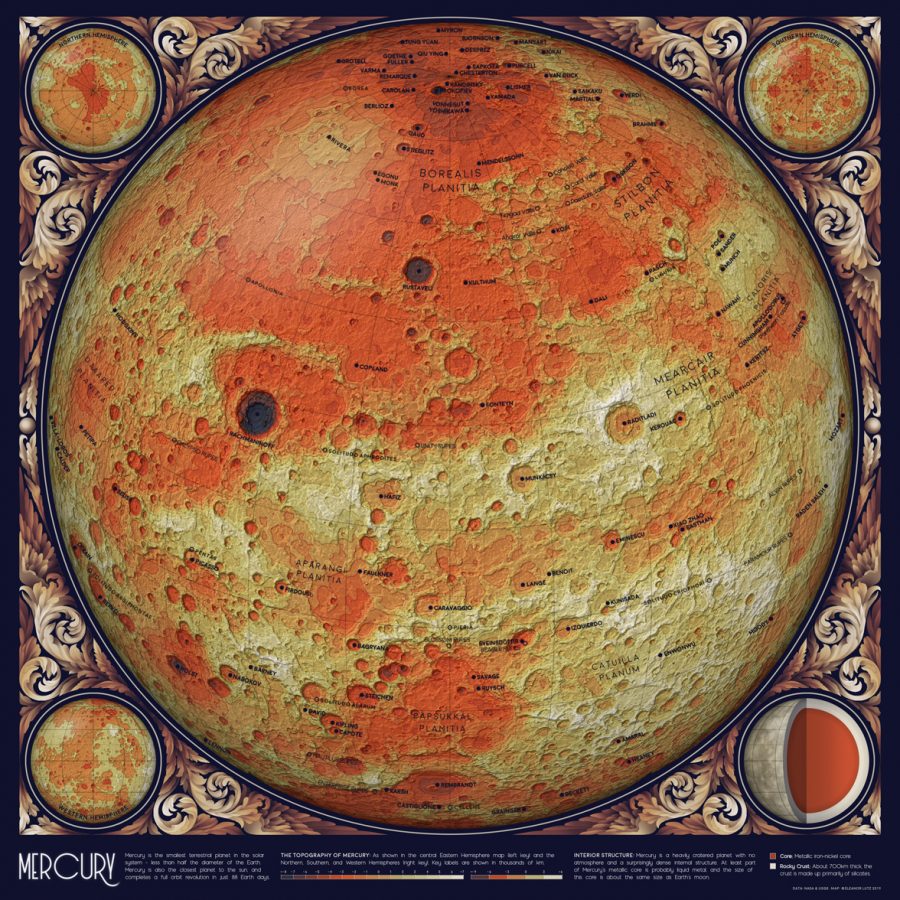
Lutz also briefly describes her plans to write about everything from “working with Digital Elevation Models (DEMs) in Bash and Python” to “using the NASA HORIZONS orbital mechanics server and scraping internet data” to “updating vintage illustrations and painting in Photoshop.” That last element has already made the project particularly eye-catching: you’ll notice the Atlas of Space pages published so far, “An Orbit Map of the Solar System” and “A Topographic Map of Mercury,” both possess a strong retro design sensibility, though each of a completely different kind. Levi Walter Yaggy would be proud — and no doubt astonished by just how much more information we’ve managed to gather about the solar system over the past 130 years.
Related Content:
The Strikingly Beautiful Maps & Charts That Fired the Imagination of Students in the 1880s
3D Map of Universe Captures 43,000 Galaxies
The Solar System Drawn Amazingly to Scale Across 7 Miles of Nevada’s Black Rock Desert
Based in Seoul, Colin Marshall writes and broadcasts on cities, language, and culture. His projects include the book The Stateless City: a Walk through 21st-Century Los Angeles and the video series The City in Cinema. Follow him on Twitter at @colinmarshall, on Facebook, or on Instagram.
Read More...Stanford’s Robert Sapolsky Demystifies Depression, Which, Like Diabetes, Is Rooted in Biology
We know that depression affects people from all walks of life. Rich. Poor. Celebs. Ordinary Joes. Young. Old. But, somehow after the death of Robin Williams, there’s a renewed focus on depression, and my mind turned immediately to a lecture we featured on the site way back in 2009. The lecture is by Robert Sapolsky, a Stanford biologist, who has a talent for making scientific subjects publicly accessible. A recipient of the MacArthur genius grant, Sapolsky notes that depression — currently the 4th greatest cause of disability worldwide, and soon the 2nd — is deeply biological. Depression is rooted in biology, much as is, say, diabetes. As the lecture unfolds, you will see how depression changes the body. When depressed, our brains function differently while sleeping, our stress response goes way up 24/7, our biochemistry levels change, etc. You will see that biology is at work.
Sapolsky is one compelling teacher. So you might not want to miss his Stanford course, Introduction to Human Biology. It’s equally worth your time. You can always find it housed in our collection 1,700 Free Online Courses from Top Universities.
Note: An earlier version of this post appeared on the site in August, 2014.
If you would like to support the mission of Open Culture, consider making a donation to our site. It’s hard to rely 100% on ads, and your contributions will help us continue providing the best free cultural and educational materials to learners everywhere. You can contribute through PayPal, Patreon, and Venmo (@openculture). Thanks!
Related Content:
Exercise May Prove an Effective Natural Treatment for Depression & Anxiety, New Study Shows
Stephen Fry on Coping with Depression: It’s Raining, But the Sun Will Come Out Again
Read More...Support Us
We're hoping to rely on loyal readers, rather than erratic ads. Please click the Donate button and support Open Culture. You can use Paypal, Venmo, Patreon, even Crypto! We thank you!

About Us

Open Culture scours the web for the best educational media. We find the free courses and audio books you need, the language lessons & educational videos you want, and plenty of enlightenment in between.
Advertise With Us

FREE UPDATES!
GET OUR DAILY EMAIL
Get the best cultural and educational resources on the web curated for you in a daily email. We never spam. Unsubscribe at any time.
FOLLOW ON SOCIAL MEDIA

Open Culture editor Dan Colman scours the web for the best educational media. He finds the free courses and audio books you need, the language lessons & movies you want, and plenty of enlightenment in between.
Advertise With Us

