Hear H.P. Lovecraft Horror Stories Read by Roddy McDowall
“Most daemoniacal of all shocks is that of the abysmally unexpected and grotesquely unbelievable,” goes a typical line in the work of H.P. Lovecraft. “Nothing I had before undergone could compare in terror with what I now saw; with the bizarre marvels that sight implied.” As a writer of what he called “weird fiction,” Lovecraft specialized in the narrator plunged into a loss for words by the sheer incomprehensibility of that which he sees before him. But in the case of this particular sentence, the narrator sees not an ancient monster awakened from its millennia of slumber but “nothing less than the solid ground” — or as the reader put it, nothing more than the solid ground. But then, most of us haven’t lived our entire lives locked up high in a castle.
The story is “The Outsider,” something of an outlier in the Lovecraft canon due to its outsized popularity as well as its Gothic tinge. By the author’s own admission, it owes a debt to his literary idol Edgar Allan Poe, and indeed represents Lovecraft’s “literal though unconscious imitation of Poe at its very height.”
In 1926 or today, one could do much worse for a model than Poe, and critics have also detected in “The Outsider” the possible influence of Nathaniel Hawthorne, Mary Shelley, and Oscar Wilde. Anyone daring to read the story aloud must thus strike a balance between several different competing tones, and few could hope to outdo Roddy McDowall’s performance on the 1966 record above. But as Dangerous Minds’ Paul Gallagher notes, that actor, “child star of Lassie Come Home and My Friend Flicka,” is “hardly a name one would associate with the master of the unnameable.”
Though McDowall would later “star in some jolly decent horror movies like The Legend of Hell House and Fright Night, he was in 1966 best known for the likes of “That Darn Cat! or Lord Love a Duck or the stage musical Camelot.” In the event, McDowell proved “almost a perfect choice to give life to Lovecraft’s words,” delivering a “light boyish charm” combined with an intonation that “causes a growing disquiet and a dreadful sense of unease,” altogether suitable for the work of “the weird and reclusive Lovecraft.” He also brings to the role the kind of faint, unexpectedly refined menace that would make him famous as Cornelius and Caesar in the Planet of the Apes films. After “The Outsider” McDowall reads Lovecaft’s earlier story “The Hound,” and surely his voice is just the one in which Lovecraft fans would want to hear spoken, for the very first time in Lovecraft’s oeuvre, the name of the Necronomicon.
Be sure to explore out collection, 1,000 Free Audio Books: Download Great Books for Free.
Related Content:
H.P. Lovecraft’s Classic Horror Stories Free Online: Download Audio Books, eBooks & More
An Animated Introduction to H.P. Lovecraft and How He Invented a New Gothic Horror
H.P. Lovecraft Gives Five Tips for Writing a Horror Story, or Any Piece of “Weird Fiction”
Making The Planet of the Apes: Roddy McDowall’s Home Movies and a 1966 Makeup Test
Based in Seoul, Colin Marshall writes and broadcasts on cities, language, and culture. His projects include the book The Stateless City: a Walk through 21st-Century Los Angeles and the video series The City in Cinema. Follow him on Twitter at @colinmarshall or on Facebook.
Read More...How African-American Explorer Matthew Henson Became the First Person to Reach the North Pole, Then Was Forgotten for Almost 30 Years
The history of exploration is replete with famous names everyone knows, like Robert Peary, the man most often credited with first reaching the North Pole. Those who work alongside the legends—doing the heavy lifting, saving lives, making essential calculations—tend to be forgotten or marginalized almost immediately in the telling of the story, especially when they don’t fit the profile for the kinds of people allowed to make history.
In Peary’s case, it seems that the most important member of his team—his assistant, African American explorer Matthew Henson—may have actually reached the North Pole first, along with four of the team’s Inuit crew members.
Henson and Perry first met in a Washington, DC clothing store where Henson worked. When they struck up a conversation, Peary learned that Henson had fled Maryland “after his parents were targeted by the Ku Klux Klan,” as Messy Nessy writes. He had then signed on as a cabin boy at 12 and sailed around the world, including the Russian Arctic seas, learning to read and write while aboard ship.
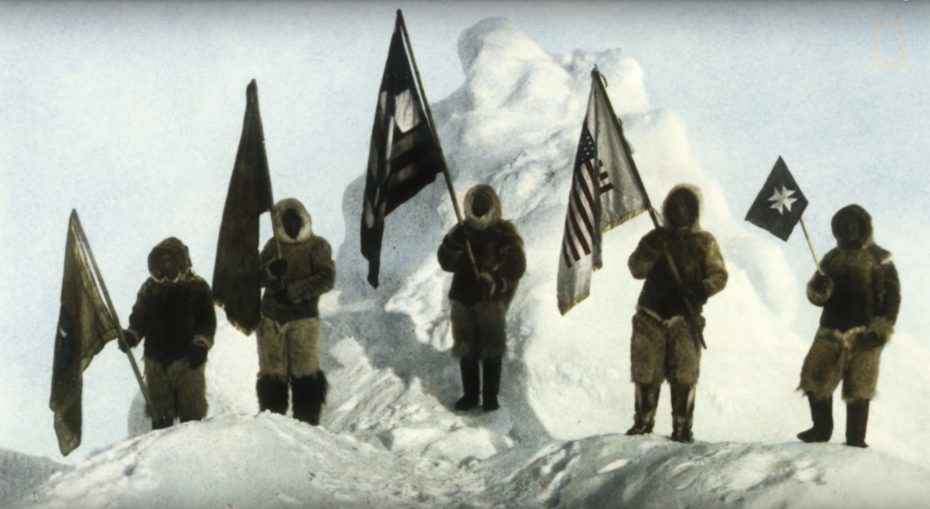
Peary was impressed and “hired him on the spot,” and “from that point forward, Henson went on every expedition Peary embarked on; trekking through the jungles of Nicaragua and, later, covering thousands of miles of ice in dog sleds to the North Pole.” Also on their last expedition were 39 Inuit men, women, and children, including the four Inuit men— Ootah, Egigingwah, Seegloo, and Oogueah—who accompanied Henson and Peary on the final leg of the 1909 journey, Peary and Henson’s eighth attempt.
As the six men neared the pole, Peary “grew more and more weary, suffering from exhaustion and frozen toes, unable to leave their camp, set up five miles” away. Henson and the others “scouted ahead,” and, according to Henson’s account, actually overshot the pole before doubling back. “I could see that my footprints were the first at the spot,” he later wrote.
Peary eventually caught up and “the sled-bound Admiral allegedly trudged up to plant the American flag in the ice—and yet, the only photograph of the historic moment shows a crew of faces that are distinctly not white.” Either Peary took the photograph as a “way of honoring the crew” or he wasn’t there at all when it was taken. The former doesn’t seem likely given Peary’s eagerness to claim full credit for the feat.
Peary accepted the sole honor from the National Geographic Society and an award from Congress in 1911, while Henson’s “contributions were largely ignored” at the time and “he returned to a very normal life” in relative obscurity, working as a U.S. Customs clerk for 23 years, unable to marshal the resources for further expeditions once Peary retired.
In his writings, Peary characterized Henson according to his usefulness: “This position I have given him primarily because of his adaptability and fitness for the work and secondly on account of his loyalty. He is a better dog driver and can handle a sledge better than any man living, except some of the best Eskimo hunters themselves.” The passage is reminiscent of Lewis and Clark’s descriptions of Sacagawea, who never emerges as a full person with her own motivations.
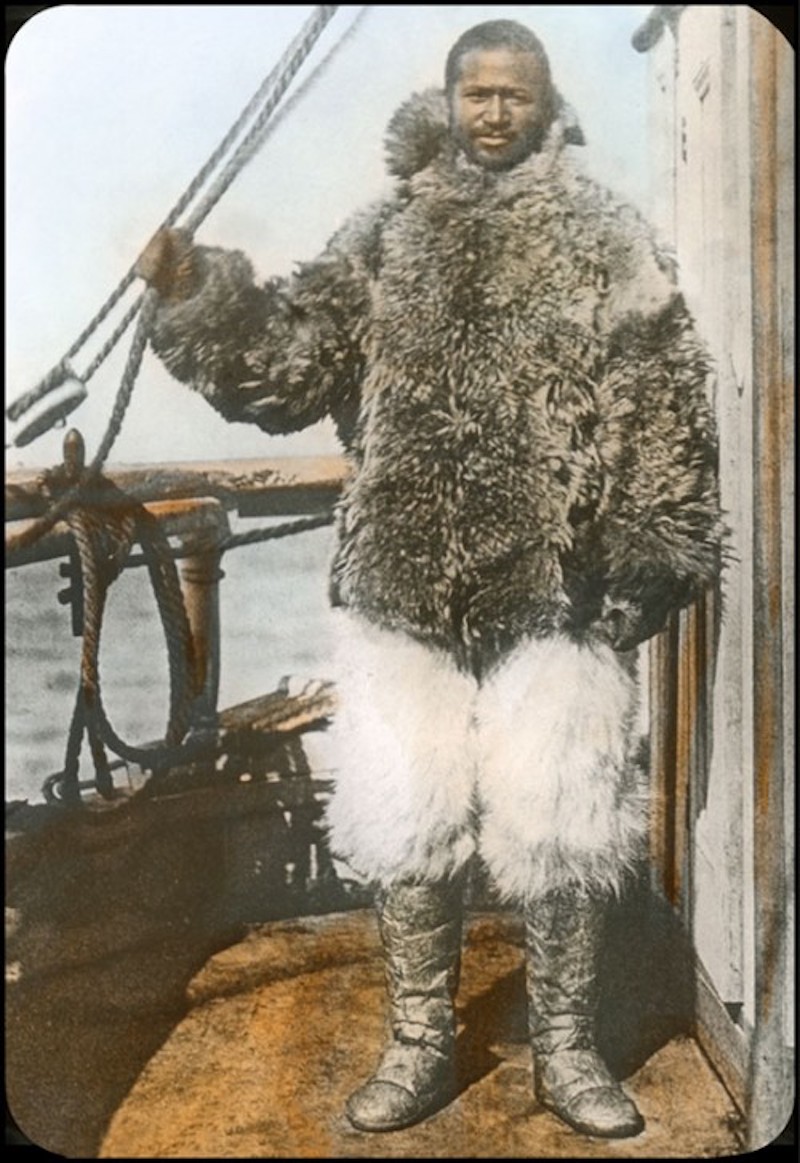
Sadly, in his 1912 account, A Negro Explorer at the North Pole, it seems that Henson internalized the racism that confined him to second-class status. “Another world’s accomplishment was done and finished,” he writes, passively eliding the doer of the deed. He then invokes a trope that appears over and over, from Shakespeare’s Tempest to Defoe’s Robinson Crusoe: “From the beginning of history, wherever the world’s work was done by a white man, he had been accompanied by a colored man. From the building of the pyramids and the journey to the cross, to the discovery of the new world and the discovery of the North Pole.”
The kind of history Henson had learned is obvious—a whitewashing on a world-historical scale. It would take almost 30 years for him to finally receive recognition, though he lived to become the first black member of The Explorers Club in 1937 and “with some irony,” Messy Nessy writes, he “was awarded the Peary Polar Expedition Medal” in 1944. Since then, his name has usually been mentioned with Peary’s in histories of the expedition, but rarely as the first person to reach the pole. Watch two short profiles of Henson’s accomplishments above, and see many more photos from the expedition at Messy Nessy.
via Messy Nessy
Related Content:
Watch the Very First Feature Documentary: Nanook of the North by Robert J. Flaherty (1922)
African American History-Emancipation to the Present: A Free Course from Yale University
Josh Jones is a writer and musician based in Durham, NC. Follow him at @jdmagness.
Read More...Mister Rogers Makes a List of His 10 Favorite Books
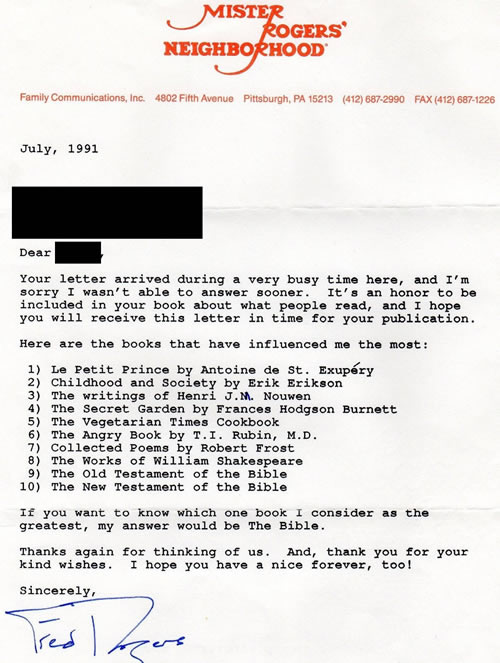
In 1991, Fred Rogers received a letter from an author working on a book about others’ favorite books. More than likely, it was a book about famous people’s favorite books. But you wouldn’t know it from Mister Rogers’ characteristically gracious typed reply, above. He opens by apologizing for his late reply and expresses his honor at being included in a “book about what people read.” What did the most unassuming and neighborly person on television read?
You can see Rogers’ list of ten books transcribed below, though his final two choices, the Old and New Testaments, might count as either one book or a collection of many, depending on one’s views. Roger’s himself was very clear about his beliefs when he wasn’t onscreen, The ordained Presbyterian minister concludes by adding, “If you want to know which one book I consider as the greatest, my answer would be The Bible.”
Rogers didn’t give anyone who knew him reason to doubt his sincerity. What becomes evident in both a recent biography, The Good Neighbor, and Morgan Neville’s documentary film, Won’t You Be My Neighbor, is that he “was exactly what he appeared to be,” as Anya Kamenetz writes at NPR. “Someone who devoted his life to taking seriously and responding to the emotions of children. In a word: to love.”
- Le Petit Prince by Antoine de Saint-Exupéry
- Childhood and Society by Erik Erikson
- The Writings of Henri J.M. Nouwen
- The Secret Garden by Frances Hodgson Burnett
- The Vegetarian Times Cookbook
- The Angry Book by T.I. Rubin, M.D.
- Collected Poems of Robert Frost
- The Works of William Shakespeare
- The Old Testament of the Bible
- The New Testament of the Bible
The way he expressed that love, however, was quite unusual in both religious and secular circles. He was, Heidi Ledford writer at Nature, “neither zany entertainer nor earnest pedagogue. Rogers was instead a respectful mentor who promoted tolerance.” He considered the show his God-given mission, but “Mister Rogers’ Neighborhood was religion-free.” Rogers never preached, and never excluded anyone from his neighborhood.
Another reason his slow, repetitive show had such wide and enduring appeal was that Rogers crafted each episode to meet preschoolers’ psychosocial needs, in frequent consultation with his mentor of 30 years, child psychologist Margaret McFarland. Rogers was well read on the subject and understood its critical importance to early childhood education to kids’ emotional and intellectual development. His ideas “are as relevant as ever,” writes Kamenetz.
Those ideas include the centrality of imaginative play in early childhood, which Rogers offered to many children who didn’t get much opportunity to explore their creativity. His religious faith may have grounded his lifelong commitment to making all kids feel valued and understood, yet it’s hard not to notice that he lists the two parts of The Bible last on his list.
His first choice is one of the most imaginative books ever written for children—one that doesn’t talk down to them and treats their emotions with serious, yet playful, respect, Antoine de Saint-Exupéry’s Le Petit Prince. He follows up this classic with Childhood and Society, Erik Erikson’s post-Freudian exploration of child development.
On the whole, Rogers’ reading list, just like his show, offers a portrait of a one-of-a-kind figure: a children’s entertainer with an educational style that drew substance from the best literature, social science, and psychology of its time, while taking its charitable spirit from Rogers’ own personal belief in universal love as the most important educational methodology.
via The Neighborhood Archive
Related Content:
Mr. Rogers’ Nine Rules for Speaking to Children (1977)
The First & Last Time Mister Rogers Sang “Won’t You Be My Neighbor” (1968–2001)
Josh Jones is a writer and musician based in Durham, NC. Follow him at @jdmagness.
Read More...Janis Joplin’s Last TV Performance & Interview: The Dick Cavett Show (1970)
The best celebrity interviewers have the ability to show us how the stars are not like us at all—not only because of the entourages, wardrobes, and bank accounts, but because of the talent for which we revere them —and also how they’re kind of just like us after all: sharing the same insecurities, fears, doubts, forgetfulness, confusion, etc. They are, that is to say, real human beings.
Like no other interviewer on network television before or since, Dick Cavett could draw all of this out of his guests: both their creativity and vulnerability. What seemed like silly chit chat was a disarming camouflage for incisive questions he let casually slip through the banter.
“Cavett’s prime-time show famously featured a who’s who of rock stars that both performed and sat for loose, freeform conversations,” writes Jambase, “which brought the ethos of the hippie generation to the homes of millions.” Amongst his many rock star guests, he developed a special bond with Janis Joplin who sat down with him on August 3, 1970 for her appearance on his show and what would turn out to be her final televised performance and interview.
Joplin belts out “My Baby” and “Half Moon,” which you can see in her full appearance above, with an introduction by Cavett. Then after both songs, she walks over the couch to hang out with the host, who greets with her warmly with, “Very nice to see you, my little songbird.” Cavett poked fun at his guests, but he didn’t talk down or kiss up. Most everyone who sat down with him found his dry wit and candor refreshing.
Joplin, who admits she doesn’t like doing interviews, “seems totally at ease during this conversation,” Ultimate Classic Rock points out, “a wide-ranging but informal chat that touches on everything from her feelings regarding concert riots to whether or not she ever waterskis.” She is poised throughout and throws Cavett off-guard with her deadpan humor.
They play off each other in a charming exchange that doesn’t go nearly as deep as her final interview with the Village Voice’s Howard Smith four days before her death that October, but which captures Joplin’s thoughtful, easygoing personality beautifully. Cavett later credited Joplin for sending so many other major rock stars his way after her first appearance on his show in 1968.
“She had done other television she didn’t like very much,” he remembered in 2016 on PBS’s American Masters. “She told people, ‘it’s okay to do his show, he’s not a dreary figure.’” Neither, despite her tragic story, was Janis Joplin. “At once insecure yet full of conviction, opinionated yet concerned about offending, fierce yet tenderhearted,” writes Maria Popova at Brain Pickings; she was, as millions of Cavett’s viewers were delighted to discover, a “complex person brimming with the sort of inner contradictions that make us human.”
Related Content:
Watch Janis Joplin’s Final Interview Reborn as an Animated Cartoon
George Harrison in the Spotlight: The Dick Cavett Show (1971)
Josh Jones is a writer and musician based in Durham, NC. Follow him at @jdmagness
Read More...The Size of Asteroids Compared to New York City
The smallest asteroid measures 4.1 meters in diameter; the largest 939 kilometers, or 580 miles. Created by 3D animator Alvaro Gracia Montoya, the data on asteroid sizes was all gleaned from Wikipedia…
If you would like to support the mission of Open Culture, consider making a donation to our site. It’s hard to rely 100% on ads, and your contributions will help us continue providing the best free cultural and educational materials to learners everywhere. You can contribute through PayPal, Patreon, and Venmo (@openculture). Thanks!
Read More...Wes Anderson’s Shorts Films & Commercials: A Playlist of 8 Short Andersonian Works
You may have noticed certain brands, over the past decade or so, going for a “Wes Anderson aesthetic” in their advertisements. But as all the younger filmmakers Anderson inspires inevitably find out, replicating the director’s signature mise-en-scène — the distinctive color palettes, the rigorous geometry, the carefully curated objects — is no easy task. To achieve the cinematically Andersonian, it seems you really need Anderson himself. Fortunately for certain marketing departments, the auteur of Rushmore, The Royal Tenenbaums, The Grand Budapest Hotel, and other pictures (including the upcoming The French Dispatch) has occasionally made himself available for commercial work.
But as anyone who has seen one or two of Anderson’s movies might expect, the man appears to have little interest in making straightforward commercials. Even when directing short spots for the likes of American Express or Stella Artois, Anderson brings us into his very own aesthetic and cultural realm: in the former he satirizes a certain idea of his own process on set, and in the latter he creates comedy from his penchant for (and mastery of) early-1960s European design. In other instances he’s taken the opportunity to indulge his cinephilia more directly than usual, as in his Jacques Tati-inspired commercial for Japanese cellphone service provider SoftBank. You can see all these and more on our Youtube playlist of eight of Anderson’s short films.
Commercial directors often discuss their projects in the same terms they would use to discuss short films. But it seems that every time Anderson makes a commercial, he really does make a short film. Sometimes he makes both: after he directed a 44-second ad for Prada, he went on with the fashion house’s sponsorship to direct the seven-minute Castello Cavalcanti. But ever since making the thirteen-minute black-and-white short that would become his debut feature Bottle Rocket, Anderson has also used short films in service of his long ones. Cousin Ben’s Troop Screening makes for a fun introduction to Moonrise Kingdom; Hotel Chevalier is practically required viewing before The Darjeeling Limited. Both remind us that, however solid the work a brand can get out of him, Wes Anderson promotes nothing quite as delightfully as he promotes Wes Anderson. Watch the playlist of 8 commercials and short films here.
Related Content:
A Complete Collection of Wes Anderson Video Essays
Watch the Coen Brothers’ TV Commercials: Swiss Cigarettes, Gap Jeans, Taxes & Clean Coal
David Lynch’s Surreal Commercials
Fellini’s Three Bank of Rome Commercials, the Last Thing He Did Behind a Camera (1992)
Based in Seoul, Colin Marshall writes and broadcasts on cities, language, and culture. His projects include the book The Stateless City: a Walk through 21st-Century Los Angeles and the video series The City in Cinema. Follow him on Twitter at @colinmarshall or on Facebook.
Read More...Watch More Than 400 Classic Korean Films Free Online Thanks to the Korean Film Archive
Even if you don’t know much about Korea, or indeed about film, it’s safe to say that you know at least one Korean film: Bong Joon-ho’s Parasite, which has circled the world gathering acclaim and awards since its release last spring. First it won the Palme d’Or at the Cannes Film Festival, becoming the first Korean production to do so; more recently, it made film history even more dramatically at the Academy Awards. There it won Oscars not just for Best International Feature Film, Best Original Screenplay, and Best Director, but also Best Picture, becoming the first non-English-language film to do so. For many viewers, Parasite and its director seem to have come out of nowhere, but lovers of Korean cinema know full well that they come out of a rich tradition — and a robust industry.
Maybe you thrilled to Bong’s suspenseful, funny, and violent tale of class warfare as much as the Academy did. Maybe you’ve even seen the work of Bong’s contemporaries: Park Chan-wook, he of the controversial hit Oldboy; the even more transgressive Kim Ki-duk; the prolific Hong Sangsoo, with his Woody Allen-meets-Éric Rohmer sensibility.
But do you know their sonsaengnim, the generations of Korean filmmakers who went before them? Now you can, no matter where in the world you are, on the Korean Film Archive’s Youtube channel. There, at no charge, you can experience decades of Korean cinema and hundreds of works of Korean cinematic art, including but not limited to those of mid-20th-century masters like Kim Ki-young, Im Kwon-taek, and my personal favorite Kim Soo-yong, director of haunting, even brazen pictures of the 1960s and 70s like Mist and Night Journey.
I actually met the then-octogenarian Kim Soo-yong a few years ago, when he called me over to his table out of curiosity about what a foreigner was doing at a screening of Mist. It happened at the Korean Film Archive’s cinematheque (known as Cinematheque KOFA) here in Seoul, where I’ve lived for the past few years. During that time I’ve also been writing a Korea Blog for the Los Angeles Review of Books, which occasionally features essays on the classic Korean films made available online by the Korean Film Archive. I began the series with Night Journey, and more recently have written up pictures like the 1960s neorealist cry of agony Aimless Bullet, the 1970s college-under-dictatorship comedy The March of Fools, the 1980s Westernization comedy Chil-su and Man-su, the 1990s food-sex-horror satirical mixture 301, 302, and others.
If you need more suggestions as to where to start with the KOFA’s more than 400 free films online, pay a visit to the Korean Movie Database (KMDb), where KOFA regularly post selections from their catalog. This month’s picks are “spy thriller films from the 1950s to 1970s infused with the anti-communist ideology during the time.” Previous months have rounded up “melodramas that are filled with women’s desire and craving for love,” films about “individual or family tragedies leading to historical tragedies,” and “heart-warming classical movies all the family members can enjoy together.” You can watch all these films either on the KMDb (which requires free registration) or on KOFA’s ever-growing Youtube channel. Either way, as we say here in Korea, 재미있게 보세요.
Related Content:
Martin Scorsese Introduces Filmmaker Hong Sangsoo, “The Woody Allen of Korea”
The Five Best North Korean Movies: Watch Them Free Online
Based in Seoul, Colin Marshall writes and broadcasts on cities, language, and culture. His projects include the book The Stateless City: a Walk through 21st-Century Los Angeles and the video series The City in Cinema. Follow him on Twitter at @colinmarshall or on Facebook.
Read More...Scientist Creates a Working Rotary Cellphone

In popular histories of the mobile phone, and of the smartphone in particular, you will rarely see mention of IBM’s 1992 Simon, a smartphone invented before the word “smartphone.” “You could… use the Simon to send and receive emails, faxes, and pages,” writes Business Insider. “There were also a suite of built-in features including a notes collection you could write in [with a stylus], an address book that looked like a file folder, calendar, world clock, and a way to schedule appointments.”
Nifty, eh? But the Simon was born too soon, it seems, and its unsexy design—like a cordless handset with a long, rectangular screen where the number pad would be—proved less than enticing. “IBM did manage to sell approximately 50,000 units,” a pitiful number next to the iPhone’s first year sales of 6.1 million. The Simon was an evolutionary dead end, while the iPhone and its imitators changed the definition of the word “phone.”
No longer is it necessary even to specify that one’s telephone is of the “smart” variety. We can spend all day on our devices without ever making or answering a call. Is this development a good thing? No matter how we ask or answer the question, it may do little to change the course of technological development or our dependence on the touchscreen computers in our pockets.
That is, unless we have the ability to redesign our mobile phone ourselves, as Justine Haupt—a scientist in the Instrumentation Division at the Brookhaven National Laboratory—has done. You’ll find no mention of anything like her rotary cellphone in any history of mobile telecommunications. No one would have seriously considered building such a thing, except as an anachronistic novelty.
But Haupt’s rotary cellphone is not a visual gag or piece of conceptual art. It’s a working device she built, ostensibly, for serious reasons. “In a finicky, annoying, touchscreen world of hyperconnected people using phones they have no control over or understanding of,” she writes, “I wanted something that would be entirely mine, personal, and absolutely tactile, while also giving me an excuse for not texting.”
Haupt’s reasoning calls to mind J.G. Ballard’s comments on the car as “the last machine whose basic technology and function we can all understand.” She lays out the rotary cellphone’s impressive features in the bulleted list below:
- Real, removable antenna with an SMA connector. Receptions is excellent, and if I really want to I could always attach a directional antenna.
- When I want a phone I don’t have to navigate through menus to get to the phone “application.” That’s bullshit.
- If I want to call my husband, I can do so by pressing a single dedicated physical key which is dedicated to him. No menus. The point isn’t to use the rotary dial every single time I want to make a call, which would get tiresome for daily use. The people I call most often are stored, and if I have to dial a new number or do something like set the volume, then I can use the fun and satisfying-to-use rotary dial.
- Nearly instantaneous, high resolution display of signal strength and battery level. No signal metering lag, and my LED bargraph gives 10 increments of resolution instead of just 4.
- The ePaper display is bistatic, meaning it doesn’t take any energy to display a fixed message.
- When I want to change something about the phone’s behavior, I just do it.
- The power switch is an actual slide switch. No holding down a stupid button to make it turn off and not being sure it really is turning off or what.
I wouldn’t hold my breath for a production run, but “it’s not just a show-and-tell piece,” Haupt insists. “It fits in a pocket; it’s reasonably compact; calling the people I most often call if faster than with my old phone, and the battery lasts almost 24 hours.” For the rest of us, it’s a conversation starter: in less obviously quirky, retro ways, how could we reimagine mobile phones to make them less “smart” (i.e. less distracting and invasive) and more personal and customizable, while also enhancing their core functionality as devices that keep us connected to important people in our lives?
Related Content:
Filmmaker Wim Wenders Explains How Mobile Phones Have Killed Photography
The World’s First Mobile Phone Shown in 1922 Vintage Film
Josh Jones is a writer and musician based in Durham, NC. Follow him at @jdmagness
Read More...Discover the Artist Who Mentored Edward Hopper & Inspired “Nighthawks”
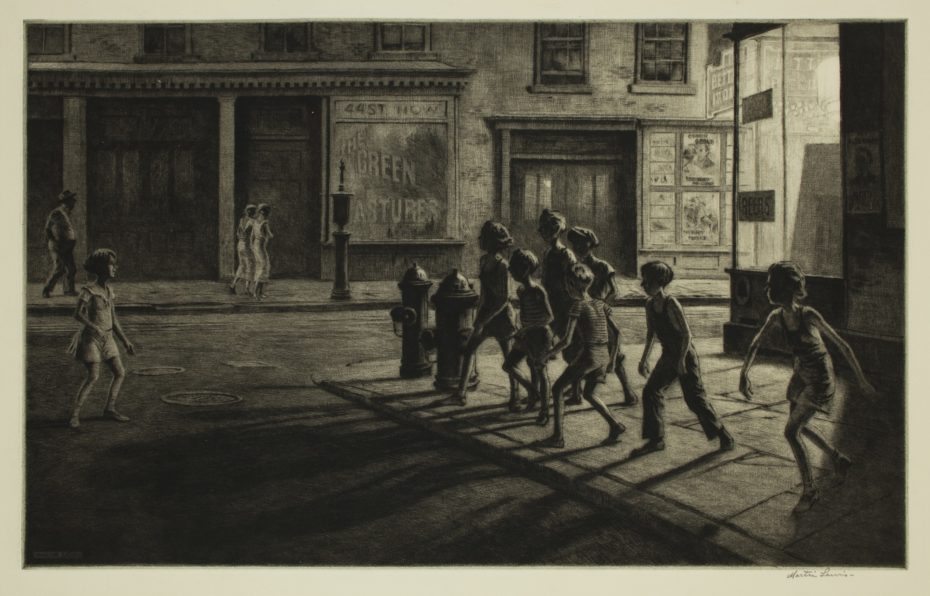
Every good teacher must be prepared for the students who surpass them. Such was the case with Martin Lewis, Edward Hopper’s onetime teacher, an Australian-born printmaker who left rural Victoria at age 15 and traveled the world before settling in New York City in 1900 to make his fame and fortune. By the 1910s, Lewis had become a commercially successful illustrator, well-known for his etching skill. It was then that he took on Hopper as an apprentice.
“Hopper asked that he might study alongside him,” writes DC Pae at Review 31, “and Lewis thereafter became his mentor in the discipline.” The future painter of Nighthawks even “cited his apprenticeship with the printmaker as inspiration for his later painting, the consolidation of his individual style.” Messy Nessy quotes Hopper’s own words: “after I took up my etching, my painting seemed to crystallize.” Hopper, she writes, “learned the finer points of etching and both artists used the great American metropolis at night as their muse.”
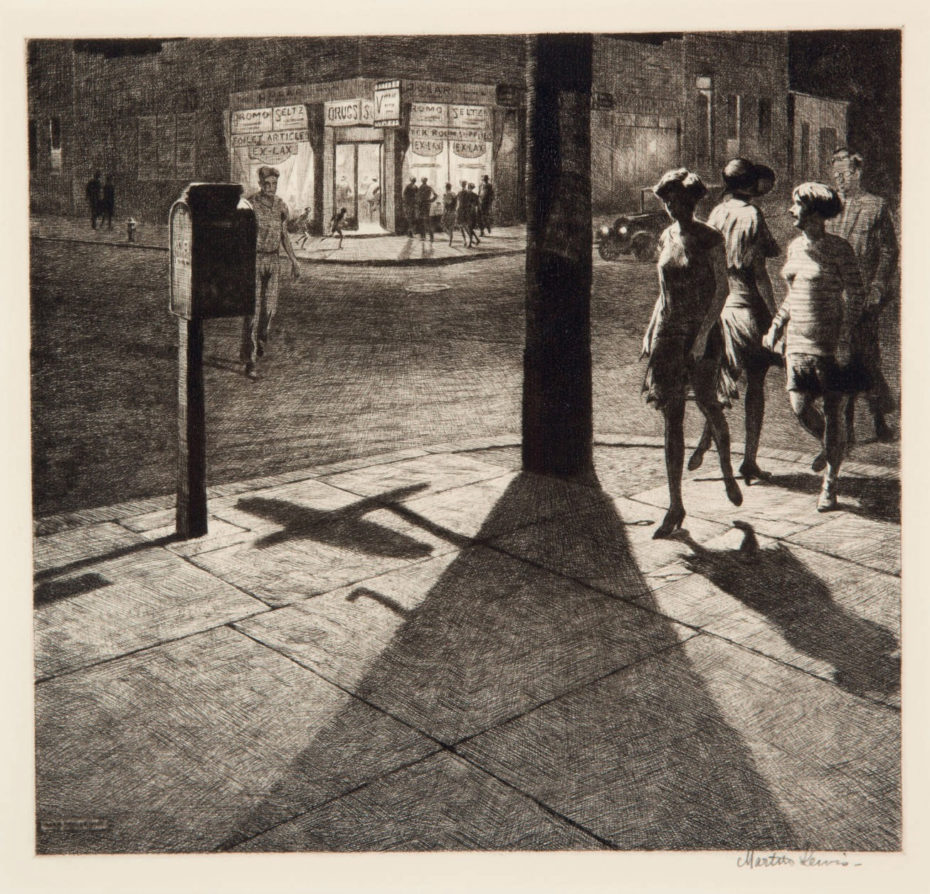
Though he is not popularly known for the art, Hopper himself became an accomplished printmaker, creating a series of around 70 works in the 1920s that drew from both Edgar Degas and his etching teacher, Lewis.
“Hopper easily took to etching and drypoint,” writes the Seattle Artist League. “He had a preference for a deeply etched plate, and very black ink on very white paper, so the prints were high contrast, similar to Martin Lewis…, Hopper’s primary influence in printmaking.”
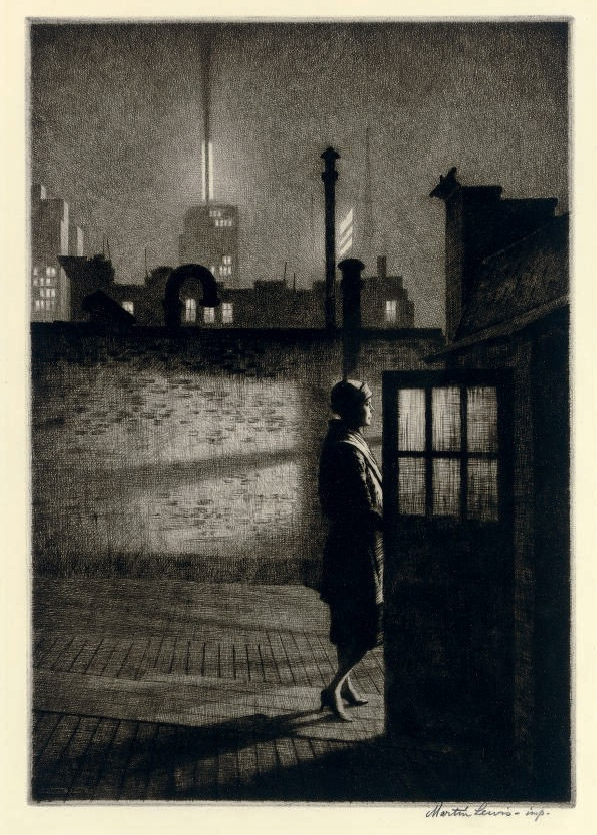
A similar series by Lewis in the 1920s, which includes the striking prints you see here, shows a far stronger hand in the art, though also, perhaps, some mutual influence between the two friends, who exhibited together during the period. But there’s no doubt Lewis’s long shadows, forlorn street-lit corners, and cinematic scenes left their mark on Hopper’s famous later paintings.
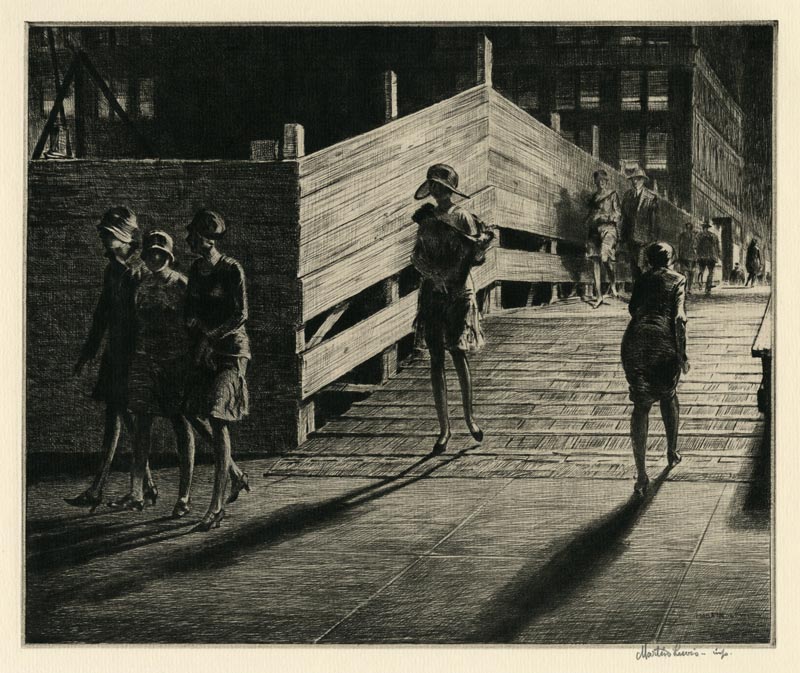
It was to painting, after the massive popularity of printmaking, that the art world turned when the Depression hit. Lewis found himself out of date. Hopper left off etching in 1928 to focus on his primary medium. In many ways, Pae points out, Lewis served as a bridge between the documentary Ashcan School and the more psychological realism of Hopper and his contemporaries. Yet he “died in obscurity in 1962, largely forgotten” notes Messy Nessy (see much more of Lewis’s work there). “History chose Edward Hopper but Martin Lewis was his mentor,” and a figure well worth celebrating on his own for his technical mastery and originality.
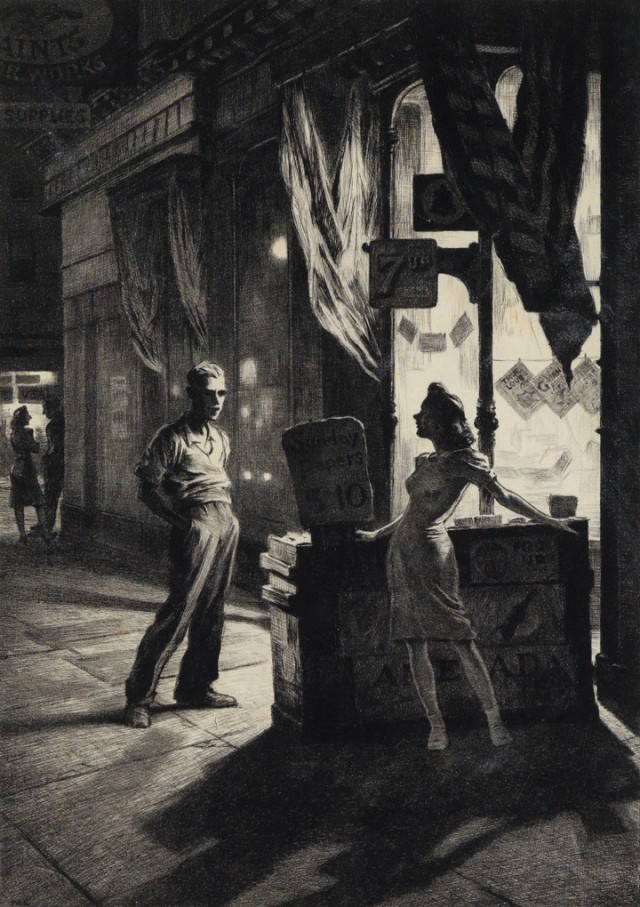
via Messy Nessy
Related Content:
Edward Hopper’s Iconic Painting Nighthawks Explained in a 7‑Minute Video Introduction
Josh Jones is a writer and musician based in Durham, NC. Follow him at @jdmagness
Read More...Wes Anderson Releases the Official Trailer for His New Film, The French Dispatch: Watch It Online
James Pogue in the Baffler recently lamented the rise of “shareable writing,” manifest in a now-common breed of article both “easy for publishers to reproduce” and for readers to absorb. Shareability requires, above all, that pieces “be simple to describe and package online.” This in contrast to the writing published by, say, The New Yorker in decades past. “Every time I have a reason to pull up a piece from the archives, I am shocked at how strange and outré the older pieces read — less like work from a different magazine than documents from an alien society.” That alien society provides the backdrop for Wes Anderson’s next feature film The French Dispatch, whose trailer has just come out.
Anyone who watches one of Anderson’s films will suspect him of loving all things mid-century — that is to say, the artifacts of life as it was lived in the decades following the Second World War, especially in western Europe. This love comes through in the look and feel of even Anderson’s earlier pictures, like Rushmore and The Royal Tenenbaums, whose stories ostensibly take place in contemporary America. But in recent years Anderson has gone in for increasingly intricate period pieces, setting Moonrise Kingdom in mid-1960s New England and The Grand Budapest Hotel in the years 1932, 1968, and 1985, all in the imagined European country of Zubrowka. The French Dispatch takes place in the 1960s in the very real European country of France, but a fictional town called “Ennui-sur-Blasé” that allows Anderson to conjure up a mid-20th-century France of the mind.
The mid-century objects of Anderson’s love include The New Yorker, a magazine he’s read and collected since his teen years. The influence of that love on The French Dispatch has not gone unnoticed at the current New Yorker. A piece published there offering stills of Anderson’s new film describes it as “about the doings of a fictional weekly magazine that looks an awful lot like — and was, in fact, inspired by — The New Yorker. The editor and writers of this fictional magazine, and the stories it publishes—three of which are dramatized in the film — are also loosely inspired by The New Yorker.” Heading the titular dispatch is Arthur Howitzer, Jr., played (naturally) by Bill Murray and inspired by New Yorker founding editor Harold Ross. Owen Wilson’s Herbsaint Sazerac is “a writer whose low-life beat mirrors Joseph Mitchell’s.” Jeffrey Wright as Roebuck Wright, “a mashup of James Baldwin and A. J. Liebling, is a journalist from the American South who writes about food.”
Other regular Anderson players include Adrien Brody’s Julian Cadazio, an art dealer “modelled on Lord Duveen, who was the subject of a six-part New Yorker Profile by S. N. Behrman, in 1951.” Consider, for a moment, that there was a time when a major magazine would publish a six-part profile of a British art dealer who had died more than a decade before — and when such a piece of writing would draw both considerable attention and acclaim. There are those who criticize as misplaced Anderson’s apparent nostalgia for times, places, and cultures like the one The French Dispatch will bring to the screen this summer. But here in the 21st century, inundated as we are by what Pogue calls the “largely voiceless and precisely formulaic” writing of even respectable publications, can we begrudge the filmmaker his yearning for those bygone days? The only thing missing back then, it might seem to us fans, was Wes Anderson movies.
Related Content:
A Complete Collection of Wes Anderson Video Essays
Wes Anderson’s First Short Film: The Black-and-White, Jazz-Scored Bottle Rocket (1992)
Watch Wes Anderson’s Charming New Short Film, Castello Cavalcanti, Starring Jason Schwartzman
Based in Seoul, Colin Marshall writes and broadcasts on cities, language, and culture. His projects include the book The Stateless City: a Walk through 21st-Century Los Angeles and the video series The City in Cinema. Follow him on Twitter at @colinmarshall or on Facebook.
Read More...Support Us
We're hoping to rely on loyal readers, rather than erratic ads. Please click the Donate button and support Open Culture. You can use Paypal, Venmo, Patreon, even Crypto! We thank you!

About Us

Open Culture scours the web for the best educational media. We find the free courses and audio books you need, the language lessons & educational videos you want, and plenty of enlightenment in between.
Advertise With Us

FREE UPDATES!
GET OUR DAILY EMAIL
Get the best cultural and educational resources on the web curated for you in a daily email. We never spam. Unsubscribe at any time.
FOLLOW ON SOCIAL MEDIA

Open Culture editor Dan Colman scours the web for the best educational media. He finds the free courses and audio books you need, the language lessons & movies you want, and plenty of enlightenment in between.
Advertise With Us

