Hear Nico’s Pre-Velvets Recording, “I’m Not Sayin,” Backed by the Rolling Stones’ Brian Jones & Led Zeppelin’s Jimmy Page (1965)
For most of us, the Teutonic singer Nico has always been associated with the first Velvet Underground album and then a series of fascinating solo albums (often with Velvets connections) released during the ‘70s and ‘80s before her untimely death in 1988. The voice and the look are unmistakable, that far away stare, that detached, brooding and flat tone. It might also feel like she magically appeared from a cloud of smoke in 1967 New York City.
But before she met Andy Warhol, the former teen model had crossed paths with a who’s who of ’50 and ‘60s cool: Coco Chanel, Mario Lanza, Federico Fellini (who cast her in a bit part in La Dolce Vita), Lee Strasberg, Jean Paul Belmondo, Alain Delon (who allegedly fathered her first child).
In 1965 Nico met and began dating Rolling Stones’ guitarist Brian Jones, and that’s how we get to the video above. Already having sung in nightclubs in New York, her smoky voice was established, but Jones convinced the Stones’ manager Andrew Loog Oldham to sign her to his boutique label Immediate, which had just started.
Oldham brought in his reliable studio musician and A&R man, a young guitarist called Jimmy Page, to produce and play guitar (along with Jones) on both sides of Nico’s first single, the A‑side “I’m Not Saying” (a Gordon Lightfoot cover) and the B‑Side “The Last Mile” (written by Page and Oldham). As a session musician, Page is on a *lot* of British hit singles, including Petula Clark’s “Downtown,” Them’s “Here Comes the Night,” Marianne Faithfull’s “As Tears Go By,” and a surprising amount more.
The resulting pleasant-enough single didn’t exactly rock the charts, but it was a first foot in the door. Jones would introduce Nico to Andy Warhol soon after that and she began to appear in some of his films like Chelsea Girls. Destiny was right around the corner.
For a singer so tied to the Velvets, it’s worth remembering she was only on three songs on the 11 song debut album and then left. But her place in rock history was assured, even though it was the oddest of team-ups at the time.
On a side note, the video for “I’m Not Saying” was shot at Canary Wharf on the Thames, long before it was turned into shiny towers for the rich. It’s a window back into a very different time.
Related Content:
The Crazy, Iconic Life of Nico; Andy Warhol Muse, Velvet Underground Vocalist, Enigma in Amber
Nico Sings “Chelsea Girls” in the Famous Chelsea Hotel
Patti Smith’s New Haunting Tribute to Nico: Hear Three Tracks
Ted Mills is a freelance writer on the arts who currently hosts the artist interview-based FunkZone Podcast and is the producer of KCRW’s Curious Coast. You can also follow him on Twitter at @tedmills, read his other arts writing at tedmills.com and/or watch his films here.
Read More...Hear Dylan Thomas Recite His Classic Poem, “Do Not Go Gentle Into That Good Night”
When Dylan Thomas was a little boy his father would read Shakespeare to him at bedtime. The boy loved the sound of the words, even if he was too young to understand the meaning. His father, David John Thomas, taught English at a grammar school in southern Wales but wanted to be a poet. He was bitterly disappointed with his station in life.
Many years later when the father lay on his deathbed, Dylan Thomas wrote a poem that captures the profound sense of empathy he felt for the dying old man. The poem, “Do not go gentle into that good night,” was written in 1951, only two years before the poet’s own untimely death at the age of 39. Despite the impossibility of escaping death, the anguished son implores his father to “Rage, rage against the dying of the light.”
The poem is a beautiful example of the villanelle form, which features two rhymes and two alternating refrains in verse arranged into five tercets, or three-lined stanzas, and a concluding quatrain in which the two refrains are brought together as a couplet at the very end. You can hear Thomas’s famous 1952 recital of the poem above. To see the poem’s structure and read along as you listen, click here to open the text in a new window.
And to hear more of Thomas reciting his own works (and more), please visit our prior post 8 Glorious Hours of Dylan Thomas Reading Poetry–His Own & Others’.
All poems have been added to our collection of Free Audio Books.
Note: an earlier version of this post originally appeared on our site in August 2012.
Related content:
Anthony Hopkins Reads ‘Do Not Go Gentle into That Good Night’
Hear Dylan Thomas Read Three Poems by W.H. Auden, Including “September 1, 1939”
Read More...This Man Flew to Japan to Sing ABBA’s “Mamma Mia” in a Big Cold River
Austin Weber traveled to Kyoto and sang ABBA’s “Mamma Mia” in a big cold river. What made the resulting video so strangely compelling? Maybe, as one YouTube commenter noted, it’s that the “video has about 100 pixels but every one is used to their full potential.” Or maybe, as another YouTuber said, “it’s the synthy ABBA, the goofy zooms and editing, or the bittersweet premise combined with the song.” Or maybe it’s that the video simply “brings us back to the mid 2000’s,” when our YouTube culture all got started. It’s hard to know. But maybe we shouldn’t overthink it and just enjoy.
If you would like to support the mission of Open Culture, consider making a donation to our site. It’s hard to rely 100% on ads, and your contributions will help us continue providing the best free cultural and educational materials to learners everywhere. You can contribute through PayPal, Patreon, and Venmo (@openculture). Thanks!
Read More...Tom Waits Releases a Timely Cover of the Italian Anti-Fascist Anthem “Bella Ciao,” His First New Song in Two Years
“La Complaine du Partisan,” a song about the French Resistance written in 1943 by Emmanuel d’Astier de la Vigerie with music by Anna Marly, was adapted into English as “The Partisan” by Hy Zaret, author of the Righteous Brother’s “Unchained Melody.” Covered by artists like Joan Baez and, most famously, Leonard Cohen, the song’s folk melody and melancholy lyricism have become so closely associated with Cohen that it has often been credited to him. Even Cohen himself remarked “I kind of re-introduced [“The Partisan”] into the world of popular music. I feel I wrote it, but I actually didn’t.”
Now another artist of Cohen’s stature, Tom Waits, may do the same for those who have never heard the World War II Italian anti-fascist song, “Bella Ciao,” which has been covered for decades in many languages and now appears as the first release on guitarist and composer Marc Ribot’s Songs of Resistance: 1942–2018, an album of protest music that comes out today and features guest vocals by Waits, Steve Earle, Meshell Ndegeocello, Justin Vivian Bond, and more. You can stream and buy the album here at Ribot’s Bandcamp page. Waits’ track is the first song he has released in two years, and it’s a helluva return.
The song comes from an old Italian folk ballad that was “revised and re-written during World War II for the Italian anti-fascist resistance fighters,” notes Sam Barsanti at The Onion’s A.V. Club. It has “since become an anthem of sorts for anyone looking to stick it to fascists.” Ribot and his collaborators fit the description. Waits’ “Bella Ciao” was released with a video, directed by Jem Cohen, “that makes its parallels with modern life very explicit,” Barsanti writes, “pairing Waits’ vocals with footage of police and soldiers guarding barricades at anti-Trump protests. It may sound heavy-handed, but fuck it, nobody said fighting fascists had to be subtle.”
Subtle it isn’t, but neither is the banning of Muslim refugees, the kidnapping and detention in camps of hundreds of migrant children, the transfer of $169 million dollars from other programs—including FEMA and the Coast Guard during yet another fatal hurricane season—for even more camps and ICE raids, the lying denial that thousands were left to die in Puerto Rico last year, and so on and so on.
Other songs on the album draw from the U.S. civil rights movement and Mexican protest ballads. At his site, Ribot acknowledges the perennial problem of the protest song. “There’s a lot of contradiction in doing any kind of political music, how to act against something without becoming it, without resembling what you detest… I imagine we’ll make mistakes,” he avows, but says the stakes are too high not to speak out. “From the moment Donald Trump was elected,” he decided “I’m not going to play downtown scene Furtwangler to any orange-comb-over dictator wannabe.” (The reference is to Wilhelm Furtwängler, leading classical conductor in Germany under the Nazi regime.)
Like so many folk songs, “Bella Ciao” has a complex and murky history: the original version, a peasant work song, may have a Yiddish origin, or in any case—explains the blog Poemas del rio wang—emerged from a region “where Jews, Romanians, Rusyns, Gypsies, Ukranians, Hungarians, Italians, Russians, Slovakians, Polish, Czech, Armenians, [and] Taters lived together” and where “melodies did not remain the exclusive property of only one ethnic group.” This submerged background gives the re-written “Bella Ciao” an even deeper resonance with the anti-fascism of the 1940s and that of today.
See the video and hear Waits and Ribot’s haggard yet determined “Bella Ciao (Goodbye Beautiful)” at the top; hear Italian singer Giovanna Daffini’s recording above (hear her version of the original folk song here); read more about the song’s long history here; and read Waits’ lyrics, slightly revised from earlier versions to be even more explicitly anti-fascist, below. All proceeds from Ribot’s album will be donated to the Indivisible Project.
One fine morning
I woke up early
o bella ciao, bella ciao
bella ciao, ciao, ciao
One fine morning
I woke up early
to find the fascists at my doorOh partigiano
take me with you
bella ciao, bella ciao
goodbye, beautiful
oh partigiano
please take me with you
I’m not afraid anymoreAnd if I die
a partigiano
bella ciao, bella ciao
goodbye, beautiful
Bury me
up on that mountain
beneath the shadow of the flowerSo all the people
the people passing
bella ciao, bella ciao
goodbye, beautiful
So all the people
the people passing
will say: “What a beautiful flower”This is the flower
of the partisan
bella ciao, bella ciao
bella ciao
this is the flower
of the partisan
who died for freedomthis is the flower
of the partisan
who died for freedom
Related Content:
Stream All of Tom Waits’ Music in a 24 Hour Playlist: The Complete Discography
Josh Jones is a writer and musician based in Durham, NC. Follow him at @jdmagness
Read More...Why We Say “OK”: The History of the Most Widely Spoken Word in the World
Ok, not to be contrary, but anyone else worry that we may be getting punked here?
Is Coleman Lowndes’ clever collage-style video on the ubiquity and origins of the word “ok” a bit too clever for its own good?
His assertion that the word “ok” was the invention of waggish Bostonian hipsters in the late 1830s sounds like an Onion headline.
It’s hard to believe that clever young adults once amused themselves by bandying about deliberately misspelled abbreviations.
Also does anyone else remember hearing that “OK” could be traced to the 1840 reelection campaign of President Martin “Old Kinderhook” Van Buren?
Or folksinger Pete Seeger’s salute to the linguistic melting pot, “All Mixed Up,” which perpetuated the notion of OK as a corruption of the Choctaw word “okeh.”
Both of those explanations sound a lot more probable than a jokey bastardization of “all correct.”
Aka “oll korrect.”
As in OK, pal, whatever you say.
(That was the wittiest jape of the season?)
Etymologist Dr. Allen Walker Read’s considerable research supported “ok” as the lone survivor of 19th-century smart set wordplay, to the point where it was the lede in his obituary.
(The writer noted, as Lowndes does, how “ok” was among the first words out of astronaut Buzz Aldrin’s mouth when he set foot on the moon.)
Oookay…
If you’d like to know more, you can always delve into English professor Allan Metcalf”s book, OK: The Improbable Story of America’s Greatest Word, which cites the telegraph’s role in the popularization of everyone’s favorite neutral affirmative, as well as our powerful psychological attraction to the letter “k.”
(Kare for a Krispy Kreme with that Kool-Aid? … The answer is an emphatic yes, I mean, OK, in any language.)
Related Content:
The History of the English Language in Ten Animated Minutes
Ayun Halliday is an author, illustrator, theater maker and Chief Primatologist of the East Village Inky zine. Join her in NYC on Monday, September 24 for another monthly installment of her book-based variety show, Necromancers of the Public Domain. Follow her @AyunHalliday.
Read More...How Breaking Bad Crafted the Perfect TV Pilot: A Video Essay
“A high school teacher finds out that he has terminal cancer and decides to cook meth in order to make money for his family.” Twenty years ago that would have sounded like an insane premise for a television show. Ten years ago that show actually premiered. Almost five years ago it ended its both widely watched and critically acclaimed five-season run. Breaking Bad could only have emerged at a certain point in television history, when the high-quality, cinematic drama became a viable prospect even for a basic-cable network like AMC. But it never would have got anywhere without an impressive pilot, the first episode of a series that provides a sense of what the whole thing will be like.
A pilot, for its part, can never get anywhere without an impressive screenplay. Here, YouTube video essay channel Lessons from the Screenplay breaks down the reasons the screenplay for Breaking Bad’s pilot works so well, not least because it perfectly executes the conventions of the form. First, it grabs the viewer’s attention with the image of a man barreling through the desert in a Winnebago, wearing only a underpants and a gas mask. This opening sequence, the “teaser,” quickly intensifies and ends with a feeling of life-and-death stakes. Then, when the episode properly begins, it introduces the man in the Winnebago, a chemistry teacher named Walt, by taking us through an earlier day in his highly unsatisfactory life: disrespectful students, financial woes, a passionless marriage.
Soon the screenplay addresses the implicit question, “What is missing in Walt’s life?” The scenes the pilot shows us illustrate that “he is someone who longs for control and purpose, but lacks both.” Then it delivers the “inciting incident for the show”: his collapse on the job and subsequent cancer diagnosis. Such an incident conventionally turns the protagonist’s life upside down, as this one turns Walt’s life upside down, and motivate that protagonist to take some kind of action, as it motivates Walt to team up with a former student to start a meth-cooking operation. Shortly after that, the now fearless Walt gets his first taste of power in a fight at a clothing store, beginning his transformation from the meek, put-upon Walt into the steely drug kingpin Walter White — a transformation that transfixed Breaking Bad’s audience.
“Television is historically good at keeping its characters in a self-imposed stasis so that shows go on for years or even decades,” says creator Vince Gilligan. “When I realized this, the logical next step was to think, how can I do a show in which the fundamental drive is toward change?” In this way, Breaking Bad furthered the revolution in cinematic television not just with its look and feel or even its content, but with its commitment to the idea that a character must come out of the story as a different person than he was when he entered it. The pilot manages to do in its own self-contained story while also establishing expectations for the rest of the series. Breaking Bad, most critics will agree, met those expectations and then some, but without a pilot as well-written as this, it almost certainly wouldn’t have had the chance to try.
Related Content:
Watch the Original Audition Tapes for Breaking Bad Before the Final Season Debuts
The Breaking Bad Theme Played with Meth Lab Equipment
The Science of Breaking Bad: Professor Donna Nelson Explains How the Show Gets it Right
Breaking Bad Illustrated by Gonzo Artist Ralph Steadman
Based in Seoul, Colin Marshall writes and broadcasts on cities and culture. His projects include the book The Stateless City: a Walk through 21st-Century Los Angeles and the video series The City in Cinema. Follow him on Twitter at @colinmarshall or on Facebook.
Read More...Margaret Atwood Offers a New Online Class on Creative Writing
FYI: If you sign up for a MasterClass course by clicking on the affiliate links in this post, Open Culture will receive a small fee that helps support our operation.
FYI: Back in July, Colin Marshall highlighted an online writing course being developed by Margaret Atwood, the author of The Handmaid’s Tale, Cat’s Eye, Alias Grace, and The Blind Assassin. As a quick follow up, it’s worth mentioning that Atwood’s creative writing course has now gone live.
You can take this class by signing up for a MasterClass’ All Access Pass. The All Access Pass will give you instant access to this course and 85 others for a 12-month period.
If you would like to support the mission of Open Culture, consider making a donation to our site. It’s hard to rely 100% on ads, and your contributions will help us continue providing the best free cultural and educational materials to learners everywhere. You can contribute through PayPal, Patreon, and Venmo (@openculture). Thanks!
Related Content:
An Animated Margaret Atwood Explains How Stories Change with Technology
Ursula Le Guin Gives Insightful Writing Advice in Her Free Online Workshop
100 Great Sci-Fi Stories by Women Writers (Read 20 for Free Online)
Annie Leibovitz Teaches Photography in Her First Online Course
Josh Jones is a writer and musician based in Washington, DC. Follow him at @jdmagness
Read More...Frida Kahlo’s Passionate Love Letters to Diego Rivera
The truth young idealistic lovers learn: relationships are messy and complicated—filled with disappointments, misunderstandings, betrayals great and small. They fall apart and sometimes cannot be put back together. It’s easy to grow cynical and bitter. Yet, as James Baldwin famously wrote, “you think your pain and your heartbreak are unprecedented in the history of the world, but then you read.” You read, that is, the life stories and letters of writers and artists who have experienced outsized romantic bliss and torment, and who somehow became more passionately alive the more they suffered.
When it comes to personal suffering, Frida Kahlo’s biography offers more than one person could seem to bear. Already disabled by polio at a young age, she found her life forever changed at 18 when a bus accident sent an iron rod through her body, fracturing multiple bones, including three vertebrae, piercing her stomach and uterus. Recalling the old Gregorian hymn, Kahlo’s friend Mexican writer Andrés Henestrosa remarked that she “lived dying”—in near constant pain, enduring surgery after surgery and frequent hospitalizations.
In the midst of this pain, she found love with her mentor and husband Diego Rivera—and, it must be said, with many others. Kahlo, writes Alexxa Gotthardt at Artsy, “was a prolific lover: Her list of romances stretched across decades, continents, and sexes. She was said to have been intimately involved with, among others, Marxist theorist Leon Trotsky, dancer Josephine Baker, and photographer Nickolas Muray. However, it was her obsessive, abiding relationship with fellow painter Diego Rivera—for whom she’d harbored a passionate crush since she laid eyes on him at age 15—that affected Kahlo most powerfully.”
Her letters to Rivera—himself a prolific extra-marital lover—stretch “across the twenty-seven-year span of their relationship,” writes Maria Popova; they “bespeak the profound and abiding connection the two shared, brimming with the seething cauldron of emotion with which all fully inhabited love is filled: elation, anguish, devotion, desire, longing, joy.”
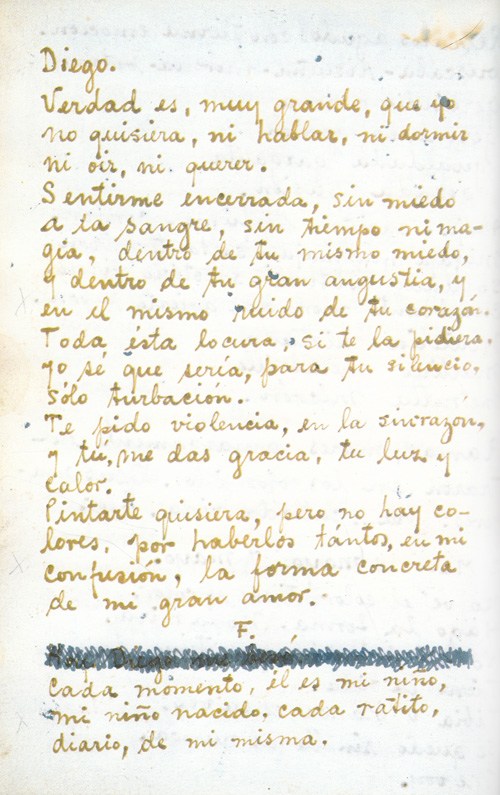
Diego.
Truth is, so great, that I wouldn’t like to speak, or sleep, or listen, or love. To feel myself trapped, with no fear of blood, outside time and magic, within your own fear, and your great anguish, and within the very beating of your heart. All this madness, if I asked it of you, I know, in your silence, there would be only confusion. I ask you for violence, in the nonsense, and you, you give me grace, your light and your warmth. I’d like to paint you, but there are no colors, because there are so many, in my confusion, the tangible form of my great love.
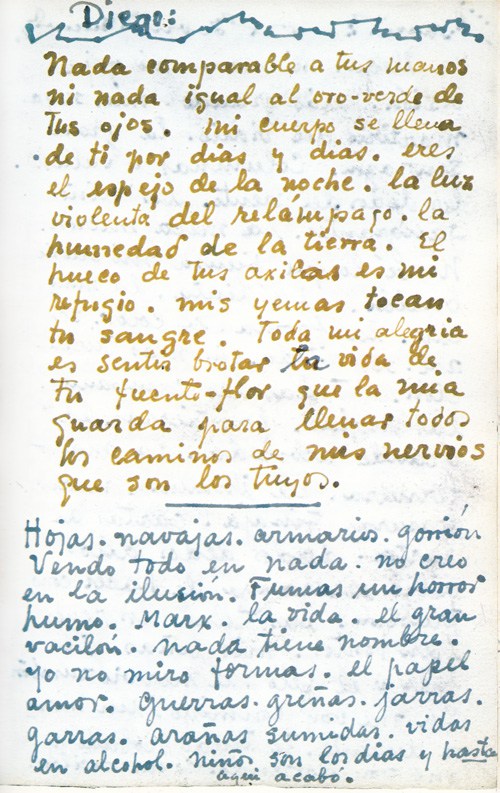
So begins the letter pictured at the top. In another, equally passionate and poetic letter, pictured further up, she writes:
Nothing compares to your hands, nothing like the green-gold of your eyes. My body is filled with you for days and days. you are the mirror of the night. the violent flash of lightning. the dampness of the earth. The hollow of your armpits is my shelter. my fingers touch your blood. All my joy is to feel life spring from your flower-fountain that mine keeps to fill all the paths of my nerves which are yours.
Kahlo and Rivera fell in love in 1928, when she asked him to look at her paintings. Over her mother’s objections, they married the following year. After ten tumultuous years, they divorced in 1939, then remarried in 1940 and stayed partnered until her death in 1954. Over these years, she poured out her emotions in letters, many, like those above, first written in her illustrated diary. Letters to and from her many lovers have also just emerged in a trove of personal artifacts, recently liberated from a bathroom at Casa Azul where they had been kept under lock and key at Rivera’s behest.
Both artists’ many affairs caused tremendous pain and “created rifts between them personally,” notes Katy Fallon at Broadly, although “their relationship has been mythologized past recognition,” in the way of so many other famous couples. In the most egregious betrayal, Rivera even slept with Kahlo’s younger sister Cristina, his favorite model, an act that inspired Frida’s 1937 painting Memory, the Heart, a self-portrait in which she stands with a metal rod piercing her chest, her hands seemingly amputated, face expressionless. We learn the wrong lessons from romanticizing “everything” about Frida and Diego’s life, Patti Smith suggests in her tribute to Kahlo’s love letters. But there is also danger in passing judgment.
“I don’t look at these two as models of behavior,” Smith says, but “the most important lesson… isn’t their indiscretions and love affairs but their devotion. Their identities were magnified by the other. They went through their ups and downs, parted, came back together, to the end of their lives.” In a 1935 letter to Rivera, read by pianist Mona Golabek above, Kahlo forgives his affairs, calling them “only flirtations…. At bottom, you and I love each other dearly, and thus go through adventures without numbers, beatings on doors, imprecations, insults, international claims. Yet, we will always love each other…. All the ranges I have gone through have served only to make me understand in the end that I love you more than my own skin.”
Read many more excerpts from Frida’s letters to Diego at Brain Pickings.
Related Content:
Artists Frida Kahlo & Diego Rivera Visit Leon Trotsky in Mexico: Vintage Footage from 1938
Rare Photos of Frida Kahlo, Age 13–23
Josh Jones is a writer and musician based in Durham, NC. Follow him at @jdmagness
Read More...R.E.M. Reveals the Secrets Behind Their Emotionally-Charged Songs: “Losing My Religion” and “Try Not to Breathe”
People lose their religion all the time. It happens in all sorts of ways. And R.E.M.’s 1991 song “Losing My Religion” has spoken to so many in the midst of these experiences that we might wonder if singer/songwriter Michael Stipe had a similar life change when he wrote those lyrics. Not so much, he says above in an interview with Dutch station Top 2000 a gogo. “What the song is about has nothing to with religion,” he says.
The lyric comes from an old Southern colloquialism meaning that something so upsetting has happened “that you might lose your religion.” Stipe used that old-time notion as a metaphor for unrequited love, a different kind of faith, one he describes in painfully tentative terms: “holding back, then reaching forward, then pulling back again, then reaching forward again.”
He explains another of the song’s ambiguities hidden within the elliptical lyrics: “You don’t ever really know if the person that I’m reaching out for is aware of me, if they even know that I exist.” It’s the heady turmoil of a romantic crush raised to the heights of saintly suffering. A brooding, alt-rock version of love songs like “Earth Angel.” Given the role of devotion in so much religious practice, there’s no reason the song can’t still be about losing one’s religion for listeners, but now we know what Stipe himself had in mind.
Some other fun facts we learn about this huge hit: Stipe recorded the song almost naked and kind of pissed-off—he had pushed to deliver his vocals in one emotional take, but the studio engineer seemed half-asleep. And his awkward, angular dance in the oh-so-90s video directed by Tarsem Singh, above? He pulled his inspiration from Sinead O’Connor’s St. Vitus dance in 1990s’ “The Emperor’s New Clothes” video and—no surprise—from David Byrne’s “riveting” herky-jerky moves.
While the record company saw the song’s mass appeal, bassist Mike Mills expresses his initial surprise at their choice of “Losing My Religion” as Out of Time’s first single: “That’s a great idea. It makes no sense at all, it’s 5 minutes long, it has no chorus, and a mandolin is the lead instrument. It’s perfect for R.E.M. because it flouts all the rules.” This period saw the band further developing its moody downbeat folk side, yet the album that produced this song also gave us “Shiny Happy People,” the poppiest, most upbeat song R.E.M.—and maybe any band—had ever recorded, a true testament to their emotional range.
The following year, Automatic for the People came out, drawing on material written during the Out of Time sessions and again featuring two singles that vastly contrasted in tone, maudlin tearjerker “Everybody Hurts” and the celebratory Andy Kaufman tribute “Man on the Moon.” Another song from that album that didn’t get as much attention, “Try Not to Breath,” hearkens back to a much earlier R.E.M. folk song, the Civil War-themed “Swan Swan H” from Life’s Rich Pageant.
As we hear the band explain above in an episode of Song Exploder, the song began its life on a Civil War-era instrument, the dulcimer. Then its sonic influences expanded to include two of Peter Buck’s favorite musical genres, surf rock and spaghetti western. The episode contains many more fascinating insider insights from R.E.M. about “Try Not to Breathe,” which may be one of the saddest songs they’ve ever written, a song about choosing to die rather than suffer.
Hear the song’s original demo and references to Blade Runner, get a glimpse into Stipe’s visual songwriting process, and learn the very personal inspiration from his family history for lyrics like “baby don’t shiver now, why do you shiver now?” Unlike “Losing My Religion,” this song does, in some ways, pull musically and emotionally from Stipe’s religious background.
via Laughing Squid
Related Content:
R.E.M.’s “Losing My Religion” Reworked from Minor to Major Scale
Why R.E.M.’s 1991 Out of Time May Be the “Most Politically Important Album” Ever
Two Very Early Concert Films of R.E.M., Live in ‘81 and ‘82
Josh Jones is a writer and musician based in Durham, NC. Follow him at @jdmagness
Read More...A Classic Video of Pablo Picasso Marking Art, Set to the Song, “Pablo Picasso,” by Jonathan Richman & The Modern Lovers
Before the Sex Pistols and the Ramones, there were the Modern Lovers, the Boston proto-punk band helmed by lead singer Jonathan Richman. Their sound owed a lot to the Velvet Underground, a band the teenaged Richman idolized, following them to New York City and ingratiating himself to such a degree that their manager allowed him to couch surf for a few weeks.
Their sole album, released two years after they broke up, was cobbled together from two different demo sessions, one of them produced by the Velvets’ John Cale.
By the time it came out, Richman had already embraced the gentler, sunnier persona and sound that’s made him a celebrated solo artist with fans of all ages. He famously remarked that he didn’t want to make music that could hurt a baby’s ears. As former bandmate, bassist Ernie Brooks told punk historian Legs McNeil:
Jonathan started saying his old songs were too negative and dark, and he started writing things like “Hey There Little Insect,” and maybe he was way ahead of us, but we couldn’t follow him—he wanted us to go, “Buzz, buzz, buzz” on stage, but we were too cool!
Richman’s impulse was correct. More than 40 years out from the Modern Lovers, his solo career is going strong. (On later recordings attributed to Jonathan Richman and the Modern Lovers, he is the only holdover from the original line up.)
But that Modern Lovers album has plenty of staying power, too.
Rolling Stone dubbed it both the 48th best debut album and the 381st greatest album of all time.
And while “Roadrunner” may be its best known track, thanks to a long running campaign to make it the official rock song of Massachusetts (over Richman’s protestations that it’s not good enough to deserve the honor), “Pablo Picasso”‘s memorable chorus cannot be unheard:
He could walk down your street
And girls could not resist his stare
Pablo Picasso never got called an asshole
(Francoise Gilot, Picasso’s model, and mother of two of his children, might say otherwise, according to several YouTube comments elicited by the unattributed short film above.)
In 1980, a writer for the zine Boston Groupie News tried to get Richman to reveal the song’s provenance. He had pursued art as a teenager, taking Saturday morning classes at Boston’s Museum of Fine Arts. He’d put his phone number on the back of his canvases, conceiving of that as a way to connect with people. So, was Picasso his favorite painter or…?
No, as it turns out:
I read about him when I was 18. I moved to New York and was intimidated by these girls who (I) thought were attractive. I was afraid to approach them. I didn’t have too high a self-image. I was self-conscious and I thought “Well, Pablo Picasso, he’s only 5 foot 3 but he didn’t let things like that bother him.” So I made up this song right after I saw those girls. You can picture it; I had this sad little look on my face and I was thinking ‘Why am I so scared to approach these girls?’ That was a song of courage for me.
Picasso looks pretty chipper in the well selected vintage footage, above. The expression Richman cops to having cultivated sounds gloomier, a deliberate ploy to entice girls into thinking he was a sad and likely soulful artist.
In other words, irresistible. Like a rock star!
The Modern Lovers’ popularity let him drop the self-conscious pose, but his interest in art remained.
He still paints, and recently identified some of the artists who have inspired him in Art News’ Muses column:
Monet contributed to his appreciation of the Left Banke’s “Walk Away Renee.”
There’s a direct line between “Roadrunner” and the loneliness of Edward Hopper’s “Gas.”
And Picasso? That asshole doesn’t even make the list.
Well some people try to pick up girls
And get called assholes
This never happened to Pablo Picasso
He could walk down your street
And girls could not resist his stare and
So Pablo Picasso was never called an asshole
Well the girls would turn the color
Of the avocado when he would drive
Down their street in his El Dorado
He could walk down your street
And girls could not resist his stare
Pablo Picasso never got called an asshole
Not like you
Alright
Well he was only 5′3″
But girls could not resist his stare
Pablo Picasso never got called an asshole
Not in New York
Oh well be not schmuck, be not obnoxious
Be not bellbottom bummer or asshole
Remember the story of Pablo Picasso
He could walk down your street
And girls could not resist his stare
Pablo Picasso was never called an asshole
Alright this is it
Well
Some people try to pick up girls
And they get called an asshole
This never happened to Pablo Picasso
He could walk down your street
And girls could not resist his stare and so
Pablo Picasso was never called…
Want to hear it again? Try the animated take below, by the endearingly modest 7atenine22.
Readers, if you have any intel on the person responsible for the film at the top of the page, please let us know, so we can give credit where credit is due.
Related Content:
Underrated Albums That You Want the World to Know About: What’s on Your List?
Ayun Halliday is an author, illustrator, theater maker and Chief Primatologist of the East Village Inky zine. Join her in NYC on Monday, September 24 for another monthly installment of her book-based variety show, Necromancers of the Public Domain. Follow her @AyunHalliday.
Read More...Support Us
We're hoping to rely on loyal readers, rather than erratic ads. Please click the Donate button and support Open Culture. You can use Paypal, Venmo, Patreon, even Crypto! We thank you!

About Us

Open Culture scours the web for the best educational media. We find the free courses and audio books you need, the language lessons & educational videos you want, and plenty of enlightenment in between.
Advertise With Us

FREE UPDATES!
GET OUR DAILY EMAIL
Get the best cultural and educational resources on the web curated for you in a daily email. We never spam. Unsubscribe at any time.
FOLLOW ON SOCIAL MEDIA

Open Culture editor Dan Colman scours the web for the best educational media. He finds the free courses and audio books you need, the language lessons & movies you want, and plenty of enlightenment in between.
Advertise With Us

