Marie Osmond Performs the Dadaist Poem “Karawane” on the TV Show, Ripley’s Believe It or Not (1985)
Remember Donny and Marie Osmond, the toothy, teenage Mormon siblings whose eponymous television variety show was a wholesome 70’s mix of skits, songs, and ice skating?
Their surprisingly enduring theme song reduced their popularity to an easily graspable binary formula:
She was a little bit country. He was a little bit rock and roll.
Turns out Marie was also more than a little bit Dada.
From 1985 to 1986, Marie served as actor Jack Palance’s cohost on Ripley’s Believe It or Not, a TV series exploring strange occurrences, bizarre historical facts, and other such crowd-pleasing oddities… one of which was apparently the aforementioned European avant-garde art movement, founded a hundred years ago this week.
If you don’t know as much about Dada as you’d like, Ms. Osmond’s brief primer is a surprisingly sturdy introduction.
No cutesy bootsy, easy references to melting clocks here.
The highlight is her performance of Dada poet and manifesto author Hugo Ball’s nonsensical 1916 sound poem “Karawane.”
Lose the yellow bathrobe and she could be a captive warrior princess on Game of Thrones, fiercely petitioning the Mother of Dragons on behalf of her people. (Invent some subtitles for extra Dada-inflected fun!)
A sharp eyed young art student named Ethan Bates did catch one error in Marie’s lesson. The ’13’ costume she pulls from a handy dressing room niche was not worn by Hugo Ball, but rather Dutch painter Theo Van Doesburg, one of the founders of the De Stijl movement.
Still you’ve got to hand it to Marie, who was slated to perform just a single line of the poem. When it came time to tape, she abandoned the cue cards, blowing producers’ and crew’s minds by delivering the poem in its unhinged entirety from memory.
Now that’s rock and roll.
Below you’ll find footage of Ball himself performing the work in 1916.
Marie’s version was eventually released by Rough Trade Records as a track on Lipstick Traces, a companion soundtrack to Greil Marcus’ seminal book.
Related Content:
Hear the Experimental Music of the Dada Movement: Avant-Garde Sounds from a Century Ago
Ayun Halliday is an author, illustrator, and Chief Primatologist of the East Village Inky zine. Follow her @AyunHalliday
Read More...
Aaron Sorkin, Creator of The West Wing & The Social Network, Teaches Screenwriting in an Online Class
FYI: If you sign up for a MasterClass course by clicking on the affiliate links in this post, Open Culture will receive a small fee that helps support our operation.
Sports Night, The West Wing, The American President, The Social Network — hardly shameful items to appear on anyone’s résumé. Sure, people disagree about the likes of Studio 60 on the Sunset Strip and The Newsroom, but we’ve all got to admit that when Aaron Sorkin writes, he hits more than he misses, and even the supposed misses have more of interest about them than many others’ hits. How does this master of the modern American scene — its concerns, its personalities, its conversations, its politics — do it? You can find out in his Screenwriting course on MasterClass, the new platform for online instruction as given by big-name doers of high-profile work.
Back in May, we featured MasterClass’s offering of Werner Herzog on filmmaking, and though most everyone can enjoy hearing the man behind Aguirre, the Wrath of God, Fitzcarraldo, and Grizzly Man talk for five hours, not everyone can summon the will to make movies like those. Sorkin, by contrast, uses his also considerable creative vitality to a different end entirely, writing snappy scripts that bring his own compelling idiosyncrasies to mainstream film and television.
But he started, according to MasterClass, by writing his first screenplay on the humble medium of cocktail napkins — cocktail napkins that became A Few Good Men. Since then, he’s come up with “rules of storytelling, dialogue, character development, and what makes a script actually sell,” now ready to share with his online students.
In fact, he gives one away for free in the trailer above: “No one in real life starts a sentence with, ‘Damn it.’ ” That alone may get you writing your own Oscar-winning screenplay, thus saving you the $90 fee for the whole five-hour course, but Sorkin goes on to tease his methods for breaking through his “constant state of writer’s block” to craft dialogue as he conceives of that process: “Taking something someone has just said, holding them in your hand, and then punching them in the face with it.” He also makes reference to Aristotle’s Poetics, making his own lecturing sound like the very same high-and-low, intellectual and visceral cocktail that his fans so enjoy in the dialogue he writes. “The worst crime you can commit,” he warns, “is telling the audience something they already know,” and it sounds as if, in teacher mode to his audience of aspiring screenwriters, he plans on following his own advice.
Note: You can get a year-long pass to all Masterclass courses for $180. Or give any individual course as a gift.
Related Content:
Werner Herzog Will Teach His First Online Course on Filmmaking
10 Tips From Billy Wilder on How to Write a Good Screenplay
Raymond Chandler: There’s No Art of the Screenplay in Hollywood
Based in Seoul, Colin Marshall writes and broadcasts on cities and culture. He’s at work on a book about Los Angeles, A Los Angeles Primer, the video series The City in Cinema, the crowdfunded journalism project Where Is the City of the Future?, and the Los Angeles Review of Books’ Korea Blog. Follow him on Twitter at @colinmarshall or on Facebook.
Read More...What Is an “Existential Crisis”?: An Animated Video Explains What the Expression Really Means
“Who am I?” many of us have wondered at some point in our lives, “What am I? Where am I?”… maybe even—while gazing in bewilderment at the pale blue dot and listening to the Talking Heads—“How did I get here?”
That feeling of unsettling and profound confusion, when it seems like the hard floor of certainty has turned into a black abyss of endless oblivion…. Thanks to modern philosophy, it has a handy name: an existential crisis. It’s a name, says Alain de Botton in his School of Life video above, that “touches on one of the major traditions of European philosophy,” a tradition “associated with ideas of five philosophers in particular: Kierkegaard, Camus, Nietzsche, Heidegger, and Sartre.”
What do these five have in common? The question is complicated, and we can’t really point to a “tradition.” As the Internet Encyclopedia of Philosophy notes, Existentialism is a “catch-all term” for a few continental philosophers from the 19th and 20th centuries, some of whom had little or no association with each other. Also, “most of the philosophers conventionally grouped under this heading either never used, or actively disavowed the term ‘existentialist.’” Camus, according to Richard Raskin, thought of Existentialism as a “form of philosophical suicide” and a “destructive mode of thought.” Even Sartre, who can be most closely identified with it, once said “Existentialism? I don’t know what it is.”
But labels aside, we can identify many common characteristics of the five thinkers de Botton names that apply to our paralyzing experiences of supreme doubt. The video identifies five such broad commonalities of the “existential crisis”:
1. “It’s a period when a lot that had previously seemed like common sense or normal reveals its contingent, chance, uncanny, and relative nature…. We are freer than we thought.”
2. We recognize we’d been deluding ourselves about what had to be…. We come to a disturbing awareness that our ultimate responsibility is to ourselves, not the social world.”
3. “We develop a heightened awareness of death. Time is short and running out. We need to re-examine our lives, but the clock is ticking.”
4. “We have many choices, but are, by the nature of the human condition, denied the information we would need to choose with ultimate wisdom or certainty. We are forced to decide, but can never be assured that we’ve done so adequately. We are steering blind.”
5. This means that anxiety is a “basic feature” of all human existence.
All of this, de Botton admits, can “seem perilous and dispiriting,” and yet can also ennoble us when we consider that the private agonies we think belong to us alone are “fundamental features of the human condition.” We can dispense with the trivializing idea, propagated by advertisers and self-help gurus, that “intelligent choice might be possible and untragic… that perfection is within reach.” Yet de Botton himself presents Existentialist thought as a kind of self-help program, one that helps us with regret, since we realize that everyone bears the burdens of choice, mortality, and contingency, not just us.
However, in most so-called Existentialist philosophers, we also discover another pressing problem. Once we become untethered from pleasing fictions of pre-existing realities, “worlds-behind-the-scene,” as Nietzsche put it, or “being-behind-the-appearance,” in Sartre’s words, we no longer see a benevolent hand arranging things neatly, nor have absolute order, meaning, or purpose to appeal to.
We must confront that fact that we, and no one else, bear responsibility for our choices, even though we make them blindly. It’s not a comforting thought, hence the “crisis.” But many of us resolve these moments of shock with varying degrees of wisdom and experience. As we know from another great thinker, Eleanor Roosevelt, who was not an Existentialist philosopher, “Freedom makes a huge requirement of every human being…. For the person who is unwilling to grow up… this is a frightening prospect.”
Related Content:
Free Online Philosophy Courses
Human, All Too Human: 3‑Part Documentary Profiles Nietzsche, Heidegger & Sartre
The Absurd Philosophy of Albert Camus Presented in a Short Animated Film by Alain De Botton
Existential Philosophy of Kierkegaard, Sartre, Camus Explained with 8‑Bit Video Games
Josh Jones is a writer and musician based in Durham, NC. Follow him at @jdmagness
Read More...The Steamy Love Letters of Virginia Woolf and Vita Sackville-West (1925–1929)
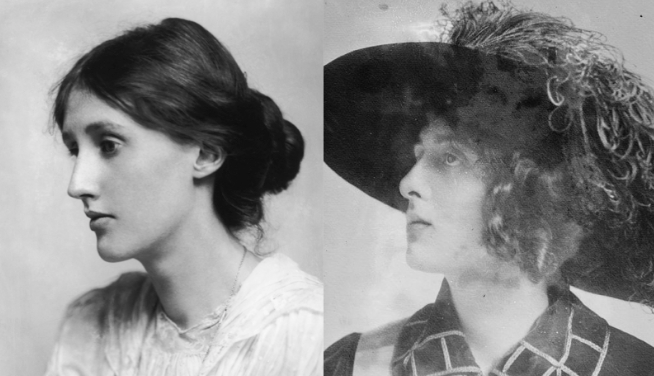
Everyone loves a love story—especially a love affair. We may think ourselves above a juicy scandal…, but who are we kidding? Tragically, however, for many famous people of the past—from Oscar Wilde to Alan Turing to Tab Hunter—affairs could not only end careers and reputations, they could end lives. People who would much rather not have to hide their love have been forced to do so by rigid social propriety, religious moralism, and repressive law.
In other famous cases, however—like that of Virginia Woolf and her friend and lover Vita Sackville-West—an affair doesn’t end in tragedy but simply in a cooling of passions into a beautiful, lasting friendship.
While prudish outsiders may have been scandalized, neither Woolf’s nor Sackville-West’s husband found the relationship shocking. Leonard Woolf, his wife reported, regarded the affair as “rather a bore… but not enough to worry him.” Vita and her aristocratic husband Harold Nicolson, writes the Virginia Woolf blog, “were both bisexual and… had an open marriage.” Furthermore, the bohemian artistic circle in which the Woolfs moved—the Bloomsbury group—hardly troubled itself about such mundane goings-on as a steamy affair between two married women. So much for social scandal and soap-operatic theatrics.
But while their love was not forbidden, what passion they had while it lasted! One need only read their letters to each other, collected in The Letters of Vita Sackville-West to Virginia Woolf. Many of those epistles document the heated period between the mid-1920s, when their affair began, and 1929, when it ended on amiable terms (in a friendship the letters document until Woolf’s suicide in 1941).
“I am reduced to a thing that wants Virginia,” writes Sackville-West in a 1926 letter to Woolf, “You have broken down my defences. And I really don’t resent it… Please forgive me for writing such a miserable letter.” The brief, agonized letter captures the exquisite pangs and pinions of romantic infatuation. Woolf, in response, is the more reserved, but also the more colorful, with playful, cryptic images that hint at who knows what:
“Always, always, always I try to say what I feel,” she writes, “I have missed you. I do miss you. I shall miss you. And if you don’t believe it, you’re a longeared owl and ass…. Open the top button of your jersey and you will see, nestling inside, a lively squirrel with the most inquisitive habits, but a dear creature all the same—”
In her diary, Woolf described Sackville-West on their first meeting in 1923 as “a pronounced sapphist…. Snob as I am, I trace her passions – 500 years back, & they become romantic to me, like old yellow wine.” Woolf was ten years older than Sackville-West, and seemed to feel inferior to her lover, comparing herself unfavorably in a sexy 1925 diary entry:
Vita shines in the grocers shop in Sevenoaks…pink glowing, grape clustered, pearl hung…There is her maturity and full-breastedness: her being so much in full sail on the high tides, where I am coasting down backwaters; her capacity I mean to take the floor in any company, to represent her country, to visit Chatsworth, to control silver, servants, chow dogs; her motherhood…her in short (what I have never been) a real woman.
The two had other lovers, and Woolf, “as the older woman in the relationship,” the Virginia Woolf blog writes, felt “unwanted and dowdy” as Sackville-West strayed. But though the love affair ended, it not only produced a close friendship, but a novel, Woolf’s Orlando, which Vita’s son Nigel called “the longest and most charming love letter in literature.”
Their love and friendship will also soon produce a film, Vita and Virginia, directed by Chanya Button and written by Dame Eileen Atkins. And, if you were wondering what Vita and Virginia’s passionate exchanges would sound like in a 21st century idiom, have a look at “The Collected Sexts of Virginia Woolf and Vita Sackville-West” at The New Yorker. The eloquence of an epistolary romance may be a thing of the past, but email and text have their own efficient charms:
Vita: Hey girl
Virginia: Hey
Vita: Sup?
Virginia: In bed
Vita: Hot
Virginia: Come visit?
Vita: Mmm can’t. Have a toothache.
Cute. But what could ever replace one of Woolf’s last letters to her friend and former lover, written in 1940 while Britain endured German air bombardments: “there you sit with the bombs falling around you. What can one say– except that I love you and I’ve got to live through this strange quiet evening thinking of you sitting there alone. Dearest—let me have a line…You have given me such happiness….”
Related Content:
Virginia Woolf’s Handwritten Suicide Note: A Painful and Poignant Farewell (1941)
Virginia Woolf Offers Gentle Advice on “How One Should Read a Book”
Josh Jones is a writer and musician based in Durham, NC. Follow him at @jdmagness
Read More...President Warren G. Harding’s Steamy Love Letters
If you know something about American history, you know that Warren G. Harding (1865–1923) will never appear on Mount Rushmore. He died during his unpopular first term in office, tarnished by the Teapot Dome scandal and revelations of an extramarital affair. Harding once apparently said, “I am not fit for this office and should never have been here.” And historians tend to agree. Consistently polls ranking the performance of American presidents put him at the bottom of the list.
History might, however, look more kindly upon Harding’s love letters, the byproduct of his womanizing ways. Before taking office, Harding fathered a love child with Nan Britton, a woman 31 years his junior. He also carried on a 15-year affair with Carrie Fulton Phillips, a friend’s wife, to whom he started writing letters in 1910. And what letters they were. Here’s one from January 28, 1912:
I love your poise
Of perfect thighs
When they hold me
in paradise…
I love the rose
Your garden grows
Love seashell pink
That over it glows
I love to suck
Your breath away
I love to cling —
There long to stay…
I love you garb’d
But naked more
Love your beauty
To thus adore…
I love you when
You open eyes
And mouth and arms
And cradling thighs…
If I had you today, I’d kiss and
fondle you into my arms and
hold you there until you said,
‘Warren, oh, Warren,’ in a
benediction of blissful joy.… I
rather like that encore
discovered in Montreal.
Did you?
And another from September 15, 1913, which John Oliver playfully mocks above:
Honestly, I hurt with the insatiate longing, until I feel that there will never be any relief untilI take a long, deep, wild draught on your lips and then bury my face on your pillowing breasts. Oh, Carrie! I want the solace you only can give. It is awful to hunger so and be so wholly denied.… Wouldn’t you like to hear me ask if we only dared and answer, “We dare,” while souls rejoicing sang the sweetest of choruses in the music room? Wouldn’t you like to get sopping wet out on Superior — not the lake — for the joy of fevered fondling and melting kisses? Wouldn’t you like to make the suspected occupant of the next room jealous of the joys he could not know, as we did in morning communion at Richmond?
Oh, Carrie mine! You can see I have yielded and written myself into wild desire. I could beg. And Jerry came and will not go, says he loves you, that you are the only, only love worthwhile in all this world, and I must tell you so and a score or more of other fond things he suggests, but I spare you. You must not be annoyed. He is so utterly devoted that he only exists to give you all. I fear you would find a fierce enthusiast today.
Originally unearthed by historian Francis Russell in 1964, the letters were donated to the Library of Congress, where they remained under seal until 2014. You can find scans of the original Warren G. Harding-Carrie Fulton Phillips Correspondence on the LOC website. (The LOC also produced an informative video on the exchange.) Read transcriptions of the best letters at The New York Times.
Related Content:
James Joyce’s “Dirty Letters” to His Wife (1909)
Dear Immanuel — Kant Gives Love Advice to a Heartbroken Young Woman (1791)
Ernest Hemingway’s “Love Letter” to His “Dearest Kraut,” Marlene Dietrich (1955)
Read Beethoven’s Lengthy Love Letter to His Mysterious “Immortal Beloved” (1812)
Read More...Slavoj Žižek Explains the Artistry of Andrei Tarkovsky’s Films: Solaris, Stalker & More
Though a filmmaker of strong personal convictions, artistic and otherwise, Andrei Tarkovsky made films that endure in part because they open themselves to a multiplicity of interpretations. Nothing in the Tarkovsky canon opens itself up to quite such a multiplicity of interpretations as Stalker, which continues to produce fascinating new works derived from their creators’ experience of the film, such as Geoff Dyer’s Zona: A Book About a Film About a Journey to a Room, the S.T.A.L.K.E.R. series of video games, and even a segment of the Slavoj Žižek-starring documentary The Pervert’s Guide to Cinema, which you can watch above.
“We need the excuse of a fiction to stage what they truly are,” declares the philosophical, cultural, and political provocateur over footage of what many consider Tarkovsky’s masterpiece. He describes it as “a film about a ‘Zone,’ a prohibited space where there are debris, remainders of aliens visiting us.” The titular professionals he describes as “people who specialize in smuggling foreigners who want to visit into this space where you get many magical objects.” The ultimate goal of all who make the harrowing journey to the Zone? “The room in the middle of this space, where it is claimed your desires will be realized.”
Not a bad summing-up of the premise of a movie even whose biggest fans struggle to explain. But Žižek, of course, takes his analysis further, bringing in Solaris, Tarkovsky’s 1972 adaptation of Stanislaw Lem’s science fiction novel about a planet that can read the minds of the humans in orbit around it, “an id machine as an object which realizes your nightmares, desires, fears, even before you ask for it.” With Stalker, Tarkovsky envisions the opposite, “a zone where your desires, your deepest wishes, get realized on condition that you are able to formulate them. Which, of course, you are never able.”
If you subscribe to Žižek’s reading of the films, it actually makes perfect sense that they could continue to find new, enthralled audiences: the human relationship to desire remains as fraught as ever — and perhaps has only gained fraughtness as we find ways to satisfy our desires — and both Solaris and Stalker find artistically striking new ways to dramatize it. And according to Žižek, the respected filmmaker also provides a solution: “religious obscurantism,” a “gesture of self-sacrifice” of the kind we see made in his final films, Nostalghia and The Sacrifice. Tarkovsky also sacrificed himself, but for cinema, and so created some of the most formally remarkable motion pictures ever made, ones in which, in Žižek’s words, “we are made to feel this inertia, drabness of time,” and even “the density of time itself.” If you wonder what he means by that, as ever, you’ve just got to experience Tarkovsky for yourself. A number of his major films you can watch free online.
Related Content:
Watch Stalker, Andrei Tarkovsky’s Mind-Bending Masterpiece Free Online
Andrei Tarkovsky’s Masterpiece Stalker Gets Adapted into a Video Game
Andrei Tarkovsky’s Advice to Young Filmmakers: Sacrifice Yourself for Cinema
Slavoj Žižek Names His Favorite Films from The Criterion Collection
Based in Seoul, Colin Marshall writes and broadcasts on cities and culture. He’s at work on a book about Los Angeles, A Los Angeles Primer, the video series The City in Cinema, the crowdfunded journalism project Where Is the City of the Future?, and the Los Angeles Review of Books’ Korea Blog. Follow him on Twitter at @colinmarshall or on Facebook.
Read More...Johnny Rotten Becomes a DJ and Plays Songs from His Record Collection, 1977

Image via Wikimedia Commons
One of the initial impressions of the British punks–and one that impresario Malcolm McLaren tried to cultivate–was that they were dangerous, unschooled yobs creating rock music from primordial materials. That’s why McLaren was unhappy about John Lydon aka Johnny Rotten’s appearance on Capital Radio’s Tommy Vance Show in the middle of the summer of punk, 1977.
“Anarchy in the U.K.” and “God Save the Queen” had already been released as singles. The Pistols had made their infamous appearance on Bill Grundy’s chat show, where goaded into doing something outrageous, they swore a bit and the British press melted down in paroxysms of panic. They had been dropped by both EMI and A&M, and had finished recording the bulk of Never Mind the Bollocks the month before. The band was in limbo.
DJ Tommy Vance was sixteen years older than Lydon, but Capital Radio was an independent station and offered an alternative to the BBC, which only a few months earlier banned outright “God Save the Queen” from the airwaves and refused to award it a number one single spot, even though the single had earned it, saleswise.
Lydon was asked to bring in records from his own collection and talk about them, and, in doing so, demonstrated that he wasn’t a thug, but an eclectic young music fan with broad tastes. He liked a lot of reggae (Peter Tosh, Makka Bees, Dr. Alimantado) and dub, and says he grew up with it. It also explains the dub heavy outings he’d soon do with Public Image Ltd. And he chooses tracks by singer-songwriters like Tim Buckley, Kevin Coyne, and Neil Young; John Cale, Lou Reed, and Nico; and art rock like Can, a band introduced to him by Sid Vicious.
He’s still abrupt, insulting and dismissive when he needs to be. He calls David Bowie a “real bad drag queen,” doesn’t think much of the Rolling Stones or most ‘60s bands (“terrible scratching sound” he says), and says most of his contemporary punk bands are “stagnant” and predictable. But it wouldn’t be Johnny Rotten any other way, would it?
When asked about his record collection, Lydon says it’s quite big:
I ain’t got a record player at the moment, so I have to pass them around, because music’s for listening to, not to store away in a bloody cupboard. Yeah, I love my music.
You can listen to the broadcast here:
And here’s the full track listing:
Tim Buckley – Sweet Surrender
The Creation – Life Is Just Beginning
David Bowie – Rebel Rebel
Unknown Irish Folk Music / Jig
Augustus Pablo – King Tubby Meets The Rockers Uptown
Gary Glitter – Doing Alright With The Boys
Fred Locks – Walls
Vivian Jackson and the Prophets – Fire in a Kingston
Culture – I’m Not Ashamed
Dr Alimantado & The Rebels – Born For A Purpose
Bobby Byrd – Back From The Dead
Neil Young – Revolution Blues
Lou Reed – Men Of Good Fortune
Kevin Coyne – Eastbourne Ladies
Peter Hammill – The Institute Of Mental Health, Burning
Peter Hammill – Nobody’s Business
Makka Bees – Nation Fiddler / Fire!
Captain Beefheart – The Blimp
Nico – Janitor Of Lunacy
Ken Boothe – Is It Because I’m Black
John Cale – Legs Larry At Television Centre
Third Ear Band – Fleance
Can – Halleluhwah
Peter Tosh – Legalise It
via That Eric Alper/WFMU
Related content:
The Sex Pistols’ 1976 Manchester “Gig That Changed the World,” and the Day the Punk Era Began
Never Mind the Bollocks, Here’s … John Lydon in a Butter Commercial?
Ted Mills is a freelance writer on the arts who currently hosts the FunkZone Podcast. You can also follow him on Twitter at @tedmills, read his other arts writing at tedmills.com and/or watch his films here.
Read More...Hear the Only Castrato Ever Recorded Sing “Ave Maria” and Other Classics (1904)
Every human culture has practiced some form of ritual mutilation, from the mild marring of a Spring Break tattoo to the disfigurement of foot-binding. On the more extreme end of the scale, we have the early modern European practice of castrating young boys to inhibit growth of their vocal cords and thyroid glands during puberty. Such singers, known as castrati, became “high-sopranos, mezzos, and altos, strident voices and sweet ones, loud and mellow voices,” writes Martha Feldman in her book The Castrato.
The purpose of mutilating these singers initially had to do with a ban on women in church choirs. Castrati took their place, and were in very high demand. “Opportunities for castrati were staggering,” writes i09, “and many families were facing starvation” in 16th century Italy, where the practice began. Despite a church prohibition on unnecessary amputation, parents and surgeons conspired to illegally castrate boys chosen to fulfill the role, and the practice continued into the 19th century.
Several castrati achieved lasting popular fame. “The best castrati were superstars,” remarks Sarah Bardwell of the Handel House Museum, “adored by female fans.” Others, io9 points out, “were low-rent singers who spent their time doing small gigs in small towns, and others spun their singing careers into positions as ministers at royal courts.” One of the more glamorous fates awaited one of the last of the castrati, Alessandro Moreschi, who may have been castrated to remedy an inguinal hernia or may have been intentionally mutilated to become a castrato.
However he came by it, Moreschi’s voice so impressed a Roman choirmaster that he appointed the singer first soprano of the Papal basilica of St. John Lateran in 1873 at age 15. Soon after, Moreschi, his fame spreading widely, joined the Sistine Chapel Choir and took on several administrative duties. By this time, it’s said that Moreschi was so popular that audiences would call out “Eviva il coltello” (“Long live the knife!”) during his performances. While still with the Sistine Choir and near the end of his career, Moreschi began to make recordings for the Gramophone & Typewriter Company of London—the only known recordings of a castrato.
Between 1902 and 1904, Moreschi recorded 17 tracks, and you can hear them all here. At the top of the post, hear a restored version of “Ave Maria,” further down, a rendition of Eugenio Terziani’s “Hostias et Preces,” and here, the complete recordings of Alessandro Moreschi, in their noisy original state. Nicholas Clapton, curator of a 2006 castrati exhibit at the Handel House Museum in London, describes Moreschi’s voice as “Pavarotti on helium” and historican David Starkey tells of the “full horror” of the procedure, but also adds, “it’s horribly like the child star of today, forced into this artificiality, forced… to deliver that ineluctable, strange, desirable thing of star quality.”
Sadly, like many of today’s harried child singers and actors, few castrati actually achieved stardom. But those few who did, like Moreschi, “had a tremendous emotional impact on the audiences of the day,” Bardwell tells us. Moreschi’s recordings, made while he was in his mid-forties, sound alien to us not only because of the strangeness of castrati singing but because of the highly melodramatic style popular at the time. His singing may not be representative of some of the most renowned castrati in history, like the 18th century sensation Farinelli, but it is—barring a resurgence of the pretty barbaric practice—probably the closest we’ll come to hearing the infamous castrati voice.
via History Buff
Related Content:
Watch Classic Performances from Maria Callas’ Wondrous and Tragically-Short Opera Career
What Beatboxing and Opera Singing Look Like Inside an MRI Machine
Josh Jones is a writer and musician based in Durham, NC. Follow him at @jdmagness
Read More...Discover the First Horror & Fantasy Magazine, Der Orchideengarten, and Its Bizarre Artwork (1919–1921)
From the 18th century onward, the genres of Gothic horror and fantasy have flourished, and with them the sensually visceral images now commonplace in film, TV, and comic books. These genres perhaps reached their aesthetic peak in the 19th century with writers like Edgar Allan Poe and illustrators like Gustave Dore. But it was in the early twentieth century that a more populist subgenre truly came into its own: “weird fiction,” a term H.P. Lovecraft used to describe the pulpy brand of supernatural horror codified in the pages of American fantasy and horror magazine Weird Tales—first published in 1923. (And still going strong!)
A precursor to EC Comics’ many lurid titles, Weird Tales is often considered the definitive early twentieth century venue for weird fiction and illustration.
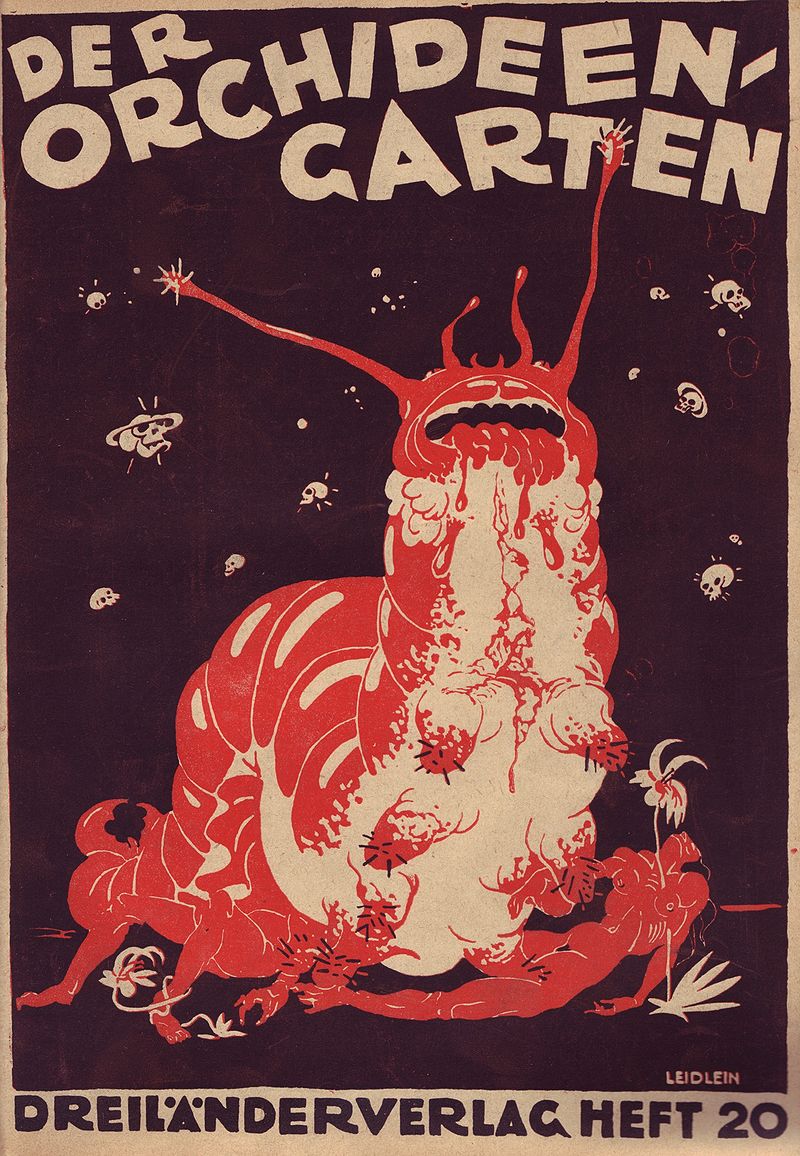
But we need only look back a few years and to another continent to find an earlier publication, serving German-speaking fans — Der Orchideengarten (“The Garden of Orchids”), the very first horror and fantasy magazine, which ran 51 issues from January 1919 to November 1921.
The magazine featured work from its editors Karl Hans Strobl and Alfons von Czibulka, from better-known contemporaries like H.G. Wells and Karel Capek, and from forefathers like Dickens, Pushkin, Guy de Maupassant, Poe, Voltaire, Washington Irving, Nathaniel Hawthorne, and others. “Although two issues of Der Orchideengarten were devoted to detective stories,” writes 50 Watts, “and one to erotic stories about cuckolds, it was a genuine fantasy magazine.” And it was also a gallery of bizarre and unusual artwork.
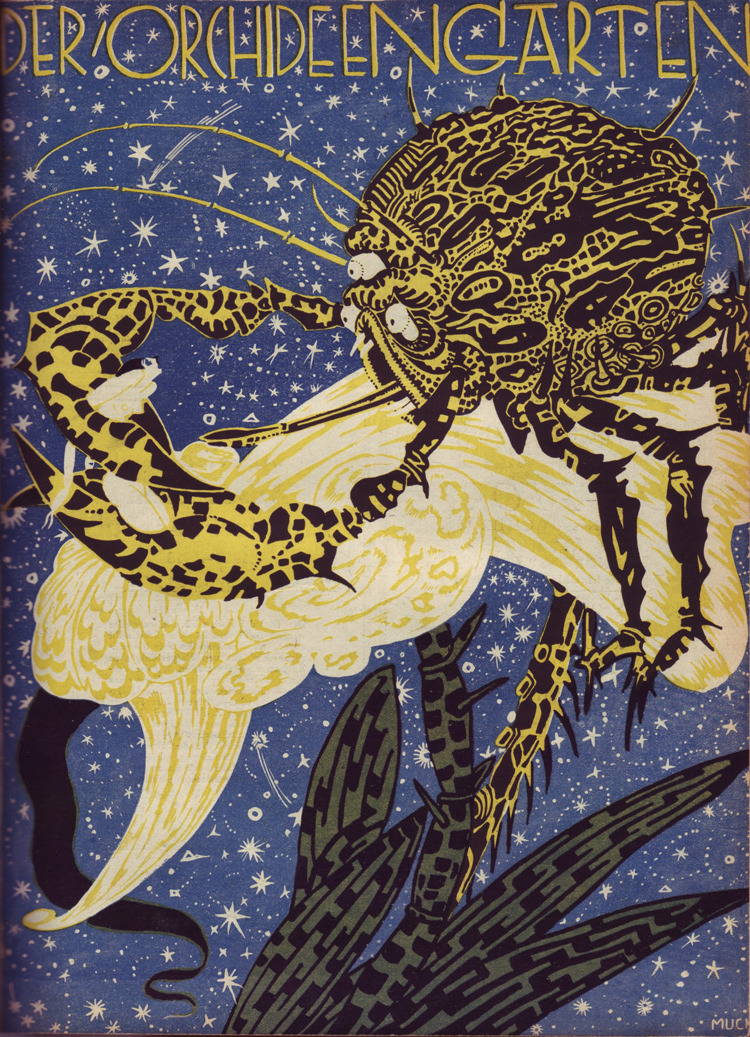
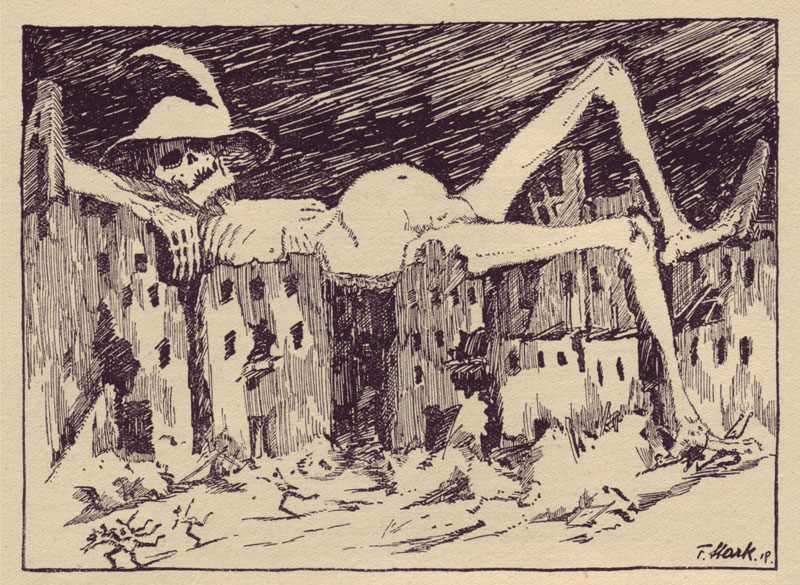
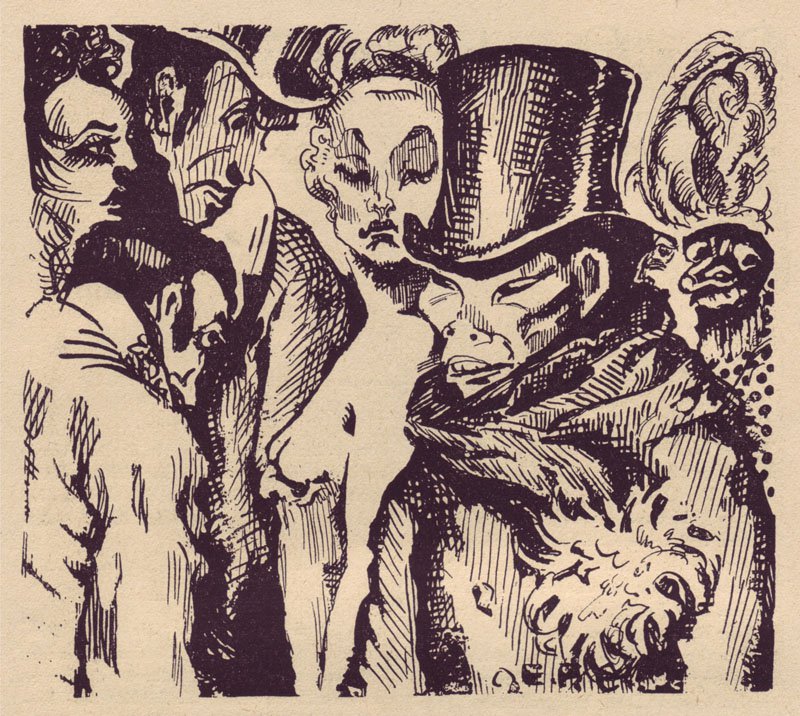
50 Watts quotes from Franz Rottensteiner’s description of the magazine’s art, which ranged “from representations of medieval woodcuts to the work of masters of the macabre such as Gustave Dore or Tony Johannot, to contemporary German artists like Rolf von Hoerschelmann, Otto Lennekogel, Karl Ritter, Heinrich Kley, or Alfred Kubin.” These artists created the covers and illustrations you see here, and many more you can see at 50 Watts, the black sun, and John Coulthart’s {feuilleton}.
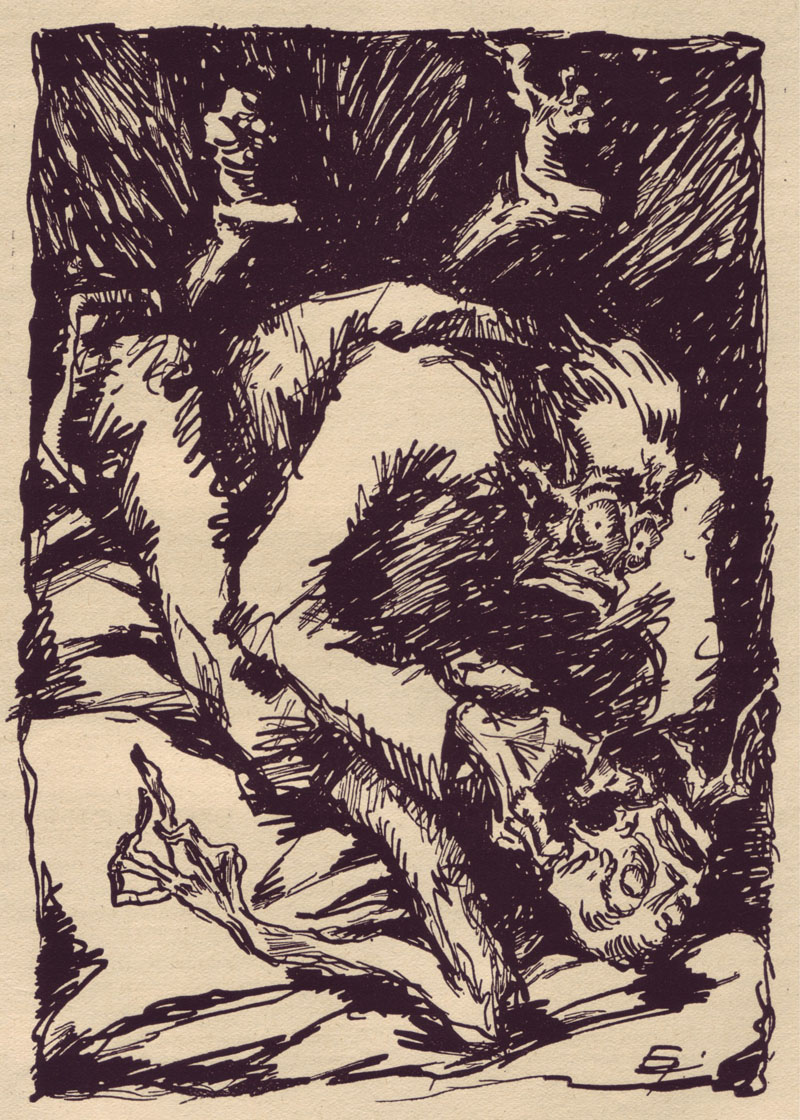
“What strikes me about these black-and-white drawings,” like the dense, frenzied pen-and-ink scene above, Coulthart comments, “is how different they are in tone to the pulp magazines which followed shortly after in America and elsewhere. They’re at once far more adult and frequently more original than the Gothic clichés which padded out Weird Tales and lesser titles for many years.” Indeed, though the format may be similar to its successors, Der Orchideengarten’s covers show the influence of Surrealism, “some are almost Expressionist in style,” and many of the illustrations show “a distinct Goya influence.”
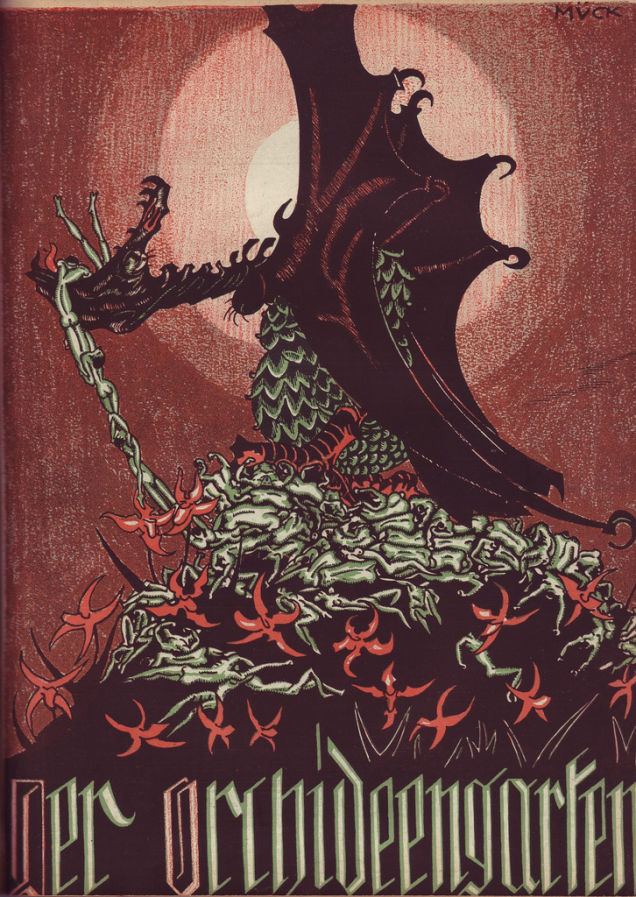
Popular fantasy and horror illustration has often leaned more toward the soft-porn of seventies airbrushed vans, pulp-novel covers, or the grisly kitsch of the comics. Rottensteiner writes in his 1978 Fantasy Book that this “large-format magazine… must surely rank as one of the most beautiful fantasy magazines ever published.” It’s hard to argue with that assessment. View, read (in German), and download original scans of the magazine’s first several issues over on this Princeton site.
via 50 Watts
Related Content:
Extensive Archive of Avant-Garde & Modernist Magazines (1890–1939) Now Available Online
Josh Jones is a writer and musician based in Durham, NC. Follow him at @jdmagness
Read More...The Best Drone Cinema in the World
From the New York Drone Festival comes a montage of the best drone cinema in the world. Put drones in the hands of 32 filmmakers, and here’s what they can deliver. Pretty remarkable. Find more fine drone cinema in the Relateds below.
If you would like to support the mission of Open Culture, consider making a donation to our site. It’s hard to rely 100% on ads, and your contributions will help us continue providing the best free cultural and educational materials to learners everywhere. You can contribute through PayPal, Patreon, and Venmo (@openculture). Thanks!
via Coudal/WFMU
Related Content:
A Haunting Drone’s‑Eye View of Chernobyl
A Beautiful Drone’s Eye View of Antarctica
A Drone’s Eye View of Los Angeles, New York, London, Bangkok & Mexico City
Read More...Support Us
We're hoping to rely on loyal readers, rather than erratic ads. Please click the Donate button and support Open Culture. You can use Paypal, Venmo, Patreon, even Crypto! We thank you!

About Us

Open Culture scours the web for the best educational media. We find the free courses and audio books you need, the language lessons & educational videos you want, and plenty of enlightenment in between.
Advertise With Us

FREE UPDATES!
GET OUR DAILY EMAIL
Get the best cultural and educational resources on the web curated for you in a daily email. We never spam. Unsubscribe at any time.
FOLLOW ON SOCIAL MEDIA

Open Culture editor Dan Colman scours the web for the best educational media. He finds the free courses and audio books you need, the language lessons & movies you want, and plenty of enlightenment in between.
Advertise With Us


