What Do Movies Say When They Say Nothing at All: A Video Essay
Sometimes less is more. Sometimes silence says more than words or sound itself. John Cage knew it. Ditto our finest filmmakers. That’s the takeaway from When Words Fail in Movies–a new video essay that stitches together 15 scenes from iconic films by Hitchcock, Kubrick, Fellini and others. Created by David Verdeure at Filmscalpel, the clip lets us meditate on “the meaningful use of silence” in the sound-film era. Fandor has pulled together a list of scenes used in the montage. Find them below:
The Matrix, dir. Lana Wachowski and Lilly Wachowski. Silver Pictures, USA, 1999. 136 mins.
The Godfather: Part III, dir. Francis Ford Coppola. Zoetrope Studios, USA, 1990. 162 mins.
Mon Oncle, dir. Jacques Tati. Specta films et al., France, 1958. 117 mins.
2001: A Space Odyssey, dir. Stanley Kubrick. Stanley Kubrick Productions, UK / USA, 1968. 149 mins.
Lost in Translation, dir. Sofia Coppola. American Zoetrope et al., USA, 2003. 101 mins.
On the Waterfront, dir., Elia Kazan. Horizon Pictures et al., USA, 1954. 108 mins.
The Graduate, dir. Mike Nichols. Lawrence Turman, USA, 1967. 106 mins.
The Loneliness of the Long Distance Runner, dir. Tony Richardson. Woodfall Film Productions, UK, 1962. 104 mins.
North by Northwest, dir. Alfred Hitchcock. Metro-Goldwyn-Mayer, USA, 1959. 136 mins.
In the Mood for Love, dir. Wong Kar-Wai. Block 2 Pictures et al., Hong Kong / China, 2000. 158 mins.
The Martian, dir. Ridley Scott. Scott Free Productions et al., USA, 2015. 144 mins.
The Discreet Charm of the Bourgeoisie, dir. Luis Buñuel. Greenwich Film Productions, France, 1972. 102 mins.
The Conversation, dir. Francis Ford Coppola. American Zoetrope et al., USA, 1974. 113 mins.
Twin Peaks: Fire Walk with Me, dir. David Lynch. Twin Peaks Productions et al., USA, 1992. 135 mins.
La Dolce Vita, dir. Federico Fellini. Riama Film et al., Italy, 1960. 180 mins.
If you would like to support the mission of Open Culture, consider making a donation to our site. It’s hard to rely 100% on ads, and your contributions will help us continue providing the best free cultural and educational materials to learners everywhere. You can contribute through PayPal, Patreon, and Venmo (@openculture). Thanks!
Related Content:
John Cage Performs His Avant-Garde Piano Piece 4’33” … in 1’22” (Harvard Square, 1973)
Thomas Edison’s Silent Film of the “Fartiste” Who Delighted Crowds at Le Moulin Rouge (1900)
101 Free Silent Films: The Great Classics
Read More...8 Writers on How to Face Writer’s Block and the Blank Page: Margaret Atwood, Jonathan Franzen, Joyce Carol Oates & More
For those who write for a living, the issue of writer’s block doesn’t come up as often as television and movies may have others believe. Sure, there’s plenty of times where the words don’t flow like they should. Or a writer may find they’ve written drivel and start again. Or the beginning proves elusive. Or the end proves tricky. But that cliché of the harried writer, sitting in front of a blank sheet of paper (maybe with the daunting “Chapter One” hovering at the top)? Maybe not so much.
In this short video made for the Louisiana Channel (a YouTube channel for the Louisiana Museum of Modern Art in Denmark), the blank page is anything but terrifying for the eight authors interviewed.
“I don’t think writer’s block actually exists,” says Philipp Meyer. “It’s basically insecurity. It’s your own internal critic turned up to a higher level than it’s supposed to be at that moment…The point is to get something down on paper.”
Alaa Al-Aswany makes the most philosophical point, calling writing the “conflict between what you want to say and what you could say.”
Many of the authors interviewed, like Jonathan Franzen, Lydia Davis, and Joyce Carol Oates agree on a similar point: the writer’s mind must have prepped and written and researched long before the body sits and the hands write. “By the time I come to the blank page I have many things to say,” Oates says.
For other writers, the blank page is a symbol of potential. For David Mitchell it’s a door that opens onto infinity. For Margaret Atwood, the page “beckons you in to write something on it. It must be filled.”
Daniel Kehlmann fills his in longhand and calls it “deeply satisfying” even though writing that first draft is the “least joyful part of writing.”
In the final minute, David Mitchell does tackle the idea of a writer’s block, but his suggestion is not worth spoiling, so go ahead and watch the whole thing. And if you’re a writer watching this video because you’re procrastinating…get back to work!
Related Content:
Stephen King Creates a List of 96 Books for Aspiring Writers to Read
The Daily Habits of Famous Writers: Franz Kafka, Haruki Murakami, Stephen King & More
Ray Bradbury Gives 12 Pieces of Writing Advice to Young Authors (2001)
Ted Mills is a freelance writer on the arts who currently hosts the artist interview-based FunkZone Podcast. You can also follow him on Twitter at @tedmills, read his other arts writing at tedmills.com and/or watch his films here.
Read More...Hear Marc Maron’s Long Talk with Werner Herzog
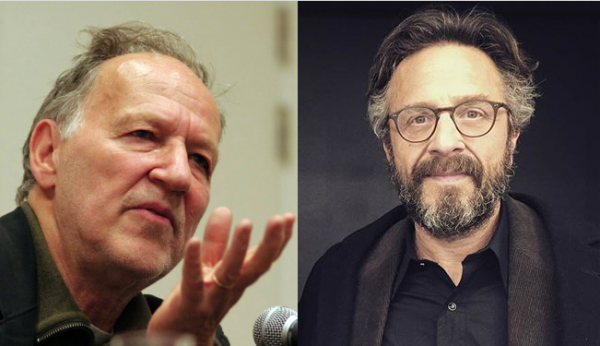
Image by Erinc Salor and The Necessary Evil, via Wikimedia Commons
Heads up: In the latest episode of the WTF podcast, filmmaker Werner Herzog pays a visit to Marc Maron’s garage in Los Angeles, and they get into a wide-ranging conversation, talking about Herzog’s upbringing in war-torn Germany, his upcoming film projects and a good deal more. But inevitably they focus on Herzog’s new film, a meditation on the internet and technology called Lo And Behold: Reveries Of The Connected World, which opens in theaters this Friday. You can also watch it at home.
Feel free to stream Maron and Herzog’s conversation below. It starts around the 33:30 mark. Or hear it over at Maron’s website.
If you would like to support the mission of Open Culture, consider making a donation to our site. It’s hard to rely 100% on ads, and your contributions will help us continue providing the best free cultural and educational materials to learners everywhere. You can contribute through PayPal, Patreon, and Venmo (@openculture). Thanks!
Related Content:
Werner Herzog Will Teach His First Online Course on Filmmaking
Werner Herzog’s Rogue Film School: Apply & Learn the Art of Guerilla Filmmaking & Lock-Picking
Werner Herzog Picks His 5 Favorite Films
Read More...Hear VALIS, an Opera Based on Philip K. Dick’s Metaphysical Novel

Image by Pete Wesch, via Wikimedia Commons
Philip K. Dick died in 1982. His distinctive, some say visionary brand of psychological sci-fi literature, however, has lived on, proving its endurance in part by taking new forms. Blade Runner, Ridley Scott’s hugely influential adaptation of Dick’s Do Androids Dream of Electric Sheep?, premiered just three months after the author’s departure. More films followed over the years, including Paul Verhoeven’s Total Recall (an adaptation of “We Can Remember It for You Wholesale”), Steven Spielberg’s Minority Report, Richard Linklater’s A Scanner Darkly, and many others.
Dick’s work has also provided the basis for radio dramas, television shows (most recently Netflix’s The Man in the High Castle, with an ambitious anthology series coming to Channel 4 this spring), and stage productions.
Typically, these adaptations use the stories and novels in which Dick wrote the setting, plot, and characters with relative straightforwardness. Other, later works found him plunging as deep into philosophy and autobiography as into science fiction. The change happened around the time he saw a mysterious pink light and met God in 1974, or claimed to, and it produced a final set of novels known as the VALIS trilogy.
The fractured tale of an authorial alter-ego named Horselover Fat, VALIS (short for “Vast Active Living Intelligence System”), the first book in the trilogy, involves an alien space probe, Watergate, the Messiah, lasers, and a range of references to religions like Christianity, Gnosticism, Buddhism, Gnosticism, Zoroastrianism, and the Red Cross Brotherhood; philosophy from the ancient Greeks to Plato, Pascal, and Schopenhauer; and cultural figures like Handel, Wagner, Goethe, and Frank Zappa. It would take an ambitious mind indeed to adapt such a thing: specifically, it took the mind of Tod Machover, composer and director of MIT’s Media Lab, who turned it into an opera in 1987.
“We live in a world that is becoming in fact more and more fragmented, more and more complex,” says Machover on the relevance of VALIS at an interview at the Philip K. Dick Fan Site. “You don’t have to have a pink light experience to realize that there is too much information to not only be aware of but to make any kind of sense out of.” He describes this “incredible feeling of the world being not only too complex for any one person to make sense out of but also dangerously complex, to the point where people will not only not understand each other but end up hating each other and being absolutely crushed under the burden of just trying to make sense with how much there is to know.”
In his VALIS opera, which premiered at Paris’ Centre Georges Pompidou with installations created by video artist Catherine Ikam, Machover tried to get that feeling artistically across, and you can hear it free on Spotify. (If you don’t have Spotify’s software, you can download it here. There’s a Youtube version right above.) Back then in the 80s, he says, it “seemed like through our media and communications there’d be a kind of facile way of connecting people, a sort of passivity and turning on your cable TV and seeing what’s going on today in Tokyo or in Europe and you sort of feel like you can take all this stuff in. But in fact I think what we’re seeing now is exactly what Dick predicted, which is that it ain’t that easy.” And it sure hasn’t got any easier.
Related Content:
Philip K. Dick Takes You Inside His Life-Changing Mystical Experience
Hear 6 Classic Philip K. Dick Stories Adapted as Vintage Radio Plays
33 Sci-Fi Stories by Philip K. Dick as Free Audio Books & Free eBooks
Based in Seoul, Colin Marshall writes and broadcasts on cities and culture. He’s at work on a book about Los Angeles, A Los Angeles Primer, the video series The City in Cinema, the crowdfunded journalism project Where Is the City of the Future?, and the Los Angeles Review of Books’ Korea Blog. Follow him on Twitter at @colinmarshall or on Facebook.
Read More...Watch Hannah Arendt’s Diagnosis of the Banality of Evil as an 8‑Bit Video Game
Permit us a couple of great oversimplifications: Hannah Arendt became well-known by writing about evil. Video games, especially classic ones, usually challenge the player to fight some kind of evil. And so we have a suitable, if at first seemingly incongruous, meeting of form and substance in this video, “What is Evil?,” from the 8‑Bit Philosophy series. It casts the 20th-century political theorist as the hero this time around, rendering in vintage video-game aesthetics her quest not simply to fight evil, but to identify evil — a much more troubling enterprise.
“Traditional conceptions of evil focus on the utter monstrosity of evil actions — the complete awe and unthinkability of horror,” says the narrator. “Called pure or radical evil, this is the sort of evil associated with antagonists or villains — is is the antithesis of good.”
It also happens to be just the sort of obvious straight-up evil video games tend to put their players up against: enemy ships you can only shoot down before they shoot you down, mad doctors you can only blow up before they blow the world up, monsters you can can only jump on before they eat you.
Arendt started seeing things differently from this black-and-white (or in the case of eight-bit video games, 64-color) conception after she saw the trial of Adolf Eichmann. “Put on trial for numerous horrors, Eichmann was found guilty of crimes against humanity — especially against the Jewish people, for overseeing the trains that transported people to Nazi death camps.” Sound like a mean piece of work though the guy may, Arendt beheld in the courtroom “an altogether innocuous and seemingly normal little man,” a “stereotypical bureaucrat” who “never stopped to put himself in anyone else’s shoes,” driven by an “unquestioning sense of obligation to authority.”
To put it in video-game terms, Arendt expected the sort of grotesque, cackling big boss that appears in the last stage, and she got the kind of drone who simply stands around waiting to be slain with one hit in the first. This led her to coin her immortal phrase “the banality of evil,” which, she explains in Eichmann in Jerusalem, describes it “only on the strictly factual level. He was not stupid. It was thoughtlessness, something by no means identical to stupidity. Such remoteness from reality can wreak more havoc than all the instincts taken together.” And what kind of sword, laser, or power-up could defeat that?
Related Content:
Hannah Arendt Discusses Philosophy, Politics & Eichmann in Rare 1964 TV Interview
Hannah Arendt’s Original Articles on “the Banality of Evil” in the New Yorker Archive
8‑Bit Philosophy: Plato, Sartre, Derrida & Other Thinkers Explained With Vintage Video Games
Existential Philosophy of Kierkegaard, Sartre, Camus Explained with 8‑Bit Video Games
Based in Seoul, Colin Marshall writes and broadcasts on cities and culture. He’s at work on a book about Los Angeles, A Los Angeles Primer, the video series The City in Cinema, the crowdfunded journalism project Where Is the City of the Future?, and the Los Angeles Review of Books’ Korea Blog. Follow him on Twitter at @colinmarshall or on Facebook.
Read More...Edward Wright Creates a List of His 1,000 Favorite Movies: Watch 10 of Them Free Online
There was a time when drawing up a list of your top ten favorite films of all time would suffice to establish yourself as a cinephile. But subsequent generations of ever more obsessive film-lovers have upped the ante — as, even more influentially, have the filmmaker-cinephiles. Quentin Tarantino (on whose favorite movies we have posted many a time) may still stand as that tribe’s living archetype, but his successors have made no secrets of the cinema they admire. Take, for instance, Edgar Wright, director of such intelligent comedies as Shaun of the Dead, Hot Fuzz, and The World’s End, and author (with MUBI’s Sam DiSalle) of a list of his top thousand favorite films of all time.
“Arranged in chronological order, Wright’s list kicks off with Robert Wiene’s 1920 classic The Cabinet of Dr. Caligari and concludes with Nicolas Winding Refn’s controversial horror flick The Neon Demon, which opened this year,” writes Entertainment Weekly’s Decvan Coggan. “In between are 998 eclectic choices, including everything from Citizen Kane and The Godfather to The Lobster and The LEGO Movie.” That may not come as much of a surprise to Wright’s fans, who appreciate the eclectic sensibility, both aesthetic and comedic, that permeates his films. Now they have a guide to follow, through its influence on his thoroughly 21st-century work, into nearly the entire history of cinema.
In fact, they can start right now with no fewer than ten pictures from the earlier part of his chronologically-arranged list. Follow the links below to our posts on them here on Open Culture, where you can watch them for free. The ones with an asterisk you can watch right here on this page.
- The Cabinet of Dr Caligari*
- Nosferatu
- The General*
- Metropolis
- Sunrise
- The Passion of Joan of Arc
- His Girl Friday
- Detour
- D.O.A.
Hyperkinetic humor, snappy dialogue, unreality, dystopia, menace: all qualities just as present in these classic movies as in Wright’s own. Once you’ve seen them, you’ll find your appreciation for his back catalog has risen to a whole new level — and they’ll no doubt place you well to have the fullest possible viewing experience of his latest picture, a crime comedy called Baby Driver, when it hits theaters next year.
Related Content:
Quentin Tarantino Picks the 12 Best Films of All Time; Watch Two of His Favorites Free Online
Martin Scorsese Makes a List of 85 Films Every Aspiring Filmmaker Needs to See
Orson Welles Names His 10 Favorite Films: From Chaplin’s City Lights to Ford’s Stagecoach
1,150 Free Movies Online: Great Classics, Indies, Noir, Westerns, etc.
Based in Seoul, Colin Marshall writes and broadcasts on cities and culture. He’s at work on a book about Los Angeles, A Los Angeles Primer, the video series The City in Cinema, the crowdfunded journalism project Where Is the City of the Future?, and the Los Angeles Review of Books’ Korea Blog. Follow him on Twitter at @colinmarshall or on Facebook.
Read More...Was a 32,000-Year-Old Cave Painting the Earliest Form of Cinema?
A few years ago, Werner Herzog’s acclaimed Cave of Forgotten Dreams pulled off an unlikely combination of technology and subject matter, using the latest in 3D cinema to capture the oldest known manmade images. But in the view of French archaeologist and filmmaker Marc Azéma, it must have made perfect sense as a kind of closing of a grand cultural loop. More than twenty years of research has made him see the kind of up to 32,000-year-old cave paintings shown in Herzog’s film as sequential images of man and beast, not just static ones — moving pictures, if you like — that emerge when arranged in a certain way.
Azéma’s short video “Sequential Animation: The First Paleolithic Animated Pictures” does that arranging for us, revealing how the early anatomical sketches found on the walls of caves in France and Portugal depict animal movement as the human artists perceived it. The connection to modern cinema, if you go through Eadweard Muybridge’s nineteenth-century studies of motion and then on to the products of the Lumière brothers’ early movie camera, looks clear indeed. Once we figured out how to satisfy our ages-long curiosity about how things move, we then, human ambition being what it is, had to find a way to turn the discovery toward artistic ends again.
“I don’t think it’s too much to call it an early form of cinema,” says Azéma in the segment from PRI’s The World embedded above. “It was the first grand form of communication, with an audience and pictures.” He points to the key concept of retinal persistence, or persistence of vision, “when you’ve got an image, then a successive image, and another image, and the retina follows what’s coming next,” which makes cinema possible in the first place — and which early man, who “had the need to get the images out of his brain and on the wall,” seems to have known something about. And what, we can hardly resist wondering, will cinema look like to the future generations who will regard even our biggest-budget 3D spectacles as, essentially, prehistoric cave paintings?
Related Content:
The History of the Movie Camera in Four Minutes: From the Lumiere Brothers to Google Glass
Watch the Films of the Lumière Brothers & the Birth of Cinema (1895)
We Were Wanderers on a Prehistoric Earth: A Short Film Inspired by Joseph Conrad
Hear the World’s Oldest Instrument, the “Neanderthal Flute,” Dating Back Over 43,000 Years
Based in Seoul, Colin Marshall writes and broadcasts on cities and culture. He’s at work on a book about Los Angeles, A Los Angeles Primer, the video series The City in Cinema, the crowdfunded journalism project Where Is the City of the Future?, and the Los Angeles Review of Books’ Korea Blog. Follow him on Twitter at @colinmarshall or on Facebook.
Read More...Portraits of Ellis Island Immigrants Arriving on America’s Welcoming Shores Circa 1907

The shibboleths of our political culture have trended lately toward the loathesome, crude, and completely specious to such a degree that at least one prominent columnist has summed up the ongoing spectacle in Cleveland as “grotesquerie… on a level unique in the history of our republic.” It’s impossible to quantify such a thing, but the sentiment feels accurate in the fervor of the moment. We’ll hear a torrent of well-worn counter-clichés at the other party’s big convention, and one of them that’s sure to come up again and again is the phrase “nation of immigrants.” The U.S., we’re told over and over, is a “nation of immigrants.” And it is. Or has become so, though the term “immigrant” is not an uncomplicated one, as we’ve seen in the EU’s struggle to parse “refugees” from “economic migrants.”

The U.S. is also a nation of indigenous people and former slaves, indentured servants, and settler colonists, all very different histories—and academic historians are careful not to blur the categories, even if politicians, ordinary citizens, and textbook publishers often do. Yet rhetoric about who owns the country, and who gets to “take it back,” clouds every issue—it belongs to everyone and no one, or as Wallace Stevens put it, “this is everybody’s world.”
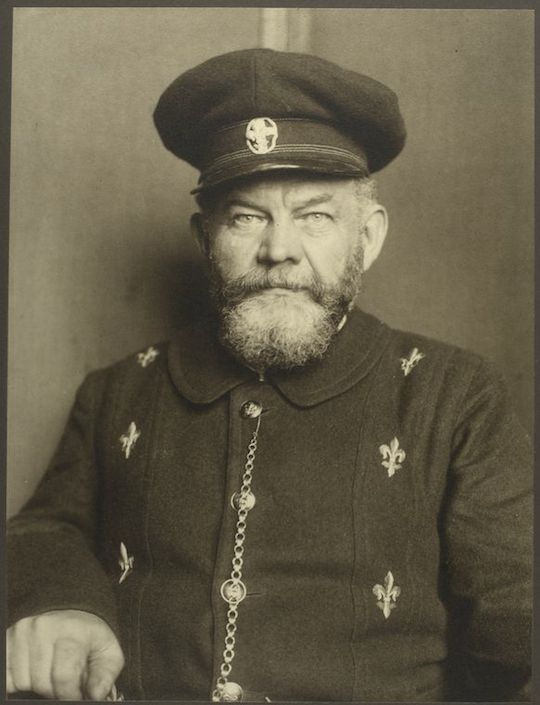
But when we talk about the history of immigration, we usually talk about a specific history dating from the mid-19th to early-20th century, during which diverse groups of people arrived from all over the world, bringing with them their languages, customs, food, and cultures, and only slowly becoming “Americans” as they naturalized and assimilated to various degrees, forcibly or otherwise. We also talk about a legal history that proscribed certain kinds of people and created hierarchies of desirable and undesirable immigrants with respect to ethnic and national origin and economic status.

Millions of the people who arrived during the peak of U.S. immigration passed through the immigration inspection station at New York’s Ellis Island, which operated between the years 1882 and 1954. The individuals and families who spent any time there were working people and peasants. Among new arrivals, “the first and second class passengers were considered wealthy enough,” writes The Public Domain Review, “not to become a burden to the state and were examined onboard the ships while the poorer passengers were sent to the island where they underwent medical examinations and legal inspections.”

Many of these individuals also sat for portraits taken by the Chief Registry Clerk Augustus Sherman while “waiting for money, travel tickets or someone to come and collect them from the island.” Sherman’s camera captured striking images like the poised Guadeloupean woman in profile at the top, the defiant German stowaway below her, stern Danish man further down, Algerian man and Italian woman above, and severe-looking trio of Dutch women and Georgian man below.

These photographs date from before 1907, which was the busiest year for Ellis Island, “with an all-time high of 11,747 immigrants arriving in April.” About two percent of immigrants at the time were denied entry because of disease, insanity, or a criminal background. That percentage of people turned away rose in the following decade, and the diversity of people coming to the country narrowed significantly in the 1920s, until the 1924 immigration act imposed strict quotas, “as immigrants from Southern and Eastern Europe were seen as inferior to the earlier immigrants from Northern and Western Europe” and those from outside the European continent were limited to a tiny fraction of the almost 165,000 allowed that year.

“Following the Red Scare of 1919,” writes the Densho Encyclopedia, “widespread fear of radicalism fueled anti-foreign sentiment and exclusionist demands. Supporters of immigration legislation stressed recurring themes: Anglo-Saxon superiority and foreigners as threats to jobs and wages.” Not coincidentally, during this time the country also saw the resurgence of the Klu Klux Klan, which—notes PBS—“moved in many states to dominate local and state politics.” It was a time that very much resembled our own, sadly, as fanatical nativism and white supremacy became dominant strains in the political discourse, accompanied by much fearmongering, demagoguery, and violence. (It was also in the teens and twenties that the idea of a superior “Western Civilization” was invented.)
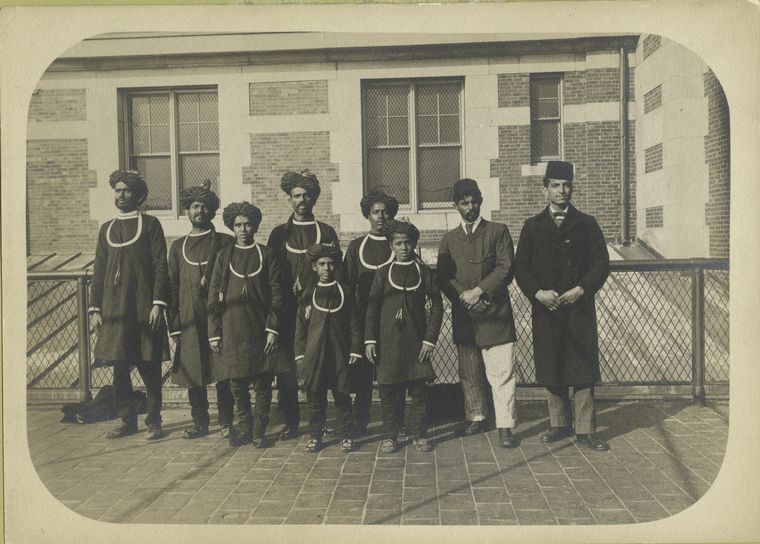
The portraits above were published in National Geographic and “hung on the walls of the lower Manhattan headquarters of the federal Immigration Service” in 1907, before the hysteria began. They show us the human face of an abstract phenomenon far too often used as an epithet or catch-all scare word rather than a fact of human existence since humans have existed. Becoming acquainted with the history of immigration in the U.S. allows us to see how we have handled it well in the past, and how we have handled it badly, and the photographic evidence preserves the dignity of the various individual people from all over the world who were lumped together collectively—as they are today—with the loaded word “immigrant.”

These images come from the New York Public Library’s online archive of Ellis Island Photographs, which contains 89 photos in all, including several exterior and interior shots of the island’s facilities and many more portraits of arriving people. We’re grateful to the Public Domain Review (who have a fascinating new book on Nitrous Oxide coming out) for bringing these to our attention. For more of the NYPL’s huge repository of historical photographs, see their Flickr gallery of over 2,500 photos or full digital photography collection of over 180,000 images.

Related Content:
478 Dorothea Lange Photographs Poignantly Document the Internment of the Japanese During WWII
Josh Jones is a writer and musician based in Durham, NC. Follow him at @jdmagness.
Read More...Why Economics is for Everyone!, Explained in a New RSA Animated Video
It has been a while, but RSA has returned with another one of their whiteboard animated videos. During the early days of YouTube, they broke some aesthetic ground by animating Slavoj Zizek on the Surprising Ethical Implications of Charitable Giving; Barbara Ehrenreich (author of Nickel and Dimed) on The Perils of Positive Psychology; Daniel Pink on The Surprising Truth About What Motivates Us, and Stanford psychologist Philip Zimbardo on The Secret Powers of Time. Now, they’re back with the influential Cambridge economist Ha-Joon Chang explaining “why every single person can and SHOULD get their head around basic economics.” Here, Chang “pulls back the curtain on the often mystifying language of derivatives and quantitative easing, and explains how easily economic myths and assumptions become gospel,” helping you to “arm yourself with some facts” and take part in “discussions about the fundamentals that underpin our day-to-day lives.” If you want to get up to speed on economics, some of the resources below will undoubtedly give you a hand.
If you would like to support the mission of Open Culture, consider making a donation to our site. It’s hard to rely 100% on ads, and your contributions will help us continue providing the best free cultural and educational materials to learners everywhere. You can contribute through PayPal, Patreon, and Venmo (@openculture). Thanks!
Related Content:
Free Online Economics Courses
Morgan Spurlock, Werner Herzog & Other Stars Explain Economic Theory in 20 Short Films
The History of Economics & Economic Theory Explained with Comics, Starting with Adam Smith
Read More...French Artist Creates Digital Street Art in the Sky
We humans are a quarrelsome lot. But one thing that unites us is the time spent on our backs, gazing at clouds for the pleasure of identifying whatever objects they may fleetingly resemble.
It’s a very relaxing activity.
I was surprised there’s an actual, medical name for it: pareidolia, defined by Merriam-Webster as “the tendency to perceive a specific, often meaningful, image in a random or ambiguous visual pattern.”
Thomas Lamadieu, the artist whose work is showcased above, has a different, but not wholly unrelated condition.
Most of us prefer to contemplate the heavens in a bucolic setting. Lamadieu’s art compels him to look upwards from a more urban landscape. The tops of the buildings hemming him in supply with irregularly shaped frames, which he captures using a fish eye lens. Later, he fills them in with Microsoft Paint drawings, which frequently feature a bearded man whose t‑shirt is striped in sky blue. Negative space, not Crayola, supplies the color here.
Think of it as street art in the sky.
Not every day can be a brilliant azure, but it hardly matters when even Lamadieu’s grayest views exhibit a determined playfulness. It takes a very unique sort of eye to tease a pink nippled, stripe-limbed bunny from a steely UK sky.
Like many street artists, he takes a global approach, traveling the world in search of giant unclaimed canvases. His portfolio contains vistas originally captured in Hong Kong, South Korea, Germany, Spain, Austria, Canada, Belgium, and the United States, as well as his native France.
“The bearded man in my images stands for the sky itself,” he told The Independent, adding that his is a wholly secular vision.
View a gallery of Lamadieu’s sky art here.
h/t to reader Alan Goldwasser
Related Content:
Google Puts Online 10,000 Works of Street Art from Across the Globe
Ayun Halliday is an author, illustrator, and Chief Primatologist of the East Village Inky zine. Follow her @AyunHalliday
Read More...Support Us
We're hoping to rely on loyal readers, rather than erratic ads. Please click the Donate button and support Open Culture. You can use Paypal, Venmo, Patreon, even Crypto! We thank you!

About Us

Open Culture scours the web for the best educational media. We find the free courses and audio books you need, the language lessons & educational videos you want, and plenty of enlightenment in between.
Advertise With Us

FREE UPDATES!
GET OUR DAILY EMAIL
Get the best cultural and educational resources on the web curated for you in a daily email. We never spam. Unsubscribe at any time.
FOLLOW ON SOCIAL MEDIA

Open Culture editor Dan Colman scours the web for the best educational media. He finds the free courses and audio books you need, the language lessons & movies you want, and plenty of enlightenment in between.
Advertise With Us


