Enter an Archive of 6,000 Historical Children’s Books, All Digitized and Free to Read Online
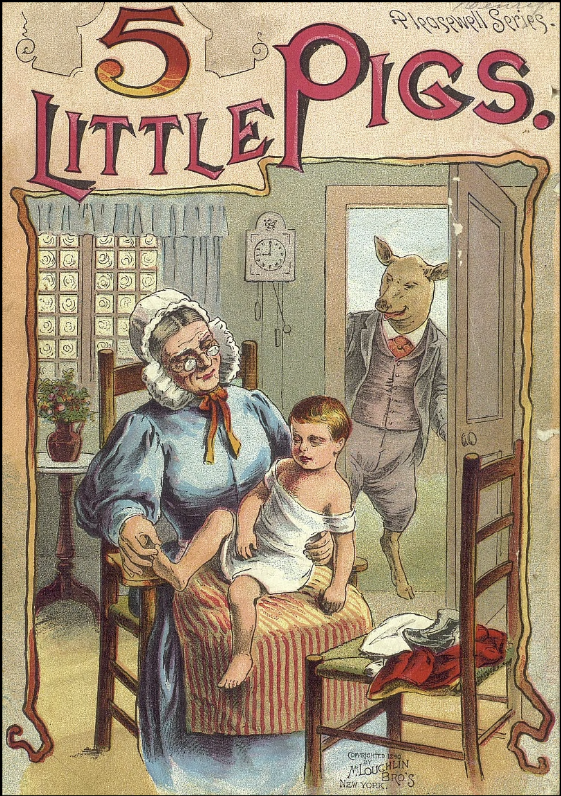
We can learn much about how a historical period viewed the abilities of its children by studying its children’s literature. Occupying a space somewhere between the purely didactic and the nonsensical, most children’s books published in the past few hundred years have attempted to find a line between the two poles, seeking a balance between entertainment and instruction. However, that line seems to move closer to one pole or another depending on the prevailing cultural sentiments of the time. And the very fact that children’s books were hardly published at all before the early 18th century tells us a lot about when and how modern ideas of childhood as a separate category of existence began.
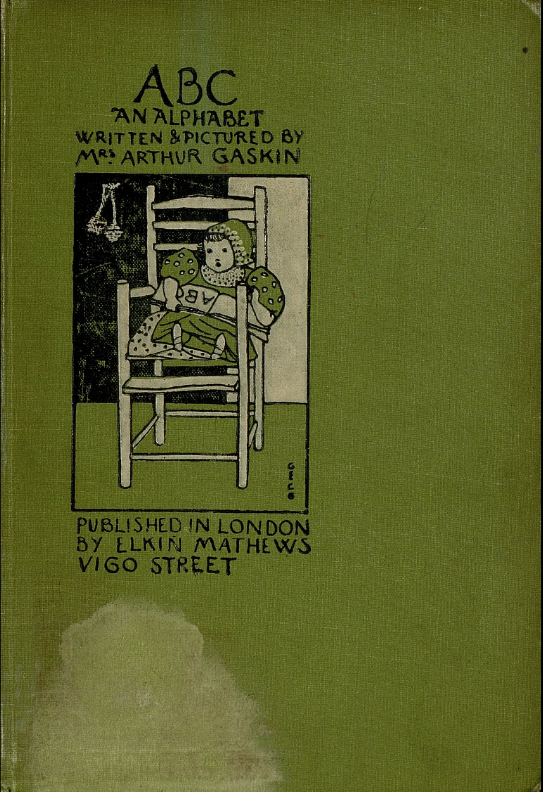
“By the end of the 18th century,” writes Newcastle University professor M.O. Grenby, “children’s literature was a flourishing, separate and secure part of the publishing industry in Britain.” The trend accelerated rapidly and has never ceased—children’s and young adult books now drive sales in publishing (with 80% of YA books bought by grown-ups for themselves).
Grenby notes that “the reasons for this sudden rise of children’s literature” and its rapid expansion into a booming market by the early 1800s “have never been fully explained.” We are free to speculate about the social and pedagogical winds that pushed this historical change.
Or we might do so, at least, by examining the children’s literature of the Victorian era, perhaps the most innovative and diverse period for children’s literature thus far by the standards of the time. And we can do so most thoroughly by surveying the thousands of mid- to late 19th century titles at the University of Florida’s Baldwin Library of Historical Children’s Literature. Their digitized collection currently holds over 6,000 books free to read online from cover to cover, allowing you to get a sense of what adults in Britain and the U.S. wanted children to know and believe.
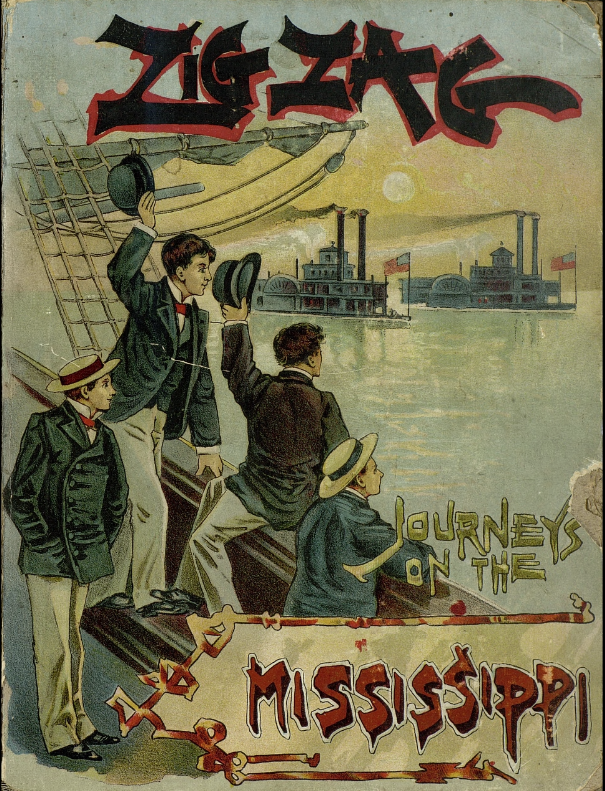
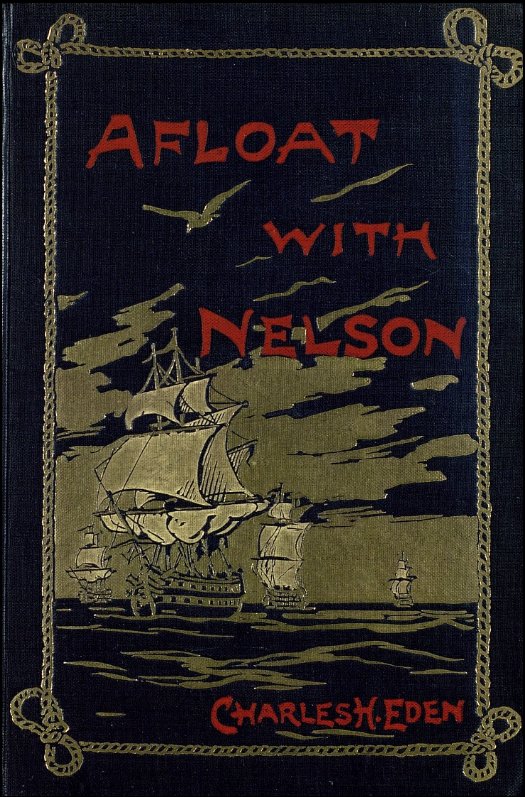
Several genres flourished at the time: religious instruction, naturally, but also language and spelling books, fairy tales, codes of conduct, and, especially, adventure stories—pre-Hardy Boys and Nancy Drew examples of what we would call young adult fiction, these published principally for boys. Adventure stories offered a (very colonialist) view of the wide world; in series like the Boston-published Zig Zag and English books like Afloat with Nelson, both from the 1890s, fact mingled with fiction, natural history and science with battle and travel accounts. But there is another distinctive strain in the children’s literature of the time, one which to us—but not necessarily to the Victorians—would seem contrary to the imperialist young adult novel.
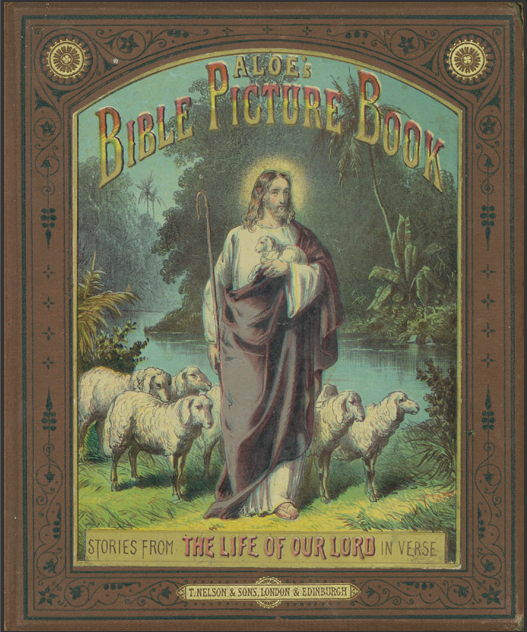
For most Victorian students and readers, poetry was a daily part of life, and it was a central instructional and storytelling form in children’s lit. The A.L.O.E.’s Bible Picture Book from 1871, above, presents “Stories from the Life of Our Lord in Verse,” written “simply for the Lord’s lambs, rhymes more readily than prose attracting the attention of children, and fastening themselves on their memories.” Children and adults regularly memorized poetry, after all. Yet after the explosion in children’s publishing the former readers were often given inferior examples of it. The author of the Bible Picture Book admits as much, begging the indulgence of older readers in the preface for “defects in my work,” given that “the verses were made for the pictures, not the pictures for the verses.”
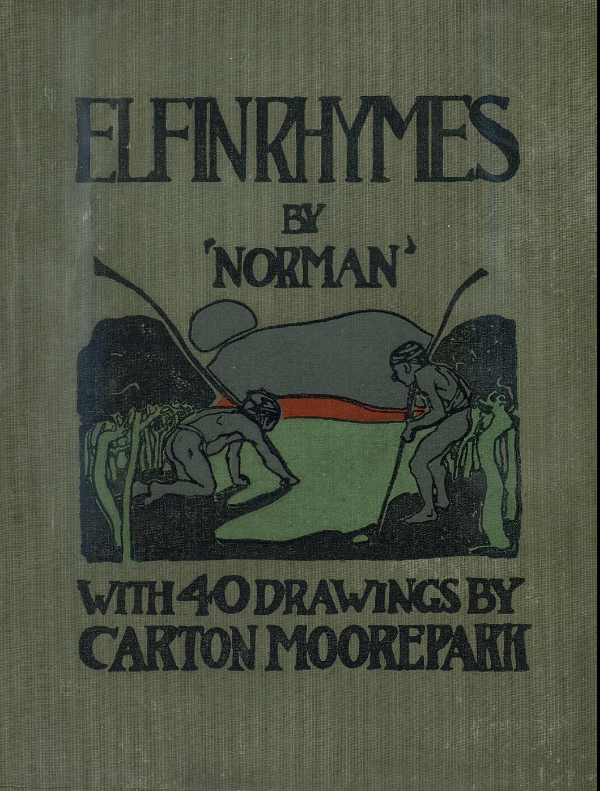
This is not an author, or perhaps a type of literature, one might suspect, that thinks highly of children’s aesthetic sensibilities. We find precisely the opposite to be the case in the wonderful Elfin Rhymes from 1900, written by the mysterious “Norman” with “40 drawings by Carton Moorepark.” Whoever “Norman” may be (or why his one-word name appears in quotation marks), he gives his readers poems that might be mistaken at first glance for unpublished Christina Rossetti verses; and Mr. Moorepark’s illustrations rival those of the finest book illustrators of the time, presaging the high quality of Caldecott Medal-winning books of later decades. Elfin Rhymes seems like a rare oddity, likely published in a small print run; the care and attention of its layout and design shows a very high opinion of its readers’ imaginative capabilities.
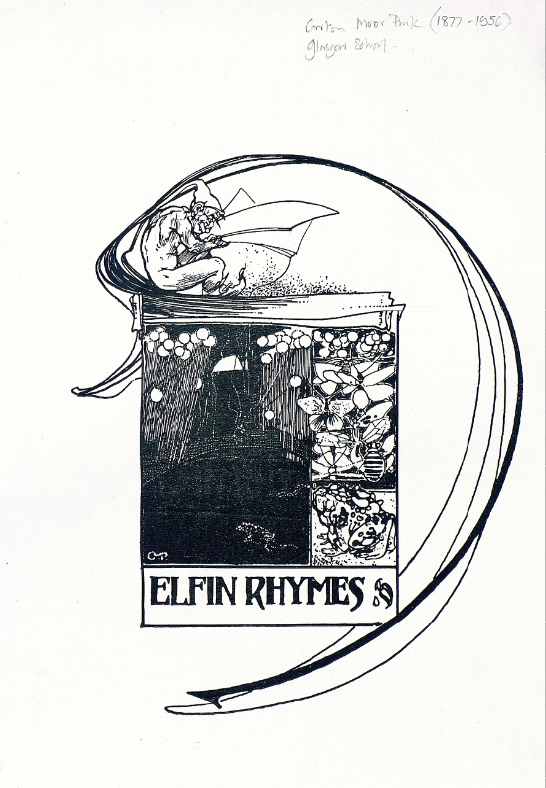
This title is representative of an emerging genre of late Victorian children’s literature, which still tended on the whole, as it does now, to fall into the trite and formulaic. Elfin Rhymes sits astride the fantasy boom at the turn of the century, heralded by hugely popular books like Frank L. Baum’s Wizard of Oz series and J.M. Barrie’s Peter Pan. These, the Harry Potters of their day, made millions of young people passionate readers of modern fairy tales, representing a slide even further away from the once quite narrow, “remorselessly instructional… or deeply pious” categories available in early writing for children, as Grenby points out.
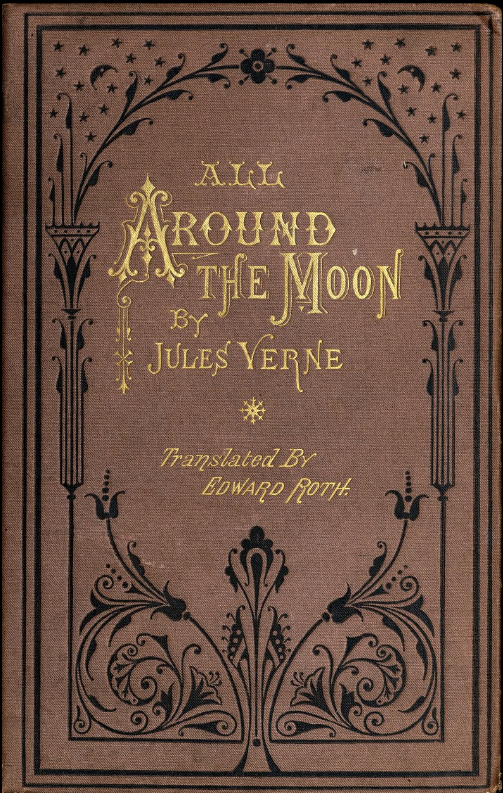
Where the boundaries for kids’ literature had once been narrowly fixed by Latin grammar books and Pilgrim’s Progress, by the end of the 19th century, the influence of science fiction like Jules Verne’s, and of popular supernatural tales and poems, prepared the ground for comic books, YA dystopias, magician fiction, and dozens of other children’s literature genres we now take for granted, or—in increasingly large numbers—we buy to read for ourselves. Enter the Baldwin Library of Historical Children’s Literature here, where you can browse several categories, search for subjects, authors, titles, etc, see full-screen, zoomable images of book covers, download XML versions, and read all of the over 6,000 books in the collection with comfortable reader views. Find more classics in our collection, 800 Free eBooks for iPad, Kindle & Other Devices.
Related Content:
The First Children’s Picture Book, 1658’s Orbis Sensualium Pictus
The Anti-Slavery Alphabet: 1846 Book Teaches Kids the ABCs of Slavery’s Evils
The International Children’s Digital Library Offers Free eBooks for Kids in Over 40 Languages
Josh Jones is a writer and musician based in Durham, NC. Follow him at @jdmagness
Read More...Tilda Swinton Gets a Portrait Drawn by Art Critic John Berger
In the winter of 2012, just before Christmas, a carful of Britons made their way through the snow to a house in rural France. The roads would soon close, but no matter; they’d planned to make some apple crumbles, do some drawing, and enjoy some conversation. This may all sound normal enough, but the car didn’t contain your average cottage-staying holidaymakers: the critic and filmmaker Colin MacCabe rode in it, as did Tilda Swinton, the actress as famed for her performances as for her range of artistic and intellectual interests. They’d come to shoot a documentary on the occupant of the house at which they’d arrived: artist, critic, writer, and self-described “storyteller” John Berger.
The novel G. won Berger the Booker prize in 1972 (half of the prize money from which he famously donated to Britain’s Black Panther Party), but most of his readers encounter him through that same year’s Ways of Seeing, a text on the ideology of images that ranks among the twenty most influential academic books of all time.
He and Swinton first became friends in the late 1980s, when she played a small part in a film based on one of his short stories, in which he himself also appeared. “The old intellectual and the young actress immediately formed a close bond,” writes The Independent’s Geoffrey McNab.
“Both were born in London, on 5 November — Berger in 1926, Swinton in 1960 — and their shared birthday has, as Swinton puts it, ‘formed a bedrock to our complicity, the practical fantasy of twinship.’ ” This they discuss in the McCabe-directed “Ways of Listening,” the first of a quartet of segments that constitute the new documentary The Seasons In Quincy: Four Portraits of John Berger, a co-production of Birkbeck, University of London’s Derek Jarman Lab. “Sometimes I think it’s as though, in another life, we met or did something,” says Berger as he draws Swinton’s portrait. “We are aware of it in some department which isn’t memory, although it’s quite close to memory. Maybe, in another life, we… touched together.”
“Ways of Listening” captures an extended conversation between Berger and Swinton, though it also features their narration. In this scene, Berger reads from his recent meditation on the practice of drawing for his book Bento’s Sketchbook: “We who draw do so not only to make something visible to others, but also to accompany something invisible to its incalculable destination.” (Swinton, for her part, reads from Spinoza.) But the talk returns to what brought them together in the first place. “Maybe we made an appointment to see each other again, in this life,” Berger proposes. “The fifth of November. But it wasn’t the same year. That didn’t matter. We weren’t in that kind of time.”
“We got off at the same station.”
“Exactly.”
Related Content:
Tilda Swinton Recites Poem by Rumi While Reeking of Vetiver, Heliotrope & Musk
Wittgenstein: Watch Derek Jarman’s Tribute to the Philosopher, Featuring Tilda Swinton (1993)
Watch David Bowie’s New Video for ‘The Stars (Are Out Tonight)’ With Tilda Swinton
The 20 Most Influential Academic Books of All Time: No Spoilers
Based in Seoul, Colin Marshall writes and broadcasts on cities and culture. He’s at work on a book about Los Angeles, A Los Angeles Primer, the video series The City in Cinema, the crowdfunded journalism project Where Is the City of the Future?, and the Los Angeles Review of Books’ Korea Blog. Follow him on Twitter at @colinmarshall or on Facebook.
Read More...1850s Japan Comes to Life in 3D, Color Photos: See the Stereoscopic Photography of T. Enami

For about a quarter of a millennium, Japan had a policy called sakoku, literally meaning “closed country,” which put to death foreigners who dared enter to Japan, or Japanese who dared to leave it. It came to an end with the Meiji Restoration, the period between 1868 to 1912, during which Japan put the Emperor back in charge and, as historians often say, began to “open up” to the outside world, lighting out on the path to its own kind of modernity. Foreigners would still have had only a vague idea of Japanese life at the time — at least those without access to a stereoscope, and who thus couldn’t lay eyes on the vivid 3D photography of Yokohama’s T. Enami.

“To many whose lives revolved around photography — including both Japanese and foreign professionals, as well as serious amateurs — Enami was not just a photographer, but a ‘photographer’s photographer,’ ” writes Enami enthusiast Rob Oechsle on his site t‑enami.org. He also dubs his photographic hero (who was born Nobukuni Enami in 1859 and lived until 1929, seeing the end of the Meiji era but not the beginning of the second world war) “King of the Stereoview, Master of the Lantern-Slide, Prolific, Anonymous Contributor To the World of Meiji-era Yokohama Album Views, Dedicated Street Photographer, and Honored Alumnus of National Geographic Magazine.”
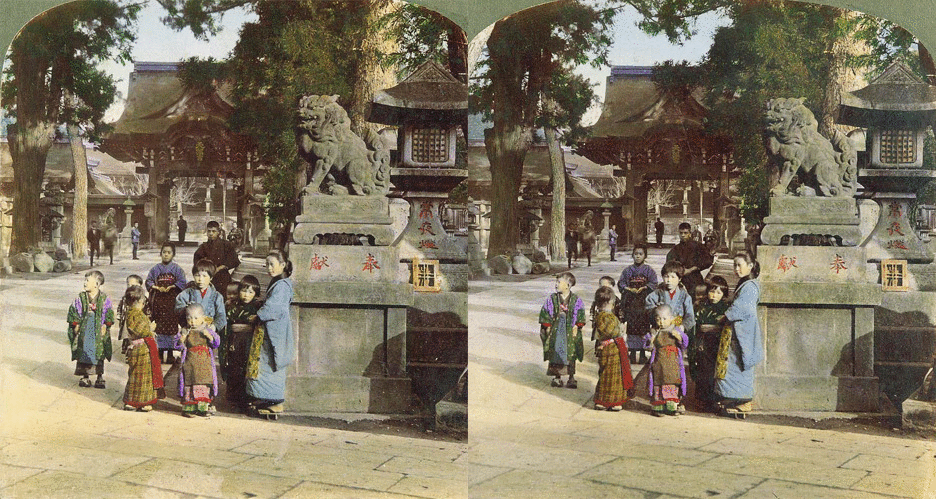
That first title has granted a portion of Enami’s large body of work a surprising recent afterlife. Following in his teacher’s footsteps, Enami refined the Japanese use of the stereographic camera, a device that produced, writes the Victoria and Albert Museum’s Zoe Clayton, a stereograph: “two pictures mounted next to each other, viewed with a set of lenses known as a stereoscope. Taken around 7cm apart, roughly corresponding to the spacing of the eyes, the left picture represents what the left eye would see, and likewise for the right, so when observing the pictures through a stereoscopic viewer, the pair of photographs converge into a single three-dimensional image.”
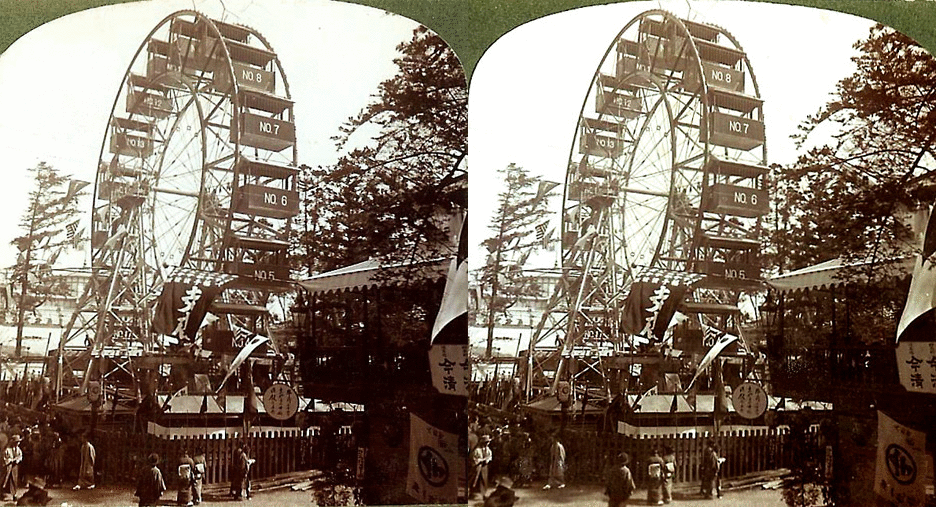
Advertised with slogans like “See the world from your parlor!,” this “optical marvel took the world by storm in the mid 19th century, becoming the first ever mass-produced photographic images sold,” their popularity such that “every Victorian home — regardless of class — had a stereoscope and a collection of views.” And though the years have made stereoscopes a little hard to come by, the internet has discovered that you can enjoy something like the same 3D effect Victorian viewers did by looking at an animated GIF that oscillates quickly between the left picture and the right one. Enami hand-tinted many of his stereographs, resulting in colored historical images that look, even in two dimensions, startlingly realistic today.
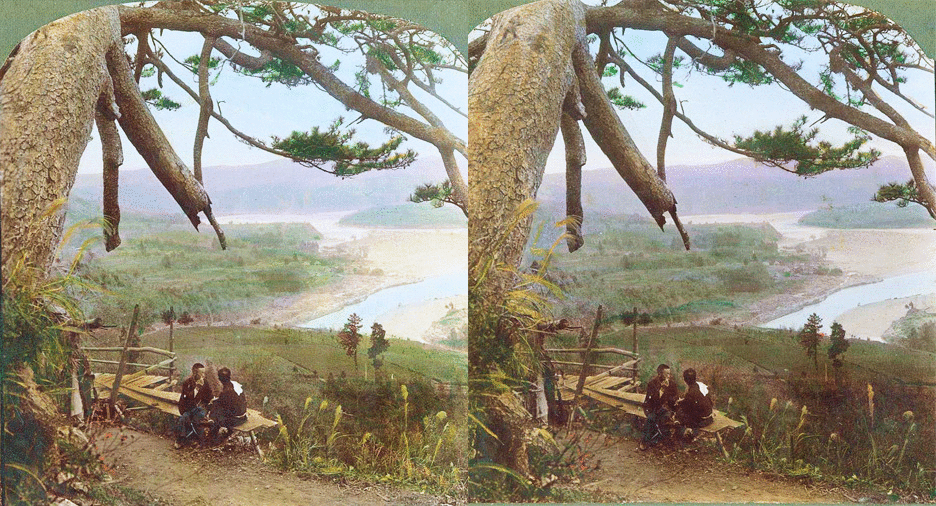
Here we present only a few of Enami’s stereographs, but you can see a much fuller collection at Oeschle’s “Old Japan in 3D” Flickr page. He survived 1923’s Great Kantō earthquake, but his studio didn’t; he rebuilt it and later passed it on to his son, who ran the place until it underwent a second destruction in 1945 by Allied bombs. Though Enami’s name remains known primarily to fans of Meiji-era photography, his posthumous reputation has slowly but steadily grown: one of his photos even appeared on the cover of the first edition of Odyssey: the Art of Photography at National Geographic. These GIFs have already sparked an interest in Enami’s work among a new generation. When 3D monitors catch on, perhaps he’ll rise to his true place in the photographic pantheon.
via Boing Boing
Related Content:
Hand-Colored 1860s Photographs Reveal the Last Days of Samurai Japan
Hand-Colored Photographs of 19th Century Japan
Advertisements from Japan’s Golden Age of Art Deco
Glorious Early 20th-Century Japanese Ads for Beer, Smokes & Sake (1902–1954)
Early Japanese Animations: The Origins of Anime (1917–1931)
A Photographic Tour of Haruki Murakami’s Tokyo, Where Dream, Memory, and Reality Meet
Based in Seoul, Colin Marshall writes and broadcasts on cities and culture. He’s at work on a book about Los Angeles, A Los Angeles Primer, the video series The City in Cinema, the crowdfunded journalism project Where Is the City of the Future?, and the Los Angeles Review of Books’ Korea Blog. Follow him on Twitter at @colinmarshall or on Facebook.
Read More...Angelo Badalamenti Reveals How He and David Lynch Composed the Twin Peaks’ “Love Theme”
On my last trip to New York, some friends took me to a favorite new-wave Chinese place of theirs. When I asked where to find the bathroom, they said to go downstairs. The staircase deposited me into one of the most surreal bathroom approaches I’ve ever experienced: a long, narrow, fully mirrored hallway with a hauntingly familiar composition piped in from speakers installed along its length. Not until I resurfaced and asked what the deal was could I identify the music: the “Love Theme” from David Lynch’s early-1990s television series Twin Peaks.
Many TV themes have lodged themselves into our collective memory, mostly through sheer repetition, but few have retained as much evocative power as the one Lynch’s composer, Angelo Badalamenti, recorded for his short-lived postmodern detective show.
It had that power from the moment Badalamenti put his fingers to the keyboard, a story told in the clip above. “What do you see, David?” he remembers asking the director as he sits down before the very same Fender Rhodes on which he composed Twin Peaks’ major themes all those years ago. “Just talk to me.”
“We’re in a dark woods,” Badalamenti recalls Lynch first saying. “There’s a soft wind blowing through sycamore trees. There’s a moon out, some animal sounds in the background. You can hear the hoot of an owl. Just get me into that beautiful darkness.” Badalamenti plays as he played then, which drew an immediate response from Lynch: “Angelo, that’s great. I love that. That’s a good mood. But can you play it slower?” With the feedback loop between the scene in Lynch’s mind and the mood of Badalamenti’s music engaged, Lynch added a detail: “From behind a tree, in the back of the woods, is this very lonely girl. Her name is Laura Palmer.”
Badalamenti lightens his improvisation in a way that makes it somehow eerier. “That’s it!” The composer and the director play off one another’s ideas, almost like two long-collaborating musicians in a jam session. “She’s walking toward the camera, she’s coming closer… just keep building it! Just keep building it!” Eventually, they’ve created an entire rising and falling dramatic arc in this single piece of music (arguably more dramatic than the one created by the series itself, which Lynch left after two seasons). “David got up, gave me a big hug, and said, ‘Angelo, that’s Twin Peaks’ ” — and to this day, a part of the culture.
Related Content:
Hear the Music of David Lynch’s Twin Peaks Played by the Danish National Symphony Orchestra
Play the Twin Peaks Video Game: Retro Fun for David Lynch Fans
David Lynch’s Twin Peaks Title Sequence, Recreated in an Adorable Paper Animation
David Lynch Draws a Map of Twin Peaks (to Help Pitch the Show to ABC)
Elementary School Students Perform in a Play Inspired by David Lynch’s Twin Peaks
David Lynch Directs a Mini-Season of Twin Peaks in the Form of Japanese Coffee Commercials
Based in Seoul, Colin Marshall writes and broadcasts on cities and culture. He’s at work on a book about Los Angeles, A Los Angeles Primer, the video series The City in Cinema, the crowdfunded journalism project Where Is the City of the Future?, and the Los Angeles Review of Books’ Korea Blog. Follow him on Twitter at @colinmarshall or on Facebook.
Read More...Star Trek Postage Stamps Coming Soon: Celebrating 50 Years of Exploring the Final Frontier
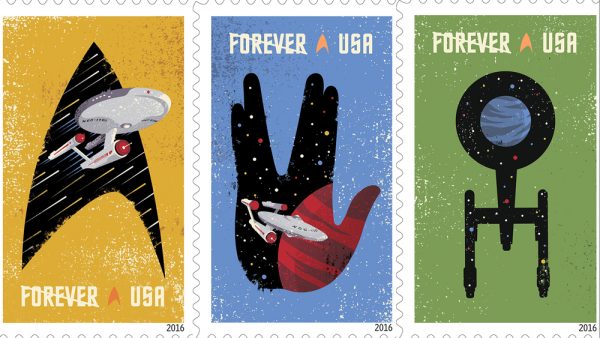
The original Star Trek TV series took to the airwaves nearly 5o years ago–on September 8, 1966. Poor ratings meant that the show didn’t last very long (only three years). But everything changed once the show went into syndication. It achieved cult status. And a franchise was born. The original Star Trek has now spawned five additional tv series, 13 feature films, and a number of fan-made sequels.
To celebrate 50 years of Star Trek, the US Postal Service has decided to release a commemorative set of stamps inspired by the original show. The four stamps (shown above) depict the following:
- The Starship Enterprise inside the outline of a Starfleet insignia against a gold background.
- The silhouette of a crewman in a transporter against a red background.
- The silhouette of the Enterprise from above against a green background.
- The Enterprise inside the outline of the Vulcan salute (Spock’s iconic hand gesture) against a blue background.
The stamps will be officially available on September 2, though they can be pre-ordered here.
Related Content:
How Isaac Asimov Went from Star Trek Critic to Star TrekFan & Advisor
Nichelle Nichols Explains How Martin Luther King Convinced Her to Stay on Star Trek
Star Wars Uncut: The Epic Fan Film
Read More...Penn Jillette Makes the Philosophical & Pragmatic Case for Libertarianism
For an anarchist like Noam Chomsky, libertarianism as it’s understood in the U.S. is a corruption of the term. Throughout their political history, Chomsky argues, “real” Libertarians have been anti-Capitalist—and he includes under this heading such classical liberals as Adam Smith and Thomas Jefferson, as well as modern anarcho-socialists like himself. Modern U.S. Libertarians like Ron and Rand Paul, Milton Friedman, and Robert Nozick have all meant something very different by the term, and certainly haven’t agreed on what that is. So what exactly is Libertarianism?
Given popular misconceptions—and some less than stellar public relations moments—one perhaps gets a clearest idea of what American Libertarianism is by reading about what it isn’t, as in this essay from one of its most contrarian theorists, Murray Rothbard. Or we can spend a few minutes with that voluble comedic magician Penn Jillette, a well-known face of Libertarian and atheist thought for many years. Jillette’s thesis in his eighteen-minute Big Think video above comes down to this: “we think you should take as little from other people by force as possible and you should be able to do whatever you think is right.” Libertarianism, Jillette elaborates, “is the strongest sense of ‘please, do what you want, try not to hurt me.”
The concept he refers to is one Isaiah Berlin wrote of as “negative liberty,” or the principle of noninterference, a staple of all Libertarian thought. The heavy stress on individual rights has come in for critique as naïve, but as Rothbard notes, “no individualist denies that people are influencing each other all the time.” Libertarian thinkers have wrestled with the conflict (if not contradiction) between maximal individual freedom and freedom from harm. Robert Nozick, for example, extended his discussion beyond our responsibilities to each other to a moral case study of our duties toward animals. Responsibility stands as a key term in Jillette’s articulation of Libertarianism—a sine qua non of a Libertarian society.
But is there such a thing as a functioning Libertarian society? Or does Jillette describe an unrealizable utopia that depends not only on most people acting responsibly, but also on most people acting rationally? As he himself says, “Libertarianism is taking a right on money, your first left on sex, and looking for utopia straight ahead.” This language aside, he doesn’t seem to operate under the illusion that people always make the best choices for themselves or their families. As part of his argument, however, he admits he isn’t qualified or desirous to make those choices for other people when he can often barely discern the right course of action for himself. As it generally does, this course of reasoning brings us to the problem of taxation in Libertarian thought.
Jillette’s appeal seems commonsensical and pragmatic, and after his general pitch, he launches into a critique of corporate capitalism that could come right out of a Chomsky talk—in some small part, that is. Jillette believes that, absent most government interference, we would have such a thing as a “true free market” in which everyone could compete fairly and without coercion. This is a position even Nozick softened on many years after his classic Anarchy, State, and Utopia, calling it “seriously inadequate” and admitting that many democratic institutions Libertarians want to abolish preserve “our equal human dignity, our autonomy and powers of self-direction.”
Whatever we make of Jillette’s laissez faire ideology, his critiques of government speak to Libertarians on either side of the economics divide. He makes an incisive case against Clinton, then tears into Trump’s willingness to “give easy answers.” Holding up career politicians Bernie Sanders and Gary Johnson as “paragons” may seem a bit much, given Jillette’s forceful argument for a healthy and thoroughgoing mistrust of government. As he says in the earlier Big Think interview above, “part of the joy and the wonder and the brilliance of the ideas of the United States of America that whoever’s in power is questioned and beat up.”
He does not, of course, mean that last part in any literal sense. While Libertarianism has perhaps been tarred by association with an increasingly violent right, it would be a mistake to lump Jillette in with certain political opportunists who at one time or another have used the term to describe themselves. His commitment to anti-war and drug legalization policies is unwavering, and he makes a strong, well-reasoned case for his politics. It’s one worth hearing out whether you agree or not in the end.
Related Content:
Noam Chomsky on Whether the Rise of Trump Resembles the Rise of Fascism in 1930s Germany
Josh Jones is a writer and musician based in Durham, NC. Follow him at @jdmagness
Read More...The Accidental Origin of the Hit Song ‘American Woman’: Randy Bachman Tells the Story
In one of our favorite old posts, guitarist Randy Bachman did us a favor when he mercifully demystified the opening chord of The Beatles’ ‘A Hard Day’s Night.’ Mystery finally solved.
Today, he returns and brings us inside the making of another classic song–“American Woman,” which Bachman co-wrote as a member of The Guess Who in 1970. In the clip above, the musician reflects on his “antiwar protest song” and its memorable riff. You know it. It goes dum dum dadada dada dada dada dum dum dadada dada da dum. The riff came about by accident, the happy byproduct of a broken guitar string and some spur of the moment improvisation. I’ll let Randy tell you the rest of the story.
Related Content:
Guitarist Randy Bachman Demystifies the Opening Chord of The Beatles’ ‘A Hard Day’s Night’
Read More...Prof. Brian Cox Has a Maddening Conversation with a Climate Science-Denying Politician
According to NASA’s Goddard Institute for Space Studies, July 2016 was the warmest month ever recorded. 2016 will likely be the warmest year on record. And the decades ahead will only get worse, much worse.
And yet, notes physicist Lawrence Krauss in The New Yorker this weekend, we have the GOP’s Frankenstein trying to demagogue his way into the presidency by calling climate science into question. Krauss writes:
In May, for instance, while speaking to an audience of West Virginia coal miners, Trump complained that regulations designed to protect the ozone layer had compromised the quality of his hair spray. Those regulations, he continued, were misguided, because hair spray is used mainly indoors, and so can have no effect on the atmosphere outside.…
Often, Trump is simply wrong about science, even though he should know better. Just as he was a persistent “birther” even after the evidence convincingly showed that President Obama was born in the United States, Trump now continues to propagate the notion that vaccines cause autism in spite of convincing and widely cited evidence to the contrary… In other cases, Trump treats scientific facts the way he treats other facts—he ignores or distorts them whenever it’s convenient. He has denied that climate change is real, calling it pseudoscience and advancing a conspiracy theory that “the concept of global warming was created by and for the Chinese in order to make U.S. manufacturing noncompetitive.”
And way across the pond, we have another politician, Australian Senator Malcolm Roberts, making his own kind of laughable claims. In a recent television broadcast, Roberts asks physicist Brian Cox for empirical proof that climate change exists. Cox offers evidence gathered by NASA, to which Roberts responds, NASA’s “data has been corrupted and manipulated.” Not good enough. If you regularly read our site, you know that this is not the first time that NASA has been accused of manipulating data. Conspiracy theorists have long accused NASA and Stanley Kubrick of faking the moon landing in 1969. Roberts bristles at being associated with these loons. But frankly it’s an apt comparison. And if anyone should be bothered by the comparison, it’s the moon landing conspiracists. However strange their theories might be, no one doubts that they’re heartfelt, genuine, and seemingly free from the hint of political and financial influence.
In the meantime, in a new video from NASA, you can see the Arctic ice levels retreating to one of the lowest levels in recorded history. Call the video “corrupted” and “manipulated” at your own peril.
Related Content:
Global Warming: A Free Course from UChicago Explains Climate Change
Michio Kaku & Noam Chomsky School Moon Landing and 9/11 Conspiracy Theorists
Carl Sagan Presents His “Baloney Detection Kit”: 8 Tools for Skeptical Thinking
Richard Feynman Creates a Simple Method for Telling Science From Pseudoscience (1966)
Sally Ride Warns Against Global Warming; Wonders If Technology Can Save Us From Ourselves
Read More...Oliver Sacks’ Final Interview: A First Look
It’s been nearly a year since the poet laureate of medicine, author and neurologist Oliver Sacks, took his final bow as a sentient being on this beautiful planet, succumbing, at 82, to metastases of ocular melanoma which spread to his liver.
The New Yorker marks the occasion by publishing Sacks’ fellow neurologist and author Dr. Orrin Devinsky’s recollection of their longstanding friendship. Devinsky paints a vivid picture of an exceptionally compassionate man, who felt a kinship not only with starfish, jellyfish, and octopi, but also humans in both financial and emotional need.
The piece becomes even more powerful in light of Sacks’ final interview, above, part of filmmaker Ric Burns’ upcoming documentary, Oliver Sacks: His Own Life.
Sacks peppers his remarks with astonishing biological tidbits, a compulsion that delighted his friend Devinsky on their frequent early morning bike rides along New York City’s west side.
(Palatal myoclonus—or rhythmic pulsing—in the palate, eardrum and strap muscles are vestigial evidence that humans once had gills!)
(The dandelion’s name evolved from dent de lion, French for lion’s tooth, a structure the spikes on its serrated leaves could be said to resemble. Also, certain dandelion species reproduce asexually, and Sacks had no fear about eating an unwashed specimen he plucked from the questionably sanitary grounds of Riverside Park!)
The musings that warrant the melancholy piano and strings accompanying Burns’ excerpt are of a more personal nature. Sacks’ was totally immersed in his chosen subject. His mother was a comparative anatomist and surgeon, and his boyish interest in the hard sciences is what led him to biology. A lifetime of scientific observation and clinical interaction only add to the poetry of his thoughts on death:
My generation is on the way out, and each death I have felt as an abruption, a tearing away of part of myself. There will be nobody like us when we are gone, but then there is nobody like anybody ever. When people die they cannot be replaced. They leave holes that cannot be filled. It is the fate, the genetic and neural fate of every human being to be a unique individual, to find his own path, to live his own life, to die his own death. Even so, I am shocked and saddened at the sentence of death, and I cannot pretend I am without fear. But my predominant feeling is one of gratitude. I have loved and been loved. I have been given much and I have given something in return. I have read and traveled and thought and written. I have had an intercourse with the world, the special intercourse of writers and readers. Above all, I have been a sentient being, a thinking animal on this beautiful planet, and this in itself has been an enormous privilege and adventure.
Related Content:
A Fascinating Case Study by Oliver Sacks Inspires a Short Animated Film, The Lost Mariner
Oliver Sacks’ Last Tweet Shows Beethoven’s “Ode to Joy” Movingly Flashmobbed in Spain
Ayun Halliday is an author, illustrator, theater maker and Chief Primatologist of the East Village Inky zine. Her latest comic contrasts the birth of her second child with the uncensored gore of Game of Thrones. Follow her @AyunHalliday
Read More...Read the Original 32-Page Program for Fritz Lang’s Metropolis (1927)
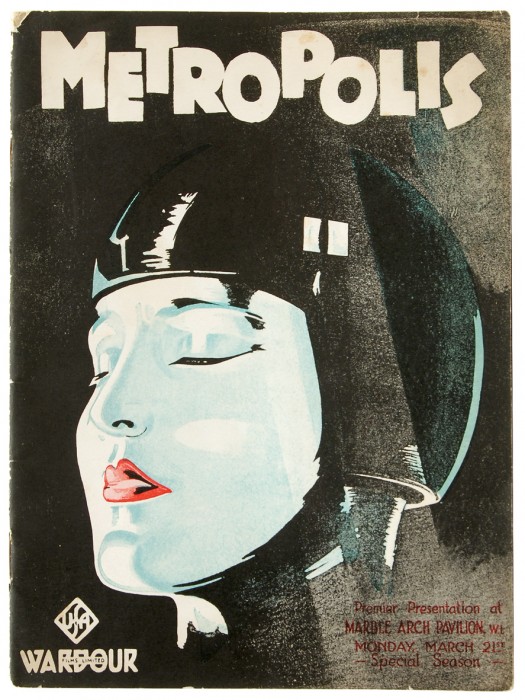
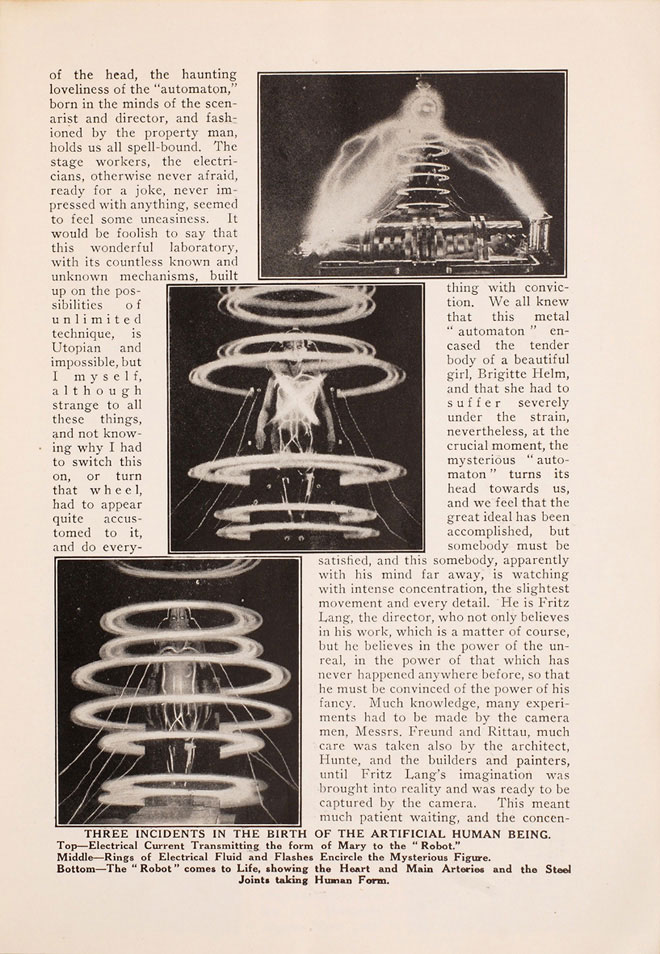
One of the very first feature-length sci-fi films ever made, Fritz Lang’s Metropolis took a daring visual approach for its time, incorporating Bauhaus and Futurist influences in thrillingly designed sets and costumes. Lang’s visual language resonated strongly in later decades. The film’s rather stunning alchemical-electric transference of a woman’s physical traits onto the body of a destructive android—the so-called Maschinenmensch—for example, began a very long trend of female robots in film and television, most of them as dangerous and inscrutable as Lang’s. And yet, for all its many imitators, Metropolis continues to deliver surprises. Here, we bring you a new find: a 32-page program distributed at the film’s 1927 premier in London and recently re-discovered.
In addition to underwriting almost one hundred years of science fiction film and television tropes, Metropolis has had a very long life in other ways: Inspiring an all-star soundtrack produced by Giorgio Moroder in 1984,with Freddie Mercury, Loverboy, and Adam Ant, and a Kraftwerk album. In 2001, a reconstructed version received a screening at the Berlin Film Festival, and UNESCO’s Memory of the World Register added it to their roster. 2002 saw the release of an exceptional Metropolis-inspired anime with the same title. And in 2010 an almost fully restored print of the long-incomplete film—recut from footage found in Argentina in 2008—appeared, adding a little more sophistication and coherence to the simplistic story line.
Even at the film’s initial reception, without any missing footage, critics did not warm to its story. For all its intense visual futurism, it has always seemed like a very quaint, naïve tale, struck through with earnest religiosity and inexplicable archaisms. Contemporary reviewers found its narrative of generational and class conflict unconvincing. H.G. Wells—“something of an authority on science fiction”—pronounced it “the silliest film” full of “every possible foolishness, cliché, platitude, and muddlement about mechanical progress and progress in general served up with a sauce of sentimentality that is all its own.” Few were kinder when it came to the story, and despite its overt religious themes, many saw it as Communist propaganda.
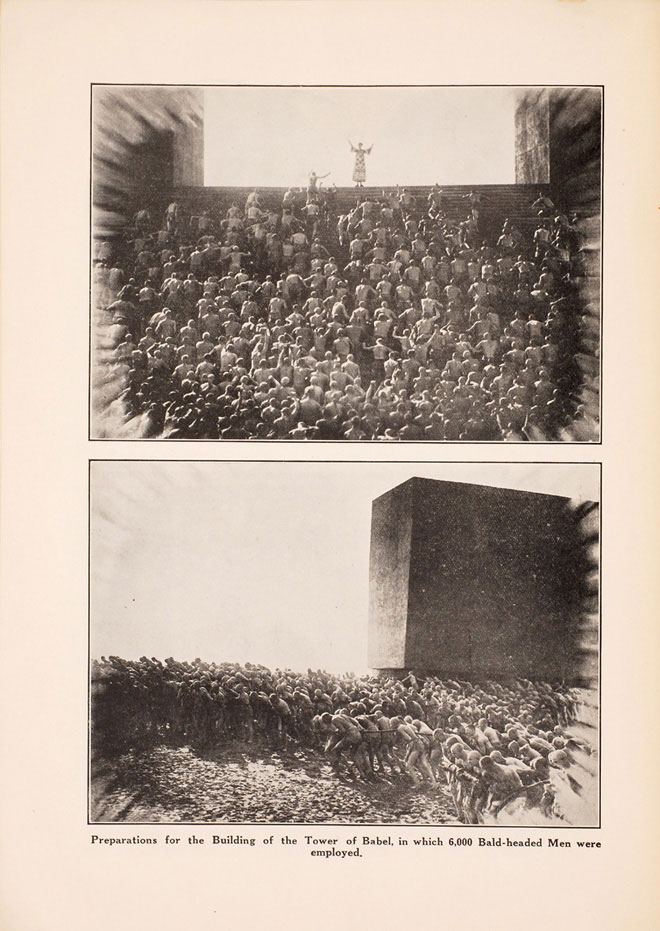
Viewed after subsequent events in 20th century Germany, many of the film’s scenes appear “disturbingly prescient,” writes the Unaffiliated Critic, such as the vision of a huge industrial machine as Moloch, in which “bald, underfed humans are led in chains to a furnace.” Lang and his wife Thea von Harbou—who wrote the novel, then screenplay—were of course commenting on industrialization, labor conditions, and poverty in Weimar Germany. Metropolis’s “clear message of classism,” as io9 writes, comes through most clearly in its arresting imagery, like that horrifying, monstrous furnace and the “looming symbol of wealth in the Tower of Babel.”
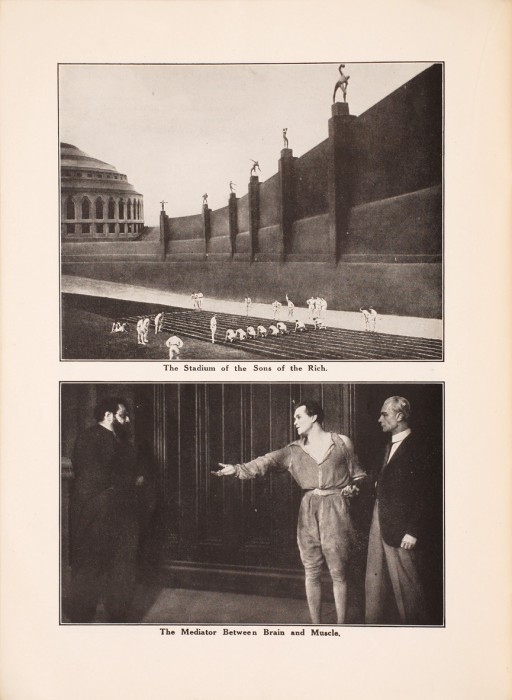
The visual effects and spectacular set pieces have worked their magic on almost everyone (Wells excluded) who has seen Metropolis. And they remain, for all its silliness, the primary reason for the movie’s cultural prevalence. Wired calls it “probably the most influential sci-fi movie in history,” remarking that “a single movie poster from the original release sold for $690,000 seven years ago, and is expected to fetch even more at an auction later this year.”
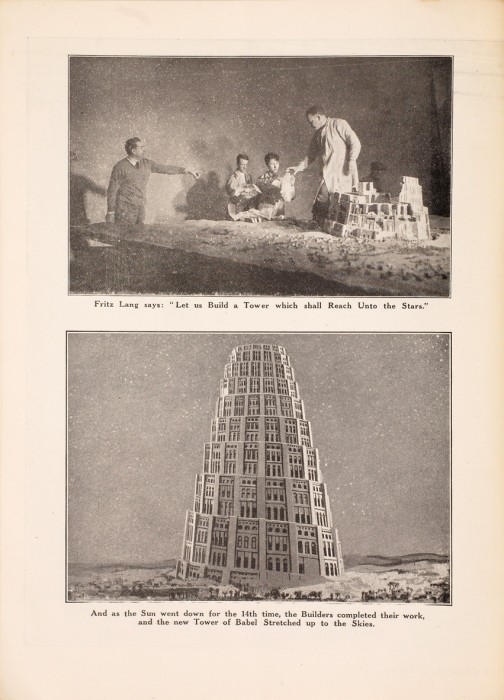
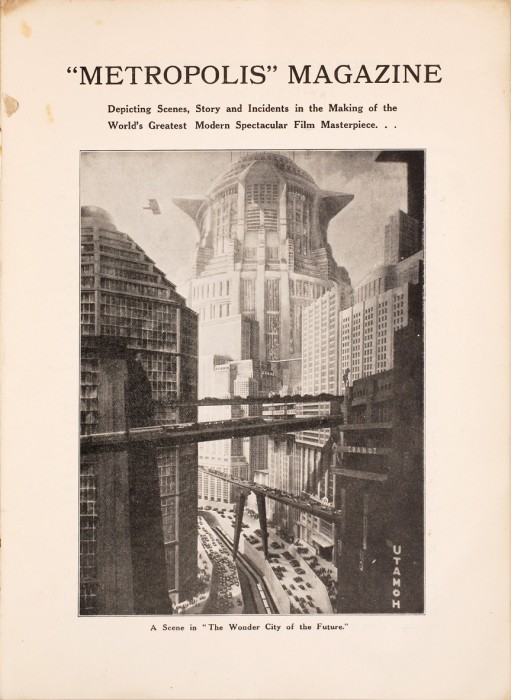
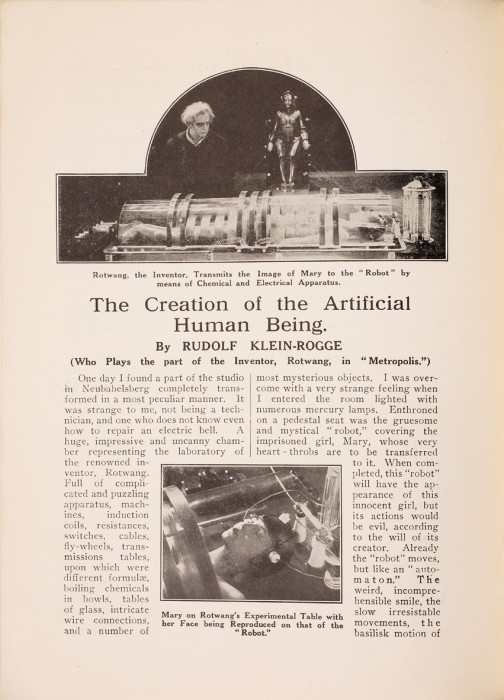
We now have another artifact from the movie’s premiere, this 32-page program, appropriately called “Metropolis” Magazine, that offers a rich feast for audiences, and text at times more interesting than the film’s script. (You can view the program in full here.) One imagines had they possessed backlit smart phones, those early moviegoers might have found themselves struggling not to browse their programs while the film screened. But, of course, Metropolis’s visual excesses would hold their attention as they still do ours. Its scenes of a futuristic city have always enthralled viewers, filmmakers, and (most) critics, such that Roger Ebert could write of “vast futuristic cities” as a staple of some of the best science fiction in his review of the 21st-century animated Metropolis—“visions… goofy and yet at the same time exhilarating.”
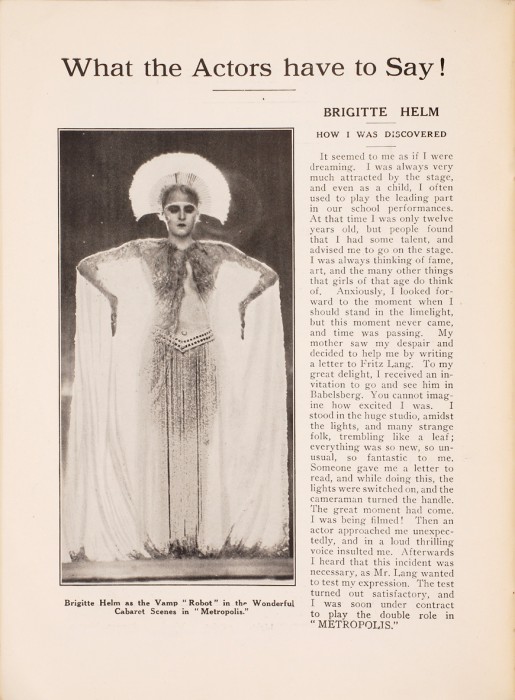
The program really is an astonishing document, a treasure for fans of the film and for scholars. Full of production stills, behind-the-scenes articles and photos, technical minutiae, short columns by the actors, a bio of Thea von Harbau, the “authoress,” excerpts from her novel and screenplay placed side-by-side, and a short article by her. There’s a page called “Figures that Speak” that tallies the production costs and cast and crew numbers (including very crude drawings and numbers of “Negroes” and “Chinese”). Lang himself weighs in, laconically, with a breezy introduction followed by a classic silent-era line: “if I cannot succeed in finding expression on the picture, I certainly cannot find it in speech.” Film history agrees, Lang found his expression “on the picture.”
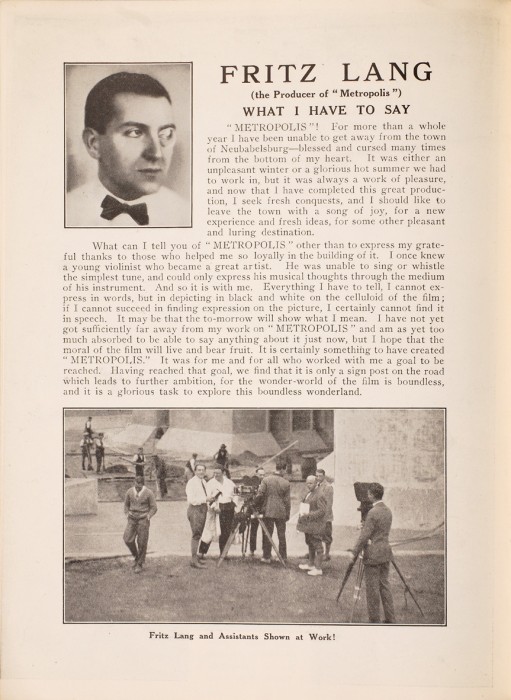
“Only three surviving copies of this program are known to exist,” writes Wired, and one of them, from which these pages come, has gone on sale at the Peter Harrington rare book shop for 2,750 pounds ($4,244)—which seems rather low, given what an original Metropolis poster went for. But markets are fickle, and whatever its current or future price, ”Metropolis” Magazine is invaluable to cineastes. See all 32 pages of the program at Peter Harrington’s website.
via Wired
Related Content:
Metropolis: Watch a Restored Version of Fritz Lang’s Masterpiece (1927)
Metropolis II: Discover the Amazing, Fritz Lang-Inspired Kinetic Sculpture by Chris Burden
Josh Jones is a writer and musician based in Durham, NC. Follow him at @jdmagness
Read More...Support Us
We're hoping to rely on loyal readers, rather than erratic ads. Please click the Donate button and support Open Culture. You can use Paypal, Venmo, Patreon, even Crypto! We thank you!

About Us

Open Culture scours the web for the best educational media. We find the free courses and audio books you need, the language lessons & educational videos you want, and plenty of enlightenment in between.
Advertise With Us

FREE UPDATES!
GET OUR DAILY EMAIL
Get the best cultural and educational resources on the web curated for you in a daily email. We never spam. Unsubscribe at any time.
FOLLOW ON SOCIAL MEDIA

Open Culture editor Dan Colman scours the web for the best educational media. He finds the free courses and audio books you need, the language lessons & movies you want, and plenty of enlightenment in between.
Advertise With Us


