Artificial Intelligence Program Tries to Write a Beatles Song: Listen to “Daddy’s Car”
Last May, we told you about Flow Machine, an artificial intelligence-driven music composer that analyses composer’s styles and then creates new works from that data. Developed by François Pachet at Sony CSL-Paris, the initial experiments demonstrated Beethoven’s “Ode to Joy” as played in the style of bossa nova, the Beatles’ “Penny Lane,” and Ennio Morricone’s romantic work. Admittedly, it wasn’t the most stunning moment in A.I.—a computer was now doing what arrangers have been doing for years, applying genre rules to a melody created in another genre.
However, Flow Machine has returned with an interesting development: two upcoming albums of A.I.-created songs, from which two tunes have been released to give you a taste of computer creativity. French composer and musician Benoît Carré helped out with the arrangements and production of the songs, and also wrote the lyrics, so it’s not completely an A.I. creation, we should note.
So what should we make of “Daddy’s Car,” above, an attempt to create an A.I song in the style of the Beatles? The opening seconds feature the three-part harmony of “Because,” but when the band kicks in, it’s closer to the Beach Boys’ Pet Sounds than the Fab Four. (If anything, it’s closer to the High Llamas.)
But does it sound like it was written by a human? Yes.
For something stranger, try the other song released so far: “Mr. Shadow,” written “in the style of American songwriters such as Irving Berlin, Duke Ellington, George Gershwin and Cole Porter.”
Now this is much odder, a mix of country twang, Daniel Lanois-style ambience, along with a vocal that sounds like a corrupted audio file. If you are looking for a true glimpse of the future, wrap your ears and sanity around this one. Musicians and music fans, let us know in the comments what you think about this brave new world that has such hit singles in it.
Related Content:
Noam Chomsky Explains Where Artificial Intelligence Went Wrong
Ted Mills is a freelance writer on the arts who currently hosts the FunkZone Podcast. You can also follow him on Twitter at @tedmills, read his other arts writing at tedmills.com and/or watch his films here.
Read More...“Somewhere Over the Rainbow” Played on a 1929 Theremin
Here in America, we’re living in some anxious times. And frankly my nerves are a little torn and frayed–especially after the run-up to last night’s debate. Maybe some of you feel the same. Maybe you could stand to relax a bit. Maybe this will do the trick.
Above, watch Peter Pringle perform on the theremin “Over the Rainbow,” the song originally written for 1939’s The Wizard of Oz. And it’s not just any theremin. It’s the 1929 RCA theremin that belonged to the Hollywood thereminist, Dr. Samuel Hoffman. In fact, it’s the very same one that Hoffman played on The Tonight Show with Johnny Carson in 1956, below.
If you would like to support the mission of Open Culture, consider making a donation to our site. It’s hard to rely 100% on ads, and your contributions will help us continue providing the best free cultural and educational materials to learners everywhere. You can contribute through PayPal, Patreon, and Venmo (@openculture). Thanks!
Related Content:
Read More...The Art of Making Old-Fashioned, Hand-Printed Books
Reports of traditional books’ death are greatly exaggerated, thanks in part to the success of print-on-demand publishing and other digital innovations.
As thrilled as we are about the survival of the printed page—it’s a relief to have something to read after Wi-Fi fails during the zombie invasion—the craftsmanship that goes into hand-printed, hand-bound volumes is an almost-lost art.
The Victoria and Albert Museum’s video, above, documents the painstaking process, beginning with the arranging of metal type that will result in an octavo, the most common type of book.
It’s a quiet endeavor, though surely a bit louder than the V&A’s silent documentation, an unusual choice given a certain segment of the millennial populace’s appetite for well-edited artisanal craft videos in which music plays a big part.
A well-deployed tune could elevate these lovely visuals to the realms of the advanced elegy.
YouTube user, Kraftsman Sheng, attempts to remedy the situation by reproducing the video (sans attribution) with a soundtrack of his own choosing—pianist Roger Williams’ syrupy 1965 rendition of “Softly As I Leave You,” below.
An unconventional choice, to be sure. I should think something baroque would go better with all of this meticulous folding, cutting, and binding.
Though perhaps something a little more robust could highlight the hardcore heroism of the artisans toiling to keep this ancient art alive. Electric Lit has a round up of great book-inspired punk songs, of which “Time” by Richard Hell and the Voidoids seems particularly apt.
Print’s not dead!
via Atlas Obscura
Related Content:
Oxford University Presents the 550-Year-Old Gutenberg Bible in Spectacular, High-Res Detail
Ayun Halliday is an author, illustrator, theater maker and Chief Primatologist of the East Village Inky zine. Her play Zamboni Godot is opening in New York City in March 2017. Follow her @AyunHalliday.
Read More...An Animated David Lynch Explains Where He Gets His Ideas
“Where do you get your ideas?” Every artist dreads having to answer that most common of all questions. Well, every artist with the exception of David Lynch. The director of such modern cinematic quasi-nightmares as Eraserhead, Blue Velvet, and Mulholland Drive will gladly explain exactly where he gets his ideas: from his own consciousness, “the TV in your mind.”
He’ll also gladly explain how he gets them by, not to mix the metaphor too much, using the folksy terms of fishing: “Ideas are like fish. If you want to catch little fish, you can stay in the shallow water. But if you want to catch the big fish, you’ve got to go deeper.” And to bait the hook with? Why, bits of other ideas. Those words come from his 2006 book Catching the Big Fish: Meditation, Consciousness, and Creativity, a slim volume on this and that which gets into some detail about his use of Transcendental Meditation as a kind of fishing pole to reel those especially compelling ideas in from one’s consciousness.
A couple of years after that, Lynch sat down with The Atlantic to talk about his special brand of creativity (as distinct from his special brand of coffee, no doubt also a fuel for thought). They’ve just recently animated his remarks to make the short video above, a visualization of his idea-getting processes, including daydreaming, traveling, and looking into a puddle in the gutter.
“I always say it’s like there’s a man in another room with the whole film together, but they’re in puzzle parts,” says Lynch as hands chop a fish into frames of celluloid. “He’s flipping one piece at a time into me. At first it’s very abstract; I don’t have a clue. More pieces come, more ideas are caught. It starts forming a thing. And then one day, there it is. In a way, there’s no original ideas. It’s just the ideas that you caught.”
The ideas Lynch has caught have become, among other things, some of the most memorable films of the late 20th century — and, according to last month’s BBC poll, the best film of the 21st century so far. What’s more, he claims not to have suffered for them, illustrating his argument of suffering as antithetical to creativity with an imaginary scenario of a diarrhea-afflicted Van Gogh. As for what part of his consciousness he fished that image out of, perhaps we’d rather not know.
Related Content:
David Lynch Explains Where His Ideas Come From
Patti Smith and David Lynch Talk About the Source of Their Ideas & Creative Inspiration
David Lynch Explains How Meditation Enhances Our Creativity
Based in Seoul, Colin Marshall writes and broadcasts on cities and culture. He’s at work on a book about Los Angeles, A Los Angeles Primer, the video series The City in Cinema, the crowdfunded journalism project Where Is the City of the Future?, and the Los Angeles Review of Books’ Korea Blog. Follow him on Twitter at @colinmarshall or on Facebook.
Read More...Hear George Orwell’s 1984 Adapted as a Radio Play at the Height of McCarthyism & The Red Scare (1953)
“If you want a picture of the future,” George Orwell famously said, “imagine a boot stamping on a human face, forever.” Since his ominous warning of coming tyranny, and the publication of his dystopian novel 1984, Orwell’s grim vision has been put to various partisan uses. Conservatives lamenting the policing of speech invoke Orwell. So too does a spectrum of voices speaking out against violent authoritarianism in actual policing, and in the politics of the right—related phenomena given the willingness of police and secret service to become enforcers of a campaign’s will at rallies nationwide. The state and corporate mass media have both become complicit in fostering a climate of outrage, mistrust, and insecurity in which there seems to be, as Orwell wrote, “no loyalty except loyalty to the Party.”
How did this happen? If we, in the United States, are ever inclined to learn from our history, we might avoid falling victim to the paranoid blandishments of demagogues and fearmongers. While one current threat to democracy comes from outside the political system, in the 1950s, an insider used several of the same tactics to hold the nation in thrall. The repressive postwar climate of anti-Communist panic in which Joseph McCarthy rose to power in the late 40s and 50s entrapped even Orwell, who “named names” in a list he sent to the British Foreign Office, suggesting certain acquaintances “were not fit for writing assignments” with the government because of supposed Soviet sympathies.
This secret act would have seemed like a bitter irony to many dissidents in McCarthy’s America, who surely read 1984 with increasing alarm as the Red Scare took hold of Congress. For their part, readers fearing the Communist threat heard echoes of Orwell’s warnings in McCarthy’s propaganda.
In whatever way it was interpreted, 1984 had an immediate impact on the culture. Its first radio dramatization, starring David Niven, premiered in 1949—the year after the novel’s publication—aired by the NBC University Theater. This was followed just four years later with another radio adaptation produced by The United States Steel Hour, a radio and TV anthology program that employed Rod Serling as a scriptwriter and featured notable guest stars like James Dean, Andy Griffith, Jack Klugman, and Paul Newman.
The program’s radio dramas, called Theatre Guild on the Air, adapted classic novels like Pride and Prejudice and plays from Eugene O’Neill and Tennessee Williams. Its 1953 radio play of 1984 starred Richard Widmark as “Smith” and Marian Seldes as “Julia.” The play opens—as you can hear above—with a dire announcement of “the most terrifying subject in the news today: the threat to all free men of Communism or totalitarian domination in any form.”
Whether they saw creeping Stalinism or the rabid anti-Communism of McCarthy as the more insidious force, readers of the 1950s found Orwell immediately relevant. He has remained so, such that conservative columnist David Brooks, who has made many an Orwell reference in the past, describes the recent “birtherism” turnaround as an “Orwellian inversion of the truth” in the PBS Newshour appearance above:
And so we are really in Orwell land. We are in “1984.” And it’s interesting that an authoritarian personality type comes in at the same time with a complete disrespect for even tangential relationship to the truth, that words are unmoored.
And so I do think this statement sort of shocked me with the purification of a lot of terrible trends that have been happening. And so what’s white is black, and what is up is down, what is down is up. And that really is something new in politics.
Like comparisons to another, all-too-real, totalitarian regime, references to Orwell’s authoritarian society have grown hoary over the decades, and often seem so elastic that they fall into trivializing cliché. But comparisons to fascism in a time when many vocal partisans are avowed fascists, or may as well be, seem almost tautological. The moment Brooks calls “Orwellian” above also seems precisely that—a willful, coordinated, blatant, and total reversal of political language’s relationship to anything even resembling the truth.
You can also stream the radio production at the Internet Archive, who host all 74 Theatre Guild on the Air productions. 1984 was the last of the radio dramas before The United States Steel Hour moved to television, where Rod Serling attracted controversy for his 1956 drama Noon at Doomsday, inspired by the Emmett Till case, and another Cold War work still terribly relevant to our time.
“The victim” of the play, wrote Serling in the intro to his 1957 collection Patterns, “was on old Jew who ran a pawnshop. The killer was a neurotic malcontent who lashed out at something or someone who might be materially and physically the scapegoat for his own unhappy, purposeless, miserable existence.” The episode immediately provoked “a welter of publicity that came from some 15,000 letters and wires from White Citizens Councils and the like protesting the production of the play” for its resemblance to the Till case. “I shrugged it off,” wrote Serling, “answering, ‘If the shoe fits.…’ ”
Related Content:
George Orwell’s Final Warning: Don’t Let This Nightmare Situation Happen. It Depends on You!
Huxley to Orwell: My Hellish Vision of the Future is Better Than Yours (1949)
Josh Jones is a writer and musician based in Durham, NC. Follow him at @jdmagness
Read More...A Map of Chicago’s Gangland: A Cheeky, Cartographic Look at Al Capone’s World (1931)
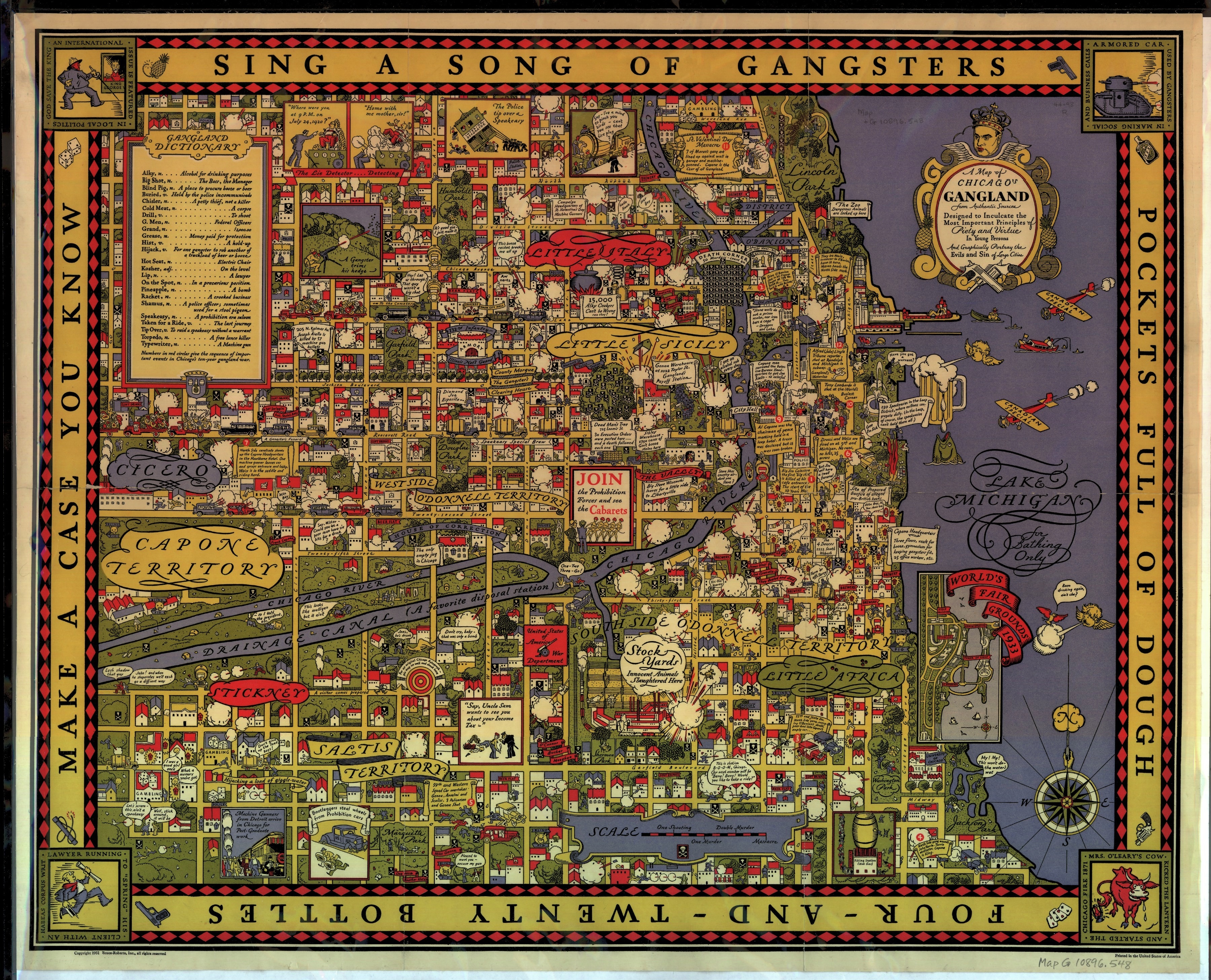
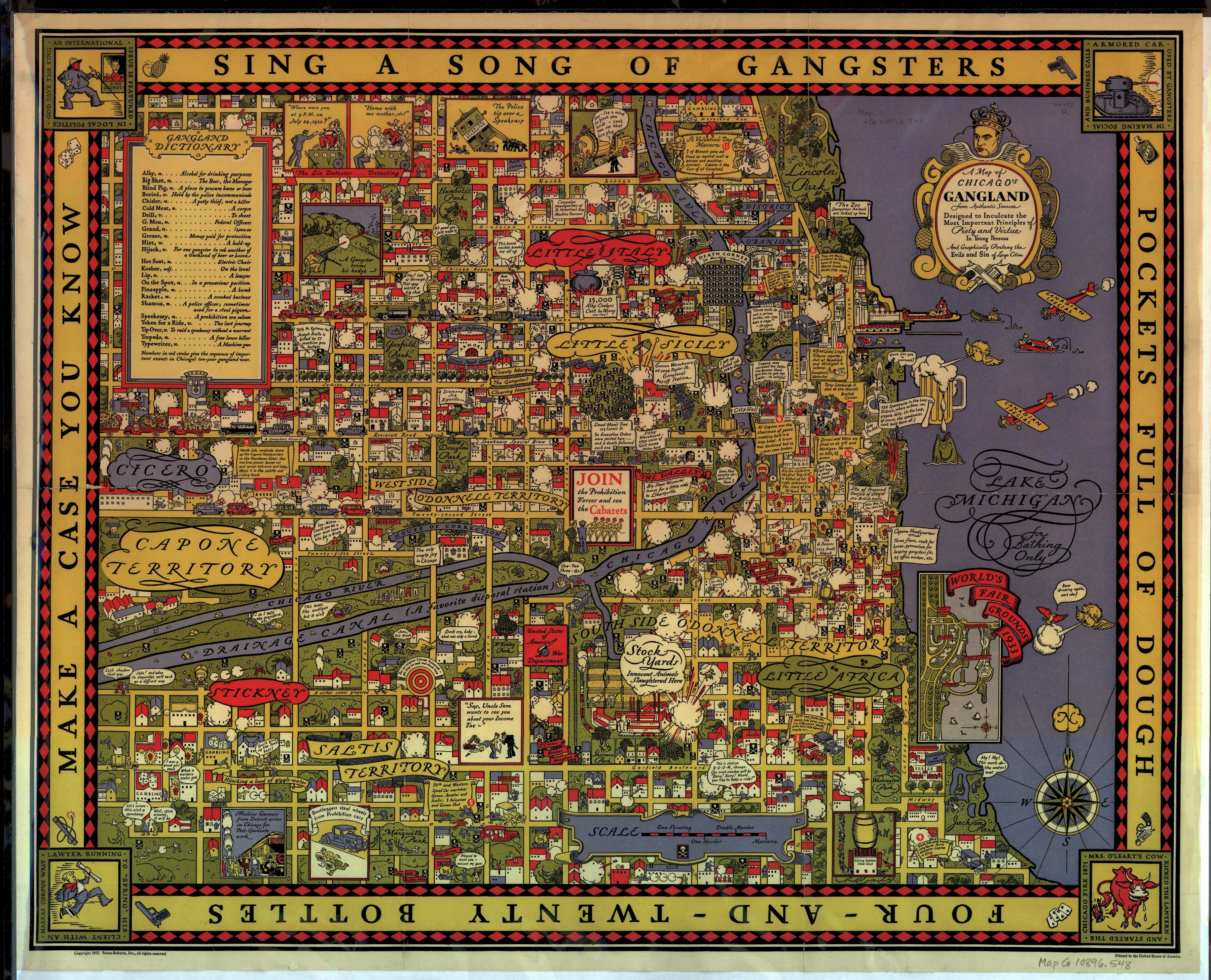
Modern day Chicagoland gang activity does not inspire quippy cartoon “wonder maps.” Back when Al Capone ruled Chicago’s underworld, the public viewed gangsters with movie magazine breathlessness. Their violent crimes and glamorous lifestyles sold newspapers and movie tickets.
Today? Gangsta rap—a genre not known for its whimsy—glorifies the hardcore existence of kids whom the system has failed, trapped in a cycle of poverty, compounding the social problems that were heaped on them at birth.
But back to 1931, the year Capone was sent to prison for tax evasion, and local firm Bruce-Roberts published Chicago’s Gangland map, above, from “authentic sources.”
As any civic minded reformer knows, the best way to “inculcate the most important principles of piety and virtue in young persons” is to pack all “the evils and sin of large cities” into something resembling a large-scale comic book.
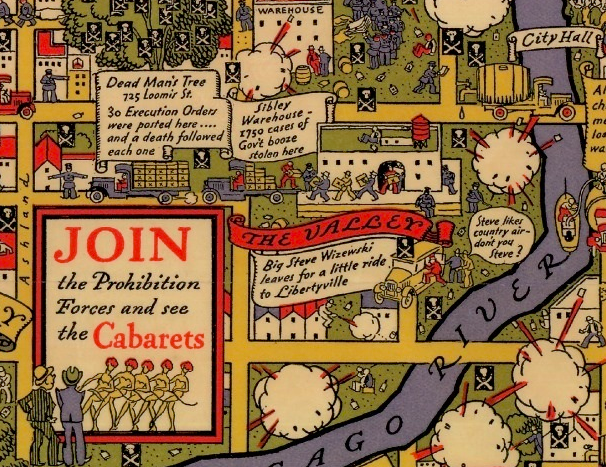
If the 30 execution orders posted on Dead Man’s Tree doesn’t scare ‘em straight, perhaps 1750 cases of government booze and some scantily clad dancing girls will!
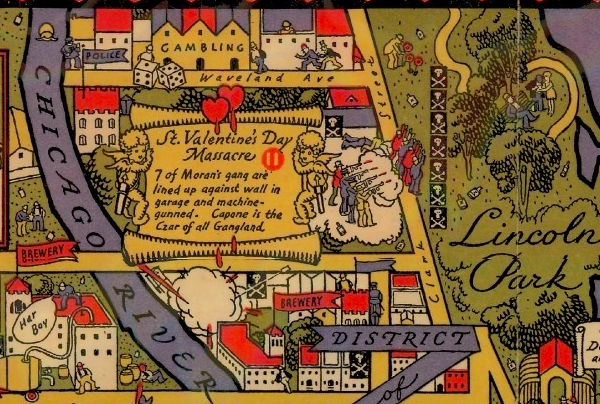
Naturally, the site of 1929’s Saint Valentine’s Day Massacre gets star treatment, with a graphic depiction guaranteed to stir the imagination far more than a visit to the actual site itself.
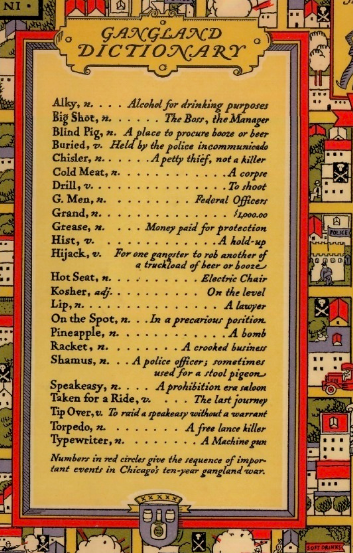
The publisher thoughtfully included a Gangland Dictionary to further inculcate the impressionable youth and explain the presence of two pineapples in the cartouche.
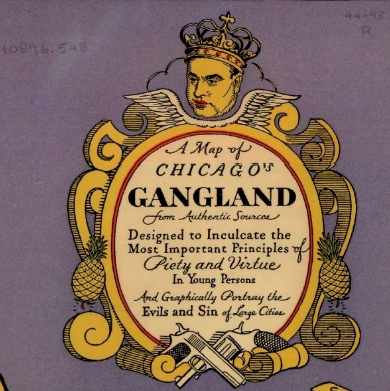
Click here to view the map in a larger format. Then zoom in to explore this lighthearted spin on Chicago’s wicked past in greater detail. The moral instruction continues in the form of poster-sized reproductions whose sale benefits Chicago’s Newberry Library.
Related Content:
A Wonderful Archive of Historic Transit Maps: Expressive Art Meets Precise Graphic Design
Ayun Halliday is an author, illustrator, theater maker and Chief Primatologist of the East Village Inky zine. Her play Zamboni Godot is opening in New York City in March 2017. Follow her @AyunHalliday.
Read More...The Essence of Linear Algebra Explained with Animations
Fyi: Grant Sanderson has a knack for math and coding. So he created a tool that has helped him explain “the essence of linear algebra” in a “visually-driven manner.” And he posted the result, a series of 13 videos, to YouTube. You can watch the collection, called “The Essence of Linear Algebra,” above. Topics covered include: Vectors, what even are they?; Matrix multiplication as composition; Dot products and duality; and more.
You can also find complete university courses on Linear Algebra in our collection of Free Online Math course, a subset of our collection, 1,700 Free Online Courses from Top Universities.
If you would like to support the mission of Open Culture, consider making a donation to our site. It’s hard to rely 100% on ads, and your contributions will help us continue providing the best free cultural and educational materials to learners everywhere. You can contribute through PayPal, Patreon, and Venmo (@openculture). Thanks!
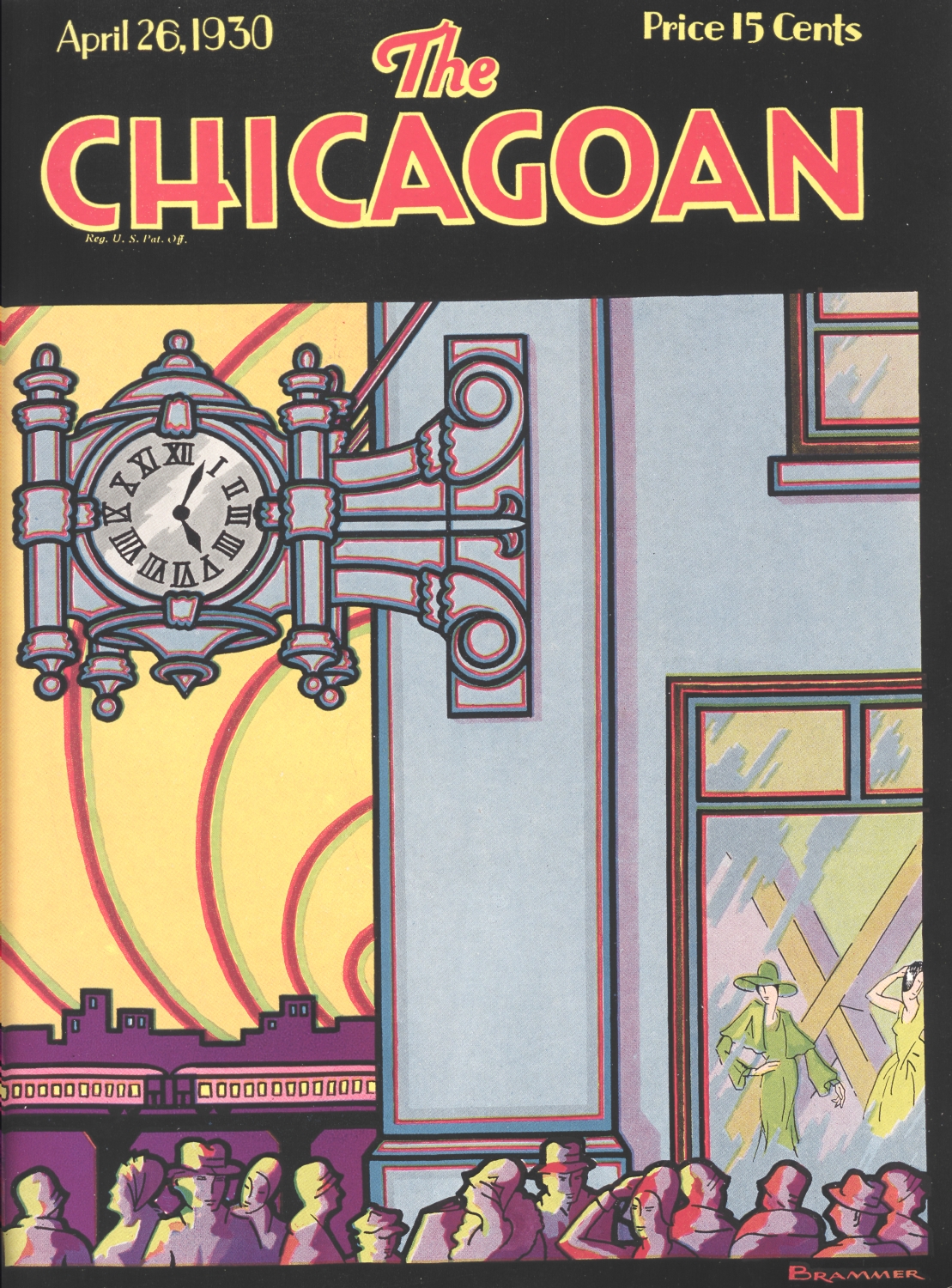
Read More...New Archive Presents The Chicagoan, Chicago’s Jazz-Age Answer to The New Yorker (1926 to 1935)
Copyright The Quigley Publishing Company, a Division of QP Media, Inc.
Chicago’s famed “second city complex” didn’t spring from organic feelings of inferiority, but rather from the poisonous pen of visiting New Yorker writer, A.J. Liebling:
Seen from the taxi, on the long ride in from the airport, the place looked slower, shabbier, and, in defiance of all chronology, older than New York… the low buildings, the industrial plants, and the railroad crossings at grade produced less the feeling of being in a great city than of riding through an endless succession of factory-town main streets.
- A.J. Liebling, Chicago: The Second City, 1952
The Manhattan born journalist’s observations about the toddlin’ town are plainly those formed by an outsider, albeit one who harbored no designs on becoming an insider.
The Chicagoan, a homegrown publication that intentionally mimicked The New Yorker in both design and content, offers a different take. From 1926 to 1935, it strove to counteract the city’s thuggish reputation (Al Capone, anyone?) by drawing attention to its cultural offerings and high society doings.
Outside of Chicago, no one cared much. Having failed to replicate The New Yorker’s national success, it folded, leaving behind very few surviving copies.
Neil Harris, a University of Chicago Professor Emeritus of History, has righted that wrong by arranging for the university library’s near complete collection of Chicagoans to be uploaded to a searchable online database.
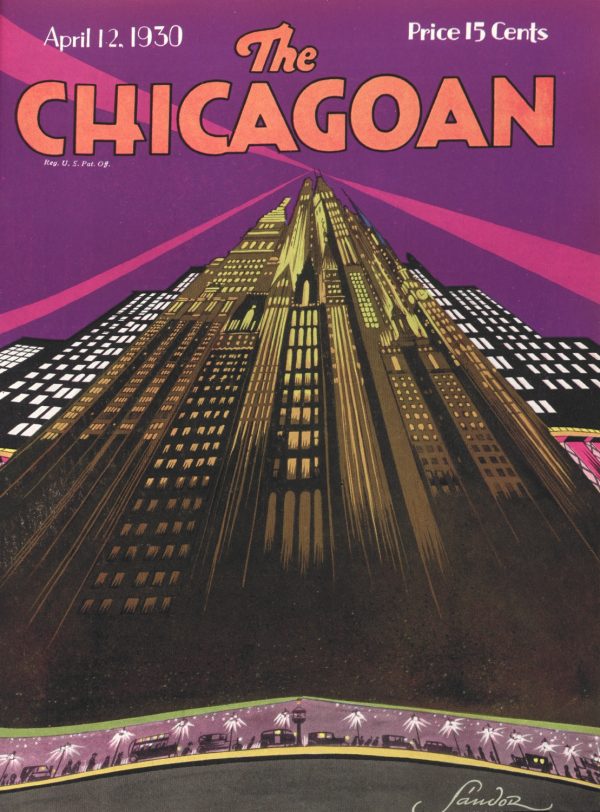
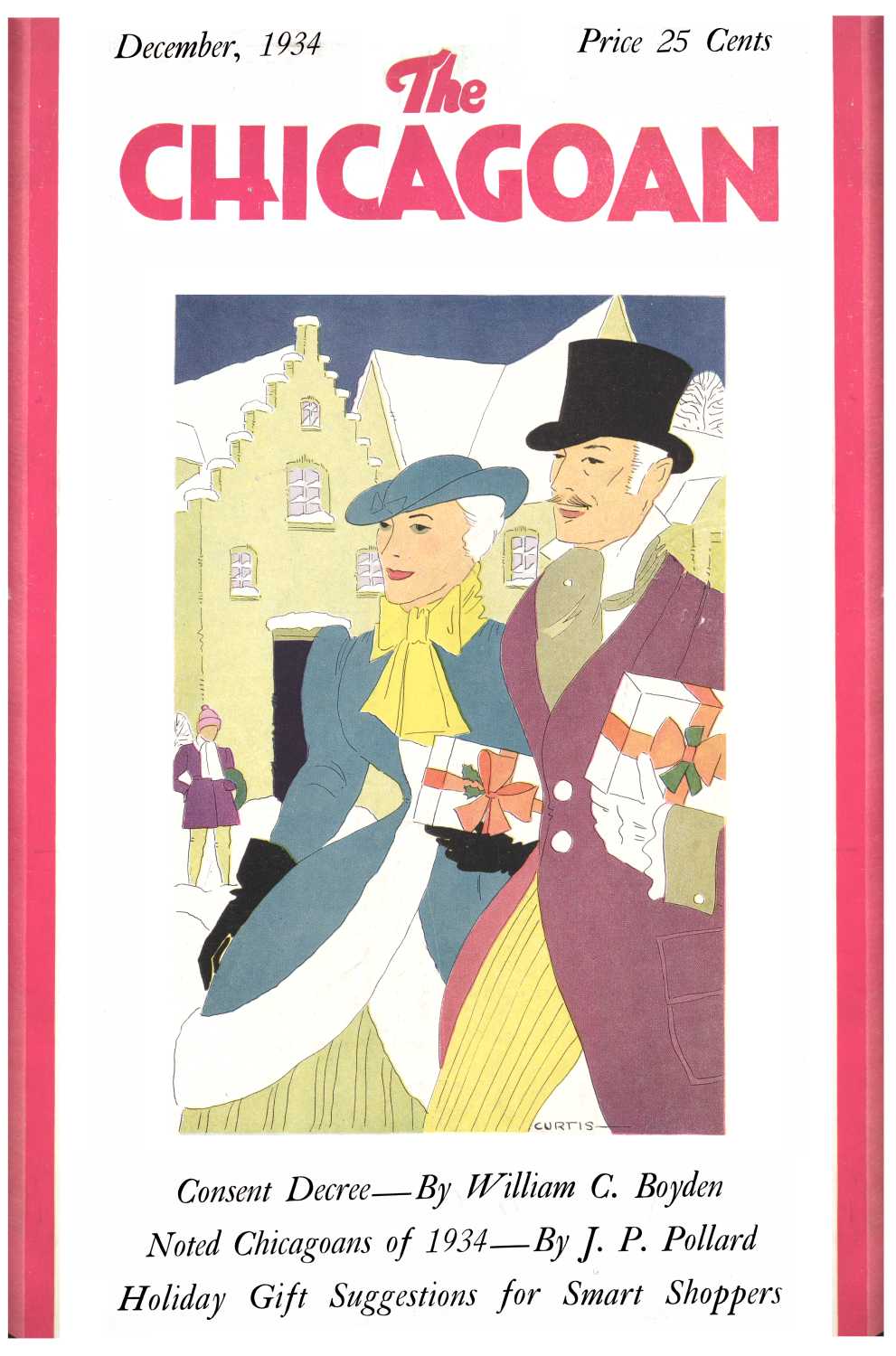
The covers have a Jazz Age vibrancy, as do articles, advertisements, and cartoons aimed at Chicago’s smart set. There’s even a Helen Hokinson cartoon, in the form of a Borden cheese ad.
A search for Lieblings yielded but two:
Copyright The Quigley Publishing Company, a Division of QP Media, Inc.
One from December 1, 1934, above, name checks pianist Emil Liebling in an article revisiting the 1897 Christmas issue of another bygone Chicago paper, the Saturday Evening Herald.
Copyright The Quigley Publishing Company, a Division of QP Media, Inc.
Four years earlier, in Vol. 9, No. 3, Robert Pollack’s Musical Notes column made mention of Leonard Liebling, a critic for the New York American… (I can hear A.J. beyond-the-grave snickering even now).
You can browse the pages of The Chicagoan here. For further reading, see Professor Harris’ book, The Chicagoan: A Lost Magazine of the Jazz Age.
Related Content:
The Best Magazine Articles Ever, Curated by Kevin Kelly
Ayun Halliday is an author, illustrator, theater maker and Chief Primatologist of the East Village Inky zine. Her latest script, Fawnbook, is available in a digital edition from Indie Theater Now. Follow her @AyunHalliday.
Read More...An Animated John Lennon Describes His First Acid Trip
Way back when, we featured an animation that documented the first acid trip of novelist Ken Kesey. In Kesey’s case, it all happened in a careful, calculated way in 1959, under the care and control of the U.S. government. Six years later and 5,000+ miles away, John Lennon’s maiden voyage went down in a very different way. A dentist–yes, a dentist of all people–slipped LSD into John and George’s coffee, unbeknownst to them. Next thing they knew buildings were bursting into fire, and rooms morphing into submarines. So began the Beatles’ experimentation with psychedelics and new musical sounds, which, together, shaped their 1965 masterpiece, Revolver (stream it free on Spotify).
John Lennon recounts that first acid trip in the animated video above. The link between psychedelics and Revolver gets covered in a new piece in Rolling Stone.
If you would like to support the mission of Open Culture, consider making a donation to our site. It’s hard to rely 100% on ads, and your contributions will help us continue providing the best free cultural and educational materials to learners everywhere. You can contribute through PayPal, Patreon, and Venmo (@openculture). Thanks!
Related Content:
Ken Kesey’s First LSD Trip Animated
Artist Draws Nine Portraits on LSD During 1950s Research Experiment
R. Crumb Describes How He Dropped LSD in the 60s & Instantly Discovered His Artistic Style
Watch The Bicycle Trip: An Animation of The World’s First LSD Trip in 1943
Read More...Watch M.C. Escher Make His Final Artistic Creation (1971)
I first encountered the world of Maurits Cornelis Escher where many others do: in school. A poster of his 22-foot-long Metamorphosis III hung along the walls of my fourth-grade classroom, where I spent many an idle minute or ten staring at its intricate geometry through which squares became birds, birds became lizards, lizards became fish, and it all somehow arrived at the cliff-like edge of a three-dimensional chessboard. It came as the last of a trilogy of woodcuts Escher made between 1937 and 1968, and a journey through its 1940 predecessor Metamorphosis II ends the 1971 documentary above, M.C. Escher: Adventures in Perception.
Escher himself seemingly had no happy classroom memories. “I hated school,” the narrator quotes him as saying. “The only class I liked at all was art. That doesn’t mean I was any good at it.” Though his work has no doubt inspired many youngsters to take up drawing, woodcutting, and printmaking themselves, it’s surely driven even more of them into mathematics.
Obsessed with perspective, geometry, and pattern (Escher described tessellation as “a real mania to which I have become addicted”), his images have, by the count of mathematician and Escher scholar Doris Schattschneider, led so far to eleven separate strands of mathematical and scientific research.
The twenty-minute Adventures in Perception, originally commissioned by the Netherlands’ Ministry of Foreign Affairs, offers in its first half a meditation on the mesmerizing, often impossible world Escher had created with his art to date. Its second half captures Escher in the last years of his life, still at work in his Laren, North Holland studio. It even shows him printing one of the three titular serpents, threaded through a set of elaborately interlocking circles, of his very last print Snakes. He never actually finished Snakes, whose patterns would have continued on to the effect of infinity, and even says here of his officially complete works that none succeed, “because it’s the dream I tried for that can’t be realized.” But those unrealized dreams have kept the rest of us dreaming, and thinking, ever since.
Adventures in Perception will be added to our collection of Free Documentaries, a subset of our list, 4,000+ Free Movies Online: Great Classics, Indies, Noir, Westerns, Documentaries & More.
Related Content:
Metamorphose: 1999 Documentary Reveals the Life and Work of Artist M.C. Escher
Inspirations: A Short Film Celebrating the Mathematical Art of M.C. Escher
M.C. Escher’s Perpetual Motion Waterfall Brought to Life: Real or Sleight of Hand?
Back to Bed: A New Video Game Inspired by the Surreal Artwork of Escher, Dali & Magritte
David Bowie Sings in a Wonderful M.C. Escher-Inspired Set in Jim Henson’s Labyrinth
Based in Seoul, Colin Marshall writes and broadcasts on cities and culture. He’s at work on a book about Los Angeles, A Los Angeles Primer, the video series The City in Cinema, the crowdfunded journalism project Where Is the City of the Future?, and the Los Angeles Review of Books’ Korea Blog. Follow him on Twitter at @colinmarshall or on Facebook.
Read More...Support Us
We're hoping to rely on loyal readers, rather than erratic ads. Please click the Donate button and support Open Culture. You can use Paypal, Venmo, Patreon, even Crypto! We thank you!

About Us

Open Culture scours the web for the best educational media. We find the free courses and audio books you need, the language lessons & educational videos you want, and plenty of enlightenment in between.
Advertise With Us

FREE UPDATES!
GET OUR DAILY EMAIL
Get the best cultural and educational resources on the web curated for you in a daily email. We never spam. Unsubscribe at any time.
FOLLOW ON SOCIAL MEDIA

Open Culture editor Dan Colman scours the web for the best educational media. He finds the free courses and audio books you need, the language lessons & movies you want, and plenty of enlightenment in between.
Advertise With Us