Twin Peaks Tarot Cards Now Available as 78-Card Deck
Through the darkness of future’s past, the magician longs to see…
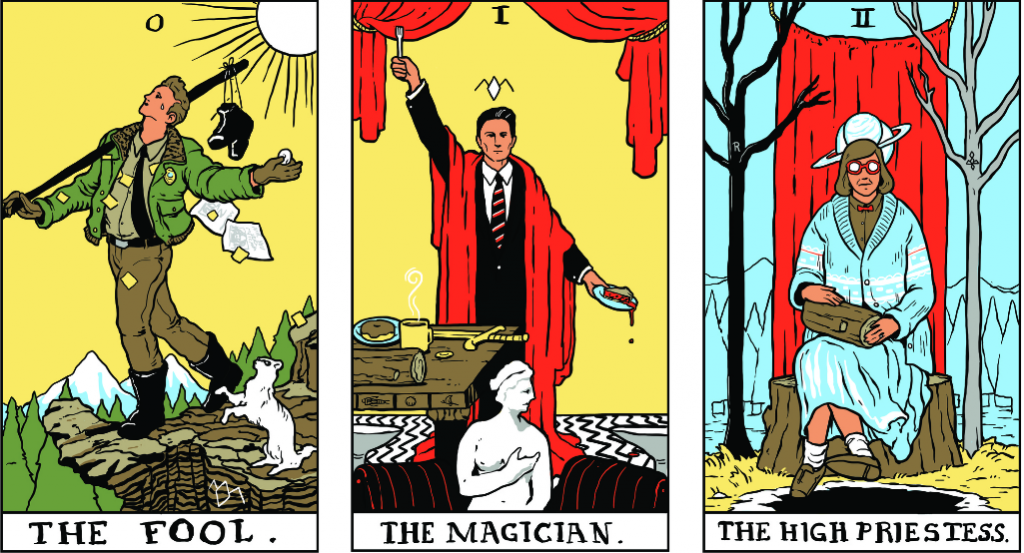
The incantation that kicks off Detective Cooper’s dream vision in Twin Peaks is part abstract clue and part divination, and occult elements reoccur through the David Lynch-Mark Frost created series. So it makes sense that pop artist Benjamin Mackey would look at combining characters from the show with the designs of the well known and well loved Rider-Waite-Smith Tarot deck from 1910.
Initially, Mackey created just the 22 Major Arcana from the deck and sold them as prints. Detective Cooper is the Magician, Sheriff Truman is Justice, the Log Lady is the High Priestess, Benjamin Horne is the Emperor and so on. (Guess who the Devil is!)
Not too surprisingly considering the show’s devoted fan-base, the Twin Peaks Tarot was a hit, and Mackey focused on completing the full deck of 78 tarot cards (view them all here), riffing on the Rider-Waite-Smith deck’s penchant for enigmatic and mystic tableaux. And now, 10 months later, he’s offering the entire deck for sale through an Indiegogo campaign for what looks like a very affordable price.
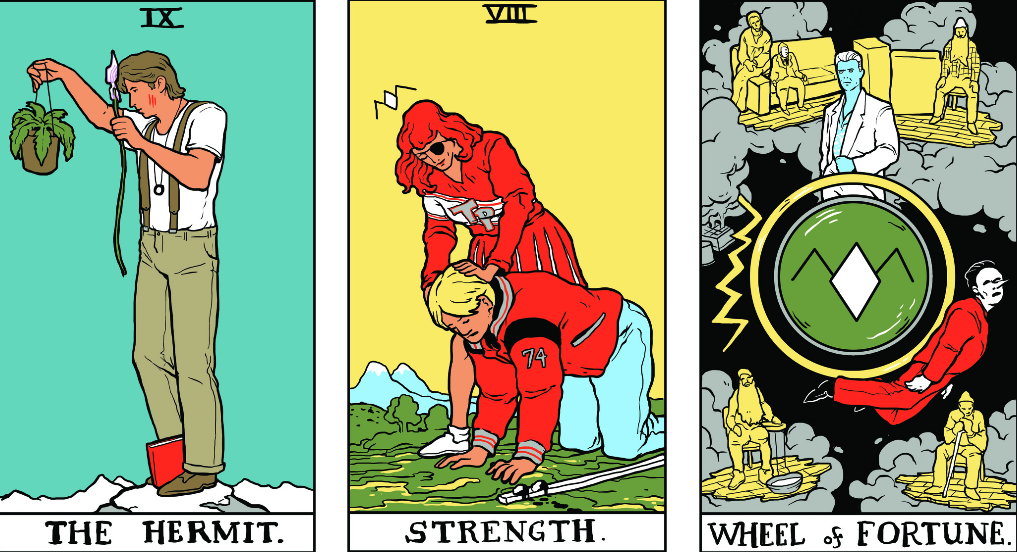
The initial campaign ask of $5,000 was reached within days, and now is heading towards $50,000. There are also extra goodies too for those who want to give more, including a booklet and an original sketch.
The Minor Arcana shows Mackey’s deep love for the television show and film, and gives a chance for even minor characters to have their own card, from Lili with the Blue Rose to Donna Hayward’s sister Harriet.
“The Magician Longs to See” decks are scheduled to arrive by December, just in time to help you tell your friends’ fortunes while reading the upcoming Twin Peaks book, waiting for the new series, or drinking some damn fine coffee.
Related Content:
Alejandro Jodorowsky Explains How Tarot Cards Can Give You Creative Inspiration
David Lynch Directs a Mini-Season of Twin Peaks in the Form of Japanese Coffee Commercials
David Lynch’s Twin Peaks Title Sequence, Recreated in an Adorable Paper Animation
Ted Mills is a freelance writer on the arts who currently hosts the artist interview-based FunkZone Podcast. You can also follow him on Twitter at @tedmills, read his other arts writing at tedmills.com and/or watch his films here.
Read More...The Night When Charlie Parker Played for Igor Stravinsky (1951)
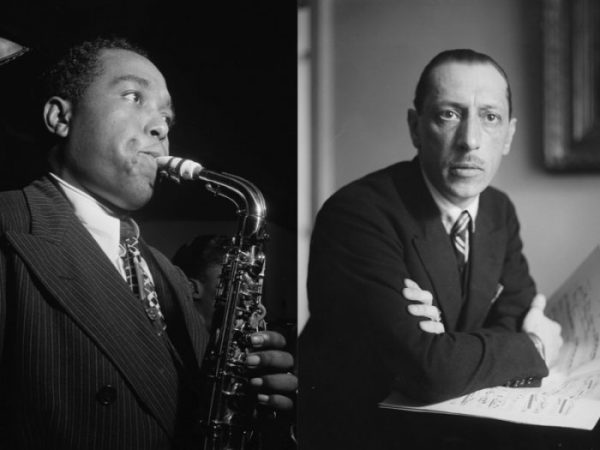
Image (left) by William P. Gottlieb, image (right) by Library of Congress, via Wikimedia Commons
The history of 20th-century music offers plenty of stories of luminaries meeting, playing together, and sometimes even entering into long-term collaboration. But it typically only happened within traditions: encounters between rock and rock, jazz and jazz, modernism and modernism. And so it still thrills to hear of the time in 1951 when Charlie Parker added one more story to the most storied jazz club of all time by performing for Igor Stravinsky at Birdland. Alfred Appel tells it definitively in his book Jazz Modernism: From Ellington and Armstrong to Matisse and Joyce:
The house was almost full, even before the opening set — Billy Taylor’s piano trio — except for the conspicuous empty table to my right, which bore a RESERVED sign, unusual for Birdland. After the pianist finished his forty-five-minute set, a party of four men and a woman settled in at the table, rather clamorously, three waiters swooping in quickly to take their orders as a ripple of whispers and exclamations ran through Birdland at the sight of one of the men, Igor Stravinsky. He was a celebrity, and an icon to jazz fans because he sanctified modern jazz by composing Ebony Concerto for Woody Herman and his Orchestra (1946) — a Covarrubias “Impossible Interview” come true.
As Parker’s quintet walked onto the bandstand, trumpeter Red Rodney recognized Stravinsky, front and almost center. Rodney leaned over and told Parker, who did not look at Stravinsky. Parker immediately called the first number for his band, and, forgoing the customary greeting to the crowd, was off like a shot. At the sound of the opening notes, played in unison by trumpet and alto, a chill went up and down the back of my neck.
They were playing “KoKo,” which, because of its epochal breakneck tempo — over three hundred beats per minute on the metronome — Parker never assayed before his second set, when he was sufficiently warmed up. Parker’s phrases were flying as fluently as ever on this particular daunting “Koko.” At the beginning of his second chorus he interpolated the opening of Stravinsky’s Firebird Suite as though it had always been there, a perfect fit, and then sailed on with the rest of the number. Stravinsky roared with delight, pounding his glass on the table, the upward arc of the glass sending its liquor and ice cubes onto the people behind him, who threw up their hands or ducked.
Parker didn’t just happen to know a few bits of Stravinsky to whip out as a novelty; he had, at that point, already deeply internalized the work of the man who composed The Rite of Spring (1913), the most rhythmically complex piece of orchestral music to date.
“Jazz musicians sat up in their seats when Stravinsky’s music started playing; he was speaking something close to their language,” writes New Yorker music critic Alex Ross in his book The Rest Is Noise: Listening to the Twentieth Century. “When Charlie Parker came to Paris in 1949, he marked the occasion by incorporating the first notes of the Rite into his solo on ‘Salt Peanuts’.”
In a piece on why jazz musicians love The Rite of Spring, NPR’s Patrick Jarenwattananon discusses other instances where Parker quoted (or paid musical tribute to) Stravinsky: “A personal favorite comes from 1947, when Parker was a guest soloist on trumpeter and arranger Neal Hefti’s ‘Repetition,’ as heard on a compilation called The Jazz Scene. Not only does Hefti’s arrangement quote the transitional horn motif which signals the second half of the ‘Augurs of Spring’ movement from The Rite, but Parker riffs on the same motif to start his solo.”
Dylan Thomas: A Centenary Celebration contains a chapter by Daniel G. Williams on Dylan Thomas and Charlie Parker, which, in establishing Parker’s engagement in “revivifying the vocabulary of jazz,” gets into how that got him drawing from Stravinsky, whose work Parker called “music at its best.” Williams quotes Parker’s trumpeter Howard McGhee as remembering that Parker “knew everything, and he hipped me to, like, Stravinsky and all those guys. I didn’t know nothin’ about Stravinsky.” When Parker brought The Rite of Spring over to listen to at McGhee’s house, he prefaced the experience with these words: “Yeah, this cat, he’s kind of cool, you know; he knows what he’s doing.” And the more we learn about what went into Parker’s music, the more we realize that he, too, knew even more thoroughly what he was doing than we’d ever realized.
via Jerry Jazz Musician/Dangerous Minds
Related Content:
Hear 46 Versions of Stravinsky’s Rite of Spring in 3 Minutes: A Classic Mashup
Stravinsky’s “Illegal” Arrangement of “The Star Spangled Banner” (1944)
Stravinsky’s The Rite of Spring, Visualized in a Computer Animation for Its 100th Anniversary
Based in Seoul, Colin Marshall writes and broadcasts on cities and culture. He’s at work on a book about Los Angeles, A Los Angeles Primer, the video series The City in Cinema, the crowdfunded journalism project Where Is the City of the Future?, and the Los Angeles Review of Books’ Korea Blog. Follow him on Twitter at @colinmarshall or on Facebook.
Read More...How to Raise Creative Children Who Can Change the World: 3 Lessons from Wharton Professor Adam Grant
Adam Grant, a professor at The Wharton School of the University of Pennsylvania, has been “recognized as Wharton’s top-rated teacher for five straight years, and as one of the world’s 25 most influential management thinkers.” He’s also the author of the bestselling book Originals: How Non-Conformists Move the World, a study that examines “what it takes to be creative and champion new ideas.”
Speaking at the 2016 Aspen Ideas Festival earlier this year, Grant asks the question: What do Nobel Prize-winning scientists do differently than their more ordinary peers? The answer: They’re twice as likely to play musical instruments. Seven times more likely to draw or paint. 12 times more likely to write fiction or poetry. And 22 times more likely to perform as dancers, actors or magicians.
Case in point Einstein, who never traveled without his beloved violin and saw a direct correlation between his groundbreaking work in physics and his musical life.
For Grant, it’s never too early to cultivate creativity. So above, he outlines three things parents can do to encourage their children’s creative development.
1. Focus on values over rules.
2. Praise their character, not their behavior. Get them to see themselves as creative at heart.
3. Help them draw creative lessons from the books they read.
This all presumably gets covered in greater depth in Chapter 6 of Originals: How Non-Conformists Move the World. The chapter is entitled “Rebel with a Cause: How Siblings, Parents and Mentors Nurture Originality.”
Below you can watch Grant’s TED Talk, “The surprising habits of original thinkers.” The video above was shot by The Atlantic.
Related Content:
The Musical Mind of Albert Einstein: Great Physicist, Amateur Violinist and Devotee of Mozart
Read More...What Life Was Like for Teenagers in Ancient Rome: Get a Glimpse from a TED-ED Animation
The more things change, the more they stay the same. That adage often holds true, but not in this historical case. While your average American teenager devotes more than 7 hours a day to imbibing media — to watching TV, playing video games, hanging out on Facebook — the average 17-year-old Roman kid (circa 73 AD) had some more serious business to deal with. Like mastering reading and writing in two languages, fighting in imperial wars, taking care of (obscenely young) spouses and various other items. All of this gets conveyed to us by Ray Laurence, a classics professor from the University of Kent. The video itself comes from the TED-Ed series that otherwise features a clip about the historic walls of Constantinople, built during the Byzantine period.
If you would like to support the mission of Open Culture, consider making a donation to our site. It’s hard to rely 100% on ads, and your contributions will help us continue providing the best free cultural and educational materials to learners everywhere. You can contribute through PayPal, Patreon, and Venmo (@openculture). Thanks!
Related Content:
The History of Rome in 179 Podcasts
Rome Reborn: Take a Virtual Tour of Ancient Rome, Circa 320 C.E.
How Many U.S. Marines Could Bring Down the Roman Empire?
Free Online Courses in the Classics
The Rise & Fall of the Romans: Every Year Shown in a Timelapse Map Animation (753 BC ‑1479 AD)
Read More...Hear Sylvia Plath’s Barely-Known Radio Play, Three Women
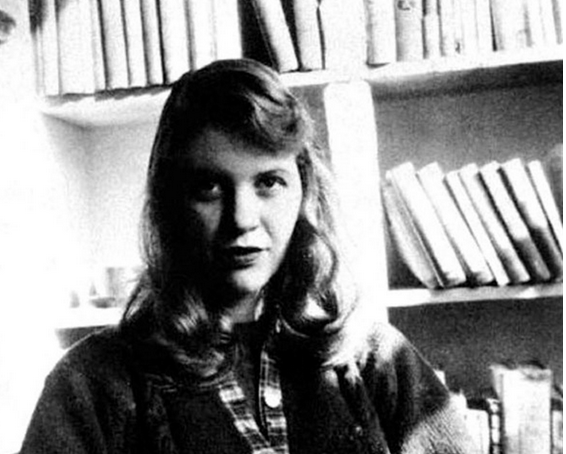
Image via Wikimedia Commons
Over the years, we’ve let you hear Sylvia Plath reading many of her poems, all written before she took her life at the age of 30. What you likely haven’t heard — until today — is Three Women, one of Plath’s lesser-known pieces of writing. “Originally written as a radio verse drama for three voices,” notes The Guardian, the play “was broadcast in 1962 on the BBC Third Programme and later included in Winter Trees, a poetry collection first published in 1971.” “With its themes of pregnancy, birth, miscarriage and adoption, it perfectly encapsulates the experience of becoming — or not becoming — a mother, including all the ecstasy and terror of childbirth.” Below you can hear a recording with actress Judith Binder as the wife, Ann Bernstein as the secretary, and Rachelle Towers as the girl. The program is made available on Archive.org by Pacifica Radio Archives. Find more Sylvia Plath audio in our collection, 1,000 Free Audio Books: Download Great Books for Free.
If you would like to support the mission of Open Culture, consider making a donation to our site. It’s hard to rely 100% on ads, and your contributions will help us continue providing the best free cultural and educational materials to learners everywhere. You can contribute through PayPal, Patreon, and Venmo (@openculture). Thanks!
Related Content
Hear Sylvia Plath Read 50+ of Her Dark, Compelling Poems
Hear Sylvia Plath Read Fifteen Poems From Her Final Collection, Ariel, in 1962 Recording
The Art of Sylvia Plath: Revisit Her Sketches, Self-Portraits, Drawings & Illustrated Letters
Sylvia Plath, Girl Detective Offers a Hilariously Cheery Take on the Poet’s College Years
Read More...A Master List of 800 Free Classic eBooks for iPad, Kindle & Other Devices

Maybe you’re an eBooks holdout, a late adopter, a disdainer of the book as a branded “device”? I get it. Is there anything more ridiculous than putting down a book because its batteries have run out? No amount of crowing about the supremacy of tech will make me love the smell and feel of paper less…
And yet…
Within the charming heft of printed books reside their limitation. Traveling students, researchers, or avid readers must lug several pounds of bound paper along with them on long journeys, or to work sessions at the local coffee shop. An eReader or smartphone can hold an entire library—which one can expand ad infinitum, it seems, on the fly.
This feature—along with the ease of copying quotes and passages and sending them across platforms—eventually sold me on the eBook as a robust supplement to print. And if it sounds like I’m making a sales pitch, I am: for hundreds of free books, available to read on the device of your choosing. Entry-level Kindle, budget smartphone, or latest, fanciest iPad—most all will accommodate the range of formats available in our collection of 800 Free eBooks.
Can you freely download the latest New York Times bestsellers? Not here, and I’d hope—for the sake of those hard-working writers—that you’d pay to read new releases. Can you carry along with you on your next business trip or vacation the works of Aristotle and Freud, several novels by Jane Austen and Joseph Conrad, the masterworks of Hegel, Hume, and Kant, the complete Shakespeare, and Proust’s multi-volume À la recherche du temps perdu? Quite easily. Here’s a small sample of what’s on our list:
- Austen, Jane - Pride & Prejudice
- Carroll, Lewis - Through the Looking-Glass
- Conrad, Joseph - Heart of Darkness
- Dostoevsky, Fyodor - Brothers Karamazov
- Eliot, George - Middlemarch
- Fitzgerald, F. Scott - Tales of the Jazz Age
- Freud, Sigmund - Dream Psychology: Psychoanalysis for Beginners
- Tolstoy, Leo - Anna Karenina
- Whitman, Walt - Leaves of Grass
- Wollstonecraft, Mary — A Vindication of the Rights of Women
See the full list of 800 offerings here. They may lack the sensory pleasure of print, but the ability to carry an entire library of classic literature in your pocket has its advantages, to say the least. And if your travels include long drives, you’ll also want to check out our master list of Free Audio Books.
Note: If you need help uploading .mobi files to your Kindle, you might find it useful to watch this video.
Related Content:
Free Audio Books: Fiction & Literature
Book Readers Live Longer Lives, According to New Study from Yale University
Josh Jones is a writer and musician based in Durham, NC. Follow him at @jdmagness
Read More...Helen Keller Had Impeccable Handwriting: See a Collection of Her Childhood Letters
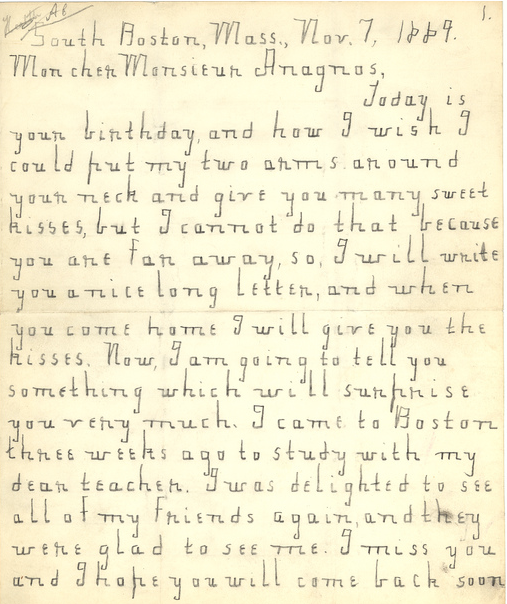
Image by Flickr, courtesy of Perkins School for the Blind
The inspirational blind and deaf activist and educator Helen Keller learned to speak aloud, but, to her great regret, never clearly.
Her careful penmanship, above, is another matter. Her impeccably rendered upright hand puts that of a great many sighted people—not all of them physicians—to shame.
Keller learned to write—and read—with the help of embossed books as a student at Perkins School for the Blind. The United States didn’t adopt Standard Braille as its official system for blind readers and writers until 1918, when Keller was in her late 30’s. Prior to that blind readers and writers were subjected to a number of competing systems, a situation she decried as “absurd.”
Some of these systems had their basis in the Roman alphabet, including Boston Line Type, the brainchild of Perkins’ Founding Director, Samuel Gridley Howe, an opponent of Braille. Students may have preferred dot-based systems for taking notes and writing letters, but Boston Line Type remained Perkins’ approved printing system until 1908.
There’s more than an echo of Boston Line Type in Keller’s blocky characters, as well as her spacing. Deviating from penmanship forms learned at school is a luxury exclusive to the sighted. Until formation became instinctual, Keller relied on a grooved board to help her size her characters correctly, an exhausting process. Small wonder that she ended many of her early letters with “I am too tired to write more.”
Perkins has published a Flickr album of letters Keller wrote between the ages of 8 and 11 to then-director Michael Anagnos, including 3 pages in French. Leafing through them, I marveled less at her ability and determination than my (sighted) 16-year-old son’s lack of interest in developing a respectable-looking hand.
Keller’s handwriting is so above reproach that it quickly fades to the background, upstaged by her charming manners and girlish preoccupations. A sample:
If you go to Roumania, please ask the good queen Elizabeth about her little invalid brother and tell her that I am very sorry that her darling little girl died. I should like to send a kiss to Vittorio, the little prince of Naples, but teacher says she is afraid you will not remember so many messages.
Browse Perkins’ collection of Keller’s handwritten letters to Michael Anagnos here.
Related Content:
Helen Keller Speaks About Her Greatest Regret — Never Mastering Speech
Ayun Halliday is an author, illustrator, theater maker and winemaker who played Annie Sullivan in her high school’s production of The Miracle Worker. Follow her @AyunHalliday.
Read More...H.G. Wells Pans Fritz Lang’s Metropolis in a 1927 Movie Review: It’s “the Silliest Film”
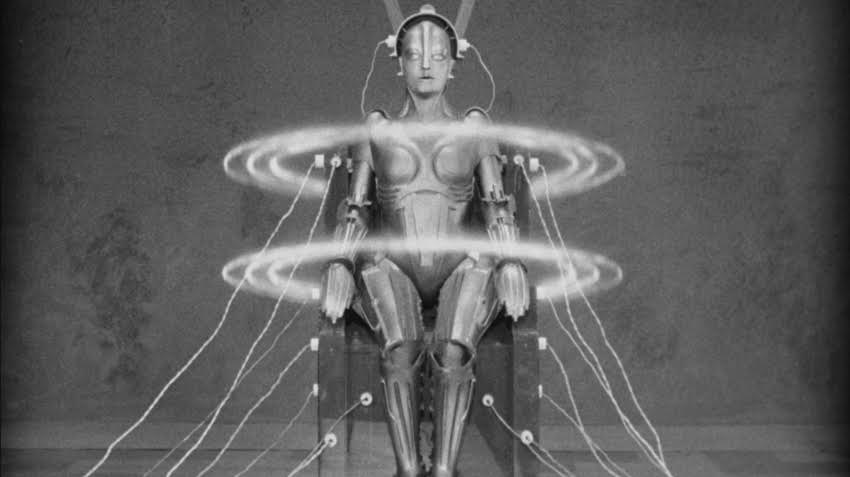
When we watch Fritz Lang’s Metropolis now, we see an aesthetically daring landmark work of science-fiction cinema. When H.G. Wells watched Metropolis back in 1927, the year of its release, he saw something very different indeed. “I have recently seen the silliest film,” wrote the author of The War of the Worlds and The Time Machine as an opener for his New York Times review. “I do not believe it would be possible to make one sillier.”
Despite its giant budget, Metropolis gives “in one eddying concentration almost every possible foolishness, cliché, platitude, and muddlement about mechanical progress and progress in general, served up with a sauce of sentimentality that is all its own.” History remembers Lang and Wells both as visionaries who looked, often with little optimism, to the future, but clearly they had a difference of opinion as to how that future would actually play out.
The scientifically-minded Wells took the impressionistic Metropolis literally, taking issue with — among other things — how its airplanes “show no advance on contemporary types”; its “motor cars are 1926 models or earlier”; its vision of a vertically stratified city look, “to put it mildly, highly improbable”; the apparent condition that the city’s “machines are engaged quite furiously in the mass production of nothing that is ever used”; and the sentimentality of its makers, “who are all on the side of soul and love and such like.”
Metropolis opened to mixed reviews at first (some of which you can read here), but no contemporary critic could match Wells for sheer disdain. “Never for a moment does one believe any of this foolish story; never for a moment is there anything amusing or convincing in its dreary series of strained events,” he wrote, steering his point-by-point takedown to its conclusion. “It is immensely and strangely dull. It is not even to be laughed at.”
Strong stuff, but the highest form of film criticism, as the French New Wave would later articulate, is filmmaking. And so, in 1936, came Things to Come, another cinematic spectacle of the future, this one built to the ostensibly more plausible specifications Wells laid out as its screenwriter — that film itself just one more predecessor to the unending series of dystopias, utopias, and every kind of future in-between to appear on the screen over the next eight decades.
Related Content:
Read the Original 32-Page Program for Fritz Lang’s Metropolis (1927)
Fritz Lang Invents the Video Phone in Metropolis (1927)
Based in Seoul, Colin Marshall writes and broadcasts on cities and culture. He’s at work on a book about Los Angeles, A Los Angeles Primer, the video series The City in Cinema, the crowdfunded journalism project Where Is the City of the Future?, and the Los Angeles Review of Books’ Korea Blog. Follow him on Twitter at @colinmarshall or on Facebook.
Read More...A Complete List of the 533 Movies & TV Shows Watched on the International Space Station

Image courtesy of NASA
To keep some measure of sanity, the astronauts living aboard the International Space Station (ISS), some 220 miles above our planet Earth, make a point of unwinding. According to NASA, the astronauts get weekends off. And, “on any given day, crew members can watch movies, play music, read books, play cards and talk to their families.” Earlier this year, PaleoFuture gave us a further glimpse into what astronaut downtime looks like, when its editor, Matt Novak, printed a Complete List of Movies and TV Shows On Board the International Space Station. Acquired through a Freedom of Information request, the list is a catalogue of every film and TV show in the ISS media library. As Matt notes, there are many classics (e.g. Alfred Hitchcock’s North by Northwest), “plenty of space-themed and dystopian sci-fi movies” (2001: A Space Odyssey, Alien and Blade Runner), and a helpful serving of comedy (Airplane). Below, you can find the first 100 items on the list. Get the complete list–all 533 movies and TV shows–at Paleofuture.
- 1941
- 12 Monkeys
- 12 Years a Slave
- 2 Fast 2 Furious
- 20,000 Leagues Under the Sea
- 2001: A Space Odyssey
- 21 Jump Street
- 24 (Seasons 1–8)
- 48 Hours
- 8 Mile
- A Christmas Carol
- A Christmas Story
- A Knights Tale
- A Man and a Woman
- A Night at the Opera
- A Night at the Roxbury
- A Perfect Murder
- A Prairie Home Companion
- A Room with a View
- Absolutely Fabulous (Series 1–3)
- Air Force One
- Airplane
- Alias Season 1
- Alien
- Alien 3
- Alien Resurrection
- Aliens
- All Good Things
- Along Came Polly
- Always
- American Gangster
- American Sniper
- American Wedding
- An American in Paris
- An Article of Hope
- Analyze This
- Anchorman
- Anchorman 2
- Animal House (1978)
- Argo
- Armageddon
- Around the World in 80 Days (1956)
- Around the World in 80 Days (2004)
- Arrow Season 1
- Arsenic and Old Lace
- As Good as it Gets
- Austin Powers International Man of Mystery
- Austin Powers The Spy Who Shagged Me
- Australia
- Avatar
- Baby Mama
- Back to Bataan
- Back to the Future
- Back to the Future Part II
- Back to the Future Part III
- Backdraft
- Band of Brothers Season 1
- Bataan
- Batman Forever
- Batman Returns
- Battle for the Planet of the Apes
- Battle of Britain
- Battleship
- Beneath the Planet of the Apes
- Ben-Hur
- Better Call Saul Season 1
- Beverly Hills Cop II
- Beverly Hills Cop III
- Big Bang Theory (Seasons 1–8)
- Big Eyes
- Big Jake
- Billy Jack
- Birdman, or the Unexpected Virtue of Ignorance
- Black Hawk Down
- Black Mask
- Black Swan
- Blade Runner
- Blazing Saddles Blended
- Blue Planet Frozen Seas
- Blue Planet Ocean World
- Blues Brothers
- Bob Newhart Button-Down Concert
- Body of Lies
- Braveheart
- Breaking Bad Seasons 1–6
- Bridesmaids
- Bull Durham
- Caddyshack
- Cahill United States Marshal
- Captain America: The First Avenger
- Captain America: The Winter Soldier Captain Phillips
- Casablanca
- Cast Away
- Catch-22
- Celtic Woman Songs from the Heart
- Chance Are
- Chariots of Fire
- Charlie St Cloud
- Children of Men
- Chisum
Find the complete list of 533 films and TV shows here.
If you would like to support the mission of Open Culture, consider making a donation to our site. It’s hard to rely 100% on ads, and your contributions will help us continue providing the best free cultural and educational materials to learners everywhere. You can contribute through PayPal, Patreon, and Venmo (@openculture). Thanks!
Related Content:
Everything You Wanted to Know About Going to the Bathroom in Space But Were Afraid to Ask
If Astronauts Cry in Space, Will Their Tears Fall?
Read More...How the Coen Brothers Storyboarded Blood Simple Down to a Tee (1984)
Seldom, in the films of the Joel and Ethan Coen, do characters’ schemes go according to plan. You can watch it happen all across their filmography: the baby theft in Raising Arizona, the own-wife kidnapping and ransom in Fargo, the casino-vault tunnel heist in The Ladykillers, the Communist conversion of a screen idol in Hail, Caesar! But they’ve earned their enormous cinematic reputation not just for their themes, but for the precision with which they construct movies around them; it sometimes seems that the more dissolute the characters and ultimately disastrous the plot they fall into, the more carefully-made the picture.
This pattern began in 1984 with their first feature, the Texas neo-noir Blood Simple. Despite its relatively small-scale production (especially by the standards of their period piece-heavy recent work), it showcases every element their fans love: the sense of place, the sharp dialogue, the fascination with “low” life, the dark humor, the attention to detail.
No wonder, then, that it has now arrived in the Criterion Collection, in an edition which includes supplementary materials like the comparison between the storyboard and finished scene above, featuring commentary from the Coens Joel and Ethan both, as well as director of photography Barry Sonnenfeld and actor Frances McDormand.
“There are directors who are completely comfortable extemporizing on the set, and others who are not,” say Joel and Ethan, trading off observations. “Some directors want to throw everything up in the air and just see where it lands; that’s really how they work, fundamentally, and get great results. We’re kind of the… other end of the spectrum. We’re more comfortable if we have a plan, even if we stray quite a distance from that plan while we’re shooting.” They seem not to have strayed at all in the particular scene in this video, but their filmography boasts more than enough vitality to rule out the possibility of complete, control-freakish rigidity. All of it shows us how the best-laid plans of mice and men go awry — but only because the Coen Brothers lay even better plans first.
via No Film School
Related Content:
Watch the Coen Brothers’ TV Commercials: Swiss Cigarettes, Gap Jeans, Taxes & Clean Coal
Tuileries: A Short, Slightly Twisted Film by Joel and Ethan Coen
World Cinema: Joel and Ethan Coen’s Playful Homage to Cinema History
Based in Seoul, Colin Marshall writes and broadcasts on cities and culture. He’s at work on a book about Los Angeles, A Los Angeles Primer, the video series The City in Cinema, the crowdfunded journalism project Where Is the City of the Future?, and the Los Angeles Review of Books’ Korea Blog. Follow him on Twitter at @colinmarshall or on Facebook.
Read More...Support Us
We're hoping to rely on loyal readers, rather than erratic ads. Please click the Donate button and support Open Culture. You can use Paypal, Venmo, Patreon, even Crypto! We thank you!

About Us

Open Culture scours the web for the best educational media. We find the free courses and audio books you need, the language lessons & educational videos you want, and plenty of enlightenment in between.
Advertise With Us

FREE UPDATES!
GET OUR DAILY EMAIL
Get the best cultural and educational resources on the web curated for you in a daily email. We never spam. Unsubscribe at any time.
FOLLOW ON SOCIAL MEDIA

Open Culture editor Dan Colman scours the web for the best educational media. He finds the free courses and audio books you need, the language lessons & movies you want, and plenty of enlightenment in between.
Advertise With Us


