Is The Big Lebowski a Great Noir Film? A New Way to Look at the Coen Brothers’ Iconic Movie
The Big Lebowski, Joel and Ethan Coen’s seventh and most polarizing film, has raised every feeling in its viewers from immediate and utter devotion to simple puzzlement. When someone says “I don’t get it,” fans may find themselves tempted to quote Louis Armstrong on the nature of jazz — but they’ll probably quote Walter, Donny, or the Dude himself instead. The film’s very quotability, longevity, and ambiguity have enthralled some and frustrated others, suggesting that, as with any important work of art, you can see The Big Lebowski in a number of different ways. The Film School’d video essay above examines one of those ways with the question, “Is The Big Lebowski a Film Noir?”
“We know film noir for its black-and-white cinematography, gritty voiceovers, venetian blinds, detectives in trench coats, troubled dames, and femme fatales with legs that go all the way up,” says its narrator, beginning in an imitation of the mid-Atlantic accent so often heard in movies of the noir era. “But what if a film doesn’t immediately qualify as film noir? What if that film utilizes all the major elements, but carries a sardonic tone that, at times, still takes itself very seriously? What if that film doesn’t really look like a film noir right away? What if, on the surface, that film appears to be an absurdist stoner comedy about mistaken identity, bowling, and a stolen rug?”
We’ve covered lists of the essential elements of film noir here at Open Culture, and this video essay does a comparative study, lining aspects of The Big Lebowski against those of such classics of the genre — or maybe movement, or maybe just fad — as The Big Sleep, Touch of Evil, The Big Heat, D.O.A., and Murder My Sweet. Like those pictures, Lebowski also uses the much-photographed city of Los Angeles in a strikingly different way from its contemporaries, and it provides the Coen brothers a golden opportunity to indulge their skill for repurposing 20th-century genre conventions (most recently on display in the 1951 Hollywood-set Hail, Caesar!).
“The Big Lebowski is about an attitude, not a story,” wrote Roger Ebert , who also once drew up his own list of the rules of film noir, upon inducting The Big Lebowski into his pantheon of great movies. “It’s easy to miss that, because the story is so urgently pursued.” He could have said the same about the pictures in the core film noir canon, which you can kick back and catch up on from the comfort of your own pad with our free film noir collection. The Dude, and Ebert, would most certainly abide.
Related Content:
The Essential Elements of Film Noir Explained in One Grand Infographic
The 5 Essential Rules of Film Noir
Roger Ebert Lists the 10 Essential Characteristics of Noir Films
The Two Gentlemen of Lebowski: What If The Bard Wrote The Big Lebowski?
The Big Lebowski Reimagined as a Classic 8‑Bit Video Game
Based in Seoul, Colin Marshall writes and broadcasts on cities and culture. He’s at work on a book about Los Angeles, A Los Angeles Primer, the video series The City in Cinema, the crowdfunded journalism project Where Is the City of the Future?, and the Los Angeles Review of Books’ Korea Blog. Follow him on Twitter at @colinmarshall or on Facebook.
Read More...Edgar Allan Poe’s the Raven: Watch an Award-Winning Short Film That Modernizes Poe’s Classic Tale
In 1909, early cinematic auteur D.W. Griffith offered his seven-minute interpretation of Edgar Allan Poe composing his acclaimed and widely-read poem “The Raven.” In 2011, filmmaker Don Thiel offered his twelve-minute interpretation of an encounter between a writer named Poe, apparently young and not long out of the military, and a stately talking raven — an encounter that takes place not in the modern day, nor in the first half of the nineteenth century during which the real Poe lived, but in the winter of 1959, over a century after Poe died — and in a Hollywood room, no less.
Poe made his name on tales of mystery and imagination; Edgar Allan Poe’s the Raven adds another layer of mystery and imagination atop it all. The effort won the film several awards, including Best Short at the H.P. Lovecraft Film Festival.
That might at first seem like an odd place for an adaptation of a poem of longing like “The Raven,” however deliberately skewed, to earn its honors. But you could see Lovecraft, who launched his own life’s career in elaborate explorations of dread beyond man’s direct comprehension almost exactly a century ago, as Poe’s literary heir.
But then, unlike Poe and “The Raven,” Lovecraft never claimed to have written anything deliberately and singlemindedly to maximize the satisfaction of the widest possible audience. Indeed, Lovecraft’s work, however influential on that of later imaginative writers, remains in the shadowy realm of the “cult,” while Poe’s has ascended onto the plane of required reading. Edgar Allan Poe’s the Raven, which envisions Poe’s most famous piece of work with booze, cigarettes, yellowing patterned wallpaper, lurid lighting, eight-millimeter film, a Corona typewriter, and other artifacts of midcentury dissolution, shows us that they’ve done so in part by transcending time and place. Longing, it seems, never gets old.
Edgar Allan Poe’s the Raven will be added to our collection, 4,000+ Free Movies Online: Great Classics, Indies, Noir, Westerns, Documentaries & More.
Related Content:
Download The Complete Works of Edgar Allan Poe: Macabre Stories as Free eBooks & Audio Books
Edgar Allan Poe Animated: Watch Four Animations of Classic Poe Stories
Based in Seoul, Colin Marshall writes and broadcasts on cities and culture. He’s at work on a book about Los Angeles, A Los Angeles Primer, the video series The City in Cinema, the crowdfunded journalism project Where Is the City of the Future?, and the Los Angeles Review of Books’ Korea Blog. Follow him on Twitter at @colinmarshall or on Facebook.
Read More...What Did Nietzsche Really Mean When He Wrote “God is Dead”?
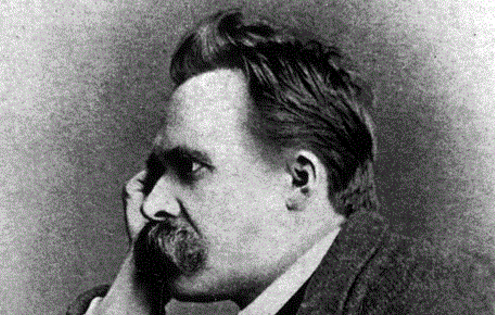
The quote inspired an anxious 1966 Time magazine cover, and a preachy 2016 movie franchise that works hard to inoculate the faithful against atheism’s threatening seductions: “God is Dead,” wrote Friedrich Nietzsche in his 1882 book of incisive aphorisms, The Gay Science, and unwittingly coined a phrase now inseparable from 20th century culture wars. Of course, Nietzsche knew he was tossing a Molotov cocktail into the fraught culture wars of his own time, but he didn’t blow things up for the sheer pleasure of it. Instead, his blunt assertion lay at the heart of what Nietzsche saw as both a tremendous problem and a necessary realization.
To clarify, Nietzsche never meant to say that there had been some sort of god but that he had died in recent history. “Rather,” writes Scotty Hendricks at Big Think, “that our idea of one had” been rendered a relic of a pre-scientific age. The philosopher, “an atheist for his adult life,” found no place for Christian belief in a post-Enlightenment world: “Europe no longer needed God as the source for all morality, value, or order in the universe; philosophy and science were capable of doing that for us.” Accepting this brute fact can impose a heavy existentialist burden, as well as a heavy philosophical and ethical one: theological thinking is deeply embedded in Western philosophy and language, or as Nietzsche wrote, “I am afraid we are not rid of God because we still have faith in grammar.”
A committed metaphysical naturalist, Nietzsche nonetheless saw that just as he was haunted by his strict religious upbringing, unable to easily rid himself of the traces of the Christian God, so too was European civilization haunted, particularly the bourgeois German society he often savaged. “God is dead; but given the way people are, there may still for millennia be caves in which they show his shadow.—And we—we must still defeat his shadow as well!” The “shadow” of god trails our ideas about morality. Fearing to give up religious thought, we cling to it even in the absence of religion. What is to take its place, we wonder, except for widespread, destructive nihilism, a condition Nietzsche feared inevitable?
Nietzsche even saw scientific discourse as haunted by ideas of divine agency. “Let us beware of saying that there are laws in nature,” he writes in The Gay Science, “There are only necessities: there is no one who commands, no one who obeys, no one who transgresses. Once you know that there are no purposes, you also know that there is no accident; for only against a world of purposes does the word ‘accident’ have a meaning.” Far from pulling away the source of human meaning, however, Nietzsche seeks to liberate his readers from the idea that “death is opposed to life”—or that losing a cherished belief is a catastrophe.
On the contrary—as philosopher Simon Critchley aptly paraphrases in a brief video at Big Think— Nietzsche thought that belief in God made us “cringing, cowardly, submissive creatures,” and profoundly unfree. He believed we would continue to be so until we accepted our place in nature—no easy feat in an age so steeped in god-think. “When will we be done with our caution and care?” Nietzsche wondered, “When will all these shadows of god no longer darken us? When will we have completely de-deified nature? When will we begin to naturalize humanity with a pure, newly discovered, newly redeemed nature?”
For Nietzsche, the mass of people may never do so. He reserves his redemption for “the kind of people who alone matter; I mean the heroic.” Failing to become heroes, ordinary people in modernity are fated to go the way of “the Last Man,” a figure, writes Hendricks, “who lives a quiet life of comfort, without thought for individuality or personal growth.” A passive consumer. We can read Nietzsche’s philosophy as thoroughgoing elitism, or as a call to the reader to personal heroism. Either way, the anxiety he tapped into has persisted for 134 years, and shows little sign of abating for many people. For others, the nonexistence of a supreme being has no effect on their psychological health.
For billions of Daoists and Buddhists, for example, the problem has never existed. Nietzsche knew perhaps as much about Eastern religion as his contemporaries, much of his knowledge tainted by Arthur Schopenhauer’s pessimistic take on Buddhism. “Compared to [Schopenhauer’s] world view,” writes Peter Abelson, “which is very severe, Buddhism seems almost cheerful.” Nietzsche could be equally severe, often as a matter of polemic, often as matter of mood, sometimes dismissing other religious systems with only slightly less contempt than he did Christianity. But he sums up one of his key atheistic values in a supposed quote from the Buddha: “Don’t flatter your benefactors! Repeat this saying in a Christian church, and it will instantly clear the air of everything Christian.” To live without belief in god, he suggests over and over, is to be fully free from servitude, and fully responsible for oneself.
Related Content:
Walter Kaufmann’s Classic Lectures on Nietzsche, Kierkegaard and Sartre (1960)
The Digital Nietzsche: Download Nietzsche’s Major Works as Free eBooks
Josh Jones is a writer and musician based in Durham, NC. Follow him at @jdmagness
Read More...The Power of Conformity: 1962 Episode of Candid Camera Reveals the Strange Psychology of Riding Elevators
Watch television creator Allen Funt predict flash mobs in the 1962 episode of Candid Camera above, filmed some forty years before Harper’s magazine editor, Bill Wasik, founded the movement with anonymously e‑mailed instructions for a coordinated public action.
The stunt, entitled “Face the Rear,” was pulled off by a handful of “agents”—a phrase coined by Improv Everywhere’s founder Charlie Todd to describe the poker-faced participants conjuring a secretly agreed upon alternate reality to confound (and not always delight) its target subject, along with unsuspecting bystanders.
Compared to the grand-scale theatrics that have transformed an upscale market into a scene from La Traviata and infiltrate subways worldwide with thousands of pants-less riders every year, this prank is quite subtle in the execution.
It succeeds on our tacit understanding of what constitutes proper elevator behavior when others passengers are present. Left to our own devices, we can sing, dance, and let the mask of propriety slip in any number of ways. Once others enter? We share the space and face forward.
But what if everyone who enters inexplicably faces the back wall?
What would you do?
As hypotheticals go, this one’s not nearly so weighty as considering whether you’d have followed the script of Stanley Milgram’s obedience experiments or put your own family at risk by hiding Anne Frank.
Still…
For the subjects of Candid Camera’s elevator gag, the pressure to succumb to group think quickly overruled years of learned physical behavior.
And normative elevator physicality definitely springs from social cues, as John Donovan, host of NPR’s “Around the Nation” said, in an interview with Lee Gray, author of From Ascending Rooms to Express Elevators: A History of the Passenger Elevator in the 19th Century:
I know a psychologist who works with teenagers who have autism who—he uses encouraging to learn skills that will allow them to be independent in the world to get out on their own. And one of his lessons with some of the teenagers is what to do in an elevator because he says that the typical kid that he works with, when the door is opened, and he’s been told that he should step inside, will step inside and face the back wall because nobody has told him that everybody else in the elevator is going to turn around and face the front doors…
Candid Camera’s stunts were always framed as comedy, though its creator, Funt, was well versed in psychology, having served as child psychologist Kurt Lewin’s research assistant at Cornell University.
In an article for the Archive of American Television, writer Amy Loomis identified five premises into which the average Candid Camera gag could fall:
- Reversing normal or anticipated procedures
- Exposing basic human weaknesses such as ignorance or vanity
- Using the element of surprise
- Fulfilling fantasies
- Placing something in a bizarre or inappropriate setting
“Face the Rear” was a case where conformity born of an unexpected reversal in normal procedure yielded laughs, at the gentle expense of a series of unsuspecting subjects, whose solo rides were disrupted by a bunch of Candid Camera operatives.
Related Content:
This is Your Brain on Sex and Religion: Experiments in Neuroscience
Ayun Halliday is an author, illustrator, theater maker and Chief Primatologist of the East Village Inky zine. Her play Zamboni Godot is opening in New York City in March 2017. Follow her @AyunHalliday.
Read More...
Decoding the Screenplays of The Shining, Moonrise Kingdom & The Dark Knight: Watch Lessons from the Screenplay
“A screenplay isn’t meant to be read,” said no less a directing-screenwriting auteur than Stanley Kubrick. “It’s to be realized on film.” The quote comes up in “The Shining — Quietly Going Insane Together,” an episode of the video essay series Lessons from the Screenplay. Creator Michael Tucker uses it to explain his lack of access to the actual “shooting script” of the film, meaning the sort of script typically written before production and then more or less adhered to on set. But Kubrick worked differently. On his projects “the words of the script and the design of the film were created together.” (Or as star Jack Nicholson says in a bit of archival footage, “I quit usin’ my script. I just take the ones they type up each day.”)
Tucker goes on to break down The Shining’s writing process in a way that will fascinate not just screenwriters but anyone with an interest in artistic structure, beginning with the segmentation implied by the film’s memorably stark title cards: “THE INTERVIEW,” “THURSDAY,” “8am,” and so on. He does this in service of one important overarching question: “What, exactly is so creepy about The Shining?” (I’ve been asking it myself ever since watching it at a Halloween party nearly twenty years ago.) In “Moonrise Kingdom: Where Story Meets Style” he gets into the question of what storytelling functions Anderson’s signature abundance of vivid, whimsical, or askew details perform, and how they do it effectively.
As far as what makes Christopher Nolan’s second Batman movie The Dark Knight work so well, Tucker has the answer in two words: the Joker. Different actors have portrayed Batman’s most famous rival with different levels of effectiveness, with Heath Ledger’s Joker generally acknowledged as the Joker, or at least one of the Jokers, to beat. But like any character, this Joker began on the page, and in “The Dark Knight — Creating the Ultimate Antagonist,” we learn which screenwriting guru-approved qualities instilled there give him so much power: his exceptional skill at attacking Batman’s weaknesses, how he pressures Batman into difficult choices, and how he and Batman ultimately compete for the same goal, the soul of Gotham, and become two sides of the same coin.
You can learn other lessons that Tucker draws from the screenplays of movies like Nightcrawler, Gone Girl, Independence Day, Ghostbusters, and a two-parter on American Beauty. While elements of cinema like the directing, the acting, the editing, and even the music might capture our attention more aggressively, we shouldn’t forget that every narrative film, large or small, traditional or unconventional, grows from words someone wrote down. “It’s not what a movie is about,” declared Roger Ebert, “it’s how it is about it” — and the decisions of how to be about it happen in the screenplay.
Related Content:
Akira Kurosawa’s Advice to Aspiring Filmmakers: Write, Write, Write and Read
10 Tips From Billy Wilder on How to Write a Good Screenplay
Woody Allen’s Typewriter, Scissors and Stapler: The Great Filmmaker Shows Us How He Writes
How Ray Bradbury Wrote the Script for John Huston’s Moby Dick (1956)
Raymond Chandler: There’s No Art of the Screenplay in Hollywood
Based in Seoul, Colin Marshall writes and broadcasts on cities and culture. He’s at work on a book about Los Angeles, A Los Angeles Primer, the video series The City in Cinema, the crowdfunded journalism project Where Is the City of the Future?, and the Los Angeles Review of Books’ Korea Blog. Follow him on Twitter at @colinmarshall or on Facebook.
Read More...Watch a 20-Year-Old Mikhail Baryshnikov Win Gold in One of His Earliest Performances (1969)
How well does Mikhail Baryshnikov dance? The question answers itself, given that the very word “Baryshnikov” has come to signify the mastery of that art, and especially of male roles in ballet. Yet there was once a time when no young dancer aspired to become the next Baryshnikov, because even Baryshnikov hadn’t yet become Baryshnikov. Born in Latvia to a dressmaker mother and an engineer father, he began studying ballet in 1960, at age eleven. Four years later, he entered the Vaganova Academy of Russian Ballet, from which he went on to win the venerable Varna International Ballet Competition and, in 1967, join the Kirov Ballet and Marinsky Theater.
The clip at the top of the post shows Baryshnikov’s performance at the 1969 Moscow International Ballet Competition, from which he came out, alongside other such soon-to-be big ballet names as Nina Sorokina and Malika Sabirova, as a gold laureate.
“Baryshnikov’s technique is faultless, his interpretation magnificent,” says the announcer as the still tender-aged dancer, just twenty years old, executes a solo from La Bayadère. The praise would, from that point on, keep on coming, and not just from the Soviet Union; around the same time, New York Times critic Clive Barnes called Baryshnikov “the most perfect dancer I have ever seen.”
Yet for all his skill, Baryshnikov didn’t fit the traditional ballet template: he lacked the height of other famous male dancers, for one, and he also harbored a desire to go beyond the boundaries of 19th-century dance and explore 20th-century dance’s possibilities for innovation. His defection from the Soviet Union in 1974 made it possible for him to work with forward-thinking choreographers like Alvin Ailey and Twyla Tharp, and to this day, in his mid-60s, he continues pushing his performative boundaries on the stage and the screen. Whether the 20-year-old dancer we see here could possibly have imagined such a future for himself — a future involving projects like his role on Sex and the City in the 2000s and his much-viewed video with Lil Buck for Rag & Bone last year — only Baryshnikov knows.
Related Content:
Ballet Dancers Do Their Hardest Moves in Slow Motion
Based in Seoul, Colin Marshall writes and broadcasts on cities and culture. He’s at work on a book about Los Angeles, A Los Angeles Primer, the video series The City in Cinema, the crowdfunded journalism project Where Is the City of the Future?, and the Los Angeles Review of Books’ Korea Blog. Follow him on Twitter at @colinmarshall or on Facebook.
Read More...Alfred Hitchcock Presents Ghost Stories for Kids (1962)
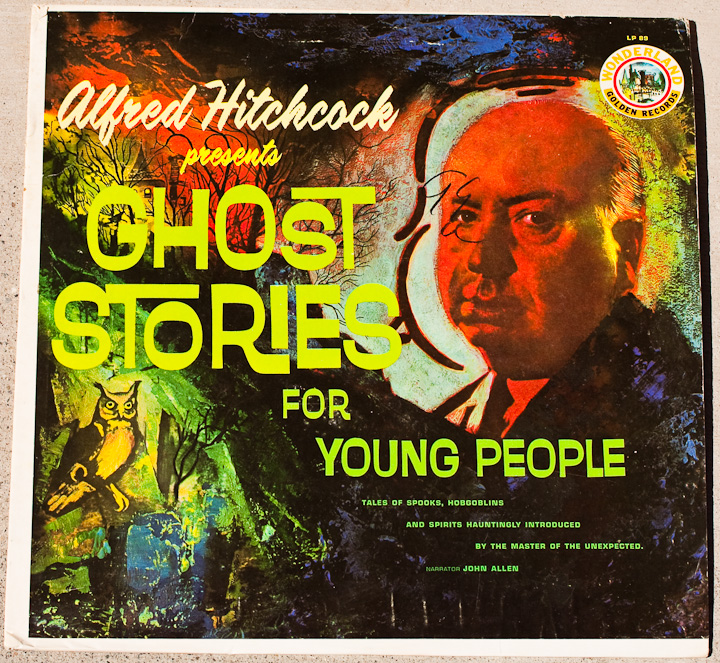
“Now of course, the best way to listen to ghost stories is with the lights out,” says the inimitable Alfred Hitchcock, as he introduces his 1962 vinyl release Alfred Hitchcock Presents: Ghost Stories for Young People. “There is nothing like a dark room to attract ghosts and you may like to have some of our mutual friends come and listen with you.”
Just in time for Halloween, we are shining a flickering light on this album, released once before on CD and now on Spotify. (You can also find it on YouTube.) It will either take listeners back to when they were kids, or frighten a new generation of young ones for the first time.
Though Hitchcock’s films toyed with spirits-—Rebecca and Vertigo among them-—he never really made straight up monster movies or ghost stories. (Psycho and The Birds are the closest he ever got.) But once he became a television host and personality in the 1950s, his mischievous character and his macabre voice made him a natural to present all sorts of ghoulish anthologies, resulting in numerous paperbacks and hardbacks, most of which he had little to do with but simply bore his name as a stamp of frightening authority.
And even before that, Hitchcock was putting his name to short suspense story collections, and a mystery magazine that was started in 1956 and continues to this day. We talk about him as one of the best film directors of all time, but he was also a one-man suspense and terror industry in his day, a canny creator who knew the worth of licensing his name.
Of the six stories here, the two given writer’s credit are “Jimmy Takes Vanishing Lessons” by Walter R. Brooks (a children’s author who created the talking horse character Mr. Ed) and “The Open Window” by Edwardian writer Saki.
Judging from the YouTube comments for the crackly recording posted there, these stories have haunted these listeners since their childhood. Kids these days might prefer a dish of creepypasta, but there’s no denying the power of a voice, creepy music, and sudden sound effects, all delivered by way of headphones…with the lights off.
Related Content:
Stephen King’s Top 10 All-Time Favorite Books
Alfred Hitchcock’s Rules for Watching Psycho (1960)
Ted Mills is a freelance writer on the arts who currently hosts the FunkZone Podcast. You can also follow him on Twitter at @tedmills, read his other arts writing at tedmills.com and/or watch his films here.
Read More...The Artists’ and Writers’ Cookbook Collects Recipes From T.C. Boyle, Marina Abramović, Neil Gaiman, Joyce Carol Oates & More
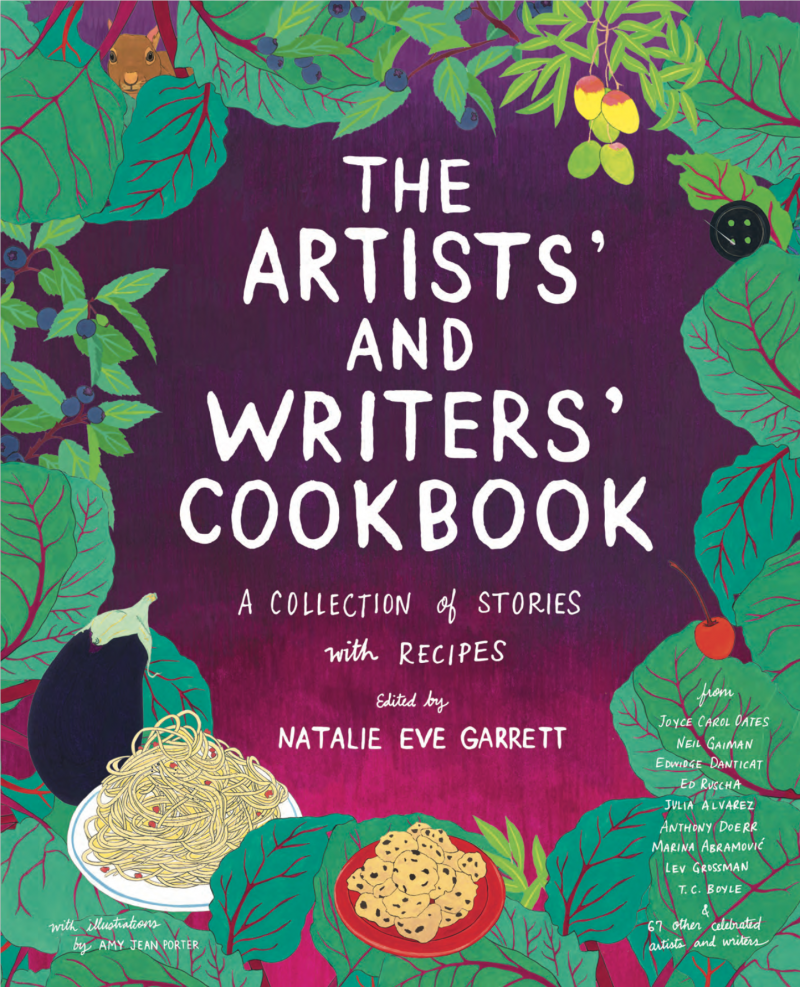
The Artists’ and Writers’ Cookbook: A Collection of Stories with Recipes © 2016, edited by Natalie Eve Garrett, illustrated by Amy Jean Porter, published by powerHouse Books..
There will never not be a market for the cookbook, with all its various subcategories, from fad diet to celebrity chef. While The Onion’s proposed “Nietzschean Diet” (which “lets you eat whatever you fear most”) may never catch on, one unusual cookbook niche does involve the recipes of famous writers, artists, musicians and other high- and pop-culture figures. The genre flourished in the sixties and seventies, with Swingers & Singers in the Kitchen in 1967, Salvador Dalí’s Les Diners de Gala in 1973, and the MoMA’s Artists’ Cookbook in 1978.
Predating these celebrity recipe books, The Artists’ & Writers’ Cookbook appeared in 1961. Brain Pickings describes the book as “a lavish 350-page vintage tome, illustrated with 19th-century engravings and original drawings by Marcel Duchamp, Robert Osbourn, and Alexandre Istrati.” It featured 220 recipes by painters, novelists, poets, and sculptors like Man Ray, John Keats, Robert Graves, Harper Lee, Georges Simenon, and more. What’s old has become new again, with the recent reprinting of Dalí’s cookbook by Taschen and, on October 11th, the publication of an updated Artists’ and Writers’ Cookbook, edited by Natalie Eve Garrett and illustrated by Amy Jean Porter.

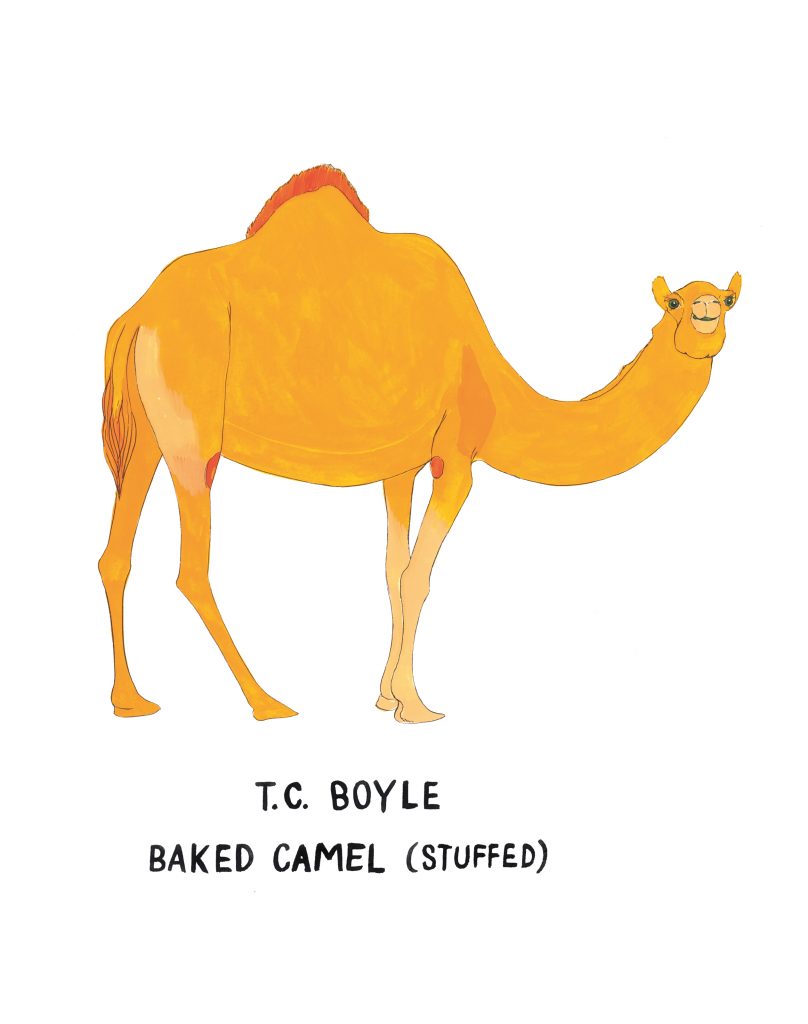
The 2016 version includes recipes from such living artists as Edwidge Danticat, Ed Ruscha, Neil Gaiman, Joyce Carol Oates, James Franco, Nikki Giovanni, Marina Abramović, and many more. The recipes range from the whimsical (see T.C. Boyle’s “Baked Camel (Stuffed)” further up) to the thoroughly metaphorical (as in Abramović’s “Essential Aphrodisiac Recipes,” above). In-between, we have such standard fare as “The Utilitarian, American-Style PB&J: An Artist’s Best Friend,” courtesy of Franco, which calls for the following ingredients:
wheat bread
peanut butter
jelly
ginger ale (optional)
pickles (optional)
Haitian novelist Edwidge Danticat takes a serious approach with a traditional recipe for “Soup Joumou.” She prefaces this more extensive dish with a poetic description of its national importance, concluding that it is consumed “as a sign of our independence, as a celebration of a new beginning.…” The recipe may send you to the grocery, but—especially this time of year—you’ll find all of the ingredients at your nearest chain store:
1 pumpkin between 2–3 pounds, peeled and cut into small pieces
1 pound cabbage, sliced and chopped
4 carrots, peeled and sliced
3 stalks celery, sliced and chopped
1 large onion, cut into small pieces
5 potatoes, peeled and cubed
2 turnips, peeled and cubed (optional)
1 lime cut in half and squeezed for a much juice as you can get from it
¼ pound macaroni
3 garlic cloves, crushed or cut into small pieces
1 sprig thyme
1 sprig parsley
2 teaspoons salt
2 teaspoons ground pepper
1 Scotch bayonet pepper
Sounds delicious.
Neil Gaiman keeps things very simple with “Coraline’s Cheese Omelette,” introduced with an excerpt from that dark children’s fantasy. For this, you likely have all you need on hand:
2 eggs
butter
cheese
1 tablespoon milk
a pinch of salt
The essays and narratives in the new The Artists’ and Writers’ Cookbook are “at turns,” writes editor Natalie Eve Garrett, “comedic and heart-wrenching, personal and apocalyptic, with recipes that are enchanting to read and recreate.” As you can see from the small sampling here, you need not have any pretentions to haute cuisine to follow most of them. And as the book’s subtitle—“A Collection of Stories with Recipes”—suggests, you needn’t cook at all to find joy in this diverse assemblage of artists and writers’ associations with food, that most personal and intimate, yet also culturally defining and communal of subjects. Pick up a copy of The Artists’ and Writers’ Cookbook on Amazon.
Related Content:
1967 Cookbook Features Recipes by the Rolling Stones, Simon & Garfunkel, Barbra Streisand & More
Salvador Dalí’s 1973 Cookbook Gets Reissued: Surrealist Art Meets Haute Cuisine
Josh Jones is a writer and musician based in Durham, NC. Follow him at @jdmagness
Read More...Stephen Fry: What I Wish I Knew When I Was 18
Growing up, many of us assume that every adult can, by definition, give us life advice. When we grow up a little more, we realize that, like everything else, it isn’t quite that simple: though older people do, on the whole, seem eager and sometimes even desperate to dole out words of wisdom, whether those words apply in our own cases, or even make sense, falls to us to determine. And so we’d do better not to ask our elders to give us advice, but to give their younger selves advice: what, we might ask, do you wish you’d known before, say at the age of eighteen? Writer, comedian, and all-around man of the page and screen Stephen Fry answers in the clip above.
“The worst thing you can ever do in life is set yourself goals,” Fry says. “Two things happen: one is you don’t meet your goals so you call yourself a failure. Secondly, you meet your goal and go, ‘Well, I’m here, now what? I’m not happy I’ve got this car, this job, I’m living in this address which I always thought was the place I wanted to be.’ Because you’re going for something outside yourself, and that’s no good.” The observation that you can’t derive lasting satisfaction from external circumstances may date back at least to the Stoics, who recommend focusing only on your own actions and reactions, but it bears repeating more often than ever in the external circumstance-rich 21st century.
But that doesn’t mean that you can simply turn inward: “Let’s forget what successful people have in common. If there’s a thing that unsuccessful people have in common, it’s that they talk about themselves all the time. ‘I need to do this, I need’ — their first two words are usually ‘I need.’ That’s why nobody likes them, and that’s why they’ll never get where they want to be.” But “if you use your eyes to look out, not to be looked into, then you connect, then you’re interesting, then people want to be around you. It’s about the warmth and the charm you can radiate that is real because of your positive interest in others.”
I myself have thought about these words of Fry’s often since first watching this interview with him half a decade ago. Clearly these pieces of advice to his eighteen-year-old self have wider applicability, and he has much more to offer besides: Spend a few extra moments and a few extra words connecting with others. Efface yourself. Deliberately pursue experiences different from the ones you “know you like.” Travel and read. Have heroes and mentors, and keep learning from them. Sharing the benefits of life is the benefit of life. Understand the dual pull of being a part of and apart from the “tribe.” Test things out instead of taking them on trust. Never read the comments. Kindness counts more than virtue, justice, truth, or anything else.
And, we might add, make sure to ask the right questions when seeking advice — but make even more sure to ask the right people.
Related Content:
Stephen Fry on Coping with Depression: It’s Raining, But the Sun Will Come Out Again
What Questions Would Stephen Fry Ask God at the Pearly Gates?
Stephen King Writes A Letter to His 16-Year-Old Self: “Stay Away from Recreational Drugs”
Based in Seoul, Colin Marshall writes and broadcasts on cities and culture. He’s at work on a book about Los Angeles, A Los Angeles Primer, the video series The City in Cinema, the crowdfunded journalism project Where Is the City of the Future?, and the Los Angeles Review of Books’ Korea Blog. Follow him on Twitter at @colinmarshall or on Facebook.
Read More...Watch Online Every Presidential Debate Since 1960–and Revisit America’s Saner Political Days
On Wednesday night, Las Vegas will mercifully host the final presidential debate. And it promises to be another rated‑R affair. You’d except nothing less from the candidate who’s going to “make America great again.”
If you want a spectacle your kids can actually watch, then shut your TVs and travel back into America’s past. Created by PBS and Microsoft, the web site watchthedebates.org lets you watch every televised presidential debate since 1960. They’re generally substantive, all rated PG, and certainly a little nostalgia-inducing.
Above you can watch Kennedy and Nixon go at it in the first televised debate (1960). Head over to www.watchthedebates.org for more.
If you would like to support the mission of Open Culture, consider making a donation to our site. It’s hard to rely 100% on ads, and your contributions will help us continue providing the best free cultural and educational materials to learners everywhere. You can contribute through PayPal, Patreon, and Venmo (@openculture). Thanks!
Related Content:
Free Online History Courses
John Green’s Crash Course in U.S. History: From Colonialism to Obama in 47 Videos
The History of the World in 46 Lectures From Columbia University
Read More...Support Us
We're hoping to rely on loyal readers, rather than erratic ads. Please click the Donate button and support Open Culture. You can use Paypal, Venmo, Patreon, even Crypto! We thank you!

About Us

Open Culture scours the web for the best educational media. We find the free courses and audio books you need, the language lessons & educational videos you want, and plenty of enlightenment in between.
Advertise With Us

FREE UPDATES!
GET OUR DAILY EMAIL
Get the best cultural and educational resources on the web curated for you in a daily email. We never spam. Unsubscribe at any time.
FOLLOW ON SOCIAL MEDIA

Open Culture editor Dan Colman scours the web for the best educational media. He finds the free courses and audio books you need, the language lessons & movies you want, and plenty of enlightenment in between.
Advertise With Us

