The History & Legacy of Magna Carta Explained in Animated Videos by Monty Python’s Terry Jones
Even those who paid next to no attention to their history teachers know about Magna Carta — or at least they know it first came about in 1215. To deliver all the other relevant details, we now have a new teacher in the form of Monty Python’s Terry Jones, who, on the occasion of this great charter’s 800th anniversary, provides the narration for these two short animations, “Magna Carta: Medieval” and “Magna Carta: Legacy,” that tell the rest of its story.
These videos come as part of a whole web site put together by the British Library meant to help us all “discover the history and legacy of one of the world’s most celebrated documents.” To this end, they’ve put up an introduction to Magna Carta by Claire Breay and Julian Harrison, which summarizes both its origins and its relevance today:
Originally issued by King John of England (r.1199–1216) as a practical solution to the political crisis he faced in 1215, Magna Carta established for the first time the principle that everybody, including the king, was subject to the law.
[ … ]
Three clauses of the 1225 Magna Carta remain on the statute book today. Although most of the clauses of Magna Carta have now been repealed, the many divergent uses that have been made of it since the Middle Ages have shaped its meaning in the modern era, and it has become a potent, international rallying cry against the arbitrary use of power.
These animations, of course, add a great deal of visual, narrative, and comedic vividness to this important piece of Western political history, following it from the reign of King John (“one of the worst kings in history”), through civil war, the creation of the United States of America, struggles for voting rights and the freedom of the press, right up to the writing of the Universal Declaration of Human Rights, in a sense Magna Carta’s modern descendant. “Although very few of Magna Carta’s original clauses remain valid in English law,” says Jones, “it continues to inspire people worldwide. Not a bad legacy for an 800-year-old document.”
Related Content:
Download 78 Free Online History Courses: From Ancient Greece to The Modern World
Free Online Political Science Courses
Colin Marshall hosts and produces Notebook on Cities and Culture as well as the video series The City in Cinema and writes essays on cities, language, Asia, and men’s style. He’s at work on a book about Los Angeles, A Los Angeles Primer. Follow him on Twitter at @colinmarshall or on Facebook.
Read More...Cookie Monster, Life Coach, Shows Why Cookies Are the Key to Happiness
You can look for answers to life’s big questions in the Zen teachings of Alan Watts, in the existentialist musings of Hunter S. Thompson, or somewhere in our collection of 130 Free Online Philosophy Courses. But maybe that’s over-thinking things — providing complicated answers when the key to life is really quite simple. Eating cookies. Ladies and gentleman, your favorite life coach and mine, Cookie Monster.
Related Content:
The Zen Teachings of Alan Watts: A Free Audio Archive of His Enlightening Lectures
Download 100 Free Philosophy Courses and Start Living the Examined Life
Hunter S. Thompson, Existentialist Life Coach, Gives Tips for Finding Meaning in Life
Read More...An Animated Marc Maron Recalls Interviewing a Shirtless Iggy Pop in LA Garage
Marc Maron’s WTF podcast now clocks in at 585 episodes. Certainly one I remember — and so does Maron too — is Episode 400, which featured the godfather of punk, Iggy Pop. Above, an animated Marc Maron recalls the many musicians he’s interviewed in his Los Angeles garage. And especially the summer day when Pop paid a visit, tore off his shirt, and gave his own nipple a little twist. Good times in LA.
Related Content:
Hear a Great Radio Documentary on William S. Burroughs Narrated by Iggy Pop
Iggy Pop Conducts a Tour of New York’s Lower East Side, Circa 1993
Read More...Download Free NASA Software and Help Protect the Earth from Asteroids!

Yes, you can help save the world. And just by downloading some free software. Writes NASA:
Protecting the Earth from the threat of asteroid impacts means first knowing where they are. NASA is harnessing the incredible potential of innovators, makers and citizen scientists by opening up the search. In an increasingly connected world, NASA recognizes the value of the public as a partner in addressing some of the country’s most pressing challenges. We need your help in identifying asteroids – and to help further this effort, we’ve built an application that enables everyone, everywhere, to help solve this global challenge.
To download the app and join the hunt for asteroids, please click here. To get more information on the project (in which Harvard is a strategic participant) click here.
Next up? Hopefully an app that saves California, which, a NASA official projects, will run out of water by next year.
Follow us on Facebook, Twitter, Google Plus and LinkedIn and share intelligent media with your friends. Or better yet, sign up for our daily email and get a daily dose of Open Culture in your inbox.
Related Content:
Free NASA eBook Theorizes How We Will Communicate with Aliens
NASA Puts Online a Big Collection of Space Sounds, and They’re Free to Download and Use
NASA Archive Collects Great Time-Lapse Videos of our Planet
Ray Bradbury Reads Moving Poem on the Eve of NASA’s 1971 Mars Mission
Read More...How to Draw Don Draper: A Short Video Primer from Mad Men Insider Josh Weltman
Josh Weltman, a 25 year veteran of the advertising business, has been a part of Mad Men since the show’s first season. He has worked closely, he tells us on his web site, “with Matthew Weiner and the show’s writers and producers to help ensure that Mad Men accurately depicts the process of creating ads and servicing clients, and that the show’s advertising and business stories play true to life, true to character and true to period. He also creates most of the original ads seen on the show.”
On his Vimeo channel, you can find just one video. But it’s an essential one — a short quick primer on how to draw Don Draper. Start practicing. The final season of Mad Men kicks off on Sunday, April 5, at 10 p.m. on AMC.
Follow us on Facebook, Twitter and Google Plus and share intelligent media with your friends. Or better yet, sign up for our daily email and get a daily dose of Open Culture in your inbox. Also, if you know of any great media we should share with your fellow readers, please send it our way.
Read More...Hear John Lennon’s Final Interview, Taped on the Last Day of His Life (December 8, 1980)
(Note: The clip above is the first of six parts. Hear the remaining parts here: 2, 3, 4, 5, 6)
John Lennon’s last days were filled with professional and domestic routines characteristic of both a typical wealthy New Yorker and a legendary rock star and activist: making breakfast and watching Sesame Street with his son Sean, going on epic shopping sprees, spending late nights in the studio, staging demonstrations, arguing with his retinue of servants and hangers-on. After five years in semi-retirement, or “siegelike retreat,” spent raising Sean, John Lennon seemed ready to emerge from seclusion and renew his career. On his final day, December 8, 1980, he was feeling hopeful about his creative future. He had just learned that his album with Yoko, Double Fantasy, had gone gold, and he and Yoko were engaged in promotion, and were looking forward to their next musical endeavor.
That morning, Annie Leibovitz and her assistant came to the Lennon’s apartment building, The Dakota, to shoot those now iconic photographs for Rolling Stone of the Lennons in bed. Meanwhile, a devoted fan named Paul Goresh, and Lennon’s murderer Mark David Chapman, started to hang around outside the building. Less than two hours later, a crew from San Francisco’s RKO radio arrived at The Dakota to interview John and Yoko. Interviewer Dave Sholin remembers meeting Lennon, who was getting dressed after the nude photo shoot: “the door opens and John jumps in with his arms extended, like ‘here I am folks!’ We were meeting John Lennon and we were all maybe a little nervous but that just put us right at ease in probably less than a minute.” “He was a regular guy, very, very sharp and extremely quick witted,” Sholin continued. “And he connected with all of us. He had been out of the public eye for five years and he was open to speaking about anything. He did not hold back.”
You can hear that interview, in six parts, above, and read a transcript here at Beatles Archive. John and Yoko talk in great detail about Double Fantasy, about parenting, about meeting, falling in love, and working together. Lennon also talks about his social vision and the need for “holistic” solutions to “stop this paranoia of 90-year old men playing macho games with the world and possibly the galaxy.” Notably, he offers his assessment of the cultural shifts from the sixties through the seventies.
The bit about the sixties we were all full of hope and then everybody got depressed and the seventies were terrible – that attitude that everybody has; that the sixties was therefore negated for being naïve and dumb. And the seventies is really where it’s at, which means, you know, putting makeup on and dancing in the disco – which was fine for the seventies – but I don’t negate the sixties. I don’t negate the seventies. The … the seeds that were planted in the sixties – and possibly they were planted generations before – but the seed… whatever happened in the sixties the… the flowering of that is in the feminist, feminization of society. The meditation, the positive learning that people are doing in all walks of life. That is a direct result of the opening up of the sixties. Now, maybe in the sixties we were naïve and like children everybody went back to their room and said, ‘Well, we didn’t get a wonderful world of just flowers and peace and happy chocolate and, and, and it wasn’t just pretty and beautiful all the time’ and that’s what everybody did, ‘we didn’t get everything we wanted’ just like babies and everybody went back to their rooms and sulked. And we’re just gonna play rock and roll and not do anything else . We’re gonna stay in our rooms and the world is a nasty, horrible place ’cause it didn’t give us everything we cried for’, right? Cryin’ for it wasn’t enough. The thing the sixties did was show us the possibility and the responsibility that we all had. It wasn’t the answer. It just gave us a glimpse of the possibility, and the seventies everybody gone ‘Nya, nya, nya, nya’. And possibly in the eighties everybody’ll say, ‘Well, ok, let’s project the positive side of life again’, you know? The world’s been goin’ on a long time, right? It’s probably gonna go on a long time… ”
After the interview, Sholin boarded a plane back to San Francisco, and John and Yoko went back to work, meeting with producer Jack Douglas. When they returned home that night, they found Mark David Chapman still waiting outside The Dakota with his .38. At 11:15 that night, Lennon was pronounced dead at Roosevelt Hospital. Sholin tells the story in a lengthy intro to the interview above. You can also listen to a streamlined version of the interview without the intro below.
Related Content:
What We Heard 34 Years Ago on the Night John Lennon Was Shot: TV & Radio
Bed Peace Revisits John Lennon & Yoko Ono’s Famous Anti-Vietnam Protests
Download the John Lennon/Yoko Ono “War is Over (If You Want It)” Poster in 100+ Languages
Josh Jones is a writer and musician based in Durham, NC. Follow him at @jdmagness
Read More...The Philosophy of Friedrich Nietzsche Explained with 8‑Bit Video Games
In the world of the 8‑bit video game, there may be no more a frustrating, Sisyphusean task than completing the various iterations of Mega Man. Each successive level can feel endless, as one dies and starts again, time after time, with no glorious end in sight. It can feel like, as Friedrich Nietzsche might say, being caught in a cycle of “eternal recurrence,” destined to repeat the same actions, over and over again for eternity.
The videos here then—part of the popular trend of 8‑bit shorts—use the graphics and bleeping sound effects and music of Mega Man to illustrate Nietzsche’s seemingly pessimistic ideas. First, with a nod to Rust Cohle, we have the theory—or rather the thought experiment—of “eternal recurrence.” Drawing on Arthur Schopenhauer’s interpretation of Buddhism, Nietzsche imagined a universe with no end and no beginning, an endless loop of suffering in which one is destined to make the same mistakes forever.
If this seems terrifyingly bleak to you, you may approach life through a haze of resentiment, Nietzsche might say, a bitter tangle of anger and blame that rejects the world as it is. The one who overcomes this snare—the ubermensch—has achieved self-mastery. Strong in the ways of the “will to power” is he, and delighted by the prospect of living in the present moment an infinite number of times, even if the universe is cold, cruel, and indifferent to human existence. The “will to power” governs all life, for Nietzsche, and human life in particular is weakened by ignoring this fact and clinging to moral systems of resentiment like that of Christianity.
Nietzsche’s argument against Christianity, as explained above at least, is that it encourages, even celebrates mediocrity and frowns upon excellence. That such is the general tenor of our current age—an assessment the narrator makes—is debatable. Yes, we may promote mediocrities at an alarming rate, but we also at least nominally celebrate uber men (almost always men), who may not truly be self made but who surely live by the dictates of the will to power, taking what they want when they want it. Whether Nietzsche’s characterization of this predatory behavior as the highest of human possibilities inspires you or not may depend on how far you feel yourself to be above the common herd.
Nietzsche’s amoral philosophy has appealed to some pretty predatory characters, but it also appeals to anti-authoritarian, post-modern types because of his critical stance toward not only religion, but also what can seem like its secular replacement, science. Nietzsche respected the scientific method, but he recognized its limitations as a means of describing, rather than explaining the world. All of our descriptions are interpretations that do not penetrate into the realm of ultimate causes or meanings, and cannot provide a privileged, god-like vantage point from which to make absolute judgments.
When, in the hopes of replacing the certainties of religious morality and metaphysics, we elevate science to the position of ultimate truth formerly granted to the mind of god, we lose sight of this basic limitation; we commit the same fallacy as the religious, mistaking our stories about the world for the world itself. Would Nietzsche’s extreme skepticism have made him sympathetic to today’s climate science deniers and antivaxxers? Probably not. He did recognize that, like the physical bodies where thought takes place, some ideas are healthy descriptions of reality and some are not. Nonetheless, our explanations, Nietzsche argued, whether scientific or otherwise, are contingent—effects of language, not exposés of Truth, capital T.
For more 8‑Bit Philosophy, see our posts on Plato, Sartre, Derrida, as well as Kierkegaard and Camus, all illustrated in short, nostalgic recreations of classic video games.
Related Content:
The Philosophy of Nietzsche: An Introduction by Alain de Botton
Nietzsche Dispenses Dating Advice in a Short Screwball Film, My Friend Friedrich
The Digital Nietzsche: Download Nietzsche’s Major Works as Free eBooks
Human, All Too Human: 3‑Part Documentary Profiles Nietzsche, Heidegger & Sartre
Josh Jones is a writer and musician based in Durham, NC. Follow him at @jdmagness
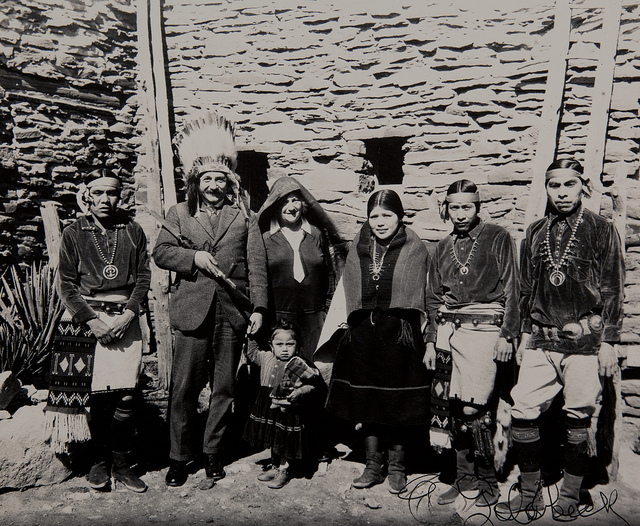
Read More...Albert Einstein Sports a Native American Headdress and a Peace Pipe at the Grand Canyon, 1931
Click here to view the image in a larger format.
In 1931, Caltech invited Albert Einstein to spend some time on their campus, with the hopes that he might eventually join their faculty. While in Southern California, he met Charlie Chaplin, took a photo with an Einstein puppet, enjoyed the mild winter, ruffled a few conservative feathers, then eventually left town. On the train ride back across the country, he visited the Hopi House, near the Grand Canyon, where he posed for a picture with members of the Hopi tribe. The website Hanksville.org revisits the classic photograph (apparently taken by Eugene O. Goldbeck) that documented his short visit:
There are several striking things about this photograph that deserve mention. It is clear that the headdress that has been placed on Professor Einstein’s head and the pipe he has been given to hold have no relationship to the Indians in this photograph. These Indians are Hopis from the relatively nearby Hopi pueblos while the headdress and pipe belong to the Plains Indian culture.… The Hopis in this picture were employees of the Fred Harvey Company who demonstrated their arts there and, no doubt, posed for many other pictures with tourists.
Besides Albert Einstein and his wife, there are 3 adult Hopis and one Hopi child in the photograph. Einstein is holding the hand of a young Hopi girl in a very natural manner; she is clutching something tightly in her other hand and is quite intent upon something outside the frame. Prof. Einstein’s attraction to children is seen in several other unofficial photographs. He loved children and felt quite comfortable with them. The two men on the left side of the photograph were there to facilitate the Einsteins’ trip. The man on the left is J. B. Duffy, General Passenger Agent of the ATSF (the famous Atichson, Tokepa and Santa Fe Railroad); the other man is Herman Schweizer, Head of Fred Harvey Curio, normally stationed in Albuquerque. He may have spoken German and was therefore present because Prof. Einstein was not completely comfortable yet with English.
According to the Einstein Almanac, the Hopi “gave Einstein a peace pipe, recognizing his pacifism, and dubbed him the ‘Great Relative.’ ” You can see the pipe on display in the photo.
As one website observed, what’s perhaps most notable about the historic image is this: It captures layers of commodification/fetishization. Here stands the most fetishized intellectual of the 20th century posing with one of the most fetishized peoples. Or maybe that’s just overthinking things.
Note: Some sources date the classic photo back to 1922, but that seems less plausible. The Harry Ransom Center provides an image available for download here.
Follow us on Facebook, Twitter and Google Plus and share intelligent media with your friends. Or better yet, sign up for our daily email and get a daily dose of Open Culture in your inbox.
Related Content:
Listen as Albert Einstein Calls for Peace and Social Justice in 1945
Albert Einstein Holding an Albert Einstein Puppet (Circa 1931)
“Do Scientists Pray?”: A Young Girl Asks Albert Einstein in 1936. Einstein Then Responds.
Einstein for the Masses: Yale Presents a Primer on the Great Physicist’s Thinking
The Musical Mind of Albert Einstein: Great Physicist, Amateur Violinist and Devotee of Mozart
Free Physics Courses in our Collection of 1100 Free Online Courses
Read More...Philosophers Drinking Coffee: The Excessive Habits of Kant, Voltaire & Kierkegaard

I think I speak for many of us when I say that coffee fuels our greatest intellectual efforts. And even as we get the jitters and leave brown rings on our desks, we can take comfort in the fact that so it also went with some of the most notable philosophers in the history of the discipline. As far back as the 18th century, no less a writer, thinker, and agitator than François-Marie Arouet, better known as Voltaire, “reportedly consumed somewhere between 40 and 50 cups of joe a day, apparently of a chocolate-coffee mixture. He lived into his eighties, though his doctor warned him that his beloved coffee would kill him.”
That comes from Amanda Scherker at The Huffington Post writing up “9 Famous Geniuses Who Were Also Huge Coffee Addicts.” Voltaire’s java habit also comes up on “10 Odd Obsessions of Famous Philosophers” by Virginia Muir at Listverse, who names his drinking venue of choice (the Café Procope in Paris) and indicates the extent of his enthusiasm by noting that “he even regularly paid exorbitant fees to have luxury coffee imported for his personal use” — which certainly doesn’t seem so eccentric today.

Later that century, Immanuel Kant took up coffee in his last days. Writing first-hand on the subject in the aptly titled The Last Days of Immanuel Kant, Thomas De Quincey (no stranger to life-changing habits himself) describes the philosopher’s “custom of taking, immediately after dinner, a cup of coffee,” a ritual he so came to relish that, whenever he sensed he may not get his new favorite beverage, there “commenced a scene of some interest. Coffee must be brought ‘upon the spot’ (a word he had constantly on his mouth during his latter days) ‘in a moment.’ ” Knowing this would happen, De Quincey made sure “the coffee was ground; the water was boiling; and the very moment the word was given, [Kant’s] servant shot in like an arrow and plunged the coffee into the water.… But this trifling delay seemed unendurable to Kant.”

(pictured: Søren Kierkegaard coffee mug)
In the 19th century, Søren Kierkegaard would also get into a coffee ritual. He “had his own quite peculiar way of having coffee,” writes biographer Joakim Garff. “Delightedly he seized hold of the bag containing the sugar and poured sugar into the coffee cup until it was piled up above the rim. Next came the incredibly strong, black coffee, which slowly dissolved the white pyramid.” I always drink it black myself, but who among us dares think ourselves too good for the teeth-aching preferred by the author of Fear and Trembling?
We must always bear in mind, too, that while coffee may constitute a necessary condition for our intellectual achievements, it never constitutes a sufficient one. Before pouring your next cup, whether your first of the day or your fiftieth, whether before or after dinner, and whether into a pyramid of sugar or not, ask yourself how much progress you’ve made on your own Candide or Critique of Pure Reason. A sobering question, to be sure — but after enough caffeine, you feel pretty sober anyway.
Related Content:
Free Online Philosophy Courses
The Coffee Pot That Fueled Honoré de Balzac’s Coffee Addiction
“The Vertue of the COFFEE Drink”: London’s First Cafe Creates Ad for Coffee in the 1650s
Colin Marshall hosts and produces Notebook on Cities and Culture as well as the video series The City in Cinema and writes essays on cities, language, Asia, and men’s style. He’s at work on a book about Los Angeles, A Los Angeles Primer. Follow him on Twitter at @colinmarshall or on Facebook.
Read More...Errol Morris Celebrates The Madness of Sports with Six New Mini-Docs: Watch Them Free Online
In honor of Errol Morris’ 67th birthday, which just passed on February 9, Grantland.com is celebrating with a full week of new documentaries shot for ESPN by the filmmaker. Frequently named one of the most important documentary filmmakers of our times, he rose to fame with 1978’s pet cemetery doc Gates of Heaven, then cemented it with The Thin Blue Line, which helped save a man from the electric chair. (It also started his long collaboration with composer Philip Glass.) Morris has been a private investigator, a journalist, and a maker of commercials, all of which provide the mental fuel (and funding) for his filmmaking. He invented the “Interrotron” a variation on the teleprompter, which allowed his subjects to talk straight into the camera while he interviewed them. It added an unsettling jolt to his two conversations with the men voted most likely to be war criminals, Robert McNamara and Donald Rumsfeld. But as Morris says in a Grantland interview, he is not here to accuse or prosecute.
When I was interviewing killers years ago, I enjoyed talking to them. I enjoyed being with them. I wasn’t there to moralize with them or temporize with them, I was there to talk to them. And I think that’s still true. Rumsfeld pushed it, I have to say.
It’s been two years since his last film, the Rumsfeld interview The Unknown Known, and, while we wait for his next feature and possibly a third book, Morris has given us six short docs that range between 10 and 20 minutes. The Subterranean Stadium (at the top of this post) delves into the sub-culture of tabletop electronic football games that have been around since the 1940s, and the grown-ups who still play them.
The Heist examines, with diagrams and suspenseful music, the four college students who stole Michael Jordan’s jersey from the vaulted heights of a stadium.
The Streaker profiles Mark Roberts, the affable Liverpudlian who has streaked at “every major sporting event in the world.”
There are three more videos waiting to be doled out. (Find them here.) One is on A.J. Mass, a writer for ESPN; another about sports collectibles; and the other about horse racing. The constant theme is the particular madness of sports fans, obsession being a major theme of Morris’ work.
The other link in all these films is the sound of Morris, who chooses not to edit out his offscreen voice. It’s the sound of a man clearly having a good time. However:
“I’m sick of interviewing,” he says. “I am really sick of it. I’m not gonna say I do it better than anybody else, but I do it differently than anybody else. I am good at it, for whatever reason. There are a lot of different reasons, but if that’s all I’m going to do for the rest of my life is stick a camera in front of people and say to them, “I don’t have a first question, what’s your first answer?” I think I would be very sad.”
So let’s celebrate Morris before he changes his mind.
This new series of short films will be added to our meta collection, 285 Free Documentaries Online. Find more films in our collection of 700 Free Movies Online.
Related content:
30 Errol Morris Movies That Can Be Streamed Online
Werner Herzog Loses a Bet to Errol Morris, and Eats His Shoe
“They Were There” — Errol Morris Finally Directs a Film for IBM
Ted Mills is a freelance writer on the arts who currently hosts the FunkZone Podcast. You can also follow him on Twitter at @tedmills and/or watch his films here.
Read More...Support Us
We're hoping to rely on loyal readers, rather than erratic ads. Please click the Donate button and support Open Culture. You can use Paypal, Venmo, Patreon, even Crypto! We thank you!

About Us

Open Culture scours the web for the best educational media. We find the free courses and audio books you need, the language lessons & educational videos you want, and plenty of enlightenment in between.
Advertise With Us

FREE UPDATES!
GET OUR DAILY EMAIL
Get the best cultural and educational resources on the web curated for you in a daily email. We never spam. Unsubscribe at any time.
FOLLOW ON SOCIAL MEDIA

Open Culture editor Dan Colman scours the web for the best educational media. He finds the free courses and audio books you need, the language lessons & movies you want, and plenty of enlightenment in between.
Advertise With Us


