The Filmmaking Craft of David Fincher Demystified in Two Video Essays
David Fincher is an auteur in the same way that Alfred Hitchcock is — you can tell a Fincher film from seeing a single frame. His shots are colored with inky blacks and sickly fluorescent greens and they are always compositionally perfect. His camera moves with an eerie disembodied smoothness that makes a Kubrick film seem down right warm and inviting. His movies mine the murky recesses of the human condition; you are more likely to see a grisly murder in a Fincher movie than a passionate kiss. Even movies that have a relatively low body count, like The Social Network, are imbued with a distinctly Finchersque grimness.
A growing number of critics are starting to pay attention. Above you can see Tony Zhou illustrate the director’s stylistic restraint in a video essay called “And the Other Way is Wrong.” Fincher himself once said, “They know you can do anything so the question is what don’t you do, not what do you do.” And Zhou elegantly shows what Fincher does not do, which is such staples of Hollywood filmmaking as hand-held cameras and close ups. He likes his camera locked down and aloof.
In another video essay series, Aaron Aradillas and the great Matt Zoller Seitz focus simply on the openings of Fincher’s films. The series starts with Fincher’s first, and most maligned, movie Alien3. Aradillas and Zoller Seitz argue that the film is distinctly different from the first two Alien films. Ridley Scott, director of Alien, kept the shots long and the edits largely invisible. Fincher, in contrast, used fast and jarring edits. He started as a music video director and was still in MTV mode when he made Alien3.
In a later episode on Zodiac, arguably his masterpiece, Aradillas and Zoller Seitz show that Fincher brilliantly packed the film’s two opening sequences with an impressive amount of exposition, setting up not just story elements but also the film’s complex, subjective point of view.
There are four videos in total in this series with a promise of a fifth. You can watch them all here.
Earlier this week, we showed you Cameron Beyl’s five-part, three-hour Directors Series study of Stanley Kubrick. Who is he tackling next? Fincher, of course.
Related Content:
Signature Shots from the Films of Stanley Kubrick: One-Point Perspective
Watch 7 New Video Essays on Wes Anderson’s Films: Rushmore, The Royal Tenenbaums & More
The Perfect Symmetry of Wes Anderson’s Movies
Jonathan Crow is a Los Angeles-based writer and filmmaker whose work has appeared in Yahoo!, The Hollywood Reporter, and other publications. You can follow him at @jonccrow. And check out his blog Veeptopus, featuring lots of pictures of badgers and even more pictures of vice presidents with octopuses on their heads. The Veeptopus store is here.
Read More...The Mad Men Reading List: 25 Revealing Books Read by the Characters on the Show
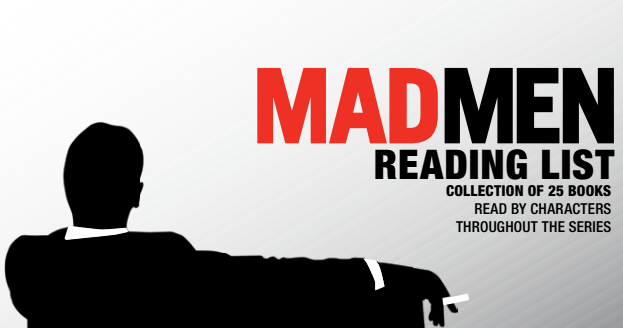
Image courtesy of The New York Public Library.
The good people over at the New York Public Library compiled a list of books read by the characters of Mad Men, which just started the last half of its seventh and final season. Over the course of the series, the show’s characters drank several swimming pools worth of cocktails, engaged in a host of ill-advised illicit affairs and, on occasion, dreamed up a brilliant advertising campaign or two. As it turns out, they also read quite a bit.
All the books seem to say something about the inner life of each character. The show’s enigmatic main character, Don Draper, favored works like Dante’s Inferno and William Faulkner’s The Sound and the Fury – books that point towards Draper’s series-long downward spiral. The whiny, insecure Pete Campbell read Thomas Pynchon’s paranoid classic The Crying of Lot 49. And Bert Cooper, the aristocratic bow-tie sporting patriarch of Sterling Cooper is apparently an Ayn Rand fan; he’s seen reading Atlas Shrugged early in the series. You can see the full reading list below or here in a beautiful PDF designed by the NYPL.
A number of the texts listed below also appear in our Free eBooks and Free AudioBooks collections.
DON DRAPER’S PICKS:
- EXODUS by Leon Uris (Episode 106 “Babylon”)
- THE BEST OF EVERYTHING by Rona Jaffe
- MEDITATIONS IN AN EMERGENCY by Frank O’Hara
- THE SOUND AND THE FURY by William Faulkner
- THE CHRYSANTHEMUM AND THE SWORD by Ruth Benedict
- THE SPY WHO CAME IN FROM THE COLD by John Le Carre
- THE FIXER by Bernard Malamud
- ODDS AGAINST by Dick Francis
- THE INFERNO by Dante Alighieri
- THE LAST PICTURE SHOW by Larry McMurtry
- PORTNOY’S COMPLAINT by Philip Roth
ROGER STERLING’S PICK:
- CONFESSIONS OF AN ADVERTISING MAN by David Ogilvy
JOAN HARRIS’S PICK:
- LADY CHATTERLEY’S LOVER by D. H. Lawrence
PETE CAMPBELL’S PICKS:
- THE CRYING OF LOT 49 by Thomas Pynchon
- GOODNIGHT MOON by Margaret Wise Brown
BETTY DRAPER’S PICKS:
- BABYLON REVISITED AND OTHER STORIES by F. Scott Fitzgerald
- THE GROUP by Mary McCarthy
LANE PRYCE’S PICK:
- THE ADVENTURES OF TOM SAWYER by Mark Twain
HENRY FRANCIS’S PICK:
- THE ADVENTURES OF HUCKLEBERRY FINN by Mark Twain
BERT COOPER’S PICK:
- ATLAS SHRUGGED by Ayn Rand
SALLY DRAPER’S PICKS:
- THE HISTORY OF THE DECLINE AND FALL OF THE ROMAN EMPIRE by Edward Gibbon
- TWENTY ONE BALLOONS by William Pene Du Bois
- NANCY DREW: THE CLUE OF THE BLACK KEYS by Carolyn Keene
- THE BLACK CAULDRON by Lloyd Alexander
- ROSEMARY’S BABY by Ira Levin
via The New York Public Library
Related Content:
Neil deGrasse Tyson Lists 8 (Free) Books Every Intelligent Person Should Read
Ernest Hemingway’s List for a Young Writer
Carl Sagan’s Undergrad Reading List: 40 Essential Texts for a Well-Rounded Thinker
David Foster Wallace’s 1994 Syllabus: How to Teach Serious Literature with Lightweight Books
Jonathan Crow is a Los Angeles-based writer and filmmaker whose work has appeared in Yahoo!, The Hollywood Reporter, and other publications. You can follow him at @jonccrow. And check out his blog Veeptopus, featuring lots of pictures of badgers and even more pictures of vice presidents with octopuses on their heads. The Veeptopus store is here.
Read More...What It’s Like to Be Color Blind and See Art in Color for the First Time
We all know that saying about walking in another’s shoes, but what about seeing through another’s eyeballs? I’m not talking about perspective. I’m talking about color. As in I see it, and my husband doesn’t. At least not the way I do.
His coping mechanism is to challenge me whenever I refer to something as “blue.” To him, it’s grey, or brown, or some other non-blue shade. He wants me to see it that way too. To admit that I am wrong. For my part, I feel it’s important that the person to whom I’m married acknowledge that there’s no way my favorite bowl can be the color of cement, no matter what his cone cell receptors are telling him.
Perhaps he’d have better luck asking patient strangers to describe color to him, as blind-from-birth film critic Tommy Edison does below. Hmm. Color may be more subjective than my husband’s and my spectral stand-offs would suggest.
According to EnChroma, the company that designed and sells the color-correcting lenses the onscreen guinea pigs are seen wearing in the video up top, an estimated 300 million people suffer from some form of color blindness. Their glasses offer some of those three million a chance at seeing red in the literal sense. The video participants are, not surprisingly, blown away by their first encounter with a Crayola-colored world.
Having refreshed myself on the structures of the eye, I took the color blindness test on EnChroma’s website. I tested normal, having identified the hidden (or in my case not-so-hidden) numbers in a variety of virtual mosaics.
My color blind friend, Bob, agreed to take it too, provided I muzzle myself from offering the sort of commentary to which husbands are subjected. (Whaddaya mean you can’t see it!? It’s bright fuchsia!!!) He pulled a pretty heavy duty protan deficiency, otherwise known as red-green color blindness.
According to the manufacturer, EnChroma glasses are unlikely to color his world. The best he could hope for is a slight improvement after weeks of wearing.
Bummer, except that he lives in Chicago, where the Museum of Contemporary Art offers EnChroma Cx loaners at the reception desk. Like many such institutions, the MCA is actively seeking ways to improve accessibility. (The museum’s color blind director of communications recommends having a look at Martin Creed’s Work No. 1351, a colorful lattice in the cafe. See right below.)

Perhaps Bob will get a peek at something he hasn’t seen before. Like red. Others will experience a revelation. Meanwhile, an insufferable non-colorblind individual such as myself might get an effect akin to an Instagram filter. My colors will pop.
“Unfair,” say Bob and my husband. I have to agree. Should the Museum of Contemporary Art offer color-leeching glasses, I will wear them, even if the frames are really ugly. Until then, the video below provides some sense of what those of us who see the full range of color aren’t missing.
Related Content:
Jorge Luis Borges, After Going Blind, Draws a Self-Portrait
Helen Keller Speaks About Her Greatest Regret — Never Mastering Speech
Ayun Halliday is an author, illustrator, and Chief Primatologist of the East Village Inky zine. Follow her @AyunHalliday
Read More...What Ignited Richard Feynman’s Love of Science Revealed in an Animated Video
The Experimenters, a three-episode series that animates the words of scientific innovators, concludes with the reflections of Richard Feynman, the charismatic, Nobel-Prize winning physicist who did so much to make science engaging to a broader public. Feynman knew how to popularize science — to make the process of scientific discovery and exploration so contagious — because he learned from a good teacher: his father. You can learn more about that by watching the animated video above. And don’t miss the previous two episodes in The Experimenters series. They touched on the life and thought of Buckminster Fuller and Jane Goodall.
Related Content:
Richard Feynman Presents Quantum Electrodynamics for the NonScientist
Read More...Watch Stars Read Classic Children’s Books: Betty White, James Earl Jones, Rita Moreno & Many More
As if we needed the competition—am I right, parents?—of some very excellent children’s books read by some beloved stars of stage and screen, and even a former vice president. With Storyline Online, the SAG Foundation, charitable arm of the Screen Actor’s Guild, has brought together top talent for enthusiastic readings of books like William Steig’s Brave Irene, read by Al Gore, Satoshi Kitamura’s Me and My Cat, read by Elijah Wood, and Patricia Polacco’s Thank You, Mr. Falker, read by the fantastic Jane Kaczmarek. There are so many readings (28 total), I could go on… so I will. How about Betty White’s irresistible reading of Harry the Dirty Dog, just above? Or Rita Moreno reading of I Need My Monster, below, a lighthearted story about our need for darkness? Or James Earl Jones, who touchingly discusses his own childhood struggles with reading aloud, and tells the story of To Be a Drum, further down?
I won’t be able to resist showing these to my three-year-old, and if she prefers the readings of highly acclaimed actors over mine, well, I can’t say I blame her. Each video features not only the faces and voices of the actors, but also some fine animation of each storybook’s art. The purpose of the project, writes the SAG Foundation, is to “strengthen comprehension and verbal and written skills for English-language learners worldwide.” To that end, “Storyline Online is available online 24 hours a day for children, parents, and educators” with “supplemental curriculum developed by a literacy specialist.” The phrase “English-language learners” should not make you think this program is only geared toward non-native speakers. Young children in English speaking countries are still only learning the language, and there’s no better way for them than to read and be read to.
As a matter of fact, we’re all still learning—as James Earl Jones says, we need to practice, no matter how old we are: practice tuning our ears to the sounds of well-turned phrases and appreciating the delight of a story—about a dirty dog, a monster, cat, cow, or lion—unfolding. So go on, don’t worry if you don’t have children, or if they happen to be elsewhere at the moment. Don’t deny yourself the pleasure of hearing Robert Guillaume read Chih-Yuan Chen’s Guji Guji, or Annette Bening read Avi Slodovnick’s The Tooth, or… alright, just go see the full list of books and readers here… or see Storytime Online’s Youtube page for access to the full archive of videos.
Related Content:
The International Children’s Digital Library Offers Free eBooks for Kids in Over 40 Languages
Stephen Fry Reads You Have To F**king Eat, the New Mock Children’s Book by Adam Mansbach
Josh Jones is a writer and musician based in Durham, NC. Follow him at @jdmagness
Read More...How Can I Know Right From Wrong? Watch Philosophy Animations on Ethics Narrated by Harry Shearer
The history of moral philosophy in the West hinges principally on a handful of questions: Is there a God of some sort? An afterlife? Free will? And, perhaps most pressingly for humanists, what exactly is the nature of our obligations to others? The latter question has long occupied philosophers like Immanuel Kant, whose extreme formulation—the “categorical imperative”—flatly rules out making ethical decisions dependent upon particular situations. Kant’s famous example, one that generally gets repeated with a nod to Godwin, involves an axe murderer showing up at your door and asking for the whereabouts of a visiting friend. In Kant’s estimation, telling a lie in this case justifies telling a lie at any time, for any reason. Therefore, it is unethical.
In the video at the top of the post, Harry Shearer narrates a script about Kant’s maxim written by philosopher Nigel Warburton, with whimsical illustrations provided by Cognitive. Part of the BBC and Open University’s “A History of Ideas” series, the video—one of four dealing with moral philosophy—also explains how Kant’s approach to ethics differs from those of utilitarianism.
In the video above, Shearer describes that most utilitarian of thought experiments, the “Trolley Problem.” As described by philosopher Philippa Foot, this scenario imagines having to sacrifice the life of one for those of many. But there is a twist—the second version, which involves the added crime of physically murdering one person, up close and personal, to save several. An analogous but converse theory is that of Princeton philosopher Peter Singer (below) who proposes that our obligations to people in peril right in front of us equal our obligations to those on the other side of the world.
Finally, the last video surveys one of the thorniest issues in moral philosophical history—the “is/ought” divide, as problematic as the ancient Euthyphro dilemma. How, asked David Hume, are we to deduce moral principles from facts about the world that have no moral dimension? Particularly when those facts are never conclusive, are subject to revision, and when new ones get uncovered all the time? The question introduces a seemingly unbridgeable chasm between facts and values. Moral judgments founded on what is or isn’t “natural” flounder before our terror of much of what nature does, and the very partial and fallible nature of our knowledge of it.
The problem is as startling as Hume’s critique of causality, and in part caused Kant to remark that Hume had awakened him from a “dogmatic slumber.” What may strike viewers of the series is just how abstract these questions and examples are—how divorced from the messiness of real world politics, with the exception, perhaps, of Peter Singer. It may be instructive that political philosophy forms a separate branch in the West. While these problems are certainly difficult enough to trouble the sleep of just about any thoughtful person, in our day-to-day lives, our decision making process seems to be much messier, and much more situational, than we’re probably ever aware of.
Related Content:
Free Online Philosophy Courses
What Makes Us Human?: Chomsky, Locke & Marx Introduced by New Animated Videos from the BBC
Josh Jones is a writer and musician based in Durham, NC. Follow him at @jdmagness
Read More...
A Short Animated History of Daylight Saving Time, Narrated by Stephen Fry
Several weeks back, we contemplated how, in the 1650s, the economic history of the West changed irrevocably when Christiaan Huygens invented the pendulum clock — a timepiece that enabled us to measure time in accurate, uniform ways, making us attentive to the passage of time and focus on things like productivity and performance. Watch “A Briefer History of Time” to get more on that.
By the 18th century, Ben Franklin, America’s great Enlightenment figure, thought of another way to discipline time and squeeze more productivity out of us. While an envoy in France, Franklin suggested that Parisians save money on candles by getting out of bed earlier and profit from the morning sunlight. Not a surprising suggestion from the man who famously said: “Early to bed, and early to rise, makes a man healthy, wealthy and wise.” In the video above, Stephen Fry tells you the rest of the Daylight Saving story. And just a reminder, Europe springs its time forward tonight.
If you would like to support the mission of Open Culture, consider making a donation to our site. It’s hard to rely 100% on ads, and your contributions will help us continue providing the best free cultural and educational materials to learners everywhere. You can contribute through PayPal, Patreon, and Venmo (@openculture). Thanks!
Related Content:
How Clocks Changed Humanity Forever, Making Us Masters and Slaves of Time
Stephen Fry Explains the Rules of Cricket in 10 Animated Videos
Read More...The Talking Heads’ First TV Appearance Was on American Bandstand, and It Was a Little Awkward (1979)
“I guess he’s…organically shy.”–Tina Weymouth
As Talking Heads went from CBGBs (see some vintage video) to college radio to a European tour opening for The Ramones in 1977, the band was slowly making its way out of New York City poverty while their art school rock was seeping into American culture at large. When “Take Me To the River,” their airy, nervous but still funky Eno-produced cover of the Al Green song became their first Billboard Top 30 hit, the band took a step towards national recognition.
And that leads us to this awkward March 17, 1979 appearance of the band on ABC’s American Bandstand, their first on American TV. Longtime host Dick Clark was pretty square–rock critic Nik Cohn described him as “a disc jockey who looked like an all-American choirboy”–but American Bandstand was a prime opportunity. In 1979, the New Wave and Post-Punk scenes were raging at the show’s doors. Talking Heads were one of the few acts that year from NYC’s creative cauldron of a music scene, apart from Blondie and Grace Jones, to make it onto Bandstand.
In the above clip, Clark apologizes for getting Tina Weymouth’s name wrong, then jumps in to interview David Byrne, who responds to Clark’s questions by shutting them down with embarrassed looks and matter-of-fact answers. Clark then turns back to Tina for some psychoanalytic help. “Is he always this enthusiastic?” he asks. It crumbles from there.
Weymouth remembered it slightly differently in this recent (2014) interview in New York Magazine:
I couldn’t explain to the record-label people why David’s behavior could be so incredibly odd. He had a freak-out on our first television appearance, on Dick Clark, on American Bandstand. David sort of froze, and Dick Clark sort of whirled around, and hands the microphone to me. And there were other things going on, too. I don’t think any person is one thing, or defined by a condition that they might have.
It’s not exactly freezing, but it is odd…for rock frontmen. And asking Byrne “Do you flog yourself into this?” tells you a bit more about Clark’s state of mind than anything else.
You can see the mimed performance of their hit here:
The other song they performed on the broadcast “Thank You for Sending Me an Angel” has not popped up on YouTube…yet.
Parting note: The other guest that night on Bandstand was twee, blue-eyed disco act Brooklyn Dreams with their single Make It Last.
Related content:
Hear the Earliest Known Talking Heads Recordings (1975)
Talking Heads Live in Rome, 1980: The Concert Film You Haven’t Seen
Jim Jarmusch’s Anti-MTV Music Videos for Talking Heads, Neil Young, Tom Waits & Big Audio Dynamite
The Talking Heads Play CBGB, the New York Club that Shaped Their Sound (1975)
Ted Mills is a freelance writer on the arts who currently hosts the FunkZone Podcast. You can also follow him on Twitter at @tedmills and/or watch his films here.
Read More...Animated: The Inspirational Story of Jane Goodall, and Why She Believes in Bigfoot
Now out. The second video in The Experimenters, a short series of animations highlighting three “icons of science” and “what spurred their creativity.” Episode 1 brought us into “the Geodesic Life” of Buckminster Fuller. This new installment gives us an animated look at Jane Goodall, the primatologist who has done such inspirational work with chimpanzees. (Don’t miss last week’s feature on her in The Times.) Drawing on a 2002 interview that aired on NPR’s Science Friday, this clip features Goodall recounting her life story — including how she got a PhD at Cambridge before getting an undergraduate degree — and it also veers into some fun terrain. Does Goodall believe in Bigfoot? You bet she does.
The next video in The Experimenters series will focus on Richard Feynman. Stay tuned.
Related Content:
Free: Richard Feynman’s Physics Lectures from Cornell (1964)
Watch an Animated Buckminster Fuller Tell Studs Terkel All About “the Geodesic Life”
Read More...
Watch a New Star Wars Animation, Drawn in a Classic 80s Japanese Anime Style

It didn’t take long for Star Wars (1977) to start spinning off fan films. Just a year after the space opera hit American cinemas, Jonathan Crow tells us, “San Francisco filmmaker Ernie Fosselius had the brainwave to make a spoof.” And, as it turns out, the 13-minute film, made for $8,000, “became a pre-internet viral hit and a staple on the festival circuit, ultimately earning over $1,000,000 – an unheard of haul for a short film.” It’s called Hardware Wars, and you can find it in our archive.
Star Wars fan films have kept coming ever since. Right through today. The latest is TIE Fighter (above). Drawn by Paul Johnson over a four-year period, the video adopts an anime style, made famous by the Japanese during the 1980s, and it tells the Star Wars story (or at least part of it), from the perspective of the Empire. A PDF of the story can be read online here. Find the official poster here.
Related Content
Andrei Tarkovsky’s Masterpiece Stalker Gets Adapted into a Video Game
How Star Wars Borrowed From Akira Kurosawa’s Great Samurai Films
Hundreds of Fans Collectively Remade Star Wars; Now They Remake The Empire Strikes Back
Read More...Support Us
We're hoping to rely on loyal readers, rather than erratic ads. Please click the Donate button and support Open Culture. You can use Paypal, Venmo, Patreon, even Crypto! We thank you!

About Us

Open Culture scours the web for the best educational media. We find the free courses and audio books you need, the language lessons & educational videos you want, and plenty of enlightenment in between.
Advertise With Us

FREE UPDATES!
GET OUR DAILY EMAIL
Get the best cultural and educational resources on the web curated for you in a daily email. We never spam. Unsubscribe at any time.
FOLLOW ON SOCIAL MEDIA

Open Culture editor Dan Colman scours the web for the best educational media. He finds the free courses and audio books you need, the language lessons & movies you want, and plenty of enlightenment in between.
Advertise With Us

