What is the Self? Watch Philosophy Animations Narrated by Stephen Fry on Sartre, Descartes & More
If you’ve followed our recent philosophy posts, you’ve heard Gillian Anderson (The X‑Files) speak on what makes us human, the origins of the universe, and whether technology has changed us, and Harry Shearer speak on ethics — or rather, you’ve heard them narrate short educational animations from the BBC scripted by Philosophy Bites’ Nigel Warburton. Now another equally distinctive voice has joined the series to explain an equally important philosophical topic. Behold Stephen Fry on the Self.
These four videos draw on Socrates’s work on what it means to know oneself (and the limits of one’s knowledge); Erving Goffman’s (The Presentation of Self in Everyday Life) Shakespearean observation that we all play roles on this stage of a world; Rene Descartes’ famous declaration “I think, therefore I am”; and Jean-Paul Sartre’s concept of human existence preceding human essence (which, if it sounds a bit foggy, the video will clarify). Whichever of these thinkers’ claims sound most plausible to you, you’ll come out feeling a bit surer that, whatever constitutes our selves — if indeed we have them — it isn’t what you might have assumed going in.
If the notions that we know nothing, that we have no fixed identities, that we create ourselves (and/or our selves) by our own actions, and that a trickster demon may be controlling your thoughts even as you read this seem too detached from everyday experience to easily grasp, at least we have a sensible English voice like Fry’s to guide us through them. The stereotypes may say that the people of that practical-minded land don’t go in for this kind of talk. But I propose a refutation: specifically, a refutation in the form of a return by Fry to talk about two of his fellow Britons, David Hume and George Berkeley. They had a few things to say about the self — to put it mildly.
Related Content:
What Makes Us Human?: Chomsky, Locke & Marx Introduced by New Animated Videos from the BBC
Colin Marshall writes on cities, language, Asia, and men’s style. He’s at work on a book about Los Angeles, A Los Angeles Primer, and the video series The City in Cinema. Follow him on Twitter at @colinmarshall or on Facebook.
Read More...Slavoj Žižek Calls Political Correctness a Form of “Modern Totalitarianism”
Opinions on what we generally mean by the phrase “political correctness” vary widely. Does it refer to the ways we try to maintain basic politeness and common decency in what we like to think of as a pluralistic, egalitarian society? Or is it a form of Orwellian, state-sponsored mind control that squashes dissent and banishes unpopular ideas from public discourse? On the one hand, stories of unacceptably abusive behavior in workplaces, classrooms, and government buildings abound, seeming to require placing reasonable limits on speech. On the other hand, extreme examples of rampant “trigger warnings” and other such qualifiers—on college literature syllabi, for example—can seem hypersensitive, patronizing, and silly at best.
In the Big Think video above, Marxist theorist, cultural critic, and professional provocateur Slavoj Žižek approaches the term as a kind of enforced niceness that obscures oppressive power relationships. He begins with an example, of a so-called “postmodern, non-authoritarian father,” who uses a subtle form of emotional coercion, playing on feelings of guilt, to enforce love and respect for a grandparent. This model, says Žižek, is “paradigmatic” of “modern totalitarianism”:
This is why the formula of modern totalitarianism is not “I don’t care what you think, just do it.” This is traditional authoritarianism. The totalitarian formula is, “I know better than you what you really want.”
“In this sense,” says Žižek, “I am horrified by this new culture of experts.” In his typically animated style, he leaps from case to case—the banning of public e‑cigarette smoking, for example—to show how concerns about public health or racism give way to meaningless, culturally stultifying moralizing. His point that political correctness can be a humorless “self-discipline” is persuasive. Whether his examples of “progressive racism”—or the social release valve of obscene or racist jokes—translate to an American context is debatable. (Trigger warning: Žižek drops a couple n‑words).
Does the uncouth Žižek get a pass because he disavows personal prejudice, even as he makes light of it? Is there really a “great art” to the racist joke that can bring people closer together? Do we need a “tiny exchange of friendly obscenities” to establish “real contact” with other people? I for one wouldn’t want to live in a society without obscene humor and honest, open conversation. But whether all forms of political correctness— whatever it is—are “modern totalitarianism,” I leave to you to decide. It does seem to me that if we can’t have political debates without fear and shame then we really have lost some measure of freedom; but if we’re unable to debate with good will and sensitivity, then we’ve lost some important measure of our humanity.
Related Content:
Slavoj Žižek: What Fullfils You Creatively Isn’t What Makes You Happy
Slavoj Žižek on the Feel-Good Ideology of Starbucks
Slavoj Žižek’s Pervert’s Guide to Ideology Decodes The Dark Knight and They Live
Josh Jones is a writer and musician based in Durham, NC. Follow him at @jdmagness
Read More...High-Tech Japanese Camera Proves That the Shape of a Wine Glass Affects the Flavor of Wines
Japanese scientists have developed a camera that confirms what we’ve long sensed: “wine glass shape has a very sophisticated functional design for tasting and enjoying wine.” That’s what Kohji Mitsubayashi, a researcher at the Tokyo Medical and Dental University, told Chemistry World.
It’s a little complicated, and I’d encourage you to read this Chemistry World article, but the upshot is this: Mitsubayashi’s team used a special camera to analyze “different wines, in different glasses – including different shaped wine glasses, a martini glass and a straight glass – at different temperatures.” And they found that “different glass shapes and temperatures can bring out completely different bouquets and finishes from the same wine.”
In the video above, you can see the new-fangled camera in action, demonstrating how wines at different temperatures (something that’s affected by the geometry of the glass) release different vapors. And those translate into different flavors. Get more on this at Chemistry World.
Follow us on Facebook, Twitter, Google Plus and LinkedIn and share intelligent media with your friends. Or better yet, sign up for our daily email and get a daily dose of Open Culture in your inbox.
Related Content:
How to Open a Wine Bottle with Your Shoe for the DIY Connoisseur
The Physics of Guinness Beer Demystified
The Physics of Coffee Rings Finally Explained
Read More...Watch a Timelapse Video Showing the Creation of New York City’s Skyline: 1500 to Present
Next month, when you step into one of the “five special elevators servicing the observatory atop the new 1 World Trade Center,” you will get a pretty great view. Though it’s not the view you might initially imagine. The New York Times describes what you’ll see:
From the moment the doors close until they reopen 47 seconds later on the 102nd floor, a seemingly three-dimensional time-lapse panorama will unfold on three walls of the elevator cabs, as if one were witnessing 515 years of history unfolding at the tip of Manhattan Island.
For less than four seconds, [the Twin Towers devastated on 9/11] will loom into view on one wall of the cab. Then, in a quick dissolve, they will evanesce.
The timelapse animation, shown in a smaller format above, was designed by the Hettema Group in Pasadena, CA, and Blur Studio of Culver City, CA. Hope you enjoy the early preview.
h/t Robin
Follow us on Facebook, Twitter, Google Plus and LinkedIn and share intelligent media with your friends. Or better yet, sign up for our daily email and get a daily dose of Open Culture in your inbox.
Read More...Johnny Cash Machines: Johnny Cash Stars in 1980s Commercials for ATM Machines
Back in the 1980s, Canada Trust installed a bunch of ATM machines and began convincing customers that banker’s hours were a thing of the past. Now customers could get money 24 hours a day, 7 days a week. And who better to tell customers how they could conveniently tap their cash than Johnny Cash. Enter the Johnny Cash Machine. Don’t believe me? Here are two 1985 commercials to prove it.
Get more on the story at Retrontario.
If you would like to support the mission of Open Culture, consider making a donation to our site. It’s hard to rely 100% on ads, and your contributions will help us continue providing the best free cultural and educational materials to learners everywhere. You can contribute through PayPal, Patreon, and Venmo (@openculture). Thanks!
Follow us on Facebook, Twitter, Google Plus and LinkedIn and share intelligent media with your friends. Or better yet, sign up for our daily email and get a daily dose of Open Culture in your inbox.
Related Content:
Johnny Cash & Joe Strummer Sing Bob Marley’s “Redemption Song” (2002)
Johnny Cash’s Short and Personal To-Do List
The 1969 Bob Dylan-Johnny Cash Sessions: 12 Rare Recordings
Read More...David Chase Reveals the Philosophical Meaning of The Soprano’s Final Scene
Eight years after it aired, the final scene of the final episode of The Sopranos still has people guessing: What happened when the screen suddenly went black? Did Tony Soprano get whacked? Or did he live to see another quasi-ordinary day? Could he really die as Journey sings, “Don’t Stop Believing?”
In a new interview appearing on The Directors Guild of America web site, David Chase, creator of The Sopranos, revisits the making of the final scene. Chase doesn’t directly answer the questions about Tony’s fate. But he does give us some insight into the deeper philosophical questions raised in the scene (watch it above) and how much they’re bound up in the lyrics of Journey’s soundtrack. There’s some deeper meaning in the small town girl and the city boy taking “the midnight train goin’ anywhere”:
I love the timing of the lyric when Carmela enters: ‘Just a small town girl livin’ in a lonely world, she took the midnight train goin’ anywhere.’ Then it talks about Tony: ‘Just a city boy,’ and we had to dim down the music so you didn’t hear the line, ‘born and raised in South Detroit.’ The music cuts out a little bit there, and they’re speaking over it. ‘He took the midnight train goin’ anywhere.’ And that to me was [everything]. I felt that those two characters had taken the midnight train a long time ago. That is their life. It means that these people are looking for something inevitable. Something they couldn’t find. I mean, they didn’t become missionaries in Africa or go to college together or do anything like that. They took the midnight train going anywhere. And the midnight train, you know, is the dark train.
And there’s meaning packed in the idea of “Strangers waiting up and down the boulevard.”
Cutting to Meadow parking was my way of building up the tension and building up the suspense, but more than that I wanted to demonstrate the lyrics of the song, which is streetlights, people walking up and down the boulevard, because that’s what the song is saying. ‘Strangers waiting.’ I wanted you to remember that is out there. That there are streetlights and people out there and strangers moving up and down. It’s the stream of life, but not only that, it’s the stream of life at night. There’s that picture called History Is Made at Night [from 1937]. I love that title. And that kind of echoes in my head all the time.
But if you’re looking for the philosophical essence of the scene, then look no further than the mantra, “Don’t stop believin.’ ” That’s what it’s all about:
I thought the ending would be somewhat jarring, sure. But not to the extent it was, and not a subject of such discussion. I really had no idea about that. I never considered the black a shot. I just thought what we see is black. The ceiling I was going for at that point, the biggest feeling I was going for, honestly, was don’t stop believing. It was very simple and much more on the nose than people think. That’s what I wanted people to believe. That life ends and death comes, but don’t stop believing. There are attachments we make in life, even though it’s all going to come to an end, that are worth so much, and we’re so lucky to have been able to experience them. Life is short. Either it ends here for Tony or some other time. But in spite of that, it’s really worth it. So don’t stop believing.
Read Chase’s complete account of the famous final scene here.
Thanks to Ted Mills for flagging this. Follow him at @TedMills.
Follow us on Facebook, Twitter, Google Plus and LinkedIn and share intelligent media with your friends. Or better yet, sign up for our daily email and get a daily dose of Open Culture in your inbox.
Read More...Disney’s 12 Timeless Principles of Animation Demonstrated in 12 Animated Primers
Last year, we featured Disney’s twelve timeless principles of animation, which Disney animators Frank Thomas and Ollie Johnston first laid out in their 1981 book The Illusion of Life: Disney Animation. Even if you’ve never heard of the principles of “squash and stretch,” “follow-through,” and “solid drawing” before, you’ll surely recognize their application — in Disney cartoons and most others besides — as soon as you read their explanations in that post. Not for nothing has Thomas and Johnson’s book attained near-Biblical status among animators.
These 12 principles give animation the clarity of composition and richness of motion Disney’s standards have us expecting. But how to actually execute these 12 principles in your own work? Alan Becker Tutorials breaks it down in a series of 12 videos focused on each principle, clearly illustrating how each looks in practice and succinctly explaining what it takes to do it right — and showing what happens when you don’t.
Because most of us grew up watching cartoons, and more than a few of us have taken the interest with us into adulthood, we know good animation when we see it. After watching these brief tutorials, even if you have no professional interest in bringing drawings to life, you’ll find out how much quality animation has to do with adherence to the 12 principles. You can learn about all of them on the series’ Youtube playlist, a viewing experience that will enrich your memories of the best cartoons you watched in childhood with an understanding of what made them the best — and an understanding of what made all the others seem so cheap. I’m looking at you, Grape Ape.
Related Content:
Disney’s 12 Timeless Principles of Animation
How Walt Disney Cartoons Are Made
The Best Animated Films of All Time, According to Terry Gilliam
Free Animated Films: From Classic to Modern
Colin Marshall writes on cities, language, Asia, and men’s style. He’s at work on a book about Los Angeles, A Los Angeles Primer, and the video series The City in Cinema. Follow him on Twitter at @colinmarshall or on Facebook.
Read More...The Modernist Gas Stations of Frank Lloyd Wright and Mies van der Rohe

Just a few miles from where I live on Los Angeles’ Olympic Boulevard stands the Helios House, which, the name notwithstanding, is a gas station — and quite a striking one. Made of stainless steel triangles, it looks like a piece of very early computer-generated imagery brought into the modern physical world. The Helios House introduced me to the concept of the architecturally forward gas station, but, built in 2007, it actually came late to the game: witness, for instance, Frank Lloyd Wright’s 1956 R.W. Lindholm Service Station in Cloquet, Minnesota (above and below).

“In the early 1930s, Wright began developing concepts for Broadacre City, a city spread out to the point where it would be ‘everywhere and nowhere,’” we wrote when we first posted about the building in 2011.
“The design for the Lindholm gas station came directly from this conceptual project.” Alas, writes The Atlantic’s Daniel Fromson, Wright’s ambitious design didn’t catch on: “Certain elements, such as gas pumps hanging from an overhead canopy—intended to boost efficiency and save space—were prohibited by Cloquet fire bylaws (although, coincidentally, hanging pumps eventually became popular in Japan). The unorthodox station was also estimated by one trade publication to have cost two to three times as much as a standard design.”

But Wright doesn’t stand alone among the modernist masters in having done gas-station work. Ludwig Mies van der Rohe, another architect with a penchant for reimagining the elements of the city, put his hand (or at least those of someone in his office ) to the task in 1969, coming up with the characteristically stripped-down Nuns’ Island gas station in the middle of Montreal’s Saint Lawrence River. Unlike the Lindholm Service Station, it no longer performs its intended function, but it does have a repurposed future as a community center. His other gas station, put up at the campus of the Illinois Institute of Technology where he headed the department of architecture, hasn’t survived at all.
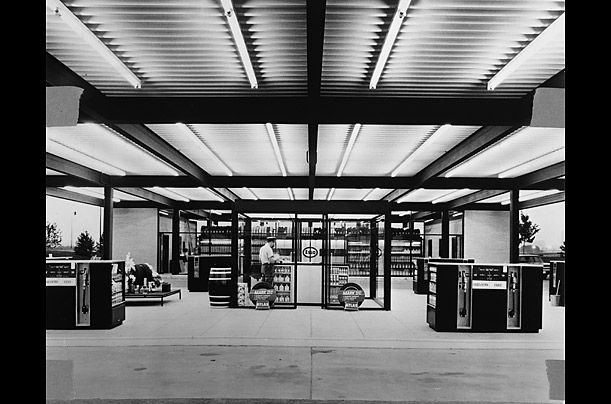
But Oobject includes it in their list of the top fifteen modernist gas stations, which features buildings by Norman Foster and Arne Jacobsen and should make fine further reading if you’ve enjoyed this post. See also Flavorwire’s list of the world’s most beautiful gas stations, which names not only Wright and Mies van der Rohe’s work, but the Helios House, a few pieces of swooping midcentury glory in Los Angeles and Scandinavia, and a “Teapot Dome Service Station” shaped like exactly that. If you’re going to pay today’s gas prices, after all, you might as well fill up under an aesthetically notable structure.
Related Content:
Frank Lloyd Wright Reflects on Creativity, Nature and Religion in Rare 1957 Audio
The History of Western Architecture: From Ancient Greece to Rococo (A Free Online Course)
Frank Lloyd Wright’s Fallingwater Animated
Colin Marshall writes on cities, language, Asia, and men’s style. He’s at work on a book about Los Angeles, A Los Angeles Primer, and the video series The City in Cinema. Follow him on Twitter at @colinmarshall or on Facebook.
Read More...Stephen Hawking Sings Monty Python’s “Galaxy Song”: Hear the Newly-Released Single
The “Galaxy Song” first appeared in the 1983 film Monty Python’s The Meaning of Life, and it has been revived in later years — on Monty Python albums, and in Monty Python stage plays. Now the song originally written by Eric Idle has been re-recorded, this time with the lyrics sung by the world-famous physicist Stephen Hawking. The lyrics include a lot of astronomical facts, some now considered outdated by scholars. But that doesn’t take the fun out of the recording.
The song will be available for download on iTunes. (If you live in the UK, find it here.) And it will also be released as a 7″ single. But you can stream it online for free above. Enjoy.
If you would like to support the mission of Open Culture, consider making a donation to our site. It’s hard to rely 100% on ads, and your contributions will help us continue providing the best free cultural and educational materials to learners everywhere. You can contribute through PayPal, Patreon, and Venmo (@openculture). Thanks!
Related Content:
Monty Python’s Best Philosophy Sketches
Terry Gilliam Reveals the Secrets of Monty Python Animations: A 1974 How-To Guide
John Cleese’s Philosophy of Creativity: Creating Oases for Childlike Play
Stephen Hawking’s Big Ideas Explained with Simple Animation
Read More...Watch the Only Known Footage of Anne Frank
Almost all of us have read the story of Anne Frank, but we surely all picture it quite differently. Most of us have seen the photos used on the various covers of The Diary of a Young Girl, and some of us have even gone to Amsterdam and walked through the home in which she wrote it. But now, thanks to the internet, we have access to historical imagery that can help everyone envision the life of Anne Frank a bit more clearly.
Many years ago, we featured the only existing film of Frank, a 20-second clip from July 22, 1941 in which she looks on as a bride and groom pass below her window. Though short, the invaluable footage breathes a surprising amount of life into the cultural image of perhaps the 20th century’s most important diarist.
Even more comes from the 3D tour of her house and hiding place more recently made available online. The tour’s interface, with which anyone who played 1990s graphic adventure games like Myst will feel immediately familiar, gives you a first-person view behind the bookcase which for two years kept the Frank family’s living quarters a secret from Amsterdam’s Nazi occupiers.
The tour’s creators have loaded the digital recreation of the house with different spots that, when clicked, tell in audio of a certain aspect of the Franks’ experience there. The farther we get from the Second World War, the more these events might seem, to students reading about them for the first time, like a piece of capital‑H History disconnected from their own experience. But resources like these keep the story of Anne Frank and its lessons feeling as immediate as they should.
You can enter the tour here.
Related Content:
Watch World War II Rage Across Europe in a 7 Minute Time-Lapse Film: Every Day From 1939 to 1945
Donald Duck’s Bad Nazi Dream and Four Other Disney Propaganda Cartoons from World War II
How Alice Herz-Sommer, the Oldest Holocaust Survivor, Survived the Horrific Ordeal with Music
Colin Marshall hosts and produces Notebook on Cities and Culture as well as the video series The City in Cinema and writes essays on cities, language, Asia, and men’s style. He’s at work on a book about Los Angeles, A Los Angeles Primer. Follow him on Twitter at @colinmarshall or on Facebook.
Read More...Support Us
We're hoping to rely on loyal readers, rather than erratic ads. Please click the Donate button and support Open Culture. You can use Paypal, Venmo, Patreon, even Crypto! We thank you!

About Us

Open Culture scours the web for the best educational media. We find the free courses and audio books you need, the language lessons & educational videos you want, and plenty of enlightenment in between.
Advertise With Us

FREE UPDATES!
GET OUR DAILY EMAIL
Get the best cultural and educational resources on the web curated for you in a daily email. We never spam. Unsubscribe at any time.
FOLLOW ON SOCIAL MEDIA

Open Culture editor Dan Colman scours the web for the best educational media. He finds the free courses and audio books you need, the language lessons & movies you want, and plenty of enlightenment in between.
Advertise With Us

