Where Do Great Ideas Come From? Neil Gaiman Explains

Every creative writer gets asked the question at least once at a social event with non-writers: “Where do you get your ideas?” To the asker, writing is a dark art, full of mysteries only the initiated understand. To the writer—as Neil Gaiman tells us in an essay on his website—the question misses the point and misjudges the writer’s task. “Ideas aren’t the hard bit,” he says.
Creating believable people who do more or less what you tell them to is much harder. And hardest by far is the process of simply sitting down and putting one word after another to construct whatever it is you’re trying to build: making it interesting, making it new.
Sometimes hardest of all is the “simply sitting down” and writing when there’s nothing, no ideas. The work’s still got to get done, after all. Gaiman used to treat the question facetiously, answering with one of a few waggish and “not very funny” prepared answers. But people kept asking, including the seven-year-old classmates of his daughter, and he decided to tell them the truth, “I make them up, out of my head.” It’s not the answer most wanted to hear, but it’s the truth. As he inarguably shows, ideas are like opinions: “Everyone’s got an idea for a book, a movie, a story, a TV series.” And they can come from anywhere.
Gaiman, feeling that he owed his daughter’s classmates a thoughtful, detailed answer, responded with the below, which we’ve put into list form.
- Ideas come from daydreaming. “The only difference between writers and other people,” says Gaiman, “is that we notice when we’re doing it.”
- Ideas come from asking yourself simple questions, like “What if…?” (“you woke up with wings?… your sister turned into a mouse?.…), “If only…” (“a ghost would do my homework”) and “I wonder….” (“what she does when she’s alone”), etc…. These questions, in turn, generate other questions.
- Ideas are only starting points. You don’t have to figure out the plot. Plots “generate themselves” from “whatever the starting point is.”
- Ideas can be people (“There’s a boy who wants to know about magic”); places (“There’s a castle at the end of time, which is the only place there is”); images (“A woman, sifting in a dark room filled with empty faces.”)
- Ideas can come from two things “that haven’t come together before.” (“What would happen if a chair was bitten by a werewolf?)
Granted some of Gaiman’s examples may be more intriguing or fantastic than what you or I might propose, but anyone can do these exercises. The idea, however, is just the starting point. “All fiction,” he writes, “is a process of imagining.” So what comes next? “Well,” says Gaiman, “then you write.” Yes, it is that simple, and that hard.
Tell us, readers, do you find any of Gaiman’s idea sources helpful? Where do you get your ideas?
Related Content:
Rod Serling: Where Do Ideas Come From?
Neil Gaiman Gives Graduates 10 Essential Tips for Working in the Arts
Writing Tips by Henry Miller, Elmore Leonard, Margaret Atwood, Neil Gaiman & George Orwell
Read Neil Gaiman’s Free Short Stories Online
Josh Jones is a writer and musician based in Durham, NC. Follow him at @jdmagness
Read More...Ingmar Bergman Names the 11 Films He Liked Above All Others (1994)
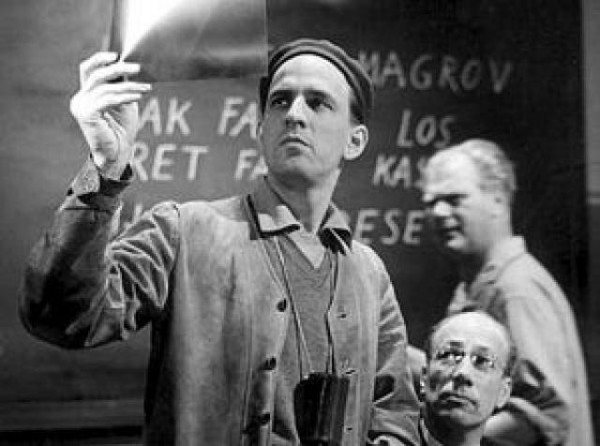
Image via Wikimedia Commons
You may remember our October post on Ingmar Bergman’s evaluation of his equally titanic colleagues in cinema, from Jean-Luc Godard (“affected”) to Alfred Hitckcock (“infantile”). Though the Bergman faithful and fans Andrei Tarkovsky often find much to disagree about, the Swedish director of pictures like Wild Strawberries and Persona had the absolute highest praise for the Russian director of pictures like Andrei Rublev and Solaris. (Watch Tarkovsky’s major films free online here.) “When film is not a document, it is dream,” said Bergman. “That is why Tarkovsky is the greatest of them all. He moves with such naturalness in the room of dreams. He doesn’t explain. He is a spectator, capable of staging his visions in the most unwieldy but, in a way, the most willing of media. All my life I have hammered on the doors of the rooms in which he moves so naturally.”
And now we have a few more words the older master spoke about the younger, whom he physically outlived — but, by his own admission, couldn’t artistically outdo — thanks to a certain Tyler Harris, who posted them to My Criterion. In his remarks there, Bergman continues with the metaphor of Tarkovsky an an inhabitant of a realm of dreams: “Suddenly, I found myself standing at the door of a room the keys of which had, until then, never been given to me,” Bergman said of first watching Andrei Rublev, which he named at the Göteborg Film Festival 1994 as a favorite. “I felt encouraged and stimulated: someone was expressing what I had always wanted to say without knowing how.” He also selected Federico Fellini’s La Strada, which prompted a background story about his ill-fated collaboration with Fellini and Akira Kurosawa under legendary producer Dino de Laurentiis. Kurosawa’s own Rashomon, which you can watch free online, also appears on this favorites list of Bergman’s, which runs, alphabetically, as follows:
- Andrei Rublev (Andrei Tarkovsky, 1971)
- The Circus (Charlie Chaplin, 1928)
- The Conductor (Andrzej Wajda, 1980)
- Marianne and Juliane (Margarethe von Trotta, 1981)
- The Passion of Joan of Arc (Carl Theodor Dreyer, 1928)
- The Phantom Carriage (Victor Sjöström, 1921)
- Port of Shadows (Marcel Carné, 1938)
- Raven’s End (Bo Wilderberg, 1963)
- Rashomon (Akira Kurosawa, 1950)
- La strada (Federico Fellini, 1954)
- Sunset Boulevard (Billy Wilder, 1950)
Related Content:
Martin Scorsese Reveals His 12 Favorite Movies (and Writes a New Essay on Film Preservation)
Ingmar Bergman’s Soap Commercials Wash Away the Existential Despair
Stanley Kubrick’s List of Top 10 Films (The First and Only List He Ever Created)
Colin Marshall hosts and produces Notebook on Cities and Culture and writes essays on cities, Asia, film, literature, and aesthetics. He’s at work on a book about Los Angeles, A Los Angeles Primer. Follow him on Twitter at @colinmarshall or on his brand new Facebook page.
Read More...Cancer Patients’ Extreme Makeovers Let Them To Forget Their Illness ‘If Only For A Second’
The season of giving can be an unseemly time for nonprofits. As New Year’s approaches, every charitable institution down in Charitable Institutionville must bang its tar-tinker and blow its hoo-hoover, in hope of donations.
No doubt they’re all deserving, but the onslaught of requests can leave supporters feeling a bit Grinchy. When that happens, I recommend the video above, which documents a hoax of Borat-like proportions. The perpetrator is the Mimi Foundation, a Belgium-based group that offers psychological counseling, beauty treatments, and hairstyle tips to people with cancer.
The unsuspecting victims? Twenty cancer patients who took it on good faith that they were being treated to standard makeovers, the sort of professional artistry that creates an illusion of health, what many think passes for normalcy. All the Mimi Foundation asked for in return was that the recipients keep their eyes closed as the magic was being worked.
Meanwhile, photographer Vincent Dixon crouched behind a one-way mirror, poised to capture each sitters’ reaction to his or her transformation.
One doesn’t want to say too much. The end results are not what you think, unless you were thinking of one of those over-the-top bizarre America’s Next Top Model photo challenges.
Dixon’s images record the shock and involuntary spontaneity. The video, called “If Only for a Second, shows those initial responses blossoming into …well, let’s just say the Mimi Foundation, assisted by a phalanx of stylists, achieved their goal.
H/T Alan Goldwasser
Related Content:
Comedian Tig Notaro’s “Truly Great” Cancer Stand-up Set Now Available on Louis C.K.’s Website
Ayun Halliday’s heart grew three sizes today. Follow her @AyunHallliday
Read More...Hear King Edward VIII Explain Why He Abdicated The Crown For Love, 77 Years Ago Today
Seventy-seven years ago, in a move unprecedented since the Glorious Revolution of 1688, King-Emperor Edward VIII abdicated the throne. Today’s audiences will recognize the episode from The King’s Speech: less than a year after having ascended to the British kingship in January of 1936, Edward became romantically entangled with a yet-to-be-divorced American socialite named Wallis Simpson. As long as the King’s liaisons remained discreet, the couple was afforded a respectable amount of privacy by the royal family and the British media. Things grew more complicated, however, when Simpson divorced her second husband in October of 1936, and the pair decided to marry, come hell or high water.
A King of the United Kingdom of Great Britain and Northern Ireland being wedded to a twice-divorced American socialite would have caused a furor. As the head of the Church of England, Edward could not marry a divorced woman whose former husband (let alone husbands) remained alive. Simpson’s first divorce proved even more problematic—it was granted based on “emotional incompatibility,” and may not have been recognized under both Church and English law. The King’s marriage to Simpson also raised the possibility of an American Queen, a sacrilegious idea in the eyes of his subjects.
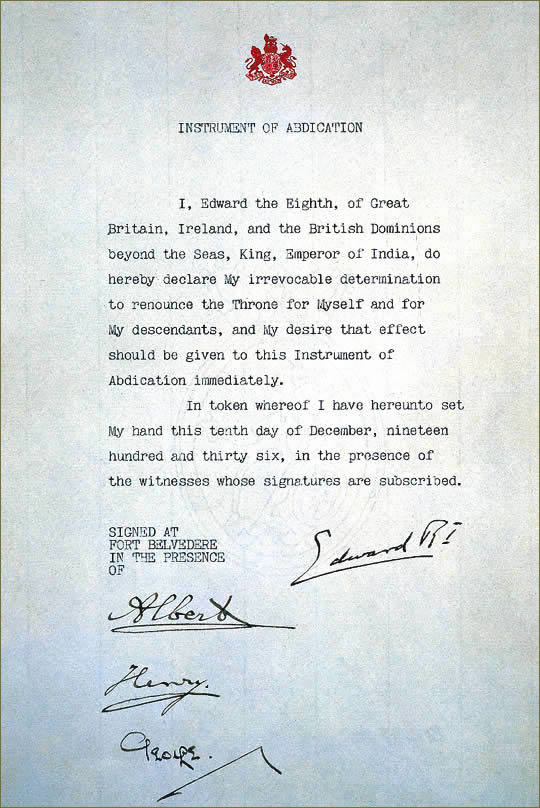
Faced with a choice between the crown and his love, Edward VIII chose to step down. On December 10, 1936, the King signed the following declaration of abdication:
In the audio clip at the top of the post, Edward VIII takes to the radio waves to declare his abdication on December 11. Brimming with hardly-contained emotion, Edward attempts to explain his reasons to the British people (read the full transcript here):
“You all know the reasons which have impelled me to renounce the Throne. But I want you to understand that in making up my mind I did not forget the country or the Empire which as Prince of Wales, and lately as King, I have for twenty-five years tried to serve. But you must believe me when I tell you that I have found it impossible to carry the heavy burden of responsibility and to discharge my duties as King as I would wish to do without the help and support of the woman I love.”
For those who had doubts about Simpson’s true feelings for the King (some suspected her of caring only about the king’s money), the next 35 years would provide sufficient proof. The pair remained married until Edward’s death in 1972.
Ilia Blinderman is a Montreal-based culture and science writer. Follow him at @iliablinderman.
Read More...Did Leonardo da Vinci Paint a First Mona Lisa Before The Mona Lisa?
Leonardo da Vinci’s Mona Lisa has been called “the best known, the most visited, the most written about, the most sung about, the most parodied work of art in the world.” (Did you catch the Lego Mona Lisa that made the rounds on the web last week?) Completed in the early 16th century, the painting offers a portrait of Lisa Gherardini, wife of a Florentine cloth merchant named Francesco del Giocond. (Hence why the painting is sometimes called La Gioconda or La Joconde.) Today, the Renaissance masterpiece hangs in the Louvre in Paris, where it’s visited by an estimated six million people each year.
There’s no shortage of debates surrounding the Mona Lisa. Was it completed in 1506? Or is 1517 a more accurate date? Does the portrait actually feature Lisa Gherardini? (Most art historians think so, but scholars have speculated about other figures, including Leonardo’s own mother, Caterina.) And then there’s this bigger question. Was da Vinci’s Mona Lisa his first Mona Lisa? That debate starts with a tantalizing piece of text written by the artist/art historian Giorgio Vasari in his 16th century book, The Lives of the Most Excellent Painters, Sculptors, and Architects. In a section called “Life of Leonardo da Vinci: Painter and Sculptor of Florence,” Vasari wrote: “Leonardo undertook to execute, for Francesco del Giocondo, the portrait of Monna Lisa, his wife; and after toiling over it for four years, he left it unfinished.…” And then Vasari attributed to the portrait some characteristics that don’t quite line up with the famous painting hanging in the Louvre today — “rosy and pearly tints,” eyes that had a “lustre and watery sheen which are always seen in life,” a nose “with its beautiful nostrils, rosy and tender,” etc. All of this left some to wonder: Was Vasari talking about another painting? Perhaps an earlier, unfinished version of the Mona Lisa?
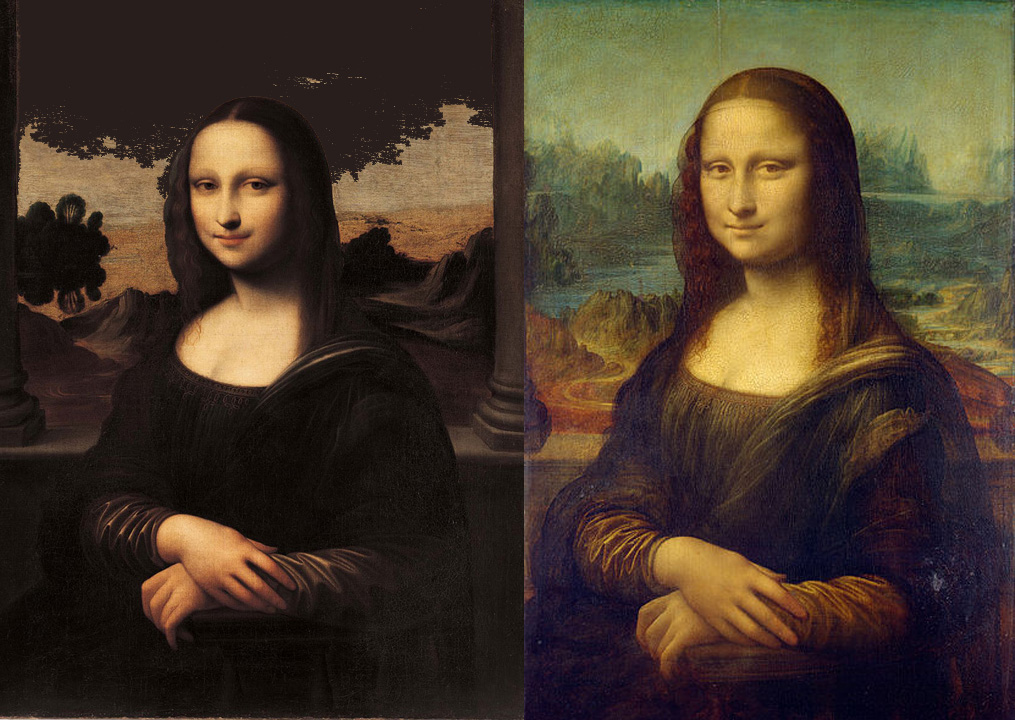
Enter The Mona Lisa Foundation, a non-profit based in Switzerland, that claims they’ve perhaps found an earlier Mona Lisa. In an essay appearing on their website, and in a 20 minute video (top), the Foundation makes the case that “Isleworth Mona Lisa” (right above) was probably painted by da Vinci around 1505, though never completed. Centuries later the portrait ended up in the hands of an English collector Hugh Blaker, only to be then locked away in a Swiss vault for 40 years. It was finally brought out, and made available to the public for the first time, in 2012.
Skeptics have been quick to point out problems with the “Isleworth Mona Lisa.” Some note that it was painted on canvas, whereas Leonardo typically painted on wood. Others claim that x‑rays of the painting call its authenticity into doubt. And then others suggest that the “Isleworth Mona Lisa” is merely a late 16th century copy of the painting now hanging in the Louvre. (The Mona Lisa Foundation web site documents the skeptical claims and offers a rebuttal for reach.)
To be sure, the Isleworth Mona Lisa has its critics, but it also has some supporters. In September 2012, the Swiss Federal Institute of Technology in Zurich carried out carbon-dating tests on the canvas and confirmed that it was likely manufactured between 1410 and 1455, which helped refute claims that the painting was a late 16th century copy. Meanwhile, John Asmus, a UCSD physics professor who “introduced the use of holography, lasers, ultrasonic imaging, digital image processing, and nuclear magnetic resonance to art-conservation practice,” carried out a brushstroke analysis and concluded that “the same construction principles” were used in the design of both Mona Lisas, increasing the likelihood that they were created by the same artist. And finally, Joe Mullins, a forensic specialist trained at the FBI, “age regressed” the original Mona Lisa to see what she would have looked like at an earlier point in time. His conclusion? “Everything lined up perfectly.” “This is Mona Lisa, two different images at two different times in her life.”
But still, skeptics certainly remain.
via Metafilter
Related Content:
NASA Sends Image of the Mona Lisa to the Moon and Back
The Anatomical Drawings of Renaissance Man, Leonardo da Vinci
What Leonardo da Vinci Really Looked Like
Read More...See John Steinbeck Deliver His Apocalyptic Nobel Prize Speech (1962)
John Steinbeck had the literary voice of an American preacher. Not a New England Calvinist, all cold reasoning, nor a Southern Pentecostal, all fiery feeling, but a California cousin, the many generations traveling westward having produced in him both hunger and vision, so that grandiosity is his natural idiom, restless, unfulfilled desire his natural tone. His themes, certainly Biblical; his characters, salt of the earth tradesmen, nomads, the lame and the halt. But his syntax always spoke of vastness, of a God-like universe emptied of all gods. And so, when Steinbeck won the Nobel Prize in 1962, his speech rang of a humanist sermon carved on stone tablets. (Above, as he reads, it’s hard not to see him as Vincent Price, a look he acquired in his final years.)
At times, I must admit, it’s not great. Or, rather, it’s a strange, uneven speech. Where Steinbeck the novelist is in full command of his bombast, Steinbeck the speechwriter sounds at times like he pieced things together in his hotel room the night before with only his Gideon as a reference. Ah, but Steinbeck at 4 in the morning exceeds what most of us could do at anytime if asked to speak on such a subject as “the nature and direction of literature,” which he says is customary for one in his position. Steinbeck decides to change the task and instead discuss no less than “the high duties and responsibilities of the makers of literature.” Perhaps a more manageable topic. He speaks of the writer’s mission not as a priestcraft of words, but as a guardianship of something even older, “as old as speech.” He invokes “the skalds, the bards, the writers,” but of the priests who came later, he has no kind words:
Literature was not promulgated by a pale and emasculated critical priesthood singing their litanies in empty churches—nor is it a game for the cloistered elect, the tin-horn mendicants of low-calorie despair.
The critic in me winces, but the reader in me thrills. After a few clunkers in his opening (something about a mouse and a lion), he has turned on the judgment, and it’s good. This is the Steinbeck we love, who makes us look through a god’s eye view telescope, then turns it around and shows us the other end. Then it’s gone, the scale, the enormity, the fantastic morality play. He gets a little vague on Faulkner, mentions some reading he’d just done on Alfred Nobel. And as you begin to suspect he’s going to tell us about his summer vacation, he erupts into a glorious finale of groundshaking fireworks worthy of comparison to the Nobel invention’s most fearsome cold war progeny.
Less than fifty years after [Nobel’s] death, the door of nature was unlocked and we were offered the dreadful burden of choice.
We have usurped many of the powers we once ascribed to God.
Fearful and unprepared, we have assumed lordship over the life or death of the whole world—of all living things.
The danger and the glory and the choice rest finally in man. The test of his perfectibility is at hand.
Having taken Godlike power, we must seek in ourselves for the responsibility and the wisdom we once prayed some deity might have.
Man himself has become our greatest hazard and our only hope.
So that today, St. John the apostle may well be paraphrased: In the end is the Word, and the Word is Man—and the Word is with Men.
I think St. John would be proud of the vehicle, if not at all the tenor. But unlike John Steinbeck, he never saw the war that gave us Auschwitz and Hiroshima. Read the full text of Steinbeck’s speech at the Nobel Prize site here.
Related Content:
“Nothing Good Gets Away”: John Steinbeck Offers Love Advice in a Letter to His Son (1958)
William Faulkner Reads His Nobel Prize Speech
On His 100th Birthday, Hear Albert Camus Deliver His Nobel Prize Acceptance Speech (1957)
Josh Jones is a writer and musician based in Durham, NC. Follow him at @jdmagness
Read More...Join Clive James on His Classic Television Trips to Paris, LA, Tokyo, Rio, Cairo & Beyond
After a morning’s girlwatching in Paris, Clive James goes for a leisurely yet harrowing drive with Bonjour Tristesse author Françoise Sagan at the wheel, walks out on the opera, pays respects to the graves of Oscar Wilde, Edith Piaf, and Marcel Proust, seeks the definition of a “fashion victim,” denounces I.M. Pei’s pyramid atop the Louvre, and descends into the dance clubs beneath the streets. On the coast of Los Angeles, he endures a celebrity-grade workout, commissions a toupee from Beverly Hills stylist José Eber and his most trusted “hair unit” craftsman, undergoes a plastic surgery consultation, and meets the most cheerful (and no doubt most successful) car-parker alive. At the height of Japan’s economic bubble, he does battle with his own chopsticks, loses himself in Shunjuku despite meaning to lose himself in the Ginza, beds down unsuccessfully in a love hotel, holds in his breath as he wedges himself into a commuter train, struggles to accept hospitality from robots, puts himself at the utter mercy of a game show, and gets drunk amidst junior geisha.
Why, you might ask, would a respected man of letters like James – author, most recently, of a new translation of Dante’s Divine Comedy — do all this pratfall-intensive globetrotting, much less on the BBC for all to see? I would submit, as a longtime follower of the man’s work, that it has to do with his twin drives to, with his wisecrackingly illuminating turns of phrase, keep his audiences laughing as well as thinking, no matter the medium in which he works. He fills the role of the entertainer, certainly, but simultaneously fills the role of the intellectual. An untiringly curious polyglot, not that you’d know it by the exaggerated ineptitude with which he asks for directions in Tokyo or interviews French starlets, James plays both low and high at all times, and you can see it in all these televisual journeys to Cairo, Rome, Miami, Rio, Chicago, Berlin, Shanghai, New York, Bombay, Hong Kong, and even the Sydney of James’ native Australia. You can also see it in James’ travel pieces for the Observer that served as their templates, all freely available on his web site.
Related Content:
Pan Am’s 1960s and 70s Travel Films: Visit 11 Places, in 7 Languages
Mashup Artist “Kutiman” Travels to Tokyo and Creates an Incredible Musical Postcard
Five Cultural Tours of Los Angeles
Al Jazeera Travel Show Explores World Cities Through Their Street Food
Colin Marshall hosts and produces Notebook on Cities and Culture and writes essays on cities, Asia, film, literature, and aesthetics. He’s at work on a book about Los Angeles, A Los Angeles Primer. Follow him on Twitter at @colinmarshall or on his brand new Facebook page.
Read More...David Rees Presents a Primer on the Artisanal Craft of Pencil Sharpening
How have you been sharpening your pencils? Regardless of your answer, rest assured that you’re doing it wrong.
Lest there be any doubt that I’m geographically situated smack dab in the middle of former cartoonist’s David Rees’ target demographic, I almost didn’t click on the link to the pitch perfect send up above because I believed it was real.
Here in non-Caribbean, non-Southeast-Asian, non-Russian, non-Mexican Brooklyn—think Girls, the Jonathans Ames and Letham, brownstone-dwelling movie stars and the very latest in n’est plus ultra strollers—it’s entirely plausible that a humorless young artisan might take to the Internet to teach us regular schlubs How to Sharpen Pencils.
Just wait ’til he brings out his leather strop. (Misplaced yours? Look in your basement, or your grandfather’s tomb.)
Please note that though the video may be satirical, Rees makes actual money sharpening—and authenticating—customers’ Number Two pencils, using the same techniques demonstrated in the video. (Sorry, holiday shoppers, as per his website, he won’t be taking orders for his live pencil sharpening services until the New Year, but he does have a book out.)
Like you need any more excuse to whip out your knife, place it in your dominant hand, and start carving.
To quote a certain classic Broadway musical, you gotta have a gimmick.
Related Content:
“The Periodic Table Table” — All The Elements in Hand-Carved Wood
Watch The New America, a Stop Motion Animation Starring 800+ Laser Engraved Wood Blocks
Learn to Draw Butts with Just Five Simple Lines
Ayun Halliday can get behind New Ork City public school teachers’ insistence on the Ticonderoga brand. Follow her @AyunHallliday
Read More...Nelson Mandela’s First-Ever TV Interview (1961)
Note: This post was originally featured on our site in 2010. In light of the news that Nelson Mandela has passed away at age 95, we’re bringing this vintage clip back to the fore. Here you can see a young Mandela making history, and without perhaps realizing it, building the remarkable legacy that remains with us today.
In 1962, Nelson Mandela was arrested on allegations of sabotage and other charges and sentenced to life in prison, where he spent 27 years before becoming South Africa’s first president elected in a fully democratic election. His story, among modern history’s most profoundly inspirational, is beautifully and poetically captured in Clint Eastwood’s 2009 gem, Invictus. But what Eastwood’s account leaves out are the events that preceded and led to Mandela’s arrest.
In May of 1961, a 42-year-old Mandela gave his first-ever interview to ITN reporter Brian Widlake as part of a longer ITN Roving Report program about Apartheid. At that point, the police are already hunting for Mandela, but Widlake pulls some strings and arranges to meet him in his hideout. When the reporter asks Mandela what Africans want, he promptly responds:
“The Africans require, want the franchise, the basis of One Man One Vote – they want political independence.”
But perhaps more interesting is the dialogue towards the end of the interview, where Mandela explores the complex relationship between peace and violence as protest and negotiation tactics. We’re left wondering whether his seemingly sudden shift from a completely peaceful campaign strategy up to that point towards considering violence as a possibility may be the product of South African police going after him with full force that week. Violence, it seems, does breed violence even in the best and noblest of us.
Related Content:
Nelson Mandela Archive Goes Online (With Help From Google)
The Nelson Mandela Digital Archive Goes Online
U2 Releases a Nelson Mandela-Inspired Song, “Ordinary Love”
Maria Popova is the founder and editor in chief of Brain Pickings, a curated inventory of eclectic interestingness and indiscriminate curiosity. She writes for Wired UK, GOOD Magazine, BigThink and Huffington Post, and spends a disturbing amount of time curating interestingness on Twitter.
Read More...Bob Dylan Reads From T.S. Eliot’s Great Modernist Poem The Waste Land
As a recent piece in The Independent notes, “students of literate songwriting” are unsurprised to find references to T.S. Eliot scattered throughout the pop canon: Genesis, Manic Street Preachers, Arcade Fire… and of course, Bob Dylan. Dylan arguably makes reference to Eliot’s masterwork The Waste Land with the line “in the wasteland of your mind” from “When The Night Comes Falling from the Sky.”
And in the penultimate verse of “Desolation Row,” he gives us an image of “Ezra Pound and T.S. Eliot / Fighting in the captain’s tower.” As with every other line in the song, this could mean just about anything. But given Dylan’s admiration for The Waste Land, it could easily refer to the editorial tug-of-war between the two poets, as it was Pound who shaped Eliot’s poem into the work we have today. And then there’s the tower image so prominent in Eliot’s great poem, an occult motif Dylan returned to.
Just above, hear Dylan riff on the first four lines of The Waste Land for his XM Radio show Theme Time Radio Hour, which aired from May 2006 to April 2009. On the show, Dylan played records, responded to (fake) listener emails, read poetry, told jokes, and did musical bits, all in keeping with themes like “Money” and “Weather.” (You can catch two episodes a day on dylanradio.com).
He reads Eliot in a faux-beat cadence—sounding like Tom Waits—with a juke joint piano banging away behind him. Dylan opens his reading with some brief commentary, telling us that Eliot’s poem “commemorated the death of Abraham Lincoln.” This throwaway line may just give us a fascinating glimpse into Dylan’s literary sensibilities. Knowing that Eliot’s lilacs refer to Lincoln seems almost certainly to indicate that Dylan knows they first refer to Walt Whitman, whose “When Lilacs Last in the Dooryard Bloom’d” directly commemorates Lincoln.
Of course, he isn’t going to tell us that, if he knows it, just like he won’t give anything away in “Desolation Row,” a song so filled with references to famous figures and works of art that it’s hard to tell how much is “original” Dylan and how much a patchwork of paraphrase. The distinction hardly matters, Dylan seems to suggest in his elision of Whitman. Eliot’s poem is, line by line, so much a collage of allusion and citation that there seems to be no Eliot at all, just a maniacal editor (or two). The first line of the poem—“April is the cruelest month”—traces in part to French Symbolist Jules Laforgue, one of Eliot’s favorites, who begins his “October’s Little Miseries” with “Every October I start to get upset.” And Eliot’s original title, “He Do the Police in Different Voices” comes verbatim from Dickens’ Our Mutual Friend. As anyone who’s read Eliot in an academic setting knows, the list goes on, and on.
One of the effects of Eliot’s mastery of other people’s work (hear him read his poem above), which he could disassemble and make monstrously his own, is that his critics and fans will never tire of pulling apart his densely compressed verses and poking around inside them. Likewise Dylan. The latter never passed himself off as a poet explicitly (although he’s often read that way), but as a songwriter he’s spawned a cottage culture industry as productive as Eliot’s. Even his erstwhile radio show, in which he offered his own commentary and criticism, has its commentary and criticism from fans. I may never be convinced that songs—pop, folk, hip-hop, or otherwise—work the same way as poems, but if anyone figured out how to leap nimbly over whatever gap lies between them, Dylan certainly did. Maybe one of the connections he made is this: what seems to set both Dylan and Eliot apart from their peers is their compete disregard for notions of authenticity in favor of the play of “different voices”—impersonation, quotation, and homage to the artists they admire.
Related Content:
Listen to T.S. Eliot Recite His Late Masterpiece, the Four Quartets
Bob Dylan Finally Makes a Video for His 1965 Hit, “Like a Rolling Stone”
Josh Jones is a writer and musician based in Durham, NC. Follow him at @jdmagness
Read More...Support Us
We're hoping to rely on loyal readers, rather than erratic ads. Please click the Donate button and support Open Culture. You can use Paypal, Venmo, Patreon, even Crypto! We thank you!

About Us

Open Culture scours the web for the best educational media. We find the free courses and audio books you need, the language lessons & educational videos you want, and plenty of enlightenment in between.
Advertise With Us

FREE UPDATES!
GET OUR DAILY EMAIL
Get the best cultural and educational resources on the web curated for you in a daily email. We never spam. Unsubscribe at any time.
FOLLOW ON SOCIAL MEDIA

Open Culture editor Dan Colman scours the web for the best educational media. He finds the free courses and audio books you need, the language lessons & movies you want, and plenty of enlightenment in between.
Advertise With Us


