Andy Warhol’s Christmas Art
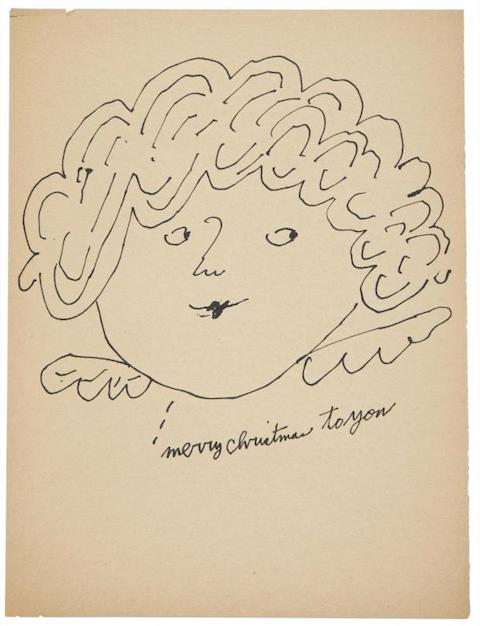
You may have read our post on the creative ways in which John Waters expresses his love for Christmas. We’d all like to receive one of the Christmas cards the Hairspray filmmaker has designed himself every year since 1964, but did you know that another famous creator, one also perceived as eccentric and possessed of his very own concepts of taste, embraced the season with equal artistic vigor? “Andy Warhol’s fondness for Campbell’s Soup cans is well documented,” writes Jennifer M. Wood at Mental Floss. “Less well known but equally ardent was his love of the holiday season. Yes, from poinsettias to Santa hats, the enigmatic artist who promised we’d all have our 15 minutes of fame spent much of the 1950s working as a commercial illustrator specializing in blotted line drawings, creating everything from shoe advertisements to greeting cards.”

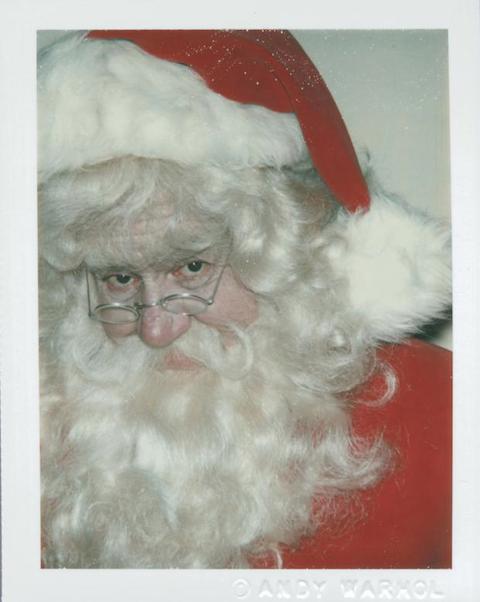
The article goes on to display the fruits of Warhol’s professional and personal interest in Christmas, which ran his personal gamut of both technique and visual sensibility. At the top, we have his simple 1954 ink-and-paper drawing of a “Christmas Fairy,” bearing the greeting “Merry Christmas to you.” Just above, you can see his color rendering, from three years later, of a Christmas ornament. Wood reports that such works went up for sale at two events this year from fine-art auction house Christie’s: “ ‘Warholiday,’ a pop-up event at the San Francisco Mulberry Store [which] featured 36 works by the late, great artist, some of them never-before-seen and all of them for sale,” and “ ‘A Christmas Thing,’ an online-only auction that featured 100 original photos, prints, and drawings from the master of Pop Art” benefiting The Andy Warhol Foundation for the Visual Arts.” And as we can call no presentation of Warhol’s work complete, even on Christmas Eve, without the inclusion of something that will get a viewer or two asking whether it counts as art at all, behold his 1981 Polaroid of Santa Claus:
Find more Andy Warhol Christmas-themed art at Mental Floss.
Related Content:
Andy Warhol Creates Album Covers for Jazz Legends Thelonious Monk, Count Basie & Kenny Burrell
Roy Lichtenstein and Andy Warhol Demystify Their Pop Art in Vintage 1966 Film
John Waters Makes Handmade Christmas Cards, Says the “Whole Purpose of Life is Christmas”
Colin Marshall hosts and produces Notebook on Cities and Culture and writes essays on cities, Asia, film, literature, and aesthetics. He’s at work on a book about Los Angeles, A Los Angeles Primer. Follow him on Twitter at @colinmarshall or on his brand new Facebook page.
Read More...Charles Dickens’ Hand-Edited Copy of His Classic Holiday Tale, A Christmas Carol

Click for larger image
No holiday season can seem to provoke as much anxiety, or even outright discord, as Christmas. But there are at least a few things most everyone can agree on. I would like to think one of them is A Charlie Brown Christmas (and its soundtrack). Another, I’m sure, is Charles Dickens’ A Christmas Carol (1843). Some readers might object to the tale’s maudlin sentimentality. But few would say it isn’t a great story, and well told. And in Dickens’ day, you might be lucky enough to catch the author himself reading it aloud. According to curator Issac Gewirtz, Dickens gave somewhere around 150 readings of A Christmas Carol. This, at a time, Gewirtz tells us, when “public readings of fiction or poetry [were] not done; it was considered a desecration of one’s art and a lowering of one’s dignity.” Nevertheless, while Dickens may have let his own children down, he would not disappoint his loyal readers.

As is generally the case when a work of prose goes to the stage, the text needed pruning. NPR’s All Things Considered brings us these images of Dickens’ “promptbook” for his performances, a copy of the text greatly abridged by Dickens’ own hand and now residing at the New York Public Library. While Dickens’ first performance ran three hours, later versions took about half that time. In-between, he slashed out whole paragraphs, simplified words and phrases, and removed entire pages. “What’s interesting to see,” says Gewirtz, “is how much of the atmospherics have been deleted.” Instead, Dickens conveys the mood with marginal stage cues like “soften very much” and “tone to mystery.” It is intriguing to imagine Dickens taking on the roles of Scrooge, Marley, and Cratchet père and fils, but alas we’ll never get to hear him. We can, however, hear the voice of Dickens’ great-grandaughter, novelist Monica Dickens (below), who in 1950 recorded her version of the family Christmas fable.
Monica’s daughter Mary Danby, also a novelist, tells the BBC that her mother’s rendition is faithful to the Dickens’ family tradition of readings, begun by Charles himself. Therefore, Monica’s phrasing is as much like Charles Dickens’ as we’re likely to hear. Dickensianism is still something of a family business, as is writing. “In my family,” says Dickens’ great-great-grandaughter Mary, “they think you are a bit odd if you haven’t written a book.” Still, I doubt their Christmases are any better, or any worse, than the rest of ours.
Related Content:
A Christmas Carol Presented in a Thomas Edison Film (1910)
A Christmas Carol, A Vintage Radio Broadcast by Orson Welles and Lionel Barrymore (1939)
Celebrate the 200th Birthday of Charles Dickens with Free Movies, eBooks and Audio Books
The Historic Meeting Between Dickens and Dostoevsky Revealed as a Great Literary Hoax
Josh Jones is a writer and musician based in Durham, NC. Follow him at @jdmagness
Read More...Listen to the Beatles’ Christmas Records: Seven Vintage Recordings for Their Fans (1963 — 1969)
1963:
Every year from 1963 to 1969, the Beatles recorded a special Christmas greeting to their fans. It started when “Beatlemania” took off and the band found itself unable to answer all the fan mail. “I’d love to reply personally to everyone,” says Lennon in the 1963 message, “but I just haven’t enough pens.” The first message was intended to make their most loyal fans feel appreciated. Like those that followed, the 1963 message was mailed as a paper-thin vinyl “flexi disc” to members of the Beatles fan club. The recording features the Beatles’ trademark wit and whimsy, with a chorus of “Rudolph the Red-Nosed Ringo” and a version of “Good King Wenceslas” that refers to Betty Grable. It was made on October 17, 1963 at Abbey Road Studios, just after the band recorded “I Want to Hold Your Hand.”
1964:
The band recorded their next holiday greeting, Another Beatles Christmas Record, on October 26, 1964, the same day they recorded the song “Honey Don’t.” Lennon’s rebellious nature begins to show, as he pokes fun at the prepared script: “It’s somebody’s bad hand wroter.”
1965:
Recorded on November 8, 1965 during the Rubber Soul sessions at Abbey Road, the 1965 message features a re-working of “Yesterday,” with the refrain “Oh I believe on Christmas Day.” The band’s gift for free-associational role playing is becoming more apparent. One piece of dialogue near the end was eventually re-used by producer George Martin and his son Giles at the end of the re-mixed version of “All You Need is Love” on the 2006 album Love: “All right put the lights off. This is Johnny Rhythm saying good night to you all and God Blesses.”
1966:
You can sense the band’s creative powers growing in the 1966 message, Pantomime: Everywhere It’s Christmas. The recording was made at Abbey Road on November 25, 1966, during a break from working on “Strawberry Fields Forever.” The Beatles were just beginning work on Sgt. Pepper’s Lonely Heart’s Club Band. Instead of simply thanking their fans and recounting the events of the year, the Beatles use sound effects and dialogue to create a vaudeville play based around a song that goes, “Everywhere it’s Christmas, at the end of every year.” Paul McCartney designed the cover.
1967:
This was the last Christmas message recorded by the Beatles all together in one place. Titled Christmas Time (Is Here Again), it reveals the group’s continuing experimentation with sound effects and storytelling. The scenario, written by the band earlier on the day it was recorded (November 28, 1967), is about a group of people auditioning for a BBC radio play. Lennon and Ringo Starr designed the cover.
1968:
By the Christmas season of 1968, relations within the Beatles were becoming strained. The holiday message was produced around the time the “White Album” was released, in November of 1968. The four members’ voices were recorded separately, in various locations. There’s plenty of self-mockery. Perhaps the most striking moment comes when the American singer Tiny Tim (invited by George Harrison) strums a ukulele and sings “Nowhere Man” in a high falsetto.
1969:
The Beatles were in the process of breaking up when they recorded (separately) their final Christmas message in November and December of 1969. A couple of months earlier, just before the release of Abbey Road, Lennon had announced to the others that he was leaving the group. Yoko Ono appears prominently on the recording, singing and talking with Lennon about peace. Fittingly, the 1969 message incorporates a snippet from the Abbey Road recording of “The End.”
Related Content:
The Beatles: Unplugged Collects Acoustic Demos of White Album Songs (1968)
Peter Sellers Reads The Beatles’ “She Loves You” in Four Different Accents
The 10-Minute, Never-Released, Experimental Demo of The Beatles’ “Revolution” (1968)
Read More...Short Film Shows What Happens When a Letter from World War II Finally Gets Delivered 69 Years Later
A few years ago, I stumbled upon a never-sent letter written to a friend when we were both in college. The contents weren’t heavy. Disorganization is the most likely explanation for why it never went in the mail. I cracked the envelope and had a look.
It was a time capsule, for sure, a cringe-inducing one. It wasn’t so much the life I was reporting on as how I framed it, self-aggrandizement straining to pass as nonchalance. Fortunately, an artist acquaintance happened to be running a project— send her your shreddable documents, and eventually, she’d send you a few sheets of handmade paper in which your mulched data mingled with that of others. Truly a beautiful way to dispose of the evidence.
But what happens when neither the writer, nor the intended recipient, is the finder of the lost letter? In February 2013, some mail posted by Lt. Joseph O. Matthews, a soldier stationed at a military training facility in Jacksonville, North Carolina, found its way to Abbi Jacobson, an actress (and coloring book author!) renting an apartment on MacDougal Street in New York City. Addressed to Matthew’s wife, the cancellation mark was dated December 2, 1944.
Jacobson opened the letter, the condition of the envelope having suggested that she would not be the first to breach its contents during the 69 years it had spent wandering in the wilderness. The words inside were romantic, a young officer informing the bride he’d left back home that he’d soon be shipping out to Okinawa. Eager to pull an Amélie by reuniting the letter with those to whom it would mean the most, Jacobson enlisted the help of her friend, documentary filmmaker Todd Bieber. Together they searched records at City Hall, looking for clues. When that approach proved fruitless, they created the Lost Letter Project, a web portal that invited the public to join in the search.
An avalanche of tweets, Facebook updates, and human interest pieces ensued. In no time at all, they had their man, or rather his descendants, Lt. Matthews having passed away in 1999, crushing Jacobson’s dreams of hand delivering the letter to “a little old man and a little old lady.” (I’m willing to bet Jacobson will one day wish there was a giant blender capable of turning digital statements like how cute would that be, my god, right? I love old people into handmade paper.)
Bieber’s video reveals what became of Lt. Matthews and his wife. Even more interesting is how the letter resonates with his grown children, particularly a certain theological reference at odds with the man they thought they knew.
Related Content:
In Touching Video, Artist Marina Abramović & Former Lover Ulay Reunite After 22 Years Apart
“Nothing Good Gets Away”: John Steinbeck Offers Love Advice in a Letter to His Son (1958)
Stephen King Writes A Letter to His 16-Year-Old Self: “Stay Away from Recreational Drugs”
Ayun Halliday is all for stuffing your stocking with a holiday gift subscription to the East Village Inky, her award winning hand-illustrated zine. Follow her @AyunHalliday
Read More...Watch Three Films by the Immensely Prolific & Widely-Admired “B‑Movie” Filmmaker, Roger Corman
I just caught a clever double-bill: Going Attractions, April Wright’s documentary on the history and future of the American drive-in movie theater, and Dementia 13, Francis Ford Coppola’s 1963 drive-in-geared feature debut (previously featured here on Open Culture). Going Attractions features a good deal of commentary from Roger Corman, the internationally respected and immensely prolific filmmaker whose career has defined the very concept of the high-quality “B‑movie.” In fact, so Wright revealed at the Q&A, Corman never went to drive-ins himself, so appalling did he find their substandard audiovisual presentations of his pictures, made cheaply but not without painstaking efforts to look and sound expensive. Still working after over 50 films to his credit as director and nearly 400 as producer, the Detroit-born, Oxford-educated, Los Angeles-based Corman, as well as making such revival-house classics as Sorority Girl, The Wild Angels, and several noted adaptations of Edgar Allan Poe, launched the careers of not just Coppola but other auteurs like Martin Scorsese (Boxcar Bertha, 1972), Monte Hellman (Beast from Haunted Cave, 1959), and Peter Bogdanovich (Voyage to the Planet of Prehistoric Women, 1968).
Corman also worked with actors now as famous as they come, as in 1960’s Little Shop of Horrors at the top, which features a young Jack Nicholson. 1962’s The Intruder, just above, stars William Shatner in a story that confronts racism with a frankness uncharacteristic of that era. 1963’s The Terror, below, brings back Nicholson, teaming him with Sandra Knight and Boris Karloff. According to a 1967 profile by Roger Ebert, Corman “shot all of Karloff’s scenes in two days to save on the payroll. Then when he got into the cutting room with his film, he realized to his horror that his horror film made no sense. Karloff was gone. What to do? Corman called in two of the bit players, shot them in close-up (the sets had already been torn down or had fallen down), and had one ask the other: ‘Now tell me what all this means.’ And then the other one did. Along the way, working quickly and improvising a lot of his scenes, Corman developed a distinctive, personal style without thinking much about it.” Yet such seemingly laughable techniques have served the man well: he titled his autobiography How I Made a Hundred Movies in Hollywood and Never Lost a Dime. What filmmaker at any level of critical regard can say the same? You can find Corman’s films in our collection, 4,000+ Free Movies Online: Great Classics, Indies, Noir, Westerns, Documentaries & More.
Related Content:
Dementia 13: The Film That Took Francis Ford Coppola From Schlockster to Auteur
Troma Entertainment, the Maker of Acclaimed B‑Movies, Puts 150 Free Films on YouTube
Colin Marshall hosts and produces Notebook on Cities and Culture and writes essays on cities, Asia, film, literature, and aesthetics. He’s at work on a book about Los Angeles, A Los Angeles Primer. Follow him on Twitter at @colinmarshall or on his brand new Facebook page.
Read More...From the Drain: A Creepy Comedy David Cronenberg Made in Film School (1967)
You’d expect a bit of strangeness from David Cronenberg‘s student films, but for most of its short length, From the Drain, which he made in 1967 while attending the University of Toronto, seems to deliver strangeness of an unexpected kind. Playing more like Waiting for Godot than his later vivid-to-the point of harrowing pictures like Crash, Videodrome, or The Fly, this thirteen-minute black-and-white film, only Cronenberg’s second, presents us with two fellows seated, fully clothed, in a bathtub. The situation looks bizarre, and as soon as the players start talking, it reveals itself as even more bizarre than we’d thought: evidently, one of these men has mistaken the tub for “the Disabled War Veterans’ Recreation Center.” The conversation continues without its participants leaving their porcelain confines, making a certain kind of sense on the surface but none at all beneath. This feels almost like the realm of Monty Python’s Flying Circus, which wouldn’t debut and begin exerting its vast influence on young comedic filmmakers until 1969.
We’d feel more secure in our laughter if we didn’t know who its director would go on to become. These days, when you watch anything by Cronenberg, perhaps the best-known living auteur of technological menace, “body horror,” and formless dread, you can rest reasonably assured that something will sooner or later go horribly, viscerally awry onscreen. So it comes to pass in From the Drain, whose title gives some suggestion as to the nature of the ultimate malevolence. Don’t let the hyper-farcical dialogue, the goofy performances, or the classical guitar soundtrack mislead you; here we definitely have a project by the king of unsettlement, though at a time when he presumably had yet to earn even the title of prince of unsettlement, a point from which he could look forward to decades of more advanced and much creepier visual effects. At this point in his career, however, with the bleak-looking Hollywood satire Maps to the Stars due out in the near future, he seems to need nothing so elaborate, still unsettling us, but preferring to do it subtly.
Related Content:
Stanley Kubrick’s Very First Films: Three Short Documentaries
The Hearts of Age: Orson Welles’ Surrealist First Film (1934)
The First Films of Great Directors: Kubrick, Coppola, Scorsese, Tarantino, and Truffaut
600 Free Movies Online: Great Classics, Indies, Noir, Westerns, etc.
Colin Marshall hosts and produces Notebook on Cities and Culture and writes essays on cities, Asia, film, literature, and aesthetics. He’s at work on a book about Los Angeles, A Los Angeles Primer. Follow him on Twitter at @colinmarshall or on his brand new Facebook page.
Read More...Mike Tyson Lists the Philosophy & History Books He’s Reading These Days
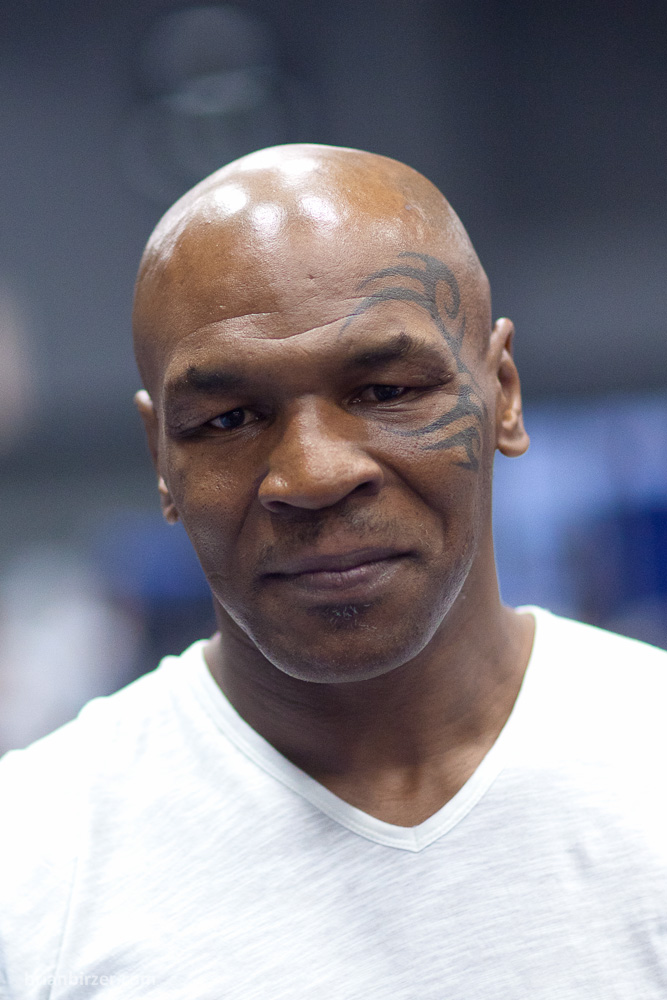
Last year, Mike Tyson staged a one-man Broadway show, directed by Spike Lee, called “Mike Tyson: The Undisputed Truth.” In November, the boxing legend published an autobiography by the same title. And now comes this: a short letter in The Wall Street Journal where Iron Mike lists the philosophy and history texts he’s reading these days. The list includes:
- The Quotable Kierkegaard, edited by Gordon Marino, “a collection of awesome quotes from that great Danish philosopher.”
[Note: Nietzsche is his favorite philosopher. Says Tyson, “He’s just insane. You have to have an IQ of at least 300 to truly understand him.”
- Alexander the Great: The Macedonian Who Conquered the World by Sean Patrick.
Why? Because “Alexander kept pushing forward. He didn’t want to have to go home and be dominated by his mother.” The same impulse drove Tyson to box his way out of Brownsville, Brooklyn. That’s all covered in his autobiography.
What else is Tyson reading? Love letters. He mentions Napoleon’s love letters to Josephine, and Virginia Woolf’s letter to her husband before committing suicide. Tyson then quips “I don’t really do any light reading, just deep, deep stuff. I’m not a light kind of guy.”
Get more at The Wall Street Journal.
H/T Partially Examined Life
Related Content:
Iron Mike Tyson Sings “The Girl From Ipanema”
Walter Kaufmann’s Classic Lectures on Nietzsche, Kierkegaard and Sartre (1960)
Download 90 Free Philosophy Courses and Start Living the Examined Life
Read More...The Art of Making Timelapse Films
Michael Shainblum released a new timelapse film this week called “Into the Atmosphere,” which is his visual tribute to California’s beautiful deserts, mountains and coastlines. Even if you’ve seen your fair share of timelapse films before, as I’m sure many of you have, you might be interested in this other newly-released film called “The Art of The Timelapse.” Produced by The Creators Project, the short film gives you a glimpse of what goes into making a timelapse — the requisite gear, the favorable lighting conditions, the ideal landscape, and more. Shainblum is your guide. You can find an archive of his films here.
If you’d like to dig deeper into the art of making timelapse films, we’d recommend checking out The Basics of Time Lapse Photography with Vincent Laforet, a four-part video series, on Canon’s education web site. The first episode appears below.
Related Content:
Watch Picasso Create Entire Paintings in Magnificent Time-Lapse Film (1956)
53 Years of Nuclear Testing in 14 Minutes: A Time Lapse Film by Japanese Artist Isao Hashimoto
NASA Archive Collects Great Time-Lapse Videos of our Planet
Le Flaneur: Time Lapse Video of Paris Without the People
Read More...Orson Welles Records Two Songs with the 1980s Heavy-Metal Band Manowar
Heavy metal music enjoyed the pleasures of excess in the 1980s, an era when, if you believe certain biographers, writer-actor-auteur Orson Welles did the very same. Though some describe the life of the man who made Citizen Kane as having by then fallen into a final period of great decadence, he still managed to leave his mark on a number of unusual projects. Many of my generation fondly remember his performance as the man-made planet Unicron, eater of worlds, in 1986’s Transformers: The Movie, but those slightly older may have first encountered Welles’ late work on Battle Hymns, the debut album by sword-and-sorcery-minded metal (technically, “epic metal”) band Manowar, for whose track “Dark Avenger,” below, he provided suitably epic narration: “And they placed in his hands a sword made for him called Vengeance, forged in brimstone and tempered by the woeful tears of the Unavenged.” Who but Welles (or maybe Christopher Lee) could sell a line like that?
Five years later, Manowar would return to the Welles well for their fifth album Fighting the World, whose track “Defender,” below, features a posthumous appearance originally recorded as a demo during the Battle Hymns sessions. Fighting the World, incidentally, appeared as the first ever digitally recorded and mixed heavy metal album, an achievement unshyly declared on the band’s web site.
There you’ll also learn that Manowar not only included fantasy imagery in both their lyrics and on their covers before their colleagues did, but that they also designed and built their own speaker cabinets and guitars first, recorded songs in 16 languages first, and collaborated with “Germany’s bestselling fantasy author, Wolfgang Hohlbein” first. They also declare themselves “the loudest band in the world (a record they have broken on three separate occasions),” but give a place of even higher honor on the list to their distinction as “the only band ever to record with Orson Welles” — epic metal, metal, or otherwise.
Related Content:
Freedom River: A Parable Narrated by Orson Welles
Fourteen-Year-Old Girl’s Blistering Heavy Metal Performance of Vivaldi
A Bluegrass Version of Metallica’s Heavy Metal Hit, “Enter Sandman”
The Physics of Mosh Pits at Heavy Metal Concerts (Explained by Cornell Grad Students)
Orson Welles Reads Coleridge’s “The Rime of the Ancient Mariner” in a 1977 Experimental Film
Colin Marshall hosts and produces Notebook on Cities and Culture and writes essays on cities, Asia, film, literature, and aesthetics. He’s at work on a book about Los Angeles, A Los Angeles Primer. Follow him on Twitter at @colinmarshall or on his brand new Facebook page.
Read More...Errol Morris Meditates on the Meaning and History of Abraham Lincoln’s Last Photograph

I believe it was Jacques Derrida, though I don’t recall exactly where, who said that some of the most revealing text of any work can be found in the footnotes. In documentarian Errol Morris’ recent photo-essay series on Lincoln for The New York Times, footnotes, chronologies, snippets of interview, and endlessly recursive references continuously intrude on the stories he tells. In this way, the series, called “The Interminable, Everlasting Lincolns,” enacts the tension Morris identifies as “the push-pull of history,” a contest between several ways of approaching the past: “Facts vs. beliefs. Our desire to know the origins of things vs. our desire to rework, to reconfigure the past to suit our own beliefs and predilections. Perhaps nothing better illustrates this than two radically different predispositions to objects—the storyteller vs. the collector.”
The way story after story inevitably nests within each historical artifact seems to be Morris’ overarching theme as he charts the history of Lincoln iconography by reference to a single image, a photo of Lincoln by Alexander Gardner that exists in only one known original print, called O‑118 after collector of Lincoln photography Lloyd Ostendorf (see the retouched version above, the original print below). This print, along with 13 others, was made either four or five days before Lincoln’s assassination.

Morris’ fascination with this photograph is as variously motivated as the number of different views he adopts in examining its provenance, its history, and its meaning. For one thing, O‑118 is supposedly the last photograph taken of Lincoln alive. In 1922, The New York Times published the original print (above) with text by James Young, who wrote:
Probably no other photograph of Lincoln conveys more clearly the abiding sadness of the face. The lines of time and care are deeply etched, and he has the look of a man bordering upon old age, though he was only 56. Proof that the camera was but a few feet away may be found by scrutiny of the picture…. The print has been untouched, and this picture is an exact likeness of the President as he looked in the week of his death.
The photo’s caption also included information that Morris makes a great deal of: “The Cracked Negative Caused it To Be Discarded. It Has Only Once Before Been Published, and Then in a Retouched Form.” For one thing, Morris seems to associate the photograph with what Walter Benjamin called “aura”; The print, it seems, was the only one Gardner was able to make before the cracked negative became useless and mass production from the source impossible. Un-retouched, the print shows a “fracture cutting through the top of Lincoln’s head.” For the storyteller, writes Morris, “the crack is the beginning of a legend—the legend of a death foretold. The crack seems to anticipate the bullet fired into the back of Lincoln’s head at Ford’s Theater on Good Friday, April 14, 1865.” Using the rhetorical term for “a figure of anticipation,” a narrative feature that foreshadows, foretells, or prophesies, Morris calls this “the proleptic crack.”
His winding narrative, replete with the antiquarian minutiae of collectors, moves from the day—February 5, 1865—that Lincoln and his son Tad walked to Gardner’s studio on 7th Street in Washington, DC for the photo session, through the use of photography as an aid to Lincoln painters and sculptors, to the meaning of Lincoln for such diverse people as Leo Tolstoy, Marilyn Monroe, and our current President. Morris’ series ranges far and wide, visiting with historians and collectors along the way, and telling many a story, some freely speculative, some wistful, some tragic, and all somehow circling back to O‑118. Like much of Morris’ documentary work, it’s an exercise in collage—of the methods of the scholar, the essayist, and the archivist—and like its subject, it’s a fractured, but everlastingly fascinating meditation. Follow Morris’ entire series below.
Related Content:
New Errol Morris Film Asks Whether We Will Ever Know the Truth About the Kennedy Assassination
The Last Surviving Witness of the Lincoln Assassination
Visualizing Slavery: The Map Abraham Lincoln Spent Hours Studying During the Civil War
The Poetry of Abraham Lincoln
Josh Jones is a writer and musician based in Durham, NC. Follow him at @jdmagness
Read More...Support Us
We're hoping to rely on loyal readers, rather than erratic ads. Please click the Donate button and support Open Culture. You can use Paypal, Venmo, Patreon, even Crypto! We thank you!

About Us

Open Culture scours the web for the best educational media. We find the free courses and audio books you need, the language lessons & educational videos you want, and plenty of enlightenment in between.
Advertise With Us

FREE UPDATES!
GET OUR DAILY EMAIL
Get the best cultural and educational resources on the web curated for you in a daily email. We never spam. Unsubscribe at any time.
FOLLOW ON SOCIAL MEDIA

Open Culture editor Dan Colman scours the web for the best educational media. He finds the free courses and audio books you need, the language lessons & movies you want, and plenty of enlightenment in between.
Advertise With Us


