Virginia Woolf Loved Dostoevsky, Oscar Wilde Sometimes Despised Dickens & Other Gossip from The Reading Experience Database
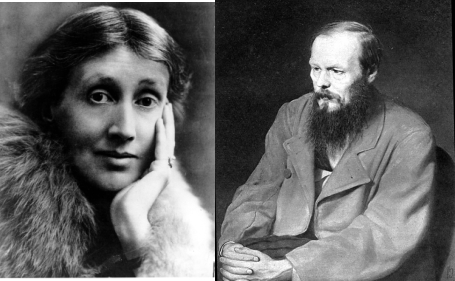
The Reading Experience Database (RED), hosted by the Open University, provides a vast, open-access compendium of British authors’ reading habits from 1450 through 1945. The resource is a continuously updated repository of literary references, compiled using excerpts of biographies, letters, newspapers, magazines, and other informative texts. Among other things, the database provides both a humorous and fascinating look at what various authors thought of their peers.
Virginia Woolf, it seems, championed Fyodor Dostoevsky (“It is directly obvious that he [Dostoevsky] is the greatest writer ever born.”), but spurned Henry James (“… we have his works here, and I read, and can’t find anything but faintly tinged rose water, urbane and sleek, but vulgar…”). Robert Louis Stevenson, a friend of James’, was too conflicted about some of his writing (“I must break out with the news that I can’t bear the Portrait of a Lady. I read it all, and I wept, too; but I can’t stand your having written it, and I beg you will write no more of the like”). Oscar Wilde, meanwhile, characteristically contrarian, despised certain aspects of Dickens (“peers were surprised to hear him speak disparagingly of Dickens, the most popular novelist of the day. While Wilde admired the author’s humor and his gift for caricature he loathed Dickens’s moralizing”).
Don’t see your favorite British author’s delightfully snarky commentary? Help your fellow reader and submit it yourself.
To learn more about the Reading Experience Database, watch this introductory video.
Related Content:
The Historic Meeting Between Dickens and Dostoevsky Revealed as a Great Literary Hoax
Vladimir Nabokov Makes Editorial Tweaks to Franz Kafka’s Novella The Metamorphosis
Stephen Fry Reads Oscar Wilde’s Children’s Story “The Happy Prince”
Read More...The History of Economics & Economic Theory Explained with Comics, Starting with Adam Smith
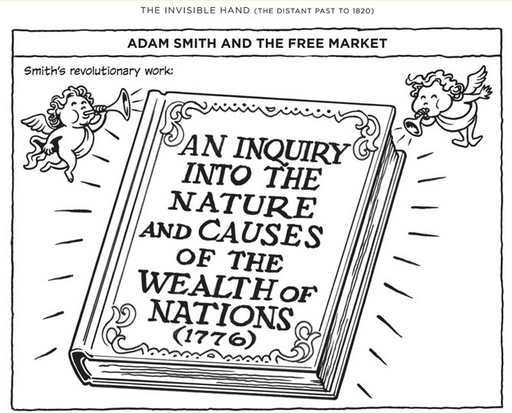
“Everyone has questions about the economy. I started looking for the answers in economics. I found enough insights to get me interested, but I couldn’t seem to make the insights add up. I went back to the original sources, the great economists, and started to see a big picture. And while the whole picture was complicated, no one part of it was all that hard to understand. I could see that all this information made a story. But I couldn’t find a book that told the story in an accessible way. So I decided to write one, in the most accessible form I knew: comics.”
Thus begins Michael Goodwin’s new book Economix: How Our Economy Works (and Doesn’t Work) in Words and Pictures.
The book covers two (plus) centuries of economic history. It starts with the Physiocrats, Adam Smith and theoretical development of capitalism, and then steams ahead into the 19th century, covering the Industrial Revolution, the rise of big business and big finance. Next comes the action packed 20th century: the Great Depression, the New Deal, the threat from Communism during the Cold War, the tax reforms of the Reagan era, and eventually the crash of 2008 and Occupy Wall Street. Along the way, Goodwin and the illustrator Dan E. Burr demystify the economic theories of figures like Ricardo, Marx, Malthus, Keynes, Friedman and Hayek — all in a substantive but approachable way.
As with most treatments of modern economics, the book starts with Adam Smith. To get a feel for Goodwin’s approach, you can dive into the first chapter of Economix, which grapples with Smith’s theories about the free market, division of labor and the Invisible Hand. Economix can be purchased online here.
If you would like to support the mission of Open Culture, consider making a donation to our site. It’s hard to rely 100% on ads, and your contributions will help us continue providing the best free cultural and educational materials to learners everywhere. You can contribute through PayPal, Patreon, and Venmo (@openculture). Thanks!
Related Content:
Reading Marx’s Capital with David Harvey (Free Course)
Read More...Watch Jean Genet’s Only Film, the Censored A Song of Love (1950)
Petty criminal, outlaw writer, political radical, gay icon—the name Jean Genet means many things to many people, but filmmaker isn’t usually one of them. Yet Genet did direct a short film, A Song of Love (Un chant d’amour), in 1950. Silent and shot in grainy black and white, the film presents a passionate relationship between inmates, separated from each other by the prison walls. The prisoners express their estranged desire for each other in increasingly sensual ways until the frame is filled with writhing bodies. All the while, a lone guard watches, menacing and jealous.
Despite the fact that the film was banned for many years, and that Genet himself disowned it, it’s a foundational work for later gay filmmakers, from Andy Warhol to the early Derek Jarman, whose first feature Sebastiane (1976) surely owes a debt to A Song of Love. Genet’s choice of setting is no mere autobiographical detail; the previous year he faced a life sentence after his tenth conviction, and was only saved by the intervention of his respected supporters Jean-Paul Sartre, Pablo Picasso, and Jean Cocteau, who petitioned the president on his behalf. It’s possible to read A Song of Love in many ways, but it’s hard not to see it at least as Genet’s projection of the frustrated (yet hothouse) sexual tension he would know if incarcerated for the rest of his days.
Of course Genet began his writing career in prison, drafting his first novel, the pulpy yet profoundly lyrical Our Lady of the Flowers, while serving out a sentence in the early forties. Genet’s erotically charged, some might say decadent, fiction worked to reclaim and revalue his identity as a homosexual, social outcast, and criminal. In his autobiographical novel, The Thief’s Journal, written in 1949 while his fate was being decided, Genet defined himself thus:
Limited by the world, which I oppose, jagged by it, I shall be all the more handsome and sparkling as the angles which wound me and give me shape are more acute and the jagging more cruel.
The quote could almost serve as an epigraph for Genet’s only film, which, writes Fernando Croce, draws its “presiding image… of flesh against stone” from The Thief’s Journal. It’s an image Croce interprets as “metaphor for society-enforced division imposed on gay men, and also of the need for connection which encompasses all human existence.” Like all Genet’s work, A Song of Love takes pleasure from pain and finds arresting intimacy and unabashedly liberating sexual fulfillment in the Parisian sewers, garrets, and jails.
Related Content:
Jean Genet, France’s Outlaw Poet, Revealed in a Rare 1981 Interview
Three “Anti-Films” by Andy Warhol: Sleep, Eat & Kiss
Wittgenstein: Watch Derek Jarman’s Tribute to the Philosopher, Featuring Tilda Swinton (1993)
Josh Jones is a writer and musician based in Durham, NC. Follow him at @jdmagness
Read More...T.S. Eliot, as Faber & Faber Editor, Rejects George Orwell’s “Trotskyite” Novel Animal Farm (1944)
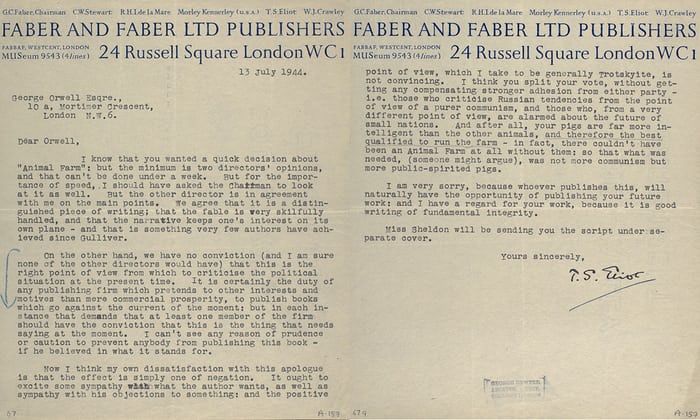
We’ve written recently about that most common occurrence in the life of every artist—the rejection letter. Most rejections are uncomplicated affairs, ostensibly reflecting matters of taste among editors, producers, and curators. In 1944, in his capacity as an editorial director at Faber & Faber, T.S. Eliot wrote a letter to George Orwell rejecting the latter’s satirical allegory Animal Farm. The letter is remarkable for its candid admission of the politics involved in the decision.
From the very start of the letter, Eliot betrays a personal familiarity with Orwell, in the informal salutation “Dear Orwell.” The two were in fact acquainted, and Orwell two years earlier had published a penetrating review of the first three of Eliot’s Four Quartets, writing “I know a respectable quantity of Eliot’s earlier work by heart. I did not sit down and learn it, it simply stuck in my mind as any passage of verse is liable to do when it has really rung the bell.”
Eliot’s apologetic rejection of Orwell’s fable begins with similarly high praise for its author, comparing the book to “Gulliver” in what may have been to Orwell a flattering reference to Jonathan Swift. A mutual admiration for each other’s artistry may have been the only thing Eliot and Orwell had in common. “On the other hand,” begins the second paragraph, and then cites the reasons for Faber & Faber’s passing on the novel, the principle one being a dismissal of Orwell’s “unconvincing” “Trotskyite” views. The rejection also may have stemmed from something a little more craven—the desire to appease a wartime ally. As the Encyclopaedia Brittanica blog puts it:
Eliot, that Tory of Tories, did not want to upset the Soviets in those fraught years of World War II. Besides, he opined, the pigs, being the smartest of the critters on the farm in question, were best qualified to run the place.
The decision was probably not Eliot’s alone, and Eliot parenthetically disowns the opinions personally, writing “what was needed, (someone might argue), was not more communism but more public-spirited pigs.” Indeed. The full text of Eliot’s letter is below.
13 July 1944
Dear Orwell,
I know that you wanted a quick decision about Animal Farm: but minimum is two directors’ opinions, and that can’t be done under a week. But for the importance of speed, I should have asked the Chairman to look at it as well. But the other director is in agreement with me on the main points. We agree that it is a distinguished piece of writing; that the fable is very skilfully handled, and that the narrative keeps one’s interest on its own plane—and that is something very few authors have achieved since Gulliver.
On the other hand, we have no conviction (and I am sure none of other directors would have) that this is the right point of view from which to criticise the political situation at the present time. It is certainly the duty of any publishing firm which pretends to other interests and motives than mere commercial prosperity, to publish books which go against current of the moment: but in each instance that demands that at least one member of the firm should have the conviction that this is the thing that needs saying at the moment. I can’t see any reason of prudence or caution to prevent anybody from publishing this book—if he believed in what it stands for.
Now I think my own dissatisfaction with this apologue is that the effect is simply one of negation. It ought to excite some sympathy with what the author wants, as well as sympathy with his objections to something: and the positive point of view, which I take to be generally Trotskyite, is not convincing. I think you split your vote, without getting any compensating stronger adhesion from either party—i.e. those who criticise Russian tendencies from the point of view of a purer communism, and those who, from a very different point of view, are alarmed about the future of small nations. And after all, your pigs are far more intelligent than the other animals, and therefore the best qualified to run the farm—in fact, there couldn’t have been an Animal Farm at all without them: so that what was needed, (someone might argue), was not more communism but more public-spirited pigs.
I am very sorry, because whoever publishes this, will naturally have the opportunity of publishing your future work: and I have a regard for your work, because it is good writing of fundamental integrity.
Miss Sheldon will be sending you the script under separate cover.
Yours sincerely,
T. S. Eliot
After four rejections in total, Orwell’s novel eventually saw publication in 1945. Five years later, a Russian émigré in West Germany, Vladimir Gorachek, published a small print run of the novel in Russian for free distribution to readers behind the Iron Curtain. And in 1954, the CIA funded the animated adaptation of Animal Farm by John Halas and Joy Batchelor (see the full film here). Yet another strange twist in the life of a book that could make discerning anti-communists as uncomfortable as it could the staunchest defenders of the Soviet system. You can find Animal Farm listed in our Free Audio Books and Free eBooks collections.
Related Content:
Read Rejection Letters Sent to Three Famous Artists: Sylvia Plath, Kurt Vonnegut & Andy Warhol
Gertrude Stein Gets a Snarky Rejection Letter from Publisher (1912)
No Women Need Apply: A Disheartening 1938 Rejection Letter from Disney Animation
Download George Orwell’s Animal Farm for Free
Josh Jones is a writer and musician based in Durham, NC. Follow him at @jdmagness
Read More...Slavoj Žižek Examines the Perverse Ideology of Beethoven’s Ode to Joy
Beethoven’s iconic Ninth Symphony premiered in Vienna in 1824, at “a time of great repression, of ultra-conservative nationalism” as the old orders fought back against the revolutions of the previous century. But it’s difficult to imagine the composer having any nationalist intent, what with his well-known hatred of authority, particularly imperialist authority (and particularly of Napoleon). Even less obvious is the imputation of nationalist tendencies to Friedrich Schiller, whose poem, “Ode to Joy” Beethoven adapts to a glorious chorus in the fourth movement. Schiller’s poem, writes Scott Horton in Harper’s, “envisions a world without monarchs” in which universal friendship “is essential if humankind is to overcome its darker moments.” And in his take on the ubiquitous piece of music, contrarian theorist Slavoj Žižek acknowledges in the clip above from his latest film, A Pervert’s Guide to Ideology, that the Ninth is generally taken for granted “as a kind of an ode to humanity as such, to the brotherhood and freedom of all people.”
And yet Žižek , being Žižek, draws our attention to the Ninth Symphony as a perfect ideological container, by reference to its unforgettable use in Stanley Kubrick’s A Clockwork Orange, as unsparing a look at humanity’s “darker moments” as one might find on film (excerpt above). Kubrick (and composer Wendy Carlos) drew on a long, dark history of associations with the Ninth. As evidence of its “universal adaptability,” Žižek points to its well-known use by the Nazis as a nationalist anthem, as well as by the Soviet Union as a communist song; in China during the Cultural Revolution, when almost all other Western music was prohibited; and at the extreme Apartheid right in South Rhodesia. “At the opposite end,” Žižek says, the Ninth Symphony was the favorite of ultra-leftist Shining Path leader Abimael Guzman, and in 1972, it became the unofficial “Anthem of Europe” (now of the European Union). The towering piece of music, Žižek claims, enables us to imagine a “perverse scene of universal fraternity” in which the world’s dictators, arch-terrorists, and war criminals all embrace each other. It’s a deeply disturbing image, to say the least. Watch the full excerpt for more of Žižek’s examination of the ideological weight Beethoven carries.
via Bibliokept
Related Content:
In His Latest Film, Slavoj Žižek Claims “The Only Way to Be an Atheist is Through Christianity”
Slavoj Žižek’s Pervert’s Guide to Ideology Decodes The Dark Knight and They Live
The Making of Stanley Kubrick’s A Clockwork Orange
Josh Jones is a writer and musician based in Durham, NC. Follow him at @jdmagness
Read More...Watch Charlie Chaplin Demand 342 Takes of One Scene from City Lights
The Criterion Collection has put out a new edition of Charlie Chaplin’s City Lights, and on the disc they’ve included the rare footage above of Chaplin directing that most famous of his pictures. We see him giving instructions to young Virginia Cherrill, who appeared in the film as a blind flower girl for whom Chaplin’s Tramp falls head over heels. Chaplin’s character approved of Cherrill much more heartily than Chaplin himself did. The director considered the actress an “amateur” and remembered her often “doing something which wasn’t right. Lines. A line. A contour hurts me if it’s not right.” That remark, originally made in an interview conducted in 1968, 37 years after City Lights, comes quoted in David Robinson’s new book, Chaplin: His Life and His Art. The New Yorker’s Richard Brody also uses it in his post on City Lights and Chaplin’s direction of Cherrill, of whom he, for one sequence, demanded as many as 342 takes.
Does that send Chaplin straight to the canon of perfectionist filmmakers? You may say yes, but Brody, whose powers of cinematic observation at times make me want to scrap everything and dedicate my life to film criticism, has a more interesting response. “It’s tempting to ascribe Chaplin’s obsessional direction,” he argues, “but I think that the episode reveals an even more powerful strain of Chaplin’s art, a sort of imperfectionism.
Chaplin didn’t have a mental template that he wanted Cherrill to match; he approaches the scene not quite knowing what he wanted.” Chaplin, so it seems, simply worked this way, seeking perfection, but an unusual “perfection of results, not of conformity to a preconceived schema. He sought what provoked, in him, the perfect emotion, the perfect aesthetic response—but he wouldn’t know it until he saw it. He started to shoot in the confidence that the thing—whatever it was—would happen.” And now you can watch 65 of the fruits of Chaplin’s quest for this imperfectionistic perfection for free on our very own collection of Chaplin films on the web.
via The New Yorker
Related Content:
Three Great Films Starring Charlie Chaplin, the True Icon of Silent Comedy
The Power of Silent Movies, with The Artist Director Michel Hazanavicius
Hollywood, Epic Documentary Chronicles the Early History of Cinema
535 Free Movies Online: Great Classics, Indies, Noir, Westerns, etc.
Colin Marshall hosts and produces Notebook on Cities and Culture and writes essays on cities, Asia, film, literature, and aesthetics. He’s at work on a book about Los Angeles, A Los Angeles Primer. Follow him on Twitter at @colinmarshall or on his brand new Facebook page.
Read More...Filmmaker Michel Gondry Presents an Animated Conversation with Noam Chomsky
Even if you regularly read Open Culture, where we make a point of highlighting unusual intersections of cultural currents, you probably never expected a collaboration between the likes of Michel Gondry and Noam Chomsky. Gondry we’ve known as an imaginative filmmaker behind features like Eternal Sunshine of the Spotless Mind and Be Kind Rewind (as well as music videos for artists like Beck, Kanye West, and the White Stripes), one driven to pursue a Continental whimsy tempered by a dedication to elaborate, difficult-looking hand craft and an apparent interest in American culture.
Chomsky we’ve known, depending on our interests, as either a noted linguist or a controversial writer and speaker on politics, society, and the media. Gondry’s new documentary Is the Man Who Is Tall Happy?, the project that brings them together at least, showcases both the less-seen purely philosophical side of Chomsky, and the also rarely acknowledged inquisitive, conversational side of Gondry. In the New York Times “Anatomy of a Scene” clip at the top, the director explains his process.
Naturally, Gondry went through a fairly unusual process to make the film, given that he based the whole thing on nothing more elaborate than a long-form in-office conversation with the MIT-based professor and activist. To get the footage he needed of Chomsky talking, he brought in — naturally — his vintage wind-up Bolex 16-millimeter film camera. He then wove those shots in with his also highly analog hand-drawn animation, which illustrates Chomsky’s ideas as he describes them — and as Gondry prods him for more. “The camera is very loud,” Gondry explains over a deliberately shaky frame, “and that’s why I have to draw it each time you hear it.” Just above, you can watch the film’s trailer, which offers Chomsky’s voice as well as Gondry’s. “Why should we take it to be obvious that if I let go of a ball,” we hear the interviewee ask, “it goes down and not up?” We also hear the interviewer admit that he “felt a bit stupid here,” but these two men’s considerable differences — in generation, in nationality, in sensibility, in their concerns, in the forms of their work — provide all the more reason to listen when they talk. And if you find the intellectual trip not to your taste, just behold the visual one.
Related Content:
Noam Chomsky & Michel Foucault Debate Human Nature & Power (1971)
Noam Chomsky vs. William F. Buckley, 1969
Colin Marshall hosts and produces Notebook on Cities and Culture and writes essays on literature, film, cities, Asia, and aesthetics. He’s at work on a book about Los Angeles, A Los Angeles Primer. Follow him on Twitter at @colinmarshall.
Read More...C.S. Lewis’ Prescient 1937 Review of The Hobbit by J.R.R. Tolkien: It “May Well Prove a Classic”
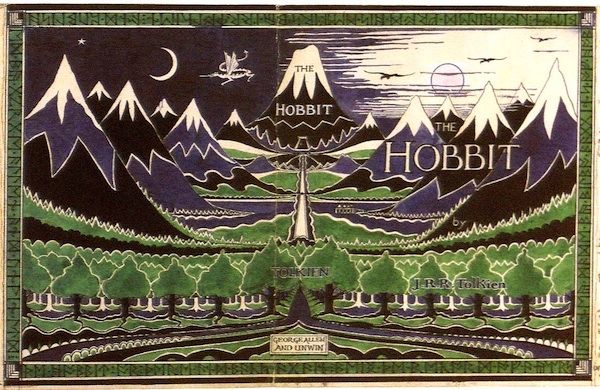 In 1937, C.S. Lewis (who would later write The Chronicles of Narnia – find it in a free audio format here) published in the Times Literary Supplement a review of The Hobbit by J.R.R. Tolkien. Lewis and Tolkien were no strangers to one another. They had met back in 1926 at Oxford University, where they both served on the English faculty. In the years to come, they formed a close friendship and joined the Inklings, an Oxford literary group dedicated to fiction and fantasy.
Lewis’ review of The Hobbit was short, a mere three paragraphs. And it’s hard to say now whether Lewis was giving a kind review to a friend, or making some prescient literary observations. Or, perhaps, some combination of the two. The closing lines go like this:
The Hobbit … will be funnier to its youngest readers, and only years later, at a tenth or a twentieth reading, will they begin to realise what deft scholarship and profound reflection have gone to make everything in it so ripe, so friendly, and in its own way so true. Prediction is dangerous: but The Hobbit may well prove a classic.
The complete review has now been republished, and you can read it over at The Paris Review.
via Flavorwire
Related Content:
Download Eight Free Lectures on The Hobbit by “The Tolkien Professor,” Corey Olsen
Listen to J.R.R. Tolkien Read a Lengthy Excerpt from The Hobbit (1952)
Discover J.R.R. Tolkien’s Personal Book Cover Designs for The Lord of the Rings Trilogy
Read More...Bob Dylan Finally Makes a Video for His 1965 Hit, “Like a Rolling Stone”
Earlier today, we told you all about Bob Dylan’s controversial Victoria’s Secret commercial shot in 2004 — the first commercial in which the musician ever appeared on screen. Tonight, we leave you with this — Dylan’s newly-released video for his 1965 hit “Like a Rolling Stone.” As you’ll see, it’s not just a video. It’s an interactive video that lets “viewers flip through 16 television channels as a variety of television personalities lip-sync the lyrics.” You can check it out above, or watch it in a larger format here. The new video coincides with the release of Bob Dylan: The Complete Album Collection Vol. 1, a CD box set that contains “35 studio titles, 6 live albums, 2‑CD ‘Side Tracks,’ and a hardcover book featuring new album-by-album liner notes.” The logical question is what’s left for Vol. 2?
via Rolling Stone
Related Content:
Andy Warhol Shoots “Screen Tests” of Nico, Bob Dylan & Salvador Dalí
Bob Dylan and The Grateful Dead Rehearse Together in Summer 1987. Listen to 74 Tracks.
Two Legends Together: A Young Bob Dylan Talks and Plays on The Studs Terkel Program, 1963
Read More...Bob Dylan’s Controversial 2004 Victoria’s Secret Ad: His First & Last Appearance in a Commercial
Bob Dylan’s been pissing off his fans since he went electric at the Newport Folk Festival in 1965, leaving scores of bitter folkies with feelings of betrayal. But he’s also taken many a principled stand, walking off The Ed Sullivan Show early in his career in 1963, for example, when he learned that CBS wanted to censor his “Talkin’ John Birch Paranoid Blues” for being potentially libelous to the far-right group. Then there are those episodes that have simply baffled his admirers, like his release of the almost universally panned Self Portrait and his conversion to evangelical Christianity. Whatever possessed him to appear in the 2004 Victoria’s Secret ad above, however, is anyone’s guess. While it may not have the same geopolitical juice as his controversial appearance in China in 2011, aside from the general weirdness of once countercultural figures selling products, it’s a move that especially troubled fans of Dylan, to say the least.
There were, of course, cries of “sell out.” Then there’s the troubling status of Victoria’s Secret, a company that has accumulated no small share of controversy since the ad aired, and which at the time was not especially known as a socially responsible entity.
Though Dylan had already licensed the song “Love Sick” from 1997’s Time Out of Mind to the company (and in 2000 licensed “Forever Young” to Apple), this is the first and only time he’s appeared on screen in a commercial, with the exception of a 2010 Google ad that recycled clips from the ’65 “Subterranean Homesick Blues” film.
While ad agencies may have replaced A&R for hungry young indie bands, the phenomenon of wealthy, aging rock stars shilling for major corporations seems to defy reason. Most people assume it’s always a cash grab. Dylan himself joked in 1965 that the only thing he’d sell out for would be “ladies undergarments.” In a perhaps unfortunately titled article for Slate, Seth Stevenson suggested that Dylan and those of his generation took the corporate bait in attempts to remain relevant and “remind the world that they still exist.” In the case of the Victoria’s Secret ad (see a “behind the scenes” video here), this is a little hard to swallow. Not even the balefully timed release of his Love and Theft in September of 2001 could overshadow the enormous success of that album, which, Allmusic writes, “stands proudly among his very best.” 2006’s platinum-selling Modern Times was not far behind. Unlike his online response to the China controversy, Dylan himself revealed nothing of his intentions, leaving fans with the unsettling image of one of the 20th century’s most iconoclastic artists (and one never especially known for his sex appeal) hawking lingerie on national television.
Related Content:
David Bowie Appears in the “Director’s Cut” of a New Louis Vuitton Ad, Nods to Labyrinth
Kerouac Wore Khakis: Ghost of the Beat Writer Stars in 1993 Gap Advertising Campaign
Never Mind the Bollocks, Here’s … John Lydon in a Butter Commercial?
Josh Jones is a writer and musician based in Durham, NC. Follow him at @jdmagness
Read More...
Support Us
We're hoping to rely on loyal readers, rather than erratic ads. Please click the Donate button and support Open Culture. You can use Paypal, Venmo, Patreon, even Crypto! We thank you!

About Us

Open Culture scours the web for the best educational media. We find the free courses and audio books you need, the language lessons & educational videos you want, and plenty of enlightenment in between.
Advertise With Us

FREE UPDATES!
GET OUR DAILY EMAIL
Get the best cultural and educational resources on the web curated for you in a daily email. We never spam. Unsubscribe at any time.
FOLLOW ON SOCIAL MEDIA

Open Culture editor Dan Colman scours the web for the best educational media. He finds the free courses and audio books you need, the language lessons & movies you want, and plenty of enlightenment in between.
Advertise With Us

