Apocalypse Now’s “Ride of the Valkyries” Attack: The Anatomy of a Classic Scene
“I love the smell of napalm in the morning.” There we have undoubtedly the most famous quote of what must count as one of Robert Duvall’s finest performances, and surely his most surprising: that of Lieutenant Colonel Bill Kilgore in Francis Ford Coppola’s Apocalypse Now. As you’ll no doubt recall — and if you don’t recall it, minimize your browser for a few hours and make your way to a screening, or at least watch it online — Captain Benjamin Willard’s Conradian boat journey into the Vietnam War’s dark heart hits a snag fairly early in the picture: they need to pass through a coastal area under tight Viet Cong control.
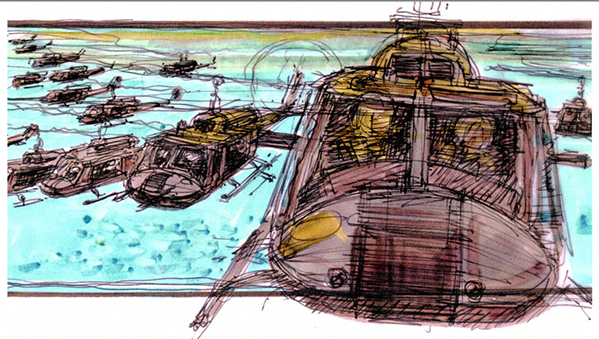
Kilgore, initially reluctant to call in his helicopters to back up Willard’s dubious mission, changes his mind when he realizes that Willard counts among his own small crew famed professional surfer Lance B. Johnson. The Lieutenant Colonel, it turns out, loves to surf. He also loves to blast Richard Wagner’s “Ride of the Valkyries” from helicopter-mounted speakers. “It scares the hell out of the slopes,” he explains. “My boys love it.”
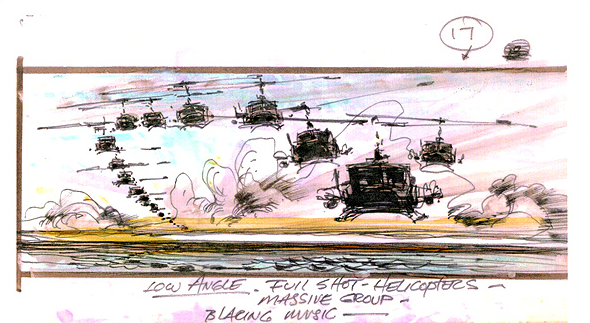
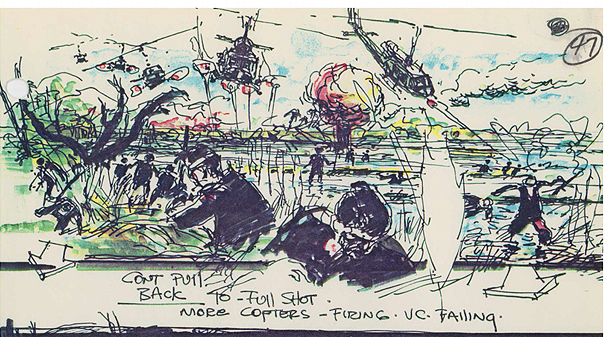
At the top, you can watch the fruits of Willard and Kilgore’s cooperation, an operatic napalm airstrike that takes the entire beach: not an easy thing to accomplish, and certainly not an easy thing to film. As anyone acquainted with the making of Apocalypse Now has heard, the production tended to turn as complicated, confusing, and perilous as the Vietnam War itself, but not necessarily for lack of planning.

At Empire, you can view the scene’s original storyboards and read alongside them a brief interview with Doug Claybourne, who on the film had the enviable title of Helicopter Wrangler. Arriving to the Philippines-based shoot (in “the middle of nowhere”), Claybourne found Coppola on the beach with a bullhorn, Martin Sheen just replacing Harvey Keitel in the role of Willard, choppers borrowed from President Ferdinand Marcos (who periodically took them back to use against insurrections elsewhere), a coming typhoon, and “a lot of chaos.”
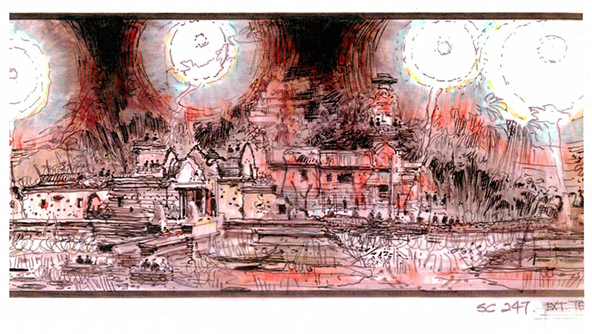
But Coppola, Claybourne, and the rest of the team saw it through, achieving results even more striking, in moments, than these storyboards suggest. As for the unflappable Kilgore, well, we all remember him rushing to catch a tantalizing wave even before the fighting subsides. After all, to quote his second-most famous line, “Charlie don’t surf!”
Related Content:
Akira Kurosawa & Francis Ford Coppola Star in Japanese Whisky Commercials (1980)
Dementia 13: The Film That Took Francis Ford Coppola From Schlockster to Auteur
Francis Ford Coppola’s Handwritten Casting Notes for The Godfather
Colin Marshall hosts and produces Notebook on Cities and Culture and writes essays on literature, film, cities, Asia, and aesthetics. He’s at work on a book about Los Angeles, A Los Angeles Primer. Follow him on Twitter at @colinmarshall.
Read More...The Best Writing Advice Pico Iyer Ever Received

One can work with language all day, I have found—write, teach, blog and tweet incessantly—and still succumb to all the worst habits of lazy writers: indulging strings of clichés and abstractions, making it impossible for a reader to, as they say, “locate herself” in time and space. Travel writer and essayist Pico Iyer found this out on the job. Though he had written his way through graduate school and the pages of Time magazine, he still needed to hear the advice of his editor at Knopf, Charles Elliott. “The reader wants to travel beside you,” said Elliott, “looking over your shoulder.”
Such a simple notion. Essential even. But Elliott’s advice is not limited to the dogma of “show, don’t tell” (maybe a limited way to think of writing). More pointedly he stresses the connection of abstract ideas to concrete, specific descriptions that anchor events to a reality outside the author’s head, one the reader wants see, hear, touch, etc. The “best writing advice” Iyer ever received is a useful precept especially, I think, for people who write all of the time, and who need to be reminded, like Iyer, to keep it fresh. Read his full description at The American Scholar.
Related Content:
Jack Kerouac Lists 9 Essentials for Writing Spontaneous Prose
Cormac McCarthy’s Three Punctuation Rules, and How They All Go Back to James Joyce
Toni Morrison Dispenses Writing Wisdom in 1993 Paris Review Interview
Josh Jones is a writer and musician based in Durham, NC. Follow him at @jdmagness
Read More...Free Online: 10 of the Greatest Silent Films of All Time
Silent films had a respectable showing, as it were, on Sight & Sound magazine’s last big critics poll. The votes, cast to determine the greatest motion pictures of all time, placed three silents among the top ten overall: F.W. Murnau’s Sunrise, Dziga Vertov’s Man with a Movie Camera, and Carl Theodor Dreyer’s The Passion of Joan of Arc. These, of course, also rank at the top of Sight & Sound’s separate list of the ten greatest silent films of all time, which came out as follows:
- Sunrise (F.W. Murnau, 1927)
- Man with a Movie Camera (Dziga Vertov, 1929)
- The Passion of Joan of Arc (Carl Theodor Dreyer, 1928)
- Battleship Potemkin (Sergei Eisenstein, 1925)
- The General (Buster Keaton, 1926)
- Metropolis (Fritz Lang, 1927)
- City Lights (Charlie Chaplin, 1931)
- Sherlock Jr. (Buster Keaton, 1924)
- Greed (Erich von Stroheim, 1923)
- Un chien andalou (Luis Buñuel, 1928) and Intolerance (D.W. Griffith, 1916)
Though all of these pictures came out within the seemingly short 15-year span between 1916 and 1921, they represent a wide cinematic diversity: in form, in theme, in genre, in place of origin (of both the films and the filmmakers), in sensibility, in aesthetics. You probably recognize all of their names, especially if you’ve taken a film studies course, and you may think of them all as familiar, but how many have you watched? Even we avowed cinephiles have a way of tricking ourselves into believing we’ve seen all the most important movies in their entirety, when in reality we know only about, albeit sometimes a lot about, their place in the history of cinema and their currents of influence that flow into films made today.
But thanks to the internet, we can catch up with ease. Given the age of works from the silent era, most of them have passed into the public domain. You can therefore watch almost all of the top ten greatest silent films of all time, as selected by the 2012 Sight & Sound critics poll, for free, online, right now. Some you can even watch right here, without leaving Open Culture: at the top of the post, you’ll find Sunrise. Just above, we’ve featured Man with a Movie Camera. Below, The Passion of Joan of Arc. To watch the others, simply click their linked titles on the list. After you’ve enjoyed everything from Murnau’s German-Expressionist-by-way-of-Hollywood romance to Keaton’s epic comedy to Buñuel’s surrealist procession of still-troubling visions, you’ll not just know where many modern cinematic techniques came from, you’ll feel how they’ve evolved over the decades. All of the films listed above appear on our list of Great Silent Films, part of our larger collection, 4,000+ Free Movies Online: Great Classics, Indies, Noir, Westerns, Documentaries & More.
Related Content:
The 10 Greatest Films of All Time According to 846 Film Critics
100 Free Silent Films: The Great Classics
The Power of Silent Movies, with The Artist Director Michel Hazanavicius
Hollywood, Epic Documentary Chronicles the Early History of Cinema
535 Free Movies Online: Great Classics, Indies, Noir, Westerns, etc.
Colin Marshall hosts and produces Notebook on Cities and Culture and writes essays on literature, film, cities, Asia, and aesthetics. He’s at work on a book about Los Angeles, A Los Angeles Primer. Follow him on Twitter at @colinmarshall.
Read More...Watch Lovebirds Amanda Palmer and Neil Gaiman Sing “Makin’ Whoopee!” Live
Amanda Palmer and Neil Gaiman strike me as a very happily married couple, an impression their live cover of Makin’ Whoopee supports.
What’s their secret? As anyone with an interest in romance or Earth Science will tell you, opposites attract. On the surface of things, the exhibitionistic, highly theatrical, always controversial Palmer is quite different from her unfailingly discreet husband of the last two-and-a-half years. (Watch him mine his reticence to great comic effect at the 2.52 mark.)
That’s not to say they don’t have things in common.
Both are insanely prolific, the fruits of their labors displayed across a variety of platforms—music, comics, film, literature, commencement speeches, TED talks, Twitter…
Both have rabid fan bases and blogs (Hers accepts comments; his does not.)
He was raised in a Scientologist household. She scrawled Nope. Not planning to fund Scientology with my Kickstarter money. That would be dumb on her nude torso, then posted a selfie on her website, thus pouring gasoline on the fires that power that portion of the internet devoted to spreading misinformation about their religious affiliation.
And while he has three children from a previous marriage, the Gaiman-Palmer union has yet to produce any little Neil or Amandas. Which brings us back to Makin’ Whoopee. Whether or not the lyrics jibe with one’s personal outlook, the song’s enduring popularity (85 years and counting) might suggest its central dilemma is evergreen. Its biological observations are certainly above reproach: sex often leads to babies, who lead to the sort of responsibilities that signal the end of the honeymoon, if not the marriage.
Perhaps an open relationship in the whoopee department will continue to keep things playful between the Gaiman-Palmers, regardless of what their future holds. It’s really none of our business, is it?
(Those drawn to speculation, could do so live, when the alt.power-couple (Namanda? Ameil?) bring their “intimate night” of spoken word, songs, stories, audience chats and surprises to New York City’s Town Hall.)
Related Content:
Amanda Palmer’s Tips for Being an Artist in the Rough-and-Tumble Digital Age
Download Neil Gaiman’s Free Short Stories
Neil Gaiman Gives Graduates 10 Essential Tips for Working in the Arts
BBC Radio Adaptation of Neil Gaiman’s Neverwhere Begins Saturday: A Preview
Ayun Halliday must tender her regrets as she is directing a cast of 15 home schooled teens in her husband’s musical, Yeast Nation, that night. Follow her @AyunHalliday
Read More...How Animated Cartoons Are Made: Watch a Short, Charming Primer from 1919
Wallace Carlson, a pioneering animator who created films like Dreamy Dud: He Resolves Not to Smoke (1915), joined Bray Studios in 1917, where, among other things, he produced a film called How Animated Cartoons Are Made. According to Cartoon Research, a site dedicated to cartoon history, the film offers perhaps the earliest and truest look at how cartoons were made nearly a century ago. And it’s all done with some charm and wit. You can find the nine-minute short added to the Animation section of our collection of 575 Free Movies Online. Meanwhile, if old-time animation fascinates you, you’ll want to watch How Walt Disney Cartoons Are Made, a 1939 production that takes you inside the making of Snow White (1937).
If you would like to support the mission of Open Culture, consider making a donation to our site. It’s hard to rely 100% on ads, and your contributions will help us continue providing the best free cultural and educational materials to learners everywhere. You can contribute through PayPal, Patreon, and Venmo (@openculture). Thanks!
Related Content:
European Cave Art: Was It The Earliest Form of Cinema?
The Disney Cartoon That Introduced Mickey Mouse & Animation with Sound (1928)
How Walt Disney Cartoons Are Made (1939)
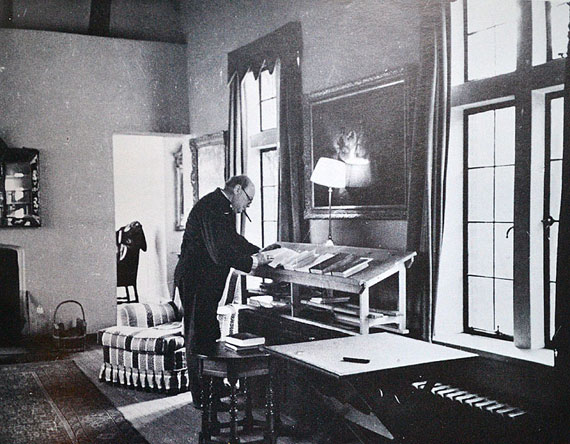
Read More...Who Wrote at Standing Desks? Kierkegaard, Dickens and Ernest Hemingway Too
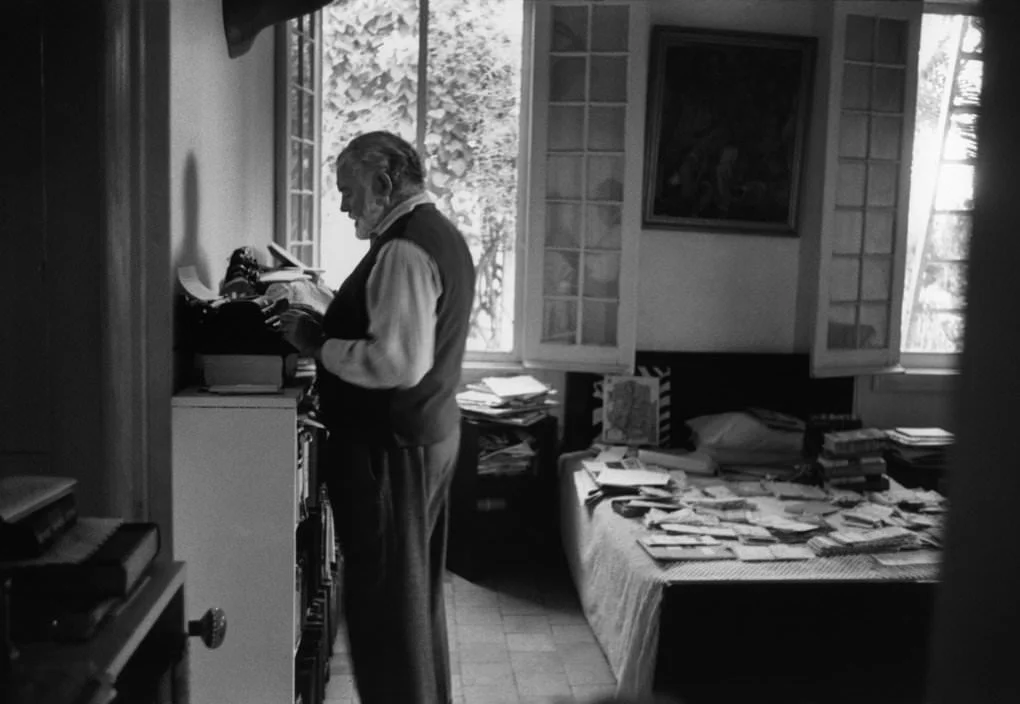
Kierkegaard apparently did his best writing standing up, as did Charles Dickens, Winston Churchill, Vladimir Nabokov and Virginia Woolf. Also put Ernest Hemingway in the standing desk club too.
In 1954, George Plimpton interviewed Hemingway for the literary journal he co-founded the year before, The Paris Review. The interview came prefaced with a description of the novelist’s writing studio in Cuba:
Ernest Hemingway writes in the bedroom of his house in the Havana suburb of San Francisco de Paula. He has a special workroom prepared for him in a square tower at the southwest corner of the house, but prefers to work in his bedroom, climbing to the tower room only when “characters” drive him up there…
The room is divided into two alcoves by a pair of chest-high bookcases that stand out into the room at right angles from opposite walls.…
It is on the top of one of these cluttered bookcases—the one against the wall by the east window and three feet or so from his bed—that Hemingway has his “work desk”—a square foot of cramped area hemmed in by books on one side and on the other by a newspaper-covered heap of papers, manuscripts, and pamphlets. There is just enough space left on top of the bookcase for a typewriter, surmounted by a wooden reading board, five or six pencils, and a chunk of copper ore to weight down papers when the wind blows in from the east window.
A working habit he has had from the beginning, Hemingway stands when he writes. He stands in a pair of his oversized loafers on the worn skin of a lesser kudu—the typewriter and the reading board chest-high opposite him.
Popular Science, a magazine with roots much older than the Paris Review, first began writing about the virtues of standing desks for writers back in 1883. By 1967, they were explaining how to fashion a desk with simple supplies instead of forking over $800 for a commercial model — a hefty sum in the 60s, let alone now. Plywood, saw, hammer, nails, glue, varnish — that’s all you need to build a DIY stand-up desk. Or, as Papa Hemingway did, you could simply throw your writing machine on the nearest bookcase and get going. As for how to write the great American novel, I’m not sure that Popular Science offers much help. But maybe some advice from Hemingway himself will steer you in the right direction. See Seven Tips From Ernest Hemingway on How to Write Fiction.
For more on the benefits of the standing desk, see this post from the Harvard Business Review.
If you would like to support the mission of Open Culture, consider making a donation to our site. It’s hard to rely 100% on ads, and your contributions will help us continue providing the best free cultural and educational materials to learners everywhere. You can contribute through PayPal, Patreon, and Venmo (@openculture). Thanks!
Read More...Richard Dawkins and Jon Stewart Debate Whether Science or Religion Will Destroy Civilization
One of the sad facts of human psychology is that knowledge can be used for evil just as easily as it can be used for good. If the human race had never figured out how to use fire, for example, we wouldn’t have to worry about those pesky arsonists.
If some people are willing to use the fruits of knowledge to hurt people, should we stop acquiring knowledge? It sounds absurd, but that’s a question that is often asked, though it’s invariably couched in different language.
When Richard Dawkins, the evolutionary biologist and outspoken atheist, made an appearance on The Daily Show last week to promote his new memoir, host Jon Stewart asked: “Do you believe that the end of our civilization will be through religious strife or scientific advancement?” The answer, Dawkins said, is probably both. “Science provides, in the form of technology, weapons which hitherto have been available only to reasonably responsible governments,” said Dawkins, and those weapons “are likely to become available to nutcases who believe that their god requires them to wreak havoc and destruction.”
The conversation then moves beyond religious fanaticism. “Science is the most powerful way to do whatever it is you want to do,” said Dawkins, “and if you want to do good, it’s the most powerful way of doing good. If you want to do evil, it’s the most powerful way to do something evil.”
Dawkins’s last statement echoes the words of Albert Einstein, who warned that the scientific method is only a means to an end, and that the welfare of humanity depends ultimately on shared goals. You can hear Einstein make his point by visiting our post, “Listen as Albert Einstein Reads ‘The Common Language of Science’ (1941)”.
Related Content:
Jon Stewart’s William & Mary Commencement Address: The Entire World is an Elective
Richard Dawkins Explains Why There Was Never a First Human Being
Read More...David Bowie’s Top 100 Books

Image by Avro, via Wikimedia Commons
“David Bowie Is,” the extensive retrospective exhibit of the artist and his fabulous costumes, hit Toronto last Friday (see our post from earlier today), and as many people have reported, in addition to those costumes—and photos, instruments, set designs, lyric sheets, etc.—the show includes a list of Bowie’s favorite books. Described as a “voracious reader” by curator Geoffrey Marsh, Bowie’s top 100 book list spans decades, from Richard Wright’s raw 1945 memoir Black Boy to Susan Jacoby’s 2008 analysis of U.S. anti-intellectualism in The Age of American Unreason.
Bowie’s always had a complicated relationship with the U.S., but his list shows a lot of love to American writers, from the aforementioned to Truman Capote, Hubert Selby, Jr., Saul Bellow, Junot Diaz, Jack Kerouac and many more. He’s also very fond of fellow Brits George Orwell, Ian McEwan, and Julian Barnes and loves Mishima and Bulgakov. You can read the full list below or over at Open Book Toronto, who urges you to “grab one of these titles and settle in to read — and just think, somewhere, at some point, David Bowie (or, to be more accurate, the man behind David Bowie, David Jones) was doing the exact same thing.” If that sort of thing inspires you to pick up a good book, go for it. You could also peruse the list, then puzzle over the literate Bowie’s lyrics to “I Can’t Read.” You can also explore a new related book–Bowie’s Bookshelf: The Hundred Books that Changed David Bowie’s Life.
- Interviews With Francis Bacon by David Sylvester
- Billy Liar by Keith Waterhouse
- Room At The Top by John Braine
- On Having No Head by Douglass Harding
- Kafka Was The Rage by Anatole Broyard
- A Clockwork Orange by Anthony Burgess
- City Of Night by John Rechy
- The Brief Wondrous Life Of Oscar Wao by Junot Diaz
- Madame Bovary by Gustave Flaubert
- Iliad by Homer
- As I Lay Dying by William Faulkner
- Tadanori Yokoo by Tadanori Yokoo
- Berlin Alexanderplatz by Alfred Döblin
- Inside The Whale And Other Essays by George Orwell
- Mr. Norris Changes Trains by Christopher Isherwood
- Halls Dictionary Of Subjects And Symbols In Art by James A. Hall
- David Bomberg by Richard Cork
- Blast by Wyndham Lewis
- Passing by Nella Larson
- Beyond The Brillo Box by Arthur C. Danto
- The Origin Of Consciousness In The Breakdown Of The Bicameral Mind by Julian Jaynes
- In Bluebeard’s Castle by George Steiner
- Hawksmoor by Peter Ackroyd
- The Divided Self by R. D. Laing
- The Stranger by Albert Camus
- Infants Of The Spring by Wallace Thurman
- The Quest For Christa T by Christa Wolf
- The Songlines by Bruce Chatwin
- Nights At The Circus by Angela Carter
- The Master And Margarita by Mikhail Bulgakov
- The Prime Of Miss Jean Brodie by Muriel Spark
- Lolita by Vladimir Nabokov
- Herzog by Saul Bellow
- Puckoon by Spike Milligan
- Black Boy by Richard Wright
- The Great Gatsby by F. Scott Fitzgerald
- The Sailor Who Fell From Grace With The Sea by Yukio Mishima
- Darkness At Noon by Arthur Koestler
- The Waste Land by T.S. Elliot
- McTeague by Frank Norris
- Money by Martin Amis
- The Outsider by Colin Wilson
- Strange People by Frank Edwards
- English Journey by J.B. Priestley
- A Confederacy Of Dunces by John Kennedy Toole
- The Day Of The Locust by Nathanael West
- 1984 by George Orwell
- The Life And Times Of Little Richard by Charles White
- Awopbopaloobop Alopbamboom: The Golden Age of Rock by Nik Cohn
- Mystery Train by Greil Marcus
- Beano (comic, ’50s)
- Raw (comic, ’80s)
- White Noise by Don DeLillo
- Sweet Soul Music: Rhythm And Blues And The Southern Dream Of Freedom by Peter Guralnick
- Silence: Lectures And Writing by John Cage
- Writers At Work: The Paris Review Interviews edited by Malcolm Cowley
- The Sound Of The City: The Rise Of Rock And Roll by Charlie Gillette
- Octobriana And The Russian Underground by Peter Sadecky
- The Street by Ann Petry
- Wonder Boys by Michael Chabon
- Last Exit To Brooklyn By Hubert Selby, Jr.
- A People’s History Of The United States by Howard Zinn
- The Age Of American Unreason by Susan Jacoby
- Metropolitan Life by Fran Lebowitz
- The Coast Of Utopia by Tom Stoppard
- The Bridge by Hart Crane
- All The Emperor’s Horses by David Kidd
- Fingersmith by Sarah Waters
- Earthly Powers by Anthony Burgess
- The 42nd Parallel by John Dos Passos
- Tales Of Beatnik Glory by Ed Saunders
- The Bird Artist by Howard Norman
- Nowhere To Run The Story Of Soul Music by Gerri Hirshey
- Before The Deluge by Otto Friedrich
- Sexual Personae: Art And Decadence From Nefertiti To Emily Dickinson by Camille Paglia
- The American Way Of Death by Jessica Mitford
- In Cold Blood by Truman Capote
- Lady Chatterly’s Lover by D.H. Lawrence
- Teenage by Jon Savage
- Vile Bodies by Evelyn Waugh
- The Hidden Persuaders by Vance Packard
- The Fire Next Time by James Baldwin
- Viz (comic, early ’80s)
- Private Eye (satirical magazine, ’60s – ’80s)
- Selected Poems by Frank O’Hara
- The Trial Of Henry Kissinger by Christopher Hitchens
- Flaubert’s Parrot by Julian Barnes
- Maldoror by Comte de Lautréamont
- On The Road by Jack Kerouac
- Mr. Wilson’s Cabinet of Wonder by Lawrence Weschler
- Zanoni by Edward Bulwer-Lytton
- Transcendental Magic, Its Doctrine and Ritual by Eliphas Lévi
- The Gnostic Gospels by Elaine Pagels
- The Leopard by Giuseppe Di Lampedusa
- Inferno by Dante Alighieri
- A Grave For A Dolphin by Alberto Denti di Pirajno
- The Insult by Rupert Thomson
- In Between The Sheets by Ian McEwan
- A People’s Tragedy by Orlando Figes
- Journey Into The Whirlwind by Eugenia Ginzburg
If you would like to support the mission of Open Culture, consider making a donation to our site. It’s hard to rely 100% on ads, and your contributions will help us continue providing the best free cultural and educational materials to learners everywhere. You can contribute through PayPal, Patreon, and Venmo (@openculture). Thanks!
Related Content:
Bowie’s Bookshelf: A New Essay Collection on The 100 Books That Changed David Bowie’s Life
David Bowie Releases Vintage Videos of His Greatest Hits from the 1970s and 1980s
David Bowie Recalls the Strange Experience of Inventing the Character Ziggy Stardust (1977)
Josh Jones is a writer and musician based in Durham, NC. Follow him at @jdmagness
Read More...Watch Janis Joplin’s Final Interview Get Reborn as an Animated Cartoon
Four days before her death, Janis Joplin spoke with Howard Smith of the Village Voice in what was to be her last interview.
Their conversation has been resurrected as a four minute animation for PBS Digital Studios’ Blank on Blank series. The cartoon Janis bears a close resemblance to Gloria Steinem, an uncomfortable fit once the topic turns from her sadness at critical rejection to the sisterhood’s alleged withholding of affection.
Smith hits his subject with some leading questions that smack of the myriad ways Women’s Lib was distorted by even the liberal media of the time: “It seems to bother a lot of Women’s Lib people that you’re so upfront sexually,” he muses.
No need to take that one at anything less than face value…
Joplin allowed herself to be led, tossing off several statements that animator Patrick Smith faithfully illustrates. (In my opinion the wounded female drummers rock far more than pregnancy and vacuums, his shorthand for “settling.” )
When later, Joplin timidly asks if “all that $#*% I said about chicks” sounded bad, Smith reassures her that no, she said what she wanted to say. Perhaps he got what he wanted her to say.
As commenter heyitsmoi observed on YouTube, “It’s always bothered me when people ask successful women to comment on how some other women don’t like them. I’ve yet to hear a successful man to be asked why other men don’t like him, even though there’s sure to be plenty. Women seem to constantly be put in this defensive position where they can’t answer the question without making it sound like all women are jealous beasts who can’t handle that some woman made it, and that’s simply not true.”
If you’re left feeling vaguely queasy, I suggest “Stiletto Power,” Blank on Blank’s take on Larry Grobel’s 1994 interview with Farrah Fawcett. Grobel’s approach seemed to have been one of turn on the tape recorder and then get out of the way. Mission accomplished. The resulting monologue is as ferocious as it is funny.
Related Content:
Animations Revive Lost Interviews with David Foster Wallace, Jim Morrison & Dave Brubeck
Remembering Janis Joplin: Some Classic Live Performances and Previews of a New Joplin Musical
‘Beastie Boys on Being Stupid’: An Animated Interview From 1985
Ayun Halliday has fond feelings for both of the women featured in the above article . Follow her @AyunHalliday.
Read More...Watch the Sex Pistols’ Very Last Concert (San Francisco, 1978)
Many things have happened on the internet this week, among them some get off my lawn outrage at a $375 Urban Outfitters leather jacket designed to replicate the homemade swag every punk rock kid once draped over their shoulders. Then there’s the Justin Bieber/Black Flag mash-up t‑shirt that “ruined punk forever.” I may have spent some formative years immersed in ersatz punk and hardcore culture, but no matter how old and cranky I may be compared to the target market of this merchandise, I just can’t bring myself to get bothered. No one has said it better than Dave Berman: “punk rock died when the first kid said / ‘punk’s not dead, punk’s not dead.’”
The strident desire of some to cling to a punk rock ethos can be amusing since the movement’s most famous figureheads, the Sex Pistols, crashed and burned a little over three years after forming and one year after introducing their mascot, Sid Vicious. The band’s creative destruction often seems like the most viable expression of punk. It burns itself out on its own energy. Everything else you can say about it is just more Malcolm McLaren marketing.
Or, put differently, maybe the only discussion worth having about punk rock is archival. It came, it went, get over it—but oh, what a glorious comet trail left by the likes of Johnny Rotten! And we have evidence of the tail end on film. Above, you can see the Pistols very last performance at San Francisco’s Winterland Ballroom in January of 1978.
The film opens with text excusing some quality control issues: “The footage contained in this video is rare archive material and irreplaceable. The publishers feel that the quality of the content… far outweighs any minor… shortcomings of sound and vision.” Then we’re off to the races, introduced by a pair of announcers, male and female, like an Olympic event. Despite the disclaimer, this is decent film and audio, and definitely “quality content.” Brilliant, in fact (Sid actually plays!), and an excellent argument for why this band needed no future. A YouTube commenter helpfully breaks down the video into the tracklist below. Great stuff.
01:45 — God Save The Queen , 05:56 — I Wanna Be Me , 10:04 — Seventeen , 12:27 — New York , 15:54 — EMI , 19:38 — Belsen Was Gas , 21:50 — Bodies , 25:50 — Holidays In The Sun , 31:17 — Liar , 35:40 — No Feelings , 38:55 — Problems , 43:26 — Pretty Vacant, 46:57 — Anarchy In The UK , 52:43 — No Fun
Related Content:
Malcolm McLaren: The Quest for Authentic Creativity
Josh Jones is a writer and musician based in Durham, NC. Follow him at @jdmagness
Read More...Support Us
We're hoping to rely on loyal readers, rather than erratic ads. Please click the Donate button and support Open Culture. You can use Paypal, Venmo, Patreon, even Crypto! We thank you!

About Us

Open Culture scours the web for the best educational media. We find the free courses and audio books you need, the language lessons & educational videos you want, and plenty of enlightenment in between.
Advertise With Us

FREE UPDATES!
GET OUR DAILY EMAIL
Get the best cultural and educational resources on the web curated for you in a daily email. We never spam. Unsubscribe at any time.
FOLLOW ON SOCIAL MEDIA

Open Culture editor Dan Colman scours the web for the best educational media. He finds the free courses and audio books you need, the language lessons & movies you want, and plenty of enlightenment in between.
Advertise With Us