The Science of Breaking Bad: Professor Donna Nelson Explains How the Show Gets it Right
There’s nothing funny about the ravages of highly addictive narcotics or gangland turf wars. Nevertheless, Vince Gilligan’s riveting hit Breaking Bad managed to start on a (yes, darkly) comic note that still sounds occasionally as the show hurtles toward its fateful conclusion this Sunday. (Conan O’Brien has had a lot of fun with these moments in parodies of the show’s characters’ quirks and its sometimes-gruesome desert absurdities.)
What anchors the show, even when it veers into gallows humor, is its sense of authenticity. Despite Breaking Bad’s theatrical—almost Shakespearean—plotting, Gilligan and his writers have taken care to build a very believable scaffolding behind every outrageous set piece, even when it comes to the science of perfectionistic chemistry teacher Walter White’s super high-quality crystal methamphetamine. In order to get the science right, Gilligan approached Donna Nelson, Professor of Organic Chemistry at the University of Oklahoma.
Nelson doesn’t only consult on the nature of illicit chemical compounds; she has also provided the show’s writers with insights into the motivations and methods of chemists and teachers. As Nelson says, “to us who are educated in science, whenever we see science presented inaccurately, it’s like fingernails on a blackboard. It just drives us crazy, and we can’t stay immersed in the show.” As a Breaking Bad fan who is, I’ll be honest, largely chemistry-illiterate, I’d still credit some of my immersion to how real the science feels, a by-product, surely, of how genuine it is. Watch Professor Nelson in the video above, produced by the American Chemical Society, explain how the show created its illusions with the stuff of 100% real science.
Well, okay, it’s maybe more like 96%. As you might have suspected, the signature powder blue color of Walter’s product is pure dramatic invention.
Related Content:
Watch the Original Audition Tapes for Breaking Bad Before the Final Season Debuts
The Breaking Bad Theme Played with Meth Lab Equipment
Inside Breaking Bad: Watch Conan O’Brien’s Extended Interview with the Show’s Cast and Creator
Download Free Online Chemistry Courses
Josh Jones is a writer and musician based in Durham, NC. Follow him at @jdmagness
Read More...James Joyce’s “Dirty Letters” to His Wife (1909)
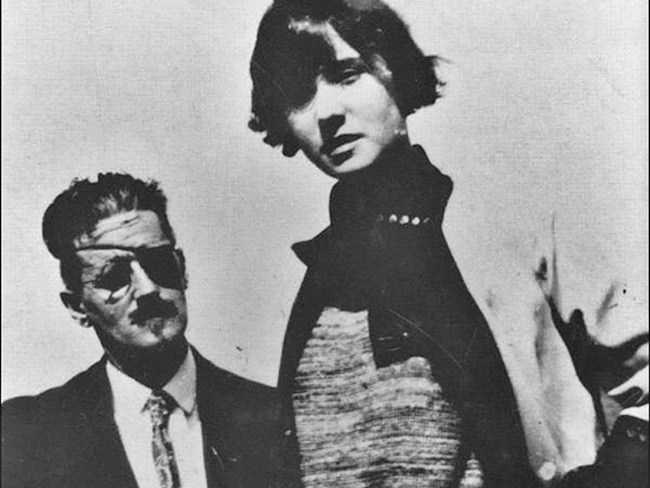
Writer and artist Alistair Gentry once proposed a lecture series he called “One Eyed Monster.” Central to the project is what Gentry calls “the cult of James Joyce,” an exemplar of a larger phenomenon: “the vulture-like picking over of the creative and material legacies of dead artists.” “Untalented and noncreative people,” writes Gentry, “are able to build lasting careers from what one might call the Talented Dead.” Gentry’s judgment may seem harsh, but the questions he asks are incisive and should give pause to scholars (and bloggers) who make their livings combing through the personal effects of dead artists, and to everyone who takes a special interest, prurient or otherwise, in such artifacts. Just what is it we hope to find in artists’ personal letters that we can’t find in their public work? I’m not sure I have an answer to that question, especially in reference to James Joyce’s “dirty letters” to his wife and chief muse, Nora.
The letters are by turns scandalous, titillating, romantic, poetic, and often downright funny, and they were written for Nora’s eyes alone in a correspondence initiated by her in November of 1909, while Joyce was in Dublin and she was in Trieste raising their two children in very straitened circumstances. Nora hoped to keep Joyce away from courtesans by feeding his fantasies in writing, and Joyce needed to woo Nora again—she had threatened to leave him for his lack of financial support. In the letters, they remind each other of their first date on June 16, 1904 (subsequently memorialized as “Bloomsday,” the date on which all of Ulysses is set). We learn quite a lot about Joyce’s predilections, much less about Nora’s, whose side of the correspondence seems to have disappeared. Declared lost for some time, Joyce’s first reply letter to Nora in the “dirty letters” sequence was recently discovered and auctioned off by Sotheby’s in 2004.
I do not excerpt here any of the language from Joyce’s subsequent letters, not for modesty’s sake but because there is far too much of it to choose from. If those prudish censors of Ulysses had read this exchange, they might have dropped dead from grave wounds to their sense of decorum. As far as I can ascertain, the letters exist in publication only in the out-of-print Selected Letters of James Joyce, edited by pre-eminent Joyce biographer Richard Ellmann, and in a somewhat truncated form on this site. Alistair Gentry has done us the favor of transcribing the letters as they appear in Ellmann’s Selected Letters on his site here. Of our interest in them, he asks:
Does anyone have the right to read things that were clearly meant only for two specific people…? Now that they have been exposed to the world’s gaze, albeit in a fairly limited fashion, does anybody except these two (who are dead) have any right to make objections about or exercise control over the manner in which these private documents and records of intimacy are used?
Questions worth considering, if not answered easily. Nevertheless, despite his critical misgivings, Gentry writes: “These letters stand on their own as brilliant and, dare I say, arousing Joycean writing. In my opinion they’re definitely worth reading.” I must say I agree. Joyce’s brother Stanislaus once wrote in a diary entry: “Jim is thought to be very frank about himself but his style is such that it might be contended that he confesses in a foreign language—an easier confession than in the vulgar tongue.” In the “dirty letters,” we get to see the great alchemist of ordinary language and experience practically revel in the most vulgar confessions.
Related Content:
James Joyce Plays the Guitar, 1915
On Bloomsday, Hear James Joyce Read From his Epic Ulysses, 1924
James Joyce, With His Eyesight Failing, Draws a Sketch of Leopold Bloom (1926)
James Joyce’s Ulysses: Download the Free Audio Book
Josh Jones is a writer and musician based in Durham, NC. Follow him at @jdmagness
Read More...The 55 Strangest, Greatest Films Never Made (Chosen by John Green)
The Lord of the Rings starring the Beatles?
The Little Prince, adapted by Orson Welles?
Batman vs. Dwight D. Eisenhower?
These are movies I’d pay to see! The first two made Mental Floss’ list of 55 Unfortunately Unfinished Films, a roll call of movies that got hung up in production or pre-production, never making it to the screen. As far as Batman battling the 34th president goes, that one’s mere wishful thinking, delivered as a typically off-the-cuff remark from list presenter, author John Green.
Moving at a speed that will be familiar to fans of his Crash Course series, Green races through a tempting menu of trivia and misfortune, obsession and obscurity.
Superheroes figure prominently, as do musicians. The Clash in Gangs of New York, The Sex Pistols in Who Killed Bambi? (The screenplay of which is available online, courtesy of its author, Roger Ebert.)
Death turns out to be another big plug-puller here. The untimely if not entirely surprising early exits of John Belushi, John Candy, and Chris Farley led to the “curse” of A Confederacy of Dunces.
As for Don Quixote, both Terry Gilliam and the aforementioned Mr. Welles have tilted at that windmill only to find out their dream was impossible, if not unfilmable.
Related Content:
Orson Welles Explains Why Ignorance Was the Genius Behind Citizen Kane
Martin Scorsese Brings “Lost” Hitchcock Film to Screen in Short Faux Documentary
Jean-Paul Sartre Writes a Script for John Huston’s Film on Freud (1958)
Ayun Halliday would love to see John Green undertake a Crash Course Cinema series. Follow her @AyunHalliday
Read More...Sci-Fi Writer Robert Heinlein Imagines the Year 2000 in 1949, and Gets it Mostly Wrong
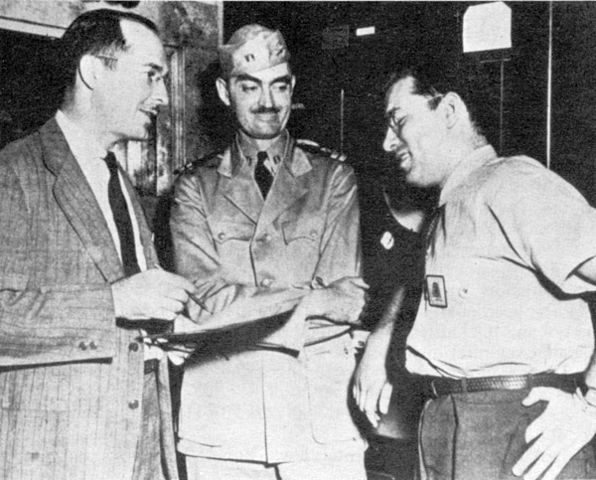
Image via Wikimedia Commons
Two giants of 20th century science fiction: Robert Heinlein and Isaac Asimov (see them together above, with L. Sprague de Camp in-between). Like every young sci-fi geek, I read them both assiduously, got lost in their dizzying universes that stretched across novels and significant teenage milestones. Even as an awkward kid, I could clearly identify an essential difference in tone between their forecasts of the future. Heinlein, the Navy man forcibly retired from service by tuberculosis, had the darker vision, in which the brute force of mass militarism continued to thrive and heroic men of action carried the day. Asimov, the practicing scientist—whose “Norby” series of kids books might be the cutest introduction to sci-fi ever written by an American—favored a future that, if still quite dangerous, was managed by robots and their creators, the technocrats.
As we can plainly see, we are no less a bellicose species than when these two authors wrote of the future, but Asimov seems to have had it right. The technocrats came out on top; too many battles are fought not by massed battalions but by deadly flying robots making (so we’re told) “surgical” strikes. A few weeks ago, we brought you a series of technocratic predictions of the year 2014 from Asimov, many of them surprisingly accurate. Today, we have a list of predictions from Heinlein, this time of the year 2000, and written in 1949 and published in 1952 in Galaxy magazine. How does his predictive ability stack up against his contemporary? Well, I’d say that 2 (stripped of some exaggeration), 8, and 11 either hit the mark or come pretty damn close. 19 is self-evidently true, and 15 is arguably not terribly far away, though it may not have seemed so in 2000. 4 is painfully ironic. The rest? Eh, not so much. Take a look and try to imagine yourself in Heinlein’s shoes in 1949. Not an easy task? Try to imagine what the world will look like in 2063. Which version of IOS will you be running then?
1. Interplanetary travel is waiting at your front door — C.O.D. It’s yours when you pay for it.
2. Contraception and control of disease is revising relations between the sexes to an extent that will change our entire social and economic structure.
3. The most important military fact of this century is that there is no way to repel an attack from outer space.
4. It is utterly impossible that the United States will start a “preventive war.” We will fight when attacked, either directly or in a territory we have guaranteed to defend.
5. In fifteen years the housing shortage will be solved by a “breakthrough” into new technologies which will make every house now standing as obsolete as privies.
6. We’ll all be getting a little hungry by and by.
7. The cult of the phony in art will disappear. So-called “modern art” will be discussed only by psychiatrists.
8. Freud will be classed as a pre-scientific, intuitive pioneer and psychoanalysis will be replaced by a growing, changing “operational psychology” based on measurement and prediction.
9. Cancer, the common cold, and tooth decay will all be conquered; the revolutionary new problem in medical research will be to accomplish “regeneration,” i.e., to enable a man to grow a new leg, rather than fit him with an artificial limb.
10. By the end of this century mankind will have explored this solar system, and the first ship intended to reach the nearest star will be a‑building.
11. Your personal telephone will be small enough to carry in your handbag. Your house telephone will record messages, answer simple inquiries, and transmit vision.
12. Intelligent life will be found on Mars.
13. A thousand miles an hour at a cent a mile will be commonplace; short hauls will be made in evacuated subways at extreme speed.
14. A major objective of applied physics will be to control gravity.
15. We will not achieve a “World State” in the predictable future. Nevertheless, Communism will vanish from this planet.
16. Increasing mobility will disenfranchise a majority of the population. About 1990 a constitutional amendment will do away with state lines while retaining the semblance.
17. All aircraft will be controlled by a giant radar net run on a continent-wide basis by a multiple electronic “brain.”
18. Fish and yeast will become our principal sources of proteins. Beef will be a luxury; lamb and mutton will disappear.
19. Mankind will not destroy itself, nor will “Civilization” be destroyed.
Here are things we won’t get soon, if ever:
– Travel through time
– Travel faster than the speed of light
– “Radio” transmission of matter.
– Manlike robots with manlike reactions
– Laboratory creation of life
– Real understanding of what “thought” is and how it is related to matter.
– Scientific proof of personal survival after death.
– Nor a permanent end to war.
Curiously, neither Heinlein nor Asimov foresaw that most terribly banal and ubiquitous phenomenon of reality TV, but really, what kind of monster could have imagined such a thing?
via Lists of Note/i09
Related Content:
Arthur C. Clarke Predicts the Future in 1964 … And Kind of Nails It
Walter Cronkite Imagines the Home of the 21st Century … Back in 1967
Marshall McLuhan Announces That The World is a Global Village
Josh Jones is a writer and musician based in Durham, NC. Follow him at @jdmagness
Read More...Bohemian Gravity: String Theory Explored With an A Cappella Version of Bohemian Rhapsody
This past spring, Timothy Blais wrote his masters thesis at McGill University in Montreal. Titled “A new quantization condition for parity-violating three-dimensional gravity,” the thesis clocks in at 74 pages and gets into some serious physics. The first line reads: “(2+1)-dimensional gravity with a negative cosmological constant is a topological theory with no local degrees of freedom.” I have to admit that Tim lost me right there. But he has made some amends with Bohemian Gravity, a potentially viral video that explores string theory with the help of an a cappella parody of Queen’s Bohemian Rhapsody. I have to admit that I don’t quite understand the substance of the video either. But I am thoroughly entertained and that counts for something.
Blais previously recorded “Rolling in the Higgs,” a scientific riff on Adele’s song. According to his Facebook page, these “science-parody creations are 100% originally recorded and made out of unaltered sounds from his mouth, throat and vocal cords.” Keep an eye on his YouTube Channel, acapellascience, for more videos (we hope) in the future.
H/T Robin/via I F’ing Love Science
Related Content:
Guitarist Brian May Explains the Making of Queen’s Classic Song, ‘Bohemian Rhapsody’
The Higgs Boson, AKA the God Particle, Explained with Animation
What’s Next for the Large Hadron Collider? PhD Comics Introduces the Search for Extra Dimensions
Read More...The Irrepressible Bette Davis Recalls Her Good and Bad Days Kissing in the Movies
In 1971, a year before Last Tango in Paris was released in the US, Bette Davis went on The Dick Cavett Show to dish on a career’s worth of onscreen kisses. Four decades on, when access to Netflix is all that’s required to enjoy a visual intimacy bordering on the gynecological with Halle Berry or Maria Bello, Davis still captivates. Watch the above excerpt and don’t feel ashamed if you spend the rest of the day trying to guess the identity of the actor who—in Cavett’s words—“was so repulsive that you just couldn’t stand to do it.”
Glenn Ford? Paul Heinreid? Popular opinion points to Edward G. Robinson.
Whoever he was, she cashed her paycheck and took one for the team, just as she did in 1930, when under contract to Universal, the self-described “Yankee-ist, modest virgin that ever walked the earth” was pressed into service as a “test girl.” This involved lying on a couch as a succession of 15 auditioning actors demonstrated their passionate kissing abilities.
That session was filmed, but evidence has yet to surface on the Internet. Fans will just have to content themselves with sneaking onto a three-acre private arboretum in Massachusetts for a glimpse of an Anna Colman Ladd fountain featuring four frolicsome nudes. Word has it a certain modest virgin Yankee served as the model for one of these figures while still in her teens. Or so a legendary actress revealed to Playboy at the age of 74.
Related Content:
Woody Allen on The Dick Cavett Show Circa 1970
George Harrison in the Spotlight: The Dick Cavett Show (1971)
Ayun Halliday recalls Lauren Bacall shilling for a lip augmentation procedure in No Touch Monkey! And Other Travel Lessons Learned Too Late. Follow her @AyunHalliday
Read More...Allen Ginsberg Gets Heckled by Beat Poet Gregory Corso at a 1973 Poetry Reading
Gregory Corso was kind of the Joey Bishop of the Beats—a member of the inner circle of Kerouac, Burroughs, and Ginsberg, but never quite achieving their degree of notoriety. Nevertheless, he outlived them all, and he was also arguably the biggest comedian in a group of inveterate pranksters (see him crack up an interviewer in this clip). A streetwise Greenwich Village kid, Corso learned his craft on the streets of Little Italy, and briefly in a psych ward and a prison cell, as much as in Harvard classes and the San Francisco poetry scene, where he relocated along with Allen Ginsberg in 1955, arriving just one day too late for Ginsberg’s historic Six Gallery reading of “Howl.”
Perhaps in order to make up for his absence then, Corso decided to make his presence decidedly known nearly twenty years later in a Ginsberg reading at New York’s 92nd St. Y in February of 1973. Ginsberg is captivating as always, reading in that almost hypnotic cadence, with elliptical conversational asides, that he and Kerouac both mastered. Listen to the whole reading above. You won’t be disappointed. But for a laugh, skip ahead to 5:50.
Corso interrupts the solemn proceedings with some wiseguy heckling, calling out Ginsberg’s “poesy bullshit.” Ginsberg takes it in stride, improvising and tossing back banter. Ginsberg’s father Louis is also onstage, and he takes up a muttering defense against Corso’s verbal siege as Ginsberg begins singing around 10:30.
Whether the whole thing was staged or a spontaneous outburst by Corso is anyone’s guess, but the two lifelong friends could put on quite a show when they wanted to, like this happening in 1981. Wherever Ginsberg and Corso lived and breathed poetry—as Michelle Dean writes at The Rumpus—heckling was “an integral part of poetry reading.”
Related Content:
Hear the Very First Recording of Allen Ginsberg Reading His Epic Poem “Howl” (1956)
“Expansive Poetics” by Allen Ginsberg: A Free Course from 1981
Bob Dylan and Allen Ginsberg Visit the Grave of Jack Kerouac (1975)
Josh Jones is a writer and musician based in Durham, NC. Follow him at @jdmagness
Read More...What Shakespeare’s Handwriting Looked Like
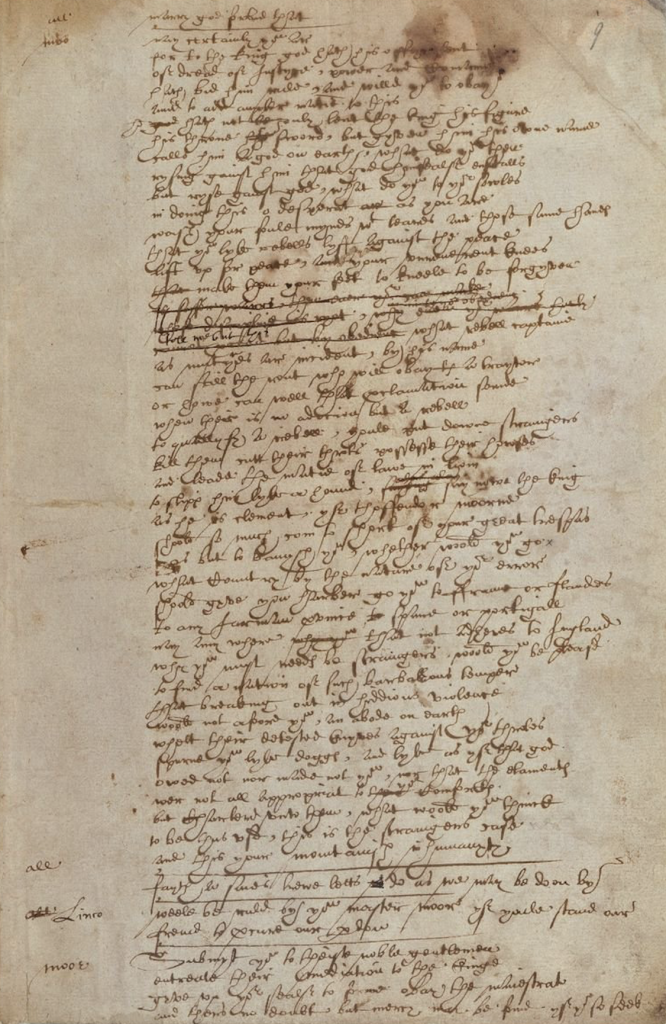
Last week, we posted on how scholars have tried to recover the original pronunciations of Shakespeare’s plays and poems when performed on the stage. Today, we bring you the bard’s original handwriting. Shakespeare’s handwriting has recently become the focus of a new article by Professor Douglas Bruster at UT Austin, who is using an analysis of the playwright’s quirky spellings and penmanship to solve a very old question of authorship. The page of handwriting you see above is a fragment of a lost play called Sir Thomas More and it goes by the name of “Hand D” (click the image above, and then the image that appears — for a much larger version).
Bruster’s short essay, published this month in the Oxford journal Notes & Queries, is far too inside baseball for anyone but hardcore textual scholars to make much sense of, but this New York Times article does a good job of distilling the finer points. Suffice it to say that thanks to Bruster’s painstaking analysis of Shakespeare’s distinctive handwriting, we can be fairly certain that a 1602 revision of Thomas Kyd’s enormously popular Renaissance play The Spanish Tragedy—in the words of Shakespeare scholar Eric Rasmussen—has the bard’s “fingerprints all over it.”
Related Content:
A Survey of Shakespeare’s Plays (Free Course)
Pink Floyd’s David Gilmour Sings Shakespeare’s Sonnet 18
Shakespeare’s Satirical Sonnet 130, As Read By Stephen Fry
Josh Jones is a writer and musician based in Durham, NC. Follow him at @jdmagness
Read More...John Cleese’s Philosophy of Creativity: Creating Oases for Childlike Play
Though he became known for the physical comedy of characters like the irate owner of a dead parrot, a minister of silly walks, and the always buffoonish Basil Fawlty, John Cleese is actually a very deep thinker. This will probably come as no surprise to fans of Monty Python’s intellectual humor, but it’s still a treat to see him, out of character, getting serious about ideas, even if he can’t resist the odd joke or ten. His subject? Creativity. His forum? Well, in the video above, we see Cleese at the 2009 World Creativity Forum in Germany. In a 2010 guest post on this talk, Maria Popova of Brain Pickings called the event “part critique of modernity’s hustle-and-bustle, part handbook for creating the right conditions for creativity.” What does John Cleese have to say about creating those conditions?
By combining another talk from Cleese from 1991 (below), we are able to piece together a Cleese philosophy of creativity. He begins in his ’91 talk by telling people what creativity is not, and why lecturing on it is “a complete waste of time.” The reason? It cannot be explained. “It is literally inexplicable.”
Drawing on research from his friend Brian Bates, a psychologist as Sussex University, Cleese claims that those considered more creative do not differ in any significant way from their equally intelligent and talented peers, and therefore, they do not possess any special skills or abilities that would qualify as “creativity.” As a onetime student of the sciences at Cambridge, Cleese has a high regard for data and observation, and in each of these talks, he applies a scientific method to his subject.
What, then, has he learned from observing his own work habits and looking at the research? What can he positively say about creativity? For one thing, it is not a skill or an aptitude, it is a “mood,” one Cleese describes as “childlike” in that it aids one in the ability to play. Cleese makes a similar point in his 2009 talk at the top, emphasizing that acquiring this mood is difficult but not impossible. As all artists know, genuine creative insights occur when rational thought ceases—during dreamstates or moments of absorption so intense that self-consciousness, anxiety, and the needling cares of the day drop away. As Cleese put it at the World Creativity Forum, “if you’re racing around all day, ticking things off a list, looking at your watch, making phone calls and generally just keeping all the balls in the air, you are not going to have any creative ideas.” This explains why the offices of companies like Google are full of toys, why the workdays of the Mad Men “creatives” often resemble preschool, and why artists’ work spaces tend to be so intriguing to peer into. They are, as Cleese terms them, “oases” from the punishing pace of the workaday world.
In Cleese’s considered opinion, such oases, both physical and mental, are the preconditions for childlike wonder to override adult routine ways of thinking. Of course as Cleese and his hard-working co-creators also show us, a great deal of grown-up discipline is required to bring creative ideas to fruition. The trick, Cleese says, is in making the space to engage in childlike play without relying on childish spontaneity—he recommends scheduling time to be creative, giving oneself a “starting time and a finish time” and thereby setting “boundaries of space, boundaries of time.” Of course, this kind of mindful structuring is something only a mature adult mind can do. Seeing this grown-up side of Cleese gives us a new appreciation for the consistently childlike characters he’s created over the years, and for the role of conscious attention in safeguarding and nurturing unconscious insight.
Related Content:
David Lynch Explains How Meditation Enhances Our Creativity
Malcolm McLaren: The Quest for Authentic Creativity
Josh Jones is a writer and musician based in Durham, NC. Follow him at @jdmagness
Read More...Read 30 Free Essays & Stories by David Foster Wallace on the 5th Anniversary of His Death
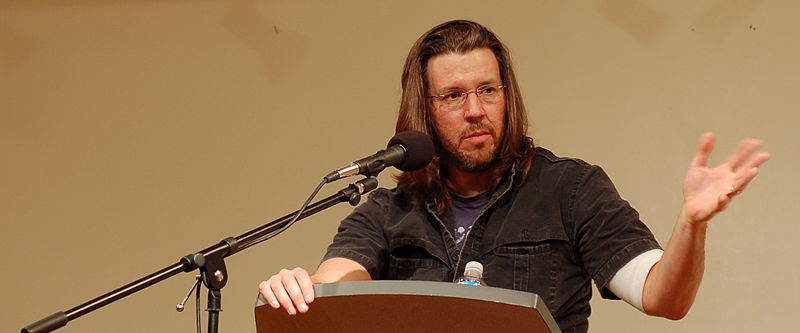 Let me start with the first lines that appeared in The New York Times five years ago: “David Foster Wallace, whose prodigiously observant, exuberantly plotted, grammatically and etymologically challenging, philosophically probing and culturally hyper-contemporary novels, stories and essays made him an heir to modern virtuosos like Thomas Pynchon and Don DeLillo, an experimental contemporary of William T. Vollmann, Mark Leyner and Nicholson Baker and a clear influence on younger tour-de-force stylists like Dave Eggers and Jonathan Safran Foer, died on Friday at his home in Claremont, Calif. He was 46.” It’s not your conventional obituary. No, it has a literary style befitting the writer we lost on September 12, 2008. And five years after DFW’s death, we might want to pause and revisit his many stories and essays still available on the web. To mark this mournful occasion, we’ve updated and expanded our list, 30 Free Essays & Stories by David Foster Wallace on the Web, which features some timely and memorable pieces — “9/11: The View From the Midwest,” “Consider the Lobster,” and Federer as Religious Experience,” just to name just a few. Below we’ve also highlighted some of our favorite David Foster Wallace posts published over the years. Hope you enjoy visiting or revisiting this material as much as I have.
David Foster Wallace’s 1994 Syllabus: How to Teach Serious Literature with Lightweight Books
‘This Is Water’: Complete Audio of David Foster Wallace’s Kenyon Graduation Speech (2005)
David Foster Wallace Breaks Down Five Common Word Usage Mistakes in English
David Foster Wallace: The Big, Uncut Interview (2003)
Visit the David Foster Wallace Audio Archive
Read More...Support Us
We're hoping to rely on loyal readers, rather than erratic ads. Please click the Donate button and support Open Culture. You can use Paypal, Venmo, Patreon, even Crypto! We thank you!

About Us

Open Culture scours the web for the best educational media. We find the free courses and audio books you need, the language lessons & educational videos you want, and plenty of enlightenment in between.
Advertise With Us

FREE UPDATES!
GET OUR DAILY EMAIL
Get the best cultural and educational resources on the web curated for you in a daily email. We never spam. Unsubscribe at any time.
FOLLOW ON SOCIAL MEDIA

Open Culture editor Dan Colman scours the web for the best educational media. He finds the free courses and audio books you need, the language lessons & movies you want, and plenty of enlightenment in between.
Advertise With Us


