The Rolling Stones at 50: Mick, Keith, Charlie & Ronnie Revisit Their Favorite Songs

The Rolling Stones are celebrating their 50th anniversary this year, and like everything with the Stones, they’re doing it big. The band has scheduled a series of five special concerts on both sides of the Atlantic, beginning next Sunday in London and continuing in Newark, New Jersey, and Brooklyn, New York, in December.
And like everything with the Stones, it’s expensive. Tickets for the London shows, for example, range in price from about $150 to $1,500, which has prompted more than a few complaints. The band has defended the prices, saying that they’re doing a large-scale show with only five audiences to cover the production costs. “We’ve already spent a million on rehearsing in Paris,” guitarist Ronnie Wood told The Telegraph recently. “And the stage is going to be another few million. And the lights. We feel no bad thing about ticket prices. We’ve got to make something.”
The rock ’n’ roll businessmen also expect to make something from a pay-per-view broadcast of the sold-out December 15 show in Newark, along with sales of a new illustrated autobiography called The Rolling Stones: 50 and a retrospective album called GRRR!, which comes in several editions ranging from the three-disc basic CD version to a five-disc vinyl boxed set. While promoting the album, all four members of the Stones agreed to be interviewed by Melissa Block of the NPR program All Things Considered. Block asked each of the Stones to pick one song from their extensive catalog to discuss. It’s an interesting series of conversations, and you can hear each one by following these links:
- Keith Richards: ‘These Riffs Were Built to Last a Lifetime’
- Charlie Watts on What Makes ‘Satisfaction’ So Satisfying
- Ronnie Wood’s Funky Contribution to the Stones’ Canon
- Mick Jagger on the Apocalyptic ‘Gimme Shelter’
Along with the expected classics, GRRR! includes two new songs, including the first single released by the Stones in six years, “Doom and Gloom.” (See the video below.) It’s a blustery tune, lacking the rhythmic sophistication and inventiveness of the band’s earlier work, but it amply demonstrates that even after 50 years, the Stones still know how to rock.
Related content:
The Rolling Stones Jam With Their Idol, Muddy Waters, 1981
The Rolling Stones Sing Jingle for Rice Krispies Commercial, 1964
The Rolling Stones Sing the Beatles’ ‘Eight Days a Week’ in a Hotel Room, 1965
Read More...The Ten Best American Essays Since 1950, According to Robert Atwan
 Robert Atwan’s favorite literary genre is the essay. As editor and founder of The Best American Essays series, Atwan has read thousands of examples of the remarkably flexible form.
“Essays can be lots of things, maybe too many things,” writes Atwan in his foreward to the 2012 installment in the Best American series, “but at the core of the genre is an unmistakable receptivity to the ever-shifting processes of our minds and moods. If there is any essential characteristic we can attribute to the essay, it may be this: that the truest examples of the form enact that ever-shifting process, and in that enactment we can find the basis for the essay’s qualification to be regarded seriously as imaginative literature and the essayist’s claim to be taken seriously as a creative writer.”
In 2001 Atwan and Joyce Carol Oates took on the daunting task of tracing that ever-shifting process through the previous 100 years for The Best American Essays of the Century. Recently Atwan returned with a more focused selection for Publishers Weekly: “The Top 10 Essays Since 1950.” To pare it all down to such a small number, Atwan decided to reserve the “New Journalism” category, with its many memorable works by Tom Wolfe, Gay Talese, Michael Herr and others, for some future list. He also made a point of selecting the best essays, as opposed to examples from the best essayists. “A list of the top ten essayists since 1950 would feature some different writers.”
We were interested to see that six of the ten best essays are available for free reading online. Here is Atwan’s list, along with links to those essays that are on the Web:
- James Baldwin, “Notes of a Native Son,” 1955 (Read it here.)
- Norman Mailer, “The White Negro,” 1957 (Read it here.)
- Susan Sontag, “Notes on ‘Camp,’ ” 1964 (Read it here.)
- John McPhee, “The Search for Marvin Gardens,” 1972 (Read it here with a subscription.)
- Joan Didion, “The White Album,” 1979
- Annie Dillard, “Total Eclipse,” 1982
- Phillip Lopate, “Against Joie de Vivre,” 1986 (Read it here.)
- Edward Hoagland, “Heaven and Nature,” 1988
- Jo Ann Beard, “The Fourth State of Matter,” 1996 (Read it here.)
- David Foster Wallace, “Consider the Lobster,” 2004 (Read it here in a version different from the one published in his 2005 book of the same name.)
“To my mind,” writes Atwan in his article, “the best essays are deeply personal (that doesn’t necessarily mean autobiographical) and deeply engaged with issues and ideas. And the best essays show that the name of the genre is also a verb, so they demonstrate a mind in process–reflecting, trying-out, essaying.”
To read more of Atwan’s commentary, see his article in Publishers Weekly.
The photo above of Susan Sontag was taken by Peter Hujar in 1966.
Related Content:
30 Free Essays & Stories by David Foster Wallace on the Web
Read More...The History of Film — 2000 Movies Across 100 Years — Presented in One Big Zoomable Graphic
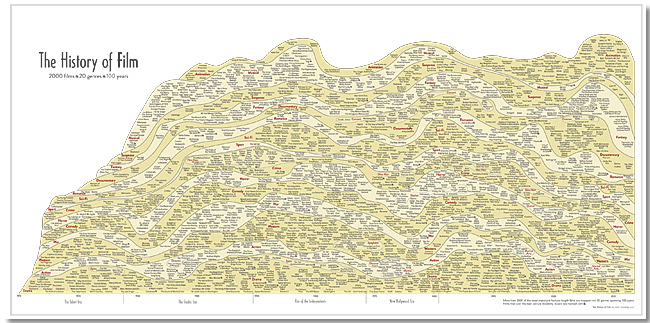
Hats off to Larry Gormley, who spent the better part of five years creating a zoomable graphic that “chronicles the history of feature films from the origins in the 1910s until the present day.” 2000 films, across 20 genres and 100 years, all presented in one artful display. Nicely done.
You can purchase a print copy, or simply enjoy the visual display online. Enjoy.
via @coudal
Read More...Harry Taylor Brings 150-Year-Old Craft of Tintype Photography into the Modern Day
Award-winning filmmaker Matt Morris appreciates craft, hard work and people who just show up for each other.
His Emmy-nominated film Pickin’ and Trimmin’ follows the men who cut hair and play bluegrass music together at Drexel’s barbershop in North Carolina. In Mr. Happy Man, an 88-year-old man talks about the hours he spends every morning greeting Bermuda’s commuters as they endure traffic.
The subject of his most recent work came to him in a round-about way, but features the same careful, affectionate filmmaking of his other films. American Tintype chronicles the process of photographer Harry Taylor, who discovered a passion for the Civil War-era “wet plate” photography.
Taylor, based in Wilmington, North Carolina, specializes in tintypes and ambrotypes. He makes them with the same big cameras and messy chemicals used during the late 1800s. At that time, the process produced a whole new layer of detail than earlier techniques had done, and allowed for an infinite number of prints to be made.
Time consuming, laborious and unpredictable, the process requires the photographer to use a portable dark room when shooting outside of the studio. Tin photographic plates are coated with collodion emulsion. (The technique is also called collodion process. There’s a nice tutorial here.) The plate must be coated, exposed and developed within fifteen minutes, before the collodion loses its sensitivity. It’s an inconvenient system, especially by today’s standards, but it pleases Taylor immensely as it forces both him and his subjects to slow down. You can view some of Taylor’s images here.
Morris allows Taylor to speak for himself in the four-minute documentary, letting the camera linger on Taylor’s wood and metal equipment, the dreaminess of his images and on Taylor’s own observations about how long-exposure photography reveals more of the subject’s thoughts. Even the flaws are interesting.
Make a point to notice the music. Morris approached composer Hanan Townshend, known for the scores he composed for director Terrence Malick. Morris blogs about the process of recording American Tintype’s soundtrack at Marin County’s Skywalker Sound—a fun little peek behind the scenes.
Kate Rix writes about digital media and education. Read more of her work at and thenifty.blogspot.com.
Read More...Watch Night of the Living Dead, the Seminal Zombie Movie, Free Online
Halloween has long since passed, granted. But given the overabundance of Christmas decorations even now arising all around us, a bracing splash of horror won’t go amiss. This goes double when the splash comes from George A. Romero’s Night of the Living Dead, urtext of the modern zombie movie. It goes triple when you can watch it free online. (It’s been uploaded in high-definition video, no less, an absolute essential for lo-fi, low-budget gorefests.) Though only released in 1968, the movie appears on the internet legally due to its distributor not indicating their copyright on the film prints. They removed the original title cards, which displayed the considerably less catchy original title Night of the Flesh Eaters, but forgot to put the copyright statement back in with the new ones.
If Night of the Living Dead strikes you as somewhat déclassé for a site like Open Culture, ask yourself whether you’ve actually seen the movie. If you haven’t, then it seems you suffer from a vast gap — a vast, zombie filled gap — in your awareness of twentieth-century cinema culture. The film has even won institutional validation. Just read the titles of these real articles: “Rewriting the Dead: The Tension between Nostalgia and Perversion in George A. Romero’s Night of the Living Dead,” “Inner-City Exhibition and the Genre Film: Distributing Night of the Living Dead,” “Greek Gifts: Vision and Revision in Two Versions of Night of the Living Dead,” “A Modern Meditation on Death: Identifying Buddhist Teachings in George A. Romero’s Night of the Living Dead.” If you’re looking for a PhD. thesis topic, you may have turned up too late to this particular movie. But it’ll certainly take your mind off gift shopping.
You can always find Night of the Living Dead in our collection, 4,000+ Free Movies Online: Great Classics, Indies, Noir, Westerns, Documentaries & More. Look in the Noir, Thriller, Horror and Hitchcock section.
If you would like to support the mission of Open Culture, consider making a donation to our site. It’s hard to rely 100% on ads, and your contributions will help us continue providing the best free cultural and educational materials to learners everywhere. You can contribute through PayPal, Patreon, and Venmo (@openculture). Thanks!
Related content:
Watch the Quintessential Vampire Film Nosferatu Free Online as Halloween Approaches
Where Horror Film Began: The Cabinet of Dr. Caligari
The First Unintended Horror Film (1895)?
Troma Entertainment, the Maker of Acclaimed B‑Movies, Puts 150 Free Films on YouTube
Colin Marshall hosts and produces Notebook on Cities and Culture. Follow him on Twitter at @colinmarshall.
Read More...Watch Phish Play the Entirety of the Talking Heads’ Remain in Light (1996)
When I encountered the above video of Phish playing the entirety of the Talking Heads’ Remain in Light as the second set of a 1996 Halloween show, let’s just say I was skeptical. How was the ultimate jam band going to approximate the tightly wound funk and weird angularity of the Heads? Or would they turn these songs into meandering fifteen-minute improv sessions with endless digressions and breakdowns? Then again, this all makes a certain amount of sense. The 1980 Brian Eno-produced Remain in Light saw the Talking Heads sprawl out in ways they never had before. They took on several additional musicians for the recording process, including one of the gods of prog-rock, King Crimson guitarist Adrian Belew. They experimented with African polyrhythms blended with New Wave sounds (decades before Vampire Weekend); they worked in a horn section, and let the art-funk overpower the nerd-punk of their first two records. The songs stretched out in length. On tour, they took on five additional players, including Belew, to form a nine-piece band.
But at the heart of it all was still the incomparable husband-and-wife team of drummer Chris Frantz and bassist Tina Weymouth, the most unlikely funk/soul rhythm section imaginable but one that could hang with almost any Stax or Motown crew. And then there’s David Byrne’s paranoid alto bark. So can Phish really bring enough white soul and weirdness to the table? Well, no; they aren’t the Talking Heads. The performances are loose and rangy, the rhythms often indistinct, particularly on the opener, “Born Under Punches,” a song that needs maximum punch. But they do hit the choruses of “Crosseyed and Painless” and “The Great Curve” nicely, even if the album’s big hit “Once in a Lifetime” is far too cluttered. Overall, even reined in by the tightly-arranged compositions of Remain, they’re still Phish, not a Talking Heads tribute band, but their love for these brilliant songs comes through in even the noodliest, tie-dye-fractal moments.
For the sake of contrast, take some time and check out the Heads themselves below, live in Rome with Adrian Belew on lead guitar. They do two Remain in Light songs: “Born Under Punches” and “Houses in Motion.” And Belew’s solos blow the roof off.
via Boing Boing
Josh Jones is a doctoral candidate in English at Fordham University and a co-founder and former managing editor of Guernica / A Magazine of Arts and Politics.
Read More...Rare Footage of Scott and Zelda Fitzgerald From the 1920s
The writer F. Scott Fitzgerald and his flamboyant wife Zelda are often remembered as the embodiment of the boom and bust that convulsed America in the period between the two world wars.
Like characters in The Great Gatsby, Scott and Zelda lived lives of wild abandon in the Roaring Twenties, riding on top of taxi cabs and splashing in the Plaza Hotel fountain. Scott was inspired and prodded along in his dissipation by the notoriously eccentric Zelda. As Ring Lardner once put it, “Mr. Fitzgerald is a novelist and Mrs. Fitzgerald is a novelty.”
But by the time the stock market crashed in 1929, so too had the Fitzgeralds. Scott’s drinking caught up with him, and Zelda’s eccentricity evolved into schizophrenia. Their sad downfall is captured in Fitzgerald’s 1930 story, “Babylon Revisited.” Zelda would live the rest of her life in mental institutions while Scott spent his final years in Hollywood, struggling to pay for her treatment and trying to recapture his lost glory. Their daughter, Scottie, was raised by other people.
In this video we catch a few glimpses of the Fitzgeralds in their heyday, before the party came to an end. The film clips are fun to watch but the YouTube video on which they are collected should perhaps be taken with a grain of salt. We’re not sure, for example, that the clip purporting to show Zelda being “very lively in a street” is actually of her. It appears to show someone else. And one of the captions claims that Fitzgerald is pictured writing The Great Gatsby, but according to the University of South Carolina’s Fitzgerald Web site, the sentence he is writing on paper is: “Everybody has been predicting a bad end for the flapper, but I don’t think there is anything to worry about.”
Related content:
Winter Dreams: F. Scott Fitzgerald’s Life Remembered in a Fine Film
F. Scott Fitzgerald Recites From Shakespeare’s Othello and John Masefield’s ‘On Growing Old’
Find F. Scott Fitzgerald’s works in our collections of Free eBooks and Free Audio Books
Read More...A Celebration of Retro Media: Vinyl, Cassettes, VHS, and Polaroid Too
In going digital, we’ve gained some convenience. That’s undeniable. But we’ve lost much when it comes to aesthetics and quality too. (Neil Young makes that point again and again.) Increasingly, we’re realizing what we’ve left behind, and there’s a movement afoot to recover old school media — things you can see, touch and feel and marvel over. Vinyl records. Tape cassettes. VHS tapes. 8mm Film. Polaroid Photos. All of that good stuff gets revisited in the latest short film produced in the PBS Off Book series. Previous installments have covered:
Art in the Era of the Internet
The Art of Film and TV Title Design
The Creativity of Indie Video Games
Read More...Japanese Cartoons from the 1920s and 30s Reveal the Stylistic Roots of Anime
Those who have become interested in Japan in the past twenty years have done so, likely as not, because of Japanese animation, best known by the Japanese term “anime.” And why not? Japan’s take on the cartoon has at this point evolved so high and so distant from its western counterparts that you sometimes can’t help staring, transfixed. Even the word “cartoon” now seems too frivolous to apply. Roll the clock back eighty or ninety years, and Japanese animation looks decidedly more… cartoonish. But even then, you can easily see an excitingly different aesthetic in play. First behold the short above, which since its 1933 production has become a surprisingly popular watch on Youtube. Seemingly influenced by the American animation of the time, this fable of fox versus raccoon still garners acclaim with its craft. Acclaim from commenters, anyway: “Much smoother than the current animes,” writes one. “Not only the quality. Story is also funny and peaceful.”
Go back a few years further, to 1929, and you find a strikingly more foreign viewing experience in The Stolen Lump. Taking the form of a standard live-action silent picture, with intertitles and everything, the film adapts a fairy tale about an old man who happens upon a pack of tengu. He asks these supernatural creatures to remove what looks like a goiter from his face, but when they do, he inspires jealousy in his village. Finally, for an offering that will seem modern by comparison, watch Private Norakuro, from 1935, below. It originally appeared as just one story, in one medium of several, of the pratfall-heavy military adventures of the titular anthropomorphic puppy. Creator Suihō Tagawa drew the humor from his own time in the Imperial Japanese Army, to the delight of Japanese readers and viewers. The delight lasted up until World War II, anyway, when the country stopped looking so kindly on military satire. But Norakuro would soon emerge from retirement, going on to star in major animated films and serve as a mascot of the Japan Self Defense Force.
Related content:
The Early Days of Animation Preserved in UCLA’s Video Archive
The Best Animated Films of All Time, According to Terry Gilliam
Gertie the Dinosaur: The Mother of all Cartoon Characters
Lots of Free Animated Films in our collection of 500 Free Movies Online
Colin Marshall hosts and produces Notebook on Cities and Culture. Follow him on Twitter at @colinmarshall.
Read More...Richard Feynman Talks Physics with Fred Hoyle in Take the World From Another Point of View, 1973
The famous American physicist Richard Feynman used to take holidays in England. His third wife, Gweneth Howarth, was a native of West Yorkshire, so every year the Feynman family would visit her hometown of Ripponden or the nearby hamlet of Mill Bank.
In 1973 Yorkshire public television made a short film of the Nobel laureate while he was there. The resulting film, Take the World From Another Point of View, was broadcast in America as part of the PBS Nova series. The documentary features a fascinating interview, but what sets it apart from other films on Feynman is the inclusion of a lively conversation he had with the eminent British astrophysicist Fred Hoyle.
A native Yorkshireman, Hoyle did groundbreaking theoretical work on the synthesis of elements in stars and was a leading proponent of the Steady State theory of cosmology. In the film, the British astrophysicist and the American particle physicist walk down to the local pub, Ripponden’s historic Old Bridge Inn, for a lively conversation on physics and the nature of scientific discovery. You can read along with a transcript of the film at the Caltech Web site.
Related Content:
Richard Feynman Presents Quantum Electrodynamics for the NonScientist
‘The Character of Physical Law’: Richard Feynman’s Legendary Lecture Series at Cornell, 1964
Read More...Support Us
We're hoping to rely on loyal readers, rather than erratic ads. Please click the Donate button and support Open Culture. You can use Paypal, Venmo, Patreon, even Crypto! We thank you!

About Us

Open Culture scours the web for the best educational media. We find the free courses and audio books you need, the language lessons & educational videos you want, and plenty of enlightenment in between.
Advertise With Us

FREE UPDATES!
GET OUR DAILY EMAIL
Get the best cultural and educational resources on the web curated for you in a daily email. We never spam. Unsubscribe at any time.
FOLLOW ON SOCIAL MEDIA

Open Culture editor Dan Colman scours the web for the best educational media. He finds the free courses and audio books you need, the language lessons & movies you want, and plenty of enlightenment in between.
Advertise With Us

