Way of Life: Rare Footage of the Hiroshima Aftermath, 1946
The recent 9.0‑magnitude Tōhoku earthquake and tsunami, and subsequent Fukushima nuclear accidents were among the most devastating environmental disasters in recorded history. The immediate consequences are frightening, but their full, long-term impact remains an unsettling mystery.
This, of course, isn’t the first time Japan has faced a nuclear emergency. After the World War II atomic bombings of Hiroshima and Nagasaki, the U.S. government recorded the raw aftermath of Hiroshima in candid, grim detail (while Hollywood was busy lampooning America’s nuclear obsession). Filmed in the spring of 1946 by the Department of Defense, Way of Life documents how the people of Hiroshima adapted to life after the atomic bomb. Though the archival footage lacks sound, its imagery — moving, heartbreaking, deeply human — speaks volumes about the delicate duality of despair and resilience.
Maria Popova is the founder and editor in chief of Brain Pickings, a curated inventory of cross-disciplinary interestingness. She writes for Wired UK, The Atlantic and DesignObserver, and spends a great deal of time on Twitter.
Read More...Oil’d, by Chris Harmon
We’re often obsessed with oil. A year ago, the issue was offshore drilling. The Deepwater Horizon rig had exploded, and crude oil was spilling into the Gulf of Mexico at a rate of 53,000 barrels a day. We all watched helplessly as BP threw everything but the kitchen sink at the problem. (Remember the golf balls?) Three months passed and 4.9 million barrels ripped into the ecosystem before the well was finally capped. Time to talk about it? Hardly. Now the discussion has moved on to skyrocketing oil prices and the issues surrounding them, like the causes (conflict in the Middle East, rising consumption in China and India, commodity speculation at home…) and the political implications for the 2012 U.S. presidential election if gas prices stay high. Weighty issues, to be sure. But before we allow the Deepwater Horizon oil spill of 2010 to fade into our collective amnesia, Chris Harmon, a Brooklyn-based designer, animator and writer, has created a work of animated typography to put some of the staggering facts into perspective.
Read More...Vladimir Nabokov Marvels Over Different “Lolita” Book Covers
In this short excerpt from a TV program called “USA: The Novel,” Vladimir Nabokov comments on different foreign editions of his novel Lolita. The individual covers he discusses are listed here; the full program is available here, and it contains some memorable quotes by the author (from chapter 1: “Mr Nabokov, would you tell us why it is that you detest Dr. Freud?” — “I think he’s crude, I think he’s medieval, and I don’t want an elderly gentleman from Vienna with an umbrella inflicting his dreams upon me. I don’t have the dreams that he discusses in his books, I don’t see umbrellas in my dreams or balloons.”).
Finding a publisher for Lolita proved to be rather difficult for Nabokov. A December 1953 review of the manuscript said: “It is overwhelmingly nauseating, even to an enlightened Freudian. To the public, it will be revolting. It will not sell, and will do immeasurable harm to a growing reputation. […] I recommend that it be buried under a stone for a thousand years.” (Get more information at Stanford’s “The Book Haven”) Lolita was first published in 1955 (original cover here) and has since been translated into many languages with a wide variety of cover designs (find a good collection at this site).
Shortly after Lolita’s publication, Nabokov discussed his novel on the CBC program “Close Up”: see part one and part two.
Bonus: Little known detail — Nabokov held the post of curator of lepidoptera at Harvard’s Museum of Comparative Zoology. He collected many butterflies and developed a theory of butterfly migration which disputed all previous theories and wasn’t taken seriously by biologists then. Only recently did genetic studies vindicate his once bold theory. Some of Nabokov’s beautiful drawings of the butterflies he studied can be enjoyed courtesy of Flavorwire.
You can find this video housed in our collection of 235 Cultural Icons.
By profession, Matthias Rascher teaches English and History at a High School in northern Bavaria, Germany. In his free time he scours the web for good links and posts the best finds on Twitter.
Read More...Spy Magazine (1986–1998) Now Online
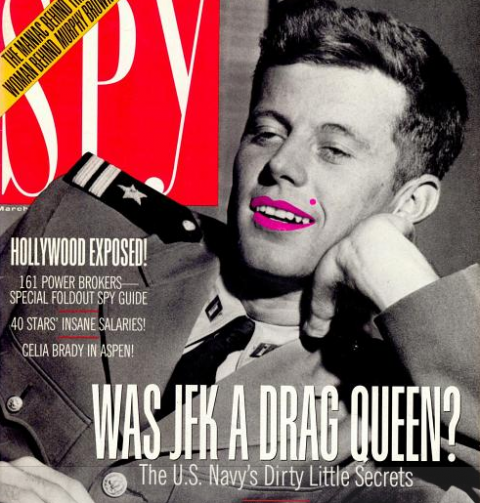
You want to know why Rupert Murdoch runs the world and you don’t? Here’s a hint: In 1990, Spy Magazine (now archived at Google Books) sent Murdoch and a slew of other wealthy celebrities checks for $1.11 as a prank. Murdoch cashed his right away — because even when he was just a lowly billionaire, the guy understood money.
And the editors at Spy (1986–98) understood celebrity culture, which is why they became arguably the most influential magazine of the late 20th century, or, in Dave Eggers’ words “cruel, brilliant, beautifully written and perfectly designed, and feared by all.” Combining an elegant house style, barbed satire, and a healthy dose of class-rage, Spy inspired a radical tonal shift in American journalism just in time for the arrival of a perfectly suited new platform: The Internet.
You can read more about the magazine’s legacy in Will Hines’ excellent article Diving into the Archives of Spy, The Funniest Magazine Ever, at the comedy blog Splitsider. Before accusing Hines of hyperbole, take a look at some of his finds:
Joe Queenan sends up the The Cult of Bob Dylan
The editors list Clinton’s First 100 Lies
Newt Gingrich, topless, on the cover
And that’s without even starting on the true classics from the 80’s. It’s all at Google Books. Enjoy.
via Splitsider
Related: The Onion: Fake News Site Launches Real Archive
Sheerly Avni is a San Francisco-based arts and culture writer. Her work has appeared in Salon, LA Weekly, Mother Jones, and many other publications. You can follow her on twitter at @sheerly.
Read More...A Very Brief History of Royal Weddings
I can’t say that we’ll be watching the royal wedding. But we should at least put a thin veneer of intelligence on top of the shallow spectacle. That’s our job. In two very quick minutes, Emory historian Patrick Allitt sketches out the history of royal weddings, and tells you why this “Royal Willding” stands out…
Read More...“Jersey Shore” in the Style of Oscar Wilde
We giddily present “Jersey Shore” Gone Wilde, as performed by the cast of The Importance of Being Earnest, a production currently being staged by the Roundabout Theatre Company in New York City.
Go ahead and catch this inspired mashup of Victorian comedy and MTV “reality” at Playbill Video in 5 parts … unless you have work to do this afternoon.
via @MaudNewton
Sheerly Avni is a San Francisco-based arts and culture writer. Her work has appeared in Salon, LA Weekly, Mother Jones, and many other publications. You can follow her on twitter at @sheerly
Read More...Fire Ants Create Life Raft in 100 Seconds Flat
The central intelligence of ants – the way ant colonies organize themselves without a leader and get things done – continues to amaze scientists and science writers alike. Back in 2003, Deborah Gordon, a Stanford biologist, gave a whole TED Talk called “How Do Ants Know What to Do?,” which sheds light on how ants can form stunningly complex, leaderless systems. Then, several years later, RadioLab continued to mull over Gordon’s fascinating research in one of its very first episodes.
Now we get this great bit of video. It comes to us via researchers at the Georgia Institute of Technology, and it shows how ants, when placed in water, can form a completely watertight raft in under two minutes. “They’ll gather up all the eggs in the colony and will make their way up through the underground network of tunnels, and when the flood waters rise above the ground, they’ll link up together in these massive rafts,” says Nathan J. Mlot, an engineering student involved in the project. Amazingly, even the ants at the bottom of the raft never get submerged. They all survive, which raises the question: Can this research lead to new floatation devices for the rest of us to use?
If you would like to support the mission of Open Culture, consider making a donation to our site. It’s hard to rely 100% on ads, and your contributions will help us continue providing the best free cultural and educational materials to learners everywhere. You can contribute through PayPal, Patreon, and Venmo (@openculture). Thanks!
via Daily Mail and Geek System
Read More...Astrophysics Goes Extreme
You wouldn’t necessarily guess it, but astrophysics comes with occupational risks. Trying to unravel the mysteries of the universe, some physicists journey to inhospitable parts of the world (Siberia, the Antarctic, deep mine shafts, etc.), searching for ideal conditions to perform experiments into dark energy, dark matter, and beyond. This all gets detailed by Anil Ananthaswamy, a software writer turned science writer, who recently published a new book The Edge of Physics: A Journey to Earth’s Extremes to Unlock the Secrets of the Universe. The talk above was presented at the INK Conference last December. You can also watch him give a fuller 50 minute talk at Google here.
Read More...Kevin Spacey & Alec Baldwin Go to Bat for the Arts
Both Alec Baldwin and Kevin Spacey are longtime advocates for government funding of the Arts. If you missed their testimony before the House Appropriations Subcommitee on the Interior earlier this month, you aren’t alone. They were kicked off the schedule because of preparations for a congressional shutdown. These speeches were delivered not to the subcommittee but to a crowd of advocates and fans.
Both are well worth watching. Spacey, who is also the artistic director of London’s Old Vic Theatre, has long been one of the most respected and articulate actors in Hollywood. (See his inspiring pep talk to a young actor on Inside the Actor’s Studio here.) He packs more wisdom in these 12 and a half minutes than some performers do in a lifetime.
As for Alec Baldwin, his speech is shorter, but equally compelling. If you’re in a rush, head straight to minute 4:00, which begins with this teaser: “I come from a business where we all know a great secret …”
Sheerly Avni is a San Francisco-based arts and culture writer. Her work has appeared in Salon, LA Weekly, Mother Jones, and many other publications. You can follow her on twitter at @sheerly.
Read More...Eagles Hatch, Millions Watch
The Iowa-based Raptor Resource Project works to foster population growth among threatened bird populations throughout the midwest. They manage 23 nests, educate others in nest-site management, and — best of all for those living far from the wilderness — maintain several webcams at their sites. You can follow several families online, including falcons, owls and osprey.
But the most popular live stream keeps track of these bald eagles in Decorah, Iowa. While we were typing up this post, we had the stream up in another window: Along with about 90,000 other viewers, we watched one of the eagles sheltering three eaglets from a strong wind, 80 feet high in the snow-covered nest. The other was presumably out hunting. (The RRP’s blog has a nice explanation of how the parents protect their young from cold and snow, both in the moment and through smart nest design.) The video above shows the 24-hour hatching of their first egg, on April 1st and April 2nd, edited down to just 10 minutes.
Sheerly Avni is a San Francisco-based arts and culture writer. Her work has appeared in Salon, LA Weekly, Mother Jones, and many other publications. You can follow her on twitter at @sheerly.
Read More...Support Us
We're hoping to rely on loyal readers, rather than erratic ads. Please click the Donate button and support Open Culture. You can use Paypal, Venmo, Patreon, even Crypto! We thank you!

About Us

Open Culture scours the web for the best educational media. We find the free courses and audio books you need, the language lessons & educational videos you want, and plenty of enlightenment in between.
Advertise With Us

FREE UPDATES!
GET OUR DAILY EMAIL
Get the best cultural and educational resources on the web curated for you in a daily email. We never spam. Unsubscribe at any time.
FOLLOW ON SOCIAL MEDIA

Open Culture editor Dan Colman scours the web for the best educational media. He finds the free courses and audio books you need, the language lessons & movies you want, and plenty of enlightenment in between.
Advertise With Us

