How Yasujirō Ozu Learned to Use Color in His Masterful Films: A New Every Frame a Painting Video Essay
Yasujirō Ozu was born in 1903, and made films from the late nineteen-twenties up until his death in 1963. Though not an especially long life, it spanned Japan’s pre- and postwar eras, meaning that in many ways, it ended in a very different country than it began. Not that you’d know it from Ozu’s films, whose distinctive form and style must have changed less through the decades than those of any of his colleagues. For viewers only casually acquainted with his oeuvre, it’s easy to joke that if you’ve seen one of his pictures, you’ve seen them all. But true Ozu enthusiasts, whose numbers have steadily grown all around the world since the filmmaker’s death, understand that each phase of his career offers distinctive pleasures of its own.
In fact, Ozu persisted through sweeping changes in not just world history, but also the history of cinema. His first 34 films were silent, the next fourteen were sound in black-and-white, and his last six were in color. It is to the domestic master’s third act that Tony Zhou and Taylor Ramos have devoted their latest Every Frame a Painting video essay.
As with most filmmakers, it took Ozu a few years to make color his own: in Equinox Flower, from 1958, “some of the scenes are so bright that it looks like an MGM musical,” owing to his studio’s desire to showcase the actress Fujiko Yamamoto. And it’s not just the hues of her kimono that dominate the images: so does the red of Ozu’s signature teapot whenever it finds its way into the frame.
Ozu’s next color film Good Morning makes use of a “much more natural, earth-toned color palette. The images feel more balanced, and there isn’t one visual element that sticks out from all the others.” In his project after that, Floating Weeds (itself a remake of his 1934 silent A Story of Floating Weeds), he worked with the acclaimed cinematographer Kazuo Miyagawa, who’d also collaborated with the likes of Kurosawa and Mizoguchi. Using strong light and shadow, Miyagawa showed how, “by shaping the light, he could change how colors were perceived,” often in different scenes framed in exactly the same way. At this point, anyone doing an Ozu binge-watch will feel that color itself is being adapted to the rigorous objectivity of his work.
“His films are full of repetitions and small variations,” Zhou says. “He will show the same hallway again, and again, and again.” Seemingly minor elements in one scene match visually with elements in others. “As a result, Ozu’s movies rhyme. One shot will mirror another, one person’s behavior will be repeated,” across not just an individual picture, but his whole filmography. Watch through it, and “you’re struck by how similar two people can be, how often one place resembles another, how life itself is cyclical, and Ozu used color as another way to build these patterns.” Though subtly expressed, these themes would certainly have resonated with audiences in a society forced to reinvent itself after losing the Second World War. Whether Ozu suspected that they could draw even more attention from future generations far from Japan is a question not even his diaries, now the subject of a documentary themselves, can answer.
Related content:
An Introduction to Yasujirō Ozu, “the Most Japanese of All Film Directors”
How One Simple Cut Reveals the Cinematic Genius of Yasujirō Ozu
The Golden Age of Japanese Cinema: Kurosawa, Ozu, Mizoguchi & Beyond
How Master Japanese Animator Satoshi Kon Pushed the Boundaries of Making Anime: A Video Essay
Based in Seoul, Colin Marshall writes and broadcasts on cities, language, and culture. He’s the author of the newsletter Books on Cities as well as the books 한국 요약 금지 (No Summarizing Korea) and Korean Newtro. Follow him on the social network formerly known as Twitter at @colinmarshall.
Read More...1,000 Years of Medieval European History in 20 Minutes
More than a few medievalists object to the term “Dark Ages” as applied to the period in which they specialize. That can seem wishful in light of most comparisons between medieval times and the Renaissance that came afterward, or indeed, the era of the Roman Empire that came before. Consider the state of Europe as the fourth century began: “The great cities of antiquity were depopulated, some left in ruins,” says the narrator of the How So video above, telling the story of the continent’s political and linguistic fragmentation. “The Roman transportation system decayed, eroding communication and long-distance trade. Coins vanished, leaving no economic system to support professional armies. Literacy plummeted, crippling administrative systems. And most notably, peace and security were gone.”
But there’s plenty more history to come thereafter: about a millennium’s worth, in fact, which the video covers in a mere twenty minutes. Events of note in that grand sweep include Justinian I’s attempt to expand the Byzantine Empire of the east; the creation and spread of the Islamic caliphate; Charlemagne’s unification of most of western Christendom; invasions by Vikings, Magyars, and Muslim raiders; the rise of castles and the feudal system that they came to symbolize; the creation of the Holy Roman Empire; the flourishing of cities and universities; and the Norman Conquest of England, as seen on the Bayeux Tapestry. There’s also the unpleasantness of the Black Death, which swept through Europe from the mid-fourteenth to the early sixteenth century — but as with other medieval disasters, the plague held the seeds of a civilizational rebirth.
“For some survivors, the consequences of the plague were not so grim,” says the narrator. “As the population dropped, land became widely available, and the demand for labor rose dramatically.” Peasants demanded improved conditions and revolted against the rulers who refused; ultimately, they “gained new freedoms and opportunities, and workers enjoyed higher wages. Creativity and innovation in science and culture followed, creating the environment in which European scholars “defined the past millennium as ‘Dark Ages,’ and so positioned themselves as the transition between the medieval and modern world.” Some liken the current state of the world to the decline of the Roman Empire; if they’re correct, maybe we have another Renaissance to look forward to about 40 generations down the road.
Related Content:
A Free Yale Course on Medieval History: 700 Years in 22 Lectures
What Did People Eat in Medieval Times? A Video Series and New Cookbook Explain
How Everything in a Medieval Castle Worked, from Its Moats to Its Dungeons
What Sex Was Like in Medieval Times?: Historians Look at How People Got It On in the Dark Ages
Based in Seoul, Colin Marshall writes and broadcasts on cities, language, and culture. He’s the author of the newsletter Books on Cities as well as the books 한국 요약 금지 (No Summarizing Korea) and Korean Newtro. Follow him on the social network formerly known as Twitter at @colinmarshall.
Read More...
Confidence: The Cartoon That Helped America Get Through the Great Depression (1933)
No more bummin’, let’s all get to work…
Actually, hold up a sec. We’ll all be happier and more productive if we take a moment to start our work day with Confidence, a peppy musical animation from 1933, starring newly elected President Franklin Delano Roosevelt and Mickey Mouse precursor, Oswald the Lucky Rabbit.
Few Americans—today we’d refer to them as the 1%—could escape the privations of the Great Depression. The movies were one industry that continued to thrive through this dark period, precisely because they offered a few hours of respite. No one went to the pictures to see a reflection of their own lives. Gorgeous gowns, glamorous Manhattan apartments and romantic trouble certain to be resolved in happy endings…remember Mia Farrow’s beleaguered waitress basking in the Purple Rose of Cairo’s reassuring glow?
Given the public’s preference for escapist fare, director Bill Nolan, the Father of Rubber Hose Animation, could have played it safe by glossing over the backstory that leads Oswald to seek out advice from the Commander in Chief. Instead, Nolan delivered his joyful cartoon animals into nightmare territory, the Depression personified as a cowled Death figure laying waste to the land. It’s weirdly upsetting to see those hyper-cheerful vintage barnyard animals (and a rogue monkey) undergo this graphic enervation.
Oh, for some oral history—I’d love to know how matinee crowds reacted as Oswald raced screaming before a spinning vertigo background, seeking a remedy for a host of non-cartoon problems. Irony is a luxury they didn’t have.
Unsurprisingly, the can-do spirit so central to FDR’s New Deal quickly turned Oswald’s frown upside down. As presidential campaign promises go, this one’s uniquely tailored to the demands of musical comedy. Witness Annie, in which the 32nd president was again called upon to Rex Harrison his way into audience hearts, this time from the wheelchair the creators of Confidence didn’t dare show, some forty years earlier.
The division between entertainment and nation-leading is pretty permeable these days, too.
Accordingly, what really sets this cartoon apart for me is the use of a Presidentially-sanctioned giant syringe as a tool to get Depression-era America back on its feet. A figurative injection of confidence is all well and good, but nothing gets the barnyard back on its singing, dancing feet like a liberal dose, delivered in the most literal way.
Note: An earlier version of this post appeared on our site in 2014.
Related Content:
A Simple, Down-to-Earth Christmas Card from the Great Depression (1933)
Yale Presents an Archive of 170,000 Photographs Documenting the Great Depression
Ayun Halliday can’t get enough of that rubber style.
Read More...When Francis Bacon Shocked the Art World: Viewers Were Horrified by His Paintings, But Couldn’t Look Away
A difficult childhood and adolescence, saturated with the feeling of being an outsider, may or may not contribute to becoming a great artist. Experiencing the social and cultural ferment of Berlin and Paris in the nineteen-twenties probably wouldn’t hurt one’s chances. Nor, surely, would formative exposure in such cities to films like Metropolis, Battleship Potemkin, and Abel Gance’s Napoleon, as well as to the paintings of Pablo Picasso. Going to art school may seem like the natural choice for any aspiring artist, but there’s also something to be gained from avoiding that academic system entirely.
These, as gallerist-Youtuber James Payne tells us in the new Great Art Explained video above, are all aspects of the life that produced Francis Bacon. As usual on that series, he proceeds from a single representative work, in this case Study after Velázquez’s Portrait of Pope Innocent X, from 1953.
If you’ve seen that painting even once, you haven’t forgotten it, and indeed, you’ve probably seen it again in your nightmares since. To trace the source of its troubling power, Payne plunges into the history of Bacon’s harrowing life as well as that of the Irish, English, and European historical contexts in which he lived — often to its dangerous, chaotic fullest.
Not that any art historian can ignore the inspiration cited right there in the painting’s title. It is to that seventeenth-century Spaniard’s acclaimed portrait of that head of the Catholic Church (who pronounced the finished work “troppo vero”) that Bacon pays twisted, deconstructive homage. Yet despite having been to Rome, he never actually saw the original; that, as Payne explains, “would have meant facing its power directly.” Instead, he worked from a small, washed-out “copy of a copy,” all the better to allow for not just reinvention, but also the incorporation of other scraps of the rapidly expanding mass media of the twentieth century: the period, despite the out-of-time quality of so much of his art, to which Bacon so thoroughly belonged.
Related Content:
The Brilliantly Nightmarish Art & Troubled Life of Painter Francis Bacon
Francis Bacon on The South Bank Show: A Singular Profile of the Singular Painter
William Burroughs Meets Francis Bacon: See Never-Broadcast Footage (1982)
What Makes Diego Velázquez’s Las Meninas One of the Most Fascinating Paintings in Art History
Based in Seoul, Colin Marshall writes and broadcasts on cities, language, and culture. He’s the author of the newsletter Books on Cities as well as the books 한국 요약 금지 (No Summarizing Korea) and Korean Newtro. Follow him on the social network formerly known as Twitter at @colinmarshall.
You Can Have Your Ashes Turned Into a Playable Vinyl Record, When Your Day Comes
Even in death we are only limited by our imagination in how we want to go out. There are now ways to turn our corpse into a tree, or have our ashes shot into space, or press our ashes into diamonds–I believe Superman is involved in that last one. And now for the music lover, a company called And Vinyly will press your ashes into a playable vinyl record.
You like that punny company name? There’s more: the business lets the dear departed “Live on from beyond the groove.” Hear that groan? That’s the deceased literally spinning in their grave…on a turntable.
The UK-based company has been around since 2009, when Jason Leach launched it “just for fun” at first. But a lot of people liked the idea and have kept him in business.
It will cost, however. The basic service generally costs between £1000 and £3000 GBP, and it partly depends on how many vinyl records you produce. From what we can tell, you cannot use copyright-protected music to fill up the 18–22 minutes per side. So no “Free Bird” or “We Are the Champions,” unfortunately. But you can put anything else: a voice recording, or the sounds of nature, or complete silence. Get more information over at the company’s FAQ.
No doubt, the service can provide comfort and a memory trigger for those left behind. The above video, “Hearing Madge,” is a short doc about a son who took recordings of his mother and used And Vinyly to make a record out of them. It’s sweet.
“I’m sure a lot of people think that it’s creepy, a lot of people think it’s sacrilegious,” the man says. “But I know my mother wouldn’t have. She would’ve thought it was a hoot.”
Jason Leach, a musician and vinyl collector himself, talks of the immediacy of sound and what it means to many.
“Sound is vibrating you, the room, and it’s actually moving the air around you,” he says. “And that’s what’s so powerful about hearing someone’s voice on a record. They’re actually moving the air and for me that’s powerful.”
Note: An earlier version of this post appeared on our site in 2017.
Related Content:
Bronze Age Britons Turned Bones of Dead Relatives into Musical Instruments & Ornaments
Death: A Free Online Philosophy Course from Yale Helps You Grapple with the Inescapable
Ted Mills is a freelance writer on the arts.
Read More...Chuck Jones’ The Dot and the Line Celebrates Geometry & Hard Work: An Oscar-Winning Animation (1965)
The animated short above, The Dot and the Line, directed by the great Chuck Jones and narrated by English actor Robert Morley, won an Oscar in 19656 for Best Animated Short Film. Based on a book written by Norton Juster, “The Dot and the Line” tells the story of a romance between two geometric shapes—taking the archetypal narrative trajectory of boy meets girl, loses girl, wins girl in the end (finding himself along the way) and injecting it with some fascinating social commentary that still resonates almost fifty years later. One way of watching “The Dot and the Line” is as a “triumph of the nerd” story, where an anxious square (as in “uncool”) Line has to compete with a hipster beatnik Squiggle of a rival for the affections of a flighty Dot.
The Line begins the film “stiff as a stick… dull, conventional and repressed” (as his love interest says of him) in contrast to the groovy Squiggle and his groovy bebop soundtrack. With the possible suggestion that this love transgresses mid-century racial boundaries, the Line’s friends disapprove and tell him to give it up, since “they all look alike anyway.” But the Line persists in his folly, indulging in some Walter Mitty-like reveries of heroic endeavors that might win over his Dot. Finally, using “great self-control,” he manages to bend himself into an angle, then another, then a series of simple, then very complex, shapes, becoming, we might assume, some kind of mathematical wiz. After refining his talents alone, he goes off to show them to Dot, who is “overwhelmed” and delighted and who “giggles like a schoolgirl.”
Here the subtext of the nerd-gets-the-girl storyline manifests a fairly conservative critique of the “anarchy” of the Squiggle, whom the Dot comes to see as “undisciplined, graceless, coarse” and other unflattering adjectives while the line—who proclaimed to himself earlier that “freedom is not a license for chaos”—is “dazzling, clever, mysterious, versatile, light, eloquent, profound, enigmatic, complex, and compelling.” I can almost imagine that George Will had a hand in the writing, which is to say that it’s enormously clever, and enormously invested in the values of self-control, hard work, and discipline, and distrustful of spontaneity, free play, and general grooviness. At the end of the film, our Dot and Line go off to live “if not happily ever after, at least reasonably so” in some cozy suburb, no doubt. The moral of the story? “To the vector belong the spoils.”
If you would like to support the mission of Open Culture, consider making a donation to our site. It’s hard to rely 100% on ads, and your contributions will help us continue providing the best free cultural and educational materials to learners everywhere. You can contribute through PayPal, Patreon, and Venmo (@openculture). Thanks!
Related Content
Carl Sagan Explains Evolution in an 8‑Minute Animation
Watch “Geometry of Circles,” the Abstract Sesame Street Animation Scored by Philip Glass (1979)
Josh Jones is a writer and musician based in Durham, NC.
Read More...How Sylvester Stallone Rescued the First Rambo Film With a Radical Recut, Cutting It From 3½ Hours to 93 Minutes
About a year ago, a certain kind of cinephile took note of obituaries for Ted Kotcheff, a television-turned-film director who worked steadily from the mid-fifties to the mid-nineties. Even to readers only casually acquainted with movies, more than one title pops out from his filmography: The Apprenticeship of Duddy Kravitz, Fun with Dick and Jane, North Dallas Forty, Weekend at Bernie’s. The focus on genres, and their variety, suggests not an auteur but a journeyman, the kind of efficient, versatile problem-solver that used to keep Hollywood afloat. But occasionally, the work of a journeyman can achieve its own kind of transcendence: that moment came with First Blood, in Kotcheff’s case, which launched the Rambo series in 1982.
Those who remember Sylvester Stallone’s John Rambo as a headbanded one-man army bent on re-fighting and winning the Vietnam War, one bout of ultra-violence at a time, will be surprised by the relative meekness of his first onscreen incarnation.
As First Blood’s story is summarized by the CinemaStix video above, Rambo drifts into a small Washington town after a search for his Vietnam comrades comes to a fruitless end. Hostilely ejected by the local sheriff, he nevertheless walks right back into city limits. Arrested and booked at the police station, he turns on the cops in a PTSD-triggered rage. When he makes his escape into the forest, the law pursues him, leaving him no choice — at least in his own mind — but to declare war on the police, the town, and perhaps the whole of American civilization.
This is a promising enough narrative for a post-Vietnam genre picture, as a variety of producers must have thought while David Morrell’s original novel was circulating through Hollywood. But only the star power of Stallone, with the first couple of Rocky pictures under his belt, could get it made. And indeed, he almost got it un-made: dismayed by its initial three-and-a-half hour cut, he decided to buy the rights and destroy the negative. The solution that ended up saving the movie wasn’t much less drastic, producing a 93-minute cut that excised most of Rambo’s dialogue. The result, as CinemaStix creator Danny Boyd explains, possesses the good kind of ambivalence, which lets the audience share not just the beleaguered protagonist’s perspective but also that of his increasingly frustrated pursuers, who escalate the battle out of all proportion to his actions. 44 years on, First Blood still offers surprises, not the least of which is that Rambo — for the last time in his career — never actually kills anyone.
Related Content:
How the Vietnam War Shaped Classic Rock–And How Classic Rock Shaped the War
How Editing Saved Ferris Bueller’s Day Off & Made It a Classic
Based in Seoul, Colin Marshall writes and broadcasts on cities, language, and culture. He’s the author of the newsletter Books on Cities as well as the books 한국 요약 금지 (No Summarizing Korea) and Korean Newtro. Follow him on the social network formerly known as Twitter at @colinmarshall.
Read More...Why Salvador Dalí and Luis Buñuel Made the Still-Shocking Un Chien Andalou (1929)
Under most circumstances, there’s nothing particularly shocking about cutting into an eye removed from a dead animal. Gratuitous, maybe, and surely disgusting for some, but certainly not psychologically damaging. I remember a man turning up one day to my first-grade classroom and showing us how to dissect a real sheep’s eye, which most of us found a fascinating break from our usual spelling and math exercises. But in education as in art, context is everything, and it is the context established by Salvador Dalí and Luis Buñuel that has allowed their own act of eye-slicing to retain its visceral impact. It occurs, of course, in their short film Un Chien Andalou, from 1929, the subject of the new Nerdwriter video above.
The shot of Buñuel’s hand taking a razor to the disembodied eye of what he later said was a calf comes early in the picture. What gives it its power are the images that precede it: Buñuel sharpening a razor and gazing up at the moon, and the actress Simone Mareuil having her own eye opened up and the razor brought near. In extreme close-up, the calf’s eye obviously isn’t Mareuil’s, but no matter.
Cinema is so often about carrying the audience along with sheer momentum, and in any case, Un Chien Andalou is a work of surrealism. To the extent that any combination of shots makes sense, it fails on that movement’s terms. Dalí and Buñuel succeeded, possibly to a unique degree, in making a film in which nothing adds up. “The rule was to refuse any image that could have a rational meaning, or any memory or culture,” says Buñuel in a late interview clip included in the video.
Nerdwriter creator Evan Puschak lists a few of the images that made the cut: “A crowd surrounding a man poking a severed hand with a stick; a man dragging two Jesuit priests, one played by Dalí himself, as well as two pianos laden with two decomposing, oozing donkeys; a woman’s armpit hair suddenly appearing over a man’s vanished mouth.” The goal of assembling such grotesqueries into one disordered viewing experience? “Buñuel felt that mainstream cinema, so concerned with re-creating the conventions of the nineteenth-century novel, was trapping itself in the same insidious morality and limiting its creative potential. He and Dalí sought to liberate the medium and the audience, and that liberation was not designed to be pleasant.” Nearly a century on, Un Chien Andalou remains memorably troubling, but most of cinema still stubbornly refuses to be freed.
Related content:
Two Vintage Films by Salvador Dalí and Luis Buñuel: Un Chien Andalou and L’Age d’Or
Watch Luis Buñuel’s Surreal Travel Documentary A Land Without Bread (1933)
Salvador Dalí Goes to Hollywood & Creates a Wild Dream Sequence for Alfred Hitchcock
Filmmaker Luis Buñuel Shows How to Make the Perfect Dry Martini
Based in Seoul, Colin Marshall writes and broadcasts on cities, language, and culture. He’s the author of the newsletter Books on Cities as well as the books 한국 요약 금지 (No Summarizing Korea) and Korean Newtro. Follow him on the social network formerly known as Twitter at @colinmarshall.
The Simpsons Present Edgar Allan Poe’s “The Raven,” and Teachers Now Use It to Teach Kids the Joys of Literature
The Simpsons has mocked or referenced literature over its many seasons, usually through a book Lisa was reading, or with guest appearances (e.g., Michael Chabon & Jonathan Franzen, Maya Angelou and Amy Tan). And it has referenced Edgar Allan Poe in both title (“The Tell-Tale Head” from the first season) and in passing (in “Lisa’s Rival” from 1994, the title character builds a diorama based on the same Poe tale.)
But on the first ever “Treehouse of Horror” from 1990—the Simpsons’ recurring Halloween episode—they adapted Poe’s “The Raven” more faithfully than any bit of lit found in any other episode. The poem, read by James Earl Jones, remains intact, more or less, but with Dan Castellaneta’s Homer Simpson providing the unnamed narrator’s voice. Marge makes an appearance as the long departed Lenore, with hair so tall it needs an extra canvas to contain it in portrait. Maggie and Lisa are the censer-swinging seraphim, and Bart is the annoying raven that drives Homer insane.
Castellaneta does a great job delivering Poe’s verse with conviction and humor, while keeping the character true to both Homer and Poe. It’s a balancing act harder than it sounds.
Suffice it to say that this foray into Poe was good enough for several teachers’ guides (including this one from The New York Times) to suggest using the video in class. (We’d love to hear about this if you were a teacher or student who experienced this.) And it’s the first and only time that Poe got co-writing credit on a Simpsons episode.
Note: An earlier version of this post appeared on our site in 2016.
Related Content:
The Simpsons Pay Wonderful Tribute to the Anime of Hayao Miyazaki
Watch The Simpsons’ Halloween Parody of Kubrick’s A Clockwork Orange and The Shining
Ted Mills is a freelance writer on the arts.
Read More...The Productive Writing Routines of Haruki Murakami, Stephen King, and Virginia Woolf, Explained
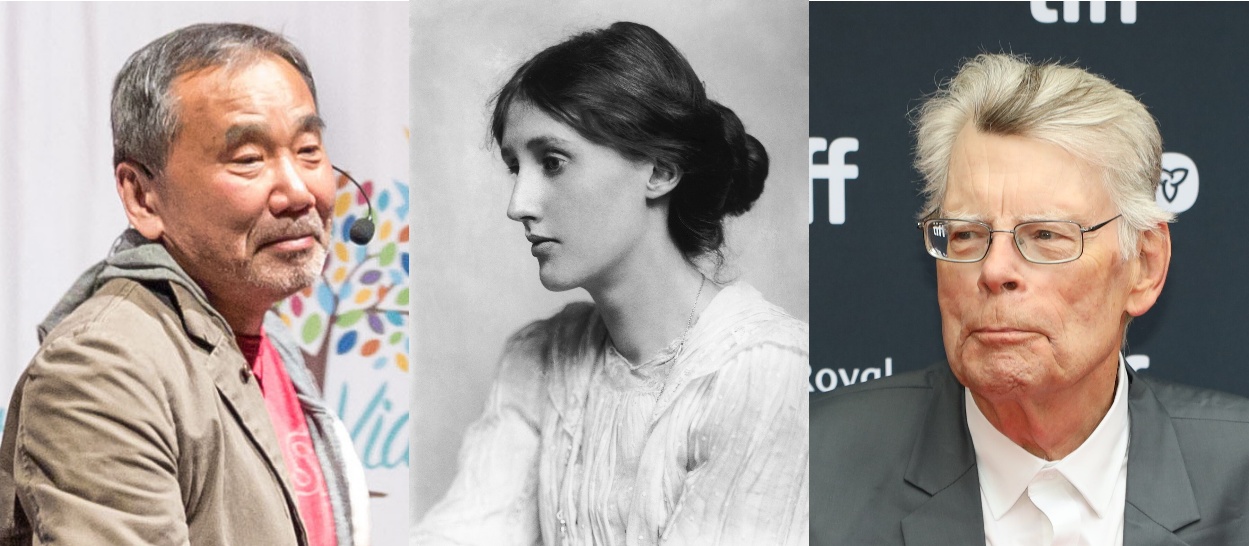
Just days ago, Haruki Murakami’s Japanese publisher announced that his sixteenth novel will come out this summer. A brief section of The Tale of KAHO, translated into English by Philip Gabriel, appeared in the New Yorker in 2024. The full book will run to 352 pages, making it a fairly hefty work for a 77-year-old novelist who’s been at it for almost half a century now. Murakami’s unflagging productivity must owe something to his famously rigorous construction of his life around the twin poles of writing and running, two activities that demand long-term endurance. In this video, the YouTuber MariWriting attempts it herself: waking up every morning at 4:00 a.m., working on a single project for five to six hours, then running ten kilometers — or, in her case, at least getting out and walking for a while.
However indispensable Murakami may consider running to his writing life, he’s also employed other idiosyncratic and seemingly effective techniques of which others can make use. Take, for example, the way he got over the block stopping him from making progress on his first novel by writing its opening chapter in English, then translating it back into his native Japanese.
He also adheres to an editing process consisting of four spaced-out phases, each one focused on a different element of the manuscript. Things work a bit differently for Stephen King, who’s less than two years older than Murakami, but has published 67 novels, twelve story collections, and five books of nonfiction, among many other projects. Yet, as underscored in MariWriting’s video here, King, no less than Murakami, writes in a wholly routinized way that constitutes “self-hypnosis.”
Virginia Woolf probably got herself into a similar state now and again, but given that she worked on a weekly deadline as a book critic for some three decades, she no doubt had many occasions when she just had to put pen to paper no matter what the state of her mind. And put pen to paper she literally did: as MariWriting explains in this final video, Woolf wrote first in longhand (sometimes in ink of her favorite color, purple), then retyped the morning’s work after lunch. In addition to her fiction and literary journalism, she also made a post-tea daily habit of writing more freely in her diary, which let her work out her thinking about her “real” projects. We might compare the importance of Woolf’s diary to that of David Sedaris’ diary, the foundation of everything he’s published. But whether man or woman, Easterner or Westerner, novelist or otherwise, we writers can all take from Woolf’s example the necessity of a dedicated space: a room, that is, of one’s own.
Related content:
The Daily Routines of Famous Creative People, Presented in an Interactive Infographic
Haruki Murakami’s Daily Routine: Up at 4:00 a.m., 5–6 Hours of Writing, Then a 10K Run
Stephen King’s 20 Rules for Writers
Write Only 500 Words Per Day and Publish 50+ Books: Graham Greene’s Writing Method
The Daily Habits of Famous Writers: Franz Kafka, Haruki Murakami, Stephen King & More
Based in Seoul, Colin Marshall writes and broadcasts on cities, language, and culture. He’s the author of the newsletter Books on Cities as well as the books 한국 요약 금지 (No Summarizing Korea) and Korean Newtro. Follow him on the social network formerly known as Twitter at @colinmarshall.
Read More...Support Us
We're hoping to rely on loyal readers, rather than erratic ads. Please click the Donate button and support Open Culture. You can use Paypal, Venmo, Patreon, even Crypto! We thank you!

About Us

Open Culture scours the web for the best educational media. We find the free courses and audio books you need, the language lessons & educational videos you want, and plenty of enlightenment in between.
Advertise With Us

FREE UPDATES!
GET OUR DAILY EMAIL
Get the best cultural and educational resources on the web curated for you in a daily email. We never spam. Unsubscribe at any time.
FOLLOW ON SOCIAL MEDIA

Open Culture editor Dan Colman scours the web for the best educational media. He finds the free courses and audio books you need, the language lessons & movies you want, and plenty of enlightenment in between.
Advertise With Us


