What Happens When a Musician Plays Stevie Ray Vaughan’s “Pride and Joy” on a $25 Kids’ Guitar at Walmart
There’s a maxim that says, “It’s not the guitar, it’s the player.” And the video above bears it out.
In this clip, musician Clay Shelburn and his pal Zac Stokes visit a Walmart at 3 a.m. and pick up a Disney Cars 2 toy guitar. Next, they proceed to play Stevie Ray Vaughan’s “Pride and Joy” and unleash the full potential of that $25 guitar. The Barbies all go crazy.
When it comes to the blues, any old guitar will do. That we know. But if you care to watch Shelburn play the same song on a guitar that runs north of $1,000, check out the video below.
If you would like to support the mission of Open Culture, consider making a donation to our site. It’s hard to rely 100% on ads, and your contributions will help us continue providing the best free cultural and educational materials to learners everywhere. You can contribute through PayPal, Patreon, and Venmo (@openculture). Thanks!
Related Content:
Ozzy Osbourne’s Guitarist Zakk Wylde Plays Black Sabbath on a Hello Kitty Guitar
Read More...Archaeologists Discover Ancient Egyptian Mummy Buried with Pages from Homer’s Iliad: When Literature Guided Souls Through the Afterlife
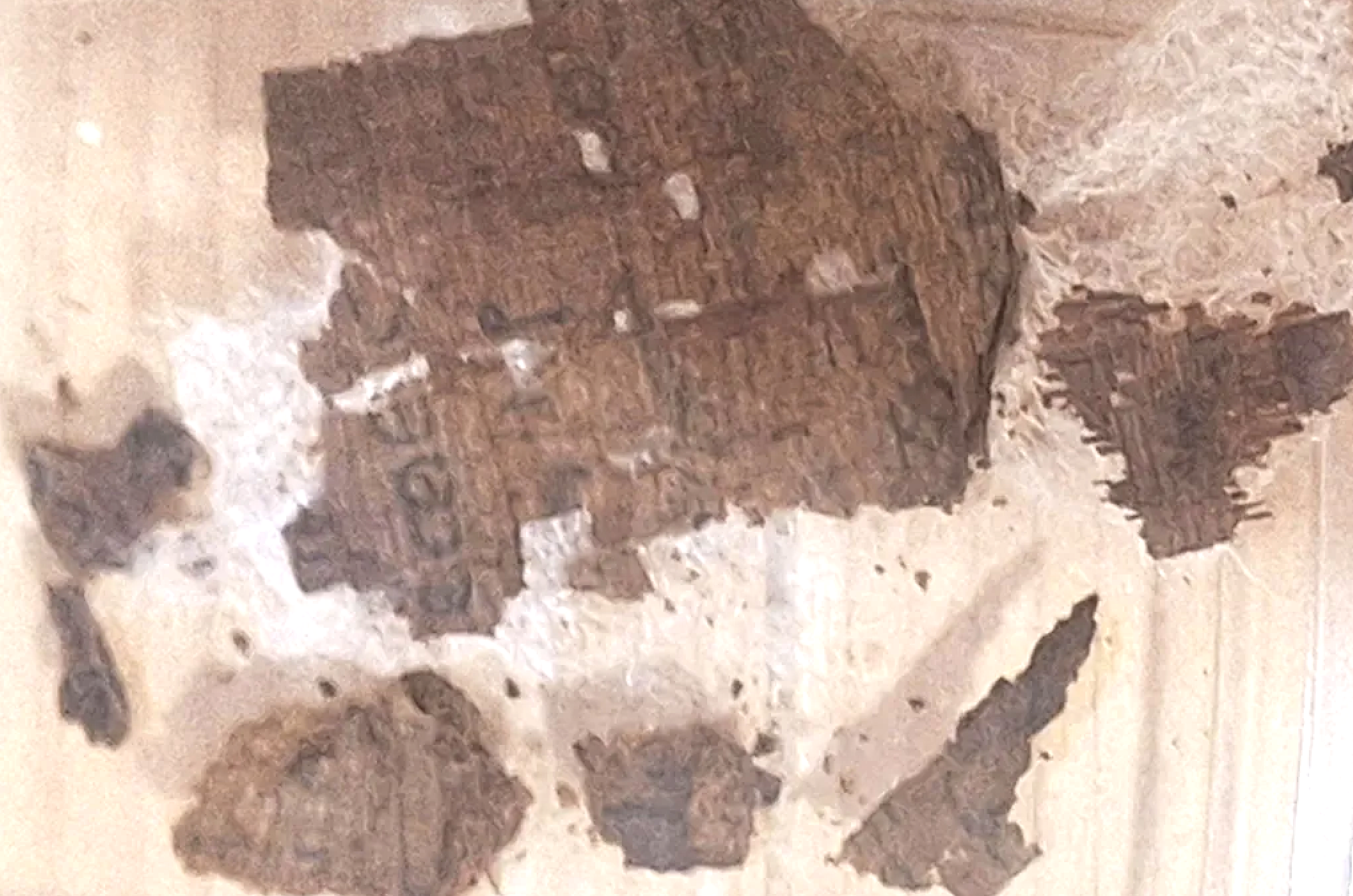
Renaissance Europe admired ancient Rome, ancient Rome admired ancient Greece, and ancient Greece admired ancient Egypt. But the admiration could actually go both ways in that last case, since the two civilizations’ periods of existence overlapped. The Greeks made no secret of their regard for Egypt as a far deeper well of knowledge and wisdom (indeed, much of what we know about ancient Egypt today comes from Greek records), but archaeological evidence shows that the Egyptians, in turn, were hardly dismissive of Greek accomplishment. Many Hellenic texts have been discovered in Egyptian burial sites, but only recently has a Greek literary work turned up packaged with a mummy — and not just any literary work, but pages from Homer’s Iliad.
Unearthed from a 1,600-year-old Roman-era tomb in the Egyptian town of Al Bahnasa, the fragment contains lines from Book 2’s epic “catalogue of ships,” which lists all the vessels the Achaean army sends off to Troy. It dates from an era in ancient Egypt, centuries after the reign of the Greek-descended Cleopatra, when “Greek literary papyri may have functioned as a crucial cultural passport,” as the New York Times’ Franz Lidz writes.
“Being Hellenic connoted an exclusive social status and financial privilege — and had to be meticulously documented through genealogies going back across several centuries.” It’s possible that pages of the Iliad were assumed to act as a kind of Greek passport that would let the deceased bypass the trials of the underworld described in the Egyptian Book of the Dead.
So venerated was Homer’s work at this stage of ancient Egyptian history, in fact, that physicians also credited it with curative properties. “For a bed-bound patient shivering with malaria, the prescription was simple: Brace your head against a papyrus scroll of Book 4 to break the fever.” Whatever the effectiveness of the Iliad against infectious disease, or even to assure safe passage into the world beyond, its continued study around the world more than a millennium and a half after it was getting slipped into Egyptian tombs — and the better part of three millennia after its composition — suggests a kind of historical and cultural power not possessed by ordinary literature. If Christopher Nolan’s coming adaptation of the Odyssey happens to do well enough to get Hollywood back on its feet, perhaps we’ll have to give it to the ancient Egyptians and admit that Homer really does offer salvation after all.
Related content:
Homer’s Iliad and Odyssey: Free AudioBooks & eBooks
Hear Homer’s Iliad Read in the Original Ancient Greek
The Only Illustrated Manuscript of Homer’s Iliad from Antiquity
The Oldest Tattoos Ever Discovered on an Egyptian Mummy Date Back 5,000 Years
The Ancient Egyptian Book of the Dead: A Guidebook for Surviving the Afterlife
Based in Seoul, Colin Marshall writes and broadcasts on cities, language, and culture. He’s the author of the newsletter Books on Cities as well as the books 한국 요약 금지 (No Summarizing Korea) and Korean Newtro. Follow him on the social network formerly known as Twitter at @colinmarshall.
Read More...The Forgotten Moment When Superman Fought Prejudice in America Instead of Villains (1950)

It makes sense that Superman would take a tolerant view of immigrants and other minorities, given that he himself arrived on Earth as a refugee from the planet Krypton.
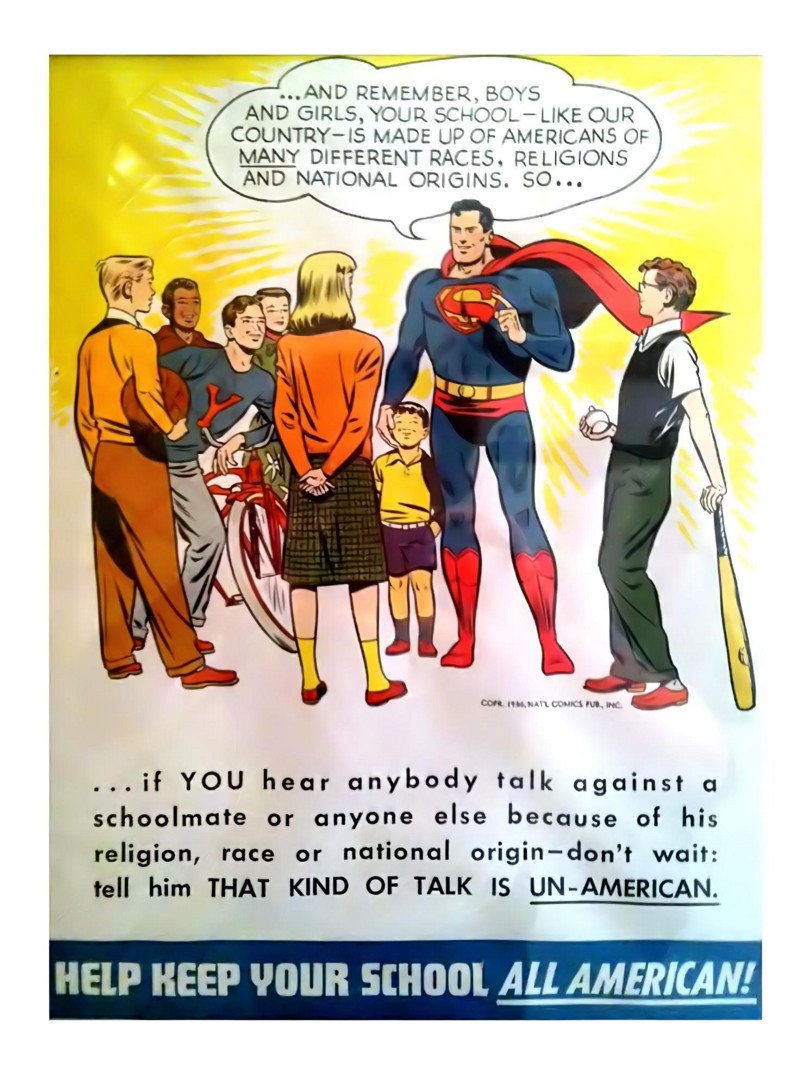
The Man of Steel may strike you as an unlikely mouthpiece for progressive ideals, but 1950 found him on a book cover, above, engaged in conversation with a small crowd of mostly white boys:
“…and remember, boys and girls, your school – like our country – is made up of Americans of many different races, religions and national origins, so … If YOU hear anybody talk against a schoolmate or anyone else because of his religion, race or national origin – don’t wait: tell him THAT KIND OF TALK IS UN-AMERICAN. HELP KEEP YOUR SCHOOL ALL-AMERICAN!”
In other words, citizens must steel themselves to take action, because you can’t always count on a superhero to show up and make things right.
The cheap paper jacket, above, was distributed to school children by the Institute For American Democracy, an offshoot of the New York-based Anti-Defamation League.
Meanwhile, a full color version of the 66-year-old illustration has been making the rounds on social media. Let us consider it a placeholder. Eventually someone will surely take it back to the drawing board to add more girls, children with disabilities, and children of color.
Note: An earlier version of this post appeared on our site in 2017.
Related Content:
Dr. Seuss Draws Anti-Japanese Cartoons During WWII, Then Atones with Horton Hears a Who!
The Original 1940s Superman Cartoon: Watch 17 Classic Episodes Free Online
Ayun Halliday is an author, illustrator, theater maker in NYC.
Read More...The Most Influential Philosophers Explained in 26 Minutes: From Socrates to Wittgenstein
The question of who are the fifteen most influential philosophers of all time may not arise at every conversation down at the pub — not outside the circle of Open Culture readers, in any case. But even among non-specialists, it could spark a livelier debate than you might imagine. Names like Socrates, Aristotle, Descartes, and Marx are known, after all, even among the general public who’ve never read a page of philosophical text. All of them appear in the million-viewed video from Jaydone History above, which takes its own crack at naming a top fifteen. Its 26 minutes also provide a brief biographical sketch of each one, informative if littered with odd mispronunciations, plus a capsulized sense of these philosophers’ lasting ideas.
In pursuit of truth, Socrates created the questioning method of dialogue that bears his name. Plato, Socrates’ student, advocated for rule by the enlightened and the pursuit of knowledge through the contemplation of pure forms. Rejecting Plato’s method, Aristotle dedicated himself to systematic empirical observation. On the other side of the world, Confucius spread teachings about the cultivation of moral virtue to maintain the social relationships he saw as the basic building blocks of civilizational order, which China eventually adopted as its state philosophy. Back in Europe, Augustine synthesized Christian theology and classical philosophy, laying the groundwork for medieval thought. Thomas Aquinas, too, dedicated himself to a combination of faith and reason, making a suite of oft-cited arguments for the existence of God.
Seeking a foundation of absolutely certain knowledge, René Descartes arrived at self-awareness, famously declaring, “I think, therefore I am” and articulating his eponymous dualistic worldview. Even apart from his work on the nature of knowledge, John Locke’s thoughts on social organization and government live on in Enlightenment-influenced modern democracies even today. David Hume mounted fundamental challenges to established ideas of empiricism, questioning our very notion that future events will mirror past experience. Jean-Jacques Rousseau introduced the conception of legitimate political authority as arising from the “general will,” a social agreement among free and equal individuals, which turned out to be central to the justifications of the French Revolution. Immanuel Kant worked to bridge the gap between rationalism and empiricism, reconciling the role of both experience and the mind’s physical structure to the formation of knowledge.
Among other concepts, Georg Wilhelm Friedrich Hegel defined that of dasein, which encapsulates the human mode of being (and which requires a lifetime spent with his writings to grasp, if even then). A professional journalist and historian, Karl Marx described human history through economic structures and class struggle, and his vision of a perfectly equal society ahead still remains compelling to many. Friedrich Nietzsche declared that “God is dead,” placing the burden of defining morality on man, and specifically a figure he called the Übermensch. Ludwig Wittgenstein took it upon himself to explain the relationship between language and reality with the highest rigor. In the comments, the video’s creator teases a part two, which makes one wonder which philosophers will be included: Spinoza? Heidegger? Sartre? The year and a half it’s taken so far is surely long enough for the narrator to have learned to pronounce them.
Related content:
Free Online Philosophy Courses
Bryan Magee’s In-Depth, Uncut TV Conversations With Famous Philosophers (1978–87)
28 Important Philosophers List the Books That Influenced Them Most During Their College Days
The Daily Habits of Highly Productive Philosophers: Nietzsche, Marx & Immanuel Kant
The 20 Most Influential Academic Books of All Time: No Spoilers
Based in Seoul, Colin Marshall writes and broadcasts on cities, language, and culture. He’s the author of the newsletter Books on Cities as well as the books 한국 요약 금지 (No Summarizing Korea) and Korean Newtro. Follow him on the social network formerly known as Twitter at @colinmarshall.
Read More...What Happened to Jesus’ Twelve Disciples After the Bible—It Wasn’t Pretty
The stories in the Bible have been told in many ways, not least through film. Among the many cinematic adaptations of Christianity’s holy book, none comes to mind that ends with freeze-frame title cards explaining the later fate of each character, in the manner of Animal House, American Graffiti, or Goodfellas. This is surprising, since that device could do much to satisfy our curiosity about so many secondary Biblical figures. Take the twelve disciples of Jesus Christ, whose lives Hochelaga creator Tommie Trelawny takes as his subject in the new video above. Be warned: things didn’t end particularly well for most of them.
Peter, who “has to be one of the most studied figures in history,” seems to have ended his days in Rome. Christianity’s rapid spread there in the first century AD, eventually brought about a crackdown by the ruling class. The emperor Nero blamed the fire of 64 on Christians, and Peter, now known as Saint Peter, was among the victims of the resulting persecution. Judas, the betrayer of Jesus, “remains the most controversial figure in all of Christianity,” though questions about his motivations have gone without definitive answers. We do know, however, that remorse eventually overtook him, leading him to take his own life in Akeldama, or the “field of blood” — and if you believe Dante, he now resides in the ninth circle of Hell.
Trelawny gives the title of most underrated to the one whose skepticism about Jesus’ return from death has guaranteed him his own eternal life through the expression “doubting Thomas.” (As with Peter and Judas, his identity was solidified by a Caravaggio painting.) According to certain stories, he also traveled the farthest of any of the disciples: far enough to follow existing Roman spice routes and found the church of the Saint Thomas Christians in Kerala, India. The not-quite-as-widely known but nevertheless highly important Andrew made travels of his own, going to Scythia, and from there to Greece. After his eventual capture and crucifixion, his holy relics were scattered far and wide: even to Scotland, so the legend has it, home of the University of St. Andrews. The St. Andrews’ Cross appears as the main design element of Scotland’s national flag, as well as a part of the Union Jack.
In these and other ways, the legacies of the disciples continue to manifest in familiar ways throughout the Western (and, occasionally, non-western) world. After telling the stories of the remaining eight, from John to Bartholomew to Simon the Zealot, Trelawny considers the possibility of a mnemonic rhyme for their fates. Alas, he admits, “I’m still trying to think of what goes with ‘flayed alive by Armenians.’ ” Being a disciple of Jesus turns out, for the most part, to have been a calling with a very low survival rate indeed. But then, in early Christianity, martyrdom was a holy act, a demonstration of devotion in imitation of the Messiah himself — and an element sure to make most any disciple biopic a gruesome viewing experience.
Related content:
The Gnostic Gospels: An Introduction to the Forbidden Teachings of Jesus
Why Real Biblical Angels Are Creepy, Beastly, and Hardly Angelic
How Our Depiction of Jesus Changed Over 2,000 Years and What He May Have Actually Looked Like
What Makes Caravaggio’s The Taking of Christ a Timeless, Great Painting?
Based in Seoul, Colin Marshall writes and broadcasts on cities, language, and culture. He’s the author of the newsletter Books on Cities as well as the books 한국 요약 금지 (No Summarizing Korea) and Korean Newtro. Follow him on the social network formerly known as Twitter at @colinmarshall.
Read More...When the Nobel Prize Committee Rejected The Lord of the Rings: Tolkien “Has Not Measured Up to Storytelling of the Highest Quality” (1961)
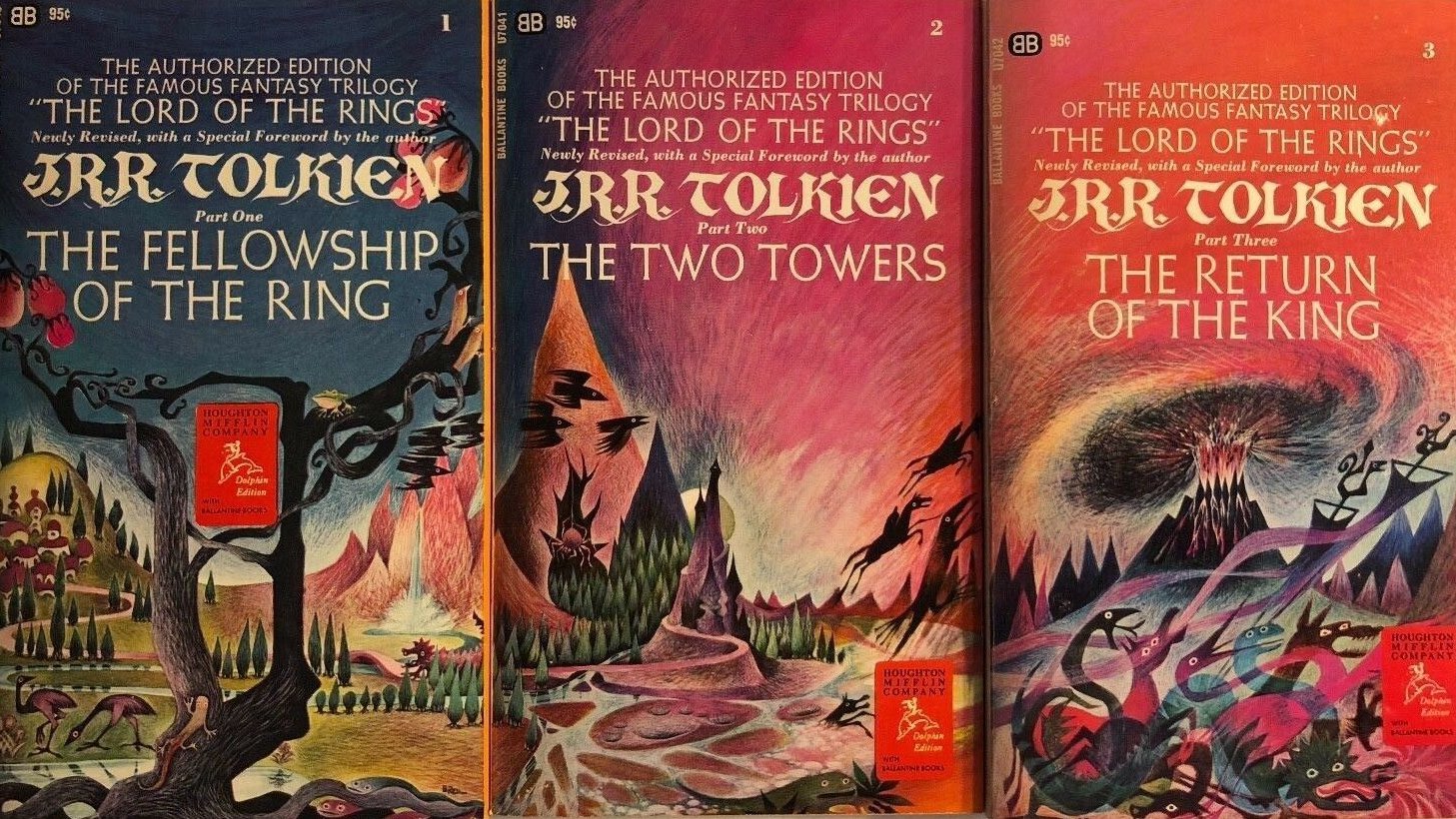
When J.R.R. Tolkien’s Lord of the Rings books appeared in the mid-1950s, they were met with very mixed reviews, an unsurprising reception given that nothing like them had been written for adult readers since Edmund Spenser’s epic 16th century English poem The Faerie Queene, perhaps. At least, this was the contention of reviewer Richard Hughes, who went on to write that “for width of imagination,” The Lord of the Rings “almost beggars parallel.”
Scottish writer Naomi Mitchison did find a comparison: to Sir Thomas Malory, author of the 15th century Le Morte d’Arthur — hardly misplaced, given Tolkien’s day job as an Oxford don of English literature, but not the sort of thing that passed for contemporary writing in the 1950s, notwithstanding the serious appreciation of writers like W.H. Auden for Tolkien’s trilogy. “No previous writer,” the poet remarked in a New York Times review, “has, to my knowledge, created an imaginary world and a feigned history in such detail.”
Auden did find fault with Tolkien’s poetry, a fact upon which critic Edmund Wilson seized in his scathing 1956 Lord of the Rings review. “Mr. Auden is apparently quite insensitive — through lack of interest in the other department,” wrote Wilson, “to the fact that Tolkien’s prose is just as bad. Prose and verse are on the same level of professorial amateurishness.” Five years later, the Nobel prize jury would make the same judgement when they excluded Tolkien’s books from consideration. Tolkien’s prose, wrote jury member Anders Österling, “has not in any way measured up to storytelling of the highest quality.”
The note was discovered recently by Swedish journalist Andreas Ekström, who delved into the Nobel archive for 1961 and found that “the jury passed over names including Lawrence Durrell, Robert Frost, Graham Greene, E.M. Forster, and Tolkien to come up with their eventual winner, Yugoslavian writer Ivo Andrić,” as Alison Flood reports at The Guardian. (The Nobel archives are sealed until 50 years after the year the award is given.) Ekström has been reading through the archives “for the past five years or so,” he says, “and this was the first time I have seen Tolkien’s name among the suggested candidates.” His name appeared on the list chiefly through the machinations of his closest friend and chief supporter, C.S. Lewis.
Lewis, “also of Oxford,” Wilson sneered, “is able to top them all” in praise of Tolkien’s books. From the first appearance of his Middle Earth fantasy in The Hobbit, Lewis promised to “do all in my power to secure for Tolkien’s great book the recognition it deserves,” as he wrote in a 1953 letter to British publisher Stanley Unwin. In what might be considered an unethical promotion of his friend’s work today, Lewis responded tirelessly to critics of the trilogy, going so far, after the publication of The Two Towers, to pen an essay on the subject titled “The Dethronement of Power.” Here, Lewis explains the prolix quality of Tolkien’s prose — that which critics called “tedious” — as a narrative necessity: “I do not think he could have done it any other way.”
Tolkien’s biggest fan also urged readers to spend more time with the books and promised that the rewards would be great. In defense of the second work of the trilogy, he concluded, “the book is too original and too opulent for any final judgment on a first reading. But we know at once that it has done things to us. We are not quite the same men. And though we must ration ourselves in our rereadings, I have little doubt that the book will soon take its place among the indispensables.” And so has all of Tolkien’s work, becoming the literary standard by which high fantasy is measured, with or without a Nobel prize.
Note: An earlier version of this post appeared on our site in 2021.
Related Content:
J.R.R. Tolkien Snubs a German Publisher Asking for Proof of His “Aryan Descent” (1938)
110 Drawings and Paintings by J.R.R. Tolkien: Of Middle-Earth and Beyond
Discover J.R.R. Tolkien’s Little-Known and Hand-Illustrated Children’s Book, Mr. Bliss
Josh Jones is a writer and musician based in Durham, NC.
Read More...How John Coltrane Introduced the World to His Radical Sound with His Recording of “My Favorite Things” (1961)
John Coltrane released “more significant works” than his 1960 “My Favorite Things,” says Robin Washington in a PRX documentary on the classic reworking of Rodgers and Hammerstein’s Broadway hit. “A Love Supreme” is often cited as the zenith of the saxophonist’s career. “But if you tried to explain that song to an average listener, you would lose them. [“My Favorite Things”] is a definitive work that everyone knows, and anyone can listen to, and the fascinating story of its evolution is something everyone can share and enjoy.” The song is accessible, a commercially successful hit, and it is also an experimental masterpiece.
Indeed, “My Favorite Things” may be the perfect introduction to Coltrane’s experimentalism. After the dizzying chord changes of 1959’s “Giant Steps,” this 14-minute, two-chord excursion patterned on the ragas of Ravi Shankar announced Coltrane’s move into the modal forms he refined until his death in 1967, as well as his embrace of the soprano saxophone and his new quartet. It became “Coltrane’s most requested tune,” says Ed Wheeler in The World According to John Coltrane, “and a bridge to a broad public audience.”
Coltrane’s take is also mesmerizing, trance-inducing, “often compared to a whirling dervish,” notes the Polyphonic video above, a reference to the Sufi meditation technique of spinning in a circle. It’s an unlikely song choice for the exercise, which makes it all the more fascinating. The Sound of Music, Rodgers and Hammerstein’s final Broadway collaboration, was an “instant classic,” and everyone who’d seen it walked away humming the tune to “My Favorite Things.” By 1960, it had become a standard, with several cover versions released by Leslie Uggams, The Pete King Chorale, the Hi-Lo’s, and the Norman Luboff Choir.
Hundreds more covers would follow. None of them sounded like Coltrane’s. The modal form—in which musicians improvise in different kinds of scales over simplified chord structures—created the “open freedom” in music explored on Miles Davis’ pathbreaking Kind of Blue, on which Coltrane played tenor sax. (It was Davis who bought Coltrane his first soprano sax that year.) Coltrane’s use of modal form in adaptations of popular standards like “My Favorite Things” and George Gershwin’s “Summertime” from Porgy and Bess was an explicit strategy to court a wider public, using the familiar to orient his listeners to the new.
The video essay brings in the expertise of musician, composer, and YouTuber Adam Neely, who explains what makes Rogers and Hammerstein’s classic unique among show tunes, and why it appealed to Coltrane as the centerpiece of the 1961 album of the same name. The song’s unusual form and structure allow the same melody to be played over both major and minor chords. Coltrane’s modification of the song reduces it to the two tonics, E major and E minor, over which he and the band solo, introducing a shifting tonality and mood to the melody with each chord change.
Neely goes into greater depth, but it’s overall an accessible explanation of Coltrane’s very accessible, yet vertiginously deep, “My Favorite Things.” Maybe only one question remains. Coltrane’s rendition came out four years before Julie Andrews’ iconic performance in the film adaptation of The Sound of Music, evoking the obvious question,” says Washington: “Did he influence her?”
If you would like to support the mission of Open Culture, consider making a donation to our site. It’s hard to rely 100% on ads, and your contributions will help us continue providing the best free cultural and educational materials to learners everywhere. You can contribute through PayPal, Patreon, and Venmo (@openculture). Thanks!
Related Content:
Jazz Deconstructed: What Makes John Coltrane’s “Giant Steps” So Groundbreaking and Radical?
John Coltrane Draws a Picture Illustrating the Mathematics of Music
Discover the Church of St. John Coltrane, Founded on the Divine Music of A Love Supreme
Behold John Coltrane’s Handwritten Outline for His Masterpiece A Love Supreme
Josh Jones is a writer and musician based in Durham, NC.
Read More...Why The Founding Fathers Were Obsessed with This Muslim Ruler
The writings of the Founding Fathers of the United States of America include many a reference to the likes of Cicero, Montesquieu, and John Locke. That the names Hyder Ali and his son Tipu Sultan never appear may not sound like much of a surprise, even if you happen to know that they ruled the Indian region of Mysore, now officially called Mysuru, at the time. But history records that more than a few Americans, including Thomas Jefferson and John Adams, followed with great interest the struggles of that father and son against the British. Those struggles took place from the mid-eighteenth to the early nineteenth century — a time when the American colonies, of course, had their own conflict brewing with the motherland.
Hyder became the Sultan of Mysore in the seventeen-sixties: “a dangerous time to come to power in South Asia,” writes Blake Smith at Aeon, given that “the British East India Company was expanding its power throughout the Subcontinent.” Allying with France, much like the rebelling American colonists, Hyder “held off the British advance for another two decades, dying in 1782, just a year before the US triumphed in its own rebellion against Britain.”
America’s fascination with Hyder and his successor Tipu, who died in battle with the East India Company in 1799, remained for some time. “Mysore’s rulers became familiar references in American newspapers, poems and everyday conversation. Yet, within a generation, Americans lost their sense of solidarity with the Indian Subcontinent.”
You can learn more about this episode of history from the PBS Origins video above. It gets into detail about the life of Tipu, known as “the Tiger of Mysore,” a nickname the man himself did much to justify. He even “commissioned a nearly life-sized automaton of a tiger eating a British soldier,” says the video’s host, which “included a crank attached to a mechanism inside the tiger’s body that simultaneously lifted the dying man’s arm and produced noises imitating his final cries.” Though he and his army continued to fight in that spirit, Mysore’s situation became untenable after both the U.S. and France made their peace with Britain. Despite the recency of the hostilities, the new liberated colony soon became something of an ally in the maintenance of the British Empire’s remaining territories, India included — and would ultimately learn a lesson or two of its own about the global extension of power.
Related content:
The American Revolution: A Free Course from Yale University
The Oldest Known Photographs of India (1863–1870)
India on Film, 1899–1947: An Archive of 90 Historic Films Now Online]
200-Year-Old Robots That Play Music, Shoot Arrows & Even Write Poems: Watch Automatons in Action
Bertrand Russell’s Improbable Appearance in a Bollywood Film (1967)
Based in Seoul, Colin Marshall writes and broadcasts on cities, language, and culture. He’s the author of the newsletter Books on Cities as well as the books 한국 요약 금지 (No Summarizing Korea) and Korean Newtro. Follow him on the social network formerly known as Twitter at @colinmarshall.
Read More...How a Volcanic Eruption Helped Unleash the Black Death in Europe in 1347
The flap of a butterfly’s wings on one side of the world can cause a hurricane on the other, or so they say. If we take it a bit too literally, that old observation may make us wonder what a hurricane can cause. Or if not a hurricane, how about another kind of large-scale natural disaster? If new findings by researchers from the University of Cambridge and the Leibniz Institute for the History and Culture of Eastern Europe are to be believed, a volcano’s eruption helped lead to the outbreak and spread of the Black Death across Europe in the fourteenth century. In the video above, British history and environmental science specialist Paul Whitewick explains the evidence on a visit to one of the abandoned medieval villages stricken by that plague.
As Cambridge’s Sarah Collins writes, “the evidence suggests that a volcanic eruption — or cluster of eruptions — around 1345 caused annual temperatures to drop for consecutive years due to the haze from volcanic ash and gases, which in turn caused crops to fail across the Mediterranean region.” Desperate Italian city-states thus fell back on trading with grain producers around the Black Sea. “This climate-driven change in long-distance trade routes helped avoid famine, but in addition to life-saving food, the ships were carrying the deadly bacterium that ultimately caused the Black Death, enabling the first and deadliest wave of the second plague pandemic to gain a foothold in Europe.”
An important clue came in the form of “information contained in tree rings from the Spanish Pyrenees, where consecutive ‘Blue Rings’ point to unusually cold and wet summers in 1345, 1346 and 1347 across much of southern Europe.” Records of lunar eclipses and layers of sulfur locked into ice cores dating to about the same time further heighten the probability of volcanic activity. Key to tying these disparate pieces of evidence together are changes in trade routes: on a map, Whitewick traces “movement increasing along these corridors, grain imports to the maritime republics of Venice and Genoa from north of the Black Sea and beyond, in 1347.” According to written records, the Black Death came to Britain the following year, arriving in “a country already shaped by failed harvests, weakened communities, and rising movement of people and goods.”
Some communities weathered the plague and, in the fullness of time, even bounced back; others, like the village amid whose remains Whitewick stands, practically vanished altogether. “This was a global problem that became very much a local one,” he says, underscoring its revelation of the risk factors present even in the early stages of what we now call globalization. “A volcanic eruption thousands of miles away altered climate patterns, and that climate reshaped harvest and trade, and trade carried disease. And here, in the quiet English fields, the consequences have settled into the ground:” not quite as poetic an image as the butterfly and the hurricane, granted, but hardly less relevant to our own world for it.
Related Content:
The History of the Plague: Every Major Epidemic in an Animated Map
A 1665 Advertisement Promises a “Famous and Effectual” Cure for the Great Plague
1,000 Years of Medieval European History in 20 Minutes
Based in Seoul, Colin Marshall writes and broadcasts on cities, language, and culture. He’s the author of the newsletter Books on Cities as well as the books 한국 요약 금지 (No Summarizing Korea) and Korean Newtro. Follow him on the social network formerly known as Twitter at @colinmarshall.
Read More...Buckminster Fuller Creates an Animated Visualization of Human Population Growth from 1000 B.C.E. to 1965
Sit back, relax, put on some music (I’ve found Chopin’s Nocturne in B major well-suited), and watch the video above, a silent data visualization by visionary architect and systems theorist Buckminster Fuller, “the James Brown of industrial design.” The short film from 1965 combines two of Fuller’s leading concerns: the exponential spread of the human population over finite masses of land and the need to revise our global perspective via the “Dymaxion map,” in order “to visualize the whole planet with greater accuracy,” as the Buckminster Fuller Institute writes, so that “we humans will be better equipped to address challenges as we face our common future aboard Spaceship Earth.”
Though you may know it best as the name of a geodesic sphere at Disney’s Epcot Center, the term Spaceship Earth originally came from Fuller, who used it to remind us of our interconnectedness and interdependence as we share resources on the only vehicle we know of that can sustain us in the cosmos.
“We are all astronauts,” he wrote in his 1969 Operating Manual for Spaceship Earth, and yet we refuse to see the long-term consequences of our actions on our specialized craft: “One of the reasons why we are struggling inadequately today,” Fuller argued in his introduction, “is that we reckon our costs on too shortsighted a basis and are later overwhelmed with the unexpected costs brought about by our shortsightedness.”
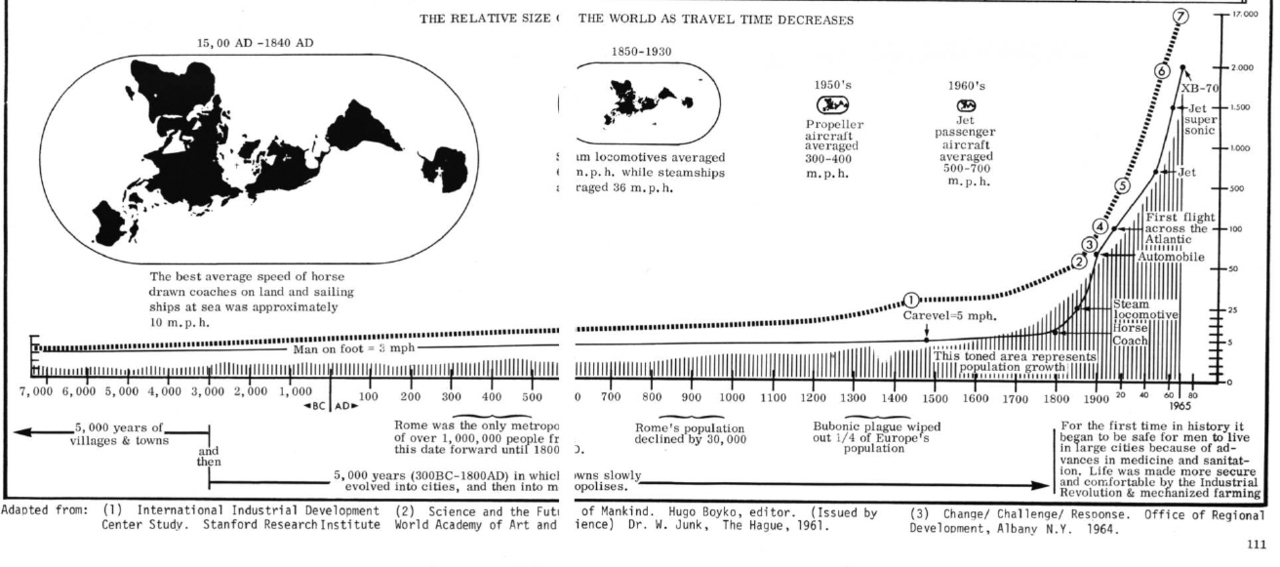
Like all visionaries, Fuller thought in long spans of time, and he used his design skills to help others do so as well. His population visualization documents human growth from 1000 B.C.E. to Fuller’s present, at the time, of 1965. In the image above (see a larger version here), we have a graphic from that same year—made collaboratively with artist and sociologist John McHale—showing the “shrinking of our planet by man’s increased travel and communication speeds around the globe.” (It must be near microscopic by now.) Fuller takes an even longer view, looking at “the confluence of communication and transportation technologies,” writes Rikke Schmidt Kjærgaard, “from 500,000 B.C.E. to 1965.”
Here Fuller combines his population data with the technological breakthroughs of modernity. Though he’s thought of in some quarters as a genius and in some as a kook, Fuller demonstrated his tremendous foresight in seemingly innumerable ways. But it was in the realm of design that he excelled in communicating what he saw. “Pioneers of data visualization,” Fuller and McHale were two of “the first to chart long-term trends of industrialization and globalization.” Instead of becoming alarmed and fearful of what the trends showed, Fuller got to work designing for the future, fully aware, writes the Fuller Institute, that “the planet is a system, and a resilient one.”
Fuller thought like a radically inventive engineer, but he spoke and wrote like a peacenik prophet, writing that a system of narrow specializations ensures that skill sets “are not comprehended comprehensively… or they are realized only in negative ways, in new weaponry or the industrial support only of war faring.” We’ve seen this vision of society played out to a frightening extent. Fuller saw a way out, one in which everyone on the planet can live in comfort and security without consuming (then not renewing) the Earth’s resources. How can this be done? You’ll have to read Fuller’s work to find out. Meanwhile, as his visualizations suggest, it’s best for us to take the long view—and give up on short-term rewards and profits—in our assessments of the state of Spaceship Earth.
Note: An earlier version of this post appeared on our site in 2017.
Related Content:
Buckminster Fuller’s Map of the World: The Innovation that Revolutionized Map Design (1943)
The Life & Times of Buckminster Fuller’s Geodesic Dome: A Documentary
Josh Jones is a writer and musician based in Durham, NC.
Read More...Support Us
We're hoping to rely on loyal readers, rather than erratic ads. Please click the Donate button and support Open Culture. You can use Paypal, Venmo, Patreon, even Crypto! We thank you!

About Us

Open Culture scours the web for the best educational media. We find the free courses and audio books you need, the language lessons & educational videos you want, and plenty of enlightenment in between.
Advertise With Us

FREE UPDATES!
GET OUR DAILY EMAIL
Get the best cultural and educational resources on the web curated for you in a daily email. We never spam. Unsubscribe at any time.
FOLLOW ON SOCIAL MEDIA

Open Culture editor Dan Colman scours the web for the best educational media. He finds the free courses and audio books you need, the language lessons & movies you want, and plenty of enlightenment in between.
Advertise With Us

