Take a Random Walk Around the Berlin Wall Just Months Before Its Sudden Fall (Summer 1989)
Officially, the Berlin Wall fell on November 9, 1989. Demolition would take more than four years, and a few sections remain for memorial purposes, but it was on that date that passage between East and West Berlin — and thus East and West Germany — opened to all citizens of both countries. To say that it came as a surprise would be a serious understatement. Earlier that year, even the best informed observers were predicting that the wall would stand for at least a few more decades. Earlier that day, for that matter, the officials involved in the opening didn’t foresee that Socialist Unity Party of Germany Secretary of Information Günter Schabowski would, that evening, mistakenly declare on national television that the liberalization of border travel was effective “immediately, without delay.”
When the border guards finally gave up their attempts to hold the line around 11:00 that night, the surrounding scene in both Berlins had turned into what attendees now remember, 36 years later, as the biggest street festival of their lives. To those of us unable to join in the celebration at the time, it may seem unlikely that such an event could really have occurred with no intimations whatsoever.
Yet the footage shot by a traveler in Berlin during the summer of 1989, right there in the vicinity of the wall, depicts a city where events seem to be frozen. Though the built environment isn’t without touches of faded grandeur here and there (and as many West Berliners were soon to discover, the real urban stateliness was over East), the overall impression given by what was then the red hot center of Cold War geopolitics is that of a dullsville.
The most outwardly interesting feature in these parts of Berlin at the very end of the nineteen-eighties is, of course, the wall itself: the brutishness of its form, the humdrum menace of its guards, the accumulation of graffiti both political and apolitical. At one point, the tourist’s camcorder captures the memorials for fallen wall jumpers, the most recent of which, a certain Chris Gueffroy, had made his fateful escape attempt from the East that past February. History would soon immortalize him as the last person to be shot trying to get over the wall, though not the last to die doing so. That title belongs to Winfried Freudenberg, who in March of 1989 fell from a balloon he’d rigged up to fly across the border. At this point, when the rapid urban evolution of the reunified German capital has long since made it one of the most popular cities in Europe, neither she nor Gueffroy would recognize the former East Berlin they were desperate to escape — nor, for that matter, the West Berlin of which they dreamed.
Related Content:
See Berlin Before and After World War II in Startling Color Video
Watch Samuel Beckett Walk the Streets of Berlin Like a Boss, 1969
Based in Seoul, Colin Marshall writes and broadcasts on cities, language, and culture. He’s the author of the newsletter Books on Cities as well as the books 한국 요약 금지 (No Summarizing Korea) and Korean Newtro. Follow him on the social network formerly known as Twitter at @colinmarshall.
Read More...M.I.T. Computer Program Predicts in 1973 That Civilization Will End by 2040
In 1704, Isaac Newton predicted the end of the world sometime around (or after, “but not before”) the year 2060, using a strange series of mathematical calculations. Rather than study what he called the “book of nature,” he took as his source the supposed prophecies of the Book of Revelation. While such predictions have always been central to Christianity, it is startling for modern people to look back and see the famed astronomer and physicist indulging them. For Newton, however, as Matthew Stanley writes at Science, “laying the foundation of modern physics and astronomy was a bit of a sideshow. He believed that his truly important work was deciphering ancient scriptures and uncovering the nature of the Christian religion.”
Over three hundred years later, we still have plenty of religious doomsayers predicting the end of the world with Bible codes. But in recent times, their ranks have seemingly been joined by scientists whose only professed aim is interpreting data from climate research and sustainability estimates given population growth and dwindling resources. The scientific predictions do not draw on ancient texts or theology, nor involve final battles between good and evil. Though there may be plagues and other horrible reckonings, these are predictably causal outcomes of over-production and consumption rather than divine wrath. Yet by some strange fluke, the science has arrived at the same apocalyptic date as Newton, plus or minus a decade or two.
The “end of the world” in these scenarios means the end of modern life as we know it: the collapse of industrialized societies, large-scale agricultural production, supply chains, stable climates, nation states…. Since the late sixties, an elite society of wealthy industrialists and scientists known as the Club of Rome (a frequent player in many conspiracy theories) has foreseen these disasters in the early 21st century. One of the sources of their vision is a computer program developed at MIT by computing pioneer and systems theorist Jay Forrester, whose model of global sustainability, one of the first of its kind, predicted civilizational collapse in 2040. “What the computer envisioned in the 1970s has by and large been coming true,” claims Paul Ratner at Big Think.
Those predictions include population growth and pollution levels, “worsening quality of life,” and “dwindling natural resources.” In the video at the top, see Australia’s ABC explain the computer’s calculations, “an electronic guided tour of our global behavior since 1900, and where that behavior will lead us,” says the presenter. The graph spans the years 1900 to 2060. “Quality of life” begins to sharply decline after 1940, and by 2020, the model predicts, the metric contracts to turn-of-the-century levels, meeting the sharp increase of the “Zed Curve” that charts pollution levels. (ABC revisited this reporting in 1999 with Club of Rome member Keith Suter.)
You can probably guess the rest—or you can read all about it in the 1972 Club of Rome-published report Limits to Growth, which drew wide popular attention to Jay Forrester’s books Urban Dynamics (1969) and World Dynamics (1971). Forrester, a figure of Newtonian stature in the worlds of computer science and management and systems theory—though not, like Newton, a Biblical prophecy enthusiast—more or less endorsed his conclusions to the end of his life in 2016. In one of his last interviews, at the age of 98, he told the MIT Technology Review, “I think the books stand all right.” But he also cautioned against acting without systematic thinking in the face of the globally interrelated issues the Club of Rome ominously calls “the problematic”:
Time after time … you’ll find people are reacting to a problem, they think they know what to do, and they don’t realize that what they’re doing is making a problem. This is a vicious [cycle], because as things get worse, there is more incentive to do things, and it gets worse and worse.
Where this vague warning is supposed to leave us is uncertain. If the current course is dire, “unsystematic” solutions may be worse? This theory also seems to leave powerfully vested human agents (like Exxon’s executives) wholly unaccountable for the coming collapse. Limits to Growth—scoffed at and disparagingly called “neo-Malthusian” by a host of libertarian critics—stands on far surer evidentiary footing than Newton’s weird predictions, and its climate forecasts, notes Christian Parenti, “were alarmingly prescient.” But for all this doom and gloom it’s worth bearing in mind that models of the future are not, in fact, the future. There are hard times ahead, but no theory, no matter how sophisticated, can account for every variable.
Note: An earlier version of this post appeared on our site in 2018.
Related Content:
In 1704, Isaac Newton Predicts the World Will End in 2060
Josh Jones is a writer and musician based in Durham, NC.
Read More...Hear Robert Johnson’s “Come On in My Kitchen” in Remarkably Restored Audio, Taken from a Rare Test Pressing
Robert Johnson died at just 27 years old, some say as a consequence of selling his soul to the devil at a crossroads. But before his time came, he managed to record 29 songs, a scant body of work that nevertheless secured his artistic immortality as one of the most influential blues musicians of all time. It’s unfortunate that his recordings, all of them made between 1936 and 1937 in less-than-ideal studio conditions even for the time, leave something to be desired in the audio quality department. But now, some 90 years later, sound restorer Nick Dellow has been uploading relatively crisp digitized “test pressings” of Johnson’s songs to YouTube: last month, for example, we featured one of “Cross Road Blues” here on Open Culture.
In the video above, you’ll find a similarly higher-quality version of “Come On in My Kitchen,” a song acknowledged as an early demonstration of the young Johnson’s otherworldly musical power. You may notice that the title labels this particular recording as “take one.” Johnson also recorded a much different second take, which his label Vocalion Records released in 1937, possibly because it sounded less mournful and thus — according to record-industry logic — more viable as a hit.
Though take one now seems to be regarded as the “true” rendition of the song by his serious enthusiasts, the public didn’t get to hear it until 1961, when it was included on the compilation King of the Delta Blues Singers that did more than any other release to win Johnson his posthumous fan base.
It is, admittedly, not easy to imagine the first take of “Come On in My Kitchen” sweeping the dance halls, even with this sound quality much improved from the version on King of the Delta Blues Singers. But the reasons Johnson’s music has endured so long have less to do with his ability to get a crowd moving than with his combination of understated virtuosity and preternatural-sounding ability to reach into genuinely haunting emotional realms. Like many canonical singer-songwriters who died young, he seems always to be and remain somehow older than us, his listeners, even as we reach (and indeed pass) middle age. Occasionally, the release of never-before-heard recordings or pressings reveals the true edge of immaturity in such figures; with Johnson, it only deepens his legend.
Related content:
Keith Richards Shows Us How to Play the Blues, Inspired by Robert Johnson, on the Acoustic Guitar
Robert Johnson Finally Gets an Obituary in The New York Times 81 Years After His Death
The Legend of How Bluesman Robert Johnson Sold His Soul to the Devil at the Crossroads
Based in Seoul, Colin Marshall writes and broadcasts on cities, language, and culture. He’s the author of the newsletter Books on Cities as well as the books 한국 요약 금지 (No Summarizing Korea) and Korean Newtro. Follow him on the social network formerly known as Twitter at @colinmarshall.
Read More...The Myth of Sisyphus Wonderfully Animated in an Oscar-Nominated Short Film (1974)
Even if you don’t know the myth by name, you know the story. In Greek mythology, Sisyphus, King of Corinth, was punished “for his self-aggrandizing craftiness and deceitfulness by being forced to roll an immense boulder up a hill, only to watch it roll back down, repeating this action for eternity.” In modern times, this story inspired Albert Camus to write “The Myth of Sisyphus,” an essay where he famously introduced his concept of the “absurd” and identified Sisyphus as the absurd hero. And it provided the creative material for a breathtakingly good animation created by Marcell Jankovics in 1974. The film, notes the annotation that accompanies the animation on YouTube, is “presented in a single, unbroken shot, consisting of a dynamic line drawing of Sisyphus, the stone, and the mountainside.” Fittingly, Jankovics’ little masterpiece was nominated for the Best Animated Short Film at the 48th Academy Awards.
Note: An earlier version of this post appeared on our site in 2015.
If you would like to support the mission of Open Culture, consider making a donation to our site. It’s hard to rely 100% on ads, and your contributions will help us continue providing the best free cultural and educational materials to learners everywhere. You can contribute through PayPal, Patreon, and Venmo (@openculture). Thanks!
Related Content
Mythos: An Animation Retells Timeless Greek Myths with Abstract Modern Designs
Mythology Expert Reviews Depictions of Greek & Roman Myths in Popular Movies and TV Shows
Read More...
Revisit Daily Life in China in 1917 Through Footage Enhanced and Colorized by AI
Even for Americans, keeping up with the geopolitical entanglements of the United States has never been an easy task. More than a century ago, just a few months after their country got involved in what’s now known as World War I, they got word that the military of a distant nation had joined their side: China, whose image would have been both opaque and forbiddingly vast. A dozen years before they’d even heard the name Pearl S. Buck, what impressions of that country they had would have come from scattered sources like post-Opium Wars missionary publications, newspaper coverage of complicated events like the Boxer Rebellion and the fall of the Qing dynasty, and silent-film genre stereotypes. (Perhaps the rare reader got ahold of John Thomson’s Through China with a Camera.) Most could live a lifetime without a glimpse of “the real China.”
By the end of 1917, however, “there were at least 10 documentaries available to satisfy curiosity about America’s new ally in the Far East,” according to the National Film Preservation Foundation. Most were shorts that played alongside features, but A Trip Through China was different. At least five years in the making, “the documentary was the brainchild of Benjamin Brodsky, a widely traveled Russian-born businessman who claimed to speak 11 languages. According to a 1912 Moving Picture World profile, the young entrepreneur had moved to China from San Francisco after the 1906 Earthquake and set up shop as a film exhibitor. Soon, as the American representative of Variety Film Exchange, he had a hand in distribution and by 1909 branched into film production in Shanghai and Hong Kong. While juggling business interests, he filmed his travels,” all of which took place not just before China’s economic rise, but before even the Communist Revolution.
Brodsky brought 20,000 feet of negatives with him back to San Francisco, eventually cutting it down to ten reels, which would have run around one hour and 50 minutes. Of this feature-length travelogue film only certain sections survive, but you can see them enhanced and colorized with artificial intelligence in the video at the top of the post. (Some of an un-enhanced black-and-white print appears just above.) Bear in mind that colors you see are not, of course, the colors Brodsky would have seen; there’s also some discussion about whether the AI rendered certain complexions unrealistically dark for the regions in which he shot these scenes. For China is quite a diverse place, not just in regional landscapes, climates, and cultures, but also in the faces of its people: something many Westerners wouldn’t have guessed in the nineteen-tens — and for that matter, something a fair few of them don’t realize even today.
Related Content:
Footage of Cities Around the World in the 1890s: London, Tokyo, New York, Venice, Moscow & More
The Photo That Triggered China’s Disastrous Cultural Revolution (1966)
Based in Seoul, Colin Marshall writes and broadcasts on cities, language, and culture. He’s the author of the newsletter Books on Cities as well as the books 한국 요약 금지 (No Summarizing Korea) and Korean Newtro. Follow him on the social network formerly known as Twitter at @colinmarshall.
Read More...Who Would Be King of the United States If George Washington Had Become a Monarch?
The young George Washington may never have hacked up his father’s cherry tree and refused to lie about it, but his life nevertheless offers plenty of deeds both virtuous and adequately documented. It was no small thing, for instance, to refuse to seek a third term as the first President of the United States of America — much less to exchange that title for “King of the United States of America.” As every enthusiast of American history knows, this set the precedent, only once violated and thereafter written into law, of a two-term limit. But as every enthusiast of alternate American history has wondered, what would have happened had Washington become king? And if the U.S. monarchy had remained intact for the past 227 years, who would rule it today?
In the UsefulCharts video above, Matt Baker explains a series of different succession scenarios. While none is highly plausible in itself, they together give an idea of the lines along which American monarchical history could have played out, at least assuming that every other event played out exactly the same way as it has in our reality.
One of the first complicating factors is that Washington himself had no biological descendants. Given that, we can trace down a theoretical royal lineage starting with his adopted son, born from his wife Martha’s first marriage; with the nephew he selected as the primary heir of his estate; or with the senior-most heir of his father (owner of the notional cherry tree). Not that any of those major paths through the chart of Washington’s indirect descendants is necessarily straightforward either.
The whole matter seems at least as complicated as figuring out who would be the Roman emperor if Rome had never fallen, an exercise Baker works through in another UsefulCharts video previously featured here on Open Culture. The possibilities for the American monarch in 2026 come down to King Robert III, or Robert E. Lee V (and great-great grandson of Robert E. Lee); Queen Brynda, or Brynda Hansen; King Richard, or Richard Washington; and King Larry II, or Lawrence Shaffner, the descendant of George Washington’s nephew Bushrod. Baker finds that Shaffner is the most convincing candidate for the job, which is hard to deny. Even apart from the relevant familial, political, and legal factors, consider that name again. King Larry: apart from the title, how much more American could it possibly sound?
Related content:
Who Would Be Emperor If the Roman Empire Still Existed Today?
How George Washington Became President of the United States: It Was Weirder Than You Think
George Washington’s 110 Rules for Civility and Decent Behavior
What We Can Learn from Past Presidents
A Visual Timeline of World History: Watch the Rise & Fall of Civilizations Over 5,000 Years
Based in Seoul, Colin Marshall writes and broadcasts on cities, language, and culture. He’s the author of the newsletter Books on Cities as well as the books 한국 요약 금지 (No Summarizing Korea) and Korean Newtro. Follow him on the social network formerly known as Twitter at @colinmarshall.
Read More...Enjoy Three Hours of Free Nature Videos Narrated by David Attenborough
For your weekend viewing pleasure, enjoy three hours of David Attenborough narrating free nature videos from the BBC. Attenborough just turned 100 this month, and he’s still going strong!
If you would like to support the mission of Open Culture, consider making a donation to our site. It’s hard to rely 100% on ads, and your contributions will help us continue providing the best free cultural and educational materials to learners everywhere. You can contribute through PayPal, Patreon, and Venmo (@openculture). Thanks!
Read More...The Spread of Christianity Animated, from Antiquity Until Today, on an Animated Map
Christianity has long been closely identified with Western civilization. The association is especially strong, in modern times, with the United States of America, that source of derisively quoted, quite possibly apocryphal arguments that “if English was good enough for Jesus Christ, it ought to be good enough for our children.” But of course, Jesus never heard a word of English, and though the spread of the religion named after him did shift into high gear not long after his death — to say nothing of after Constantine’s — it took its sweet time getting to the American continent. In fact, it doesn’t show up there until more than five and a half minutes into the new eight-minute video from Ollie Bye above, which animates Christianity’s historical propagation on a world map.
It’s a world map by the end, in any case: the view zooms out as the reach of Christianity increases, starting with the region we now call the Middle East and ending up with every continent on display, none of them untouched save Antarctica (which actually does have eight churches of its own). Remarkable though it is that this first-century “desert religion” has taken root in such a variety of environments, cultures, and societies, it hasn’t come through that process completely unchanged.
Indeed, Bye’s map includes a running legend of its major variants, from Nicene, Celtic, and Chalcedonian Christianity early on to Anglican, Lutheran, Baptist, and many more in our time. It makes less sense to speak of the spread of Christianity, perhaps, than the spread of Christianities.
In the singular or the plural, what has made all this so adaptable to such a wide variety of human settings? Christianity’s non-ethnic universalism surely has something to do with it, as does the broad emotional resonance of its core narratives of sin, salvation, and rebirth. The assiduous translation of its texts and outward march of missionaries and other carriers of the gospel has been going on almost since the very beginning. Throughout its history, Christianity has also shown the versatility to thrive as a clandestine underground movement, a state religion, and everything in between. All the while, it has assimilated qualities of the civilizations it enters, from Greco-Roman philosophy to Celtic festivals to Korean shamanistic traditions. In fact, I’m writing this very post from one of the many church cafés in Seoul, as convincing an experience as to underscore Christianity’s improbable — and continuing — endurance.
Related content:
Animated Map Shows How the Five Major Religions Spread Across the World (3000 BC — 2000 AD)
180,000 Years of Religion Charted on a “Histomap” in 1943
The Birth and Rapid Rise of Islam, Animated (622‑1453)
A Visual Map of the World’s Major Religions (and Non-Religions)
The History of the World in One Video: Every Year from 200,000 BCE to Today
Based in Seoul, Colin Marshall writes and broadcasts on cities, language, and culture. He’s the author of the newsletter Books on Cities as well as the books 한국 요약 금지 (No Summarizing Korea) and Korean Newtro. Follow him on the social network formerly known as Twitter at @colinmarshall.
Read More...Watch Led Zeppelin’s Jimmy Page Rock the Theremin, the Early Soviet Electronic Instrument
It can be frustrating for Led Zeppelin fans to hear the band reduced to plagiarism lawsuits or the quintessence of sexually-aggressive rock-star entitlement (though much of that is deserved). For one thing, Zeppelin’s occult songwriting tendencies, courtesy of both Page and Plant, play just as prominent a role as their blues-rock come-ons (as several generations of fantasy metal bands can attest). For another, their studio productions and live shows are renowned for pioneering mash-ups of modern rock, folk, and classical instrumentation, courtesy of both Page and Jones. And finally, the band’s recording techniques were—for the time—demonstrations of technical wizardry.
Thus it should come as no surprise that technical wizard Jimmy Page would play the Theremin, though he does play on it the kind of screaming, feedback-laden bends he unleashed from his Les Paul. Introduced to the world by Soviet inventor Leon Theremin in 1919, the early electronic instrument emits high-pitched singing when a player’s hands come within range of its invisible electrical fields. “It hasn’t got six strings,” Page says in his demonstration at the top of the post, from the 2009 film It Might Get Loud, “but it’s a lot of fun.”
Page used a Sonic Wave Theremin in his Zeppelin days in a very guitar-like way—running it through a Maestro Echoplex and Orange amps and cabinets. (Watch him revive the technique in a 1995 French TV broadcast above.) For several months in 1971, writes fansite Achilles Last Stand, Page “used a double-stacked Theremin” for twice the sonic assault.
Though he seems to have gone back to just the one Theremin in the solo above, the effect is no less electrifying, if you’ll excuse the pun, as he sends echoes of ray-gun noise cascading around the theater. Well over five minutes into the hypnotic affair, Page takes to his Les Paul, creating more ragged patterns with violin bow and Echoplex. Even if you aren’t in a dazed and confused state, you’ll feel like you are if you give yourself over to this piece of performance art. Heroics? Yes, and indeed the bowed guitar act has its phallic overtones. But it begins and ends with long stretches of the kind of droning experimental noise one would expect to find onstage at an early Kraftwerk show.
Those in the know will know that Page put the theremin to use on one of the band’s most technically experimental recordings (though it also happens to be an appropriated blues stomper), “Whole Lotta Love” from 1969’s Led Zeppelin II. “I always envisioned the middle to be quite avant-garde,” Page told Guitar World, “The Theremin generates most of the higher pitches and my Les Paul makes the lower sounds.” Watch him rip out a theremin-and-guitar solo above in the live performance from 1973. Taken with the psychedelic video effects, the performance reaches mystical planes of rhythmic abstraction.
Note: An earlier version of this post appeared on our site in 2016.
Related Content:
Learn How to Play the Theremin: A Free Short Video Course
Josh Jones is a writer and musician based in Durham, NC.
Read More...Hand-Colored Photographs from 19th Century Japan: 110 Images Capture the Waning Days of Traditional Japanese Society
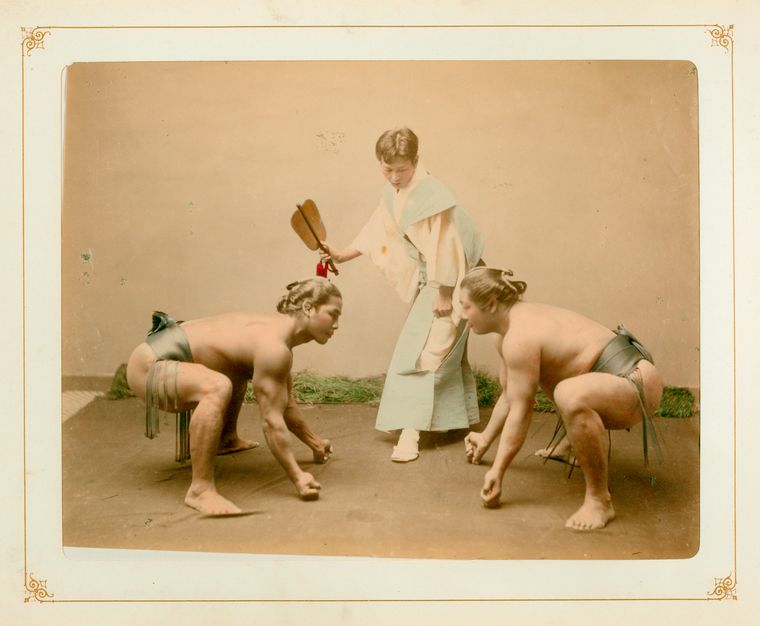
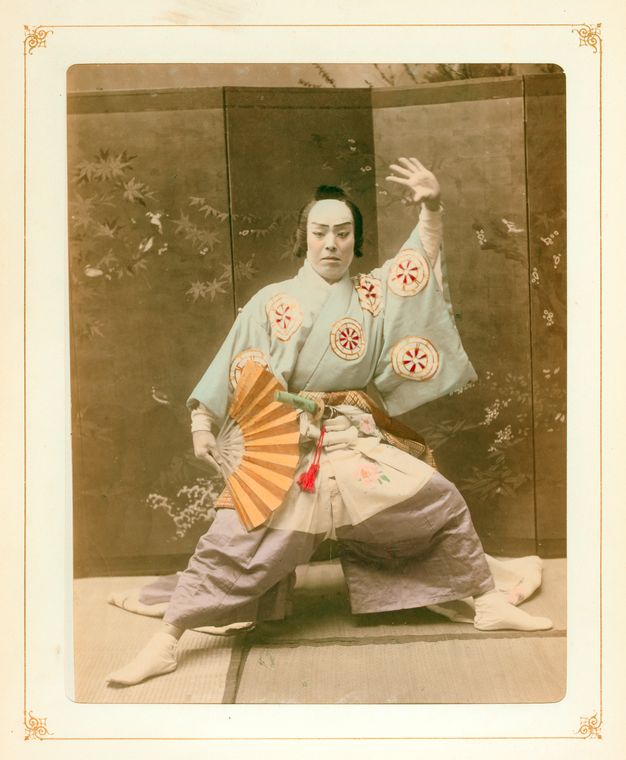
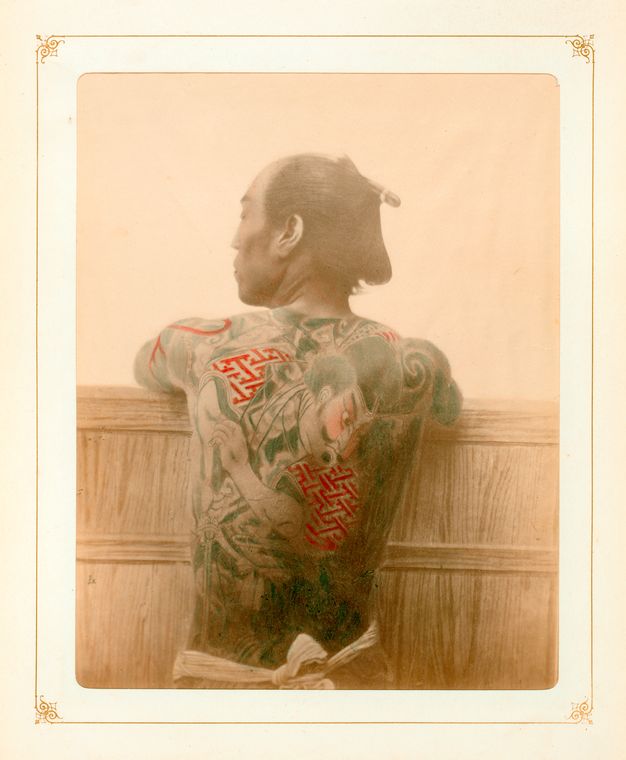
What we euphemistically refer to as the “Opening of Japan” catalyzed a period of seismic upheaval for the proud formerly closed country. Between the fall of the Tokugawa shogunate in 1853 and the Meiji restoration in 1868, Japanese society changed rapidly due to the sudden forced influx of foreign capital and influence, much of it destructive. “Unemployment rose,” writes historian John W. Dower, “Domestic prices soared sky high…. Much of Japan was wracked by famine in the mid 1860s…. As if all this were not curse enough, the foreigners also brought cholera with them.” They also brought photography, and both Western and Japanese photographers documented not only the country’s profound transformation, but also its traditional dress and culture.
Closed for 200 years, Japan became a source of endless fascination for Westerners as artifacts made their way across the sea. Among them was “an extensive photographic documentation of Japan,” notes the New York Public Library, and “of interaction between the Japanese and foreigners” (Commodore Perry’s expedition to Tokyo Bay included a daguerreotype photographer.)
“In the broadest sense, photography entered Asia from Europe and America as part of the process of colonialism, but soon took root in those regions with local photographers.”
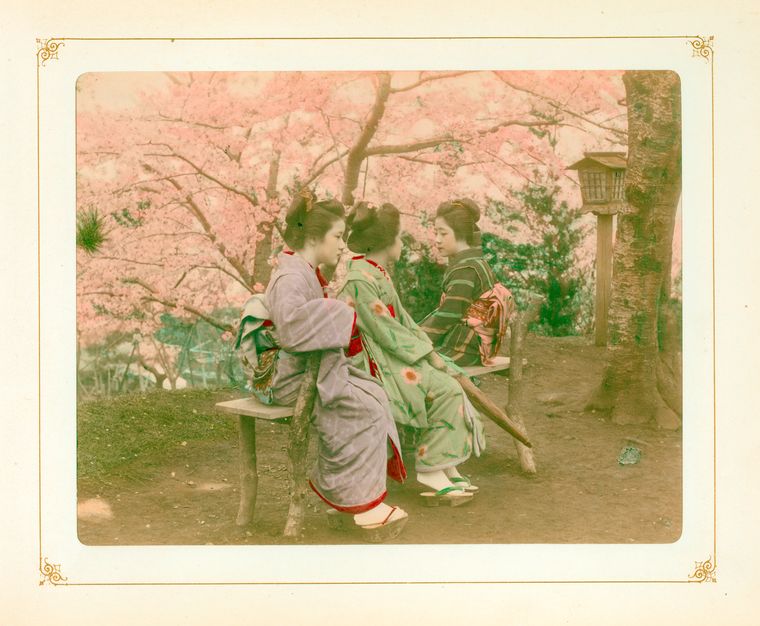
The colorized images you see here come from the NYPL’s large collection of late 19th century Japanese photography, taken by photographers like the Italian-British Felice Beato and his Japanese student Kimbei, who “assisted Beato in the hand-coloring of photographs until 1863,” then “set up his own large and flourishing studio in Yokohama in 1881.” The archive provides “a rich resource for the understanding of the political, social, economic, and artistic history of Asia from the 1870s to the early 20th century.” These images date from between 1890 and 1909, by which time much of Japan had already been extensively westernized in dress, architecture, and style of government.
To many Japanese, the old ways, sustained through a couple hundred years of isolation, must have seemed in danger of slipping away. To many Westerners, however, the encounter with Japan offered a kind of cultural renewal. As the Metropolitan Museum of Art points out, “a tidal wave of foreign imports” from Asia, including “woodcut prints by masters of the ukiyo‑e school… transformed Impressionist and Post-Impressionist art.” European collectors, traders, and artists discovered a mania for all things Japanese, even as some of its cultural forms threatened to disappear. Enter the NYPL’s digital collection, Photographs of Japan, here.
Note: An earlier version of this post appeared on our site in 2017.
Related Content:
Josh Jones is a writer and musician based in Durham, NC.
Read More...Support Us
We're hoping to rely on loyal readers, rather than erratic ads. Please click the Donate button and support Open Culture. You can use Paypal, Venmo, Patreon, even Crypto! We thank you!

About Us

Open Culture scours the web for the best educational media. We find the free courses and audio books you need, the language lessons & educational videos you want, and plenty of enlightenment in between.
Advertise With Us

FREE UPDATES!
GET OUR DAILY EMAIL
Get the best cultural and educational resources on the web curated for you in a daily email. We never spam. Unsubscribe at any time.
FOLLOW ON SOCIAL MEDIA

Open Culture editor Dan Colman scours the web for the best educational media. He finds the free courses and audio books you need, the language lessons & movies you want, and plenty of enlightenment in between.
Advertise With Us

