The Official Mister Rogers’ Neighborhood YouTube Channel Goes Live: Watch Complete Episodes, Including the Very First
A great many, and perhaps the majority of Americans now between their late twenties and early sixties, have spent time in Mister Rogers’ neighborhood. My own period of regular visitation would have been in the nineteen-eighties, a decade when Fred Rogers introduced his preschool-age viewers to guest stars from Lou Ferrigno, in and out of Incredible Hulk makeup, to a ten-year-old boy with spina bifida. He also took on geopolitical issues, up to and including mutually assured nuclear destruction, and social ones, as on the memorable “divorce week” of 1981. Such topical broadcasts were mixed in with re-runs produced as far back as 1969, the year Mister Rogers got the country’s attention by inviting Officer Clemmons to share his wading pool.
What those of us then tuning in didn’t see was anything from the first, black-and-white season of Mister Rogers’ Neighborhood, which comprised an astonishing 130 episodes that aired in 1968 alone. You can watch the series premiere at the top of the post, just recently uploaded onto the show’s new official channel.
It may come as a shock to see a 39-year-old Mister Rogers, whom most of us remember as the embodiment of avuncularity or even grandfatherliness. But what’s even more striking, if unsurprising, is that his onscreen persona, with its disinclination to talk down to children, never really changed. That surely owes to its apparent identity with his offscreen persona: as he liked to put it, “kids can spot a phony a mile away.”
“Aside from clips and compilations,” writes the New York Times’ Sopan Deb, “the channel will make a selection of full-length episodes available globally for the first time as well as some that haven’t aired in several decades on PBS stations.” With the show’s 60th anniversary coming up the year after next, the time does seem right to make as many of its 895 episodes as possible available to a new generation. As of now, the channel also offers the episodes with Officer Clemmons and the pool, Koko the Gorilla, and the mesmerizing look inside the crayon factory. There’s even the crossover between Mister Rogers and Bill Nye the Science Guy from 1997, by which time the latter had become a television icon to us millennials. Though we probably didn’t catch his visit at the time, we can now keep it bookmarked to show our own kids — assuming they don’t discover it first.
Related Content:
Mr. Rogers Takes Breakdancing Lessons from a 12-Year-Old (1985)
Mr. Rogers’ Nine Rules for Speaking to Children (1977)
Watch the First Episode of Sesame Street and 140 Other Free Episodes
Based in Seoul, Colin Marshall writes and broadcasts on cities, language, and culture. He’s the author of the newsletter Books on Cities as well as the books 한국 요약 금지 (No Summarizing Korea) and Korean Newtro. Follow him on the social network formerly known as Twitter at @colinmarshall.
Read More...What Happens When the Author Directs the Movie: How Robert Rodriguez Recruited Frank Miller to Co-Direct Sin City
In the nineteen-nineties, Quentin Tarantino and Robert Rodriguez first collaborated on a movie. No, it wasn’t From Dusk Till Dawn, the Rodriguez-directed crime-picture-turned-horror-comedy in which Tarantino plays George Clooney’s psychotic brother. It was an anthology picture called Four Rooms, whose separate but interconnected stories, all set in the same hotel on New Year’s Eve, were directed by an all-star lineup of the “Indiewood” auteurs of 1995: Tarantino, Rodriguez, Allison Anders, and Alexandre Rockwell. Rodriguez jumped at the chance to do short-form work and collaborate with friends, but alas, the concept inspired much more enthusiasm from moviegoers than the result, to say nothing of the critics’ judgment.
“Anthologies never work,” Rodriguez said last year during an interview with Lex Fridman. Even with the best filmmakers participating, “they bomb because people can’t quite wrap their head around it”: they feel like the movie keeps starting over and over again. Yet in the fullness of time, Four Rooms took his career up a level, not down.
“I really want this anthology thing to work,” he says, explaining his mindset about a decade after that film’s failure. “What if it’s three stories, like a three-act structure, not four, same director, not four different directors?” After all, “I had already done one and figured out how I could do it better.” The result was Sin City, from 2005, his adaptation of Frank Miller’s acclaimed noir comic-book series co-directed with Miller himself.
By now, comic-book movies, or at least movies that make use of intellectual property drawn from comic books, have long been commonplace. What Rodriguez and Miller made two decades ago was something different: a film that looked and felt just like its source material. As Danny Boyd explains in the CinemaStix video at the top of the post, Sin City was “not an adaptation, but a translation,” which Rodriguez thought of less as bringing the page to the screen than “taking cinema and turning it into a book.” Ironically, Miller had meant to avoid the whole Hollywood development process by deliberately making the original comics as un-filmable as possible — he just hadn’t reckoned on what technology and Rodriguez’s D.I.Y. ethos would eventually make possible.
Having famously broken into Hollywood with his debut feature El Mariachi, the “$7,000 movie” on which he performed all technical duties, Rodriguez understood how digital filmmaking could empower individual creators. The green screen, which enables the placement of real actors into any setting imaginable, promised him a way to re-create the “layers of unreality” that constitute a flamboyantly stylized work of ultra-noir like Sin City. In the video just above, Boyd shows us how green-screen shooting made it possible to realize the comic’s elaborate aesthetic in motion, creating not a cheap substitute for real sets and locations, as has since become dispiritingly common in Hollywood, but another reality altogether. And if you can bring Quentin Tarantino in to guest-direct a sequence, as Rodriguez did, so much the better.
Related Content:
Director Robert Rodriguez Teaches The Basics of Filmmaking in Under 10 Minutes
How the “Marvelization” of Cinema Accelerates the Decline of Filmmaking
When a Modern Director Makes a Fake Old Movie: A Video Essay on David Fincher’s Mank
The Essential Elements of Film Noir Explained in One Grand Infographic
Every Spider-Man Movie and TV Show Explained By Kevin Smith
Nigerian Teenagers Are Making Slick Sci Fi Films With Their Smartphones
Based in Seoul, Colin Marshall writes and broadcasts on cities, language, and culture. He’s the author of the newsletter Books on Cities as well as the books 한국 요약 금지 (No Summarizing Korea) and Korean Newtro. Follow him on the social network formerly known as Twitter at @colinmarshall.
Read More...Hear the First Book of Homer’s Iliad Read Aloud in the Original Greek
You can, of course, learn the Greek language as it’s spoken today. You can also learn Greek as it was spoken in antiquity — and as it was, until fairly recently in historical time, taught to students in the modern West. But it’s a fairly different endeavor again to learn Greek as Homer spoke it. The fact of the matter is that no human being ever really spoke like Achilles, Agamemnon, Odysseus, Penelope, or any of the other characters in the Iliad and Odyssey. Homer’s many literary achievements through these works include the creation and command of a kind of synthesized poetic Greek, combining qualities of regional Ionic and Aeolic dialects with various forms and expressions that were outdated even in the eighth century BC. If it served the meter, Homer used it.
Needless to say, when most of us attempt to read Homer aloud in the original, we get it all or mostly wrong, even if we’re familiar with modern Greek. We’d have to spend a long time indeed in the world of classicists before hearing a more accurate recording than the one above, delivered by a YouTuber called Thomas Whichello.
On his channel, Whichello specializes in performing venerable literary texts with a pronunciation and cadence as close to period-accurate as possible, often in the original language, sometimes with his own musical accompaniment. He’s done readings of the Bible, Shakespeare, Keats, and Wilde, but none so far has been so popular as his rendition of the first book of the Iliad, accompanied by subtitles of Homer’s text and an English translation.
A Greek here in 2026 with no particular knowledge of the classical language may understand a quarter of the individual words Whichello uses, and maybe half of them in certain passages. Actually being able to follow the story, however, is another matter. Still, you can get a surprising amount out of the video even if you understand nothing at all, since Whichello is aiming not just for linguistic accuracy, but also emotional resonance in his delivery. Ignore his glasses, button-down shirt, microphone, and window frame, and you could almost be sitting around a campfire with him nearly 30 centuries ago. Note, also, that the commenters include genuine classicists who call his the best reading they’ve ever heard — as well as viewers, credentialed or otherwise, eager to hear him name all those mighty Achaean ships in Book 2.
Related content:
Hear What Homer’s Odyssey Sounded Like When Sung in the Original Ancient Greek
Learn Ancient Greek in 118 Free Lessons: A Free Online Course from Brandeis & Harvard
The Ancient Greeks: A Free Online Course from Wesleyan University
Listen to The Epic of Gilgamesh Being Read in its Original Ancient Language, Akkadian
Based in Seoul, Colin Marshall writes and broadcasts on cities, language, and culture. He’s the author of the newsletter Books on Cities as well as the books 한국 요약 금지 (No Summarizing Korea) and Korean Newtro. Follow him on the social network formerly known as Twitter at @colinmarshall.
Read More...How Conflict Helped Create Pink Floyd’s “Comfortably Numb” and Its Legendary Guitar Solos
Even among the most acclaimed albums ever recorded, not a single one is perfect. That goes more so for the releases of what I call the “heroic age of the album,” which enjoyed its zenith around the late seventies. Not coincidentally, 1979 was the year that Pink Floyd put out The Wall, a rock opera whose sprawl across two discs deals with themes ranging from the bombings of the Second World War to drug dependency to fascist impulses to the isolation of superstardom. This ambition was repaid: The Wall soon became the best-selling double album of all time, despite having been received with at least a measure of ambivalence over the grandness, or perhaps grandiosity, of the scale of its production and the tone of its narrative.
Yet those few prepared to call The Wall an artistic failure must nevertheless acknowledge how much impressive work it really does contain. Of its popularly appreciated achievements, perhaps the most memorable is David Gilmour’s guitar solo, or rather the guitar solos, on “Comfortably Numb,” a song about being medically revived from a substance-induced stupor moments before giving a concert.
They certainly stuck in my own head in seventh grade, when my music teacher assigned our class term paper analyzing the album, and kept popping back into it over the subsequent decades. “His playing is so lyrical,” says YouTuber David Hartley in his new video about the making of “Comfortably Numb.” “The way he plays each note is in a way that you can almost sing it, and the way he uses phrases is so simple, and so beautiful.”
These solos were recorded in a context of less-than-smooth sailing for the Floyd: as we’ve previously featured here on Open Culture, “Comfortably Numb” was the product of another argument punctuating the long-fraying partnership between Gilmour and lead singer Roger Waters, for whom The Wall was a way of rendering his own life experiences and perceptions in musical form. But as sometimes happens, conflict — in this case, between two competing and starkly different concepts of the song, whose evolution Hartley explains with demo recordings and interview clips — produced a greater result than any one artist’s vision. It all arrives at what Hartley calls “possibly the greatest guitar solo of all time,” which closes out side three, and indeed the most fruitful era of Gilmour and Waters’ collaboration. Even those who can’t take The Wall too seriously have to admit that life isn’t necessarily easy for a rock star, much less for two of them in the same studio.
Related content:
The History of the Electric Guitar Solo: A Seven-Part Series
Oxford Scientist Explains the Physics of Playing Electric Guitar Solos
David Gilmour & David Bowie Sing “Comfortably Numb” Live (2006)
The Evolution of the Rock Guitar Solo: 28 Solos, Spanning 50 Years, Played in 6 Fun Minutes
Based in Seoul, Colin Marshall writes and broadcasts on cities, language, and culture. He’s the author of the newsletter Books on Cities as well as the books 한국 요약 금지 (No Summarizing Korea) and Korean Newtro. Follow him on the social network formerly known as Twitter at @colinmarshall.
Read More...Kurt Vonnegut Diagrams the Shape of All Stories in a Master’s Thesis Rejected by U. Chicago
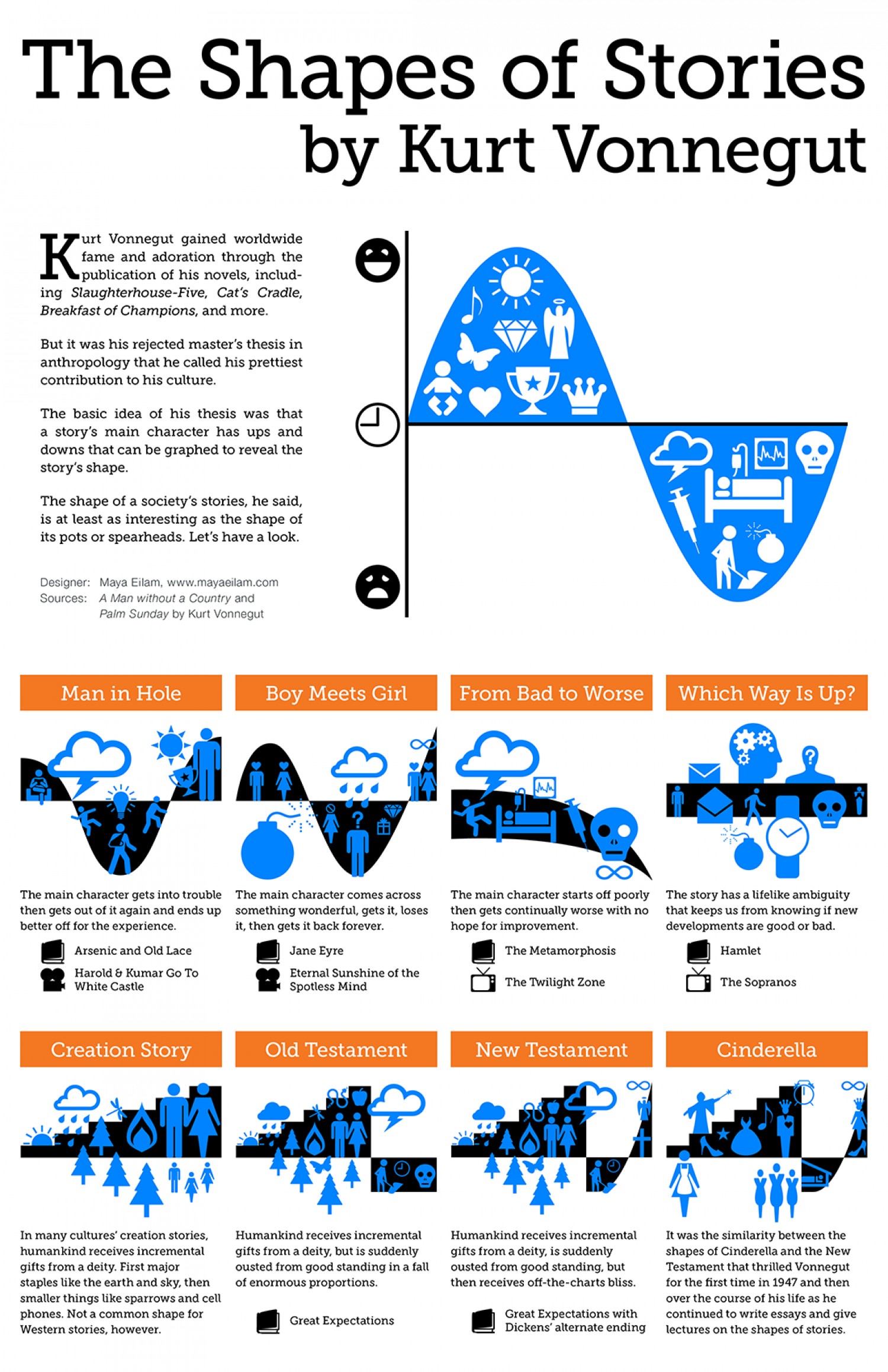
“What has been my prettiest contribution to the culture?” asked Kurt Vonnegut in his autobiography Palm Sunday. His answer? His master’s thesis in anthropology for the University of Chicago, “which was rejected because it was so simple and looked like too much fun.” The elegant simplicity and playfulness of Vonnegut’s idea is exactly its enduring appeal. The idea is so simple, in fact, that Vonnegut sums the whole thing up in one elegant sentence: “The fundamental idea is that stories have shapes which can be drawn on graph paper, and that the shape of a given society’s stories is at least as interesting as the shape of its pots or spearheads.” In 2011, we featured the video below of Vonnegut explaining his theory, “The Shapes of Stories.” We can add to the dry wit of his lesson the picto-infographic by graphic designer Maya Eilam above, which strikingly illustrates, with examples, the various story shapes Vonnegut described in his thesis. (Read a condensed version here.)
The presenter who introduces Vonnegut’s short lecture tells us that “his singular view of the world applies not just to his stories and characters but to some of his theories as well.” This I would affirm. When it comes to puzzling out the import of a story I’ve just read, the last person I usually turn to is the author. But when it comes to what fiction is and does in general, I want to hear it from writers of fiction. Some of the most enduring literary figures are expert writers on writing. Vonnegut, a master communicator, ranks very highly among them. Does it do him a disservice to condense his ideas into what look like high-res, low-readability workplace safety graphics? On the contrary, I think.
Though the design may be a little slick for Vonnegut’s unapologetically industrial approach, he’d have appreciated the slightly corny, slightly macabre boilerplate iconography. His work turns a suspicious eye on overcomplicated posturing and champions unsentimental, Midwestern directness. Vonnegut’s short, trade publication essay, “How to Write With Style,” is as succinct and practical a statement on the subject in existence. One will encounter no more ruthlessly efficient list than his “Eight Rules for Writing Fiction.” But it’s in his “Shapes of Stories” theory that I find the most insight into what fiction does, in brilliantly simple and funny ways that anyone can appreciate.
Note: An earlier version of this post appeared on our site in 2014.
Related Content:
Kurt Vonnegut Explains “How to Write With Style”
The Shape of A Story: Writing Tips from Kurt Vonnegut
Kurt Vonnegut Offers 8 Tips on How to Write Good Short Stories
Kurt Vonnegut: Where Do I Get My Ideas From? My Disgust with Civilization
Josh Jones is a writer and musician based in Durham, NC.
Read More...An Introduction to the Islamic World: 1,000 Years of History in 19 Minutes
References to Islam in major media can make it sound monolithic and eternal. But it’s actually a much younger and less unified phenomenon than many of us imagine, especially if we happen to live outside the Middle East. As a religion, it dates back “only” to the seventh century, when it was founded by the Prophet Muhammad. As an engine of large-scale civilization, Islam took a bit longer to come into its own, and it hasn’t stopped undergoing divisions, transformations, declines, and rebirths since. Here on Open Culture, we recently featured a video from YouTube channel How So covering 1,000 years of medieval European history in 20 minutes. The one above does the same thing for the Islamic world’s first millennium, ending with the rise of the Ottoman Empire.
After he united the formerly polytheistic Arab tribes under his new faith, Muhammad lived for a decade longer. His death in the year 632 marked the last time that every believer in Islam would have been on the same page. It was at that point that the title caliph, or successor, was defined, and the first four caliphs after Muhammad held power for thirty years, the period in which the first Muslim state emerged.
The caliphate, as their territory was called, expanded widely across and out of the Arabian Peninsula, into the territories of the Byzantine and Sassanian empires. Supporters of the early caliph Ali ibn Abi Talib argued that he was the true heir to Islam, and detractors that he wasn’t. Eventually, the former group became known as the Shias, and the latter as the Sunnis, the two sides of a schism of which practically everyone today has heard.
Lesser known to the general public are the Umayyads, Abbasids, Buyids, and Fatimids, all of them major players in the continuing expansion of Islam well into the Middle Ages. But the still-familiar place names of Damascus, Jerusalem, Baghdad, and Constantinople (or, as we know it, Istanbul) are just as important in these chapters of the story of Islam, and without understanding that religion, it’s impossible to understand the diverse forms that civilization has taken in those places and others in the wider region of the world around them. The crisis of authority that began setting in after Muhammad’s death has, in some sense, persisted for nearly fourteen centuries now, more than long enough to have become a defining characteristic of the Islamic world. What shape its societies will take over the next millennium, it would surely take a prophet to know.
Related Content:
The Birth and Rapid Rise of Islam, Animated (622‑1453)
500+ Beautiful Manuscripts from the Islamic World Now Digitized & Free to Download
How Medieval Islamic Engineering Brought Water to the AlhambraThe Complex Geometry of Islamic Art & Design: A Short Introduction
The World Map That Introduced Scientific Mapmaking to the Medieval Islamic World (1154 AD)
1,000 Years of Medieval European History in 20 Minutes
Based in Seoul, Colin Marshall writes and broadcasts on cities, language, and culture. He’s the author of the newsletter Books on Cities as well as the books 한국 요약 금지 (No Summarizing Korea) and Korean Newtro. Follow him on the social network formerly known as Twitter at @colinmarshall.
Read More...The Largest Bookshelf Tour Ever Filmed: Inside a Classicist’s 20,000-Volume Library
If you grew up in the last few generations, chances are you didn’t get much of an education, if any, in Latin or ancient Greek. One long-made argument for phasing them out of curricula in English-speaking countries holds that room must be made for Spanish, Mandarin, and other languages actually used at scale in the modern world. Nowadays, when even those classes face the pressure of extinction, advocacy for classical languages exudes an ever stronger contrarian appeal. “Dead” though they may be, they also live on through not just the Romance languages, but also the mighty hegemon known as English. Indeed, it makes sense to ask whether an Anglophone without knowledge of Latin or Greek truly understands his own native tongue.
Nor, according to classicist David Butterfield, can one learn Latin without having any Greek. Getting a handle on both of those languages and their surviving body of texts isn’t just the work of a lifetime; it also fills a house, as evidenced by the two-and-a-half-hour video tour of Butterfield’s personal library above. (The subsequent two hours contain Butterfield’s introductions to a selection of particular volumes from his many shelves.) Youtuber Timothy Kenny has previously uploaded quite a few such videos on the collections of serious bibliophiles, but this one he describes as the largest ever attempted, including the complete Loeb Classical Library, I Tatti Renaissance Library, and Pauly-Wissowa encyclopedias.
Yet according to Butterfield himself, a young man by the standards of his profession and specialty, he’s still got a lot of collecting to do. He’s only about 80 percent of the way to a full set of Oxford University Press’ Very Short Introductions, a series through which I’ve been gradually making my own way in recent years. Having found that its books offer “a really good view of whatever the topic or person is,” he decided to “collect all the volumes that interested me. And that emerged to be more than I thought, because I am interested in almost everything.” But with all of us, no matter how broadly curious, some of his interests are stronger than others, as one might expect from a man with the patience to amass a great amount of manuals for writing Greek and Latin prose and verse made for schoolboys (and, often, containing their doodles).
After spending a couple of decades at Cambridge, Butterfield crossed the Atlantic to go from one of the oldest institutions of higher education to one of the very newest. He’s now Provost of and Professor of Latin at Ralston College in Savannah, Georgia, which received its first cohort of students in 2022. With its master’s degree program closely focused on ancient, medieval and modern literature and art considered foundational to Western civilization, it seems like the kind of institution designed to attract someone like Butterfield, who was already winning prizes for his library in or shortly after his college days. “I can’t see myself relaxing until I have accumulated around 10,000 books,” he said in a 2008 interview. His home, as captured in Kenny’s video, now contains double that amount, but the thumos clearly hasn’t deserted him just yet.
Related content:
Watch Umberto Eco Walk Through His Immense Private Library: It Goes On, and On, and On!
Jorge Luis Borges Selects 74 Books for Your Personal Library
Take a Virtual Tour of Jane Austen’s Library
Based in Seoul, Colin Marshall writes and broadcasts on cities, language, and culture. He’s the author of the newsletter Books on Cities as well as the books 한국 요약 금지 (No Summarizing Korea) and Korean Newtro. Follow him on the social network formerly known as Twitter at @colinmarshall.
Read More...Hip 1960s Latin Teacher Translated Beatles Songs into Latin for His Students: Read Lyrics for “O Teneum Manum,” “Diei Duri Nox” & More
I’ve interacted with many entertaining language-learning resources in various classes—from miniseries in Spanish to comic books in French—all geared toward making the unfamiliar language relevant to daily life. Learning counterintuitive pronunciations, parsing a new system of grammar, or memorizing the genders of word after word can be laborious and intimidating in the classroom. Doing so in everyday pop cultural settings, not as much.
When it comes to the teaching of dead languages, the resources can seem less approachable. I certainly appreciate the literary and rhetorical genius of Virgil, Ovid, Horace, Cicero, and Julius Caesar. But during my high school years, I did not always find their work easy to read in English, much less in formal classical Latin. The elation I felt after successfully translating a passage was sometimes dampened as I puzzled over historical notes and glosses that often left me with more questions than answers.
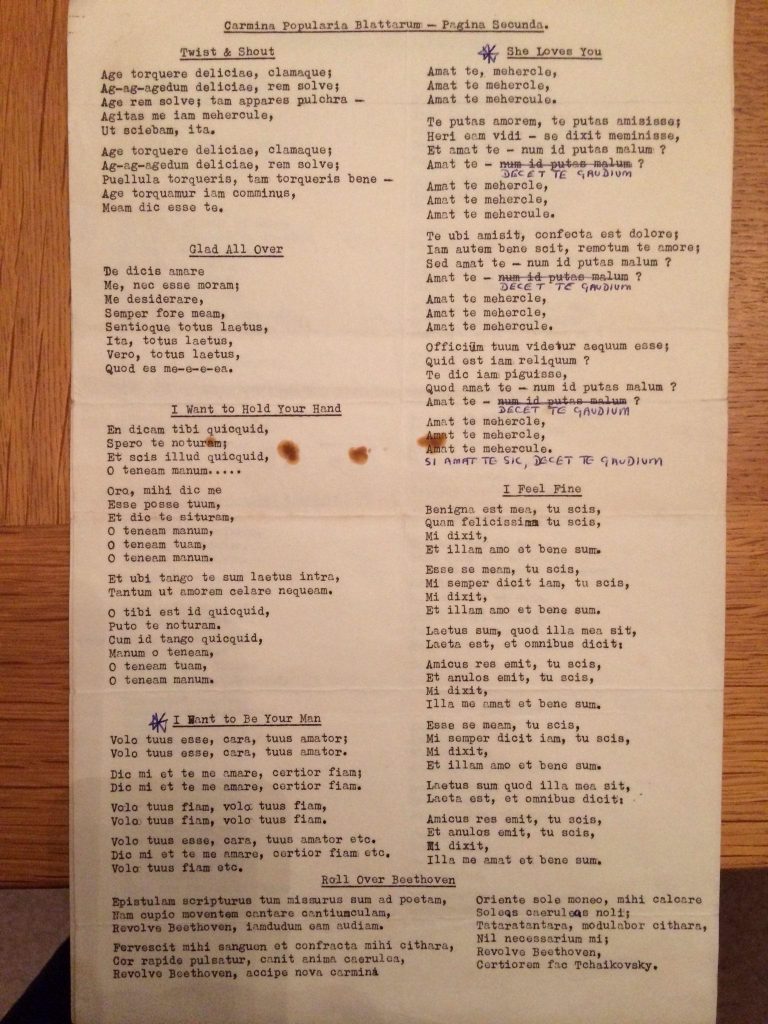
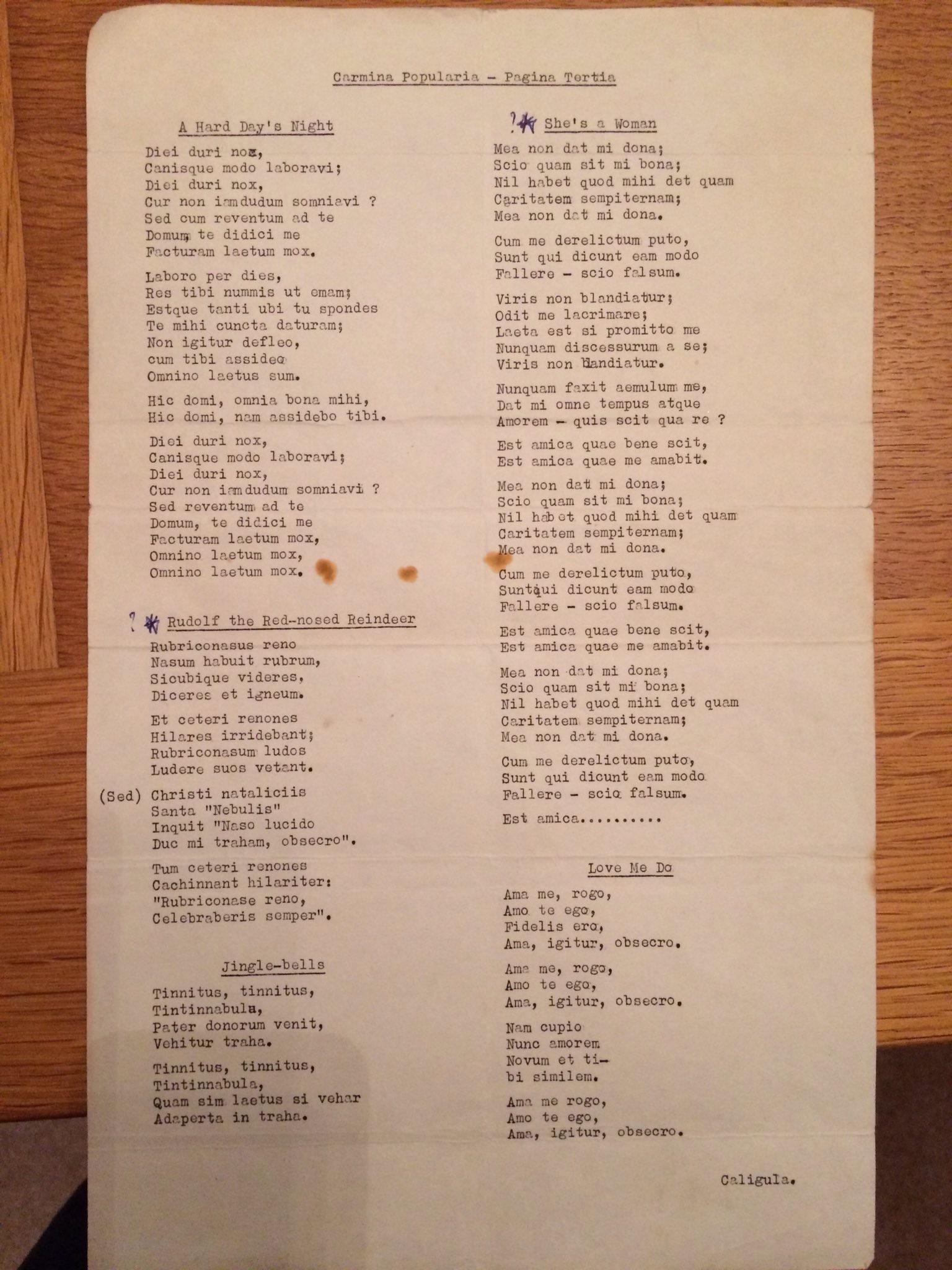
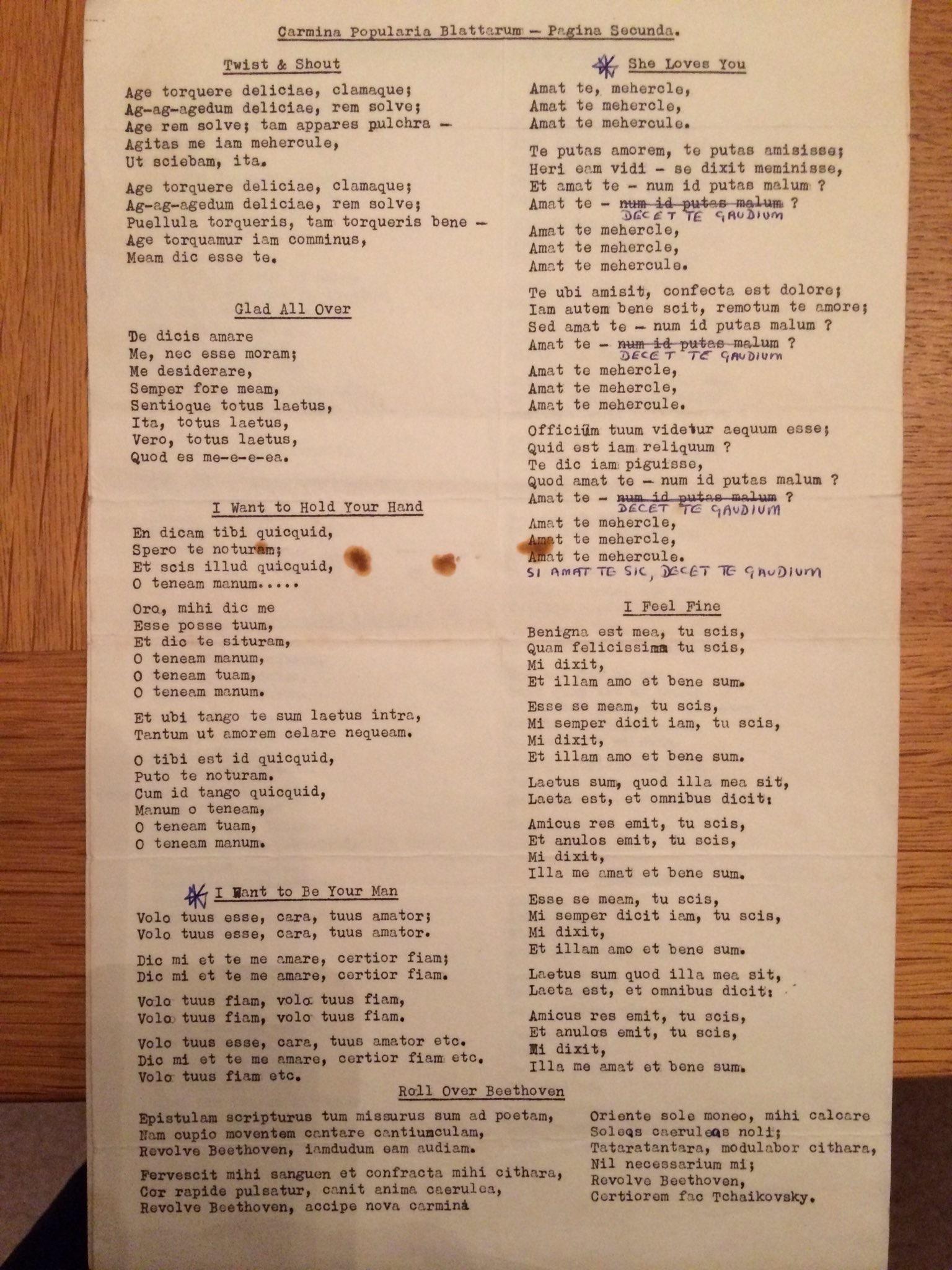
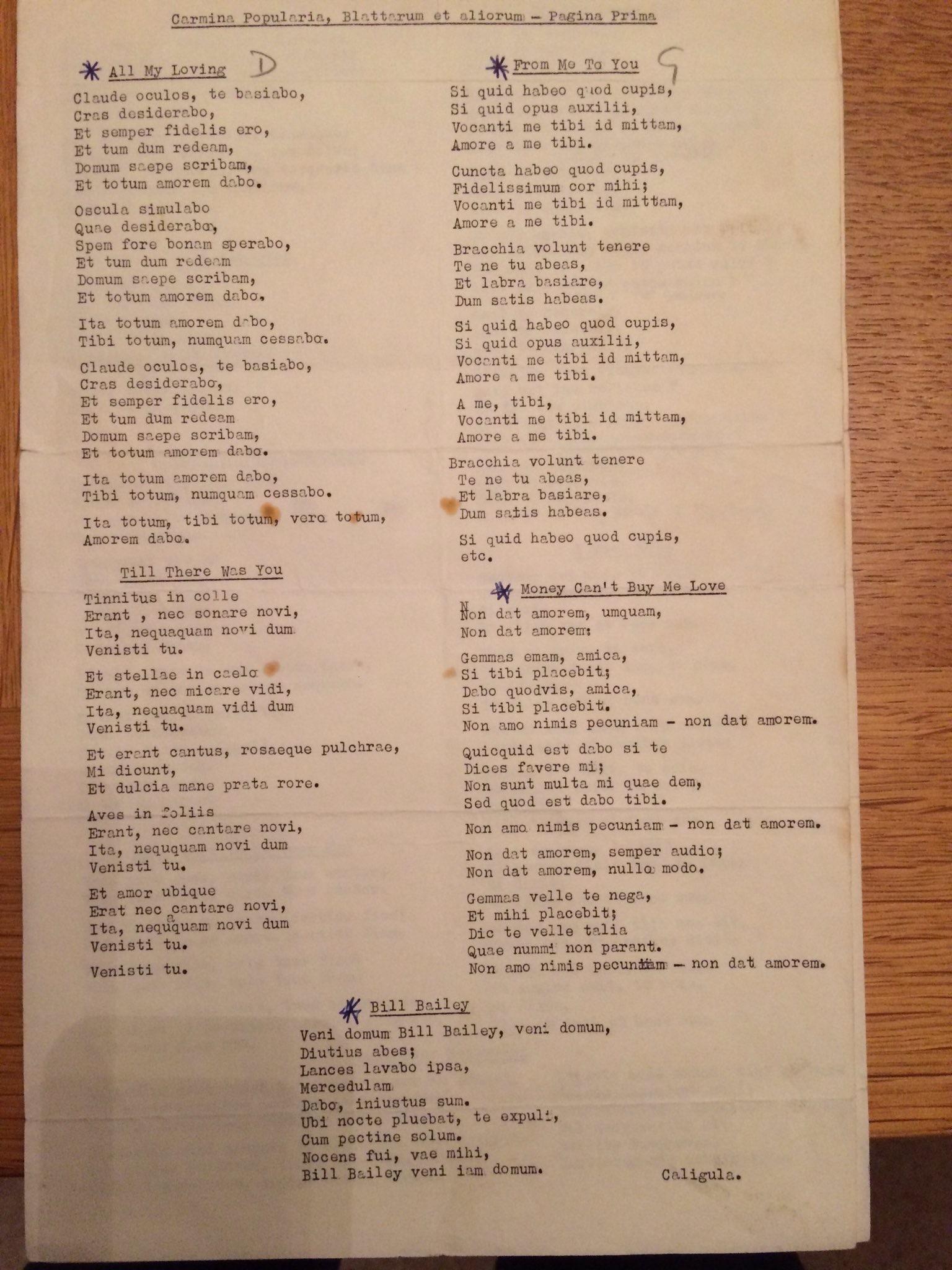
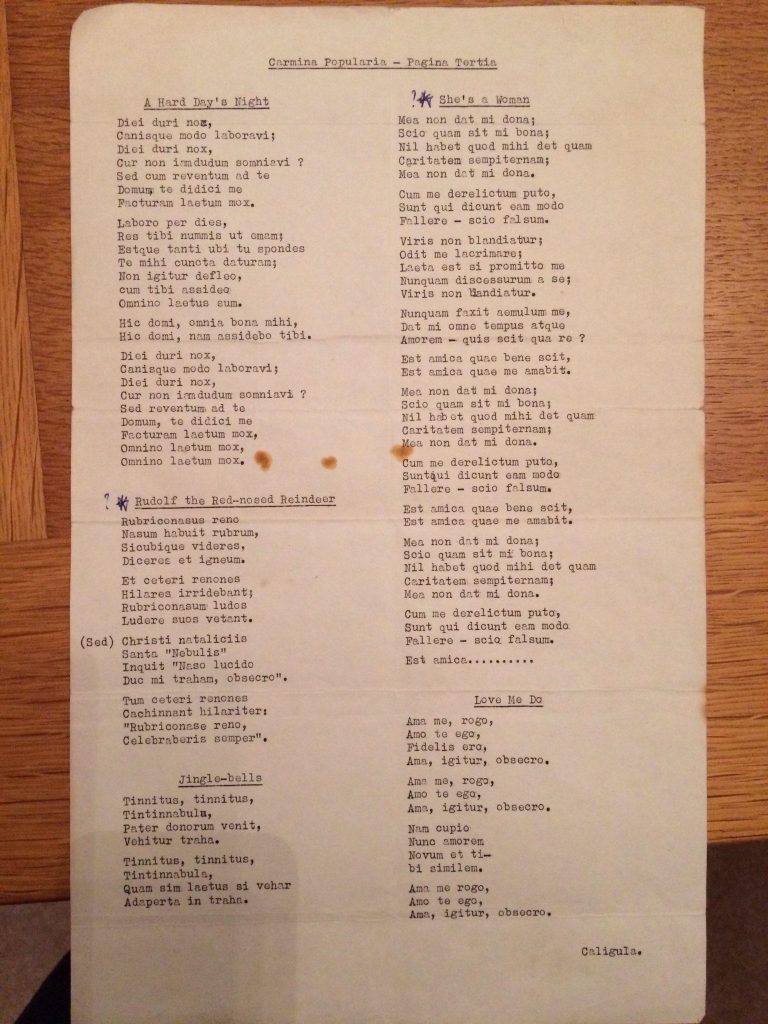
That’s not at all to say that students of Latin shouldn’t be exposed to cultural and historical context or read the finest exemplars of the written language. Only that a break from the heavy stuff now and then goes a long way. Might I submit to Latin instructors one ingenious tool from Eddie O’Hara, former British Labour Party MP and classics teacher? O’Hara passed away in May 2016, and not long after his death, his son Terry O’Hara tweeted these translations of Beatles songs (including two Christmas tunes) his father made in the 60s for his students. At the time, these were the height of pop culture relevance, and, while a far cry from the complexities of the Aeneid, a fun way for Latin learners to relate to a language that can seem cold and imposing.
I will admit, my Latin has fallen into such a state that I can’t immediately vouch for the accuracy or elegance of these translations (“cue fierce arguments among Latin grammarians,” replies one Twitter user), but there’s no reason to doubt Mr. O’Hara knew his stuff. ““He was a born educator,” his son remembers, “He was a teacher and classicist by background and he had a strong interest in educational matters and Greek cultural heritage.” Educated himself at Magdalen College, Oxford, O’Hara taught at Perse School, Cambridge, Birkenhead School, and in the early 70s, C.F. Mott College in the Beatles’ own Liverpool.
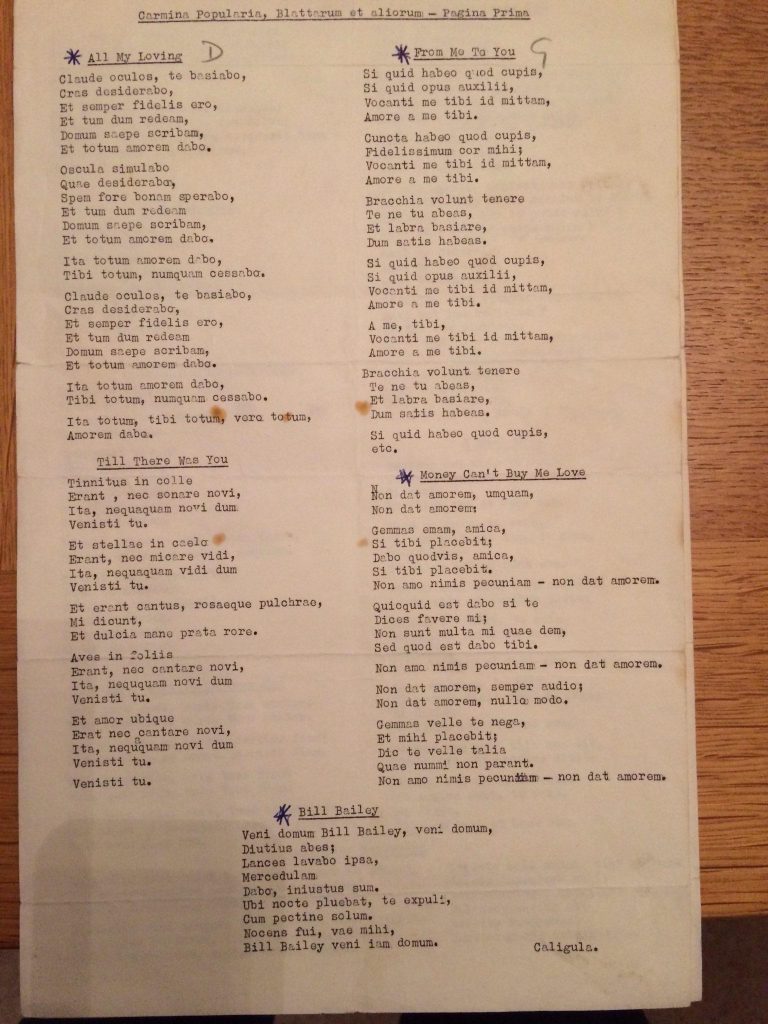
In addition to his role as a statesman, the Liverpool Echo remembers O’Hara’s many decades as “a popular teacher who brought classes to life translating Beatles lyrics into Latin.” We do not have any indication of whether he actually tried to sing the lyrics, though his students surely must have attempted it. What must the chorus of “All My Loving” sound like as “Ita totum amorem dabo, Tibi totum, numquam cessaba”? Or “She Loves You” as “Amat te, mehercle”? Singing them to myself, I can see that O’Hara was sensitive to the meter of the original English in his Latin renderings. But I’d really love to see someone set these to music and make a video. Any of our readers up to the challenge?
Finally, since early sixties Beatles lyrics aren’t as likely to engage students in 2017, what pop cultural material would you translate today—classics teachers out there—to reach the bemused, bewildered, and the bored? If you’re already hard at work using hip resources in the classroom, please do share them with us in the comments!
Note: To view the images in a larger format, please click on the links to these individual images: Image 1 - Image 2 — Image 3. When the image opens, click on it again to zoom in.
Note 2: An earlier version of this post appeared on our site in 2017.
Related Content:
Hear Nirvana’s “Smells Like Teen Spirit” Performed in Classical Latin
Can Modern-Day Italians Understand Latin? A YouTuber Puts It to the Test on the Streets of Rome
They Might Be Giants’ John Linnell Releases an EP of Songs in Latin
The Story of Lorem Ipsum: How Scrambled Text by Cicero Became Used by Typesetters Everywhere
Josh Jones is a writer and musician based in Durham, NC.
Read More...A Tour of Athens’ Acropolis, Explained with 3D Reconstructions
Since it was first built as a Mycenaean fortress in the thirteenth century BC, what we now know as the Acropolis has been used to worship not just Greek gods, but also, in later periods, the Virgin Mary and Allah. Now, of course, with its days of military and religious functions long behind it, it stands as a set of ruins. Still, they’re very popular ruins, as evidenced by the crowds captured in the video above from Manuel Bravo. Though most tourists at the Acropolis come with the idea that its buildings would have looked more glorious in the distant past, few can have much of a sense of how to imagine that with any accuracy. Using 3D models, Bravo integrates views of how the Parthenon, the Temple of Athena Nike, and other structures look now with how they would have looked in Athens’ golden age.
To fully appreciate the Acropolis requires not just an idea of how it was originally intended to look, as Bravo emphasizes, but also the intentions of ancient Greek architecture. The approach up the hill was meant to feel like an ascent from the mundane world into the sacred one.
Entering the central space on top, the visitor was led to viewing points that showed the surrounding collection of buildings at their most dramatic, a design the architects might have described as cinematic, had cinema existed at the time. Even in its ruined state, the Acropolis still transmits a sense of how, where, and to what degree that visitor was meant to be filled with awe, as well as where he was meant to look. And nothing up there — at least in the absence of Phidias’ thirty-foot statue Athena Promachos — draws attention as deliberately as the Parthenon.
As we previously noted here on Open Culture, if you make the trip to the Acropolis yourself, you can now see the Parthenon without scaffolding (or, depending on when you go, a minimum of scaffolding) for the first time in 200 years. That lack of obstruction makes it easier to envision the glories of that celebrated building back when it was both the temple of Athena and the treasury of Athens. But as Bravo says, if you really want to gaze upon the Parthenon as the ancients knew it, marbles and all, you’ll have to make the trek out to Nashville, Tennessee, where a full-scale replica was built in 1897 for the city’s Centennial Exposition. It may feel a bit odd to turn up in a place known for country music and bachelorette parties in search of the architectural, and perhaps spiritual foundation of Europe. But then, civilization has never taken a predictable course.
Related Content:
How the Ancient Greeks Built Their Magnificent Temples: The Art of Ancient Engineering
A 3D Model Reveals What the Parthenon and Its Interior Looked Like 2,500 Years Ago
A Virtual Tour of Ancient Athens: Fly Over Classical Greek Civilization in All Its Glory
Take a High Def, Guided Tour of Pompeii
Based in Seoul, Colin Marshall writes and broadcasts on cities, language, and culture. He’s the author of the newsletter Books on Cities as well as the books 한국 요약 금지 (No Summarizing Korea) and Korean Newtro. Follow him on the social network formerly known as Twitter at @colinmarshall.
Read More...The Unexpected Math Behind Van Gogh’s “Starry Night”
If you’ve taken a good art history course on the Impressionists and Post-Impressionists, you’ve inevitably encountered Vincent van Gogh’s 1889 masterpiece “Starry Night,” which now hangs in the MoMA in New York City. The painting, the museum writes on its website, “is a symbolic landscape full of movement, energy, and light. The quietness of the village contrasts with the swirling energy of the sky.… Van Gogh’s impasto technique, or thickly applied colors, creates a rhythmic effect—the picture seems to constantly move in its frame.” Artistically, van Gogh managed to capture movement in a way that no artist had ever quite done it before. Scientifically, it turns out, he was on to something too. Just watch the new TED-ED lesson above, The Unexpected Math Behind Van Gogh’s “Starry Night.”
Created by math artist/teacher Natalya St. Clair and animator Avi Ofer, the video explores how “Van Gogh captured [the] deep mystery of movement, fluid and light in his work,” and particularly managed to depict the elusive phenomenon known as turbulence. In Starry Night, the video observes, van Gogh depicted turbulence with a degree of sophistication and accuracy that rivals the way physicists and mathematicians have best explained turbulence in their own scientific papers. And, it all happened, perhaps by coincidence (?), during the turbulent last years of van Gogh’s life.
Note: An earlier version of this post appeared on our site in 2014.
If you would like to support the mission of Open Culture, consider making a donation to our site. It’s hard to rely 100% on ads, and your contributions will help us continue providing the best free cultural and educational materials to learners everywhere. You can contribute through PayPal, Patreon, and Venmo (@openculture). Thanks!
Related Content
1,000+ Artworks by Vincent Van Gogh Digitized & Put Online by Dutch Museums
Vincent Van Gogh’s “The Starry Night”: Why It’s a Great Painting in 15 Minutes
Discover the Only Painting Van Gogh Ever Sold During His Lifetime
Read More...Support Us
We're hoping to rely on loyal readers, rather than erratic ads. Please click the Donate button and support Open Culture. You can use Paypal, Venmo, Patreon, even Crypto! We thank you!

About Us

Open Culture scours the web for the best educational media. We find the free courses and audio books you need, the language lessons & educational videos you want, and plenty of enlightenment in between.
Advertise With Us

FREE UPDATES!
GET OUR DAILY EMAIL
Get the best cultural and educational resources on the web curated for you in a daily email. We never spam. Unsubscribe at any time.
FOLLOW ON SOCIAL MEDIA

Open Culture editor Dan Colman scours the web for the best educational media. He finds the free courses and audio books you need, the language lessons & movies you want, and plenty of enlightenment in between.
Advertise With Us