John Coltrane’s “Giant Steps” & Bach’s “Prelude in C Major” Get Turned into Dazzling Musical Animations by an Artist with Synesthesia
Colour is the keyboard, the eyes are the harmonies, the soul is the piano with many strings. The artist is the hand that plays, touching one key or another, to cause vibrations in the soul.
—Wassily Kandinsky
We may owe the history of modern art to the condition of synesthesia, which causes those who have it to hear colors, see sounds, taste smells, etc. Wassily Kandinsky, who pioneered abstract expressionism in the early 20th century, did so “after having an unusually visual response to a performance of Wagner’s composition Lohengrin at the Bolshoi Theatre,” the Denver Museum of Art notes. He was so moved by the moment that he “abandoned his law career to study painting at the prestigious Munich Academy of Fine Arts. He later described the life-changing experience: ‘I saw all my colors in spirit, before my eyes. Wild, almost crazy lines were sketched in front of me.’”
Kandinsky never heard Coltrane, but if he had, and had access to 3D rendering software, he might have made something very much like the short animation above from Israeli artist Michal Levy. “Roughly 3 per cent of people experience synaesthesia,” writes Aeon, “a neurological condition in which people have a recurring sensory overlap, such as … envisioning letters and numbers each with their own inherent colour.”
Levy’s condition is one of the most common forms, like Kandinsky’s: “chromaesthesia, in which sounds and music provoke visuals.” Where the Russian painter saw Wagner in “wild, almost crazy lines,” Levy sees the “rollicking notes” of Coltrane’s Giant Steps as a “kinetic, cascading cityscape built from colourful blocks of sound.”
After visualizing her experience of Coltrane, Levy created the animation above, Dance of Harmony, to illustrate what happens when she hears Bach. During a maternity leave, working with her friend, animator Hagai Azaz, she set herself the challenge of showing, as she describes it, “the cascading flow of emotion, to make the feeling contagious, by using only color, the basic shape of circles, and minimalist motion, assigning to each musical chord the visual elements that correspond to it synaesthetically.”
It is fascinating to compare Levy’s descriptions of her condition with those of other famous synesthetes like Vladimir Nabokov and, especially Kandinsky, who in essence first showed the world what music looks like, thereby giving art a new visual language. Levy calls her synesthesia art, an “emotional voyage of harmony,” and includes in her visualization of Bach’s famous prelude an “unexpected elegiac sidebar of love and loss,” Maria Popova writes. Read Levy’s full description of Dance of Harmony here and learn more about the “extraordinary sensory condition called synesthesia” here.
via Aeon
Related Content:
An Artist with Synesthesia Turns Jazz & Rock Classics Into Colorful Abstract Paintings
Jazz Deconstructed: What Makes John Coltrane’s “Giant Steps” So Groundbreaking and Radical?
Deconstructing Bach’s Famous Cello Prelude–the One You’ve Heard in Hundreds of TV Shows & Films
Josh Jones is a writer and musician based in Durham, NC. Follow him at @jdmagnes
Read More...A Glass Floor in a Dublin Grocery Store Lets Shoppers Look Down & Explore Medieval Ruins
In South Korea, where I live, many recent buildings — the new Seoul City Hall, Zaha Hadid’s Dongdaemun Design Plaza — have incorporated the century-upon-century old ruins discovered on their sites. This makes literally visible, often through clear glass floors, the “5,000 years of unbroken history” about which one often hears boasts in Korea. But nor is Europe historically impoverished, and there the window-onto-the-past architectural technique has been applied in even less likely places: a new Dublin location, for instance, of German chain discount supermarket Lidl.
“Architects discovered the remains of an 11th-century house during the development of the site on Aungier Street,” says the video from Irish broadcaster RTÉ above. “The sunken-floored structure has been preserved and is displayed beneath the glass.” Archaeological site director Paul Duffy described the discovery as potentially having “functioned as many things, as a house or an extra space for the family. It’s a domestic structure, so you have to imagine that there would have been a suburb here of Hiberno-Norse Dubliners, who were effectively the ancestors of the Vikings.”
We’re a long way indeed from James Joyce’s Dubliners of 900 years later. But the new Lidl has put more than one formerly buried era of the city’s past on display: “A second glass panel near the checkout tills allows shoppers to glimpse an 18th-century ‘pit trap’ from the stage of the old Aungier Street Theatre,” writes Irish Central’s Shane O’Brien, pit traps being devices “used to bring an actor on stage as if by magic. Another working area under the building preserves “the foundations of the medieval parish church of St. Peter, which served parishioners for more than 600 years between 1050 AD and 1650 AD.”
In the RTÉ video, Dublin City Archaeologist Ruth Johnson frames this as a challenge to the speed-oriented construction model — “put up a hoarding, excavate a site, and then put up a development” — prevalent during Ireland’s recent “Celtic Tiger” period of economic growth. That and other factors have made the built environment of Dublin, a city of many charms, less interesting than it could be. In his recent book Trans-Europe Express’ chapter on Dublin, critic Owen Hatherley writes that “contemporary Irish architecture is marked by a striking parsimony, a cheapness and carelessness in construction.” Looking to the past isn’t always the answer, of course, but in this case Lidl has done well to take it literally.
Related Content:
Magnificent Ancient Roman Mosaic Floor Unearthed in Verona, Italy
James Joyce’s Dublin Captured in Vintage Photos from 1897 to 1904
Based in Seoul, Colin Marshall writes and broadcasts on cities, language, and culture. His projects include the Substack newsletter Books on Cities, the book The Stateless City: a Walk through 21st-Century Los Angeles and the video series The City in Cinema. Follow him on Twitter at @colinmarshall, on Facebook, or on Instagram.
Read More...Janis Joplin & Tom Jones Bring the House Down in an Unlikely Duet of “Raise Your Hand” (1969)
If you’re a fan of Tom Jones and you don’t care who knows it, then no one needs to justify the jovial Welsh superstar’s lounge-soul covers of pop, R&B, and rock songs to you. Certain purists have been a tougher sell on Jones’ act, including, in 1969, Neil Young, who joined Jones onstage once, and only once, on the This is Tom Jones show and immediately regretted it. But who cares about Neil Young’s cranky dislike of commercial television? Who is Neil Young to say we can’t enjoy Jones’ bravado vocals on Crosby, Stills, Nash & sometimes Young’s “Long Time Gone”? The audience sure got a kick out of it, as apparently did the rest of the band.
Janis Joplin didn’t have any such hangups when she went on Jones’ show that same year. Well, she had a hangup, but it wasn’t Jones. “God bless her,” Jones remembered, “she said to me when she came on, ‘Look, I don’t do variety shows; I’m only doing it because it’s you.’ So she saw through it. Then when Janis and I did the rehearsal for Raise Your Hand she looked at me and said, ‘Jesus, you can really sing! (laughs) I thought, thank God people like Janis Joplin had taken note.” If she outshines Jones in the televised performance of the song, above, and I think we can agree she does, he doesn’t seem to mind it much.
Jones may not have had much rock cred; he would never have been invited to share the Woodstock stage with CSNY and Joplin, but as a singer, he’s always earned tremendous respect from everyone, and rightly so.
“Tom held his own,” writes Society of Rock, “and kept up beautifully as he was swept up in the storm that was Janis Joplin’s stage presence, trading verbal licks and sending her into fits of joy when he let go and surrendered to her overwhelming energy. This wasn’t just your regular, run of the mill variety show but then again, nothing was ordinary after Janis was through with it.”
This includes any stage that had her on it, which she immediately dominated as soon as she opened her mouth. Hear her live version of “Raise Your Hand” at Woodstock from earlier that year, further up, and see her tear it up in Frankfurt on her European tour with the Kozmic Blues Band. “I make it a policy not to tell anyone to sit down,” she says by way of introduction. “That’s to encourage everybody to stand up.” Joplin’s death the following year deprived the world of one of its all-time greatest blues singers, but thanks to the internet, and Tom Jones, we’ll always have performances like these to remember her by.
Related Content:
Watch Janis Joplin’s Final Interview Get Reborn as an Animated Cartoon
Janis Joplin’s Last TV Performance & Interview: The Dick Cavett Show (1970)
Josh Jones is a writer and musician based in Durham, NC. Follow him at @jdmagness
Read More...When Billy Idol Went Cyberpunk: See His Tribute to Neuromancer, His Recording Session with Timothy Leary, and His Limited-Edition Floppy Disk (1993)
Billy Idol has long evaded straightforward musical classification, being a full-on star but one fully belonging to neither rock nor pop. He may have come up in the 1970s as the frontman of Generation X, the first punk band to play Top of the Pops, but the hits he went on to make as an MTV-optimized solo artist in the 80s and 90s — “Eyes Without a Face,” “Cradle of Love” — sit less than easily with those origins. But as the end of the millennium approached and the zeitgeist grew increasingly high-technological, it seems to have occurred to the former William Michael Albert Broad that, if he couldn’t be a punk, he could perhaps be a cyber-punk instead.
As bad luck would have it, the biomechanical had already intruded onto Idol’s life in the form of a steel rod implanted in his leg after a motorcycle accident. This lost him the role of T‑1000, the killer cyborg in Terminator 2, but it inspired him in part to record the ambitious concept album Cyberpunk in 1993. Like Pete Townshend’s Psychoderelict or Donald Fagen’s Kamakiriad from that same year (or David Bowie’s Outside from 1995), Cyberpunk is built on a dystopian narrative in which “the future has imploded into the present” and “mega-corporations are the new governments. Computer-generated info-domains are the new frontiers.” Thus speaks Idol in the album’s opening manifesto.
“Though there is better living through science and chemistry, we’re all becoming cyborgs. The computer is the new cool tool. Though we say all information should be free, it is not. Information is power and currency of the virtual world we inhabit.” Here, “cyberpunks are the true rebels.” This would have sounded familiar to readers of William Gibson, whose Neuromancer popularized the aesthetic and ethos of “high tech meets low life” — and shares a title with one of Cyberpunk’s songs. In fact, as Gibson later recalled, Idol “made it a condition of getting an interview with him, that every journalist had to have read Neuromancer.” They did, “but when they met with Billy, the first thing that became really apparent was that Billy hadn’t read it.”
Whatever his intellectual investment in cyberpunk, Idol threw himself into what he saw as the culture surrounding it. This effort involved frequenting Usenet’s alt.cyberpunk newsgroup; reading Mondo 2000; and connecting with figures like Gareth Branwyn, author of cyberpunk manifestos, and Mark Frauenfelder, co-founder of Boing Boing. “We are merging with machines to become smarter, faster, and more powerful,” writes Frauenfelder in an essay included among the “multimedia” contents of the 3.5″ floppy disk originally bundled with Cyberpunk. “Are you going to ignore technology, turn your back on it, and let authority enslave you with it, or are you going to learn everything you can about surviving in the digital age?”
Cyberpunk constitutes Idol’s affirmative answer to that question. Much of his excitement about personal technology surely owes to the liberating possibilities of the professional-grade home recording studio. “I’d always really sort of worked through a team of a producer and an engineer,” he said in one interview, “and in the end I think really you felt like you weren’t getting as close to your ideas as you could be.” From his own home studio he witnessed the 1992 Los Angeles riots, which prompted him then and there to rewrite the song “Shock to the System” to reflect the turmoil roiling outside his door. (Filmmaker Kathryn Bigelow would explore at greater length that explosion of urban discontent’s intersection with cyberpunk culture in 1995’s Strange Days.)
Seeing cyberpunk as the latest manifestation of a broader counterculture, Idol cast a wide net for collaborators and inspirations. He invited Timothy Leary, the “cyberdelic” cultural icon who dreamed of making a Neuromancer computer game, not just to interview him about the project but participate in its recording. The album’s centerpiece is a cover of the Velvet Underground’s “Heroin,” and a dance cover at that. Though remembered as neither an artistic nor a commercial success (the reasons for which Youtube music critic Todd in the Shadows examines in the video at the top of the post), Cyberpunk set something of a precedent for mainstream musicians keen to use cutting-edge recording and production technology to go fully D.I.Y. — to go, as it were, cyber-punk.
Related Content:
William Gibson’s Seminal Cyberpunk Novel, Neuromancer, Dramatized for Radio (2002)
When David Bowie Launched His Own Internet Service Provider: The Rise and Fall of BowieNet (1998)
Based in Seoul, Colin Marshall writes and broadcasts on cities, language, and culture. His projects include the Substack newsletter Books on Cities, the book The Stateless City: a Walk through 21st-Century Los Angeles and the video series The City in Cinema. Follow him on Twitter at @colinmarshall, on Facebook, or on Instagram.
Read More...The Craft of Writing Effectively: Essential Lessons from the Longtime Director of UChicago’s Writing Program
Academic writing has a bad reputation. “When a scholar’s vanity/insecurity leads him to write primarily to communicate and reinforce his own status as an Intellectual,” as David Foster Wallace diagnosed the problem nearly two decades ago, “his English is deformed by pleonasm and pretentious diction (whose function is to signal the writer’s erudition) and by opaque abstraction (whose function is to keep anybody from pinning the writer down to a definite assertion that can maybe be refuted or shown to be silly).” Indeed. But the disorders behind the kind of prose that inspires provocations like Philosophy and Literature’s “Bad Writing Contest” are, if you believe University of Chicago Writing Programs director Larry McEnerney, even more basic than that.
“You think that writing is communicating your ideas to your readers,” McEnerney declares to a roomful of academics in the video above. “It is not.” In this 80-minute talk, titled “The Craft of Writing Effectively,” he identifies the core misconceptions that cause academic writing to be bad — or more to the point, uninteresting, uninfluential, unread. Most all of us grow up learning to write in school, where we need not give much consideration to our audience: a teacher, or in college perhaps a teaching assistant, who’s paid to read what we’ve written. But when nobody’s next meal is coming from reading our papers anymore, we come face to face with an essential mismatch between our assumed goals as a writer and the desires of an unpaid reader.
“I got no problem with somebody writing an essay because they want to think,” says McEnerney. “What I have a problem with is when they come to my office and say, ‘My readers don’t appreciate me.’ ” But “they don’t owe you their appreciation,” nor even their attention — not if you neglect your core task as a writer, “to change the way your readers think.” This has little to do with the task of writing back in school, which involved the presentation of your ideas and knowledge in exchange for a grade. To produce “clear, organized, persuasive, and valuable” writing, to McEnerney’s mind, you must “identify the people with power in your community and give them what they want,” which necessitates mastering the “code” of that community.
This doesn’t simply mean sucking up to the higher-ups. While you should, of course, demonstrate familiarity with the work already accomplished in your field, you’ve also got to tell those higher-ups — who, like most anyone else, read to have their ideas changed — that something they know is wrong. This requires saving the explanation of your subject for later, after first setting up a problem with the language of instability (words like “but,” “however,” “inconsistent,” and “anomaly”), then offering your own solution. You can see these and other techniques in use, as well as examples of what not to do, in the lecture’s PDF handout. Are there valid objections to McEnerney’s view of writing? He acknowledges that there are, such as as the moral critique mounted by critical theorist Homi K. Bhabha, then a professor at the University of Chicago — and also, as it happens, a second-placer in the Bad Writing Contest.
Related Content:
10 Writing Tips from Legendary Writing Teacher William Zinsser
Martin Amis Explains His Method for Writing Great Sentences
Based in Seoul, Colin Marshall writes and broadcasts on cities, language, and culture. His projects include the Substack newsletter Books on Cities, the book The Stateless City: a Walk through 21st-Century Los Angeles and the video series The City in Cinema. Follow him on Twitter at @colinmarshall, on Facebook, or on Instagram.
Read More...The Japanese Traditions of Sashiko & Boro: The Centuries-Old Craft That Mends Clothes in a Sustainable, Artistic Way
The state of our troubled planet dictates that disposables are out.
Reusables are in.
And anyone who’s taught themselves how to mend and maintain their stuff has earned the right to flaunt it!
A quick scroll through Instagram reveals loads of visible mending projects that highlight rather than disguise the area of repair, drawing the eye to contrasting threads reinforcing a threadbare knee, frayed cuff, ragged rip, or moth hole.
While some practitioners take a freeform approach, the most pleasing stitches tend to be in the sashiko tradition.
Sashiko—frequently translated as “little stabs”—was born in Edo period Japan (1603–1868), when rural women attempted to prolong the life of their families’ tattered garments and bedding, giving rise to a humble form of white-on-indigo patchwork known as boro.
While sashiko can at times be seen serving a purely decorative function, such as on a very well preserved Meiji period jacket in the Metropolitan Museum of Art’s collection, its primary use was always one born of necessity.
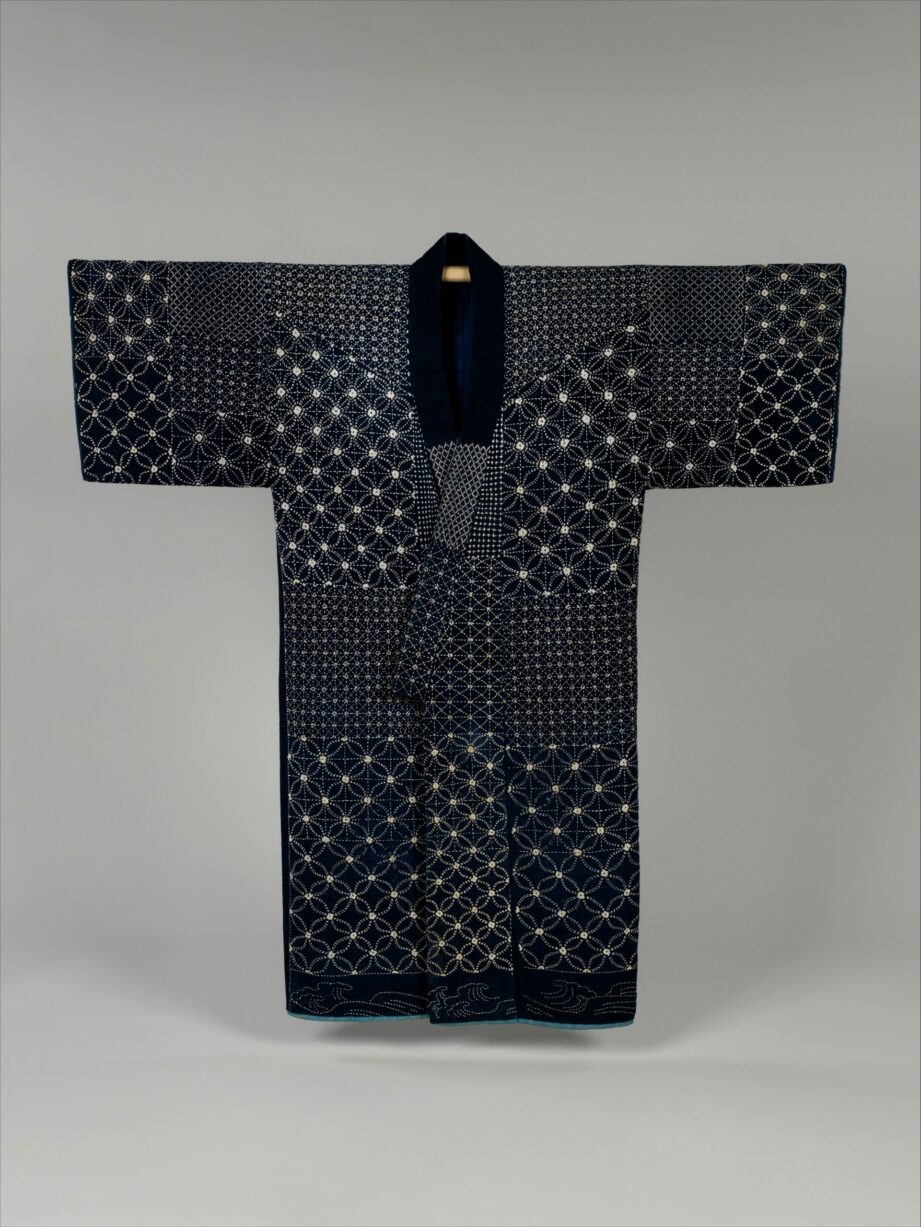
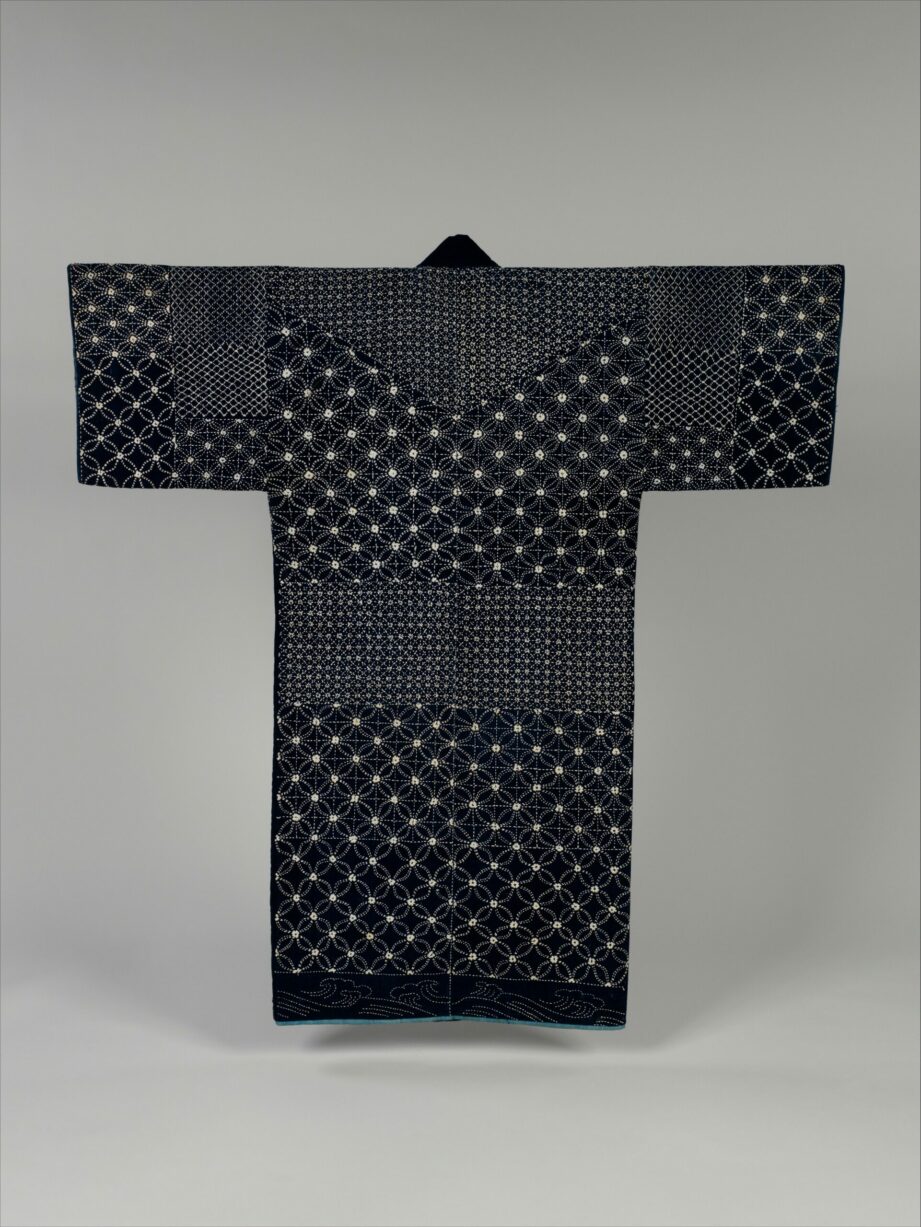
As Austin Bryant notes on Heddels, a news and education website dedicated to sustainable goods:
Over generations of families, these textiles would acquire more and more patches, almost to the point of the common observer being unable to recognize where the original fabric began. As they recovered after the end of World War II, to some the boro textiles reminded the Japanese of their impoverished rural past.
Keiko & Atsushi Futatsuya are a mother-and-son artisan team whose posts on sashiko and boro go beyond straightforward how-tos to delve into cultural history.
According to them, the goal of sashiko should not be aesthetically pleasing rows of uniform stitches, but rather “enjoying the dialogue” with the fabric.
As Atsushi explains in an Instagram post, viewers seeing their work with a Western perspective may respond differently than those who have grown up with the elements in play:

This is a photo of a “Boro-to-be Jacket” in the process. This is the back (hiding) side of the jacket and many non-Japanese would say this should be the front and should show to the public. The Japanese would understand why it is a backside naturally, but I would need to “explain” to the non-Japanese who do not share the same value (why we) purposefully make this side as “hiding” side. That’s why, I keep sharing in words. One picture may be worth a thousand words, but the thousand words may be completely different based on their (free) interpretation. In sharing the culture, some “actual words” would be also very important.
To try your hand at sashiko, you will need a long needle, such as a cotton darning needle, white embroidery thread, and—for boro—an aging textile in need of some attention.
Should you find yourself sliding into a full blown obsession, you may want to order sashiko needles and thread, and a palm thimble to help you push through several weights of fabric simultaneously.
You’ll find many patterns, tips, and tutorials on the Futatsuya family’s Sashi.co YouTube channel.
Related Content:
20 Mesmerizing Videos of Japanese Artisans Creating Traditional Handicrafts
See How Traditional Japanese Carpenters Can Build a Whole Building Using No Nails or Screws
Ayun Halliday is an author, illustrator, theater maker and Chief Primatologist of the East Village Inky zine. Follow her @AyunHalliday.
Read More...How to Speak: Watch the Lecture on Effective Communication That Became an MIT Tradition for Over 40 Years
In his legendary MIT lecture “How to Speak,” professor Patrick Winston opens with a story about seeing Olympic gymnast Mary Lou Retton at a Celebrity Ski Weekend. It was immediately clear to him that he was the better skier, but not because he had more innate athletic ability than an Olympic gold medalist, but because he had more knowledge and practice. These, Winston says, are the key qualities we need to become better communicators. Inherent talent helps, he says, but “notice that the T is very small. What really matters is what you know.”
What some of us know about communicating effectively could fill a greeting card, but it’s hardly our fault, says Winston. Schools that send students into the world without the ability to speak and write well are as criminally liable as officers who send soldiers into battle without weapons. For over 40 years, Winston has been trying to remedy the situation with his “How to Speak” lecture, offered every January,” notes MIT, “usually to overflow crowds.” It became “so popular, in fact, that the annual talk had to be limited to the first 300 participants.”
Now it’s available online, in both video and transcript form, in the talk’s final form from 2018 (it evolved quite a bit over the decades). Professor Winston passed away last year, but his wisdom lives on. Rather than present us with a dry theory of rhetoric and composition, the onetime director of the MIT’s Artificial Intelligence Laboratory offers “a few heuristic rules” distilled from “praxis in communication approaches that incorporate Neurolinguistics, Linguistics, Paleoanthropology, Cognitive Science and Computer Science,” writes Minnie Kasyoka.
Winston’s research on “creating machines with the same thought patterns as humans” led him to the following conclusions about effective speaking and writing—observations that have borne themselves out in the careers of thousands of public speakers, job seekers, and professionals of every kind. Many of his heuristics contradict decades of folk opinion on public speaking, as well as contemporary technological trends. For one thing, he says, avoid opening with a joke.
People still settling into their seats will be too distracted to pay attention and you won’t get the laugh. Instead, open with an analogy or a story, like his Mary Lou Retton gambit, then tell people, directly, what they’re going to get from your talk. Then tell them again. And again. “It’s a good idea to cycle on the subject,” says Winston. “Go around it. Go round it again. Go round it again.” It’s not that we should assume our audience is unintelligent, but rather that “at any given moment, about 20%” of them “will be fogged out no matter what the lecture is.” It’s just how the human mind works, shifting attention all over the place.
Like all great works on effective communication, Winston’s talk illustrates his methods as it explains them: he fills the lecture with memorable images—like “building a fence” around his idea to distinguish it from other similar ideas. He continues to use interesting little stories to make things concrete, like an anecdote about a Serbian nun who was offended by him putting his hands behind his back. This is offered in service of his lengthy defense of the blackboard, contra PowerPoint, as the ultimate visual aid. “Now, you have something to do with your hands.”
The talk is relaxed, humorous, and informative, and not a step-by-step method. As Winston says, you can dip in and out of the copious advice he presents, taking rules you think might work best for your particular style of communication and your communication needs. We should all, he emphasizes, hone our own way of speaking and writing. But, “while he never explicitly stresses the ultimate need for rhetorical devices,” Kasyoka points out, he demonstrates that they are imperative.
Professor Winston masterfully uses persuasive techniques to hammer on this point. For example, the use of anadiplosis, that is the repetition of a clause in a sentence for emphasis, is very manifest in this snippet from his talk: “Your careers will be determined largely by how well you speak, by how well you write, and by the quality of your ideas… in that order.”
How do we learn to use rhetoric as effectively as Winston? We listen to and read effective rhetoric like his. Do so in the video lecture at the top and on the “How to Speak” course page, which has transcripts for download and additional resources for further study.
Related Content:
Literary Theorist Stanley Fish Offers a Free Course on Rhetoric, or the Power of Arguments
The Shape of A Story: Writing Tips from Kurt Vonnegut
Josh Jones is a writer and musician based in Durham, NC. Follow him at @jdmagness
Read More...When Andy Warhol & Edie Sedgwick, the First Couple of Pop Art, Made an Odd Appearance on the Merv Griffin Show (1965)
Andy Warhol adored television and, in a way, considered it his most formative influence. While his paintings, silkscreens, and films, and the Velvet Underground, might be all the legacy he might need, Warhol, more than anything, longed to be a TV personality. He made his first concerted effort in 1979, launching a New York public access interview show. In one of the show’s 42 episodes, Warhol sits in almost total silence while his friend Richard Berlin interviews Frank Zappa.
But Warhol hated Zappa, and hated him even more after the interview. When he talked to and about subjects he liked, he could be particularly chatty, in his deadpan way: see, for example, his interview with Alfred Hitchcock, whom he greatly admired, or early eighties Saturday Night Live spots for NBC and later eighties MTV variety show. In Warhol’s much earlier 1965 appearance on the Merv Griffin show, above, long before he made TV presenter a profession, he appears with the stunningly charismatic Edie Sedgwick, his beloved muse and original superstar, and he chooses to say almost nothing at all.
Sedgwick does the talking, informing the host that Andy, unused to making “really public appearances,” would only whisper his answers in her ear, and she would whisper them to Griffin. It’s an act, of course, but the performance of a persona that hid an even more shy, retiring character. In a textbook irony, the artist who ushered in the age of self-promoting influencers and invented the superstar could be about as engaging as a houseplant. Sedgwick, on the contrary, is characteristically enthralling.
Known as “girl of the year” in 1965, the California socialite had defected from her privileged surroundings to live in Warhol’s world. The two “fell in love platonically but intensely,” Karen Lynch writes at Blast magazine, “and their mutually beneficial relationship became the talk of the town.” Griffin introduces them as “the two leading exponents of the new scene. No party in New York is considered a success unless they are there.” This was no hyperbole, though the audience doesn’t know who they are… yet.
Sedgwick explains how they met at the Factory, where she arrived the previous year with her trust fund to introduce herself and join the scene. She more or less takes over the interview, selling Warhol’s superstar myth with eloquence and wit, and she seems so much more like today’s art stars than Warhol (who eventually gives a few one-word answers), and has arguably had as much or more influence on Gen Y and Z creators. Sedgwick was “more than aspirational stereotypes allow,” writes Lynch, and more than the fact of her untimely death at 28.
One online artistic statement of this fact, Edie’s Farm, a site for “counterfactual current events,” supposes that Sedgwick had survived her drug addiction and anorexia and continued making art (and giving makeup tutorials) into the 21st century, imagining her as her young self, not the woman in her 70s she would be. “Maybe no one’s ever had a year quite as amazing as my 1965,” the fictional Sedgwick says. “I loved Andy and his Factory. But it wasn’t a sustainable life for me”—a tragic irony impossible to ignore in watching her otherwise impossibly charming performance above.
Related Content:
Josh Jones is a writer and musician based in Durham, NC. Follow him at @jdmagness
Read More...Jazz-Zither-Piano-Man Laraaji Discusses His Decades of Meditative Improvisations: A Nakedly Examined Music Podcast Conversation (#134)
Jazz multi-instrumentalist Edward Larry Gordon Jr. became Laraaji around the same time he started releasing meditative zither music in the late 70s and was then discovered by Brian Eno, who produced “The Dance No. 1” from Ambient 3: Day of Radiance (1980). Laraaji has since had around 40 releases of largely improvised music, and this interview (below) explores his approach toward improvisation on numerous instruments, playing “functional” music intended to aid meditation and reflection, and the evolution of Laraaji’s unique musical vision.
Each episode of Nakedly Examined Music features full-length presentations of four recordings discussed by the artist with your host Mark Linsenmayer. Here we present “Hold on to the Vision” and “Shenandoah” from Laraaji’s latest release, Sun Piano (2020), the single edit of “Introspection” from Bring On the Sun (2017), and “All of a Sudden,” a 1986 vocal tune released on Vision Songs, Vol. 1 (2017). Get more information at laraaji.blogspot.com.
Want more? Hear all of “The Dance No. 1.” Watch the live TV version of “All of a Sudden” we discuss, as well another episode of Celestrana featuring Dr. Love the puppet. Watch a similar, recent isolation stream also featuring Dr. Love and much more. Listen to the full glory of “Introspection” and the trip that is “Sun Gong.” Check out some live gong playing. Here’s a remix of “Introspection” by Dntel.
Find the archive of songwriter interviews at nakedlyexaminedmusic.com or get the ad-free feed at patreon.com/nakedlyexaminedmusic. This podcast is part of the Partially Examined Life podcast network.
Nakedly Examined Music is a podcast. Mark Linsenmayer also hosts The Partially Examined Life Philosophy Podcast and Pretty Much Pop: A Culture Podcast, and releases music under the name Mark Lint.
Read More...Daisugi, the 600-Year-Old Japanese Technique of Growing Trees Out of Other Trees, Creating Perfectly Straight Lumber

Image by Indiana Jo, via Wikimedia Commons
We’ve all admired the elegance of Japan’s traditional styles of architecture. Their development required the kind of dedicated craftsmanship that takes generations to cultivate — but also, more practically speaking, no small amount of wood. By the 15th century, Japan already faced a shortage of seedlings, as well as land on which to properly cultivate the trees in the first place. Necessity being the mother of invention, this led to the creation of an ingenious solution: daisugi, the growing of additional trees, in effect, out of existing trees — creating, in other words, a kind of giant bonsai.
“Written as 台杉 and literally meaning platform cedar, the technique resulted in a tree that resembled an open palm with multiple trees growing out if it, perfectly vertical,” writes Spoon and Tamago’s Johnny Waldman. “Done right, the technique can prevent deforestation and result in perfectly round and straight timber known as taruki, which are used in the roofs of Japanese teahouses.”
These teahouses are still prominent in Kyoto, a city still known for its traditional cultural heritage, and not coincidentally where daisugi first developed. “It’s said that it was Kyoto’s preeminent tea master, Sen-no-rikyu, who demanded perfection in the Kitayama cedar during the 16th century,” writes My Modern Met’s Jessica Stewart.
At the time “a form of very straight and stylized sukiya-zukuri architecture was high fashion, but there simply weren’t nearly enough raw materials to build these homes for every noble or samurai who wanted one,” says a thread by Twitter account Wrath of Gnon, which includes these and other photos of daisugi in action. “Hence this clever solution of using bonsai techniques on trees.” Aesthetics aside — as far aside as they ever get in Japan, at any rate — “the lumber produced in this method is 140% as flexible as standard cedar and 200% as dense/strong,” making it “absolutely perfect for rafters and roof timber.” And not only is daisugi’s product straight, slender, and typhoon-resistant, it’s marveled at around the world 600 years later. Of how many forestry techniques can we say the same?
Related Content:
The Art & Philosophy of Bonsai
Based in Seoul, Colin Marshall writes and broadcasts on cities, language, and culture. His projects include the Substack newsletter Books on Cities, the book The Stateless City: a Walk through 21st-Century Los Angeles and the video series The City in Cinema. Follow him on Twitter at @colinmarshall, on Facebook, or on Instagram.
Read More...Support Us
We're hoping to rely on loyal readers, rather than erratic ads. Please click the Donate button and support Open Culture. You can use Paypal, Venmo, Patreon, even Crypto! We thank you!

About Us

Open Culture scours the web for the best educational media. We find the free courses and audio books you need, the language lessons & educational videos you want, and plenty of enlightenment in between.
Advertise With Us

FREE UPDATES!
GET OUR DAILY EMAIL
Get the best cultural and educational resources on the web curated for you in a daily email. We never spam. Unsubscribe at any time.
FOLLOW ON SOCIAL MEDIA

Open Culture editor Dan Colman scours the web for the best educational media. He finds the free courses and audio books you need, the language lessons & movies you want, and plenty of enlightenment in between.
Advertise With Us


