Explore the Beautiful Pages of the 1902 Japanese Design Magazine Shin-Bijutsukai: European Modernism Meets Traditional Japanese Design
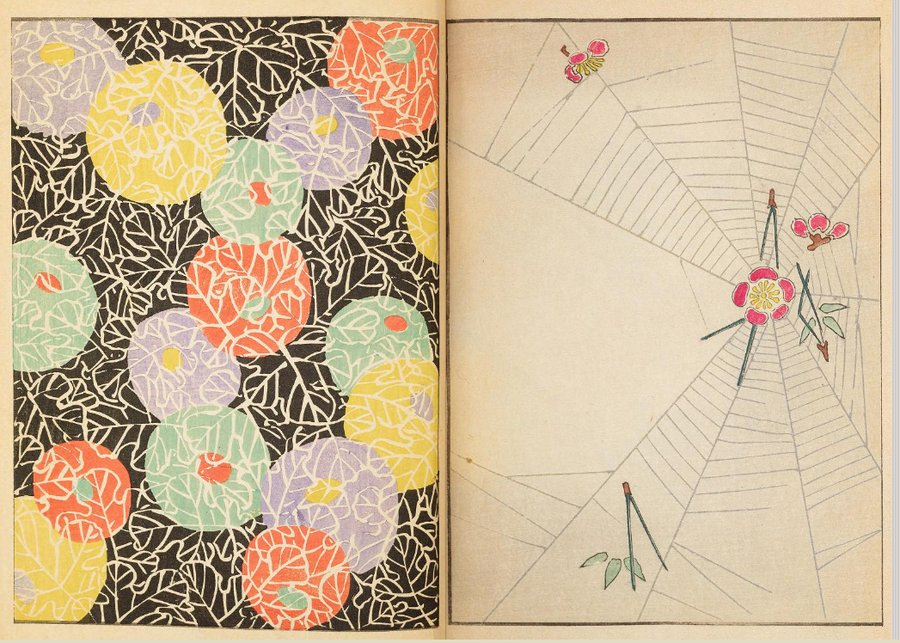
We read much about the role of Japanism in the art of late 19th Europe and North America. “The craze for all things Japanese,” writes the Art Institute of Chicago, “was launched in 1854 when American Commodore Matthew Perry forced Japan to recommence international trade after two centuries of virtual isolation.” Britain, the Continent, and the U.S. were awash in Japanese art and artifacts and ideas about the pre-industrial purity of Japanese forms proliferated. “Westerners were… drawn to traditional Japanese artistic expression because of its ties to the natural world. Japanese artists in all media treated the subjects of birds, flowers, landscapes, and the seasons.”
Westerners like Louis Comfort Tiffany emulated these patterns in their designs, and they appeared in the work of van Gogh and Gauguin. We may be familiar with how much the admiration for Japanese woodcuts, furniture, architecture, and poetry influenced Impressionism, the Arts and Crafts Movement, and early 20th century Modernism.
We may not know that the influence was mutual, with Japanese artists developing their own forms of Art Deco, European-influenced Modernism and a nationalist Japanese Arts and Crafts Movement called “Mingei” that was heavily inspired by earlier British artists who had themselves been inspired by the Japanese.
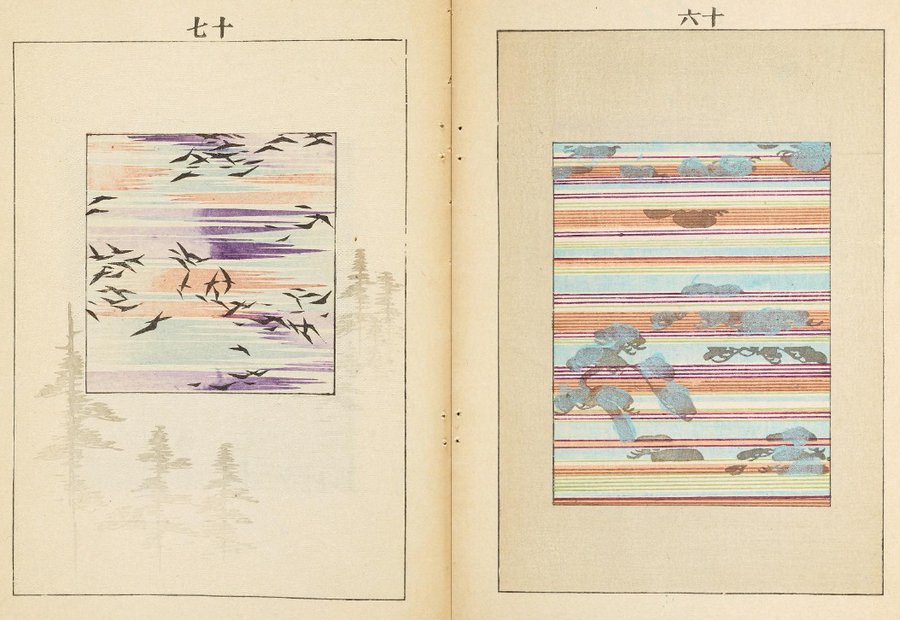
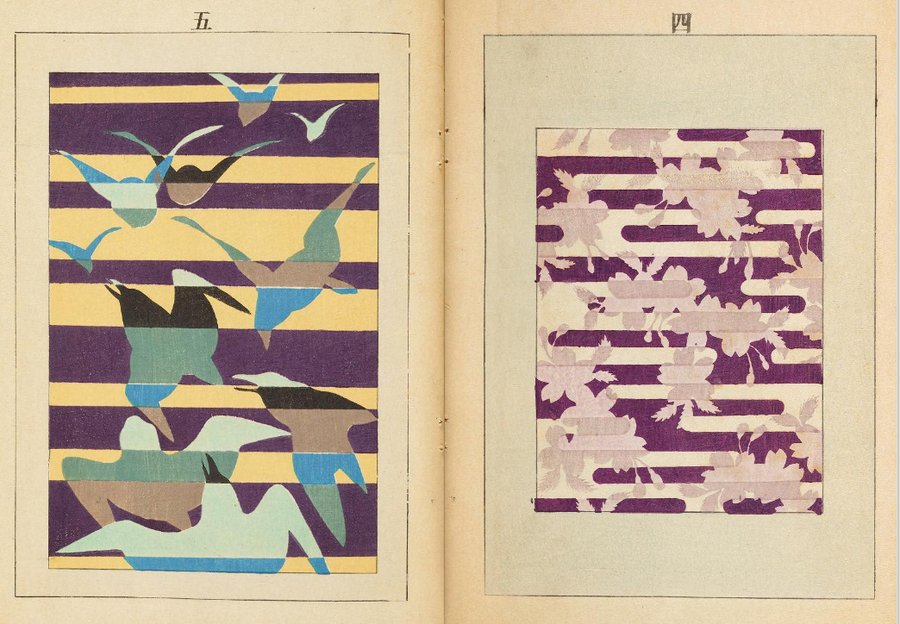
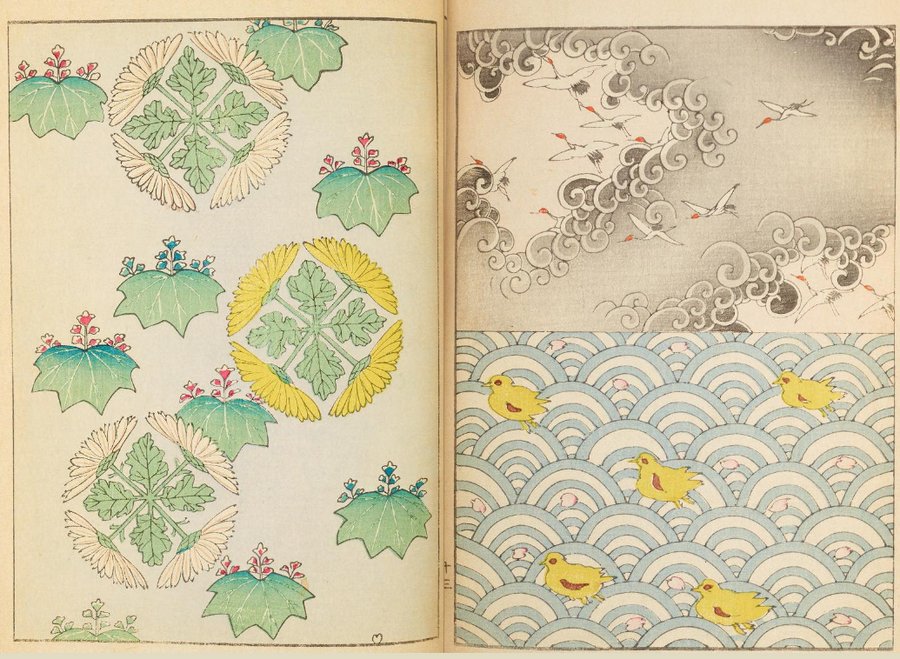
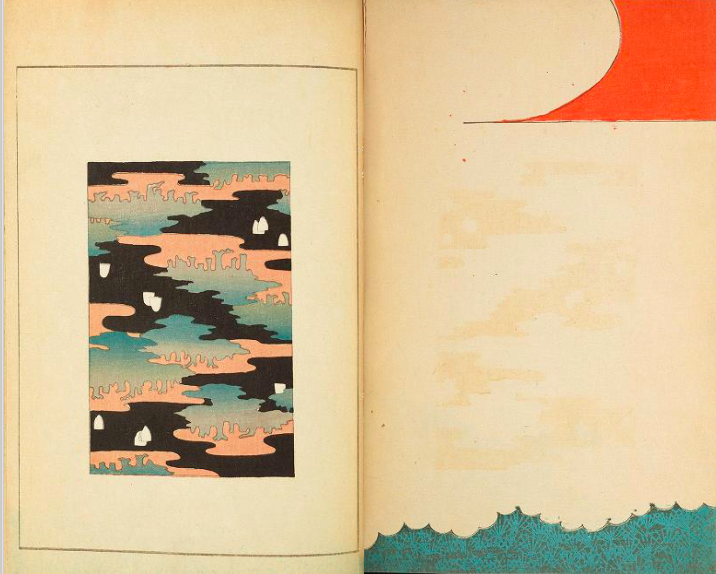
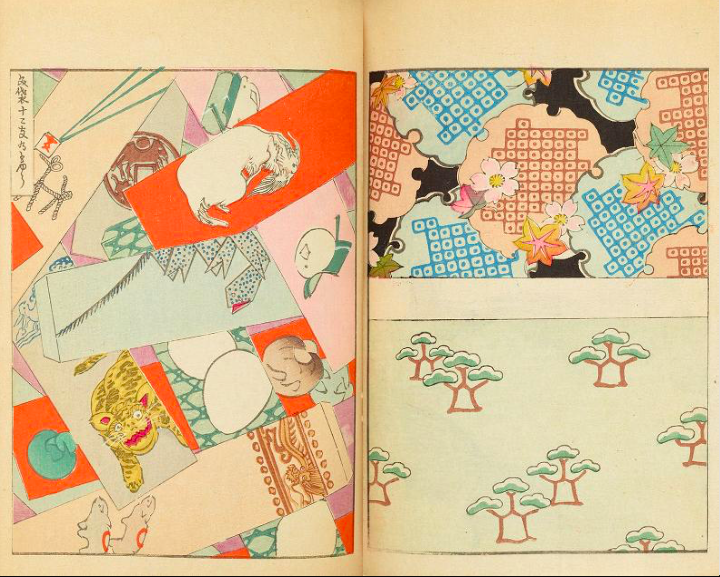
An earlier example of the cross-cultural exchange in the arts between Europe and Japan can be seen here in these prints from Shin-Bijutsukai (新美術海)… a Japanese design magazine that was edited by illustrator and designer Korin Furuya (1875–1910),” notes Spoon and Tamago. These images come from a collection of issues from 1901 to 1902, bound together in a huge 353-page design book (view it online at the Internet Archive or the Public Domain Review). We can see in the traditional images of flowers and birds the influence of industrial design as well as “hints of art nouveau and other influences of the time” from European graphic arts.
There was a reluctance among many Japanese artists to acknowledge their debts to Western artists, a symptom, writes Wendy Jones Nakanishi, professor at Shikoku Gakuin University, of “the ambivalence felt by many Japanese towards the rapid westernization of their country at the cost of the loss of indigenous cultural practices.” Despite the enormous popularity of Japanese art in Europe, “the ambivalence was mutual.” Many appeared to feel that “the subtle beauty of the Japanese art threatened European claims to cultural supremacy” when it appeared in Victorian exhibitions in London and elsewhere.
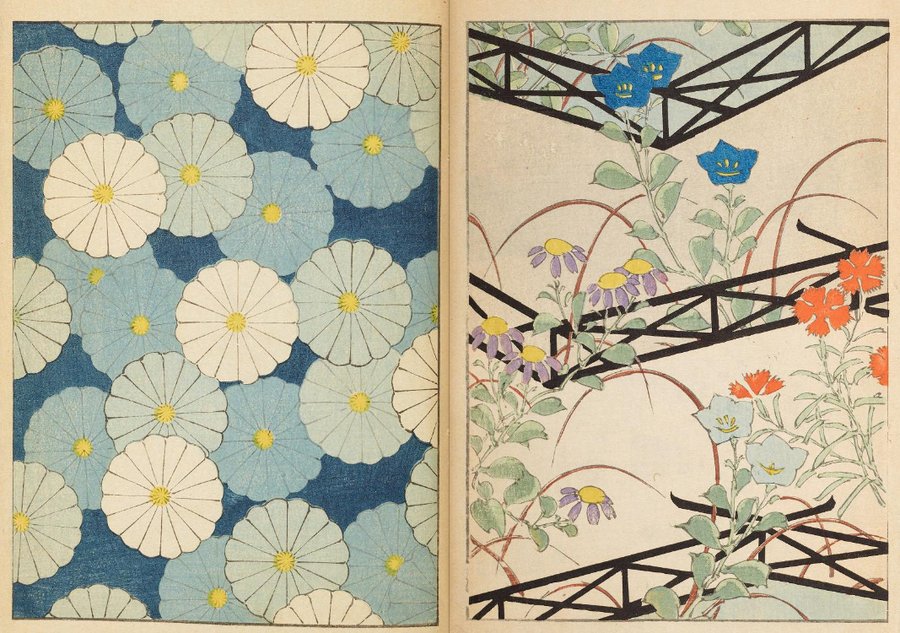
These fears aside, the meeting of many cultures in the exchanges between Europe and Japan helped to revitalize the arts and shake off stagnant classical traditions while responding in dynamic ways to rapid industrialization. The emphasis on folk and decorative art, brought into the realm of fine art, was culturally transformative in Europe. In Japan, the stylizations of modernist painting disrupted traditional scenes and techniques, as in the woodblock prints here and in the several hundred more in various issues of the monthly magazine. See them all at Public Domain Review.
Related Content:
Download 2,500 Beautiful Woodblock Prints and Drawings by Japanese Masters (1600–1915)
Advertisements from Japan’s Golden Age of Art Deco
Josh Jones is a writer and musician based in Durham, NC. Follow him at @jdmagness
Read More...A Chilling Time-Lapse Video Documents Every COVID-19 Death on a Global Map: From January to June 2020
The story of the Coronavirus, at least in the US, has swung between a number of rhetorical tics now common to all of our discourse. Called a “hoax,” then given several racist nicknames and dismissed as a “nothing burger,” the pandemic—currently at around 3 million cases in the country, with a U.S. death toll over 130,000—has now become the “new normal,” a phrase that pops up everywhere you look.
“This framing is inviting,” writes Chime Asonye at the World Economic Forum. It conveys “the idea that our present is okay because normal is regular,” and we’re all supposed to be getting back to regular life, according to the powers that be, who don’t seem particularly troubled by the dead, sick, and dying or the continued threat to public health.
But pretending things are normal is simply a form of a denial, a maladaptive and unhealthy response to trauma as much as to disease. “Allowing ourselves to cope means not normalizing our situation,” writes Asonye, “but giving ourselves the time to truly process it.” We are all living in the midst of profound loss—of loved ones, livelihoods, future plans and present joys. Asonye adds:
Psychologists advise that it’s important to identify the losses we are feeling and to honour the grief surrounding us through methods like meditation, communicating our struggle, and expressing ourselves through art or by keeping a journal. In uncertain times, the ‘new normal’ frame reinforces an understanding that the world and our emotions should by now have settled. Surrounded by uncertainty, it’s okay to admit that things are not normal. It’s okay to allow ourselves to grieve or to be scared. It’s okay not to be comfortable with what is going on.
How do we process if we cannot admit that there is a problem—a massive problem that requires our lives to change, even if we’re feeling fatigued and worn out? Though we may have grown cynically accustomed to the callous, corrupt response of certain governments to human suffering, the “overwhelming scale” of the pandemic, as James Beckwith writes on YouTube, marks the coronavirus as decidedly not normal. It may be the kind of catastrophe the world has not witnessed in over a century.
Inspired by artist Isao Hashimoto’s “Time-Lapse Map of Every Nuclear Explosion Since 1945,” which we’ve previously featured here, Beckwith used the same visual presentation to map the over 500,000 lives lost to the virus since the first January outbreak in China. “The virus grows, continuing to work its way throughout the world until the end of June—where this piece ends but the real virus has not,” he writes. “It is likely a sequel will need to be made.” Though he admits the animation “may be upsetting to some people,” Beckwith, like Asonye, recognizes the importance of admitting the full scope.
Watching the virus spread, and kill, over the past six months hits much harder than reading the dry facts. The video is dedicated to “every person that tragically lost their lives to COVID-19.” Beckwith would like it “to be understood and seen by as many people around the world as possible,” so that we can all have a shared understanding of what we’re facing together (and maybe come to an agreement that this cannot be the “new normal”). “Sometimes there are no words for terrible events like this,” Beckwith writes, but he would like help translating the video description into other languages. You can contact him via his YouTube or Instagram channels to volunteer.
Related Content:
Josh Jones is a writer and musician based in Durham, NC. Follow him at @jdmagness
Read More...Salvador Dalí Explains Why He Was a “Bad Painter” and Contributed “Nothing” to Art (1986)
Not so very long ago, Salvador Dalí was the most famous living painter in the world. When the BBC’s Arena came to shoot an episode about him in 1986, they asked him what that exalted state felt like. “I don’t know if I am the most famous painter in the world,” Dalí responds, “because lots of the people who ask for my autograph in the street don’t know if I’m a singer, a film star, a madman, a writer — they don’t know what I am.” He was, in one sense or another, most of those things and others besides. But we can safely say, more than thirty years after his death, that Dalí will be remembered first for his visual art, with its vast seas and skies, its impossible beasts, its melting clocks. And what did Dalí himself believe he had contributed to art?
“Nothing,” he says. “Absolutely nothing, because, as I’ve always said, I’m a very bad painter. Because I’m too intelligent to be a good painter. To be a good painter you’ve got to be a bit stupid, with the exception of Velázquez, who is a genius, whose talent surpasses the art of painting.” In other words, when Dalí’s ever-present detractors said he was no Velázquez, Dalí’s wholeheartedly agreed.
Over the past few decades, appreciation of the distinctive combination of vision and technique on display in Dalí’s paintings has won him more official respect (as well as a lavish new collection published in book form by Taschen), but the debate about to what extent he was a true artist and to what extent a calculatedly eccentric self-promoter will never fully simmer down.
Dalí also claimed to owe his life to painting badly. “The day Dalí paints a picture as good as Velázquez, Vermeer, or Raphael, or music like Mozart,” he says, “the next week he’ll die. So I prefer to paint bad pictures and live longer.” That he had already entered his ninth decade by the time Arena came calling suggests that this strategy might have been effective, though he wasn’t without his health troubles. In his first public appearance after having had a pacemaker implanted that same year, he declared that “When you are a genius, you do not have the right to die, because we are necessary for the progress of humanity.” Dalí’s kept his askew arrogance to the end, even through the controversial final years that saw him sign off on the large-scale production of shoddy lithographs of his paintings. About the people who made them and the people who bought them, Dalí had only this to say: “They deserve each other.”
Related Content:
Q: Salvador Dalí, Are You a Crackpot? A: No, I’m Just Almost Crazy (1969)
When Salvador Dali Met Sigmund Freud, and Changed Freud’s Mind About Surrealism (1938)
A Soft Self-Portrait of Salvador Dali, Narrated by the Great Orson Welles
Based in Seoul, Colin Marshall writes and broadcasts on cities, language, and culture. His projects include the book The Stateless City: a Walk through 21st-Century Los Angeles and the video series The City in Cinema. Follow him on Twitter at @colinmarshall, on Facebook, or on Instagram.
Read More...The Film Music of Ennio Morricone (RIP) Beautifully Performed by the Danish National Symphony Orchestra Play: “The Good, the Bad, and the Ugly” & Much More
What we think of as “film music” today is a creation of only a few inventive and original composers, one fewer of whom walks the Earth as of yesterday. Though Ennio Morricone will be remembered first for his association with spaghetti western master Sergio Leone, his career in film scores spanned half a century and encompassed work for some of the most acclaimed directors of that period: his countrymen like Michelangelo Antonioni, Bernardo Bertolucci, Pier Paolo Pasolini, but also such commanding Hollywood filmmakers as John Huston, Terrence Malick, and Quentin Tarantino. Morricone didn’t just write music to add to their films; he became a collaborator, without whose work their films would be difficult to imagine.
The result, in pictures from L’Avventura to Salò to Days of Heaven to The Untouchables to The Hateful Eight, is a union of the arts that transcends individual cultures. It doesn’t matter what country you come from, what generation you belong to, whether you enjoy Westerns or indeed cinema itself: you know the theme music Morricone wrote for Leone’s The Good, the Bad, and the Ugly the moment you hear it.
Whether or not you’ve seen the movie, you’ll appreciate the especially rich performance by the Danish National Symphony Orchestra at the top of the post, part of a 2018 concert called The Morricone Duel, a celebration of “a wide range of western movies and mafia movies reflecting different perspectives on an Italian-American movie and film music style.”
The Morricone Duel’s Youtube playlist includes the Danish National Symphony Orchestra’s renditions of pieces from other Morricone-Leone collaborations like A Fistful of Dollars, For a Few Dollars More, Once Upon a Time in the West, and Once Upon a Time in America. Though the evening also included pieces from The Untouchables and Henri Verneuil’s The Sicilian Clan, many in the audience must have thrilled most when the musicians launched into the overture from The Hateful Eight. They could hardy be more ardent Morricone fans than Tarantino himself, who used pieces from Morricone’s existing Spaghetti-western soundtracks in Kill Bill and Inglourious Basterds before making a western of his own, which wouldn’t have been complete without original Morricone music. The Hateful Eight turned out to be Morricone’s penultimate film score, but his influence will resonate through generations of cinema to come — and outlast, no doubt, the western and gangster genres themselves.
Related Content:
The Music in Quentin Tarantino’s Films: Hear a 5‑Hour, 100-Song Playlist
Based in Seoul, Colin Marshall writes and broadcasts on cities, language, and culture. His projects include the book The Stateless City: a Walk through 21st-Century Los Angeles and the video series The City in Cinema. Follow him on Twitter at @colinmarshall, on Facebook, or on Instagram.
Read More...Vintage Science Face Masks: Conquer the Pandemic with Science, Courtesy of Maria Popova’s BrainPickings
If you don’t floss or brush your teeth, they will rot and fall out. If you don’t eat fruits and vegetables, you will get scurvy or some other horrible disease. If you don’t use protection… well, you know the rest. These are facts of life we mostly accept if we care about ourselves and others because they are beyond disputing. But the idea of wearing a cloth mask when in public during a viral pandemic spread through droplets from the nose and mouth—a practice endorsed by the CDC, the World Health Organization, scientists at Stanford, Johns Hopkins, and pretty much every other research university—has become some kind of bizarre culture war.
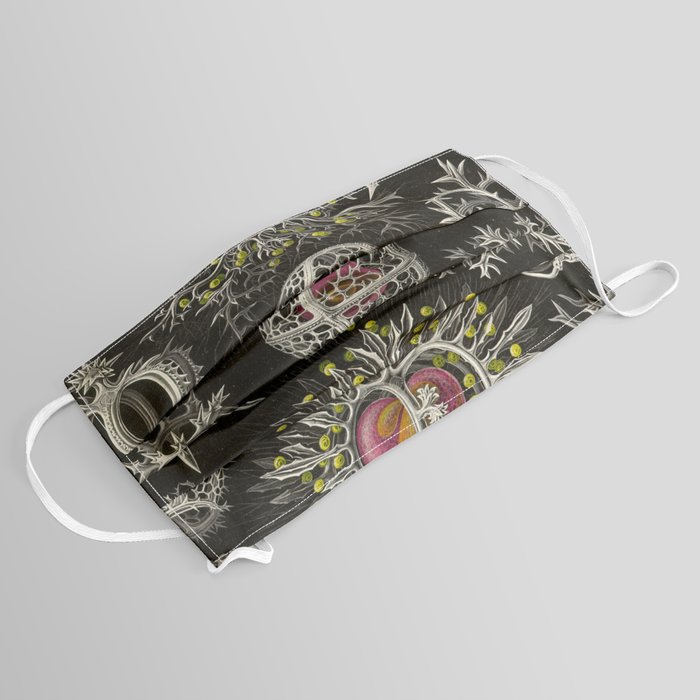
Maybe some walk around mask-less because they’ve internalized the idea that the coronavirus is “over,” despite the fact it’s spreading at around 50,000 new cases per day in the US, and potentially heading toward double that number. Maybe some feel it won’t affect them because they aren’t elderly or immunocompromised, never mind that viruses mutate, and that the novel (meaning “new”) coronavirus has already demonstrated that it is far less discriminating (in purely biological terms) than previously thought. (In Florida, the median age for COVID-19 has dropped from 65 to 37 years old.) Never mind that spreading the virus, even if one is not personally at high risk, compromises everybody else.
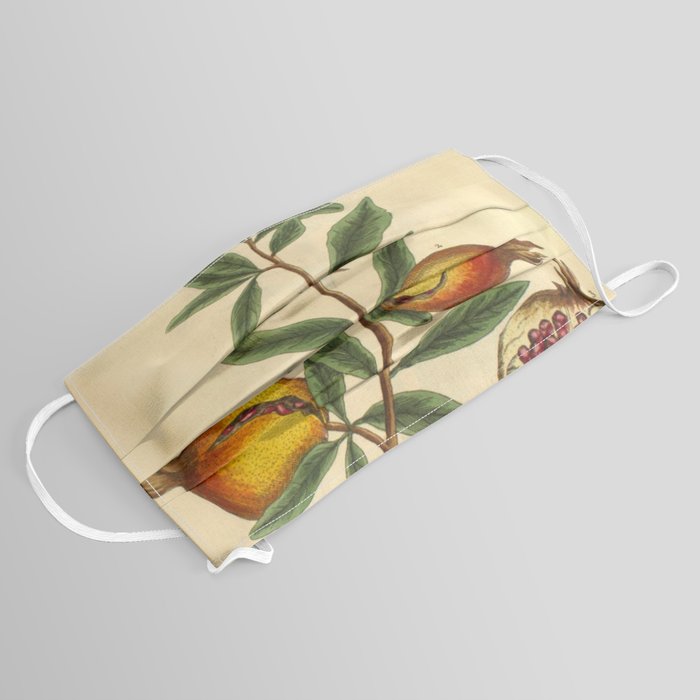
Are masks uncomfortable, especially in hot, humid weather? Do they muffle speech and make it hard to have satisfying face-to-face interactions? Well, yes. But consider your hourlong masked trip to the grocery store against the 12 or 24 or 48 or whatever hour-long shifts medical personnel are pulling in emergency departments across the country.
It really is the least we can do. And we can do it in style—masks went from scarce, with armies of homebound neighbors sewing homely stacks of them, to truly overabundant and fashionable, on the rack of every grocery, pharmacy, and convenience store. It couldn’t be easier.
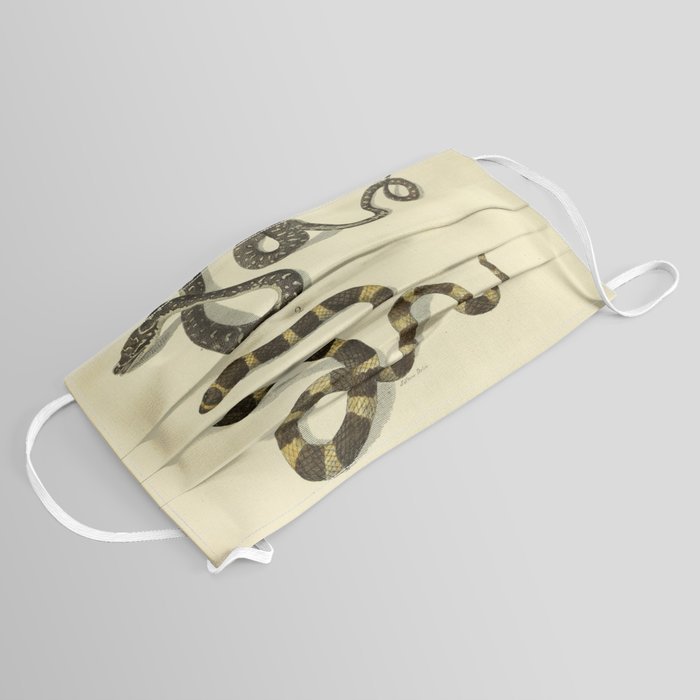
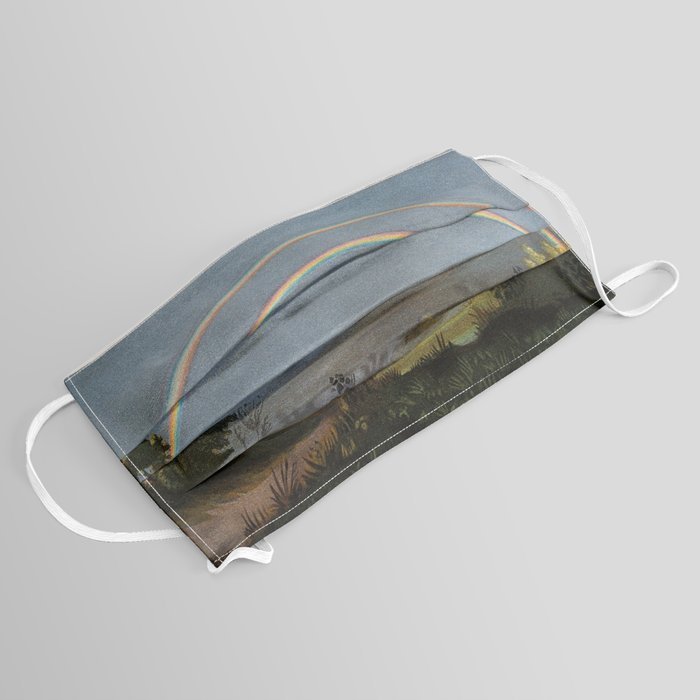
If you’re concerned about looking like every other masked weirdo out there, consider these masks created by Maria Popova of Brain Pickings, which she introduces with references to Rebecca Elson’s poem, “Antidotes to Fear of Death.” The science of public health may demand that we are grimly practical at the moment, but Popova wants to remind us that scientific thinking is equally invested in the experience of awe and the love of life. By wearing these masks, we can communicate to others, those who may be feeling despondent over the sea of masked faces in public places, that there is beauty in the world and we can fully experience if we get through this. Popova’s masks, printed and sold by Society6, illustrate the wonders of scientific curiosity with “wondrous centuries-old astronomical art and natural history illustrations.”
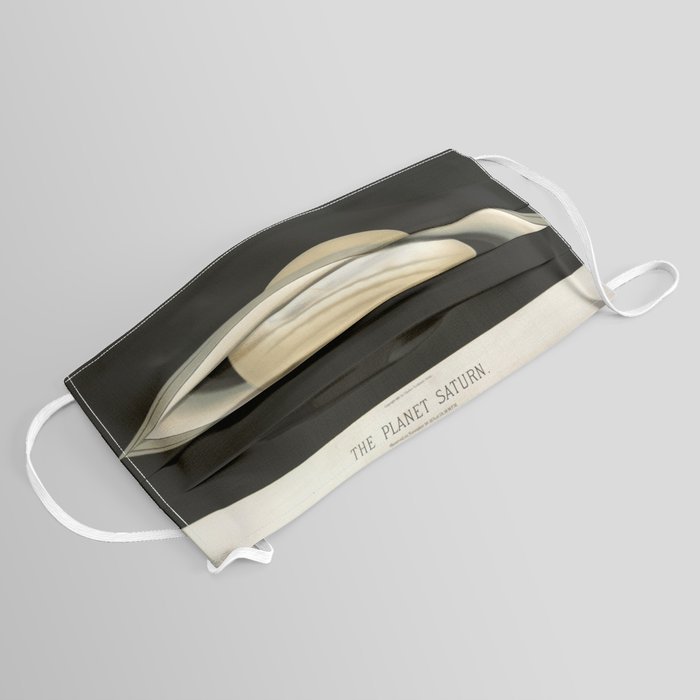
These include “treasures like the Solar System quilt Ella Harding Baker spent seven years crafting… gorgeous 18th-century illustrations from the world’s first encyclopedia of medicinal plants… astonishing drawings of celestial objects and phenomena…trailblazing 18th-century artist Sarah Stone’s stunning illustrations of exotic, endangered, and now-extinct animals; some graphically spectacular depictions of how nature works from a 19th-century French physics textbook; Ernst Haeckel’s heartbreak-fomented drawings of the otherworldly beauty of jellyfish…William Saville Kent’s pioneering artistic-scientific effort to bring the world’s awareness and awe to the creatures of the Great Barrier Reef; and art from the German marine biologist Carl Chun’s epoch-making Cephalopod Atlas — the world’s first encyclopedia of creatures of the deep.”
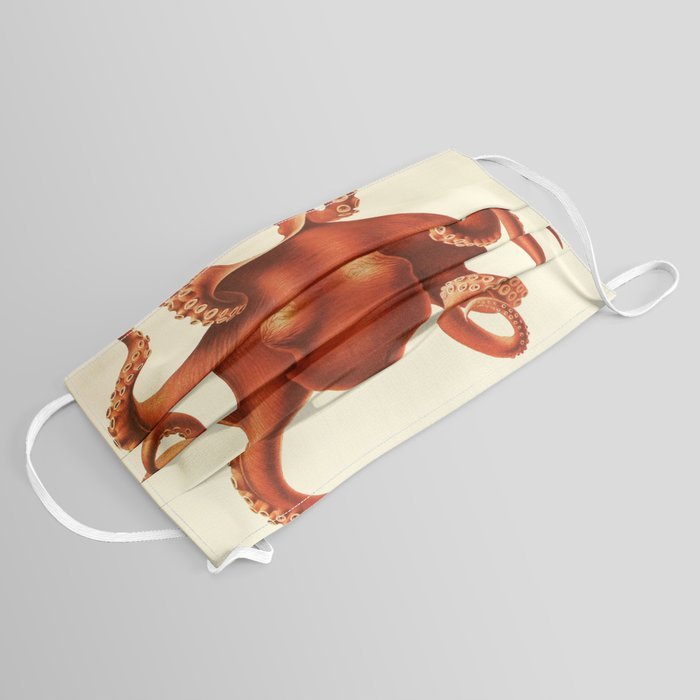
Society6 is donating a portion of its proceeds to World Center Kitchen, and Popova is donating to The Nature Conservancy. You can purchase your own vintage science illustration mask here and see some of these illustrations in their original context at the links further down.
Antidotes to Fear of Death
Sometimes as an antidote
To fear of death,
I eat the stars.Those nights, lying on my back,
I suck them from the quenching dark
Til they are all, all inside me,
Pepper hot and sharp.Sometimes, instead, I stir myself
Into a universe still young,
Still warm as blood:No outer space, just space,
The light of all the not yet stars
Drifting like a bright mist,
And all of us, and everything
Already there
But unconstrained by form.And sometime it’s enough
To lie down here on earth
Beside our long ancestral bones:To walk across the cobble fields
Of our discarded skulls,
Each like a treasure, like a chrysalis,
Thinking: whatever left these husks
Flew off on bright wings.
Related Content:
The Brilliant Colors of the Great Barrier Revealed in a Historic Illustrated Book from 1893
Josh Jones is a writer and musician based in Durham, NC. Follow him at @jdmagness
Read More...The Ayn Rand Institute Takes a Loan from Paycheck Protection Program: Like Rand Herself, Her Followers Don’t Walk the Talk
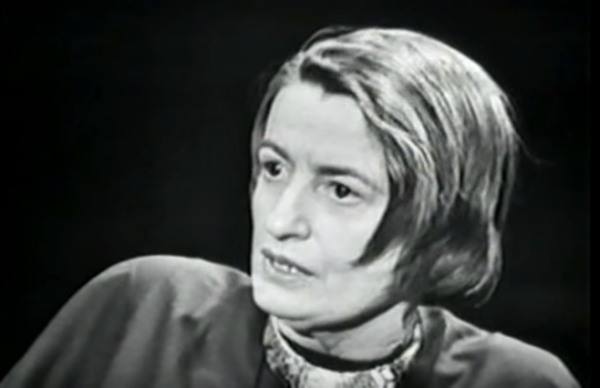
Image via YouTube, 1959 interview with Mike Wallace
Finally bowing to public pressure, the Trump administration has revealed which companies received loans from the Paycheck Protection Program (PPP) created to support small businesses during COVID-19. To no one’s surprise, the published list reportedly includes a host of privileged entities: the shipping business owned by Mitch McConnell’s wife Transportation Secretary Elaine Chao; businesses associated with members of Congress (from both parties); the law firm of David Boies; elite private schools like Sidwell Friends and Saint Ann’s; Grover Norquist’s Anti-Tax Group; the law firm run by Trump’s longtime personal lawyer, Marc E. Kasowitz; billionaire Kanye West’s company, Yeezy; the fine art studio for millionaire sculptor Jeff Koons, a venture that raises money for Trump’s campaign and the RNC, etc.
Add to the list the Ayn Rand Institute–an organization named after Ayn Rand, the Russian writer who exalted the self-reliant individual and criticized social welfare programs that support the vulnerable. As she wrote in The Virtue of Selfishness, “The right to life means that a man has the right to support his life by his own work (on any economic level, as high as his ability will carry him); it does not mean that others must provide him with the necessities of life.” In short, if you can’t make it, you’re on your own.
Rand’s political theory collapses when it confronts everyday reality. At the end of her own life, Rand, suffering from lung cancer, had to grudgingly rely on social security and medicare to make ends meet. Now, reports Reuters, the institute bearing her name has requested (and apparently received) “a Paycheck Protection Program (PPP) loan of up to $1 million.” All while showing no gratitude to the American taxpayer. The Ayn Rand Institute deemed the loan “partial restitution for government-inflicted losses.” (Also see their latest justification here.) Some will consider that spin–a way to justify accepting government largesse.
Watching Ayn Rand talk below, it seems like a principled Randian would have gone, hat in hand, to a private charity instead.
Related Content:
When Ayn Rand Collected Social Security & Medicare, After Years of Opposing Benefit Programs
Read More...Ella Fitzgerald’s Lost Interview about Racism & Segregation: Recorded in 1963, It’s Never Been Heard Until Now
When Ella Fitzgerald took the stage for the first time at the Apollo Theater in Harlem, “we heard a sound so perfect” that the entire theater went silent, says dancer and choreographer Norma Miller. “You could hear a rat piss on cotton.” Fitzgerald was 17 years old, and she had already faced severe racial discrimination. “Everything was race,” says Miller, describing the de facto segregation in Harlem in the 20s and 30s. “You couldn’t go out of your zone… slavery is over, but you don’t have jobs. So the confinement meant you had to do for yourself.”
In 1917, a 2 year old Fitzgerald had traveled with her mother and stepfather from Newport News, Virginia, where she was born, to Yonkers, New York. They were part of the Great Migration that brought blues and jazz to Northern cities. Fitzgerald grew up sneaking into Harlem’s ballrooms to hear Duke Ellington and Louis Armstrong. Then at age 13, her mother died. Fitzgerald was devastated. She began skipping school and the police arrested her for truancy and sent her to a reform school.
Black girls at the school, writes Nina Bernstein in The New York Times, “were segregated in the two most crowded and dilapidated of the reformatory’s 17 ‘cottages,’ and were routinely beaten by male staff. There was a fine music program at the school, but Ella Fitzgerald was not in the choir: it was all white.” Fitzgerald escaped and made her way back to Harlem, where she slept on the streets. She stepped onstage at the Apollo’s amateur night as part of a dare and had originally planned to do a dance routine.
The year after her Apollo debut, Fitzgerald performed at Yale University with Chick Webb’s orchestra. She released her first single, one of the biggest records of the decade, in 1938. In 1939, she took over as bandleader and carved out a career in the following years that included tours in Japan, Europe, and Australia, where she became a huge sensation in 1954. In the states, however, she was still treated like a criminal. She missed her first two shows in Sydney because she and her pianist, assistant, and manager Norman Granz were thrown off the plane in Honolulu without explanation or recourse. (Fitzgerald later sued and won, as she explains in a 1970 CBC interview clip above.)
In 1955, Fitzgerald’s career received a major boost when Marilyn Monroe pressured the owner of Sunset Strip’s famed Mocambo to book the singer. “After that, I never had to play a small jazz club again,” Fitzgerald later recalled. That same year, reports USA Today, “she was arrested in her dressing room at an integrated show in Houston. When she arrived at the police station, an officer asked for her autograph, Fitzgerald recalls.” She rose above the ugliness with poise and grace and mostly preferred not to talk about it, though it surely took its toll. “She lived, she survived,” says cultural critic Margo Jefferson. “She became famous and she kept on keeping on—at what inner price, we don’t know.”
We do, however, have a slightly better sense of how she felt thanks to clips from a 1963 interview with New York radio host Fred Robbins that have emerged after going unheard for decades (beginning at :30 in the video at the top). Discussing her frustration with segregation in the South, she says:
Maybe I’m stepping out (of line), but I have to say it, because it’s in my heart. It makes you feel so bad to think we can’t go down through certain parts of the South and give a concert like we do overseas, and have everybody just come to hear the music and enjoy the music because of the prejudice thing that’s going on.
I used to always clam up because you (hear people) say, ‘Oh, gee, show people should stay out of politics.’ But we have traveled so much and been embarrassed so much. (Fans) can’t understand why you don’t play in Alabama, or (ask), ‘Why can’t you have a concert? Music is music.’
The situation was truly “embarrassing,” as she put it, for the country and for her and her fellow musicians. Fitzgerald had seen enough in her life at that point to understand how deeply entrenched racism could become. Hopeful about the future, she also recognized that there were some minds that would never change. “The die-hards, they’re just going to die hard,” she says. “They’re not going to give in. You’ve got to try and convince the younger ones, they’re the ones who’ve got to make the future and those are the ones we’ve got to worry about. Not those die-hards.”
Robbins had promised Fitzgerald that the interview would air “all over the world.” Instead, for reasons unknown, it was shelved and forgotten until author Reggie Nadelson discovered the recording in 2018 at the Paley Center for Media. Despite her reticence to speak out, Fitzgerald was grateful for the opportunity, even if it might end up costing her. “I really ran my mouth,” she says, worrying, “Is it going down South? You think they’re going to break my records up when they hear it? This is unusual for me.” Nonetheless, she says, “I’m so happy that you had me, because instead of singing, for a change I got a chance to get a few things off my chest. I just a human being.”
The clip at the top comes from a new documentary titled Ella Fitzgerald: Just One of Those Things. Watch the trailer for the film above.
Related Content:
How Marilyn Monroe Helped Break Ella Fitzgerald Into the Big Time (1955)
Ella Fitzgerald Sings ‘Summertime’ by George Gershwin, Berlin 1968
Josh Jones is a writer and musician based in Durham, NC. Follow him at @jdmagness
Read More...
Watch Vintage Footage of Tokyo, Circa 1910, Get Brought to Life with Artificial Intelligence
For more than 200 years, the rulers of Japan kept the country all but closed to the outside world. In 1854, the “Black Ships” of American commander Matthew Perry arrived to demand an end to Japanese isolation — and a commencement of Japanese world trade. Within decades, many fashion-forward Europeans and even Americans couldn’t get enough things Japanese, especially the art, crafts, and clothing that exemplified kinds of beauty they’d never known before. (Vincent van Gogh was a particularly avid fan.) But if Japan changed the West, the West transformed Japan, a process fully in effect in the footage above, shot on the streets of Tokyo between 1913 and 1915.
These scenes may look familiar to dedicated Open Culture readers, and indeed, we previously featured another version of this film back in 2018. With its speed corrected to remove the herky-jerkiness common to old films and with background noise added, these glimpses of the men, women, and many children of the Japanese capital, all of them living between the inward-looking tradition of their country as it had been and the onrush of modernity from without, already felt realistic.
But now you may feel you’ve been personally transported to this culturally and economically heady time in the Land of the Rising Sun thanks to the work of Denis Shiryaev, a Youtuber who specializes in enlarging and restoring vintage film clips with artificial intelligence.
Shirayev is also responsible for the enhanced versions of scenes from Belle Époque Paris, czarist Moscow, Victorian England, New York City in 1911, and even the Lumière Brothers’ early motion picture The Arrival of a Train at La Ciotat Station. At the beginning of this video he reveals the stages of the process that brought this century-old footage of Tokyo to greater vividness: de-noising and damage removal, colorization, facial restoration, and upscaling to 4K resolution at 60 frames per second — all assisted by neural networks that, “trained” on relevant visual materials new and old, crisp and weathered, to determine the best ways to make it all look more convincing. The results may make you wonder what else will soon be possible — surely not a feeling unknown to these early 20th-century Tokyoites.
Related Content:
Download Hundreds of 19th-Century Japanese Woodblock Prints by Masters of the Tradition
1850s Japan Comes to Life in 3D, Color Photos: See the Stereoscopic Photography of T. Enami
The Entire History of Japan in 9 Quirky Minutes
Based in Seoul, Colin Marshall writes and broadcasts on cities, language, and culture. His projects include the book The Stateless City: a Walk through 21st-Century Los Angeles and the video series The City in Cinema. Follow him on Twitter at @colinmarshall, on Facebook, or on Instagram.
Read More...16th Century Bookwheels, the E‑Readers of the Renaissance, Get Brought to Life by 21st Century Designers
Most of us, through our computers or our even our phones, have access to more books than we could ever read in one lifetime. That certainly wouldn’t have been the case in, say, the middle ages, when books — assuming you belonged to the elite who could read them in the first place — were rare and precious objects. Both books and literacy became more common during the Renaissance, though acquaintance with both could still be considered the sign of a potentially serious scholar. And for the most serious Renaissance scholars of all, Italian military engineer Agostino Ramelli designed the bookwheel, an elaborate mechanical device allowing the user to turn from one book to another in relatively quick succession.
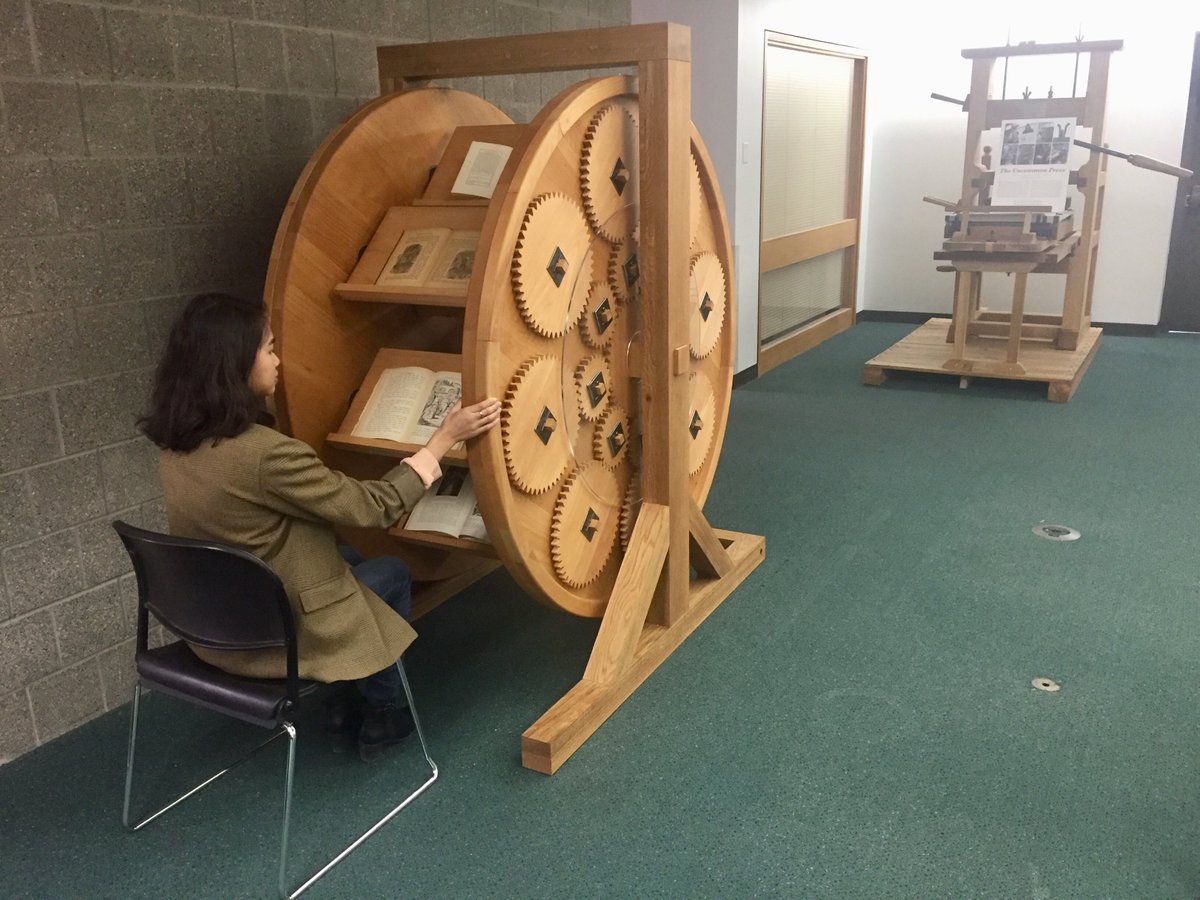
First drawn by Ramelli in 1588 (and previously featured here on Open Culture in 2017) but never actually constructed by him, the bookwheel has attracted renewed attention in the 21st century. “In 2018, a group of undergraduate engineering students at the Rochester Institute of Technology set out to build two,” writes Atlas Obscura’s Claire Voon. “They began by diligently studying the Italian engineer’s illustration, then procured historically accurate materials, such as European beech and white oak.
With the help of modern power tools and processes, such as computer modeling and CNC routing, they brought it to life.” You can see the RIT bookwheels under construction and in action in the video above. (Its schematics, near-impossibly complex by the standards of Ramelli’s day, are also available at RIT’s web site.)
Others have also brought Ramelli’s design into reality. In the video just above, for example, we have writer Joshua Foer (previously featured here for his work on the science of memorization) taking his own reproduction for a spin. “It’s a ferris wheel for books,” Foer explains, “so that a scholar can have eight books in front of them, sort of like tabbed browsing before tabbed browsing.” The device’s cherry wood and laser-cut gears are certainly handsome, but what of its practicality? “I often read multiple books at one time, and this way I can have them all open in front of me.” Most all of us start more books than we can finish, and as we attempt to read them all in parallel, occasionally one or two do get forgotten. Hence one advantage, even in our modern times, of Ramelli’s book wheel: any book placed on it becomes as unignorable as the machine itself.
Related Content:
Discover the Jacobean Traveling Library: The 17th Century Precursor to the Kindle
The Art of Making Old-Fashioned, Hand-Printed Books
Wonderfully Weird & Ingenious Medieval Books
Wearable Books: In Medieval Times, They Took Old Manuscripts & Turned Them into Clothes
Based in Seoul, Colin Marshall writes and broadcasts on cities, language, and culture. His projects include the book The Stateless City: a Walk through 21st-Century Los Angeles and the video series The City in Cinema. Follow him on Twitter at @colinmarshall, on Facebook, or on Instagram.
Read More...An Animated Introduction to the Pioneering Anthropologist Margaret Mead
Modern Western societies haven’t solved the problem of sex, but Samoa has the answer. Or at least it does according to the work of influential anthropologist Margaret Mead, subject of the animated introduction from Alain de Botton’s School of Life above. Her mentor Franz Boas, the founder of anthropology in the United States, saw not a world progressing “in a linear fashion from barbarism to savagery to civilization” but “teeming with separate cultures, each with their own unique perspectives, insights, and efficiencies.”
Though Mead’s time living among the natives on the distant islands of Samoa came at Boas’ suggestion, she already believed that “isolated cultures could serve as laboratories that would reveal ways of living that the modern world had forgotten about, but needed to remember.” The resulting book, 1928’s Coming of Age in Samoa, turned Mead into the most famous anthropologist in the world. In it she describes Samoan culture as “far more open and comfortable with sex than the modern United States. Little children in Samoa knew all about masturbation, and learned about intercourse and other acts through first-hand observation, but thought of it as no more scandalous or worthy of comment than death or birth.”
Mead also noted an acceptance of not just homosexuality but a natural shift in sexual orientation over time — a condition bound to intrigue a serious scholar who herself led a rather unconventional life, “simultaneously involved with successive husbands and her ever-present female lover.” Her analysis of Samoa, which informed the worldviews of such influential figures as childrearing guru Benjamin Spock, would take on an even broader appeal in the 1960s, when a rising counterculture sought inspiration in its push to transform Western society. Proponents of the “sexual revolution” and its loosening of norms found a natural ally in Mead, and traces of her life and work remain in fragments of the Summer of Love up to and including Hair, one of whose minor characters has her name.
Mead also comes up in Hunter Thompson’s 1971 epitaph for the counterculture, Fear and Loathing in Las Vegas. The scene is the National District Attorneys Association’s Conference on Narcotics and Dangerous Drugs, at which a participant suggests that Mead partakes in the substance known as marijuana. The “drug expert” onstage replies thus: “At her age, if she did smoke grass, she’d have one hell of a trip.” Though Mead publicly showed sympathy for addicts, whom she described as “casualties of a badly organized society,” her own experiences with mind-altering substances are less well documented. But then, her time in Samoa may well have been the only consciousness-expanding trip she needed.
Related Content:
The History of Western Social Theory, by Alan MacFarlane, Cambridge University
Anthropologist Claude Lévi-Strauss Remembered
Based in Seoul, Colin Marshall writes and broadcasts on cities, language, and culture. His projects include the book The Stateless City: a Walk through 21st-Century Los Angeles and the video series The City in Cinema. Follow him on Twitter at @colinmarshall, on Facebook, or on Instagram.
Read More...Support Us
We're hoping to rely on loyal readers, rather than erratic ads. Please click the Donate button and support Open Culture. You can use Paypal, Venmo, Patreon, even Crypto! We thank you!

About Us

Open Culture scours the web for the best educational media. We find the free courses and audio books you need, the language lessons & educational videos you want, and plenty of enlightenment in between.
Advertise With Us

FREE UPDATES!
GET OUR DAILY EMAIL
Get the best cultural and educational resources on the web curated for you in a daily email. We never spam. Unsubscribe at any time.
FOLLOW ON SOCIAL MEDIA

Open Culture editor Dan Colman scours the web for the best educational media. He finds the free courses and audio books you need, the language lessons & movies you want, and plenty of enlightenment in between.
Advertise With Us

