Saxophonist Plays into Large Gas Pipes & Then Uses the Echo to Accompany Himself
The best saxophonists play just as well unaccompanied as they do accompanied — but they also know that, in the act of musical creation, it certainly helps to have even a little bit of sound to play off coming your way. German musician Armin Küpper discovered more than a little bit of sound coming his way when he tried playing his saxophone into a gas pipe he happened across near his home. Kept at a construction site and not currently in a state to pipe any gas, it served him as a kind of echo device, one distinctive in both sound and appearance. On his Youtube channel he’s posted a dozen videos so far of the “concerts” he’s given at the pipe: playing into it, standing beside it, sitting in it.
“This sound on the tube, in this loneliness always gives me the feeling: Hey, you’re not alone there!” writes Küpper. “Sometimes I just can’t stop playing. The nice thing is, when it gets cool in the evening, I sit down in the tube heated up during the day and enjoy the sunset playing the saxophone.”
These sentiments appear in the description of the video at the top of the post, in which Küpper demonstrates the style of music he calls “Pipelinefunk,” or in his native German Röhrensound. He’s also tried his hand at “Pipelineblues,” pipeline guitar, and a composition called “Walking on the Pipeline” — during his performance of which he does just that, the sound of his saxophone changes with every step he takes toward the opening.
When played directly into the pipe, Küpper’s saxophone comes back sounding uncannily like a classic call-and-response. But what’s truly impressive is the range of effects he discovers while approaching the pipe differently each time, producing whole new soundscapes by changing little more than the angle of his playing. Alas, his time with the pipe seems to have lasted only so long. The building project that brought the pipe in the first place would sooner or later have to make use of it, and in one video description Küpper mentions that “ ‘my pipe’ was laid in the ground.” There could be no better sendoff for this unusual musical partner — and a collaborator in the creation of this surprising variety of, literally, German industrial music — than Küpper’s dusk performance of “Somewhere Over the Rainbow”?
via Laughing Squid
Related Content:
The Sax Solo on Gerry Rafferty’s “Baker Street” on a 10 Hour, Endless Loop
Parking Garage Door Does Impression of Miles Davis’ Jazz Album, Bitches Brew
Behold Mystical Photographs Taken Inside a Cello, Double Bass & Other Instruments
Acclaimed Japanese Jazz Pianist Yōsuke Yamashita Plays a Burning Piano on the Beach
Based in Seoul, Colin Marshall writes and broadcasts on cities, language, and culture. His projects include the book The Stateless City: a Walk through 21st-Century Los Angeles and the video series The City in Cinema. Follow him on Twitter at @colinmarshall, on Facebook, or on Instagram.
Read More...Nile Rodgers Tells the Story of How He Turned David Bowie’s “Let’s Dance” from Folk to New Wave Funk
When David Bowie invited Chic guitarist and all-around funk/disco guitar genius Nile Rodgers to make an album of “hits” in Switzerland, Rogers remembers thinking, “okay, ‘hits’ with David Bowie, that’s an awesome project.” The way he deadpans might make us think he wasn’t super stoked about it, but the fact is, it’s hard to impress Nile Rodgers. He has produced, written, and played guitar—the very Stratocaster he’s holding in the video above—on “hundreds, maybe thousands” of records, he says. What’s one more, with one more superstar?
The album, it turned out, would become Let’s Dance, runner-up to Thriller for album of the year in 1984, containing such danceable hits as the title track, “Modern Love,” and “China Girl.” It was to be Bowie’s best-selling album—as he described it, “a rediscovery of white-English-ex-art-school-student-meets-black-American-funk.” He certainly brought the first part of that equation, a tune he strummed for Rogers on his 12-string acoustic that “sounded like folk music to me,” the guitarist says.
“Since I knew David loved jazz and he understood the vernacular, I said to him, ‘David, can I do an arrangement of this song?’” (What he has remembered saying elsewhere is much funnier: “I come from dance music. You can’t call that thing you just played ‘Let’s Dance.’”) Rodgers shows how he substituted and moved Bowie’s chords, giving the song its distinctive voicing. “Running away from funk because of the whole disco sucks thing,” Rodgers says, he simplified his strumming, letting a delay effect “make the groove.”
While he may not have gone into the experience expecting much more than the usual hit-making collaboration, the experience, “changed my life,” he says, “it changed David’s life, and we wound up working together on another five projects over the next five years.” In an NPR interview last year, Rogers debuted the first demo of “Let’s Dance” with Bowie singing over his new arrangement. You can hear just above.
The video at the top is part of Fender Guitars’ educational series, so Rodgers wraps up with an essential takeaway for guitarists about the importance of “good theoretical knowledge,” the basis of his “Let’s Dance” transformation from folk to jazz to New Wave post-funk. Sadly, we cannot hear from Bowie himself or from his other famous guitarist-collaborator on “Let’s Dance,” Stevie Ray Vaughan. But Bowie also credited the Texas legend for helping him access his inner American to create music, as he once observed, with a “European sensibility, but owed its impact to the blues.”
via Boing Boing
Related Content:
David Bowie Became Ziggy Stardust 48 Years Ago This Week: Watch Original Footage
David Bowie Picks His 12 Favorite David Bowie Songs: Listen to Them Online
Josh Jones is a writer and musician based in Durham, NC. Follow him at @jdmagness
Read More...Get a First Glimpse of Foundation, the New TV Series Being Adapted from Isaac Asimov’s Iconic Series of Novels
Five years ago we told you about the plans to create a mini-series out of Isaac Asimov’s classic sci-fi series Foundation, while also pointing you in the direction of the 1973 BBC radio dramatization. Back in 2015, Jonathan Nolan, brother of Christopher, was attached and HBO was set to produce. And then we all forgot about it. (Well I did, anyway.)
Fast forward into the COVID tsunami of this week and AppleTV just dropped the first trailer for the series. Nolan is out and David Goyer is in as showrunner. Goyer loves his pulp, and wrote or co-wrote the Blade trilogy, the Dark Knight trilogy, Dark City, and a lot of the recent DC Universe films. Also on board as executive producer is Robyn Asimov, Isaac’s daughter.
Production had started in Ireland on the series, but it closed up shop in March due to COVID-19. We have no idea how much of the 10-episode first season was shot, which might explain a preponderance of footage in the above trailer of people walking down corridors, walking into rooms, and staring out of windows, along with purely CGI establishing shots of spaceships and a black hole straight out of Interstellar.
On the other hand, we get a glimpse of Jared Harris (Mad Men, Chernobyl) as Hari Seldon, a mathematician who has developed a theory called “psychohistory” that allows him to see the future. And he does not like what he sees–empires collapsing, and a long dark age of 30,000 years. There’s also his protege called Gaal, played here by newcomer Lou Llobell; Lee Pace (Halt and Catch Fire) plays Brother Day, the emperor; and Leah Harvey plays Salvor, the warden of Terminus, where Seldon and Gaal are exiled. (Spoiler alert…we think.)
Two large questions to ask right now: will this ever get finished? And do we really need Foundation, or has its time passed?
For the first, AppleTV has put a date of 2021 for the hopeful premiere, but all the arts are on hold now. We might be looking at films that are even more CGI than they are now, shot totally on greenscreen in large socially distant studios, and assembled by a gigantic crew of remote animators. (Ireland is down to less than 10 cases of COVID-19 per day, so who knows.)
The second is more a matter of taste and a case of who’s adapting the books. Goyer’s filmography shows he’s much more of an action guy, and Asimov was more of an intellectual. We might see something between the international trade tariff skullduggery of The Phantom Menace and some Game of Thrones court intrigue.
The discussion on Metafilter certainly deserves a look, as it brings up issues like Asimov’s history of sexual harassment, the idea of Grand Old White Men of Sci-Fi, and a need to keep prestige television churning out product. And, of course, there’s a discussion of how much we might need some of Asimov’s optimism.
Asimov’s Foundation series was influenced by Edward Gibbon’s History of the Decline and Fall of the Roman Empire, and we are certainly thinking about empires falling right now, especially as we can hear Nero’s fiddle off in the distance, getting louder every day.
Related Content:
Ted Mills is a freelance writer on the arts who currently hosts the Notes from the Shed podcast and is the producer of KCRW’s Curious Coast. You can also follow him on Twitter at @tedmills, and/or watch his films here.
Read More...Hear the Voices of Americans Born in Slavery: The Library of Congress Features 23 Audio Interviews with Formerly Enslaved People (1932–75)
“During the last three decades of legal slavery in America,” writes Lucinda MacKethan at the National Humanities Center, “African American writers perfected one of the nation’s first truly indigenous genres of written literature: the North American slave narrative.” These heavily mediated memoirs were the only real firsthand accounts of slavery most Americans outside the South encountered. Their authors were urged by abolitionist publishers to adopt conventions of the sentimental novel, and to feature showy introductions by white editors to validate their authenticity.
Fugitive slave narratives did not necessarily give white Americans new information about slavery’s wrongs, but they served as “proof” that enslaved people were, in fact, people, with feelings and intellects and aspirations just like theirs. Ex-enslaved writers like Frederick Douglass and Harriet Jacobs sensationalized readers with stories of the physical and sexual violence of slavery, and their stories became abolitionists’ most potent weapon. The form succeeded as much on dramatic effect as on its documentary value.
Douglas and Jacobs were exceptional in that they had learned to read and write and escaped their terrible conditions through strength of will, ingenuity, the kindnesses of others, and sheer luck. Most were not so fortunate. But we now have access to many more firsthand accounts—thanks to the work of the Federal Writers Project (FWP) of the Works Progress Administration and others, who recorded thousands of interviews with formerly enslaved people living well into the 20th century, all from the first generation to outlive slavery.
Ted Koppel debuted some clips of those recordings to his Nightline audience in the 1999 episode above. “They are haunting voices,” he says, then prefaces the tape with “brace yourselves for a minor miracle.” What is miraculous about the fact that people who were born in slavery lived into the age of audio recording? Perhaps one reason it seems so is that we are conditioned to think of legal enslavement and its effects as receding further back in time than they actually do. In the 1930s, the FWP filed transcripts of over 2,300 interviews and 500 black-and-white photographs of people born into slavery.
Also, in the 30s, ethnologists like Zora Neale Hurston and the Lomaxes began recording audio interviews with formerly enslaved people like Fountain Hughes, further up, born in Charlottesville, Virginia. Recorded in 1949, he is fearfully reluctant to talk about his experience but vocal about it nonetheless: ““You wasn’t no more than a dog to some of them in them days. You wasn’t treated as good as they treat dogs now. But still I didn’t like to talk about it. Because it makes, makes people feel bad you know. Uh, I, I could say a whole lot I don’t like to say. And I won’t say a whole lot more.”
The Library of Congress puts the 23 surviving recordings in context:
The recordings of former slaves in Voices Remembering Slavery: Freed People Tell Their Stories took place between 1932 and 1975 in nine states. Twenty-three interviewees discuss how they felt about slavery, slaveholders, coercion of slaves, their families, and freedom. Several individuals sing songs, many of which were learned during the time of their enslavement. It is important to note that all of the interviewees spoke sixty or more years after the end of their enslavement, and it is their full lives that are reflected in these recordings. The individuals documented in this presentation have much to say about living as African Americans from the 1870s to the 1930s, and beyond.
Only seven of these voices have been matched with photographs. Many of these mean and women were interviewed elsewhere, but on the whole, little biographical information about them exists. The final interviewee, Charlie Smith, recorded in 1975, was the subject of a book and numerous magazine articles. He died four years later at 137 years old. Hear all of the audio interviews with formerly enslaved people at the Library of Congress’s Voices Remembering Slavery project and find resources for teachers here.
Related Content:
Josh Jones is a writer and musician based in Durham, NC. Follow him at @jdmagness
Read More...The End of an Era: A Short Film About The Last Day of Hot Metal Typesetting at The New York Times (1978)
This is usually what happens when I write a piece for Open Culture: As I drink an overpriced coffee at my local coffee shop, I research a topic on the internet, write and edit an article on Microsoft Word and then copy and paste the whole thing into WordPress. My editor in Open Culture’s gleaming international headquarters up in San Francisco gives it a look-over and then, with the push of a button, publishes the article on the site.
It’s sobering to think what I casually do over the course of a morning would require the effort of dozens of people 40+ years ago.
Until the 1970s, with the rise in popularity of computer typesetting, newspapers were printed the same way for nearly a century. Linotype machines would cast one line at a time from molten lead. Though an improvement from handset type, where printers would assemble lines of type one character at a time, linotype still required numerous skilled printers to assemble each and every newspaper edition.
The New York Times transitioned from that venerated production method to computer typesetting on Sunday, July 2, 1978. David Loeb Weiss, a proofreader at the Times, documented this final day in the documentary Farewell — Etaoin Shrdlu.
The title of the movie, by the way, comes from the first two lines of a printer’s keyboard, which are arranged according to a letter’s frequency of use. When a printer typed “etaoin shrdlu,” it meant that the line had a mistake in it and should be discarded.
Watching the movie, you get a sense of just how much work went into each page and how printers were skilled craftsmen. (You try spotting a typo on a page of upside down and backwards type.) The film also captures the furious energy and the cacophony of clinks and clanks of the composing room. You can see just how much physical work was involved. After all, each page was printed off of a 40-pound plate made of lead.
The tone of the movie is understandably melancholy. The workers are bidding farewell to a job that had existed for decades. “All the knowledge I’ve acquired over my 26 years is all locked up in a little box now called a computer,” notes one printer. “And I think most jobs are going to end up the same way.” Someone else wrote the following on the composing room’s chalkboard. “The end of an era. Good while it lasted. Crying won’t help.”
You can watch the full documentary above. It will also be added to our list of 200 Free Documentaries, a subset of our meta collection, 4,000+ Free Movies Online: Great Classics, Indies, Noir, Westerns, Documentaries & More.
Note: This post originally appeared on our site in August 2015.
Related Content:
Friedrich Nietzsche’s Curious Typewriter, the “Malling-Hansen Writing Ball”
The Enduring Analog Underworld of Gramercy Typewriter
Mark Twain Wrote the First Book Ever Written With a Typewriter
Jonathan Crow is a Los Angeles-based writer and filmmaker whose work has appeared in Yahoo!, The Hollywood Reporter, and other publications. You can follow him at @jonccrow. And check out his blog Veeptopus, featuring lots of pictures of vice presidents with octopuses on their heads. The Veeptopus store is here.
Read More...Neil Armstrong Sets Straight an Internet Truther Who Accused Him of Faking the Moon Landing (2000)
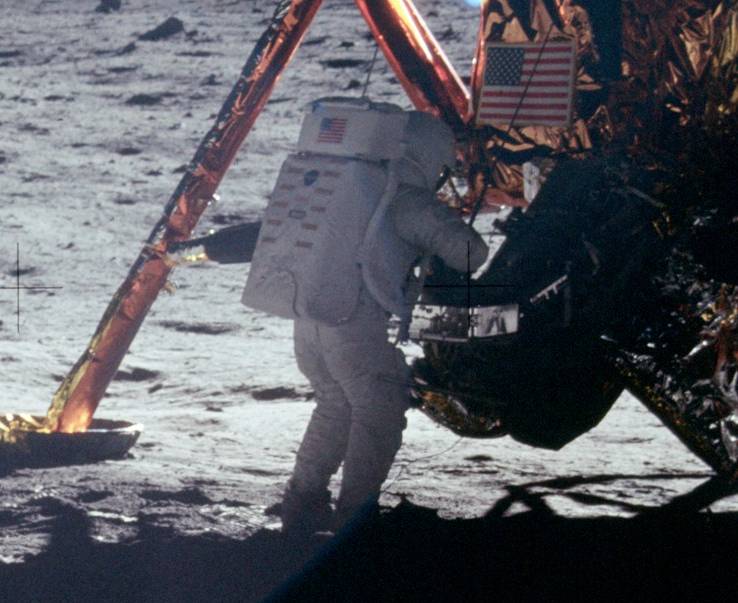
Image via Wikimedia Commons
People have been graduating from college this year who are as old as the role of internet truther. It is a venerable hobby (some might call it a cult) leading increasing numbers of people to bizarre conclusions drawn from dubious evidence proffered by spurious sources; people convinced that some wild allegation or other must be true because they saw it on the Internet, shared by people they knew and liked.
Twenty years ago, one pioneering truther wrote Mr. Neil Armstrong to put him in his place about that bugbear, the faked moon landing. The author of the letter, a Mr. Whitman, identifies himself as a “teacher of young children” charged with “a duty to tell them history as it truly happened, and not a pack of lies and deceit.” His letter shows some difficulty with grammar, and even more with critical thinking and standards of evidence.
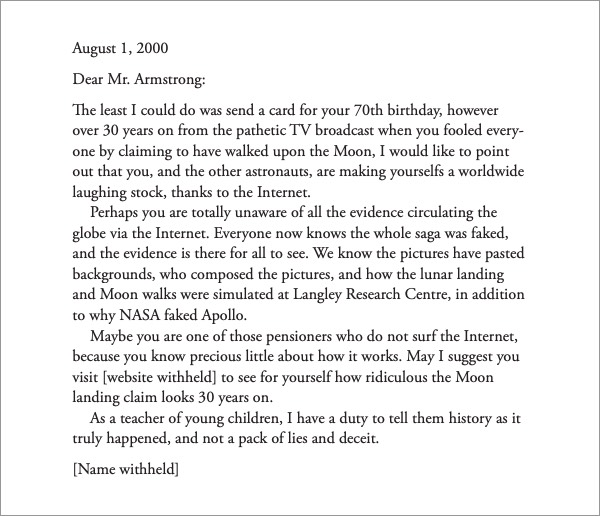
Mr. Whitman makes his accusations with certainty and smugness. “Perhaps you are totally unaware,” he writes, “of all the evidence circulating the globe via the Internet,” which he then summarizes.
He also sends Neil Armstrong—an astronaut who either walked on the Moon or engaged in perhaps the greatest conspiracy in history—a URL, “to see for yourself how ridiculous the Moon landing claim looks 30 years on.” Whitman sent Armstrong the letter on the astronaut’s 70th birthday.
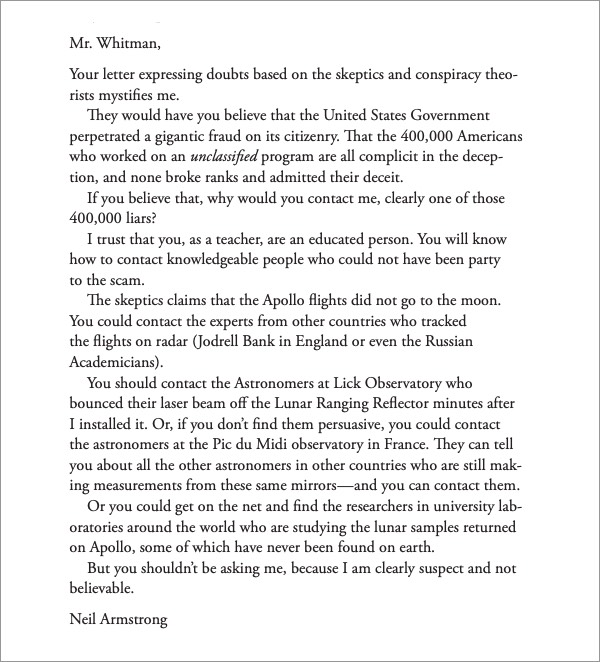
Armstrong’s response, via Letters of Note, can be read in full above. Perhaps Mr. Whitman learned something from the exchange—or had a moment of clarity about his methods of investigation. One can hope. In any case, Armstrong’s unsparing reply serves as a template for responding—should someone be so inclined—to internet truthers armed with wild conspiracy theories 20 years later. These letters have been collected in A Reluctant Icon: Letters to Neil Armstrong.
Related Content:
Stanley Kubrick Faked the Apollo 11 Moon Landing in 1969, Or So the Conspiracy Theory Goes
Josh Jones is a writer and musician based in Durham, NC. Follow him at @jdmagness
Read More...Pretty Much Pop: A Culture Podcast #49 Considers Conspiracy Theories as Pop

Ex-philosopher Al Baker works at the UK-based Logically, a company that fights misinformation.
He joins your hosts Mark Linsenmayer, Erica Spyres, and Brian Hirt to try to answer such questions as: What’s the appeal of conspiracy theories? How similar is being consumed them to being a die-hard fan of some pop culture property? What’s the relation between pernicious conspiracy theories and fun speculation (like, maybe Elvis is alive)? Is there a harmless way to engage in conspiracy theorizing as a hobby? Is something still a conspiracy theory in the pejorative sense if it turns out to be true?
We touch on echo chambers, the role of irony and humor in spreading these theories, how both opponents and proponents claim to be skeptics, Dan Brown Novels, Tom Hanks, the Mel Gibson film Conspiracy Theory, and documentaries like Behind the Curve (about Flat Earthers) and The Family.
For expert opinions on the psychology of conspiracy theories, try The Conversation’s Antill Podcast, which had a whole series on this topic. For even more podcast action, try FiveThirtyEight, BBC’s The Why Factor podcast, Skeptoid, and The Infinite Monkey Cage.
Here are some more articles:
- “Why We Should Not Treat All Conspiracy Theories the Same” by Jaron Harambam
- “We’re Keeping A Running List Of Hoaxes And Misleading Posts About The Nationwide Police Brutality Protests” by Jane Lytvyneko and Craig Silverman
- “The Greatest Celebrity Conspiracy Theories of All Time” by Matt Miller
- “My Father, the QAnon Conspiracy Theorist” by Reed Ryley Grable
- “COVID-19 and the Turn to Magical Thinking” by Hugh Gusterson
- A new podcast called Wind of Change claims that the CIA wrote the Scorpions song by that name.
If you enjoy this, try Pretty Much Pop #14 on UFOs. The Partially Examined Life episodes referred to in this discussion are #96 on Oppenheimer and the Rhetoric of Science Advisers and #82 on Karl Popper.
Learn more at prettymuchpop.com. This episode includes bonus discussion that you can only hear by supporting the podcast at patreon.com/prettymuchpop. This podcast is part of the Partially Examined Life podcast network.
Pretty Much Pop: A Culture Podcast is the first podcast curated by Open Culture. Browse all Pretty Much Pop posts or start with the first episode.
Read More...The World According to Le Corbusier: An Animated Introduction to the Most Modern of All Architects
Among modern architects, was any architect ever so modernity-minded as Charles-Édouard Jeanneret, better known a Le Corbusier? Like many cultural figures well-known outside their field — Franz Kafka, George Orwell, David Lynch — his name has long since been adjectivized, though nowadays the term “Corbusian” is seldom used as a compliment. Many a self-described opponent of modern architecture, whatever they consider modern architecture to be, points to Le Corbusier as the originator of all the inhumanity of buildings designed over the past 90 years, and especially the second half of the 20th century: their drab colors (or lack thereof), their depressing austerity, their forbidding scale, their dark corridors, their leaky roofs. But how much, really, is he to blame?
“Le Corbusier recommended that the houses of the future be ascetic and clean, disciplined and frugal,” says The Book of Life, the companion site to Alain de Botton’s School of Life. Remembered as an architect but both an artist and engineer at heart, he thought that “true, great architecture – meaning, architecture motivated by the quest for efficiency – was more likely to be found in a 40,000-kilowatt electricity turbine or a low-pressure ventilating fan” than in the capitals of old Europe. For inspiration he looked to modern machines, especially those that had begun appearing in the sky in his youth: “he observed that the requirements of flight of necessity rid airplanes of all superfluous decoration,” says de Botton in the animated School of Life primer above, “and so unwittingly transformed them into successful pieces of architecture.”
Hence Le Corbusier’s infamous pronouncement that “a house is a machine for living in,” which first appeared in his 1923 manifesto Vers une architecture (Towards an Architecture). Le Corbusier was a writer — and a painter, and a furniture designer, and an urban planner — as much as he was an architect. “The problem is that both his detractors and his acolytes want to believe that his written manifestos, urbanistic visions, utopian ideologies and theories are compatible with his buildings,” writes Jonathan Meades, sometime architectural critic and full-time resident of Le Corbusier’s Unité d’habitation apartment block in Marseilles. But “Le Corbusier, writer, has little in common with Le Corbusier, maker of the century’s most profoundly sensuous, most moving architecture”: one was a “self-advertising propagandist,” the other “an artist-craftsman of peerless originality.”
Le Corbusier’s headline-making urban-renewal proposals included, Meades writes, “the destruction of the Right Bank in Paris and its replacement with ranks of cruciform skyscrapers”; he also proposed demolishing Manhattan, as de Botton says, “to make way for a fresh and more ‘Cartesian’ attempt at urban design.” Le Corbusier’s utopian dreams of colossal skyscrapers placed in the middle of vast green parkland and surrounded by elevated freeways led, in this telling, to “the dystopian housing estates that now ring historic Paris, the wastelands from which tourists avert their eyes in confused horror and disbelief on their way into the city.” But if cities can still use Le Corbusier’s planning ideas as a negative example, they have more to learn from the positive example of his aesthetic sensibility, which remains exhilarating today, even amid a kind of modernity the man himself could never have imagined.
Related Content:
The Modernist Gas Stations of Frank Lloyd Wright and Mies van der Rohe
Modernist Birdhouses Inspired by Bauhaus, Frank Lloyd Wright and Joseph Eichler
Based in Seoul, Colin Marshall writes and broadcasts on cities, language, and culture. His projects include the book The Stateless City: a Walk through 21st-Century Los Angeles and the video series The City in Cinema. Follow him on Twitter at @colinmarshall, on Facebook, or on Instagram.
Read More...Watch Hundreds of Free Films from Around the World: Explore Film Archives from Japan, France, and the U.S.
While the world retreated indoors in March, and the cinemas we knew and loved closed up shop, so many film libraries have turned around and opened up their archives to the world. This is a good thing. Don’t say you have nothing to watch! We have explored all the links below and can verify that they are all indeed free to watch. Some are even free to download. Here’s a brief rundown of some we’ve found:
The National Film Registry of the Library of Congress
The Library of Congress annually selects films to preserve that it considers “culturally, historically or aesthetically significant” and quite a lot of them are available to screen. May we suggest:
Modesta, Benjamin Doniger’s 1955 short drama about women’s rights in a rapidly modernizing Puerto Rico. It won the prize at the Venice Film Festival in 1956.
St. Louis Blues, basically an extended music video (before such a thing existed) for the Queen of the Blues, Bessie Smith, from 1929.
Within Our Gates, the astounding 1919 feature film by Oscar Micheaux. Directed by and starring African-Americans, this rebuttal to Birth of a Nation says something more incisive about American racial politics than most films created in the 20th century.
The physical Cinematheque–a cultural institution since 1936, and currently housed in a Frank Gehry-designed building–might be closed, but its streaming platform, dubbed “Henri” is up and showing some rare and restored classics. On one hand, it really helps if you can understand French, because not everything is subtitled. On the other, there are plenty of silent and subbed films:
Protea, Victorin-Hippolyte Jasset’s 1913 response to the Fantomas serials, features Josette Andriot as the slinky, sexy Mata Hari-like super-spy, a few years before Irma Vep and her similar get-up.
The Fall of the House of Usher: Jean Epstein’s surreal adaptation of the Poe classic features brilliant photography and an expressionist style. Fans of The Lighthouse will appreciate its lunacy.
Paris qui dort: Rene Clair’s *other* surreal film made in 1924 (the better known is Entr’acte), this glorious 4K restoration looks like it was shot yesterday as a group of friends wake up to find that all people in Paris have been frozen in place. Play time commences and there is some footage of climbing the Eiffel Tower that might give you the willies. Watch it above.
Japanese Animated Film Classics
With works that go back as far as 1917, this is a deep dive into the world of Japanese animation curated by the Nobuo Ofuji Memorial Museum. There’s traditional cell animation, but also a surprising amount of cut-out animation
The Dull Sword, Junichi Kuichi’s short film from 1917, is a tale of a hapless samurai with an ending told in shadow puppets.
Propagate is a 1935 film from Shigeji Ogino, showing the cycle of plant life through a modernist dance of black and white shapes, close to Oskar Fischinger in style.
Ari-chan the Ant is more what we expect from animation in 1941–a copy of the Disney/Merrie Melodies house style, pleasant enough, but under Mitsuyo Seo’s direction also a critique of imperialism, however subtle. Seo would go on to direct Japan’s first feature-length animated film, Momotaro’s Divine Sea Warriors.
National Film Preservation Foundation
Bringing us full circle, the NFPF is a non-profit created by Congress in 1997 to save films that otherwise would disappear, and that includes many early animated films, avant-garde works, and films that were once thought lost but have since been discovered in Australia and New Zealand, around 2,500 works.
Too Much Johnson is the long-thought-destroyed film directed by Orson Welles that was to be part of his 1938 multimedia production for his Mercury Theater. The archive presents both the 66 minute work print and a 34 minute reimagined cut.
The Fall of the House of Usher…wait, didn’t we already mention this? In fact, just like the year that brought us Armageddon and Deep Impact, another Poe adaptation hit the screens in 1928. This one is shorter, and even more surreal, and directed by James Sibley Watson and Melville Webber.
At first this silent footage of the Negro Leagues seems a bit too comical–a baseball version of the Harlem Globetrotters–but it’s actually a portrait of an era in flux, two years before segregation was about to end in baseball. Shot at Cincinnati’s Crosley Field, the star of this footage is Reece “Goose” Tatum of the Cincinnati Clowns. As the film notes point out, just because they were goofing off for the camera doesn’t mean these players weren’t athletes–Hank Aaron was their shortstop before signing to the Braves, and the Clowns’ rival team, the Kansas City Monarchs, boasted Jackie Robinson also as a shortstop.
You can find more free films in the Relateds below…
Related Content:
4,000+ Free Movies Online: Great Classics, Indies, Noir, Westerns, Documentaries & MoreWatch 3,000+ Films Free Online from the National Film Board of Canada
Watch More Than 400 Classic Korean Films Free Online Thanks to the Korean Film Archive
Download 6600 Free Films from The Prelinger Archives and Use Them However You Like
1,150 Free Movies Online: Great Classics, Indies, Noir, Westerns, etc.
Ted Mills is a freelance writer on the arts who currently hosts the Notes from the Shed podcast and is the producer of KCRW’s Curious Coast. You can also follow him on Twitter at @tedmills, and/or watch his films here.
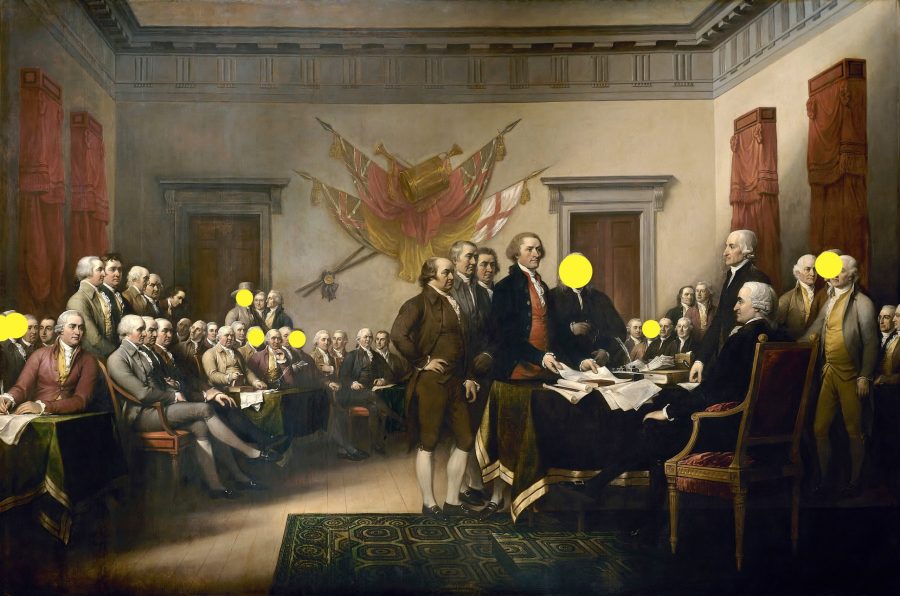
Read More...John Trumbull’s Famous 1818 Painting Declaration of Independence Virtually Defaced to Show Which Founding Fathers Owned Slaves
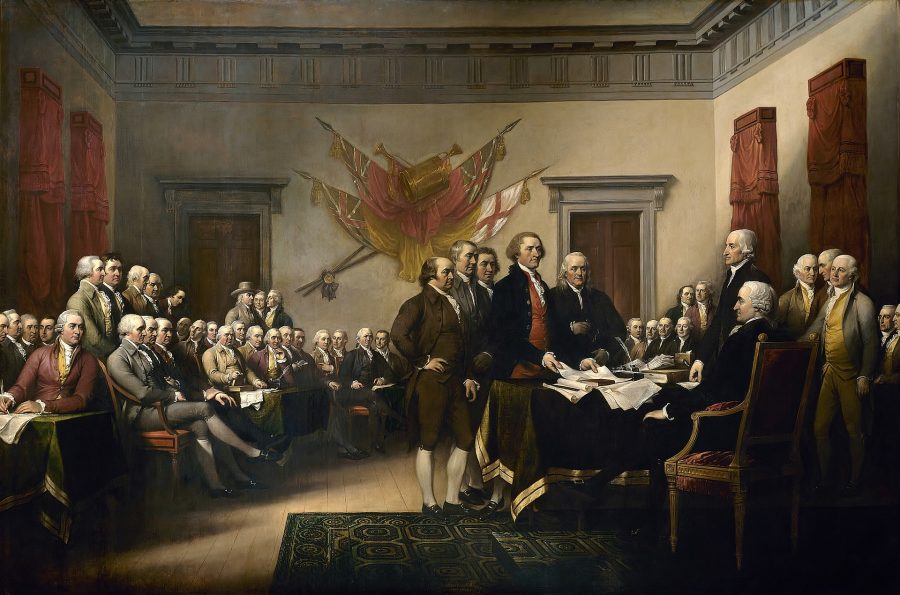
Statues of slaveholders and their defenders are falling all over the U.S., and a lot of people are distraught. What’s next? Mount Rushmore? Well… maybe no one’s likely to blow it up, but some honesty about the “extremely racist” history of Mount Rushmore might make one think twice about using it as a limit case.
On the other hand, a sandblasting of the enormous Klan monument in Stone Mountain, Georgia—created earlier by Rushmore sculptor Gutzon Borglum—seems long overdue.
We are learning a lot about the history of these monuments and the people they represent, more than any of us Americans learned in our early education. But we still hear the usual defense that slaveholders were only men of their time—many were good, pious, and gentle and knew no better (or they agonized over the question but, you know, everyone was doing it….) People subjected to the violence and horror of slavery mostly tended to disagree.
Before the Haitian Revolution terrified the slaveholding South, many prominent slaveholders, Jefferson and Washington included, expressed intellectual and moral disgust with slavery. They could not consider abolition, however (though Washington freed his slaves in his will). There was too much profit in the enterprise. As Jefferson himself wrote, “It [would] never do to destroy the goose.”
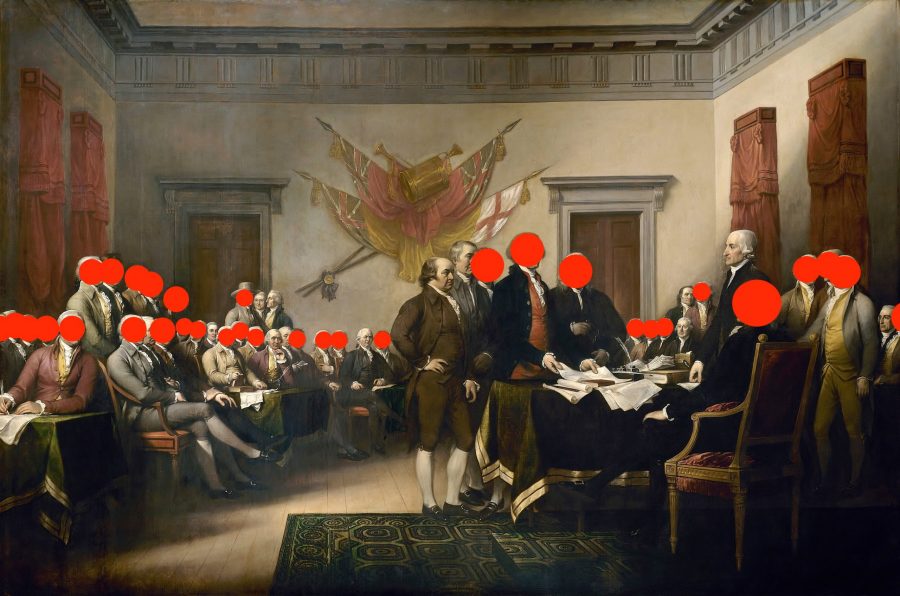
What we see when we look at the Revolutionary period is the fatal irony of a republic based on ideals of liberty, founded mostly by men who kept millions of people enslaved. The point is made vividly above in a virtual defacement of Declaration of Independence, John Trumbull’s famous 1818 painting which hangs in the U.S. Capitol rotunda. All of the founders’ faces blotted out by red dots were slaveowners. Only the few in yellow in the corresponding image freed the the people they enslaved.
These images were not made in this current summer of national uprisings but in August of 2019, “a bloody month that saw 53 people die in mass shootings in the US,” notes Hyperallergic. Their creator, Arlen Parsa sought to make a different point about the Second Amendment, but wrote forcefully about the founders’ enslaving of others. “There were no gentle slaveholders,” writes Parsa. “Countless children were born into slavery and died after a relatively short lifespan never knowing freedom for even a minute.” Many of those children were fathered by their owners.
Some founding fathers paid lip service to the idea of slavery as a blight because it was obvious that kidnapping and enslaving people contradicted democratic principles. Slavery happened to be the primary metaphor used by Enlightenment philosophers and their colonial readers to characterize the tyrannical monarchism they opposed. The philosopher John Locke wrote slavery into the constitution of the Carolina colony, and profited from it through owning stock in the Royal African Company. Yet by his later, hugely influential Two Treatises, he had come to see hereditary slavery as “so vile and miserable an estate of man… that ‘tis hardly to be conceived” that anyone could uphold it.
There were, of course, slaveholding founders who resisted such talk and felt no compunction about how they made their money. But lofty principles or no, the U.S. founders were often on the defensive against non-slaveholding colleagues, who scolded and attacked them, sometimes with frank references to the rapes of enslaved women and girls. These criticisms were so common that Thomas Paine could write the case for slavery had been “sufficiently disproved” when he published a 1775 tract denouncing it and calling for its immediate end:
The managers of [the slave trade] testify that many of these African nations inhabit fertile countries, are industrious farmers, enjoy plenty and lived quietly, averse to war, before the Europeans debauched them with liquors… By such wicked and inhuman ways, the English are said to enslave towards 100,000 yearly, of which 30,000 are supposed to die by barbarous treatment in the first year…
So monstrous is the making and keeping them slaves at all… and the many evils attending the practice, [such] as selling husbands away from wives, children from parents and from each other, in violation of sacred and natural ties; and opening the way for adulteries, incests and many shocking consequences, for all of which the guilty masters must answer to the final judge…
The chief design of this paper is not to disprove [slavery], which many have sufficiently done, but to entreat Americans to consider:
With that consistency… they complain so loudly of attempts to enslave them, while they hold so many hundred thousands in slavery and annually enslave many thousands more, without any pretence of authority or claim upon them.
Jefferson squared his theory of liberty with his practice of slavery by picking up the fad of scientific racism sweeping Europe at the time, in which philosophers who profited, or whose patrons and nations profited, from the slave trade began to coincidentally discover evidence that enslaving Africans was only natural. We should know by now what happens when racism guides science.…
Maybe turning those who willfully perpetuated the country’s most intractable, damning crime against humanity into civic saints no longer serves the U.S., if it ever did. Maybe elevating the founders to the status of religious figures has produced a widespread historical ignorance and a very specific kind of nationalism that are no longer tenable. Younger and future generations will settle these questions their own way, as they sort through the mess their elders have left them. As Locke also argued, in a paraphrase from American History professor Holly Brewer, “people do not have to obey a government that no longer protects them, and the consent of an ancestor does not bind the descendants: each generation must consent for itself.”
via Hyperallergic
Related Content:
Josh Jones is a writer and musician based in Durham, NC. Follow him at @jdmagness
Read More...Support Us
We're hoping to rely on loyal readers, rather than erratic ads. Please click the Donate button and support Open Culture. You can use Paypal, Venmo, Patreon, even Crypto! We thank you!

About Us

Open Culture scours the web for the best educational media. We find the free courses and audio books you need, the language lessons & educational videos you want, and plenty of enlightenment in between.
Advertise With Us

FREE UPDATES!
GET OUR DAILY EMAIL
Get the best cultural and educational resources on the web curated for you in a daily email. We never spam. Unsubscribe at any time.
FOLLOW ON SOCIAL MEDIA

Open Culture editor Dan Colman scours the web for the best educational media. He finds the free courses and audio books you need, the language lessons & movies you want, and plenty of enlightenment in between.
Advertise With Us


