Miles Davis is Attacked, Beaten & Arrested by the NYPD Outside Birdland, Eight Days After the Release of Kind of Blue (1959)
It is hard, on the other hand, to blame the policeman, blank, good-natured, thoughtless, and insuperably innocent, for being such a perfect representative of the people he serves. He, too, believes in good intentions and is astounded and offended when they are not taken for the deed.
—James Baldwin
James Baldwin’s 1960 essay “Fifth Avenue, Uptown” is rich with heartrending ironies and razor-sharp refutations of the usual apologies for racist violence in America. It does not matter, Baldwin argues, whether individuals are “good” or “bad” apples in a system designed to enforce segregation, whether by force of law or brute force of will. “None of the police commissioner’s men,” writes Baldwin, “even with the best will in the world, have any way of understanding the lives led by the people they swagger about in twos and threes controlling.”
This brutal ignorance extends widely to radicals, dissidents, peaceful protesters, and hapless bystanders during times of mass political unrest. (As Ed Kilgore points out at New York magazine, the term “police riot” originated in the 1968 Chicago Democratic Convention.) The brutality we’ve seen visited on elderly white activists, journalists, and even local politicians during recent protests (against brutality) has been a daily reality for millions of black Americans, even Americans as famous as Miles Davis.
In 1959—eight days after the release of Kind of Blue and just after recording a broadcast for armed forces radio—Davis was harassed and then viciously attacked by the police outside Birdland in Midtown Manhattan. Then he was arrested for resisting arrest and dragged to the police station for booking and further harassment. You can hear the story in a clip above from The Miles Davis Story. Davis himself recounted the event in his autobiography:
I had just finished doing an Armed Forces Day broadcast, you know, Voice of America and all that bullshit. I had just walked this pretty white girl named Judy out to get a cab. She got in the cab, and I’m standing there in front of Birdland wringing wet because it’s a hot, steaming, muggy night in August.
This white policeman comes up to me and tells me to move on. I said, “Move on, for what? I’m working downstairs. That’s my name up there, Miles Davis,” and I pointed to my name on the marquee all up in lights.
He said, “I don’t care where you work, I said move on! If you don’t move on I’m going to arrest you.”
I just looked at his face real straight and hard, and I didn’t move. Then he said, “You’re under arrest!” He reached for his handcuffs, but he was stepping back…I kind of leaned in closer because I wasn’t going to give him no distance so he could hit me on the head… A crowd had gathered all of a sudden from out of nowhere, and this white detective runs in and BAM! hits me on the head. I never saw him coming. Blood was running down the khaki suit I had on.
Davis, who grew up wealthy in St. Louis, came from vastly different circumstances than Baldwin. He understood the violence of the South, but not of Northern cities. Nonetheless, his experience with the police was identical, whether in Missouri or New York. “Now I would have expected this kind of bull about resisting arrest and all back in East St Louis,” he wrote, “but not here in New York City, which is supposed to be the slickest, hippest city in the world. But then, again, I was surrounded by white folks and I have learned that when that happens, if you’re black, there is no justice. None.”
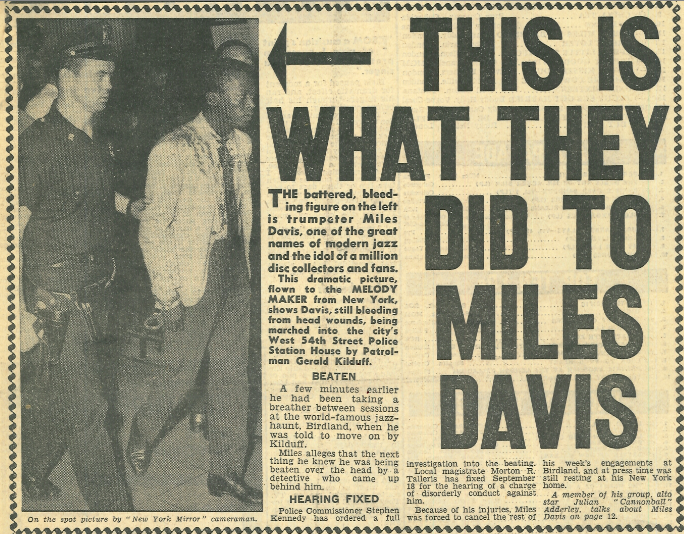
He speaks from bitter experience. Davis later sued the NYPD, but his case was dismissed, “despite a mountain of evidence in his favour,” writes Queen’s University researcher Mitchell Crouse, “including multiple witness statements, photographic evidence, and the fact that at least one of the officers was drunk.”
Baldwin and Davis both wrote of what Jamelle Bouie describes in The New York Times as the raw knowledge afforded those who live under constant surveillance and threats of assault, arrest, or murder by agents of the state: “African-American observers have never had any illusions about who the police are meant to serve.” See the many photographs of a bloody Miles taken during and after his arrest at the 1959 Project.
Related Content:
Miles Davis’ Bitches Brew Turns 50: Celebrate the Funk-Jazz-Psych-Rock Masterpiece
Josh Jones is a writer and musician based in Durham, NC. Follow him at @jdmagness
Read More...In 1968, a Teenager Convinced Thelonious Monk to Play a Gig at His High School to Promote Racial Unity; Now the Concert Recording Is Getting Released
In 1964, Thelonious Monk appeared on the cover of TIME. He had been chosen for an extensive profile, his biographer Robin D.G. Kelley tells Terry Gross, because the magazine thought Miles Davis or Ray Charles might be “too controversial.” Monk, it was thought “had no complaints… he wasn’t so political.” This is not exactly so, Kelley writes in Thelonious Monk: The Life and Times of an American Original. The eccentric genius played benefit concerts throughout the 60s. But he was also beginning to suffer from mental health issues that remained undiagnosed to the end of his life. Still, he followed Civil Rights struggles closely. “Thelonious was moved by these events” and wondered what more he could do.
That year Monk had an opportunity to make a direct contribution by playing the mostly white Palo Alto High School after the most “racially tense” summer of the decade, a moment in history eerily like the current time. The show was organized by enterprising 16-year-old junior Danny Scher, who would go on to become a major concert promoter.
Through his local connections, Scher contacted Monk’s manager and arranged the booking. In order to fill the auditorium, he promoted the show in his wealthy Palo Alto enclave, in the local newspapers, and in largely segregated East Palo Alto. (“Against the urging of the police department,” notes Jazziz.) Scher’s hard work turned the event into a rousing success, Kelley writes:
Neither Thelonious nor sixteen-year-old Danny Scher fully grasped what this concert meant for race relations in the area. For one beautiful afternoon, blacks and whites, P.A. and East P.A., buried the hatchet and gathered together to hear “Blue Monk,” “Well, You Needn’t,” and “Don’t Blame Me.”
Monk played for over an hour to the integrated audience, then played an encore after “thunderous applause.” The story of how the concert came about is full of plot twists, including the fact that Monk never actually saw the contract and only found out about the gig when Scher called him a few days before. But he “dug the kid’s chutzpah and agreed to do it.” While Scher may have had the presence of mind to follow up before the gig, he didn’t think to document the moment. That fell to a Black custodian at the high school (whose name has been unfortunately lost) who approached Scher, Nate Chinen tells NPR, and offered to tune the piano if he could record the gig.
The custodian gave the tapes to Scher and the promoter held on to them for over 50 years. Now they’re finally being released as Palo Alto by Impulse! Records on July 31st. You can preview the new release with “Epistrophy,” at the top. This record is no minor rarity, according to Monk’s son, T.S. Monk, who calls it “one of the best live recordings I’ve ever heard by Thelonious.” Maybe he was energized by the urgency of the moment, maybe it was the energy of the audience that drove his performance. Whatever inspired him that day, Monk showed, as many jazz musicians did at the time, how art can succeed where politics fail, and can—at least temporarily—unite communities who might have come to believe they have nothing left in common.
via NPR
Related Content:
How Music Unites Us All: Herbie Hancock & Kamasi Washington in Conversation
How Jazz Helped Fuel the 1960s Civil Rights Movement
Thelonious Monk’s 25 Tips for Musicians (1960)
Josh Jones is a writer and musician based in Durham, NC. Follow him at @jdmagness
Read More...How One Simple Cut Reveals the Cinematic Genius of Yasujirō Ozu
Since his death 56 years ago, Yasujirō Ozu has only become more and more often referenced as a locus of greatness in Japanese cinema. Almost without exception, his exegetes explain the power of his films first through their deceptive simplicity. His movies may look and play like simple midcentury domestic dramas, each bearing a strong resemblance to the one before, but within these rigid thematic and aesthetic strictures, Ozu achieves transcendence. In fact, before becoming a filmmaker in his own right Paul Schrader elevated Ozu into a trinity alongside Robert Bresson and Carl Theodor Dreyer in his 1972 book Transcendental Style in Film.
“Perhaps the finest image of stasis in Ozu’s films is the lengthy shot of the vase in a darkened room near the end of Late Spring,” Schrader writes, citing the 1949 picture usually counted among Ozu’s best. “The father and daughter are preparing to spend their last night under the same roof; she will soon be married. They calmly talk about what a nice day they had, as if it were any other day. The room is dark; the daughter asks a question of the father, but gets no answer. There is a shot of the father asleep, a shot of the daughter looking at him, a shot of the vase in the alcove and over it the sound of the father snoring. Then there is a shot of the daughter half-smiling, then a lengthy, ten-second shot of the vase again, and a return to the daughter now almost in tears, and a final return to the vase.”
Some viewers see the vase as an inexplicable inclusion, especially at such a charged moment. Schrader sees it as stasis itself, “a form which can accept deep, contradictory emotion and transform it into an expression of something unified, permanent, transcendent.” In the video essay at the top of the post, Evan Puschak, better known as the Nerdwriter, examines for himself the place of the vase in Late Spring, in Ozu’s style more broadly, and in the body of critical work surrounding Ozu’s oeuvre.
To Puschak’s mind, the various readings of the vase by Schrader and others “speak to the unique power that Ozu has, that he developed over his long career. His style may appear simple, but is in fact so fine-tuned, so carefully calibrated, that he has the power to overwhelm the viewer, to launch a thousand interpretations with a single cut.”
Late Spring features performances by Ozu regulars Chishū Ryū and Setsuko Hara, both of them inhabiting the kind of characters for which the director relied on them: Ryū the good-natured but firm father, Hara the by turns melancholic and optimistic but ultimately dutiful daughter. These are archetypal Ozu people, and the vase is an archetypal Ozu object, as much so as the recurring red tea kettle Ozu enthusiasts delight in spotting. Those fans will understand the appearance of the vase as a kind of “pillow shot,” the term used to describe those visual moments in all of Ozu’s pictures that have nothing to do with plot or character and everything to do with rhythm and reflection. They depict kettles and vases, but also pagodas, clothesline, street signs, smokestacks — things, not people, but things that, in their context, underscore Ozu’s powerful humanity.
Related Content:
An Introduction to Yasujiro Ozu, “the Most Japanese of All Film Directors”
How David Lynch Manipulates You: A Close Reading of Mulholland Drive
Based in Seoul, Colin Marshall writes and broadcasts on cities, language, and culture. His projects include the book The Stateless City: a Walk through 21st-Century Los Angeles and the video series The City in Cinema. Follow him on Twitter at @colinmarshall, on Facebook, or on Instagram.
Read More...Rick Astley Sings an Unexpectedly Enchanting Cover of the Foo Fighters’ “Everlong”
Now, if this leaves you wanting to hear Dave Grohl sing “Never Gonna Give You Up,” all you have to do is click here. Enjoy…
Related Content:
Student Rickrolls Teacher By Sneaking Rick Astley Lyrics into Quantum Physics Paper
Neil Finn Sings a Lovely Version of David Bowie’s “Heroes,” Live from Home
Read More...Construct Your Own Bayeux Tapestry with This Free Online App
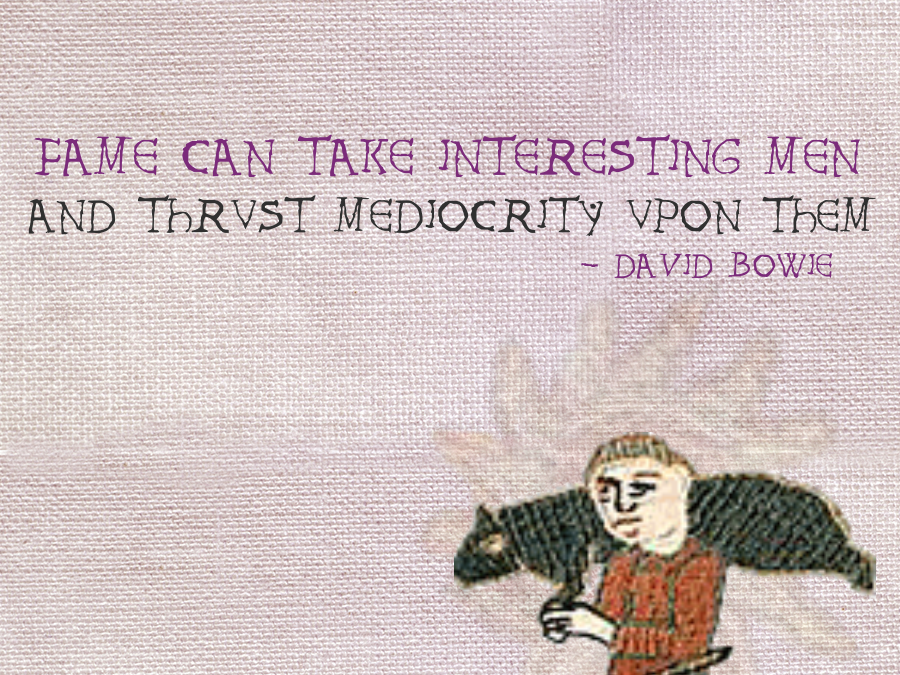
A wise woman once quoth that one man’s adult coloring book is another’s Medieval Tapestry Edit.
If taking crayons to empty outlines of mandalas, floral patterns, and forest and ocean scenes has failed to calm your mind, the Historic Tale Construction Kit may cure what ails you.
Programmers Leonard Allain-Launay and Mathieu Thoretton and software engineer Maria Cosmina Etegan created the online kit as a tribute to a late, great, early 21st-century application designed by Academy of Media Arts Cologne students Björn Karnebogen and Gerd Jungbluth.
They separated out various elements of the Bayeux Tapestry, allowing you to freely mess around with 1000-year-old images of warriors, commoners, beasts, and buildings:
Craft thy own Bayeux Tapestry
Slay mischievous beasts
Rule the kingdom
Choose a background, add some text in your choice of Bayeux or Augusta font and you’ll have done your bit to revive the fading art of the Medieval Macro (or meme.)
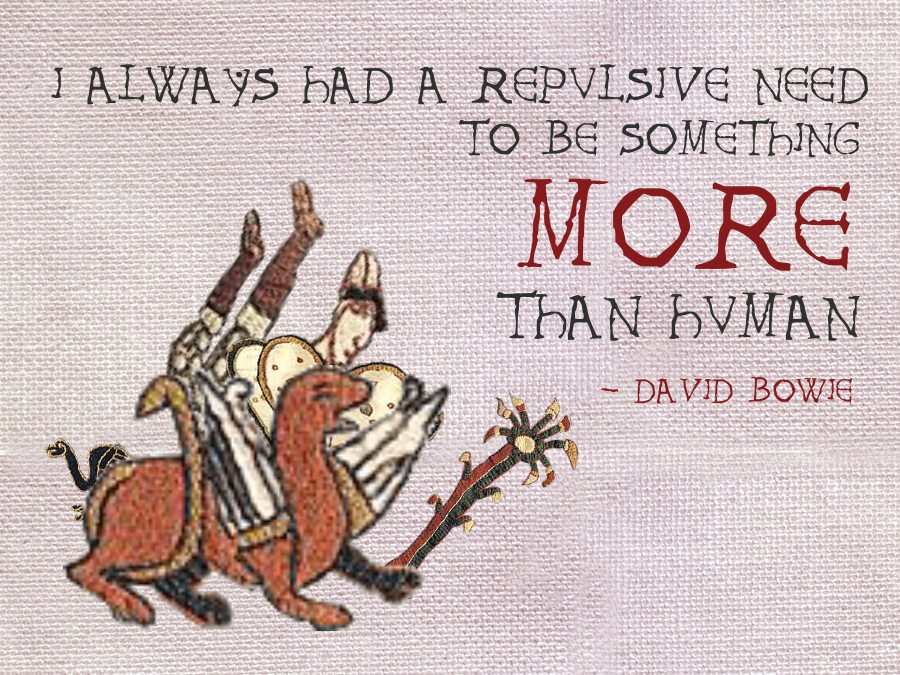
The original tapestry used some 224 feet of wool-embroidered linen to recount the Battle of Hastings and the events leading up to it.
You need not have such lofty aims.
Perhaps test the waters with a Father’s Day greeting, resizing and rotating until you feel ready to export as a PNG.
The interface is extremely user friendly, kind of like a tech-savvy 11th-century cousin of the online drag-and-drop graphic design tool, Canva.
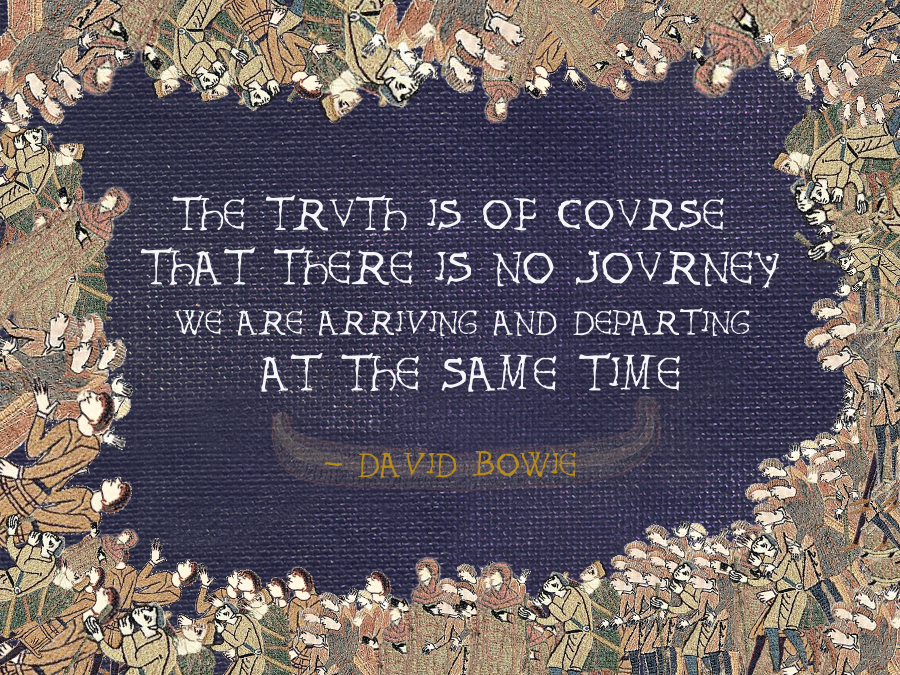
The Historic Tale Construction Kit’s most impressive bells and whistles reside in the paintbrush tool in the lower left corner, which allows you to lay down great swaths of folks, birds, or corpses in a single sweep.
Your palette will be limited to the shades deployed by the Bayeux embroiderers, who obtained their colors from plants—dyer’s woad, madder, and dyer’s rocket (or weld).
The text, of course, is entirely up to you.
It pleased us to go with the eminently quotable David Bowie, and only after we groped our way into the three fledgling efforts you see above did we discover that we’re not the only ones.
Presenting Early Pre-Bowie References to “Space Oddity”
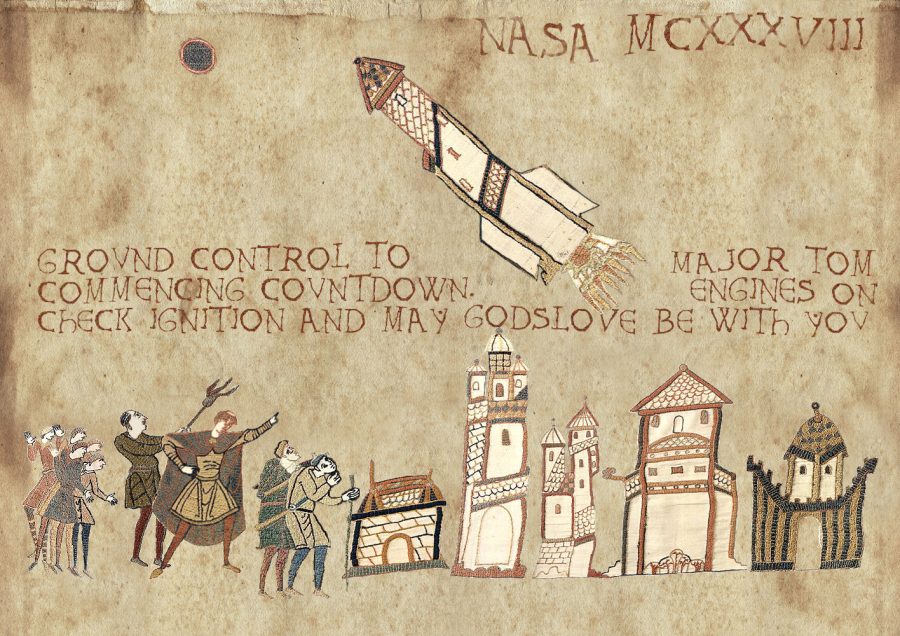

Throw on some Bardcore and begin reworking the Bayeux Tapestry with the Historic Tale Construction Kit here.
If you are interested in something a bit more technical, the designers have put the opensource code on GitHub for your customizing pleasure.
The Bayeux Tapestry has also been recently digitized. Explore it here: The Bayeux Tapestry Gets Digitized: View the Medieval Tapestry in High Resolution, Down to the Individual Thread
Related Content:
Why Knights Fought Snails in Illuminated Medieval Manuscripts
Ayun Halliday is an author, illustrator, theater maker and Chief Primatologist of the East Village Inky zine. Follow her @AyunHalliday.
Read More...How Fast Can a Vaccine Be Made?: An Animated Introduction
From Ted-Ed comes a video that answers a timely question: How fast can a vaccine be made?
They write: “When a new pathogen emerges, our bodies and healthcare systems are left vulnerable. And when this pathogen causes the outbreak of a pandemic, there’s an urgent need for a vaccine to create widespread immunity with minimal loss of life. So how quickly can we develop vaccines when we need them most? Dan Kwartler describes the three phases of vaccine development.” Exploratory research, clinical testing, and manufacturing.
When you’re done, you can watch their related video: When is a pandemic over?
If you would like to support the mission of Open Culture, consider making a donation to our site. It’s hard to rely 100% on ads, and your contributions will help us continue providing the best free cultural and educational materials to learners everywhere. You can contribute through PayPal, Patreon, and Venmo (@openculture). Thanks!
Read More...Why This Font Is Everywhere: How Cooper Black Became Pop Culture’s Favorite Font
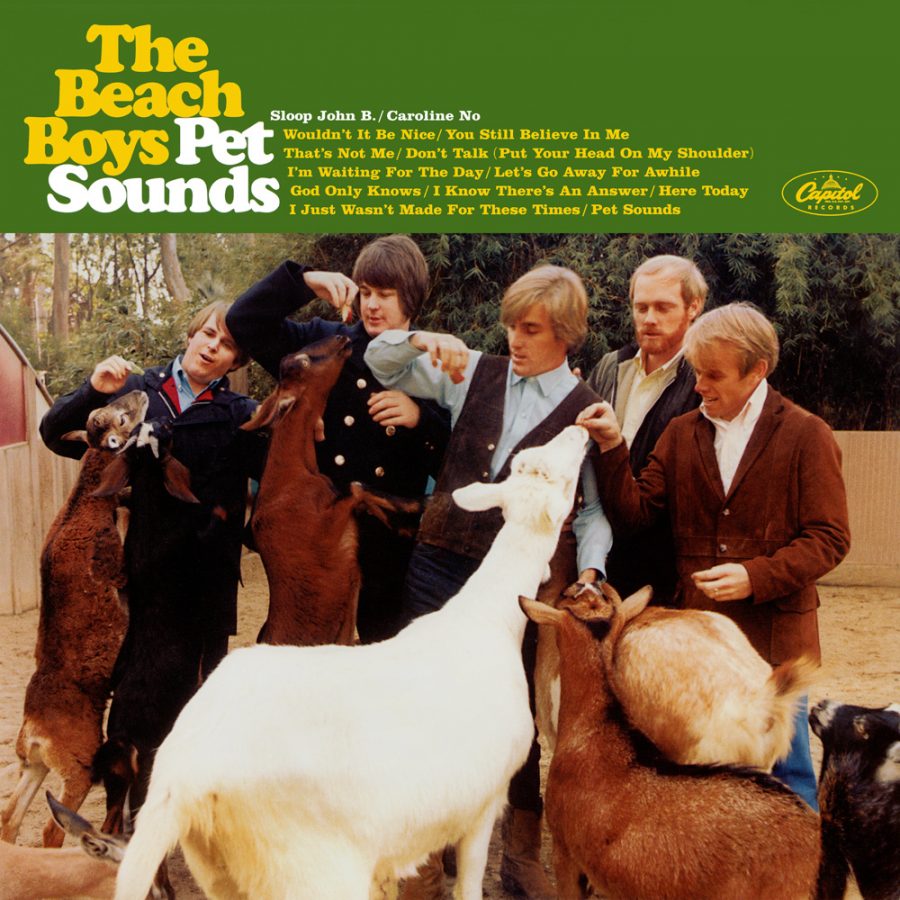
You know Times New Roman, you know Helvetica, you know Comic Sans — and though you may not realize it, you know Cooper Black as well. Just think of the “VOTE FOR PEDRO” shirt worn in Napoleon Dynamite (and in real life for years thereafter), or a few decades earlier, the cover of Pet Sounds. In fact, the history of Cooper Black extends well before the Beach Boys’ mid-1960s masterpiece; to see and hear the full story, watch the Vox video above. It begins, as narrator Estelle Caswell explains, in Chicago, at the turn of the 1920s when type designer Oswald Bruce Cooper created the series of fonts that bear his name. Nearly a century after the 1922 introduction of the variant Cooper Black, we see it everywhere, not just on album covers and T‑shirts but storefronts, movie posters, and candy wrappers all over the world.
The evolution of printing, specifically the evolution from carved wood type to cast metal, made Cooper Black possible. Its distinctive look — and the curved edges that made it forgiving to imperfect printing processes — made it a hit. And when film strips replaced metal type, allowing the kind of closely-spaced printing that Cooper thought best presented his font, the already-popular Cooper Black underwent a renaissance.
“It thrived, as always, in advertising,” says Caswell. “Its friendly curves fit the tongue-in-cheek aesthetic of the 1960s and 70s, but it also showed up in magazines, movies, and hundreds of album covers.” To typography enthusiasts, Pet Sounds seemingly remains Cooper Black’s finest hour: “Just look at the way the D works with the E and the Y, and ‘Boys’ fits so nicely over the O,” as art director Stephen Heller says in the video.
In the 1920s Cooper Black not only showcased cutting-edge printing technology, its aesthetic looked exhilaratingly modern as well. Now, of course, it looks comfortingly retro, evocative of the era of handmade graphic design slipping out of living memory in our digital 21st century. But the 21st century so far has also been a time of “retromania”: with all previous media increasingly at our fingertips, we draw inspiration (and even material) for our art and design more directly and instinctively than ever from the trends of the past. No wonder we continue to feel a resonance in Cooper Black, whose letters, as Caswell puts it, bring with them the weight of “a century’s worth of changes in technology and pop culture.” Nor is Cooper Black’s next century, whatever uses it sees the font put to, likely to diminish its appeal.
Related Content:
The History of Typography Told in Five Animated Minutes
Based in Seoul, Colin Marshall writes and broadcasts on cities, language, and culture. His projects include the book The Stateless City: a Walk through 21st-Century Los Angeles and the video series The City in Cinema. Follow him on Twitter at @colinmarshall, on Facebook, or on Instagram.
Read More...Take Free Online Courses on African-American History from Yale and Stanford: From Emancipation, to the Civil Rights Movement, and Beyond
As every American knows, February is Black History Month. And as every American also knows — if the events of 2020 haven’t warped their sense of time too badly — is isn’t February right now. But thanks to online learning technology, we all have the freedom to study any subject we want, as much as we want, whenever we want, irrespective of the time of year. Sources of internet-based education have proliferated in the 21st century, but long-respected institutions of higher learning have also got in on the action. Yale University, for example, has produced the online course African American History: Emancipation to the Present, whose 25 lectures by history professor Jonathan Holloway you can watch on YouTube, or at Yale’s web site. The first lecture appears above.
Originally recorded in the spring of 2010, Holloway’s course examines “the African American experience in the United States from 1863 to the present,” involving such chapters of history as “the end of the Civil War and the beginning of Reconstruction” and “African Americans’ urbanization experiences.”
It also includes lectures on the “thought and leadership of Booker T. Washington, Ida B. Wells-Barnett, W.E.B. Du Bois, Marcus Garvey, Martin Luther King Jr., and Malcolm X” — all writers and thinkers Open Culture readers will have encountered before, but a course like African American History: Emancipation to the Present offers the opportunity to consider their lives and work in clearer context and greater detail.
Black history has deeper roots in some parts of the United States than others. But that doesn’t mean the universities of the west have nothing to offer in this department: take, for example, Stanford University’s African-American History: Modern Freedom Struggle, taught by the historian (and editor of MLK’s papers) Clayborne Carson. Available to watch on YouTube and iTunes (or right above), its 18 lectures deliver an introduction to “African-American history, with particular emphasis on the political thought and protest movements of the period after 1930, focusing on selected individuals who have shaped and been shaped by modern African-American struggles for freedom and justice.” Taken together, these online courses offer you more than enough material to hold your own Black History Month right now.
Note: Clay Carson’s course can also be taken as a MOOC on edX. Enroll now in American Prophet: The Inner Life and Global Vision of Martin Luther King, Jr. And find the courses listed above in our collection, 1,700 Free Online Courses from Top Universities.
Related Content:
Free Online History Courses
Based in Seoul, Colin Marshall writes and broadcasts on cities, language, and culture. His projects include the book The Stateless City: a Walk through 21st-Century Los Angeles and the video series The City in Cinema. Follow him on Twitter at @colinmarshall, on Facebook, or on Instagram.
Read More...Andrei Tarkovsky’s Solaris Shot by Shot: A 22-Minute Breakdown of the Director’s Filmmaking
“What is Bresson’s genre? He doesn’t have one. Bresson is Bresson,” wrote master filmmaker Andrei Tarkovsky in his seminal book Sculpting in Time. “The very concept of genre is as cold as the tomb.”
Nonetheless, Tarkovsky made two of the most praised, best-regarded science fiction films in cinema. Stalker is a metaphysical riddle wrapped in the trappings of a sci-fi thriller. In the verdant area called the Zone, ringed off by miles of barbed wire and armed soldiers, pilgrims come to behold an uncanny landscape ruled by a powerful, otherworldly intelligence. The film seemed to prefigure the Chernobyl disaster that happened years later and proved to be the unlikely inspiration for a video game.
Adapted from a novel by Stanislaw Lem, Solaris is about a space station that orbits a sentient planet that causes hallucinations in the cosmonauts. The hyper-rational protagonist, Kris Kelvin, is thrown for a loop when he is confronted by a doppelganger of his dead wife who killed herself years earlier. The logical side of him knows that this is a hallucination but he falls in love anyway, only to lose her again. Kelvin is caught in a hell of repeating the mistakes of his past.
Solaris was seen as a Cold War-era response to Stanley Kubrick’s 2001: A Space Odyssey. Both movies are mind-altering deep-space epics that raise more questions than they answer. Yet Tarkovsky hated 2001’s ostentatious use of cutting-edge special effects. “For some reason, in all the science-fiction films I’ve seen, the filmmakers force the viewer to examine the details of the material structure of the future,” he told Russian film journalist Naum Abramov in 1970. “More than that, sometimes, like Kubrick, they call their own films premonitions. It’s unbelievable! Let alone that 2001: A Space Odyssey is phony on many points, even for specialists. For a true work of art, the fake must be eliminated.”
Indeed, Tarkovsky seemed to deliberately half-ass the generic elements of film. He used leisurely shots of tunnels and highways of 1971 Tokyo to depict the city of the future. He devoted only a couple minutes of the film’s nearly three hour running time to things like spaceships. And you have to love the fact that the space station in Solaris has such distinctly unfuturistic design elements as a chandelier and a wood-paneled library.
Tarkovsky, of course, isn’t interested in science. He’s interested in art and its way to evoke the divine. And his primary way of doing this is with long takes; epic shots that resonate profoundly even if the meaning of those images remains elusive. Solaris opens with a shot of water flowing in a brook and then, later in the scene, there is a sudden downpour. The camera presses into a shot of a teacup filling with rain. It’s a beautiful, memorable, evocative shot. Maybe the image means something. Maybe its beauty is, in and of itself, its meaning. Either way, Tarkovsky forces you to surrender to his deliberate cinematic rhythm and his pantheistic view of the world.
In a piece called Tarkovsky Shot by Shot, video essayist Antonios Papantoniou dissects a few scenes from Solaris, breaking down each according to camera angle, shot type and duration while pointing out recurring visual motifs. “Diametrically different from Hollywood’s extravagant moviemaking Tarkovsky’s Solaris is in a cinematic universe of its own,” writes Papantoniou in one of the video’s copious intertitles. “Symbolic images and metaphysical manifestations are created and expressed in a poetic way where every visual detail matters.” Watching Shot by Shot, you get a real sense of just how beautifully his films unfold with those gorgeously choreographed long takes. You can watch the full video above.
Note: This post originally appeared on our site in June, 2015.
Related Content:
The Masterful Polaroid Pictures Taken by Filmmaker Andrei Tarkovsky
Tarkovsky’s Advice to Young Filmmakers: Sacrifice Yourself for Cinema
Andrei Tarkovsky’s Message to Young People: “Learn to Be Alone,” Enjoy Solitude
Jonathan Crow is a Los Angeles-based writer and filmmaker whose work has appeared in Yahoo!, The Hollywood Reporter, and other publications. You can follow him at @jonccrow. And check out his blog Veeptopus, featuring lots of pictures of vice presidents with octopuses on their heads. The Veeptopus store is here.
Read More...The Grateful Dead’s “Ripple” Played By Musicians Around the World (with Cameos by David Crosby, Jimmy Buffett & Bill Kreutzmann)
Poet and Grateful Dead lyricist Robert Hunter penned some of the band’s best-known songs. Even if you’re only casually familiar with the Dead’s vast catalogue and even vaster labyrinth of live recordings, you can probably sing along to classics like “Casey Jones” or “Box of Rain.” Both came about during the most prolific phase of Hunter and Jerry Garcia’s collaboration on the country-folk masterpieces Workingman’s Dead and American Beauty, released one after the other in 1970.
Among these collections of timeless tunes, one stands above the rest: “Ripple” is “perhaps the quintessence of both the band’s delicate studio magic and the Garcia/Hunter partnership,” writes Jim Beviglia at American Songwriter. Hunter himself, when asked about his favorite lyric, answered, “’Let it be known there is a fountain / That was not made by the hands of men.’ That’s pretty much my favorite line I ever wrote, that’s ever popped into my head. And I believe it, you know?”
The line popped into his head in London in 1970. Jerry Garcia’s melody arrived shortly thereafter. “We were in Canada,” says Hunter, “on that train trip [the Festival Express, 1970] and one morning the train stopped and Jerry was sitting out on the tracks not too far off, in the sunrise, setting ‘Ripple’ to music. That’s a good memory.” They debuted it right away, “in an acoustic set at the Fillmore West on August 19, 1970,” notes David Dodd at the official Dead site, “along with first performances of ‘Brokedown Palace,’ ‘Operator,’ and ‘Truckin’.’”
What’s so great about “Ripple”? Where to start. “The Dead had damn near perfected the harmonies they used heavily on Workingman’s Dead,” Beviglia writes. “The ensemble voices on ‘Ripple’ provide comfort when the words evoke hardship.” Such is the balance struck by the most beautifully bittersweet of American folk songs, from “You Are My Sunshine” to “Will the Circle Be Unbroken.” The lyrics themselves “evoke cosmic wisdom and serenity without ignoring the darkness on the fringes of even the most blessed lives.”
C’mon, the chorus is a freakin’ haiku…
“Each of us has our own individual path, for our steps alone,” Dodd writes of the song. “That might seem like a frightening thought, but I find the universality of it a comfort: we’re all in the same boat.” This truth is inescapable, whether we approach it philosophically, contemplatively, or Biblically, as the song’s verses seem to do (with allusions to William Butler Yeats). What better illustration of this theme than a collection of musicians from around the world—some famous some obscure—playing the song alone together in Playing for Change’s excellent collaboration video above?
Among the famous names we have Jimmy Buffett, David Crosby, David Hidalgo of Los Lobos, and Bill Kreutzmann himself. The joy this song evokes is unmistakable on the faces of the musicians: no matter who sings it, “Ripple” is a song that brings people together by reminding us that existence is much vaster than our individual lives. Playing for Change has previously brought together international musicians for other classic sing-along songs from the American (and Jamaican and Canadian) popular songbook. See more in the links below.
Related Content:
Iconic Songs Played by Musicians Around the World: “Stand by Me,” “Redemption Song,” & More
Musicians Around the World Play “Lean on Me,” the Uplifting Song by Bill Withers (RIP)
Josh Jones is a writer and musician based in Durham, NC. Follow him at @jdmagness
Read More...Support Us
We're hoping to rely on loyal readers, rather than erratic ads. Please click the Donate button and support Open Culture. You can use Paypal, Venmo, Patreon, even Crypto! We thank you!

About Us

Open Culture scours the web for the best educational media. We find the free courses and audio books you need, the language lessons & educational videos you want, and plenty of enlightenment in between.
Advertise With Us

FREE UPDATES!
GET OUR DAILY EMAIL
Get the best cultural and educational resources on the web curated for you in a daily email. We never spam. Unsubscribe at any time.
FOLLOW ON SOCIAL MEDIA

Open Culture editor Dan Colman scours the web for the best educational media. He finds the free courses and audio books you need, the language lessons & movies you want, and plenty of enlightenment in between.
Advertise With Us


