The Internet Archive Hosts 20,000 VHS Recordings of Pop Culture from the 1980s & 1990s: Enter the VHS Vault

Image by Evan-Amos, via Wikimedia Commons
My neighborhood thrift store has a very large VHS wall, filled with Hollywood movies, endless children’s videos, instructional tapes, and best of all a box of unknown vids. Maybe they’re blank. Maybe they contain 6 episodes of Matlock. And maybe, just maybe, they have something completely nuts.
But who has time or the old technology for that, especially when the Internet Archive has recently expanded its VHS Vault section to 20,000 digitized tapes under the (non) curation of archivist Jason Scott. We make no claims for the quality of the videos contained therein, because that’s really up to you. A cursory glance shows episodes of Blues Clues next to Traci Lords’ workout tape next to Mystery Science Theater alongside Gerry Anderson’s Lavender Castle, a mix of claymation, puppetry, and rudimentary CGI.
So look: you have to go digging. There’s gems among the junk. There’s That’s My Bush! the ill-conceived and ill-fated sitcom from South Park’s Trey Parker and Matt Stone that disappeared down the memory hole after 9–11.
Or check out this Law Enforcement Guide to Satanic Cults, 75 minutes of paranoid lunacy with a halfway decent ambient soundtrack and some groovy visuals. Once you hear “abnormal sexology” you’ll be hooked!
This 1994 footage/interviews from the playa at Burning Man is a fascinating time capsule. “We have enough guns out here to start World War III,” one man says. Yep, it was certainly a different time.
You’ll also find plenty of just straight-up “no idea what’s on this, just hit play and record” VHS tapes, like this 4 hour block of MTV from 1995.
The Archive also serves another purpose: right now it acts as a kind of “safe space” from the increasingly unforgiving algorithms of YouTube, designed to take down anything its AI hears as unlicensed footage or music. It’s one reason for the amount of Mystery Science Theater episodes up here, as some can no longer be shown due to expired film rights.
And unlike YouTube, all the videos are available for you to download, keep, remix, edit, and/or purge. You won’t have to wash your hands like after a trip to the thrift store, but your soul will feel equally gross. Enjoy! Enter the archive here.
Related Content:
Watch 700 Videos Nostalgia-Inducing Videos from the Early Days of MTV
Ted Mills is a freelance writer on the arts who currently hosts the artist interview-based FunkZone Podcast and is the producer of KCRW’s Curious Coast. You can also follow him on Twitter at @tedmills, read his other arts writing at tedmills.com and/or watch his films here.
Read More...The Earth Archive Will 3D-Scan the Entire World & Create an “Open-Source” Record of Our Planet
If you keep up with climate change news, you see a lot of predictions of what the world will look like twenty years from now, fifty years from now, a century from now. Some of these projections of the state of the land, the shape of continents, and the levels of the sea are more dramatic than others, and in any case they vary so much that one never knows which ones to credit. But of equal importance to foreseeing what Earth will look like in the future is not forgetting what it looks like now — or so holds the premise of the Earth Archive, a scientific effort to “scan the entire surface of the Earth before it’s too late.”

This ambitious project has three goals: to “create a baseline record of the earth as it is today to more effectively mitigate the climate crisis,” to “build a virtual, open-source planet accessible to all scientists so we can better understand our world,” and to “preserve a record of the Earth for our grandchildren’s grandchildren so they can study & recreate our lost heritage.”
All three depend on the creation of a detailed 3D model of the globe — but “globe” is the wrong word, bringing to mind as it does a sphere covered with flat images of land and sea.

Using lidar (short for Light Detection & Ranging), a technology that “involves shooting a dense grid of infrared beams from an airplane towards the ground,” the Earth Archive aims to create not an image but “a dense three-dimensional cloud of points” capturing the whole planet. At the top of the post, you can see a TED Talk on the Earth Archive’s origin, purpose, and potential by archaeologist and anthropology professor Chris Fisher, the project’s founder and director. “Fisher had used lidar to survey the ancient Purépecha settlement of Angamuco, in Mexico’s Michoacán state,” writes Atlas Obscura’s Isaac Schultz. “In the course of that work, he saw human-caused changes to the landscape, and decided to broaden his scope.”

Now, Fisher and Earth Archive co-director Steve Leisz want to create “a comprehensive archive of lidar scans” to “fuel an immense dataset of the Earth’s surface, in three dimensions.” This comes with certain obstacles, not the least the price tag: a scan of the Amazon rainforest would take six years and cost $15 million. “The next step,” writes Schultz, “could be to use some future technology that puts lidar in orbit and makes covering large areas easier.” Disinclined to wait around for the development of such a technology while forests burn and coastlines erode, Fisher and Leisz are taking their first steps — and taking donations — right now. On the off chance that humans of centuries ahead develop the ability to recreate the planet as we know it today, it’s the Earth Archive’s data they’ll rely on to do it.
via Atlas Obscura
Related Content:
A Century of Global Warming Visualized in a 35 Second Video
Based in Seoul, Colin Marshall writes and broadcasts on cities, language, and culture. His projects include the book The Stateless City: a Walk through 21st-Century Los Angeles and the video series The City in Cinema. Follow him on Twitter at @colinmarshall or on Facebook.
Read More...Updating Joseph Campbell’s “Hero’s Journey” to Cover Female Action Heroes–Pretty Much Pop: A Culture Podcast #33
This week’s guest Vi Burlew has arisen, a shining figure clad in mail, carrying aloft a shimmering broadsword to bring your hosts Mark Linsenmayer, Erica Spyres, and Brian Hirt this topic about the hero’s journey.
This general plot structure dating back to ancient myth was detailed by Joseph Campbell and famously and deliberately plundered to create the plot of the original Star Wars. So how has this evolved with the increasing introduction of female heroes in recent, largely Disney-owned blockbusters? We talk Wonder Woman and Captain Marvel, anticipate Black Widow and the new Mulan, but also bring in Lord of the Rings, Harry Potter, The Wizard of Oz, Little Women, Jane Eyre, Working Girl, and of course Road House.
What complicates this issue is that a distinct “heroine’s journey” had already been plotted in response to Campbell by feminist thinkers at least back to Maureen Murdock in 1990. The key difference is that while the hero achieves the goal and comes home in triumph, the heroine then realizes that there was something self-betraying about the triumph and requires an additional step of reconciliation with her origins. This is like if Luke realized after destroying the Death Star that he was a moisture farmer all along and had to come to terms with that. (Maybe he could actually grieve for his dead aunt and uncle and his best friend Biggs!)
It’s been argued that Harry Potter’s journey more closely resembles that heroine’s journey, whereas, say, Eowyn from Lord of the Rings (“I am no man!”) is a more traditional hero. Action films of today may feature female heroes, but when this is done thoughtfully (not just by taking an action hero and swapping the gender without further alteration), then filmmakers may tweak the structure of the myth to include some gender-specific elements and perhaps blend the two types of journey. These new variants that may or may not resonate in the way that caused the original Star Wars/Campbell formula to become so popular.
Two articles we specifically cite in our discussion are:
- “Is There a Heroine’s Journey?” by Rosanne Welch
- “This Is the Toxic Myth at the Heart of Female Movie Reboots” By Emily Spiers
For some basics about the journeys described by Joseph Campbell, Maureen Murdok, and a different version by Victoria Lynn Schmidt, see the Wikipedia entries on Hero’s Journey and Heroine’s Journey.
In addition, The Heroine Journeys Project website features numerous articles about female heroes in media. We also looked at this reddit thread, which among other things provides some opposing views to those of our guests about the Star Wars franchise character Rey.
This episode includes bonus discussion that you can only hear by supporting the podcast at patreon.com/prettymuchpop. This podcast is part of the Partially Examined Life podcast network.
Pretty Much Pop: A Culture Podcast is the first podcast curated by Open Culture. Browse all Pretty Much Pop posts or start with the first episode.
Read More...Every Possible Melody Has Been Copyrighted, and They’re Now Released into the Public Domain
When Helen Keller was only twelve years old, she stood accused of plagiarizing a short story. A tribunal acquitted her of the charges, but when her dear friend Mark Twain read about the incident years later, he strenuously protested, exclaiming in a 1903 letter, “the kernel, the soul—let us go further and say the substance, the bulk, the actual and valuable material of all human utterance—is plagiarism.”
Given the finite number of possible narratives, and combinations of phrases, words, and syllables, he’s got a point, though it wouldn’t hold up in court where the question of intent comes into play.
Litigious artists and their estates frequently sue other artists whose work is too close to what they claim as their own invention. Twain might say (his own copyrights aside) that the idea of inventing art from scratch is an “owlishly idiotic and grotesque” fantasy. He might say so, for example, of the recent legal decision that keeps Woody Guthrie’s “This Land is Your Land” a form of private property, despite its author’s desire for anyone and everyone to sing and record the song. (Guthrie’s daughter Nora claims she is protecting it from “evil forces” who would misuse it.)
If literature is mostly plagiarism, what about music? How is it possible to copyright melodies when they float through the cultural ether, appearing in similar forms in song after song around the world? What would have become of the blues, bluegrass, and nearly every form of traditional folk music from time immemorial had copyright law prevented unauthorized borrowings? These are questions judges and juries often ponder when faced with two similar sounding pieces of music.
In one recent case, for example, a jury found that pop star Katy Perry had “infringed upon the copyright of Flame, a Christian rapper who’d posted a song” with the same melody as her song “Dark Horse,” even though Perry “insisted that she’d never heard of the song or the rapper” as Alexis Madrigal writes at The Atlantic. “For some musicians, musicologists, and lawyers, the verdict felt scary; after all, large numbers of songs now live on SoundCloud and YouTube. It became thinkable to ask: Could the world run out of original melodies?”
This seems unlikely given the “functionally infinite possibilities” for melodies resulting from “all the notes and all the traditions of music around the world.” However, when it comes to Western pop music and the more limited parameters that govern its composition, the number reaches a more “comprehensible part of finitude.” Programmer, lawyer, and musician Damien Riehl and his fellow programmer and musician Noah Rubin decided to “brute force” their way out of the problem entirely, as Riehl tells Adam Neely above, using an algorithm that generated all of the melodies in the range they’d seen in copyright lawsuits.
By generating all possible melodies above the middle‑C octave as MIDI files, the two artists hope to head off costly infringement litigation that can hobble creative freedom. Riehl explains the ingenious concept in the TEDx Minneapolis talk at the top of the post, beginning with the issue of “subconscious” copyright infringement that sometimes forces artists to pay out millions in damages, as happened to George Harrison when he was sued for plagiarizing “My Sweet Lord” from the Chiffons’ “He’s So Fine.”
Maybe what the law has not considered, says Riehl, is that “since the beginning of time, the number of melodies is remarkably finite.” Rather than inventing out of whole cloth, artists choose melodies from an already extant “melodic dataset” to which everyone potentially has mental access. Now, everyone could potentially have legal access. By committing melodic data to a “tangible format,” Samantha Cole reports at Vice, “it’s considered copyrighted.” Or as Riehl explains:
Under copyright law, numbers are facts, and under copyright law, facts either have thin copyright, almost no copyright, or no copyright at all. So maybe if these numbers have existed since the beginning of time and we’re just plucking them out, maybe melodies are just math, which is just facts, which is not copyrightable.
Riehl and Rubin have released their billions of melodies under a Creative Commons Zero license, meaning they have “no rights reserved” and are similar to public domain. Available as open-source downloads on Github and the Internet Archive, along with the code for the algorithm the artists used to make them, the dataset might actually have sidestepped the problem of musical copyright infringement with technology, though whether the law, writes Cole, with its “complicated and often nonsensical” application, will agree is another issue entirely.
via Vice
Related Content:
Zeppelin Took My Blues Away: An Illustrated History of Zeppelin’s “Copyright Indiscretions”
Josh Jones is a writer and musician based in Durham, NC. Follow him at @jdmagness
Read More...Meet ‘The Afronauts’: An Introduction to Zambia’s Forgotten 1960s Space Program
Broadly speaking, the “Space Race” of the 1950s and 60s involved two major players, the United States and the Soviet Union. But there were also minor players: take, for instance, the Zambian Space Program, founded and administered by just one man. A Time magazine article published in November 1964 — when the Republic of Zambia was one week old — described Edward Mukuka Nkoloso as a “grade-school science teacher and the director of Zambia’s National Academy of Science, Space Research and Philosophy.” Nkoloso had a plan “to beat the U.S. and the Soviet Union to the moon. Already Nkoloso is training twelve Zambian astronauts, including a 16-year-old girl, by spinning them around a tree in an oil drum and teaching them to walk on their hands, ‘the only way humans can walk on the moon.’ ”
Nkoloso and his Quixotic space program seem to have drawn as much attention as the subject of the article, Zambia’s first president Kenneth David Kaunda. Namwali Serpell tells Nkoloso’s story in a piece for The New Yorker: not just the conception and failure of his entry into the Space Race (“the program suffered from a lack of funds,” Serpell writes, “for which Nkoloso blamed ‘those imperialist neocolonialists’ who were, he insisted, ‘scared of Zambia’s space knowledge‘”), but also his background as “a freedom fighter in Kaunda’s United National Independence Party.”
Born in 1919 in then-Northern Rhodesia, Nkoloso received a missionary education, got drafted into World War II by the British, took an interest in science during his service, and came home to illegally found his own school. There followed periods as a salesman, a “political agitator,” and a messianic liberator figure, ending with his capture and imprisonment by colonial authorities.
How on Earth could this all have convinced Nkoloso to aim for Mars? Some assume he experienced a psychological break due to torture endured at the hands of Northern Rhodesian police. Some see his ostensible interplanetary ambitions as a cover for the training he was giving his “Afronauts” for guerrilla-style direct political action. Some describe him as a kind of national court jester: Serpell quotes from the memoir of San Francisco Chronicle columnist Arthur Hoppe, author of a series of contemporary pieces on the Zambian Space Program, who “believed it was the Africans who were satirizing our multi-billion-dollar space race against the Russians.” As Serpell points out, “Zambian irony is very subtle,” and as a satirist Nkoloso had “the ironic dédoublement — the ability to split oneself — that Charles Baudelaire saw in the man who trips in the street and is already laughing at himself as he falls.”
Whatever Nkoloso’s purposes, the Zambian Space Program has attracted new attention in the years since documentary footage of its facilities and training procedures found its way to Youtube. This fascinatingly eccentric chapter in the history of man’s heavenward aspirations has become the subject of short documentaries like the one from SideNote at the top of the post, as well as the subject of artworks like the short film Afronauts above. Nkoloso died more than 30 years ago, but he now lives on as an icon of Afrofuturism, a movement (previously featured here on Open Culture) at what Serpell calls “the nexus of black art and technoculture.” No figure embodies Afrofuturism quite so thoroughly as Sun Ra, who transformed himself from the Alabama-born Herman Poole Blount into a peace-preaching alien from Saturn. Though Nkoloso never seems to have met his American contemporary, such an encounter would surely, as a subject for Afrofuturistic art, be truly out of this world.
Related Content:
Sun Ra Applies to NASA’s Art Program: When the Inventor of Space Jazz Applied to Make Space Art
Wonderfully Kitschy Propaganda Posters Champion the Chinese Space Program (1962–2003)
Soviet Artists Envision a Communist Utopia in Outer Space
Based in Seoul, Colin Marshall writes and broadcasts on cities, language, and culture. His projects include the book The Stateless City: a Walk through 21st-Century Los Angeles and the video series The City in Cinema. Follow him on Twitter at @colinmarshall or on Facebook.
Read More...Americans Visited Libraries Almost Twice as Often as They Went to the Movies Last Year, a New Survey Shows

Image via Wikimedia Commons
One recurring story over the past year, covered by every major news outlet, asks whether streaming services are “killing” movie theaters (or if they are killing themselves). Another looks into the trend of binge-watching, and the effect of an entertainment ecosystem built on shows that seem to stream themselves. Given the ubiquity of this kind of coverage, we might be forgiven for suspecting that the U.S. is turning into a mass of passive home viewers transfixed by supernatural thrillers, dark comedies, reality TV, teen dramas, etc.….
This isn’t entirely the case.… While others tally up the number of eyeballs on variously-sized screens, veteran polling outfit Gallup spent part of December 2019 asking Americans around the country what they did when they went out. Among the nine activities they listed—including movies, concerts, sporting events, museums, zoos, and casinos—“visiting the library remains the most common cultural activity Americans engage in, by far,” averaging 10.5 visits per year, notes Justin McCarthy at Gallup News.
To put that “by far” into perspective, those polled reported, on average, going to the library almost twice as often as going to the movies, the second-place activity, over the past year. But as with all such polling data, we should not draw hasty conclusions without looking at specifics. Gallup breaks down the demographics by gender, age, income, region, and by households with and without children. Surprisingly, they found very little difference between the latter two groups’ reported library trips.
Among the other categories, we find that women reported going to libraries almost twice as often as men; that people between 18–29 report going over twice as often as those between 50–64—perhaps due to college assignments; and that low income households report going at much higher rates than those in higher brackets. “Cost seems to be a factor driving these trends,” writes Brigit Katz at Smithsonian. “Visiting the library is free, as are the variety of services libraries offer, including Wi-Fi.”
Indeed, “29 percent of library-going Americans over the age of 16 went to use computers, the internet or a public Wi-Fi network.” Libraries are places to gain access to cultural experiences that can be cost-prohibitive elsewhere: to take free classes and enjoy free movies, music, and, yes, books. The number of average visits has remained unchanged since a similar poll in 2001, “suggesting libraries are as popular now as they were at the turn of the millennium.” Trips to the movies, on the other hand, are down an average of 1.3 visits.
Make of the data what you will in the full breakdown at Gallup News. The telephone survey has a very small sample size—1,024 adults in all 50 states—which may not be at all representative of the whole. Nonetheless, McCarthy concludes that “despite the proliferation of digital-based activities over the past two decades… libraries have endured.” May they continue to do so, and to serve the needs of all Americans, especially those who might otherwise have little access to the kinds of knowledge, information, and culture that libraries steward.
via Smithsonian
Related Content:
The New York Public Library Announces the Top 10 Checked-Out Books of All Time
Josh Jones is a writer and musician based in Durham, NC. Follow him at @jdmagness.
Read More...What Happened Hazel Scott? Meet the Brilliant Jazz Musician & Activist Who Disappeared into Obscurity When She Was Blacklisted During the McCarthy Era
Women in the entertainment business who have taken a stand against racism and state violence and oppression have often found their careers ruined as a result, their albums and performances boycotted, opportunities rescinded. This, according to Nina Simone, is what happened to her after she began her fight for Civil Rights with the ferocious “Mississippi Goddam.” She continued performing in Europe until the 1990s, but her cultural stock in her own country declined after the 60s. She was largely unknown to younger generations until Lauryn Hill and later hip hop artists turned her music into a “secret weapon.”
Maybe the music of Hazel Scott will enjoy a similar revival now that her name has been returned to popular consciousness by Alicia Keys, who paid tribute to Scott at last year’s Grammys. Once the biggest star in jazz, Scott’s career was destroyed by the House Un-American Activities Committee (HUAC) in the 1950s when a publication called Red Channels accused her of Communist sympathies. Blacklisted, she moved to Paris and performed exclusively in Europe until the mid-sixties. As with many an artist who suffered this fate during the Cold War, Scott stood accused of anti-Americanism not for any actual support of the Soviets but because she challenged racial segregation and discrimination at home.
Born in Trinidad and raised by her mother in New York City, like Simone, Scott was a classically trained child prodigy (see her play jazz-infused Liszt for World War II soldiers in the video below), whose early, sometimes violent, experiences with racism left lasting scars. She auditioned for Julliard at age 8. “When she finished,” writes Lorissa Rineheart at Narratively, “the auditions director whispered, ‘I am in the presence of a genius.” Julliard founder Frank Damrosch agreed, and she was admitted.
Scott’s mother Alma, herself a jazz musician, “befriended some of the Harlem Renaissance’s brightest stars,” and the young Scott grew up surrounded by the leading lights of jazz. When she got her big break at 19, taking over a three-week engagement for Billie Holiday, she immediately joined the ranks of Harlem’s finest.
As it turned out, not only was Scott a brilliant pianist, she also had a hell of a voice: deep and sonorous, comforting yet provocative — the sort of singing style that makes you want to embrace the sublime melancholy that is love and life and whiskey on a midwinter’s night.
She was flown to Hollywood in the early 40s to appear in musicals, but refused to countenance the usual racist stereotypes in film. Relegated to bit parts, she returned to New York. “I had antagonized the head of Columbia Pictures,” she wrote in her journal. “In short, committed suicide.” But she continued her activism, and her career continued to thrive. Finally, “she came to break the color barrier on the small screen” becoming the first black woman to host her own show in 1950. “Three nights a week, Scott played her signature mix of boogie-woogie, classics, and jazz standards to living rooms across America. It was a landmark moment.”
And it was not to last. That same year, Scott voluntary appeared before HUAC to answer the supposed charges against her, remaining calm in the face of hours of questioning and reading an eloquent prepared statement. “It has never been my practice to choose the popular course,” she said. “When others lie as naturally as they breathe, I become frustrated and angry.” She concluded “with one request—and that is that your committee protect those Americans who have honestly, wholesomely, and unselfishly tried to perfect this country and make the guarantees in our Constitution live. The actors, musicians, artists, composers, and all of the men and women of the arts are eager and anxious to help, to serve. Our country needs us more today than ever before. We should not be written off by the vicious slanders of little and petty men.”
Weeks later, her show was canceled “and concert bookings became few and far between,” writes her biographer Karen Chilton at Smithsonian. “The government’s suspicions were enough to cause irreparable damage to her career,” and damn her to obscurity when she deserves a place next to contemporary greats like Holiday, Ella Fitzgerald, Duke Ellington, and others. “After a decade of living abroad, she would return to an American music scene that no longer valued what she had to offer.” Learn much more about Hazel Scott in the short documentary video, “What Ever Happened to Hazel Scott,” at the top, and in Chilton’s book Hazel Scott: The Pioneering Journey of a Jazz Pianist, from Café Society to Hollywood to HUAC.
via Narratively
Related Content:
Bertolt Brecht Testifies Before the House Un-American Activities Committee (1947)
Ayn Rand Helped the FBI Identify It’s A Wonderful Life as Communist Propaganda
Watch a New Nina Simone Animation Based on an Interview Never Aired in the U.S. Before
Josh Jones is a writer and musician based in Durham, NC. Follow him at @jdmagness
Read More...An Interactive Social Network of Abstract Artists: Kandinsky, Picasso, Brancusi & Many More
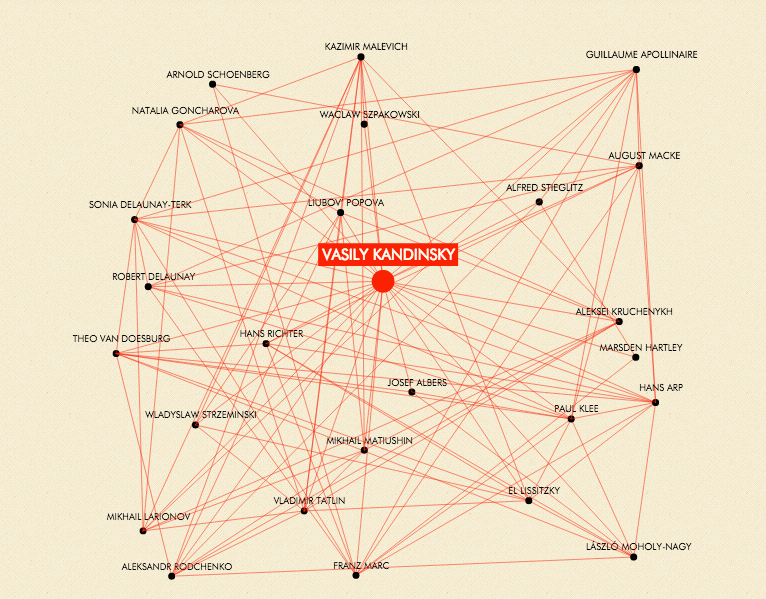
Who’s your favorite abstract artist? Some of us, if we like early abstraction, might name a painter like Wassily Kandinsky, some a composer like Arnold Schoenberg, some a poet like Guillaume Apollinaire, and some, even, a photographer like Alfred Stieglitz. When we answer a question like this, we tend to consider each artist, and each artist’s body of work, in isolation. But when we talk about artistic movements, especially one overarching and influential as abstraction, all names, all paintings, all compositions, all poems, all photographs — all works of any kind — are interconnected. Just as abstract artists managed to make visible, audible, and legible concepts and feelings never before realized in art, the Museum of Modern Art’s interactive social-network map of abstract art puts all those connections on display for us to see.
“Abstraction may be modernism’s greatest innovation,” says the web site of Inventing Abstraction 1910–1925, the MoMA exhibit for which the map (downloadable as a PDF poster here) was originally designed. “Today it is so central to our conception of artmaking that the time when an abstract artwork was unimaginable has become hard to imagine.”
But when abstract art emerged, it seemed to do so quite suddenly: beginning in 1911, Kandinsky and other artists, including Fernand Léger, Robert Delaunay, František Kupka, and Francis Picabia, “exhibited works that marked the beginning of something radically new: they dispensed with recognizable subject matter.” You can view the Inventing Abstraction diagram with Léger at the center, which reveals his connections to such figures as Man Ray, Marcel Duchamp, and Pablo Picasso. Reconfigured with Delaunay at the center, links emerge to the likes of Blaise Cendrars, Edgard Varèse, and Paul Klee.

But no abstract artist seems to have been as well-connected as Kandinsky, who “became a central force in the development and promotion of abstraction through his intrepid efforts as a painter, theorist, publisher, exhibition organizer, teacher, and as a generous host to the dozens of artists and writers who trekked, often from great distances, to meet him.” So says the bio alongside Kandinsky’s page on the diagram, which depicts him as the node connecting figures, influential in their own right, like Josef Albers, László Moholy-Nagy, and Hans Richter. Kandinsky’s “message about abstraction’s potential transcended distinctions between mediums, and his impact was felt from New York to Moscow.” But only a community of artists spanning at least that range of the globe, each in his or her own way looking to create a new world, could bring abstract art into being. More than a century later, we can safely call it here to stay.
Enter the social network of abstract artists here.
Related Content:
Steve Martin on How to Look at Abstract Art
How to Paint Like Kandinsky, Picasso, Warhol & More: A Video Series from the Tate
How the CIA Secretly Funded Abstract Expressionism During the Cold War
Based in Seoul, Colin Marshall writes and broadcasts on cities, language, and culture. His projects include the book The Stateless City: a Walk through 21st-Century Los Angeles and the video series The City in Cinema. Follow him on Twitter at @colinmarshall or on Facebook.
Read More...The Library of Congress Wants You to Help Transcribe Walt Whitman’s Poems & Letters: Almost 4000 Unpublished Documents Are Waiting
Every once in a while, a prominent artist will offer the advice that you should quit your day job and never look back. In some fields, this may be possible, though it’s becoming increasingly difficult these days, which may explain the reception Brian Eno gets when he tells art school students “not to have a job.” Eno admits, “I rarely get asked back.” In a letter to his anxious mother, Gustave Flaubert, railed against “those bastard existences where you sell suet all day and write poetry at night.” Such a life, he wrote, was “made for mediocre minds.”
Sure, if you can swing it, by all means, quit your job. Most poets throughout history—save the few with independent means or wealthy patrons—haven’t had the luxury. Poetry may never pay the bills, but that shouldn’t stop a poet from writing. It didn’t stop T.S. Eliot, who worked as an editor (he rejected George Orwell’s Animal Farm) and a bank clerk (he turned down a fellowship from the Bloomsbury group). It did not stop William Carlos Williams, the doctor, nor Wallace Stevens, who spent his days in the insurance game, nor Charles Bukowski, though he’d never recommend it….
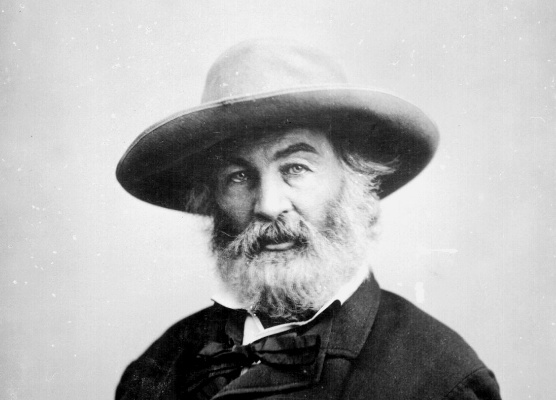
Then there’s ultimate journeyman poet Walt Whitman, who left school at 11 to get a job and variously throughout his life “worked as a school teacher, printer, newspaper editor, journalist, carpenter, freelance writer, civil servant, and Union Army nurse in Washington D.C. during the Civil War,” as the Library of Congress (LOC) noted for the 200th anniversary of the poet’s 1819 birth. The LOC holds “the world’s largest Walt Whitman manuscript collection” and last year they announced a volunteer campaign to transcribe thousands of unpublished documents.
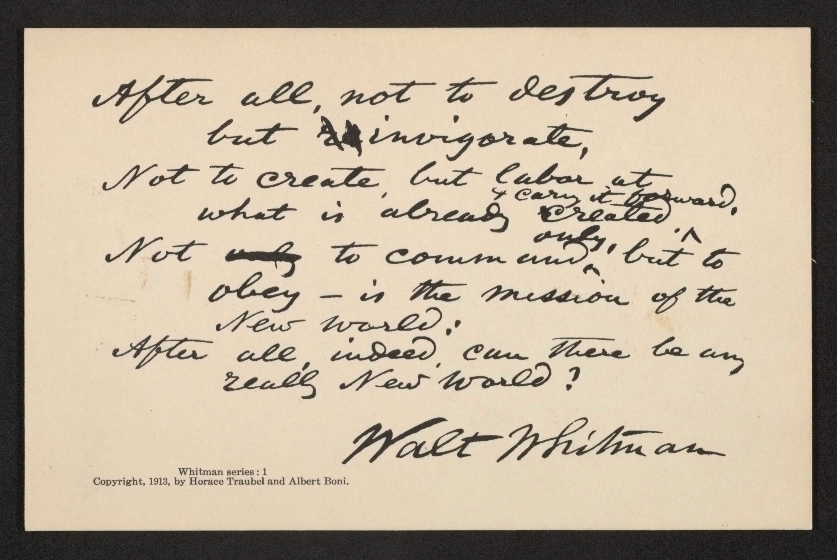
Whitman offered his own possibly dubious advice to aspiring writers—“don’t write poetry”—but he himself never stopped writing, no matter the demands of the day. He also advised, “it is a good plan for every young man or woman having literary aspirations to carry a pencil and a piece of paper and constantly jot down striking events in daily life. They thus acquire a vast fund of information.” Whitman’s “jottings” include typed and handwritten letters, original copies of poems, drafts of essays and reviews, and more.
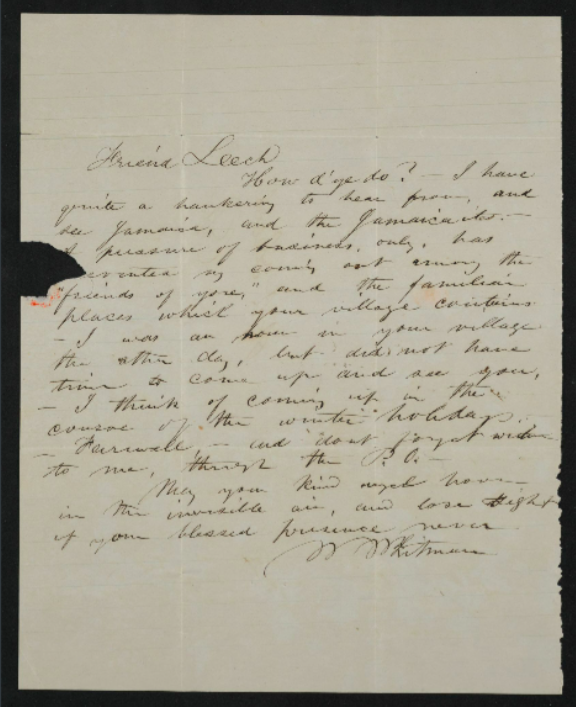
His prose is always lively and robust, full of exhortations, exaltations, and admixtures of the high literary language and casual talk of city streets that were his hallmark. Witness the wild swings in tone in his brief letter to Abraham P. Leech (above) circa 1881:
Friend Leech,
How d’ye do? — I have quite a hankering to hear from and see Jamaica, and the Jamaicaites. — A pressure of business only, has prevented my coming out among the “friends of yore” and the familiar places which your village contains. –I was an hour in your village the other day, but did not have time to come up and see you,–I think of coming up in the course of the winter holidays.–Farewell–and don’t forget write to me, through the P.O. May your kind angel hover in the invisible air, and lose sight of your blessed presence never.
Whitman
There are many, many more such documents remaining to be transcribed among the close to 4000 in the LoC’s digitized Whitman collection. “More than half of those have been completed so far,” writes Mental Floss, and roughly 1860 transcriptions still need to be reviewed. Anyone can read the documents that need approval and officially add them to the Whitman archive.” This is a very worthy project, and it may or may not feel like work to volunteer your time deciphering, reading, and transcribing Whitman’s ebullient hand.
The question may still remain: How did Whitman acquire the physical and mental stamina to get so much excellent writing done and still hold down steady gigs to make the rent? Perhaps a series of guides called “Manly Health and Training” that he wrote between 1858 and 1860 hold a clue. The poet recommends routine trips to the “gymnasium” and a diet of meat, “to the exclusion of all else.” For those “students, clerks” and others “in sedentary and mental employments”—including the “literary man”—he has one word: “Up!”
As with all such pieces of advice, results may vary. Enter the two huge manuscript archives—“Miscellaneous” and “Poetry”—at the Library of Congress digital collections and peruse, or transcribe, as much of Whitman’s endless stream of writing as you like.
Related Content:
Walt Whitman’s Poem “A Noiseless Patient Spider” Brought to Life in Three Animations
Josh Jones is a writer and musician based in Durham, NC. Follow him at @jdmagness
Read More...10 Rules of Self Discipline from the 1930 Self Help/Business Guru Napoleon Hill
It seems ridiculous to refer to the Golden Rule as a “weapon,” but that is just what it is—a weapon that no resistance on earth can withstand! —Napoleon Hill
Napoleon Hill—whose early books The Law of Success (1928), The Magic Ladder To Success (1930), and Think and Grow Rich (1937) helped establish the self-help genre—would be considered a life coach or motivational speaker in today’s parlance.
And were he alive today, he’d likely he’d be facing charges, or at the very least, cancelled for some of the behaviors, schemes, and whoppers Matt Novak details in an exhaustively researched essay for Gizmodo’s Paleofuture blog.
We think it’s important to tip you off to that shady side, because Hill’s “10 Rules for Profitable Self Discipline,” above, are so sunny, they could spur you to disseminate them immediately, leaving you vulnerable to harsh words from better informed friends and, more crucially, social media followers, who are already het up about any number of things in this election year, and who enjoy the catharsis a good call out affords.
Ergo, if you’re inclined to share, investigate the well from which they sprung, and then decide whether or not you want to proceed.
Why did we proceed?
Because practiced with the purest of intentions, these rules constitute extremely humanistic advice from a man whose outward philosophy continues to be a touchstone for many in the business community.
And as evidenced by the comments left by grateful YouTube viewers, many of whom stumbled across his words by accident, people are thirsty for such explicitly positive guideposts to interpersonal dealings.
(A good number also seem quite taken with the Virginia native’s old timey speech patterns and vintage lingo.)
If nothing else, applying these rules could sweeten your next argument with someone you love, or serve as inspiration if you’re ever called upon to give a commencement speech:
Napoleon Hill’s 10 Rules for Profitable Self Discipline
- Keep a cool head around hot heads. Rage doesn’t have to be contagious,.
- Believe that there are three sides to every argument. If you’re in a dust-up, don’t assume that the fault lays with the other person, but rather that you both shoulder a portion of the blame. This is a pretty compassionate way of ensuring that everyone’s ass will be partially covered for both better and worse.
- Never give directives to a subordinate when you are angry. Given that swift and decisive action is often required of those in leadership positions, you’ll have to learn to ice your own hot head pretty quickly to put this one into consistent play.
- Treat everyone as if they were a rich relative who might leave you a sizable inheritance. Which is kind of a gross way of putting it, but otherwise, we agree with Napoleon Hill that treating others with respect and loving attention is a real “honey” of a concept, especially if the other person can offer little beyond their friendship.
- When you find yourself in an unpleasant circumstance, immediately start searching for the seed of an equivalent benefit within the experience. If Novak’s Gizmodo essay is any indication, Hill probably had a lot of opportunity to put this one into practice, squeezing lemonade from lemons of his own making.
- Ask questions and listen to the answer. If you find yourself inclined to disagree with a statement, employ the phrase, “How do you know?” to get the speaker to do all the heavy lifting. For example, Napoleon Hill might say to Matt Novak, “How do you know?” which would be Matt Novak’s cue to produce a mountain of documentation.
- Never say or do anything before thinking if it will benefit someone or hurt them. The goal is to refrain from hurting others. Let those of us are without sin cast the first stone here. Hill’s karmic spin on this rule is that any injuries you cause that don’t immediately come around to bite you in the ass, will bite you in the ass much harder at some future point, a la compound interest.
- Learn the difference between friendly analysis and unfriendly criticisms. His not entirely foolproof method for distinguishing intent is to consider the nature of your relationship with the one offering the observations, their tone of voice, manner of delivery, and somewhat quaintly, whether or not they throw in any epithets. If it’s friendly, you can set some store by it. Otherwise, disregard.
- A good leader knows how to take orders cheerfully. This pairs nicely with Rule Number 3, don’t you think?
- Be tolerant of your fellow humans. Always.
Related Content:
How Much Money Do You Need to Be Happy? A New Study Gives Us Some Exact Figures
Ayun Halliday is an author, illustrator, theater maker and Chief Primatologist of the East Village Inky zine. Join Ayun’s company Theater of the Apes in New York City for her book-based variety series, Necromancers of the Public Domain, and the world premiere of Greg Kotis’ new musical, I AM NOBODY (March 5 — 28) Follow her @AyunHalliday.
Read More...Support Us
We're hoping to rely on loyal readers, rather than erratic ads. Please click the Donate button and support Open Culture. You can use Paypal, Venmo, Patreon, even Crypto! We thank you!

About Us

Open Culture scours the web for the best educational media. We find the free courses and audio books you need, the language lessons & educational videos you want, and plenty of enlightenment in between.
Advertise With Us

FREE UPDATES!
GET OUR DAILY EMAIL
Get the best cultural and educational resources on the web curated for you in a daily email. We never spam. Unsubscribe at any time.
FOLLOW ON SOCIAL MEDIA

Open Culture editor Dan Colman scours the web for the best educational media. He finds the free courses and audio books you need, the language lessons & movies you want, and plenty of enlightenment in between.
Advertise With Us


