The History of the Plague: Every Major Epidemic in an Animated Map
All of us have tried to come to grips with the coronavirus in different ways. Here on Open Culture we’ve featured online courses to get you conversant in the science around the pandemic, but readers of this site will also have sought out the most pertinent works of history and literature. That goes especially for those in need of reading material while in states of quarantine or lockdown (self-imposed or otherwise), and any list of recommended books must include Daniel Defoe’s A Journal of the Plague Year and Albert Camus’ The Plague. (I recently wrote about the experience of reading that last in Korea, where I live, for the Los Angeles Review of Books.) Both fictionalize local outbreaks of the bubonic plague, but how far and wide did that horrific and much-mythologized disease actually spread?
You can see exactly how far and wide in the animated historical map above, created by a Youtuber called EmperorTigerstar. It mainly covers the period of 431 BC to 1353 AD, during most of which the plague looks to have occurred in Europe, the Middle East, and Africa with some regularity. Up until the 1330s, the outbreaks stay small enough that you may have to view the map in fullscreen mode to ensure that you even see them.
But even the most casual students of history know what happened next: the best-known occurrence of the Black Death, whose peak lasted from 1347 to 1351 and which claimed somewhere between 75 to 200 million lives (including roughly half of Europe’s entire population). Rendered, suitably, in black, the plague’s spread comes eventually to look on the map like a sea of ink splashed violently across multiple continents.
The plague hardly died with the 1350s, a fact this map acknowledges. It would, writes EmperorTigerstar, “take years to go away, and even then there would be local outbreaks in individual cities for centuries.” These Black Death aftershocks, “big in their own right,” include the Great Plague of Milan in the 1630s, the Great Plague of Seville in the 1640s, and the Great Plague of London in the 1660s — the subject of Defoe’s novel. When Camus wrote The Plague in 1947, the Algerian city of Oran in which he set its story had experienced its last outbreak of the disease just three years before (at least the fifth such experience in its history). Though harrowing stories are even now coming out of places like modern-day Milan, the coronavirus has yet to match the gruesome deadliness of the plagues featured in either of these books. But unless we understand how epidemics afflicted humanity in the past, we can hardly handle them properly in the present.
Related Content:
Free Courses on the Coronavirus: What You Need to Know About the Emerging Pandemic
200,000 Years of Staggering Human Population Growth Shown in an Animated Map
Animated Map Shows How the Five Major Religions Spread Across the World (3000 BC – 2000 AD)
Based in Seoul, Colin Marshall writes and broadcasts on cities, language, and culture. His projects include the book The Stateless City: a Walk through 21st-Century Los Angeles and the video series The City in Cinema. Follow him on Twitter at @colinmarshall or on Facebook.
Read More...How Schools Can Start Teaching Online in a Short Period of Time: Free Tutorials from the Stanford Online High School
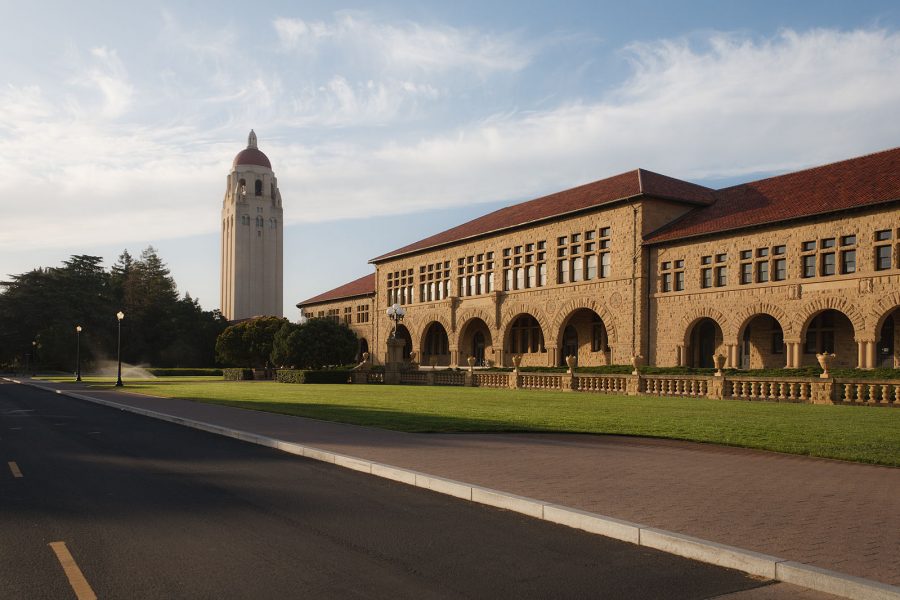
Image by King of Hearts, via Wikimedia Commons
A quick note: The Stanford Online High School–an independent high school that operates fully online–has created video tutorials designed for schools that may need to close classrooms and pivot online. “All guidance is platform-agnostic, focusing on the essential steps for preparing to teach online in a short period of time.”
In addition to this videos, the Online High School will host a free webinar today at 2pm California time. You can register here and learn more about the transition to online teaching.
Note: Zoom–which provides a turnkey video conferencing solution–has made its product free for K‑12 institutions during the COVID-19 crisis. This can help schools spin up online courses quickly. More on that here.
If you would like to support the mission of Open Culture, consider making a donation to our site. It’s hard to rely 100% on ads, and your contributions will help us continue providing the best free cultural and educational materials to learners everywhere. You can contribute through PayPal, Patreon, and Venmo (@openculture). Thanks!
Read More...
Take a Drive Through 1940s, 50s & 60s Los Angeles with Vintage Through-the-Car-Window Films
Many claim Los Angeles was “built for the car,” a half-truth at best. When the city — or rather, the city and the vast region of southern California surrounding it — first boomed in the late 19th and early 20th century, it grew according to the spread of its electric railway networks. But for early adopters of the automobile (as well as the many aspirants close behind), its sheer size, easily navigable terrain, and still-low population density made greater Los Angeles an ideal place to drive.
After the Second World War, the days of the Pacific Electric and Los Angeles Railroad, once among the finest urban rail systems in the world, were clearly numbered. Both went out of service by the early 1960s, and for the next few decades the car was indeed king. One theory holds, though with imperfect evidence, that Los Angeles lost its trains because of an automakers’ conspiracy.
Whatever the cause, the long heyday of the automobile and its attendant “car culture” changed mid-20th-century Los Angeles. It left its boldest mark in the city’s architecture, a category that must surely include the swooping concrete of the freeways, but more obviously includes the buildings designed to catch the eye of a human being behind the wheel cruising at speed. We notice at a different scale in a car than we do on foot, and so the structures along Los Angeles’ main roads — especially boulevards like Wilshire, Hollywood, and Sunset — grew more legible to the motorist in the second half of the twentieth century.
That means Los Angeles’ architecture grew ever bigger, bolder, more eye-catching — or, depending on your perspective, ever more garish, ungainly, and impersonal. You can see this transformation captured in action from the car window in the three videos featured here. At the top of the post is a six-minute drive through the downtown Los Angeles of the 1940s, which begins on Bunker Hill, an area originally built up with stately Victorian houses in the late 19th century.
By the time of this film those houses had been subdivided into cheap apartments, and films noirs (such as Robert Aldrich’s Kiss Me Deadly) were using it as a typical “bad neighborhood.” That atmosphere also made it a target for a 50-year “urban renewal” project that, starting in the late 50s onward, scraped the houses off Bunker Hill and rebuilt it with corporate towers and prestige cultural venues.
A through-the-windshield view of Los Angeles in the 50s appears in the video second from the top, a 1957 drive down Hollywood Boulevard. That street and that year stand at the intersection of pre-war and post-war Los Angeles, and the built environment reflects as much the sensibility of the turn of the 20th century as it does what we know think of as “mid-century modern.”
Below that we have a drive through the city so many think of when they think of Los Angeles: the Los Angeles of the 1960s, a seemingly limitless realm of palm trees, brightly colored billboards, and Space Age-influenced towers that pop out even more from their low-slung surroundings when seen from the freeway — in other words, the Los Angeles Quentin Tarantino recreates in Once Upon a Time… in Hollywood.
To get a sense of the greater sweep of change in Los Angeles, have a look at the New Yorker video above (previously featured here on Open Culture) that puts the downtown drive from the 1940s alongside the same drive replicated in the 2010s. Popular culture may associate Los Angeles with the willful erasure of history as much as it associates Los Angeles with the automobile, but traces are there for those — in a car, on foot, on a bike, or going by any form of transportation besides — who know how to see them.
Related Content:
Enjoy Dazzling & Dizzying 360° Virtual Tours of Los Angeles Landmarks
Watch Randy Newman’s Tour of Los Angeles’ Sunset Boulevard, and You’ll Love L.A. Too
Based in Seoul, Colin Marshall writes and broadcasts on cities, language, and culture. His projects include the book The Stateless City: a Walk through 21st-Century Los Angeles and the video series The City in Cinema. Follow him on Twitter at @colinmarshall or on Facebook.
Read More...The Allure of Puzzlement: Pretty Much Pop #34 w/ Adal Rifai on Escape Rooms and Other Puzzling Pastimes

The comic and the tragic are well-established modes within entertainment, but what about the puzzling? Riddles may have been a chief pastime in days of yore (well, they’re featured in Oedipus and The Hobbit, anyway), but does this way of being entertained have a place in today’s age of mass media?
Improviser and podcaster Adal Rifai joins Mark Linsenmayer, Erica Spyres, and Brian Hirt to discuss his love of escape rooms, riddles, and other opportunities for puzzlement. We discuss lateral vs. algorithmic thinking, group dynamics, comparisons to improvisation and trivia, riddle types, video games, and more. Some puzzle-relevant films we touch on include Escape Room, Cube, The Game, and Midnight Madness.
Some resources we used to prepare include:
- Adal’s podcast Hey, Riddle Riddle
- “Get Me Out of Here! Why Escape Rooms Have Become a Global Craze” by Simon Usbourne
- “Five-Year US Escape Room Industry Report” by Lisa Spira
- “Five Dead, One Injured in Polish Escape Room Fire” by David Spira
- “Solving Puzzles Satisfies The Nimble Brain” from NPR
- Wikipedia on Escape Rooms and Escape-the-Room Video Games
- TV Tropes on Stock Video Game Puzzles
Adal’s two other podcasts are Hello From the Magic Tavern and Siblings Pecular. Follow him @adalrifai. He performs regularly on Whirled News Tonight at Chicago’s IO Theater.
Every Pretty Much Pop episode includes bonus, post-episode discussion, and this time Adal stayed around for a little more on escape rooms (can they engage all five senses?) and quite a bit more on podcasting, including the parasocial relationships that listeners may have with podcast hosts. This was sufficiently fun that we’d like to share it with all of you, in hopes that you might then want to hear this for all our our episodes by supporting us at patreon.com/prettymuchpop.
This podcast is part of the Partially Examined Life podcast network.
Pretty Much Pop: A Culture Podcast (prettymuchpop.com) is curated by Open Culture. Browse all Pretty Much Pop posts or start with the first episode.
Read More...See How Traditional Japanese Carpenters Can Build a Whole Building Using No Nails or Screws
If it came down to it, most of us could hammer basic shelter together with enough wood and nails. But what if we just had the wood? And what if we needed to make not just a hut, but a full-fledged building: a livable house, or even a house of worship? That may well sound like an impossible task — unless, of course, you’ve trained as a miyadaiku (宮大工), the class of Japanese carpenter tasked with building and maintaining buildings like shrines and temples. Without a single nail or screw, miyadaiku join wood directly to wood — a method of joinery know as kanawatsugi (金輪継) — and in so doing manage to build some of the world’s longest-lasting wooden structures, just as they’ve done for centuries upon centuries.
Back when this style of carpentry first developed in Japan more than a millennium ago, “it was difficult to acquire iron.” And so “people tried to build buildings only with wood,” making up for what they lacked in tools with sheer skill. So says Takahiro Matsumoto, a miyadaiku carpenter based in the city of Kamakura, in the Great Big Story video above.
Japan’s de facto capital from the late 12th to early 14th century, Kamakura is still filled with Buddhist temples and Shinto shrines, some built more than 1,200 years ago. To build new temples and shrines, or to provide the existing ones with the repairs they need every century or two, a miyadaiku must master a host of differently shaped wooden joints, each of them developed over generations to hold as tightly and solidly as possible.
For another view of kanawatsugi, have a look at The Joinery, a library of explanatory animations previously featured here on Open Culture. You can see exactly how each of these joints are cut and assembled for real-life projects — as well as every other aspect of how miyadaiku put together a building — at the Youtube channel Japanese Architecture: Wisdom of Our Ancestors. The channel is aptly named, for only with a high regard for the carpentry knowledge gradually built up, tested, and refined by their predecessors could today’s miyadaiku do their work. “Advanced skills are needed, but we work with the old buildings built by our ancestors,” says Matsumoto. “Today, we also learn from the ancestors’ skills, since the old buildings themselves are standing documents of those skills.” Each and every one testifies to how, for want of a nail, some of the most admired architecture in the world was born.
Related Content:
20 Mesmerizing Videos of Japanese Artisans Creating Traditional Handicrafts
The Making of Japanese Handmade Paper: A Short Film Documents an 800-Year-Old Tradition
Based in Seoul, Colin Marshall writes and broadcasts on cities, language, and culture. His projects include the book The Stateless City: a Walk through 21st-Century Los Angeles and the video series The City in Cinema. Follow him on Twitter at @colinmarshall or on Facebook.
Read More...Paris Had a Moving Sidewalk in 1900, and a Thomas Edison Film Captured It in Action
It’s fair to say that few of us now marvel at moving walkways, those standard infrastructural elements of such utilitarian spaces as airport terminals, subway stations, and big-box stores. But there was a time when they astounded even residents of one of the most cosmopolitan cities in the world. The innovation of the moving sidewalk demonstrated at the Paris Exposition of 1900 (previously seen here on Open Culture when we featured Lumière Brothers footage of that period) commanded even Thomas Edison’s attention. As Paleofuture’s Matt Novak tells it at Smithsonian magazine, “Thomas Edison sent one of his producers, James Henry White, to the Exposition and Mr. White shot at least 16 movies,” a clip of which footage you can see above.
White “had brought along a new panning-head tripod that gave his films a newfound sense of freedom and flow. Watching the film, you can see children jumping into frame and even a man doffing his cap to the camera, possibly aware that he was being captured by an exciting new technology while a fun novelty of the future chugs along under his feet.”
Novak also includes hand-colored photographs from the Paris Exhibition and quotes a New York Observer correspondent describing the moving sidewalk as a “novelty” consisting of “three elevated platforms, the first being stationary, the second moving at a moderate rate of speed, and the third at the rate of about six miles an hour.” Thus “the circuit of the Exposition can be made with rapidity and ease by this contrivance. It also affords a good deal of fun, for most of the visitors are unfamiliar with this mode of transit, and are awkward in its use.”
Novak features contemporary images of the Paris Exhibition’s moving sidewalk at Paleofuture, found in the book Paris Exposition Reproduced From the Official Photographs. Its authors describe the trottoir roulant as “a detached structure like a railway train, arriving at and passing certain points at stated times” without a break. “In engineers’ language, it is an ‘endless floor’ raised thirty feet above the level of the ground, ever and ever gliding along the four sides of the square — a wooden serpent with its tail in its mouth.” But the history of the moving walkway didn’t start in Paris: “In 1871 inventor Alfred Speer patented a system of moving sidewalks that he thought would revolutionize pedestrian travel in New York City,” as Novak notes, and the first one actually built was built for Chicago’s 1893 Columbian Exposition — but it cost a nickel to ride and “was undependable and prone to breaking down,” making Paris’ version the more impressive spectacle.
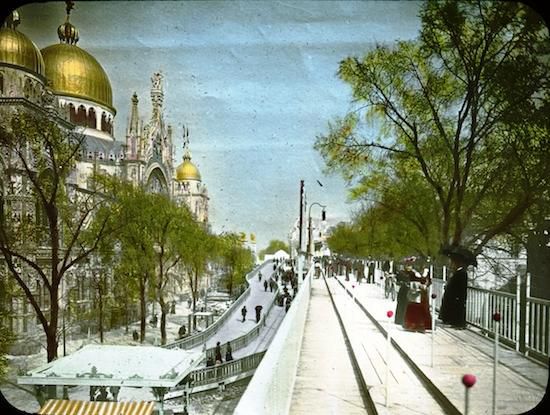
Still, the Columbian Exposition’s visitors must have got a kick out of gliding down the pier without having to do the walking themselves. You can learn more about this first moving walkway and its successors, the one at the Paris Exhibition included, from the Little Car video above. However much these early models may look like quaint turn-of-the century novelties, some still see in the technology genuine promise for the future of public transit. Moving walkways work well, writes Treehugger’s Lloyd Alter, “when the walking distance and time is just a bit too long.” And they remind us that “transportation should be about more than just getting from A to B; it should be a pleasure as well.” Parisians “kept the Eiffel Tower from the exhibition” — it had been built for the 1889 World’s Fair — but “it is too bad they didn’t keep this, a sort of moving High Line that is both transportation and entertainment.”
If you would like to support the mission of Open Culture, consider making a donation to our site. It’s hard to rely 100% on ads, and your contributions will help us continue providing the best free cultural and educational materials to learners everywhere. You can contribute through PayPal, Patreon, and Venmo (@openculture). Thanks!
Related Content:
How French Artists in 1899 Envisioned Life in the Year 2000: Drawing the Future
Based in Seoul, Colin Marshall writes and broadcasts on cities, language, and culture. His projects include the book The Stateless City: a Walk through 21st-Century Los Angeles and the video series The City in Cinema. Follow him on Twitter at @colinmarshall or on Facebook.
Read More...Hear the Sound of the Hagia Sophia Recreated in Authentic Byzantine Chant
Audio technology has made many exciting advances in the past few years, one of which enables recording engineers to capture the sound of a specific space and recreate it elsewhere. Through a process called “convolution reverb,” the sound of a concert hall or club can be portable, so to speak, and a band or group of singers in a studio can be made to sound as if they were performing in Carnegie Hall, or inside a cave or grain silo.
Also being recreated are the sounds of gothic cathedrals and Byzantine churches—acoustic environments being preserved for posterity in digital recordings as their physical forms decay. This technology has given scholars the means to represent the music of the past as it sounded hundreds of years ago and as it was originally meant to be heard by its devout listeners.
Music took shape in particular landscapes and architectural environments, just as those environments evolved to enhance certain kinds of sound. Medieval Christian churches were especially suited to the hypnotic chants that characterize the sacred music of the time. As David Byrne puts it in his TED Talk on music and architecture:
In a gothic cathedral, this kind of music is perfect. It doesn’t change key, the notes are long, there’s almost no rhythm whatsoever, and the room flatters the music. It actually improves it.
There’s no doubt about that, especially in the case of the Greek Orthodox cathedral Hagia Sophia. Built in 537 AD in what was then Constantinople, it was once the largest building in the world. Though it lost the title early on, it remains on incredibly impressive feat of engineering. While the structure is still very much intact, no one has been able to hear its music since 1453, when the Ottoman Empire seized the city and the massive church became a mosque. “Choral music was banned,” notes Scott Simon on NPR’s Weekend Edition, “and the sound of the Hagia Sophia was forgotten until now.”
Now (that is, in the past ten years or so), well over five centuries later, we can hear what early medieval audiences heard in the massive Byzantine cathedral, thanks to the work of two Stanford professors, art historian Bissera Pentcheva and Jonathan Abel, who teaches in the computer music department and studies, he says, “the analysis, synthesis and processing of sound.”
Now a museum, the Hagia Sophia allowed Pentcheva and Abel to record the sound of balloons popping in the space after-hours. “Abel used the acoustic information in the balloon pops to create a digital filter that can make anything sound like it’s inside the Hagia Sophia,” as Weekend Edition guest host Sam Hartnett explains.
Pentcheva, who focuses her work “on reanimating medieval art and architecture,” was then able to “reanimate” the sound of high Greek Orthodox chant as it would have been heard in the heart of the Byzantine Empire. “It’s actually something that is beyond humanity that the sound is trying to communicate,” she says.” That message needs a larger-than-life space for its full effect.
Hear more about how the effect was created in the Weekend Edition episode above. And in the videos further up, see the choral group Capella Romana perform Byzantine chants with the Hagia Sophia effect applied. Just last year, the ensemble released the album of chants above, Lost Voices of Hagia Sophia, using the filter. It is a collection of music as valuable to our understanding and appreciation of the art of the Byzantine Empire as a restored mosaic or reconstructed cathedral.
via Kottke
Related Content:
David Byrne: How Architecture Helped Music Evolve
Josh Jones is a writer and musician based in Durham, NC. Follow him at @jdmagness.
Read More...The Summerhill School, the Radical Educational Experiment That Let Students Learn What, When, and How They Want (1966)
Among the political and social revolutions of the 1960s, the movement to democratize education is of central historical importance. Parents and politicians were entrenched in battles over integrating local schools years after 1954’s Brown v. Board of Education. Sit-ins and protests on college campuses made similar student unrest today seem mild by comparison. Meanwhile, quieter, though no less radical, educational movements proliferated in communes, homeschools, and communities that could pay for private schools.
Most of these experimental methods drew from older sources, such as the theories of Rudolf Steiner and Maria Montessori, both of whom died before the Age of Aquarius. One movement that got its start decades earlier was popularized in the 60s when its founder A.S. Neill published the influential Summerhill: A Radical Approach to Child Rearing, a classic work of alternative pedagogy in which the Scottish writer and educator described the radical ideas developed in his Summerhill School in England, first founded in 1921.
Neill’s school “helped to pioneer the ‘free school’ philosophy,” writes Aeon, “in which lessons are never mandatory and nearly every aspect of student life can be put to a vote.” His methods “and a rising countercultural movement inspired similar institutions to open around the world.” When Neill first published his book, however, he was very much on the defensive, against “an increasing reaction against progressive education,” psychologist Erich Fromm wrote in the book’s foreword.
At the extreme end of this backlash Fromm situates “the remarkable success in teaching achieved in the Soviet Union,” where “the old-fashioned methods of authoritarianism are applied in full strength.” Fromm defended experiments like Neill’s, despite their “often disappointing” results, as a natural outgrowth of the Enlightenment.
During the eighteenth century, the ideas of freedom, democracy, and self-determination were proclaimed by progressive thinkers; and by the first half of the 1900’s these ideas came to fruition in the field of education. The basic principle of such self-determination was the replacement of authority by freedom, to teach the child without the use of force by appealing to his curiosity and spontaneous needs, and thus to get him interested in the world around him. This attitude marked the beginning of progressive education and was an important step in human development.
What seemed anarchic to its detractors had its roots in the tradition of individual liberty against feudal traditions of unquestioned authority. But Neill was less like John Locke, who included children in his category of irrational beings (along with “idiots” and “Indians”) than he was like Jean Jacques Rousseau. Fromm suggests this too: “A.S. Neill’s system is a radical approach to child rearing because it represents the true principle of education without fear. In Summerhill School authority does not mask a system of manipulation.”
Students decide what they want to learn, and what they don’t, with no curriculum, requirements, or testing to speak of and no structured time or mandatory attendance. Is such a thing even possible in practice? How could educators manage and measure student progress, or ensure their students learn anything at all? What might this look like? Find out in the 1966 National Film Board of Canada documentary Summerhill, above, full of “candid moments and scenes,” Aeon writes, “that evoke the rhythms of daily life at the school and give a sense of the children’s lived experience.”
Disorganized, but not chaotic, classroom bustle contrasts with idyllic, sunlit moments on Summerhill’s verdant grounds and honest criticism, some from the students themselves. One girl admits that the free play wears thin after a while and that “there probably aren’t such good facilities for learning here, after a certain level. But you can always go somewhere else afterwards” (though many would have difficulty with entrance exams). Another student talks about the struggle to study without structure to help minimize distractions. Despite Neill’s philosophical aversion to fear, she says “you’re always afraid of missing something.”
We also meet the man himself, A.S. Neill, a rumpled, avuncular figure at 83 years old, who proclaims freedom as the answer for students who struggle in school, and for students who don’t. If we’re honest, we might all admit we felt this strongly as children ourselves. It may never be an impulse that’s compatible with contemporary goals for education, which is often geared toward workplace training at the expense of creative thinking. But for many students, the opportunity to pursue their own course on their own terms can become the impetus for a lifetime of independent thought and action. I can’t think of a loftier educational goal.
Related Content:
Noam Chomsky Spells Out the Purpose of Education
Noam Chomsky Defines What It Means to Be a Truly Educated Person
Josh Jones is a writer and musician based in Durham, NC. Follow him at @jdmagness
Read More...Jeremy Bentham’s Mummified Body Is Still on Display–Much Like Other Aging British Rock Stars
Plato’s ideal of philosopher-kings seems more unlikely by the day, but most modern readers of The Republic don’t see his state as an improvement, with its rigid caste system and state control over childbearing and rearing. Plato’s Socrates did not love democracy, though he did argue that men and women (those of the guardian class, at least) should receive an equal education. So too did many prominent European political philosophers of the 18th and 19th centuries, who had at least as much influence on world affairs as Plato did on Athens, for better and worse.
One such thinker, Jeremy Bentham, is often remembered as the inventor of the panopticon, a dystopian prison design that makes inmates internalize their own surveillance, believing they could be watched at any time by unseen eyes. Made infamous by Michel Foucault in the mid-20th century, the proposal was first intended as humane reform, consistent with the tenets of Bentham’s philosophical innovation, Utilitarianism, often associated with his most famous disciple, John Stuart Mill.
Bentham may also have been one of the most progressive secular philosophers of any age—espousing full political rights for everyone—by which he actually meant everyone, not only European landowning men. “In his own time,” writes Faramerz Dabhoiwala at The Guardian, Bentham “was celebrated around the globe. Countless practical efforts at social and political reform drew inspiration from him. […] He was made an honorary citizen of revolutionary France, while the Guatemalan leader José del Valle acclaimed him as ‘the legislator of the world.’ Never before or since has the English-speaking world produced a more politically engaged and internationally influential thinker across such a broad range of subjects.”
Bentham took the role seriously, though there may be the seeds of a morbid practical joke in his last philosophical act.
As he lay dying in the spring of 1832, the great philosopher Jeremy Bentham left detailed directions for the preservation of his corpse. First, it was to be publicly dissected in front of an invited audience. Then, the preserved head and skeleton were to be reassembled, clothed, and displayed ‘in the attitude in which I am sitting when engaged in thought and writing.’ His desire to be preserved forever was a political statement. As the foremost secular thinker of his time, he wanted to use his body, as he had his mind, to defy religious superstitions and advance real, scientific knowledge. Almost 200 years later, Bentham’s ‘auto-icon’ still sits, staring off into space, in the cloisters of University College London.
His full-body parody of saints’ relics doesn’t just sit in London, in the “appropriate box or case” he specified in his instructions. It has also sat in its box in cities across England, Germany, and New York’s Metropolitan Museum of Art. “Not unlike an aging British rock star,” writes Isaac Schultz at Atlas Obscura, “the older he gets, the more tours he seems to go on. Sometimes Bentham’s severed, mummified head,” with its terrifying, unblinking glass eyes, “accompanies the rest of him.” Sometimes it doesn’t.
The head, which was supposed to have been kept atop the fully dressed skeleton, was mishandled and damaged in the creation of the “auto-icon” and replaced by a wax replica (surely an accident and not a way to mitigate the creepiness). What did Bentham mean by all of this? And what is an “auto-icon”? Though it sounds like the sort of inscrutable prank Salvador Dali might have played at the end, Bentham described the idea straightforwardly in his pamphlet Auto-Icon; or, Farther Uses of the Dead to the Living. The philosopher, says Hannah Cornish, science curator at the University College London, genuinely “thought it’d catch on.”
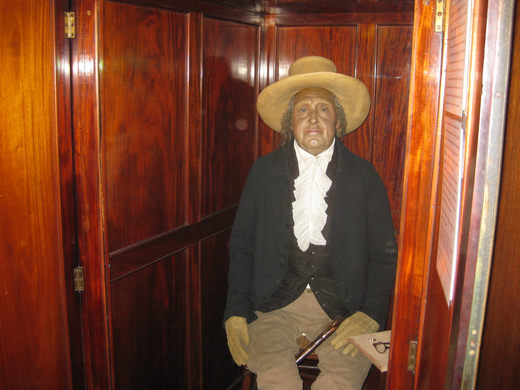
Photo via Wikimedia Commons
In his short, final work of moral philosophy, Bentham shows that, like Plato, he didn’t quite get the point of making art, advancing a theory that becoming one’s own icon would eliminate the need for paintings, statues, and the like, since “identity is preferable to similitude” (to the extent that a mummified corpse is identical to a living person). Other utilitarian reasons include benefits to science, reduced public health risks, and creating “agreeable associations with death.”
Also, in what must have been intended with at least some undercurrent of humor, he asked that his remains “occasionally be brought into meetings involving his still-living friends,” writes Schultz, “so that what’s left of Bentham might enjoy their company.”
Learn more about Bentham’s “auto-icon” in the Atlas Obscura videos here, including the video further up showing how a team of professionals packed up and moved the whole macabre assemblage to its new home across the University of London campus. And read an even more detailed description, with several photographs, of how the oldest partially mummified British rock star philosopher travels, here.
Related Content:
97-Year-Old Philosopher Ponders the Meaning of Life: “What Is the Point of It All?”
Josh Jones is a writer and musician based in Durham, NC. Follow him at @jdmagness.
Read More...Watch Scenes from Belle Époque Paris Vividly Restored with Artificial Intelligence (Circa 1890)
In his latest act of digital restoration, Denis Shiryaev has used AI to revive and colorize footage documenting daily life in Paris during the 1890s. The remarkably clear footage lets you see horses and buggies move past Notre Dame; youngsters floating their boats at Luxembourg Gardens; the Eiffel Tour during its first decade of existence; firemen dashing down the city’s grands boulevards; and people hopping onto futuristic moving sidewalks. Quite a delight to see.
Find other recent video restorations in the Relateds below.
If you would like to support the mission of Open Culture, consider making a donation to our site. It’s hard to rely 100% on ads, and your contributions will help us continue providing the best free cultural and educational materials to learners everywhere. You can contribute through PayPal, Patreon, and Venmo (@openculture). Thanks!
Related Content:
Immaculately Restored Film Lets You Revisit Life in New York City in 1911
Read More...Support Us
We're hoping to rely on loyal readers, rather than erratic ads. Please click the Donate button and support Open Culture. You can use Paypal, Venmo, Patreon, even Crypto! We thank you!

About Us

Open Culture scours the web for the best educational media. We find the free courses and audio books you need, the language lessons & educational videos you want, and plenty of enlightenment in between.
Advertise With Us

FREE UPDATES!
GET OUR DAILY EMAIL
Get the best cultural and educational resources on the web curated for you in a daily email. We never spam. Unsubscribe at any time.
FOLLOW ON SOCIAL MEDIA

Open Culture editor Dan Colman scours the web for the best educational media. He finds the free courses and audio books you need, the language lessons & movies you want, and plenty of enlightenment in between.
Advertise With Us


