Why You Should Read Dune: An Animated Introduction to Frank Herbert’s Ecological, Psychological Sci-Fi Epic
A vision of humanity’s future without most of the high technology we expect from science fiction, but with a surfeit of religions, martial arts, and medieval politics we don’t; pronunciation-unfriendly names and terms like “Bene Gesserit,” “Kwisatz Haderach,” and “Muad’Dib”; a sand planet inhabited by giant killer worms: nearly 55 years after its publication, Dune remains a strange piece of work. But applying that adjective to Frank Herbert’s highly successful saga of interstellar adventure and intrigue highlights not just the ways in which its intricately developed world is unfamiliar to us, but the ways in which it is familiar — and has grown ever more so over the decades.
“Following an ancient war with robots, humanity has forbidden the construction of any machine in the likeness of a human mind,” says Dan Kwartler in the animated TED-Ed introduction to the world of Dune above. This edict “forced humans to evolve in startling ways, becoming biological computers, psychic witches, and prescient space pilots,” many of them “regularly employed by various noble houses, all competing for power and new planets to add to their kingdoms.” But their superhuman skills “rely on the same precious resource: the spice,” a mystical crop that also powers space travel, “making it the cornerstone of the galactic economy.”
Herbert sets Dune — the first of five books by him and many successors by his son Brian Herbert and Kevin J. Anderson — on the desert planet Arrakis, where the noble House Atreides finds itself relocated. Before long, its young scion Paul Atreides “is catapulted into the middle of a planetary revolution where he must prove himself capable of leading and surviving on this hostile desert world.” Not that Arrakis is just some rock covered in sand: an avid environmentalist, Herbert “spent over five years creating Dune’s complex ecosystem. The planet is checkered with climate belts and wind tunnels that have shaped its rocky topography. Differing temperate zones produce varying desert flora, and almost every element of Dune’s ecosystem works together to produce the planet’s essential export.”
Herbert’s world-building “also includes a rich web of philosophy and religion,” which involves elements of Islam, Buddhism, Sufi mysticism, Christianity, Judaism, and Hinduism, all arranged in configurations the likes of which human history has never seen. What Dune does with religion it does even more with language, drawing for its vocabulary from a range of tongues including Latin, Old English, Hebrew, Greek, Finnish, and Nahuatl. All this serves a story dealing with themes both eternal, like the decline of empire and the misplaced trust in heroic leaders, and increasingly topical, like the consequences of a feudal order, ecological change, and wars over resources in inhospitable, sandy places. At the center is the story of a man struggling to attain mastery of not just body but mind, not least by defeating fear, described in Paul’s famous line as the “mind-killer,” the “little-death that brings total obliteration.”
The scope, complexity, and sheer oddity of Herbert’s vision has repeatedly tempted filmmakers and the film industry — and repeatedly defeated them. Perhaps unsurprisingly Alexander Jodorowsky couldn’t get his plans off the ground for a 14-hour epic Dune involving Pink Floyd, Salvador Dalí, Moebius, Orson Welles, and Mick Jagger. In 1984 David Lynch managed to direct a somewhat less ambitious adaptation, but the nevertheless enormously complex and expensive production came out as what David Foster Wallace described as “a huge, pretentious, incoherent flop.” Dune will return to theaters in December 2020 in a version directed by Denis Villeneuve, whose recent work on the likes of Arrival and Blade Runner 2049 suggests on his part not just the necessary interest in science fiction, but the even more necessary sense of the sublime: a grandeur and beauty of such a scale and starkness as to inspire fear, much as every Dune reader has felt on their own imagined Arrakis.
Related Content:
Moebius’ Storyboards & Concept Art for Jodorowsky’s Dune
Why You Should Read One Hundred Years of Solitude: An Animated Video Makes the Case
Based in Seoul, Colin Marshall writes and broadcasts on cities, language, and culture. His projects include the book The Stateless City: a Walk through 21st-Century Los Angeles and the video series The City in Cinema. Follow him on Twitter at @colinmarshall or on Facebook.
Read More...A Visual Introduction to Kintsugi, the Japanese Art of Repairing Broken Pottery and Finding Beauty in Imperfection
Kintsugi, the Japanese art of joining broken pottery with gleaming seams of gold or silver, creates fine art objects we can see as symbols for the beauty of vulnerability. Surely, these bowls, cups, vases, etc. remind of us Leonard Cohen’s oft-quoted lyric from “Anthem” (“There is a crack in everything, that’s how the light gets in.”) Writer and artist Austin Kleon touches on this same sentiment in a recent post on his blog. “The thing I love the most about Kintsugi is the visible trace of healing and repair—the idea of highlighted, glowing scars.”
Kintsugi, which translates to “golden joinery,” has a history that dates back to the 15th century, as Colin Marshall explained in a previous post here. But it’s fascinating how much this art resonates with our contemporary discourse around trauma and healing.
“We all grow up believing we should emphasize the inherent positives about ourselves,” writes Marshall, “but what if we also emphasized the negatives, the parts we’ve had to work to fix or improve? If we did it just right, would the negatives still look so negative after all?”
A key idea here is “doing it just right.” Kintsugi is not a warts-and-all presentation, but a means of turning brokenness into art, a skillful realization of the Japanese idea of wabi-sabi, the “beauty of things imperfect, impermanent, and incomplete,” as Leonard Koren writes in Wabi-Sabi for Artists, Designers, Poets & Philosophers. Objects that represent wabi-sabi “may exhibit the effects of accident, like a broken bowl glued back together again.” In kintsugi, those effects are due to the artist’s craft rather than random chance.
When it comes to healing psychic wounds so that they shine like precious metals, there seems to be no one perfect method. But when we’re talking about the artistry of kintsugi, there are some—from the most refined artisanship to less rigorous do-it-yourself techniques—we can all adopt with some success. In the video at the top, learn DIY kintsugi from World Crafted’s Robert Mahar. Further up, we have an intensive, wordless demonstration from professional kintsugi artist Kyoko Ohwaki.
And just above, see psychologist Alexa Altman travel to Japan to learn kintsugi, then make it “accessible” with an explanation of both the physical process of kintsugi and its metaphorical dimensions. As Altman shows, kintsugi can just as well be made from things broken on purpose as by accident. When it comes to the beautifully flawed finished product, however, perhaps how a thing was broken matters far less than the amount of care and skill we use to join it back together.
Related Content:
Wabi-Sabi: A Short Film on the Beauty of Traditional Japan
Josh Jones is a writer and musician based in Durham, NC. Follow him at @jdmagness
Read More...Itzhak Perlman Appears on Sesame Street and Poignantly Shows Kids How to Play the Violin and Push Through Life’s Limits (1981)
I always champion anything that will improve the lives of people with disabilities and put it on the front burner. — Itzhak Perlman
At its best, the Internet expands our horizons, introducing us to new interests and perspectives, forging connections and creating empathy.
The educational children’s series Sesame Street was doing all that decades earlier.
Witness this brief clip from 1981, starring violin virtuoso Itzhak Perlman and a six-year-old student from the Manhattan School of Music.
For many child—and perhaps adult—viewers, this excerpt presented their first significant encounter with classical musical and/or disability.
The little girl scampers up the steps to the stage as Perlman, who relies on crutches and a motorized scooter to get around, follows behind, heaving a sigh of relief as he lowers himself into his seat.
Already the point has been made that what is easy to the point of unconsciousness for some presents a challenge for others.
Then each takes a turn on their violin.
Perlman’s skills are, of course, unparalleled, and the young girl’s seem pretty exceptional, too, particularly to those of us who never managed to get the hang of an instrument. (She began lessons at 3, and told the Suzuki Association of the Americas that her Sesame Street appearance with Perlman was the “highlight of [her] professional career.”)
In the nearly 40 years since this episode first aired, public awareness of disability and accessibility has become more nuanced, a development Perlman discussed in a 2014 interview with the Wall Street Journal, below.
Having resented the way early features about him invariably showcased his disability, he found that he missed the opportunity to advocate for others when mentions dropped off.
Transparency coupled with celebrity provides him with a mighty platform. Here he is speaking in the East Room of the White House in 2015, on the day that President Obama honored him with the Medal of Freedom:
And his collaborations with Sesame Street have continued throughout the decades, including performances of “You Can Clean Almost Anything” (to the tune of Bach’s Partita for Solo Violin), “Put Down the Duckie,” Pagliacci’s Vesti la giubba (backing up Placido Flamingo), and Beethoven’s Minuet in G, below.
Read more of Perlman’s thoughts on disability, and enroll in his Master Class here.
Related Content:
Great Violinists Playing as Kids: Itzhak Perlman, Anne-Sophie Mutter, & More
Philip Glass Composes Music for a Sesame Street Animation (1979)
See Stevie Wonder Play “Superstition” and Banter with Grover on Sesame Street in 1973
Ayun Halliday is an author, illustrator, theater maker and Chief Primatologist of the East Village Inky zine. Join her in NYC on Monday, January 6 when her monthly book-based variety show, Necromancers of the Public Domaincelebrates Cape-Coddities by Roger Livingston Scaife (1920). Follow her @AyunHalliday.
Read More...Illustrations from the Soviet Children’s Book Your Name? Robot, Created by Tarkovsky Art Director Mikhail Romadin (1979)

As we approach three full decades of a world without the Soviet Union, certain details about life in the societies that constituted it inevitably begin to fade from living memory. But nobody who grew up Soviet could ever forget the children’s books they grew up reading, and recent efforts to digitally archive them — such as Playing Soviet at the Cotsen Collection at Princeton’s Firestone Library, previously featured here on Open Culture — have ensured that future generations will be able to enjoy them too, no matter the regime under which they come of age, or even what language they speak.
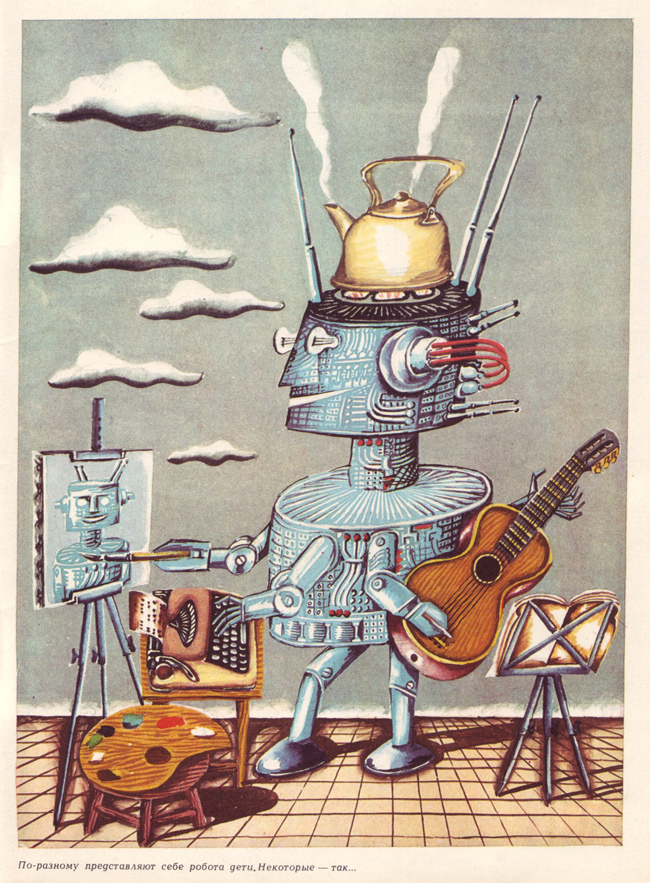
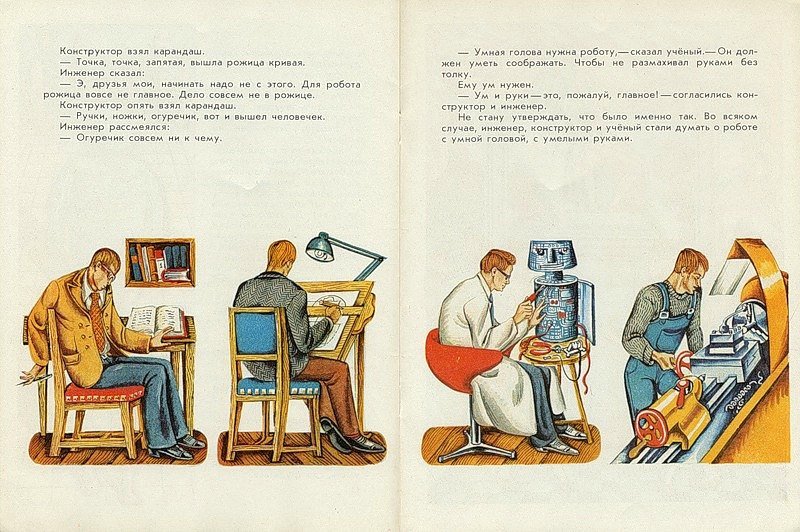
Most Soviet children’s books have such captivating illustrations that one need not read them to enjoy them. Take, for instance, Your Name? Robot, a 1979 Soviet picture book featured on book and design blog 50 Watts.
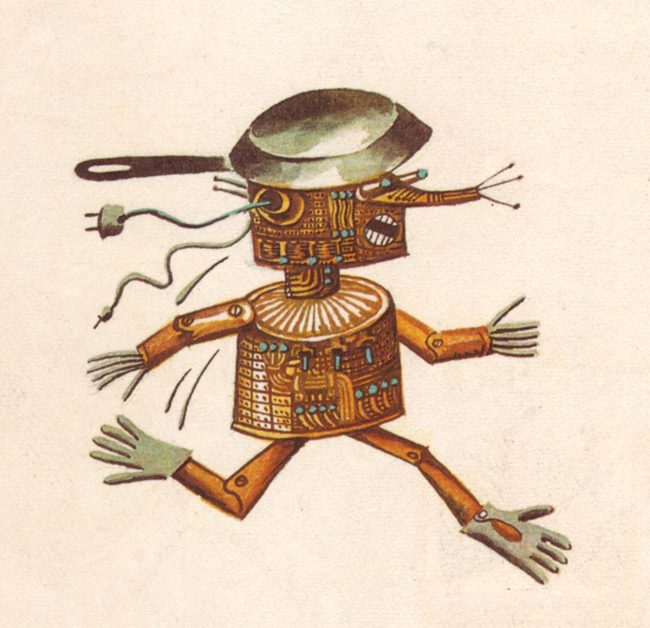
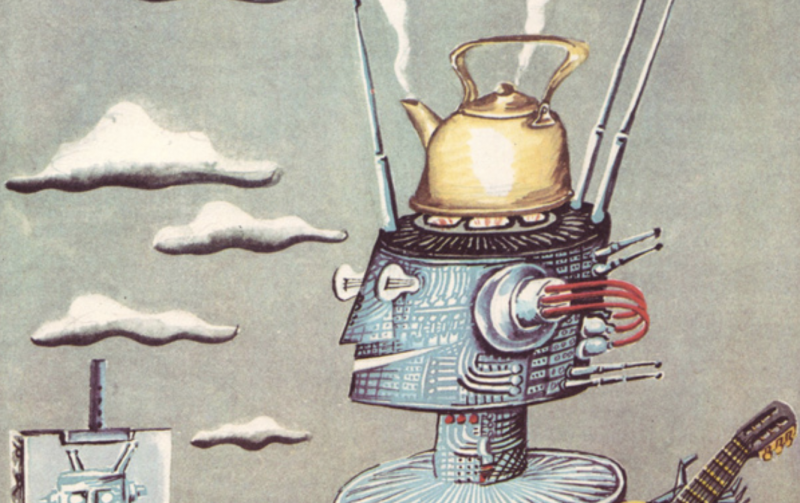
Who could resist the charm of these mechanical creatures displaying their many abilities: picking up signals, playing music, painting pictures, spouting complicated figures, boiling water? With their hypnotically detailed patterns of circuits and wires, the inner workings of these robots also look quite unlike anything else — and certainly unlike the also-popular robot characters who have long figured into stories for American children.
In the mid-20th century, America and the Soviet Union were racing each other to the future: though visionaries in both lands may have disagreed about what exact form that future would take, many saw some kind of utopia made real through high technology dead ahead. And whether worker’s paradise or consumer’s paradise, the rest of the millennium would surely see the development of intelligent robots to assist, educate, and entertain us.
But by the late 1970s, some of these visions had turned dystopian: to borrow the tagline from Zardoz, they’d seen the future, and it didn’t work — itself a grim reversal of American journalist Lincoln Steffens’ optimistic early-20th-century declaration about Soviet Russia.

From Soviet cinema, one less-than-optimistic treatment of the future endures above all: 1972’s Solaris, adapted by Andrei Tarkovsky from the novel by Stanislaw Lem. The production designer who gave that film’s future its look and feel was none other than Mikhail Romadin, the artist who would go on to illustrate Your Name? Robot just a few years later (in an illustration career involving hundreds of books, including volumes by Leo Tolstoy and Ray Bradbury).
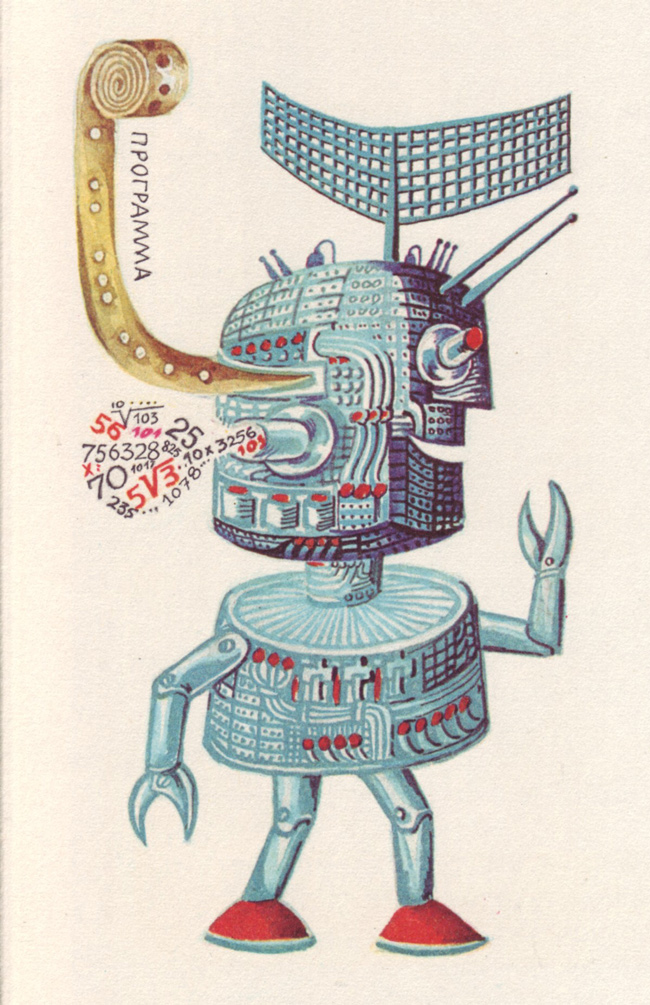
“Romadin’s character is hidden, forced deep inside,” said Tarkovsky of his collaborator and friend since film school. “In his best works what often happens is that the outward characteristics of barely ordered dynamism and chaos that one perceives initially, melt imperceptibly into the appreciation of calm and noble form, silent and simple” — an appreciation Your Name? Robot must have done its part to instill in a generation of young readers.

Related Content:
Soviet-Era Illustrations Of J. R. R. Tolkien’s The Hobbit (1976)
Enter an Archive of 6,000 Historical Children’s Books, All Digitized and Free to Read Online
Based in Seoul, Colin Marshall writes and broadcasts on cities, language, and culture. His projects include the book The Stateless City: a Walk through 21st-Century Los Angeles and the video series The City in Cinema. Follow him on Twitter at @colinmarshall or on Facebook.
Read More...An Animated Introduction to Cynicism, the Anti Conformist Philosophy That Originated in Ancient Greece
The word “cynical,” like “stoic,” has come to have a very specific meaning in English, one that bears only a partial resemblance to the ancient Greek philosophy from which it came. “Cynics,” writes psychiatrist Neel Burton, “often come across as contemptuous, irritating, and dispiriting.” They are bitter, unhappy people, defined by thoroughgoing pessimism, summed up in the Oscar Wilde quote about those who “know the price of everything and the value of nothing.” This characterization is partly the result of ancient slander.
As with many movements of the past, the first Cynics were named by their enemies. Diogenes of Sinope, often credited as the first Cynic (though there were others before him), was “an individual well known for dog-like behavior,” notes Emory University professor Julie Piering at the Internet Encyclopedia of Philosophy. “As such, the term [Cynic, from kunikos, or “dog-like”] may have begun as an insult referring to Diogenes’ style of life, especially his proclivity to perform all of his activities in public.” His shamelessness and exile from Greek civil society for the crime of counterfeiting made him unwelcome in polite company.
But Diogenes turned his public humiliation into experimental philosophy. Like many who have insults hurled at them regularly, the early Cynics “embraced their title: they barked at those who displeased them, spurned Athenian etiquette, and lived from nature…. What may have originated as a disparaging label became the designation of a philosophical vocation.” Of what did their philosophy consist? In the TED-Ed video above, scripted by Maynooth University professor of Ancient Classics William Desmond, we learn the basics.
Like the Stoics who came after them, Cynics valued simplicity and self-sufficiency. But unlike many a famed Stoic philosopher—such as Nero’s advisor Seneca or the Emperor Marcus Aurelius—Diogenes and his disciples cared nothing for material comforts or political power. The Cynics were vagrant exhibitionists by choice. Diogenes “did not go about his new existence quietly but is said to have teased passersby and mocked the powerful, eating, urinating, and even masturbating in public.”
If the philosopher lived like a dog, this does not mean that he had abandoned all human values, only redefined them. Dogs aren’t bitter, angry pessimists. “They’re happy creatures,” Desmond’s lesson points out, “free from abstractions like wealth and reputation.” The “dog philosophers” were a serious irritation, living examples of a social alternative in which money, fame, and power meant nothing. Their contentment posed a challenge to the established order of things.
Cynics followed Diogenes’ example for almost a thousand years after his death—and even far longer, we might argue, if we consider them forerunners of hobos, hippies, and every intentionally homeless wanderer who decides to rid themselves of property and society and live fully on their own terms.
Related Content:
A Short Animated Introduction to Hypatia, Ancient Alexandria’s Great Female Philosopher
Josh Jones is a writer and musician based in Durham, NC. Follow him at @jdmagness
Read More...Download Beautiful Free Posters Celebrating the Achievements of Living Female STEM Leaders

Remember the posters that decorated your childhood or teenaged bedroom?
Of course you do.
Whether aspirational or inspirational, these images are amazingly potent.
I’m a bit embarrassed to admit what hung over my bed, especially in light of a certain CGI adaptation…
No such worries with a set of eight free downloadable posters honoring eight female trailblazers in the fields of science, technology, engineering, and math.
These should prove evergreen.

Commissioned by Nevertheless, a podcast that celebrates women whose advancements in STEM fields have shaped—and continue to shape—education and learning, each poster is accompanied with a brief biographical sketch of the subject.
Nevertheless has taken care that the featured achievers are drawn from a wide cultural and racial pool.
No shame if you’re unfamiliar with some of these extraordinary women. Their names may not possess the same degree of household recognition as Marie Curie, but they will once they’re hanging over your daughter’s (or son’s) bed.

It’s worth noting that with the exception of the undersung mother of DNA Helix Rosalind Franklin, these are living role models. They are:
Astronaut Dr. Mae Jemison
Robotics pioneer Dr. Cynthia Breazeal
Mathematician Gladys West
Tech innovator Juliana Rotich
Pharmaceutical chemist Tu Youyou
Biopharmacist and women rights advocate Maria da Penha
Biotechnologist Dr. Hayat Sindi
Kudos, too, to Nevertheless for including biographies of the eight female illustrators charged with bringing the STEM luminaries to aesthetically cohesive graphic life: Lidia Tomashevskaya,Thandiwe Tshabalala, Camila Rosa, Xu Hui, Karina Perez, Joana Neves, Geneva B, and Juliette Brocal

Listen to Nevertheless’ episode on STEM Role Models here.
Download Nevertheless’ free posters in English here. You can also download zipped folders containing all eight posters translated into Brazilian Portuguese, French, French Canadian, German, Italian, Spanish, and Simplified Chinese.

Related Content:
Women Scientists Launch a Database Featuring the Work of 9,000 Women Working in the Sciences
Ayun Halliday is an author, illustrator, theater maker and Chief Primatologist of the East Village Inky zine. Join her in NYC on Monday, January 6 when her monthly book-based variety show, Necromancers of the Public Domaincelebrates Cape-Coddities (1920) by Roger Livingston Scaife. Follow her @AyunHalliday
Read More...Watch Annie Leibovitz Photograph and Get Scolded by Queen Elizabeth: “What Do You Think This Is?”
No matter how many cultural icons you’ve met, Annie Leibovitz has almost certainly met more of them. Not only has she met them, she’s talked with them, spent long stretches of time with them, told them what to do, and even looked into the nature of their very being — which is to say, she’s photographed them. Having put in her crosshairs the likes of John Lennon, Michael Jackson, Christopher Hitchens, and Barack Obama, one would assume Leibovitz has lost entirely the ability to be intimidated by any personage, no matter how august. But then, she didn’t have to address any of the aforementioned figures as “Your Majesty.”
“Back in 2007, Leibovitz was hired to shoot a set of portraits of the Queen at Buckingham Palace in preparation for a state visit to the United States,” writes Petapixel’s Michael Zhang. “The photographer and her 11 assistants spent 3 weeks preparing for the 30-minute photo shoot.” For the Queen’s part, preparation included “the full regalia of the ancient Order of the Garter, complete with tiara,” putting on all of which took 15 minutes longer than planned.
But when she got the Queen seated, Leibovitz — perhaps figuring that, if a casual manner works with pop stars and presidents, it might work even better with royalty — suggested that “it will look better without the crown.” It would look better, she suggested, “less dressy.” “Less dressy?” the Queen snaps back in a kind of irritated astonishment. “What do you think this is?”
Leibovitz, to her credit, remains unfazed, even when informed that the tiara can’t go back on once it’s been taken off. You can see it happen in the Dutch TV clip above, which takes its footage from the BBC documentary A Year with the Queen. Despite the pressure, the portraits came out well, as did the second series Leibovitz shot of the Queen in 2016. These more recent photographs were taken under less strict conditions. “I was told how relaxed she was at Windsor, and it was really true,” says Leibovitz in the accompanying Vanity Fair story. “You get the sense of how at peace she was with herself, and very much enthralled with her family.” At the Queen’s request, the pictures included her family members both human and corgi, all arranged according to her own ideas. If she tires of her current job, she may have a promising future in portrait photography ahead of her.
Related Content:
Annie Leibovitz Teaches Photography in Her First Online Course
A Very Brief History of Royal Weddings
Colin Marshall hosts and produces Notebook on Cities and Culture and writes essays on cities, language, Asia, and men’s style. He’s at work on a book about Los Angeles, A Los Angeles Primer. Follow him on Twitter at @colinmarshall or on Facebook.
Read More...Hear Every Sample on the Beastie Boys’ Acclaimed Album, Paul’s Boutique–and Discover Where They Came From
How would the Beastie Boys follow their debut, Licensed to Ill, wondered critics when the album rose to number one after its 1986 release. The cross-over appeal of their hip hop/frat rock solidified a fan base whose devotion often mirrored their parents’ revulsion. Like many of their later imitators, the Beastie Boys could have played overgrown delinquents till their fans aged out of the act.
Few critics expected more from them. “Rolling Stone entitled their review ‘Three Idiots Create a Masterpiece’ and gave more credit to producer Rick Rubin,” writes Colleen Murphy at Classic Album Sundays. Three years later, they far surpassed expectations with their experimental second album, 1989’s Paul’s Boutique, though it took a little while for the fans to catch up.
It’s a record so dense with allusions both musical and lyrical, so original in its verbal interplay and comic storytelling, that the Beastie Boys were suddenly hailed as serious artists. As Murphy puts it:
Paul’s Boutique gave the Beastie Boys the critical acclaim they desperately desired. Rolling Stone maneuvered a U‑turn and brazenly called it, “the Pet Sounds / The Dark Side of the Moon of hip hop.” But more importantly, it also earned the group respect with their peers and idols. Miles Davis claimed he never got tired of listening to it, and Public Enemy’s Chuck D even said, ‘The dirty secret among the Black hip hop community at the time of the release was that Paul’s Boutique had the best beats.”
They spat absurdly hilarious rhymes by the dozen in mock epic narratives brimming with rhythmic and melodic complexity, thanks to the high-concept production by the Dust Brothers. The two producers pieced the album’s soundscape together from an estimated 150-odd samples, a method that “would be prohibitively expensive if not impossible” today, notes Kottke. In the video above, you can hear every sample on the album, “from the soundtrack to Car Wash to the Sugarhill Gang to the Eagles to the Ramones to the Beatles.”
For legal and creative reasons, nothing has ever sounded quite like Paul’s Boutique (except, perhaps, De La Soul’s Three-Feet High and Rising, a similarly groundbreaking, sample-heavy album released the same year). Thirty years after it came out, “it’s still not out of the ordinary to discover something you never heard before across this 15-track odyssey into a thrift story rack full of weird vinyl,” Billboard points out in a list of 10 deep cuts sampled on the record.
Like every classic album, Paul’s Boutique repays endless re-listens, both for its surreal lyrical playfulness and library of musical references. Hearing the breadth of samples that built the album drives home how much those two features are interwoven. Head over to Kottke for more Paul’s Boutique goodies, including a remix with source tracks and audio commentary and a Spotify playlist of all the sampled songs.
Related Content:
‘Beastie Boys on Being Stupid’: An Animated Interview From 1985
Josh Jones is a writer and musician based in Durham, NC. Follow him at @jdmagness.
Read More...Hear Neil Gaiman Read A Christmas Carol Just as Dickens Read It

Image by New York Public Library
Last Christmas, we featured Charles Dickens’ hand-edited copy of his beloved 1843 novella A Christmas Carol. He did that hand editing for the purposes of giving public readings, a practice that, in his time, “was considered a desecration of one’s art and a lowering of one’s dignity.” That time, however, has gone, and many of the most prestigious writers alive today take the reading aloud of their own work to the level of art, or at least high entertainment, that Dickens must have suspected one could. Some writers even do a bang-up job of reading other writers’ work: modern master storyteller Neil Gaiman gave us a dose of that on Monday when we featured his recitation of Lewis Carroll’s “Jabberwocky” from memory. Today, however, comes the full meal: Gaiman’s telling of A Christmas Carol straight from that very Dickens-edited reading copy.
Gaiman read to a full house at the New York Public Library, an institution known for its stimulating events, holiday-themed or otherwise. But he didn’t have to hold up the afternoon himself; taking the stage before him, BBC researcher and The Secret Museum author Molly Oldfield talked about her two years spent seeking out fascinating cultural artifacts the world over, including but not limited to the NYPL’s own collection of things Dickensian. You can hear both Oldfield and Gaiman in the recording above. But perhaps the greatest gift of all came in the form of the latter’s attire for his reading: not only did he go fully Victorian, he even went to the length of replicating the 19th-century literary superstar’s own severe hair part and long goatee. And School Library Journal has pictures.
The story really gets started around the 11:25 mark. Gaiman’s reading will be added to our list of Free Audio Books. You can find the text of Dickens’ classic in our collection, 800 Free eBooks for iPad, Kindle & Other Devices.
Note: An earlier version of this post appeared on our site in December 2014.
Related Content:
Neil Gaiman Teaches the Art of Storytelling in His New Online Course
A Christmas Carol Presented in a Thomas Edison Film (1910)
O Frabjous Day! Neil Gaiman Recites Lewis Carroll’s “Jabberwocky” from Memory
Colin Marshall hosts and produces Notebook on Cities and Culture and writes essays on cities, language, Asia, and men’s style. He’s at work on a book about Los Angeles, A Los Angeles Primer. Follow him on Twitter at @colinmarshall or on Facebook.
Read More...Revisiting Band Aid’s Cringe-Inducing 1984 Single, “Do They Know It’s Christmas?”
We all know, don’t we, that the 1984 charity hit “Do They Know It’s Christmas?” qualifies as possibly the worst Christmas song ever recorded? Does that go too far? The song’s writer, Bob Geldof, went even further, once saying, “I am responsible for two of the worst songs in history. One is ‘Do They Know It’s Christmas?’ and the other one is ‘We Are the World.’”
There’s no objective measure for such a thing, but I’m not inclined to disagree, with due respect for the millions Geldof, co-organizer and co-producer Midge Ure, and British celebrity supergroup Band Aid raised to feed victims of famine in Ethiopia in the mid-80s. Revisiting the lyrics now, I’m shocked to find they’re even more ridiculous and cringe-inducing than I remembered.
We can quickly dispense with the absurdity of the title. As an exasperated Spotify employee helpfully pointed out recently in a series of annotations, “the people of Ethiopia probably did know it was Christmas—it’s one of the oldest Christian nations in the world” with a majority Christian population.
The song’s aid recipients are referred to as “the other ones” who live in “a world of dread and fear.” Listeners are enjoined to “thank God it’s them instead of you.” And two years after Toto’s “Africa,” Band Aid manages to deliver the clumsiest, most ill-informed stanza perhaps ever written about the continent:
And there won’t be snow in Africa
This Christmas time
The greatest gift they’ll get this year is life
Where nothing ever grows
No rain or rivers flow
Do they know it’s Christmas time at all?
Troublingly, the song “peddles myths about the cause of the famine,” writes Greg Evans at The Independent, “suggesting it was down to a drought, rather than the corrupt government misusing international aid.”
But it’s Christmas, as you probably know, so let’s not be too hard on “Do They Know It’s Christmas?” The artists who participated, including George Michael, Bono, Boy George, Sting, and many others had a significant impact on the entertainment industry’s role in international aid, for good and ill. The song was re-recorded three times, in 1989, 2004, and 2014, and it has become, believe it or not, “the second bestselling single in Britain’s history,” Laura June points out at The Outline.
Evans notes that “a reported £200m was raised via sales of the single which went towards the relief fund and it later went on to inspire the iconic Live Aid concert in July 1985, which raised a further £150m.” (Some of that money, it was later discovered, inadvertently made it into the hands of Ethiopia’s corrupt government.) Other benefit events, like Farm Aid in the U.S., would follow Geldof and Urge’s lead, and the model proved to be an enduring way for artists to support causes they cared about.
See the unbearably earnest original video at the top of the post and, just above, a thirty-minute making of film with a who’s who of mid-1980s British pop royalty learning to sing “let them know it’s Christmas time again” together.
Related Content:
Stream a Playlist of 68 Punk Rock Christmas Songs: The Ramones, The Damned, Bad Religion & More
Hear Paul McCartney’s Experimental Christmas Mixtape: A Rare & Forgotten Recording from 1965
Josh Jones is a writer and musician based in Durham, NC. Follow him at @jdmagness
Read More...Support Us
We're hoping to rely on loyal readers, rather than erratic ads. Please click the Donate button and support Open Culture. You can use Paypal, Venmo, Patreon, even Crypto! We thank you!

About Us

Open Culture scours the web for the best educational media. We find the free courses and audio books you need, the language lessons & educational videos you want, and plenty of enlightenment in between.
Advertise With Us

FREE UPDATES!
GET OUR DAILY EMAIL
Get the best cultural and educational resources on the web curated for you in a daily email. We never spam. Unsubscribe at any time.
FOLLOW ON SOCIAL MEDIA

Open Culture editor Dan Colman scours the web for the best educational media. He finds the free courses and audio books you need, the language lessons & movies you want, and plenty of enlightenment in between.
Advertise With Us

