Stanley Kubrick’s Eyes Wide Shut, the Most Troubling Christmas Film Ever Made
Those in search of non-standard Christmas movies to watch this holiday season will have long since tired of hearing recommendations of Die Hard. While the cop-versus-terrorists hit that made Bruce Willis an action star does indeed feature an unusually high body count for a picture set at Christmastime, it adheres in other respects to the usual Hollywood contours. For serious Yuletide cinematic subversion you need the work of Stanley Kubrick, who made an entire career out of refusing to honor the expectations of genre. Specifically, you need the final work of Stanley Kubrick: Eyes Wide Shut, which adapts Arthur Schnitzler’s Dream Story, a novella of fin-de-siècle Vienna, into a vision of wealth, sex, and decadence — as well as secrecy and possible murder — in New York at the end of the millennium.
“The film was billed as an erotic thriller starring the two hottest — and, yes, married — actors, at the time,” says Wisecrack’s Jared Bauer in the video above. But since its release 20 years ago, “what was initially dismissed as a failed piece of erotica has proven, upon further inspection, to be something way deeper: an exploration of sociology, dreams, desire — and yes, sex — through the lens of New York City’s elite.”
It all begins when Tom Cruise’s well-to-do doctor Bill Harford hears his wife, played by Nicole Kidman, confess a fantasy she once had about another man. This sends him into an all-night journey into the sexual underworld, one designed to be experienced by the viewer, as Nerdwriter Evan Pucschak has argued, like an immersive virtual-reality experience, and one whose central themes manifest in every single scene.
Kubrick fills Eyes Wide Shut with prostitution, of both the obvious fur-coat-on-the-street-corner variety and its many subtler instantiations at every level of society as well. “At its deeply cynical core,” says Bauer, “the film asks the question: are we all somebody’s whore?” The video’s analysis draws heavily on “Introducing Sociology,” Tim Kreider’s analysis in Film Quarterly. Kreider writes that “almost everyone in this film prostitutes themselves, for various prices”: true on the surface level of the women at the occult masked orgy at which the doctor finds himself in the middle of the night, but just as true on a deeper level of Mr. and Mrs. Harford themselves. “The real pornography in this film,” according to Kreider, “is in its lingering depiction of the shameless, naked wealth of Millennial Manhattan, and of the obscene effect of that wealth on our society, and on the soul.”
It is in a toy store that the film, with what Bauer calls its “metaphor of Christmas as an orgy of consumption,” concludes. As their young daughter looks for things to buy, the Harfords discuss what to do about the revelatory experiences of the past two days. Kidman’s famous final line suggests that the couple is “doomed to repeat the same petty jealousies again and again, while potentially spending beyond their means — you know, the American Dream.” It also “connects to the title of the film, which evokes a sense of enlightened false consciousness. We may know that we’re being screwed over and controlled by the wealthy and powerful, but at least it’s Christmas and we can play with our toys, both commercial and sexual. So our eyes are firmly, deliberately shut, because that’s the only way to tolerate this world.” Kubrick has taken us a long way indeed from It’s a Wonderful Life, but perhaps we can consider the ever-greater resonance and relevance of Eyes Wide Shut his final Christmas gift to us.
Related Content:
Are Stanley Kubrick Films Like Immersive Video Games? The Case of Eyes Wide Shut
Discover the Life & Work of Stanley Kubrick in a Sweeping Three-Hour Video Essay
How Stanley Kubrick Became Stanley Kubrick: A Short Documentary Narrated by the Filmmaker
The Shining and Other Complex Stanley Kubrick Films Recut as Simple Hollywood Movies
Based in Seoul, Colin Marshall writes and broadcasts on cities, language, and culture. His projects include the book The Stateless City: a Walk through 21st-Century Los Angeles and the video series The City in Cinema. Follow him on Twitter at @colinmarshall or on Facebook.
Read More...Pretty Much Pop: A Culture Podcast #24 Considers Holiday Viewing: What’s Canon?

Join Mark Linsenmayer, Erica Spyres, and Brian Hirt for a special “snake draft,” where we take turns picking the holiday films and TV specials that we think are (or should be) part of America’s yearly viewing traditions.
Were I to list all the shows and films we mention, that would give away our picks now, wouldn’t it? Compare your intuitions about what is classic or seminal or over-rated with ours!
Here are some articles with most of the likely suspects to get you warmed up:
- “Primer: TV Christmas Specials” from AV Club
- “Mr. Movie: Holiday Movies, the Good and the Bad” by Gary Wolcott
- “Here’s Why We Bloody Love Repeats on TV Over Christmas and New Year” by Morgan Jefferey
- “The War for Christmas TV Is More Competitive than Ever” by Joseph Adalia
- “Christmas Shows Are TV’s December Comfort Food” by John Koblin
- “12 Worst Holiday Specials Of All Time” by Rose Moore
- “It’s Not just “Rudolph”: Holiday TV Specials Are Mostly Creepy, Weird or Depressing as Hell” by Melanie McFarland
We did NOT beforehand actually look at IMDB’s Top 25 Christmas Movies or their Greatest Christmas Specials list, but YOU certainly can. Neither did we look this ranking of the various versions of A Christmas Carol by Dave Trumbore. While we’re at it, here are times where TV shows ripped off It’s a Wonderful Life.
Other references and information:
When does A Christmas Story take place? 1940; read trivia about that film. The Dare Daniel podcast has a brutal take-down of the little-seen 2012 sequel that serves as a great substitute for actually viewing that pile of garbage.
You can watch the quick version of the very funny Rifftrax running commentary on the Star Wars Holiday Special on YouTube or buy the whole thing. Did George Lucas really want to smash all copies of it as Mark said?
Brian refers to this article, “Diagnosing the Home Alone Burglars’ Injuries: A Professional Weighs In” by Lauren Hansen.
It’s actually the Thanksgiving Charlie Brown special that has been blasted as racist, not the Xmas one. Here’s an article about the history of Franklin being included in the strip.
Whenever discussing or watching It’s a Wonderful Life, I can’t help but think of the Saturday Night Live “lost ending” to the film.
This episode includes bonus discussion that you can only hear by supporting the podcast at patreon.com/prettymuchpop. This podcast is part of the Partially Examined Life podcast network.
Pretty Much Pop: A Culture Podcast is the first podcast curated by Open Culture. Browse all Pretty Much Pop posts or start with the first episode.
Read More...Richard Feynman’s “Lost Lecture:” An Animated Retelling
Nobel prize-winning physicist Richard Feynman is “famous in a number of dimensions,” says science and math explainer Grant Sanderson of the YouTube channel 3blue1brown in the video above. “To scientists, he’s a giant of 20th century physics… to the public, he’s a refreshing contradiction to the stereotypes about physicists: a safe-cracking, bongo-playing, mildly philandering non-conformist.” Feynman is also famous, or infamous, for his role in the Manhattan Project and the building of the first atomic bomb, after which the FBI kept tabs on him to make sure he wouldn’t, like his colleague Klaus Fuchs, turn over nuclear secrets to the Soviets.
He may have led an exceptionally eventful life for an academic scientist, but to his students, he was first and foremost “an exceptionally skillful teacher… for his uncanny ability to make complicated topics feel natural and approachable.” Feynman’s teaching has since influenced millions of readers of his wildly popular memoirs and his lecture series, recorded at Caltech and published in three volumes in the early 1960s. (Also see his famous course taught at Cornell.) For decades, Feynman fans could list offhand several examples of the physicist’s acumen for explaining complex ideas in simple, but not simplistic, terms.
But it wasn’t until the mid-nineties that the public had access to one of the finest of his Caltech lectures. Discovered in the 1990s and first published in 1996, the “lost lecture”—titled “The Motion of the Planets Around the Sun”—“uses nothing more than advanced high school geometry to explain why the planets orbit the sun elliptically rather than in perfect circles,” as the Amazon description summarizes. You can purchase a copy for yourself, or hear it Feynman deliver for free just below.
Feynman gave the talk as the guest speaker in a 1964 freshman physics class. He addresses them, he says, “just for the fun of it”; none of the material would be on the test. Nevertheless, he ended up hosting an informal 20-minute Q&A afterwards. Given his audience, Feynman assumes only the most basic prior knowledge of the subject: an explanation for why the planets make elliptical orbit around the sun. “It ultimately has to do with the inverse square law,” says Sanderson, “but why?”
Part of the problem with the lecture, as its discoverers David and Judith Goodstein—husband and wife physicist and archivist at Caltech—found, involves Feynman’s extensive reference to figures he draws on the blackboard. It took some time for the two to dig these diagrams up in a set of class notes. In Sanderson’s video at the top, we get something perhaps even better: animated physical representations of the mathematics that determine planetary motion. We need not know this math in depth to grasp what Feynman calls his “elementary” explanation.
“Elementary” in this case, despite common usage, does not mean “easy,” Feynman says. It means “that very little is required to know ahead of time in order to understand it, except to have an infinite amount of intelligence.” That last part is a typical bit of humor. Even those of who haven’t pursued math or physics much beyond the high school level can learn the basic outlines of planetary motion in Feynman’s witty lecture, supplemented by the video visual aids Sanderson offers at the top.
Related Content:
Learn How Richard Feynman Cracked the Safes with Atomic Secrets at Los Alamos
Richard Feynman on the Bongos
Richard Feynman Plays the Bongos
Josh Jones is a writer and musician based in Durham, NC. Follow him at @jdmagness
Read More...A Beautiful New Book of Japanese Woodblock Prints: A Visual History of 200 Japanese Masterpieces Created Between 1680 and 1938
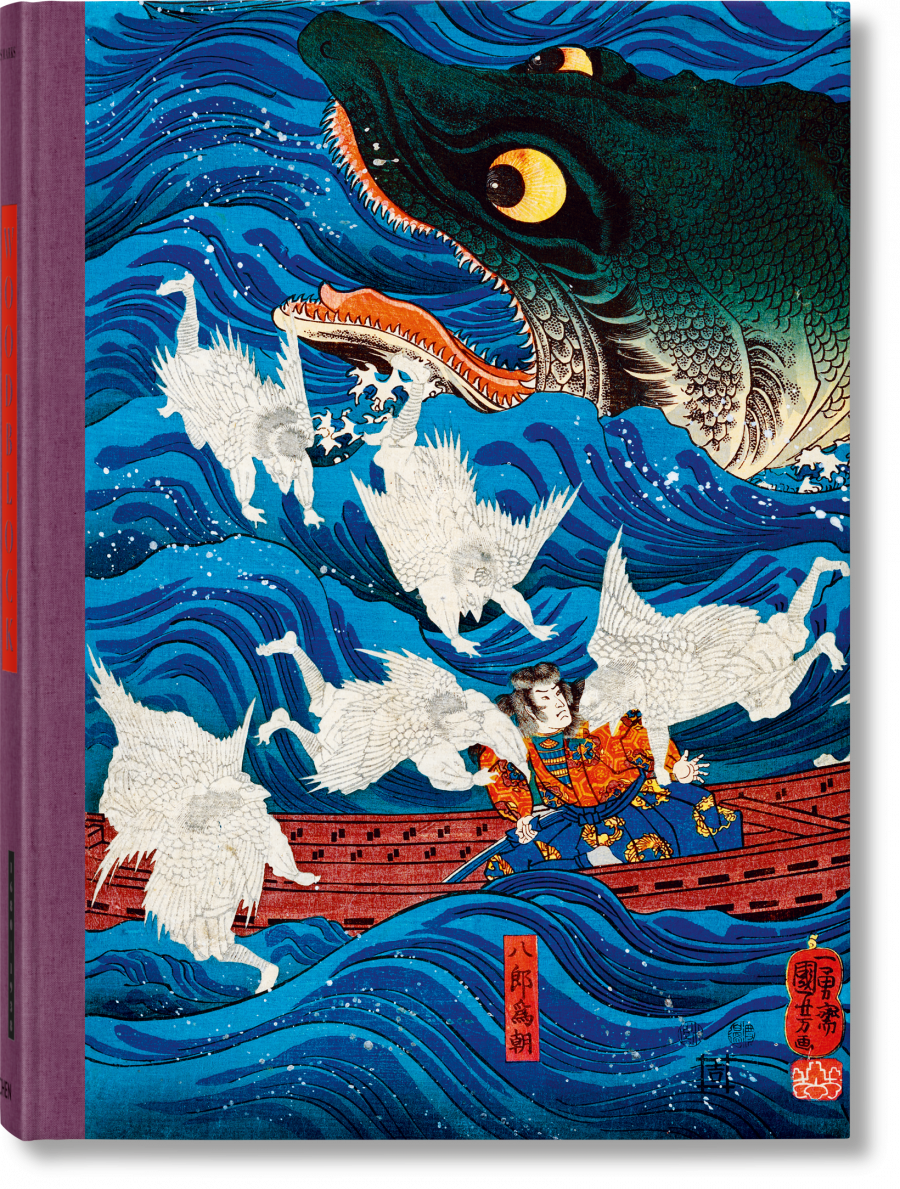
Japanese woodblock prints, especially in the style known in Japanese as ukiyo‑e, or “pictures of the floating world,” portray the social, natural, and supernatural realms in a way no other art form ever has. They also repay the attention you give them, one reason we here on Open Culture have tried to share with you every opportunity to download them — from the archive at Ukiyo‑e.org, for example, or at the Library of Congress — and build your own digital collection.

But appreciating Japanese woodblock prints on a screen is one thing, and appreciating them in large-scale reproductions on paper is quite another. At least that’s one implicit premise of the book Japanese Woodblock Prints (1680–1938), newly published by Taschen.
As a publisher, Taschen has made its formidable name in part by collecting between two covers the lesser-known work of famous artists of the recent past: Andy Warhol’s hand-illustrated books, for example, or Salvador Dalí’s cookbook and tarot deck.
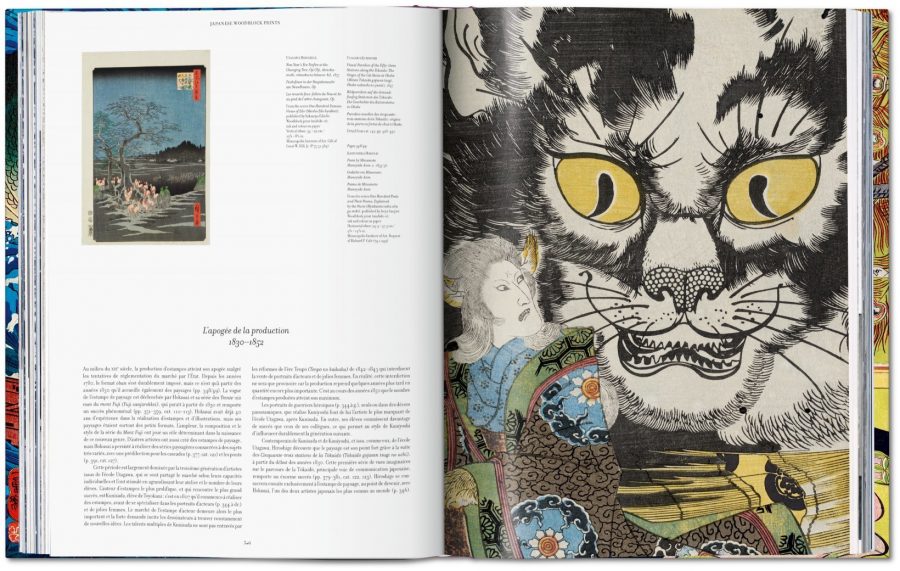
Never an outfit to fear accusations of immodesty, Taschen’s projects also include “XXL books” like a 500-page, 14-pound volume on Jean-Michel Basquiat. Surpassing even that book in length by more than 200 pages, Japanese Woodblock Prints contains, according to Taschen’s official site, an artistic reality where “breathtaking landscapes exist alongside blush-inducing erotica; where demons and otherworldly creatures torment the living; and where sumo wrestlers, kabuki actors, and courtesans are rock stars.”
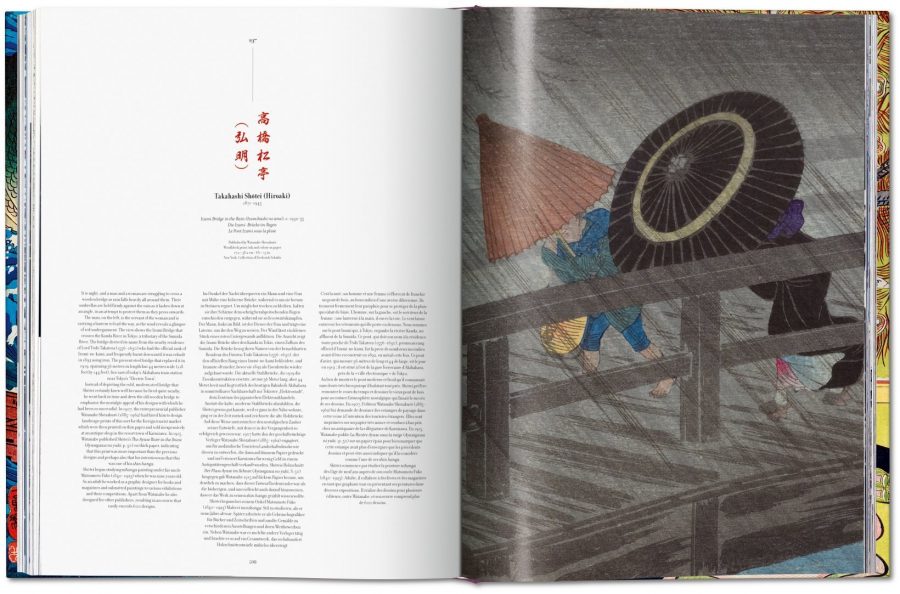
“For this tome, Taschen spent three years reproducing woodblock prints from museums and private collections from around the world,” writes Colossal’s Andrew Lasane. “Written by Andreas Marks, head of the Japanese and Korean Art Department at the Minneapolis Institute of Art, the book is divided chronologically into seven chapters beginning with the 17th century early masters and concluding with the Shin-hanga movement.” (That last is a late 19th- and early 20th-century woodblock style, in which we once featured renderings of Hayao Miyazaki’s characters.)

No matter our temporal and cultural distance from the Japanese masters of ukiyo‑e, we’ve nearly all been captivated by their work at one time or another, most often when we run across pieces of it online. With Japanese Woodblock Prints, Taschen means to get those of us who prefer print even more captivated — and at the same time, to teach us more than a little about the cultural and historical context of all these landscapes, cityscapes, monsters, beauties, and historical figures at which we marvel.
If you want to pick up a copy of this artistic work, you can make a purchas on Amazon.

via Colossal
Related Content:
Enter a Digital Archive of 213,000+ Beautiful Japanese Woodblock Prints
Download 2,500 Beautiful Woodblock Prints and Drawings by Japanese Masters (1600–1915)
Download Hundreds of 19th-Century Japanese Woodblock Prints by Masters of the Tradition
Based in Seoul, Colin Marshall writes and broadcasts on cities, language, and culture. His projects include the book The Stateless City: a Walk through 21st-Century Los Angeles and the video series The City in Cinema. Follow him on Twitter at @colinmarshall or on Facebook.
Read More...Hear the Trippy Mystical Sounds of Giant Gongs
Growing up I thought there were only two uses for gongs. One was for making one large bonnnnnnng sound for something important, like the announcement of a royal banquet or the beginning of a J. Arthur Rank production. The other was as a weapon against cartoon animals–it would make a funny sound and their heads would be turned into a pancake. How was I to know there was so much more to gongs, especially 80-inch wide gongs that cost around $27,000? Thank goodness for YouTube, then.
The above video features Sven aka Gong Master Sven aka Paiste Gong Master Sven (it’s not very clear in the description) very gingerly playing this monster symphonic gong, coaxing out of it menacing, echoing groans and wails straight out of a horror movie.
Just a gentle stroke can cause the metal to vibrate and feed back onto itself. Using a smaller mallet produces sounds like whale songs. That something so large can make such a stunning array of tones, and react to such delicacy is fascinating. (Watch with headphones on or a good sound system, by the way).
If that whets your whistle, here’s more gong action with musician Bear Love, who manages to make his gong sound like something out of science fiction, incredibly creepy. If there’s a ghost story movie out there with a one-gong soundtrack, I’d believe it.
Michael Bettine plays the same Paiste gong in a more familiar way, by whacking it with a big mallet. It’s impressive, and he doesn’t really hit it that hard. “You can feel your internal organs being massaged by the vibrations,” he says.
Finally, Tom Soltron Czartoryski, slims it down to a 62 inch “earth gong” with its array of indentations, and creates a nearly 10 minute ambient work, which is one expansive dose of space music. Groovy and sometimes stressful, fascinating and all-encompassing. Enjoy!
(Note to self: Resolve to find a local giant gong and have a go.)
via Kottke.org
Related Content:
A Modern Drummer Plays a Rock Gong, a Percussion Instrument from Prehistoric Times
Hear a 9,000 Year Old Flute—the World’s Oldest Playable Instrument—Get Played Again
Punk Dulcimer: The Ramones’ “I Wanna Be Sedated” Played on the Dulcimer
Ted Mills is a freelance writer on the arts who currently hosts the artist interview-based FunkZone Podcast and is the producer of KCRW’s Curious Coast. You can also follow him on Twitter at @tedmills, read his other arts writing at tedmills.com and/or watch his films here.
Read More...Radiohead Puts Every Official Album on YouTube, Making Them All Free to Stream
There are those who say that Radiohead was the last of the great rock bands before the internet crushed the record industry and popular music fragmented into a proliferation of microgenres. Maybe it’s fair to say some of those people have been humming Radiohead songs since the band’s debut, Pablo Honey, in 1992.
And maybe rock isn’t a thing of the past, it’s just evolved, thanks in no small part to Radiohead, who also helped usher in the very streaming and downloading revolution that killed the rock star system. They did so with several groundbreaking experimental albums that seemed to uncannily coincide with major shifts in digital technology.
Now you can stream all of those albums on YouTube, from Pablo Honey to 2016’s Moon Shaped Pool. Revisit not only the songs on their debut besides “Creep” but the albums that devastated, then reshaped, the industry, and irrevocably changed the sound of popular music.
Go back to 1997, after Windows 95 had put millions more people behind a PC, and hear Radiohead deconstruct the sound of massive guitar rock and reassemble it into a Futurist machine called OK Computer. Other bands were forced to reevaluate their whole approach. The industry held on to the old ways for a few more years, but Radiohead needed to change as well.
“There were other guitar bands out there trying to do similar things,” said bassist Colin Greenwood. “We had to move on.” Thom Yorke believed rock had “run its course.” Then came the devastating dual attack of Napster and Kid A, The sharing service sent labels into a panic. By the time of the album’s release in 2000, it had been illegally downloaded over a million times.
Not only did Kid A “kick off the streaming revolution,” as Steven Hyden writes at Grantland, but young internet-savvy indie artists just beginning to put their own compositions online looked to the record’s warped, glitchy dread for inspiration, spinning its electronic experimentation into webs of loosely-related genre hybrids.
As Yorke had predicted, Napster encouraged “enthusiasm for music in a way that the music industry has long forgotten to do.” The industry began to collapse. File sharing may have been utopian for listeners, but it was potentially ruinous for artists. 2007’s In Rainbows showed a way forward.
Released on a pay-what-you-want model, with a “digital tip jar,” the release was met with bemusement and contempt. (The Manic Street Preacher’s Nicky Wire wrote that it “demeans music.”) Two years later, the jury was still out on the “Radiohead experiment.”
Yet it wouldn’t be long before both musicians and small labels started selling music through Bandcamp, which debuted in 2008 with a similar business model, combating piracy with a kind of online honor system that lets fans determine their own sliding scale. (The “digital tip jar” has become a standard feature of all online promotion.)
Radiohead’s release strategies have allowed them to keep surprising fans with rarities, like the single “Ill Wind” at the top, and Scotch Mist, a 2007 film in which they played songs from In Rainbows for a New Year’s Eve webcast (see “Weird Fishes/Arpeggio” further up). All of these are free to stream, in addition to their nine studio albums and re-releases like OKNOTOK, a remastered OK Computer.
They may be following industry trends this time, especially the Billboard move to include YouTube video plays in its official rankings. But in its scope, this offering is uniquely generous, and allows a generation too young to remember “Creep,” Windows 95, and the shock generated by Kid A to discover the band’s evolution and take it in even more radical directions.
Related Content:
The Secret Rhythm Behind Radiohead’s “Videotape” Now Finally Revealed
Josh Jones is a writer and musician based in Durham, NC. Follow him at @jdmagness
Read More...20+ Knitters and Crochet Artists Stitch an Astonishing 3‑D Recreation of Picasso’s Guernica
Softness is perhaps not the first quality that springs to mind when one imagines recreating the chaos and anguish of Picasso’s Guernica in a 3‑dimensional representation.
Though how else to describe the primary medium of the urban knitting group Sul filo dell’arte?

More than 20 fiber artists worked for over a year, meticulously crocheting embroidering and knitting the most familiar elements of the painting as stand-alone figures, to mark the eightieth anniversary of the bombing of the small Spanish town depicted in the 1937 masterpiece.
Students from the State Art School of the Royal Villa of Monza contributed the frameworks over which the fiber pieces were stretched.
The result, Guernica 3D, was later displayed as part of Metamorphosis, a Picasso-themed exhibition at the Royal Palace in Milan.



A look at Sul filo dell’arte’s Instagram page reveals that Picasso is not the only artist to inspire their needles. Frida Kahlo, Magritte, Keith Haring, Andy Warhol, and Vincent Van Gogh are among those to whom they have paid painstaking woolen tribute.
Related Content:
Behold an Anatomically Correct Replica of the Human Brain, Knitted by a Psychiatrist
Ayun Halliday is an author, illustrator, theater maker and Chief Primatologist of the East Village Inky zine. Join her in NYC on Monday, January 6 when her monthly book-based variety show, Necromancers of the Public Domain celebrates Cape-Coddities (1920) by Roger Livingston Scaife. Follow her @AyunHalliday.
Read More...Neil deGrasse Tyson Teaches Scientific Thinking and Communication in a New Online Course
One doesn’t normally get into astrophysics for the fame. But sometimes one gets famous anyway, as has astrophysicist Neil DeGrasse Tyson, Director of the Hayden Planetarium at the Rose Center for Earth and Space. But that title doesn’t even hint at the scope of his public-facing ventures, from the columns he’s written in magazines like Natural History and StarDate to his hosting of television shows like NOVA and the sequel to Carl Sagan’s Cosmos to his podcast StarTalk and his high-profile social media presence. Has any other figure in the annals of science communication been as prolific, as outspoken, and as willing to talk to anyone and do anything?
Here on Open Culture, we’ve featured Tyson recommending books, giving a brief history of everything, delivering “the greatest science sermon ever,” chatting about NASA’s flyby of Pluto with Stephen Colbert, “performing” in a Symphony of Science video, inventing a physics-based wrestling move in high school, looking hip in grad school, defending science in 272 words, breaking down the genius of Isaac Newton, talking non-Newtonian solids with a nine-year-old, discussing the history of video games, creating a video game with Neil Gaiman and George R.R. Martin, selecting the most astounding fact about the universe, explaining the importance of arts education alongside David Byrne, pondering whether the universe has a purpose, debating whether or not we live in a simulation, remembering when first he met Carl Sagan, interviewing Stephen Hawking just days before the latter’s death, and of course, moonwalking.
Now comes Tyson’s latest media venture: a course from Masterclass, the online education company that specializes in bringing big names from various fields in front of the camera and getting them to tell us what they know. (Other teachers include Malcolm Gladwell, Steve Martin, and Werner Herzog.) “Neil DeGrasse Tyson Teaches Scientific Thinking and Communication,” whose trailer you can watch above, gets into subjects like the scientific method, the nature of skepticism, cognitive and cultural bias, communication tactics, and the inspiration of curiosity. “There’s, like, a gazillion hours of me on the internet,” admits Tyson, and though none of those may cost $90 USD (or $180 for an all-access pass to all of Masterclass’ offerings), in none of them has he taken on quite the goal he does in his Masterclass: to teach how to “not only find objective truth, but then communicate to others how to get there. It’s not good enough to be right. You also have to be effective.” You can sign up Tyson’s course here.
If you sign up for a MasterClass course by clicking on the affiliate links in this post, Open Culture will receive a small fee that helps support our operation.
Related Content:
Masterclass Is Running a “Buy One, Give One Free” Deal
Neil deGrasse Tyson Lists 8 (Free) Books Every Intelligent Person Should Read
Neil deGrasse Tyson Presents a Brief History of Everything in an 8.5 Minute Animation
Based in Seoul, Colin Marshall writes and broadcasts on cities, language, and culture. His projects include the book The Stateless City: a Walk through 21st-Century Los Angeles and the video series The City in Cinema. Follow him on Twitter at @colinmarshall or on Facebook.
Read More...Malcolm Gladwell Rebuts the Terrible Advice Given to Students: Don’t Go to “the Best College You Can,” Go to Where You Can Have “Deeply Interesting Conversations with People” at Night
Malcolm Gladwell is a writer of many contrarian opinions. His readers love the way he illustrates his ideas with rhetorical ease, in story after interesting story. Maybe he has too many opinions, say his critics, “who’d prefer it if Gladwell made smaller, more cautious, less dazzling claims,” Oliver Burkeman writes at The Guardian.
But we should take some of his arguments, like his defense of Lance Armstrong and doping in sports, less seriously than others, he says himself. “When you write about sports,” Gladwell tells Burkeman, “you’re allowed to engage in mischief! Nothing is at stake. It’s a bicycle race!” This in itself is a highly contrarian claim for fans, athletes, and their vested sponsors.
But the mischief in hyper-competitive, high dollar pressure of professional cycling is far removed from the cheating, bribing, and fraud scandals in U.S. college admissions, it may seem. The stakes are so much higher, after all. Gladwell offers his take on the situation in the audio interview above on the Tim Ferriss show. (He starts this discussion around the 57:25 mark.)
It’s true, he says, there is a gamesmanship that drives the college admissions process. But here is a case where winning isn’t worth the cost. He doesn’t say this is because the game is rigged, but because it’s oriented in the wrong direction. Students should be taught to find “interestingness” by interacting with “flawed” and “interesting people.”
Instead “we terrify high school students about their college choices,” making achievement and prestige the highest aims.
To my mind, you could not have conceived of a worse system. So any advice that has to do with you need to work hard and get into I’m sorry, it’s just bullshit. It’s just terrible. You should not try to go to the best college you can, particularly if best is defined by US News and World Report. The sole test of what a good college is is it a place where I find myself late at night having deeply interesting conversations with people that I like and find interesting? You go where you can do that. That’s all that matters.
With his tendency to speak in an oracular “we,” Gladwell defines another problem: an elitist disdain for the “interesting” people.
There are interesting kids everywhere. And it’s only in our snobbery that we have decided that interestingness is defined by your test scores. This is just such an outrageous lie.
Test scores, sure they matter in some way, but I’m talking about college now. What makes for a powerful college experience is can I find someone interesting to have an interesting discussion with? And you can do that if you’re curious and you’re interesting. That’s it. Not that you’re interesting, you’re interested. That’s all that matters.
There are, of course, still those who seek out places and people of interest over the highest-ranked schools, which are inaccessible to a majority of students in any case. Gladwell may tend to generalize from his own experience, although college, he has said, “was not a particularly fruitful time for me.” (Maybe ask your doctor before you take his advice about breakfast at the very beginning of the show.)
Different students have different experiences and expectations of college, but overall pressures are high, tuitions are rising, politics are inflamed, and student debt becomes more burdensome by the year.… Gladwell might have used another metaphor, but he’ll likely find wide agreement that in some sense or another, at least figuratively, “the American college system needs to be blown up and they need to start over.” Now that is a subject on which nearly everyone might have an opinion.
Related Content:
Malcolm Gladwell Explains Where His Ideas Come From
Malcolm Gladwell Admits His Insatiable Love for Thriller Novels and Recommends His Favorites
Josh Jones is a writer and musician based in Durham, NC. Follow him at @jdmagness
Read More...The Zen of Bill Murray: I Want to Be “Really Here, Really in It, Really Alive in the Moment”
We all know, on the deepest level, what we have the potential to achieve; once in a great while, we even catch glimpses of just what we could do if only we put our minds to it. But what, if anything, does it mean to “put our minds to it”? In breaking down that cliché, we might look to the example of Bill Murray, an actor for whom breaking down clichés has become a method of not just working but living. In the 2015 Charlie Rose clip above, Murray tells of receiving a late-night phone call from a friend’s drunken sister. “You have no idea how much you could do, Bill, if you could just — you can do so much,” the woman kept insisting. But to the still more or less asleep Murray, her voice sounded like that of “a visionary speaking to you in the night and coming to you in your dream.”
Through her inebriation, this woman spoke directly to a persistent desire of Murray’s, one he describes when Rose asks him “what it is that you want that you don’t have.” Murray replies that he’d “like to be more consistently here,” that he’d like to “see how long I can last as being really here — you know, really in it, really alive in the moment.” He’d like to see what he could do if he could stay off human auto-pilot, if he “were able to not get distracted, to not change channels in my mind and body, so I would just, you know, be my own channel.” He grounds this potentially spiritual-sounding idea in physical terms: “It is all contained in your body, everything you’ve got: your mind, your spirit, your soul, your emotions, it is all contained in your body. All the prospects, all the chances you ever have.”
Murray had spoken in even more detail of the body’s importance at the previous year’s Toronto International Film Festival. “How much do you weigh?” he asked his audience there, leading them into an impromptu guided meditation. “Try to feel that weight in your seat right now, in your bottom right now.” If you can “feel that weight in your body, if you can come back into the most personal identification, a very personal identification, which is: I am. This is me now. Here I am, right now. This is me now.” The idea is to be here now, to borrow the words with which countercultural icon Ram Dass titled his most popular book. But Murray approached it by reading something quite different: the writings of Greco-Armenian Sufi mystic George Ivanovich Gurdjieff, whose contribution to Murray’s comedic persona we’ve previously featured here on Open Culture.
Gurdjieff believed that most of us live out our lives in a hypnosis-like state of “waking sleep,” never touching the state of higher consciousness that might allow us to more clearly perceive reality and more fully realize our potential. In recent years, Murray has taken on something like this role himself, having “long bypassed mere celebrity status to become something close to a spiritual symbol, a guru of zen, and his frequent appearances among the masses (in a karaoke bar! In a couple’s engagement photo!) are reported on the internet with the excitement of sightings of the messiah.” So writes the Guardian’s Hadley Freeman in a Murray profile from 2019, which quotes the actor-comedian-trickster-Ghostbuster-bodhisattva returning to his wish to attain an ever-greater state of presence. “If there’s life happening and you run from it, you’re not doing the world a favor,” he says. “You have to engage.” And if you do, you may discover possibilities you’d never even suspected before.
Related Content:
The Philosophy of Bill Murray: The Intellectual Foundations of His Comedic Persona
Listen to Bill Murray Lead a Guided Mediation on How It Feels to Be Bill Murray
An Animated Bill Murray on the Advantages & Disadvantages of Fame
97-Year-Old Philosopher Ponders the Meaning of Life: “What Is the Point of It All?”
Based in Seoul, Colin Marshall writes and broadcasts on cities, language, and culture. His projects include the book The Stateless City: a Walk through 21st-Century Los Angeles and the video series The City in Cinema. Follow him on Twitter at @colinmarshall or on Facebook.
Read More...Support Us
We're hoping to rely on loyal readers, rather than erratic ads. Please click the Donate button and support Open Culture. You can use Paypal, Venmo, Patreon, even Crypto! We thank you!

About Us

Open Culture scours the web for the best educational media. We find the free courses and audio books you need, the language lessons & educational videos you want, and plenty of enlightenment in between.
Advertise With Us

FREE UPDATES!
GET OUR DAILY EMAIL
Get the best cultural and educational resources on the web curated for you in a daily email. We never spam. Unsubscribe at any time.
FOLLOW ON SOCIAL MEDIA

Open Culture editor Dan Colman scours the web for the best educational media. He finds the free courses and audio books you need, the language lessons & movies you want, and plenty of enlightenment in between.
Advertise With Us

