The Music, Books & Films Liberated into the Public Domain in 2020: Rhapsody in Blue, The Magic Mountain, Sherlock, Jr., and More
“I heard it as a sort of musical kaleidoscope of America, of our vast melting pot, of our unduplicated national pep, of our blues, our metropolitan madness.” So said Porgy and Bess composer George Gershwin of Rhapsody in Blue, the orchestral piece he wrote back in 1924 and which has remained in the American canon ever since. It will surely become even more widely heard from this year on, since 1924 plus 95 — the term of a copyright under current United States law — equals 2020. Given that Rhapsody in Blue’s entrance into the public domain means that creators can now freely do what they like with it, the piece will also, no doubt, undergo all manner of creative rearrangement and repurposing in order to reflect the America of the 2020s.
Copyright terms didn’t always last nearly a century. Before the 1998 Copyright Term Extension Act they lasted only 75 years, and for the additional two decades of waiting for works to enter the public domain we usually blame Disney. That entertainment giant did indeed do much of the lobbying for copyright extension, seeking to retain its rights to Mickey Mouse’s 1928 debut Steamboat Willie.
But as Duke Law’s Center for the Study of the Public Domain reports in a post on the works newly in public domain this year, “the Gershwin Family Trust also pushed for the extension, so that George and Ira Gershwin’s works from the 1920s and 1930s would remain under copyright.” But now several been liberated from it: not just Rhapsody in Blue, but also standards (with lyrics penned by Gershwin’s brother Ira) like “Fascinating Rhythm” and “Oh, Lady Be Good!”
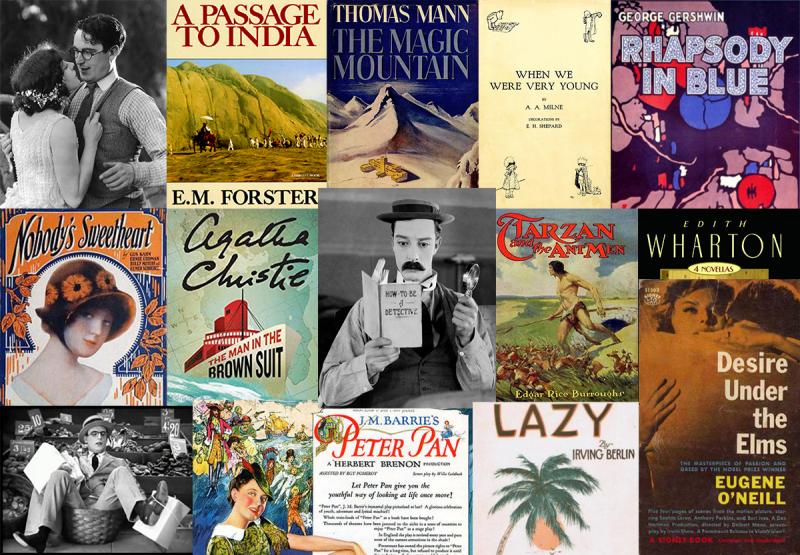
2020’s is a promising Public Domain Day indeed for fans of the Great American Songbook, what with the work of other composers like Irving Berlin (specifically the popular tune “Lazy,” well known from Marilyn Monroe’s performance in There’s No Business Like Show Business.) But the list of literary works that have just gone public-domain is even more impressive, boasting internationally acclaimed books like Thomas Mann’s The Magic Mountain, E.M. Forster’s A Passage to India, Edith Wharton’s novella collection Old New York, and the pillar of modern dystopian literature that is Yevgeny Zamyatin’s We (in English translation by Gregory Zilboorg). In many works of 1924, we can see the roots of the art we make and enjoy in 2020.
That holds especially true in the realm of film, which this year contributes to the public domain pictures from two masters of silent comedy: Harold Lloyd’s Girl Shy and Hot Water, and Buster Keaton’s The Navigator and Sherlock, Jr. That last film has the honor of being preserved by the United States Library of Congress for its cultural significance, as well as of having been named by the American Film Institute one of the funniest motion pictures in American history. You can learn more about all that entered the public domain this year (and what might, but for changes in the law, have entered it) at the Center for the Study of the Public Domain and the Public Domain review. But even more important than what enters the increasingly kaleidoscopic melting pot of the public domain, of course, is what we do with it. Future George Gershwins, Thomas Manns, and Buster Keatons, take note.
Related Content:
Ella Fitzgerald Sings ‘Summertime’ by George Gershwin, Berlin 1968
Rare 1940 Audio: Thomas Mann Explains the Nazis’ Ulterior Motive for Spreading Anti-Semitism
Based in Seoul, Colin Marshall writes and broadcasts on cities, language, and culture. His projects include the book The Stateless City: a Walk through 21st-Century Los Angeles and the video series The City in Cinema. Follow him on Twitter at @colinmarshall or on Facebook.
Read More...When Robin Williams & Steve Martin Starred in Samuel Beckett’s Waiting For Godot (1988)
Despite the dourest demeanor in literary history and a series of plays and novels set in the bleakest of conditions, there’s no doubt that Samuel Beckett was foremost a comic writer. Indeed, it is because of these things that he remains a singularly great comic writer. The deepest laughs are found, as in that old Mel Brooks quote, in the most absurdly tragic places. In Beckett, however, characters don’t just tell jokes about the wretched exigencies of human life, they fully embody all those qualities; just as the best comic actors do.
It’s true that some of Beckett’s characters spend all of their time onstage immobilized, but the playwright was also a great admirer of physical comedy onscreen and drew liberally from the work of his favorite film comedians. Veteran vaudeville comic Bert Lahr, best known as The Wizard of Oz’s cowardly lion, starred in the original Broadway production of Waiting for Godot in 1956. “Beckett once wrote a film script for Buster Keaton,” notes theater critic Michael Kuchwara. Godot’s central characters, Vladimir and Estragon, evoke one of the most renowned of comedy duos, many of their gestures “obvious derivations from Laurel and Hardy,” as film historian Gerald Mast notes.
It is fitting then—and might meet with the approval of Beckett himself—that Robin Williams and Steve Martin, two of the most riveting physical comedians of the seventies and eighties, should step into the roles of the bumbling, bowler-hatted frenemies of Godot. The production, which took place in October and November 1988 at the 299-seat Mitzi E. Newhous Theater on Broadway, sold out almost immediately. Williams and Martin weren’t its only big draw. Mike Nichols directed, and the rest of the cast included F. Murray Abraham as Pozzo, Bill Irwin as Lucky, and Lucas Haas as the absent Godot’s messenger boy.
Sadly, we only have a few clips of the performance, which you can see in the grainy video above, interspersed with interviews with Martin and Irwin. These too will leave you wanting more. “I saw it as a comedy,” says Martin of his reading of the play. What this meant, he says, is that the laughs “must be served, almost first…. The comedy of the play won’t take care of itself unless it’s delivered.” Robin Williams, writes Kuchwara, delivered laughs. “His Estragon is a maniacal creature, verging out of control at times.”
Williams also veered “into some stage antics and line twistings that Beckett never would have dreamed of—giving hilarious imitations of R2D2 and John Wayne, complete with an improvised machine gun.” For his part, Martin had “a tougher assignment playing the subdued, almost straight man Vladimir to Williams’ more flamboyant Estragon.” Martin has always tended to submerge his maniacal comic energy in straighter roles. Here he seems perhaps too restrained.
For reasons that have nothing to do with the play, the tragic heart of these clips is seeing Williams as Estragon. Yet in the final few minutes, trained mime Irwin shows why his Lucky may have been the most inspired piece of casting in the show. We get a taste of his performance as he recites part of Lucky’s monologue. “Every gesture has been carefully thought out, not only for the comedy, but for the pain that lies underneath the laughs,” Kuchwara says.
Lucky is essentially a slave to Abraham’s domineering Pozzo, who keeps him on a leash. He gives one speech, when his master orders him to “think.” But in his verbiage and bearing, he conveys the play’s deepest pathos, in the form of the archetypal tortured clown, who reappears in Alan Moore’s joke about Pagliacci. When Beckett was asked why he named the character Lucky, he replied, with mordant wit, “I suppose he is lucky to have no more expectations….” It is as though, Mel Brooks would say, he had fallen into an open sewer and died
Related Content:
Hear Waiting for Godot, the Acclaimed 1956 Production Starring The Wizard of Oz’s Bert Lahr
Steve Martin Performs Stand-Up Comedy for Dogs (1973)
Robin Williams Uses His Stand-Up Comedy Genius to Deliver a 1983 Commencement Speech
Josh Jones is a writer and musician based in Durham, NC. Follow him at @jdmagness
Read More...Sportscaster Dave Revsine (Big 10 Network) Joins Pretty Much Pop: A Culture Podcast to Discuss the Role of Sports in Pop Culture

How is spectator sports different from other types of entertainment? Dave Revsine (lead studio host for the Big Ten Network and former ESPN anchor) joins your hosts Mark Linsenmayer, Erica Spyres, and Brian Hirt to discuss the various sources of appeal, team identification, existing in a sports-filled world as a non-fan, watching vs. playing, human interest stories, sports films, and more.
Some of the articles we looked at to prepare included:
- “Why Do We Care About Sports So Much” by Christine Emba
- “The Science Behind Our Love of March Madness” by Marco Iacoboni
- “Trying to Understand 50% of America: Sports Fans” by Carolyn Canetti
- “5 Reasons People Hate Sports — That Sports Fans Secretly Understand” by Logan Rhoades
- “The Art of Telling Human Interest Stories at the Olympics” from The Frame
- “10 Great Sports Movies For Non-Sports Fans” by Jason Bailey (there are several other articles out there on this if you want to search for them)
- “The Non-Football Fan’s Guide to Enjoying the Super Bowl” by Dan Steinberg
The first two links above were part of a series of 2016 editorials in the Washington Post coinciding with March Madness. As the whole series is definitely worth a look, just follow the links at the bottom of those articles.
Dave wrote a book you might want to look at called The Opening Kickoff: The Tumultuous Birth of a Football Nation. Follow him on Twitter @BTNDaveRevsine.
This episode includes bonus discussion that you can only hear by supporting the podcast at patreon.com/prettymuchpop. This podcast is part of the Partially Examined Life podcast network.
Pretty Much Pop: A Culture Podcast is the first podcast curated by Open Culture. Browse all Pretty Much Pop posts or start with the first episode.
Woody Guthrie Creates a Doodle-Filled List of 33 New Year’s Resolutions (1943): Beat Fascism, Write a Song a Day, and Keep the Hoping Machine Running
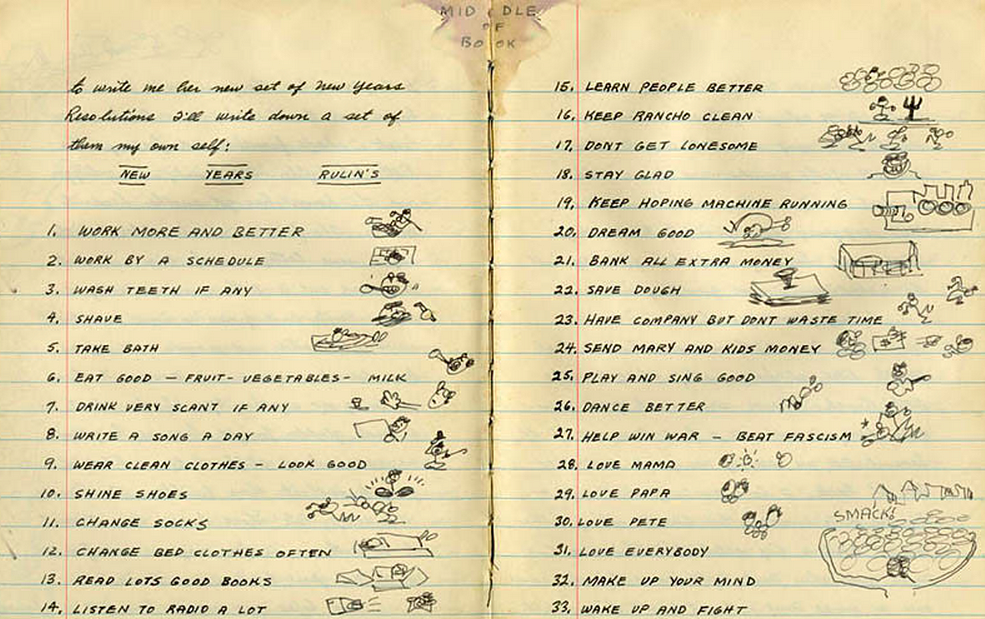
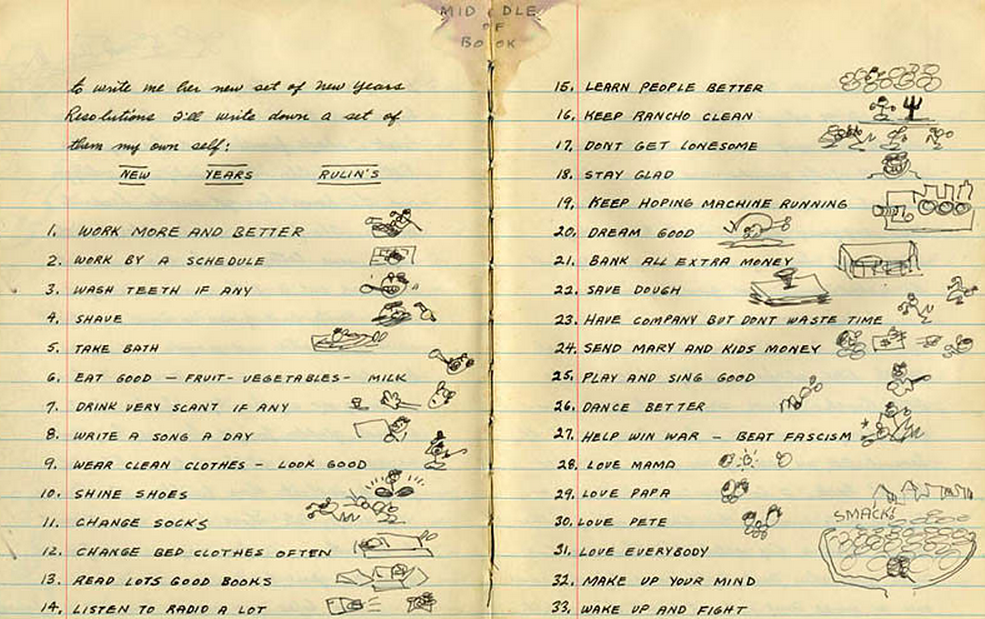
On January 1, 1943, the American folk music legend Woody Guthrie jotted in his journal a list of 33 “New Years Rulin’s.” Nowadays, we’d call them New Year’s Resolutions. Adorned by doodles, the list is down to earth by any measure. Family, song, taking a political stand, personal hygiene — they’re the values or aspirations that top his list. You can click here to view the list in a larger format. Below, we have provided a transcript of Guthrie’s Rulin’s.
1. Work more and better
2. Work by a schedule
3. Wash teeth if any
4. Shave
5. Take bath
6. Eat good — fruit — vegetables — milk
7. Drink very scant if any
8. Write a song a day
9. Wear clean clothes — look good
10. Shine shoes
11. Change socks
12. Change bed cloths often
13. Read lots good books
14. Listen to radio a lot
15. Learn people better
16. Keep rancho clean
17. Dont get lonesome
18. Stay glad
19. Keep hoping machine running
20. Dream good
21. Bank all extra money
22. Save dough
23. Have company but dont waste time
24. Send Mary and kids money
25. Play and sing good
26. Dance better
27. Help win war — beat fascism
28. Love mama
29. Love papa
30. Love Pete
31. Love everybody
32. Make up your mind
33. Wake up and fight
We wish you all a happy 2020.
If you would like to support the mission of Open Culture, consider making a donation to our site. It’s hard to rely 100% on ads, and your contributions will help us continue providing the best free cultural and educational materials to learners everywhere. You can contribute through PayPal, Patreon, and Venmo (@openculture). Thanks!
Note: This fine list originally appeared on our site back in 2014.
Related Content:
The Top 10 New Year’s Resolutions Read by Bob Dylan
Marilyn Monroe’s Go-Getter List of New Year’s Resolutions (1955)
Read More...RIP Syd Mead: Revisit the Life and & Art of the Designer Behind Blade Runner, Alien & More
Has any year ever sounded more futuristic than 2020, the one we all live in as of today? 2019 came close, mostly because it was the year in which Blade Runner took place. Though initially a flop, Ridley Scott’s cinematic adaptation of Philip K. Dick’s novel Do Androids Dream of Electric Sheep? soon became a contender for the most influential vision of the future ever put on screen. This owes not just to the directorial skill of Scott himself, but also of the many collaborators who set their imaginations to the year 2019 — then nearly 40 years in the future — along with him. Among the most important was concept artist Syd Mead, who died this past Monday at the age of 86.
Mead credited as an inspiration for his own Blade Runner work Métal hurlant, the 1970s French comic book that brought attention to the even more deeply influential art of Moebius. But his own career as an illustrator and industrial designer, already far along by that time, had also prepared him thoroughly for the job. That career began in 1959 with Mead’s recruitment to the Ford Motor Company’s Advanced Styling Studio, where he spent two years thinking up the cars of the future. He then illustrated publications for other corporations before launching his own design firm in 1970, working with European clients including Philips and Intercontinental Hotels, and later nearly every Japanese corporation that mattered, from Sony, Bandai, and NHK to Minolta, Dentsu, and Honda.
That was in the early 1980s, when we all looked upon Japan as a vision of the future. To an extent we still do, not least because of the Japanified future envisioned in Blade Runner — as well as the one envisioned in its recent sequel Blade Runner 2046, also a beneficiary of Mead’s contributions. No matter how much Japan fascinated Mead, Japan repaid that fascination tenfold, seeking him out for film and animation projects, putting on shows of his work, and even publishing a digital collection of his art as one of the very first CD-ROMs. (I myself first heard of Mead from Syd Mead’s Terraforming, a Japanese-made video game for the Turbografx-CD that made use of his visuals.) This was perhaps an unexpected development in the life of a kid from Minnesota who spent his youth drawing in solitude, even one who grew up absorbing the sci-fi swashbuckling of Buck Rogers and Flash Gordon.
But unlike those kitschy, dated worlds of flying cars, gleaming towers, rocketships, robots, Mead created credible, enduring worlds of flying cars, gleaming towers, rocketships, robots. That must owe in part to an instinct, developed through industrial design work, of rooting the fantastical in the possible. A look back at the full scope of his art — which you can glimpse in the trailer for the documentary Visual Futurist: The Life and Art of Syd Mead at the top of the post as well as in the montage video just above — reveals that Mead really believed in the futures he drew. And by having believed in them, he makes us believe in them. The real 2020 may not bring any of the sky-high buildings, impossibly sleek vehicles, or sublimely vast pieces of infrastructure that Mead could render so convincingly. But however the next year — or the next decade, or indeed the next century — does look, it will owe more than a little to the imagination of Syd Mead.
Related Content:
The Blade Runner Sketchbook Features The Original Art of Syd Mead & Ridley Scott (1982)
Based in Seoul, Colin Marshall writes and broadcasts on cities, language, and culture. His projects include the book The Stateless City: a Walk through 21st-Century Los Angeles and the video series The City in Cinema. Follow him on Twitter at @colinmarshall or on Facebook.
Read More...The Voynich Manuscript: A New Documentary Takes a Deep Dive Into the Mysteries of the Bizarre Manuscript
If you’re a regular reader of Open Culture, you know we like to bring you the latest attempts to decipher the legendary Voynich Manuscript, a strange medieval book whose language has baffled scholars for centuries. Like many other early 15th century texts, the Voynich seems to combine medicine, alchemy, herbology, botany, zoology, astrology, and other forms of folk knowledge in a compendium. But it’s filled with bizarre illustrations (see an online version here) and written in a language no one can read. Is it a lost ancestor tongue? The secret code of a cult? Is it a hoax? Why was it made and by whom?
Researchers have tried to translate the Voynich language as variant forms Latin, Arabic, and Sino-Tibetan. An AI identified it as Hebrew. This year a father and son team convincingly made the case for Old Turkic. No Voynich translation has been definitively accepted by a scholarly consensus, and perhaps none ever will. This may say as much about the mysterious Voynich as it does about the niche research area, in which academic linguists, codicologists, and all manner of amateur sleuths try to make a name for themselves as Jean-François Champollions of Voynich studies.
The hour-long documentary above tells the story of both the manuscript’s enigmas and the cult of fascination that has grown up around them. We first learn the origin of the name: Acquired by Polish bookseller Wilfrid Voynich in 1912, the manuscript passed into the care of his wife Ethel, an Irish artist and novelist, upon his death in 1930. Ethel died 30 years later in New York, leaving the manuscript behind, sealed in a bank vault. “Its fate had troubled both Mrs. Voynich and her husband before her.”
Wilfred Voynich has often been suspected as the manuscript’s true author, but its materials have been carbon dated to the early 1400s, and its first confirmed owner, an alchemist from Prague named George Baresch, lived in the 17th century. Other proposed authors have included Queen Elizabeth I’s advisor John Dee, an alchemist and occult philosopher, and Franciscan friar and philosopher Roger Bacon, who was renowned as a wizard almost two centuries before the extant Voynich could have been produced.
Evidence for these claims is often tenuous, but the wealth of speculation to which the Voynich has given rise only deepens the mystery of its creation. As more Voynich scholars undertake frustrating, and often fruitless, investigations, they add to the manuscript’s lore, itself so rich as to occasion another, two-hour, follow-up video from our documentarian, who goes by the name The Histocrat on YouTube. See the further “Deep Dive” on the Voynich manuscript’s many historical owners—both confirmed and rumored—just above.
Related Content:
Josh Jones is a writer and musician based in Durham, NC. Follow him at @jdmagness
Read More...Free Online Data Science Courses
Note: This section includes a lot of Massive Open Online Courses (MOOCs). If you want to enroll in a free version of a MOOC, please select the “Full Course, No Certificate” (edX) or “Audit” (Coursera) option. If you opt to take the course for a certificate/credential, you will be charged.
- A Crash Course in Data Science — Massive Open Online Course (MOOC) — Johns Hopkins
- Building a Data Science Team — Massive Open Online Course (MOOC) — Johns Hopkins
- Creating Dashboards and Storytelling with Tableau — Massive Open Online Course (MOOC) — UC Davis
- Data Science (What is Data Science?) — Massive Open Online Course (MOOC) — IBM
- Databases and SQL for Data Science — Massive Open Online Course (MOOC) — IBM
- Data Science Ethics - Massive Open Online Course (MOOC) — University of Michigan
- Data Science: Linear Regression — Massive Open Online Course (MOOC) — Harvard
- Data Science Methodology — Massive Open Online Course (MOOC) — IBM
- Data Science: Productivity Tools — Massive Open Online Course (MOOC) — Harvard
- Data Science Tools — Massive Open Online Course (MOOC) — IBM
- Data Science: Machine Learning — Massive Open Online Course (MOOC) — Harvard
- Data Science Math Skills — Massive Open Online Course (MOOC) — Duke University
- Data Science: Probability — Massive Open Online Course (MOOC) — Harvard
- Data Science: R Basics — Massive Open Online Course (MOOC) — Harvard
- Data Science: Visualization — Massive Open Online Course (MOOC) — Harvard
- Data Science: Wrangling — Massive Open Online Course (MOOC) — Harvard
- Developing Data Products — Massive Open Online Course (MOOC) — Johns Hopkins
- Essential Design Principles for Tableau — Massive Open Online Course (MOOC) — UC Davis
- Exploratory Data Analysis — Massive Open Online Course (MOOC) — Johns Hopkins
- Getting and Cleaning Data — Massive Open Online Course (MOOC) — Johns Hopkins
- Inferential Statistics — Massive Open Online Course (MOOC) — University of Amsterdam
- Introduction to Computational Thinking and Data Science — Massive Open Online Course (MOOC) — Eric Grimson, John Guttag, and Ana Bell, MIT
- Introduction to Data Science in Python — Massive Open Online Course (MOOC) — University of Michigan
- Introduction to Probability — Massive Open Online Course (MOOC) — Harvard
- Linear Regression and Modeling — Massive Open Online Course (MOOC) — Duke University
- Machine Learning — Massive Open Online Course (MOOC) — Andrew Ng, Stanford
- Managing Data Analysis — Massive Open Online Course (MOOC) — Johns Hopkins
- Open Source Tools for Data Science — Massive Open Online Course (MOOC) — IBM
- Practical Machine Learning — Massive Open Online Course (MOOC) — Johns Hopkins
- Probability and Statistics in Data Science using Python — Massive Open Online Course (MOOC) — UCSD
- Python for Data Science and AI — Massive Open Online Course (MOOC) — IBM
- Python Data Structures — Massive Open Online Course (MOOC) — University of Michigan
- R Programming — Massive Open Online Course (MOOC) — Johns Hopkins
- Reproducible Research — Massive Open Online Course (MOOC) — Johns Hopkins
- Statistics and R — Massive Open Online Course (MOOC) — Harvard
- The Data Scientist’s Toolbox — Massive Open Online Course (MOOC) — Johns Hopkins
For a complete list of online courses, please visit our complete collection, 1,700 Free Online Courses from Top Universities.
For a list of online certificate programs, visit 200 Online Certificate & Microcredential Programs from Leading Universities & Companies, which features programs from our partners Coursera, Udacity, FutureLearn and edX.
And if you’re interested in Online Mini-Masters and Master’s Degrees programs from universities, see our collection: Online Degrees & Mini Degrees: Explore Masters, Mini Masters, Bachelors & Mini Bachelors from Top Universities.
Read More...The History of the Fisheye Photo Album Cover
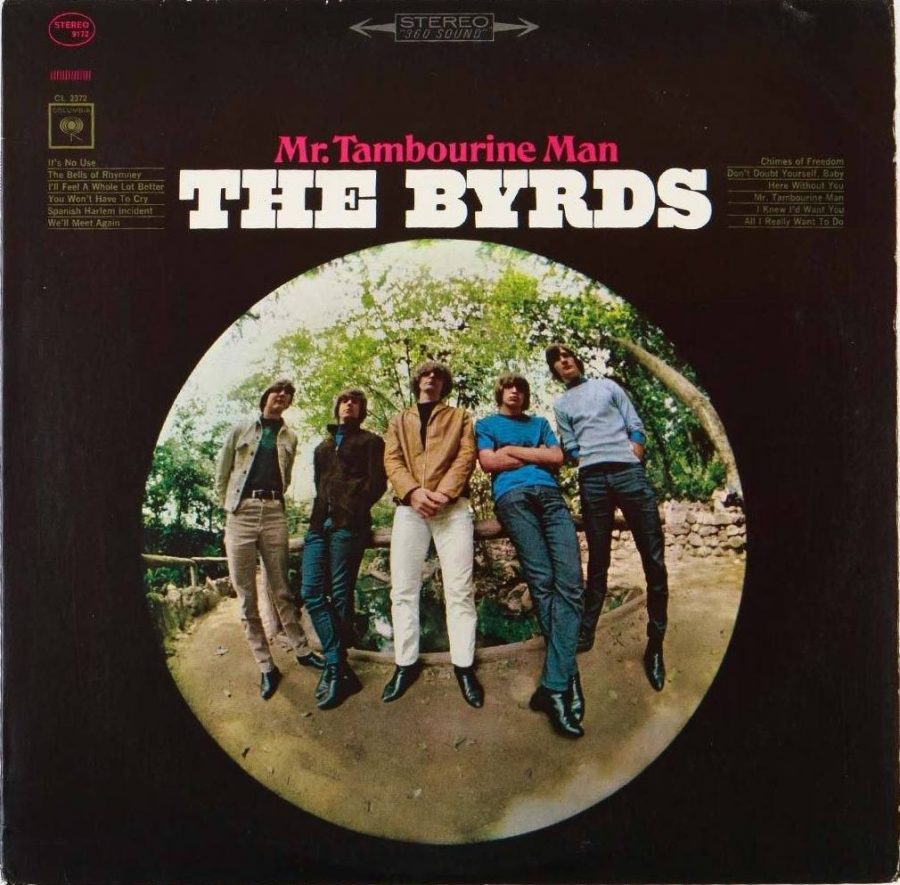
Like gothic script in heavy metal, the fisheye album cover photo seems like a naturally occurring feature of certain psychedelic strains of music. But it has a history, as does the fisheye photograph itself. The Vox video above begins in 1906 with Johns Hopkins scientist and inventor Robert Wood, a somewhat eccentric professor of optical physics who wanted to duplicate the way fish see the world: “the circular picture,” he wrote, “would contain everything within an angle of 180 degrees in every direction, i.e. a complete hemisphere.”
Rather than putting them to underwater use, later scientists employed Wood’s ideas in astronomical observation. Their next stop was the professional photography market: the first mass-produced fisheye lens, made by Nikon, cost $27,000 in 1957. From academic journals to the pages of Life magazine: mass media brought fisheye photography into popular culture. An affordable, consumer-grade lens in 1962 brought it within the reach of the masses. For the way it compresses angles, the fisheye lens “was, and always has been, a handy tool to capture tight quarters, as well as huge spaces.”
The fisheye lens suited the Beatles phenomenon perfectly, compressing backstage hallways and stadium-sized crowds into the same hypnotically circular dimensions. “Perhaps its greatest strength was making rock stars appear larger than life.”
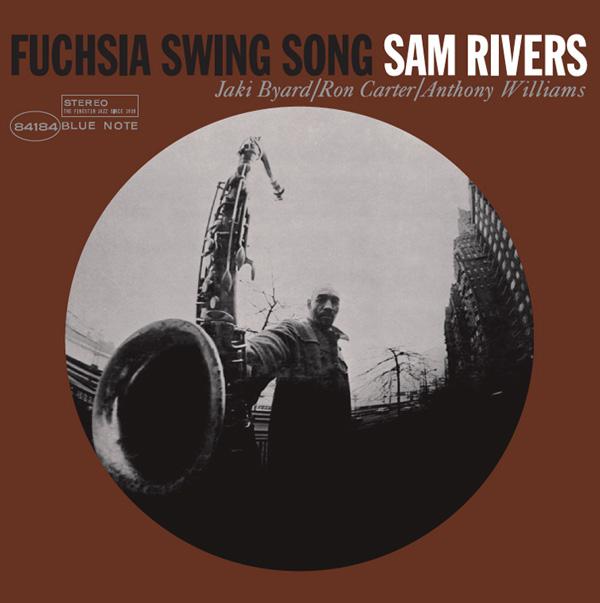
The fisheye photo “reflected the trippiness of the psychedelic era.” Although one of the earliest uses on an album cover was Sam Rivers’ Fuschia Swing Song, it soon adorned the Byrds Mr. Tambourine Man and—of course—the cover of Jimi Hendrix’s Are You Experienced. The iconic band photo of the Experience, taken by graphic designer Karl Ferris, inspired hundreds of psychedelic imitators.
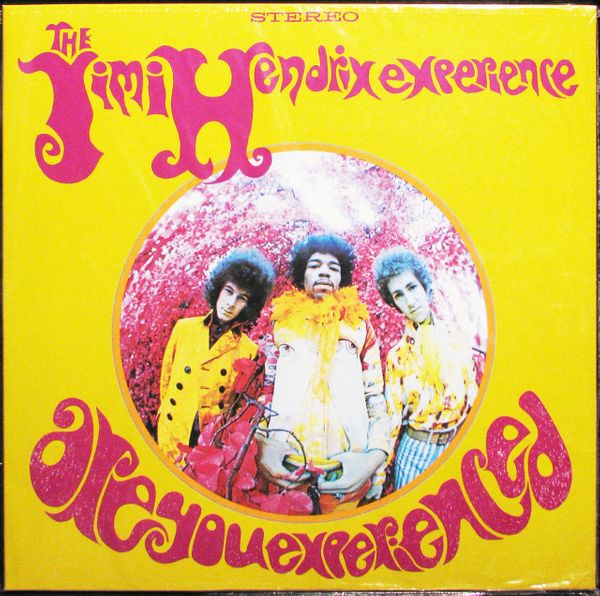
Ferris thought of the fisheye photo with reference, again, not to the ocean but the stars: Hendrix’s music, he said, was “so far out that it seemed to come from outer space.” In order to introduce the band to audiences who hadn’t heard of them yet, he conceived of them as a “group traveling through space in a Biosphere on their way to bring their otherworldly space music to earth.” Inseparable from space travel after NASA’s many fisheye photos of the Apollo missions, the fisheye album cover contains entire worlds in a single droplet, and promises to transport us to the outer reaches of sound.
Related Content:
People Pose in Uncanny Alignment with Iconic Album Covers: Discover The Sleeveface Project
Josh Jones is a writer and musician based in Durham, NC. Follow him at @jdmagness
Read More...Steve Martin Performs Stand-Up Comedy for Dogs (1973)
In what looks/sounds like his first appearance on The Tonight Show Starring Johnny Carson, Steve Martin performs a groundbreaking comedy routine. As you’ll see, you might not get the jokes. But your dogs will. Although recorded 46 years ago (February 15, 1973), the pooches will laugh as hard now as they did then.
If you would like to support the mission of Open Culture, consider making a donation to our site. It’s hard to rely 100% on ads, and your contributions will help us continue providing the best free cultural and educational materials to learners everywhere. You can contribute through PayPal, Patreon, and Venmo (@openculture). Thanks!
Related Content:
Steve Martin Teaches His First Online Course on Comedy
Watch Steve Martin Make His First TV Appearance: The Smothers Brothers Comedy Hour (1968)
Steve Martin Writes a Hymn for Hymn-Less Atheists
Read More...
John Coltrane Talks About the Sacred Meaning of Music in the Human Experience: Listen to One of His Final Interviews (1966)
A few years ago, the animated series Blank on Blank released a video with five minutes from one of John Coltrane’s last interviews in 1966, eight months before his death from liver cancer at age 40. In the excerpts, Coltrane tells interviewer Frank Kofsky, a Pacifica Reporter, about his intuitive approach to practicing, his switch to soprano sax, and his desire to “be a force for real good.” As juicy as these tidbits are for Coltrane fans, the full interview, above, is even better—an hour-long encounter with the jazz saint, who opens up to Kofsky in his relaxed, yet guarded way.
Coltrane chooses his words carefully. His refusal to elaborate is often its own subtle form of expression. During their opening banter, Kofsky asks him about seeing Malcolm X speak just before the latter’s death. Coltrane calls Malcolm “impressive” and leaves it at that. Kofsky then asks his first pointed question: “Some musicians have said that there’s a relationship between some of Malcom’s ideas and music, especially the new music. You think there’s anything in there?”
Kofsky had his own reasons for pushing this line. Just a few years later, he published Black Nationalism and the Revolution in Music in 1971. The book was reprinted with the more specific, less threatening, title John Coltrane and the Jazz Revolution of the 1960s. Both versions prominently feature Coltrane on the cover. “Dedicated to both John Coltrane and Malcolm X,” notes Soul Jazz Records, the book “places the revolutionary ‘new thing’ music and ideas of Coltrane, Albert Ayler and others in a wider context of 60’s radicalism, African American politics and history.”
An historian and academic who published several books on jazz, Kofsky isn’t subtle about his agenda, but Coltrane is unwilling to be pushed into a political corner, as fans have pointed out in discussions of this interview. He wants to embrace everything. “I think that music, being an expression of the human heart, or the human being itself,” he says, “does express just what is happening. It expresses the whole thing.” He consistently refuses to get drawn into a discussion of racial politics with Kofsky.
When they finally move on to talking about performance, the unflappable Coltrane stops demurring and opens up. We hear him describe his experience of being on stage at one concert as “too busy” to know what was happening in the audience, but the right audience can also be, he says, a participating member of the group. When Kofsky again pushes Coltrane on the relationship between his music and black nationalism, Coltrane coolly replies, “I have consciously made an attempt to change what I’ve found. In other words, I’ve tried to say, ‘this could be better, in my opinion, so I will try to do this to make it better.”
Coltrane’s knack for cutting to the heart of his purpose—to add to the world with his playing, without a need to control what happens afterwards—comes through in the entire hour-long interview. His reticence to engage with Kofsky’s analysis might have something to do with who was asking the questions, but in any case, there’s no doubt that Coltrane was integral to the fierce, uncompromising Black Arts poetry of the 1970s, and many other politically informed movements. He was influential, however, not as the representative of an ideology, but as the inventor—or the vessel, he might say—of an entirely new form of creative expression.
Related Content:
John Coltrane Performs A Love Supreme and Other Classics in Antibes (July 1965)
Read More...Support Us
We're hoping to rely on loyal readers, rather than erratic ads. Please click the Donate button and support Open Culture. You can use Paypal, Venmo, Patreon, even Crypto! We thank you!

About Us

Open Culture scours the web for the best educational media. We find the free courses and audio books you need, the language lessons & educational videos you want, and plenty of enlightenment in between.
Advertise With Us

FREE UPDATES!
GET OUR DAILY EMAIL
Get the best cultural and educational resources on the web curated for you in a daily email. We never spam. Unsubscribe at any time.
FOLLOW ON SOCIAL MEDIA

Open Culture editor Dan Colman scours the web for the best educational media. He finds the free courses and audio books you need, the language lessons & movies you want, and plenty of enlightenment in between.
Advertise With Us